Notes of DHTT Ist Year, Applied chemistry & Chemistry Lab Lubrication Pdf - Study Material
Page 1 :
Department of Chemistry, National Institute of Technology Srinagar, LUBRICANTS AND LUBRICATION, Lubricants, Materials applied to various machine parts to in order to minimize the friction are called as, lubricants., Functions of a lubricant:, 1. It reduces deformation (wear & tear) of the concerned parts of the machine as it forms a, film between the surfaces thereby avoiding direct contact between the moving, sliding or, rolling surfaces. Thus, it reduces the maintenance cost of the machine., 2. It acts as a coolant, i.e., reduces the loss of energy in the form of heat, because heat is, produced only when two surfaces come in direct contact with each other, which it prevents., 3. It reduces wastage of energy and hence, increases the efficiency of the machine., 4. It reduces the expansion of the metal and chances of welding or seizure get minimized., 5. Sometimes, it also acts as a seal and prevents leakage., Classification of Lubricants, Lubricants have been classified on the basis of physical state, into following:, A. Liquid Lubricants, , B. Semi-Solid Lubricants, , C. Solid Lubricants, , A. Liquid Lubricants, These are also called as lubricating oils and are the most commonly used lubricants., Lubricating oils have further been sub-classified into four types on the basis of chemical, composition:, 1. Fatty Oils, , 2. Mineral Oils, , Lubricants & Lubrication, , 3. Blended Oils, , 1, , 4. Synthetic Oils, , By: J. A. Banday
Page 2 :
1. Fatty Oils, These oils are obtained from animals, seeds of vegetables and fish. These are sometimes used, alone, but, are generally compounded with mineral oils. These oils are also referred to as, "fixed oils", because they cannot be ordinarily distilled without undergoing decomposition., However, the most common designation is, , "fatty oils". The various fatty oils used as, , lubricants, are;, i). Rapeseed oil- obtained from plant seeds, ii). Castor oil- obtained from seeds or beans of Ricinus plant, iii). Coconut oil- obtained from coconut, iv). Tallow oil-obtained from fat of cattle, sheep, goat, v). Lard oil- obtained from hog fats, vi). Sperm oil- obtained from head of sperm whale, vii). Menhaden and whale oils- obtained from menhaden (a small fish) and from whales, viii). Neat's foot oil-obtained from hoofs of cattle, horses, sheep and hogs., Advantages of Fatty Oils, These oils have a very good oiliness (Property of a liquid to stick to surfaces even under high, loads and high temperature)., These oils have a good emulsibility in presence of water and steam., Disadvantages of Fatty Oils, 1. These oils are gummy, acidic and corrosive., 2. These undergo oxidation easily and readily., 3. These oils decompose at high temperature., 4. These oils undergo hydrolysis easily under warm moist conditions., 5. These are expensive., 6. When exposed to air, many vegetable oils absorb oxygen and change into hard solids, e.g.,, linseed oil. These oils are called as "drying oils". These oils cannot be used as lubricants., Lubricants & Lubrication, , 2, , By: J. A. Banday
Page 3 :
However, they can be used in paints, varnishes, etc. The mechanism of drying appears to be a, complicated process involving oxidation, polymerization and colloidal gel formation., 7. Also, during oxidation, the acid content in the oil increases which is indicated by a foul, smell. This is called as "rancidation". During this process, there takes place oxidative, cleavage at the unsaturated sites thereby leading to the formation of mixture of aldehydes,, ketones and carboxylic acids., 2. Mineral Oils, These oils are obtained during distillation of crude petroleum. In contrast to fatty oils, these, oils are thermally stable and do not undergo oxidation easily. They are cheap, and readily, available. However, they have very low oiliness as compared to fatty oils. Viscosity of, mineral oils is also low. Mineral oils are used as lubricants, however, after subjecting to, various purification processes in order to remove different types objectionable impurities,, like, waxes, asphalts, acids, alkalis, etc., 3. Blended Oils, Blended oils are the mineral oils in which some additives have been incorporated. During, treatment of mineral oils, in addition to objectionable impurities, various desirable, constituents are also lost. In order to correct this drawback, and improve the lubricating, properties, certain additives are incorporated in mineral oils. Various additives are:, i. Oiliness carriers: These are the materials added to increase oiliness and film strength of the, lubricating oil. These compound contain certain strongly polar groups, e.g., vegetable oils,, fatty easters (glycerides), dibenzyl disulphide, sulpharized sperm oil, amylphenyl phosphate,, tricresyl phosphate., ii. Thickners: These are also called as viscosity index improvers. These are generally long, chain polymers with molecular weight 3000-30,000. e.g., polystyrene or alkyl styrene, polymers, polyalkyl acrylates and polyesters., iii. Extreme Pressure Additives: Materials added to improve the persisting properties of oil, under extreme pressure conditions. They are the organic compounds containing active groups, like chlorine, sulphur and phosphorous, which form surface compounds with metals at high, , Lubricants & Lubrication, , 3, , By: J. A. Banday
Page 4 :
temperatures, attained due to high load, high speed and prevent the welding or seizure of the, materials., iv. Pour Point Depressants: Pour point is defined as the temperature, at which an oil ceases to, flow. The pour point depressants are added to reduce the temperature at which oil becomes, solid ( wax bearing oils cease to flow when wax crystallizes). The depressants prevent the, wax crystals from agglomeration by formation of colloidal dispersion. e.g., alkyl, naphthalenes, multivalent metal soaps, etc., v. Antioxidants: The substances added to oils to prevent oxidation. e.g., phenols, organic, phosphides, amines, etc., vi. Detergents or Deflocculants: These are the materials added to some lubricating oils to, disperse and hold the dirt particles, so that the dirt particles may not agglomerate into large, masses, which may block the oil passages. They are also known as peptizers. e.g., multivalent, metals, salts of phenols, carboxylic acids, etc., vii. Emulsifiers: These are the materials which emulsify the lubricating oils with water. This, prevents the water from coming in direct contact with metal surfaces ( if there is threat of, contact with water) and causing corrosion. e.g., metallic soaps, salts of sulphonic acids,, rapeseed oil, etc., 4. Synthetic Oils, Mineral oils, even with various additives, cannot be used sometimes due to :, i). Attainment of extreme temperatures in machines during operation due to which the oil, cannot persist ii). When atmosphere is chemically reactive iii). Under certain peculiar, operating conditions like heavy load, etc., Under such conditions, purely synthetic lubricants, with improved lubricating properties, are, used. Various synthetic lubricating oils are:, 1. Hydrocarbons: The hydrocarbons used as lubricants are; polymerized alkylenes, like,, polyethylene, polypropylene, polybutylene, etc of the molecular weight 250-30,000. They are, free from non-hydrocarbons. They are non-corrosive and non-toxic, have high thermal, stability, less prone to oxidation., , Lubricants & Lubrication, , 4, , By: J. A. Banday
Page 5 :
2. Polyglycols and related compounds: The polyglycols used are polyethylene glycol,, polypropylene glycol, etc. These lubricants have high viscosity index, high thermal stability, and low pour point., 3. Esters: Natural fats and oils are esters of glycerol with higher fatty acids (Glycerides), but, their freezing point is quite high and are they prone to oxidation. Therefore, the esters used, are: diesters of aliphatic and aromatic dibasic acids, triesters of phosphoric acid, etc. In, addition to other characteristics, these oils have fire-resistant property and are used in air craft, hydraulic oils., 4. Silicones: silicones are used as lubricants, because of their excellent properties like; high, oxidation resistance, high viscosity index, chemical inertness, high temperature resistance., Some Important Properties of Lubricating Oils, 1. Viscosity Index, Viscosity index of a lubricating oil is defined as measure of change in viscosity with, temperature. High viscosity index means low change in viscosity with temperature., Therefore, a good lubricating oil must possess as high viscosity index as possible., 2. Aniline Point: Aniline point of a lubricating oil is defined as the temperature at which, equal volumes of aniline and lubricating oil are completely miscible. Low aniline point, means high percentage of aromatic hydrocarbons in the oil. It should be as high as possible,, because aromatic hydrocarbons dissolve and deteriorate the rubber seals., 3. Flash Point: Flash point of a lubricating oil is defined as the temperature at which the oil, produces enough vapours which burn for an instant (as a flash) when a small flame is brought, near it., 4. Fire Point: Fire point of a lubricating oil is defined as the temperature at which the oil, produces enough vapours which burn for at least five seconds when a small flame is brought, near it., The flash and fire point of a good lubricant must be as high as possible, at least higher than, the operating temperature., , Lubricants & Lubrication, , 5, , By: J. A. Banday
Page 6 :
Mechanism of Lubrication, Depending upon the operating conditions and the lubricant characteristics, lubrication is of, following types:, 1. Thick Film or Hydrodynamic or Fluid Film Lubrication, 2. Thin Film or Boundary Lubrication, 3. Extreme Pressure Lubrication, 1. Thick Film or Hydrodynamic or Fluid Film Lubrication, In this lubrication, the moving/sliding metal surfaces are separated from each other by a thick, film ( about 1000 oA) of fluids. The lubricant film covers the irregularities of the surfaces and, forms a thick layer in between them, so that there is no direct contact between the surfaces., This avoids the wear and tear of the metals thereby reducing the maintenance cost in terms of, frequent repairs /replacements of the machine parts. The resistance in movement of the, moving/sliding parts is now only due to internal resistance between the lubricant particles,, moving over each other. Thus, the lubricant chosen should have minimum viscosity and at, the same time, should remain in place and separate the surfaces. In such a system, friction, depends upon the viscosity of the lubricant, relative velocity and area of moving/sliding, surfaces. The coefficient of friction is low, 0.001-0.03. Such lubrication is done in watches,, clocks, guns, sewing machines, scientific instruments, etc. Lubricants used are hydrocarbon, oils., , 2. Thin Film or Boundary Lubrication, It is applicable when a continuous film (Thick film) of the lubricant cannot persist and direct, metal to metal contact is possible due to many reasons like, load is too high, viscosity of the, lubricant is too low. Under such conditions, an oily lubricant is used, a thin layer of which, gets adsorbed by physical or chemical means on metallic surfaces. The whole load is carried, Lubricants & Lubrication, , 6, , By: J. A. Banday
Page 7 :
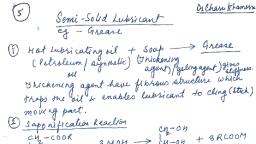
by the layers of adsorbed lubricant, thus, preventing the direct contact between the two, surfaces. The lubricant chosen should possess active groups or atoms which can form, chemical linkages of metal surfaces with long chain hydrocarbons . The lubricants used are, vegetable oils, animal oils, glycerides of higher fatty acids, mineral oils with added oiliness, carriers., , 3. Extreme Pressure Lubrication, When moving/sliding surfaces are under high pressure and speed, a high temperature is, attained and under such conditions, liquid lubricant fails to stick and even vaporize. Thus,, some additives called extreme pressure additives are introduced. These additives are organic, compounds containing some active groups like chlorine, sulphur , phophorous. These active, groups react with metal surfaces at high temperature to form metal chlorides, metal sulphides, and metal phophides, which possess high melting points and prevent the lubricants from, vaporization., , B. Semi-Solid Lubricants (Greases), These are also called as greases. Greases can be defined as a semisolid combination of a, lubricating oil and a soap of lithium, sodium, calcium or barium) as a thickening agent., Other substances used as thickeners are carbon black, asphaltenes, siloxanes, etc., Lubricants & Lubrication, , 7, , By: J. A. Banday
Page 8 :
Greases are generally prepared by saponification of fats with alkali followed by addition of, hot lubricating oil with constant mixing. Sufficient oil is added to obtain the desired, consistency. The nature of soap decides the temperature up to which the grease can be used, and its consistency. Some important aspects of greases are as follows:, i. Consistency of greases can vary from a heavy viscous liquid to that of a solid mass. The, consistency changes suddenly with change in temperature because the interaction of gelling, agents and the viscosity of the oil changes with increase in temperature., ii. Greases have a tendency to separate into oils and soaps on storage., iii. Greases are less stable to oxidation than the component lubricating oil present. Thus,, antioxidants or the inhibitors are added to grease., iv. Most of the thickening agents are hydrophillic in nature and hence the greases absorb, water and are poor water resistant., Applications of Greases, Greases are mainly used:, i. When a machine is working at slow speed and high pressure, the lubricanting oil cannot, remain in place., ii. In bearings and gears which work at high temperature., iii. In machines for manufacture of paper, textiles, etc., Classification of Greases, The consistency, temperature up to which greases can be used, are all dependent upon the, nature of soap and hence, are classified on the basis of soap use in their manufacture., Important classes of greases are:, , 1. Calcium based or cup greases, 2. Soda-based greases, 3. Lithium-based greases, 4. Axle greases, C. Solid Lubricants, There are number of situations where lubricating oils or greases cannot be used satisfactorily., Under these conditions, to minimise the friction, solid lubricants are used. The solid, lubricants are used in either dry form or mixed with water or oil. The most commonly used, solid lubricants are graphite and molybdenum disulphide., Lubricants & Lubrication, , 8, , By: J. A. Banday



 Learn better on this topic