Page 1 :
| Topic 1: Group 15 Elements, Properties and some Important Compounds Page 59, } Topic 2: Group 16 Elements, Properties and some Important Compounds Page 62, } Topic 3: Group 17 Elements, Properties and some Important Compounds Page 65, } Topic 4: Group 18 Elements, Properties and some Important Compounds Page 67, , EXERCISES — Covering complete Chapter _ ori Fase 7, Self Assessment Test AVENE? ; “ae sa Page 82, , =, Ge, , |=, , , , , , , , , , Group 15 Elements, properties and some important compounds., » The p-block elements are those which involve the filling of p-orbitals of their outermost, , energy levels., , * General electronic configuration : ns" np'—* ., , © ‘The elements of groups 13 to 18 involving the filling of one, two, three, four, five and six electrons, in the p-orbitals of their atoms belong to p-block and have the general configuration ns®np'-®,
Page 2 :
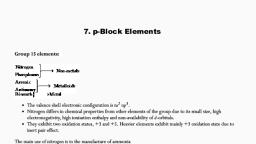
—_———=3,, , ——— y ‘, , MBU dure vrrr>, rus (P), arsenic (As), antimony ‘Sh a, , , , , , a, , > Group 15 elements are nitrogen (N), phospho, , bismuth (Bi). This group is regarded as nitrogen, > The general electronic configuration of this group, N and P are non-metallic, As and Sb are metalloids a, , family. en, may be expressed as na*np"., , nd Bi is a typical metal., , , , , r . a, > The elements of group 15 exhibit common oxidation state * bp ih tit iti hyela, . Nitrogen can exist in various oxidation states from } ay, , oxides. . ., * Phosphorus also exhibits +1 and +4 oxidation atates in mn Beran |, ° Nitrogen has unique tendency to form pa—pT multiple bon 8 With 1, other elements having small size and high electronegativity. ‘ |, > The two nitrogen atoms are held together by triple bond (one 6 and two 7) between tre, , atoms., —, , , , => The triple bond in nitrogen molecule has very high bond enthalpy and therefore, th,, nitrogen molecule is inert and has very low reactivity., , All these elements form hydrides of the general formula MH3., e All are pyramidal in shape., , Basic character decreases on moving down the group., NH, > PH, > AsH; > SbH; > BiH,, , Thermal stability decreases down the group., , Reducing character increases down the group., NH, has higher boiling point than PH, and then boiling point increases down the, , >, , group., The group 15 elements combine with oxygen to form two types of oxides, E,03 (trioxides), , and E,O, (pentaoxides)., » Nitrogen forms a number of oxides with oxidation states ranging from +1 to +5 such as, , N,0, NO, N20, N,O, and N,O; which have no analogues of P, As, Sb or Bi., » The elements of group 15 form two series of halides of the type EX; (trihalides) and EX,, , (pentahalides)., , @ Oe (LTT), *% Nitrogen cannot form pentahalides due to the absence of vacant d-orbitals in, its outermost shell., , All the elements of group 15 combine with metals to form their binary compounds in, , r, which the elements show —3 oxidation state., > Phosphorus exists as P, in elemental state., » Phosphorus exists in many allotropic forms., » Allotropic forms of phosphorus are white, red and black phosphorus., > White phosphorus is the most reactive form so it is stored under water to protect it, , from air, e Black phosphorus is the least reactive form. Red and black phosphorous are stable in, , air., > Phosphorus forms a number of oxoacids.
Page 4 :
S 2), , Group 16 Elements, properties and some important compounds ', , }, » Group 16 elements are oxygen (O), sulphur (S), selenium (Se), tellurium (Te auf, polonium (Po). These are named as oxygen family., » The elements of this group have six electrons in the outermost shell and have the gener,, electronic configuration as ns*np*., > Oxygen exhibits oxidation state of -2 in its compounds., * Oxygen does not show Positive oxidation states except in OF). However, other, elements in the group also show oxidation state of +2, +4 and +6 due to the Promotion, , of electrons to vacant d-orbitals., , , , , , , , (where E = O, S, Se, Te, Po). For example, H,O, HS, H,Se, H,Te and H,Po., ¢ All these hydrides are angular in shape., * The bond angles decrease 48 we go down the group., * Volatility increases from H,0 to H,S and then decreases,, H,0 < H,S > H,Se >.H,Te, ° These are weakly acidic and acidic character increases as:, H,0 < HS < H,Se < H,Te, >» The elements of group 16 form a large number of halides of the type EX,, EX, and EX,, (X = holegon)., , BS. Hexahalides are not formed by chlorine, bromine and iodine. As the size of the halogen, atom increases, the coordination number of the elements of this Group decreases, As a, result, hexachlorides, hexabromides and hexaiodides are unknown., , ————____. —
Page 5 :
K ELEMENTS, ee — 63}, , The binary compounds of, , Oxygen wi . ., . simple (e.g. MgO, AlL,O,, ete Verwenn other elements are called oxides, Oxides can be, « Acidic oxides. The oxides whi Ixed (Mn,Oy, Fe, 04, Pb,O4, ete.) ., oxides. S which combine with water to give acids are called acidic, Sulphur exists in many a] : :, ’ Y allotropic forms, the main allot ropic forms are: Rhombic sulphur,, , Monoclinic sulphur and Plastic sulphur, y Sulphur forms a number of oxoacids, , , , structures of Oxoacids of Sulphur, q s, a | 6 Y ra > Lf yer, , 1,80, (+4) H,SO, (+6), siphur0us (+2) H,SO, (+6), — Suiphune acia mictetree acid Peroxymonosulphuric acid, , | fof fF jf, INN? £~0/\. LOS, , 9, , 9, , , , H,S,0, (+6) H,S.0, (+6) H,S,0, (+5), (or Pyrosutphunc acid) (or Marshall's acid), , , , # Peroxymono sulphuric acid (H,SO;) is called Caro’s acid., , * Peroxydisulphuric acid (H,S,0,) is called Marshall’s acid,, , + Oxygenexistsasdiatomicmoleculewhereasotherexistas polyatomiccomplexmolecules., + Sulphur exists as S, and has puckered ring structure., , * Corrosive action of conc. HySO, on skin is due to its dehydration character which, , i when burns produces itching sensation., , , , JQ): Multiple Choice @uéstions GEO D, WwW, , Sib dS are oN, , Q9. Most volatile hydride of oxygen family is However, H,O has highest boiling point, (a) H,O (6) HS due to hydrogen bonding, Therefore, the, (c) H,Te (d) H,Se. correct order of boiling points is, , Ans.(b) ; H,0 > H,S < H,Se < H,Te, , Explanation: In general, the boiling points Thus, the most volatile hydride is H,S., , of hydrides increase down the group.