Page 1 :
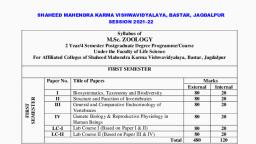
ZL-101; Biosystematics and Taxonomy, , Unit I, , c Definition and basic concepts of biosystematics taxonomy and classification,, , © History and theories of biological Classification., , © Trends in biosystematics: Chemotaxonumy, cytolaxonomy and molecular taxonomy, , o Dimensions of speciation. Species concepts: Typological, Nominalistic and Biological, species concepts. Subspecies and other infra-specific categories., , Unit IL, , oe Taxonomic Characters and different kinds., , o Origin of reproductive isolation, biological mechanism of genetic incompatibility., , © Taxonomic procedures; Taxonomic collections, preservation, curetting, process of, identification., , Unit U1, , eo Taxonomic keys, different types of keys, their merits and demerits., , c International code of Zoological Nomenclature (ICZN): Operative _ principles,, interpretation and application of important rules: Formation of Scientific names of various, Taxa., , co Synonyms, homonyms and tautonomy., , Unit IV, , o Evaluation of biodiversity indices., , e Evaluation of Shannon Weiner Index., oe Evaluation of Dominance Index., , © Similarity and Dissimilarity Index., , Suggested Reading Material (All latest editions), , 1. M. Kato. The Biology of Biodiversity, Springer., , 2. J.C. Avise. Molecular Markers, Natural History and Evolution, Chapman & Hall, New York., 3. E.O. Wilson. Biodiversity, Academic Press, Washington., , 4. G.G. Simpson. Principle of animal taxonomy, Oxford IBH Publishing Company., , 5. E. Mayer. Elements of Taxonomy., , 6. E.O. Wilson. The Diversity of Life (The College Edition), W.W. Northem& Co., , 7. B.K. Tikadar. Threatened Animals of India, ZSI Publication, Calcutta., , Practical Module -1, , + Composition assessment of the taxonomic diversity / biodiversity in a habitat (c.g., grassland, arid land, wet land, etc.)., , ¢ Influence of climatic conditions on taxonomic diversity in a given habitat., , « Preparation of models showing the status of certain taxa or species in a particular habitat.
Page 3 :
Kinds of Systematics, , o Systematics can be divided into two closely, related and overlapping levels — of, classificatjon: taxonomic (known as_ the, Linnaean System) and phylogenetic., , o Taxonomic classifications group living things, , =egether based on shared traits - usually what, they look like or what their bodies do., , o For example, animals that lay eggs and have, scales we call reptiles, and animals that give, births and have fur or hair we call mammals., , o More specifically, all humans share the same, characteristics and so belong to a group, or, taxon, of the genus Homo, and species sapien., , o Phylogenetic classifications use the taxonomic, names, but further group organisms by how, evolutionarily related they are to one another., , o By looking at each organism's genes, we know, that gorillas (taxonomic term) are more close, related to humans than they are to, cockroaches., , Taxonomy:, o Taxo is the theory and_ practice :, identifyin lant ; fact,, , ith the principle myolved in, the study of classification Of Tea 5, —_—___——, =
Page 4 :
identification, nomenclature and classification, , 80 EEE —, © The “word ™texoremy” is derived from the —, ~~ Greek words taxis acetal and nomos, (= law) and the term ‘taxonomy’ was coined, by A. P. de Candolle in 1813., There are several stages of taxonomy such as:, , o Alpha taxonomy: In this stage species are, identified and characterized on the basis of, gross morphological features. _, , o Beta taxonomy: In this s_stage species are, , ee from n lower to o higher pateeores, i.e.,, , , , , , differences, studied., , , , , , , , , and evolutionary, , he nomenclatural and taxonomic system for, botany introduced by Linnaeus and improved, by many generations of later botanists as its, first goal to make possible information storage, and_retrieval concerning plants and_ plant, products., , o While Linnaeus originally believed the, systematic pattern he recognized in nature to, , , , , , , , , , 4
Page 5 :
divine creation, post-Darwinian botanists have, mostly interpreted it as resulting from, evolution., , o Many botanical taxonomists of today therefore, regard systematics as the art of tracing, similarities between taxa, combining them into, larger _groups, and hypothesizing about their, evolution., , o While the number of taxonomic features, available to Linnaeus was very limited, the, gradual refinement of technical equipment has, both widened the scope of, morphological studies and |, facilitated the introduction °, of ancillary sciences like, anatomy, embryology,, serology, cytotaxonomy, genetics, palynology,, and chemotaxonomy., , o Those have provided a number of new, character sets, the incorporation of which has, been facilitated by methodologies such as, numerical taxonomy, cladistics and DNA, hybridization., , , , , , , , VERTEBRATA