Page 1 :
XII POLITICAL SCIENCE, COMPLETE NOTES IN ENGLISH, PART 1, , POLITICS IN INDIA, SINCE INDEPENDENCE, , PREPARED BY, MATHEW JOSEPH, GHSS KOZHICHAL, , E PLUS KERALA IN YOUTUBE
Page 2 :
1. CHALLENGES OF NATION BUILDING, TRYST WITH DESTINY, ‘Tryst with Destiny’ is the famous speech delivered by, Jawaharlal Nehru, the first Prime Minister of India at a special session of the, Constituent Assembly, which was held at midnight on 14 August 1947. Through, this speech, Nehru asked the members of the Constituent Assembly to dedicate, themselves to serve the nation., FOCUS AREA 2022, , CHALLENGES FACED BY INDEPENDENT INDIA, India was born in very difficult circumstances. Independent India faced, multiple challenges. Broadly, India faced three kinds of challenges., 1. Nation Building -The first challenge that independent India faced was, to make India a nation . The country's large size and high population have, complicated the nation- building process., 2. The Establishment of Democracy - Making of the Constitution and, training of citizens in democratic process was another task before, independent India., 3. Social and Economic Development - Another major challenge was, ensuring the welfare of all the people in the country. The leaders of, independent India have devised various programs to eradicate poverty and, to ensure economic development and equality., NATION BUILDING, Two-Nation Theory, The Muslim League put forward the demand for a separate state,, comprising the Muslim majority areas of British India. Through the two- nation, theory, the party argued that Hindus and Muslims are ‘two people’., Congress party strongly opposed the two-nation theory. Political competition, between Congress and Muslim League and the support of the British to the twonation theory led to the creation of Pakistan., , PROCESS OF PARTITION, Partition of India was difficult and painful. Four major difficulties related to the, partition of British India are given below., 1. The Muslim majority areas were not a single belt in British India. There were, two areas of muslim concentration in two different parts of British India. The, problem was solved by creating Pakistan with two territories, West and East, Pakistan separated by a long expanse of Indian territory., 2. Not all Muslim majority areas wanted to be in Pakistan. Leaders like Khan, Abdul Gaffar Khan, popularly known as the Frontier Gandhi, strongly opposed, the two- nation theory. But ignoring such objections, British India was divided., , E PLUS KERALA IN YOUTUBE
Page 3 :
3. Punjab and Bengal, the two Muslim-dominated provinces of British India,, also had non-Muslim majority areas. The problem was solved by dividing the, two provinces and giving the non-Muslim majority areas to India., 4. Another major problem related to the partition was the issue of minorities in, the border areas. Many people belong to the minority communities in India and, Pakistan became the targets of attack., , FOCUS AREA 2022, , The Consequences of Partition, -, , -, , Between 5 and 10 million people were killed on both countries in the, name of religion., More than eight million people of minority communities were, compelled to fled., Millions of people are forced to live in refugee camps., Hindu and Muslim ‘communal zones’ were created in cities like Lahore,, Amritsar and Kolkata., Many women have been sexually assaulted., Other challenges women faced were forced marriages and conversions., Many women were killed by their own family members to preserve, the ‘family - honour’., , Many children were separated from their parents., , FOCUS AREA 2022, INTEGRATION OF PRINCELY STATES, British India was divided into British Indian provinces and princely states., There were 565 princely states in British India. After the end of the British, rule, the princely states were free to join either in India or in Pakistan or to, remain independent. Most of the princely states announced independence. The, first announcement was done by Maharaja of Travancore. ., The following are three points that have influenced the, Indian government in its dealings with the integration of princely states., The people who were part of the princely states wanted to join India., India was ready to grant autonomy to certain areas., The Government of India wanted to resolve the integration of the, princely states urgently in the backdrop of the problems associated, with the partition of India., Following the continuous efforts of Sardar Patel, all the states except Kashmir,, Hyderabad, Junagadh and Manipur signed ‘Instrument of Accession’ with, India., The Merger of Hyderabad - Hyderabad, the largest princely state, in India, was ruled by ‘Nizam’. Determined to make Hyderabad an, independent nation, the Nizam signed the Standstill Agreement with India. In, the meantime the people of Hyderabad started agitation against the oppressive, E PLUS KERALA IN YOUTUBE
Page 4 :
rule of Nizam. The Communist Party and the Hyderabad Congress Party, strongly supported the movement. The Nizam tried to suppress the popular, uprising by using his paramilitary force called the Razakars. Non-Muslims, were the main target of Razakar's atrocities. As the situation deteriorated, the, Indian army intervened and defeated the Nizam. After this, Hyderabad was, merged with India., The Merger of Manipur - Bodachandra Singh, Maharaja of, Manipur, signed Instrument of Accession with India on the assurance that, Manipur's internal autonomy would be maintained. Under strong popular, pressure, the Maharaja held elections in Manipur and established a, constitutional monarchy in the region. Manipur is the first part in India to hold, an election on the basis of universal adult franchise. Congress members of the, Manipur Assemblyfavoured the merger with India but other parties strongly, opposed the move. However, the Maharaja signed a Merger Agreement with, India without consulting the legislature. This caused unrest in the area., FOCUS AREA 2022, , REORGANISATION OF STATES, Another challenge to the nation building was the reorganisation of the state., The national leaders feared that forming states based on language would, seriously affect the unity of the country. The leaders also feared that the, restructuring of the state would adversely affect the socio- economic, development of the country. The integration of the princely states was not, completed and the state reorganization was delayed. But local leaders refused, to accept the decision of the central government. Agitations in different parts, of the country have begun demanding the formation of a state based on, language., The Vishalandhra Movement - The first agitation demanding the, formation of a state on the basis of language was carried out by the people of, the Telugu speaking areas. The agitators demanded the creation of Andhra, Pradesh, which included the Telugu speaking areas of Madras state. The, Gandhian leader Potti Sriramalu went on an indefinite fast that led to his death, after 56 days. This caused great unrest in the Andhra region. Many members of, the Madras Legislative Assembly resigned. Finaaly the central government, formed Andhra Pradesh in December 1952. Andhra Pradesh is the first Indian, state to be formed on language basis., State Reorganization Commission - Following the formation of, Andhra Pradesh, struggles for language-based states have intensified in, different parts of the country. This was followed by the formation of a State, Reorganization Commission headed by Fazal Ali. In 1956, 14 states and 6, union territories were formed, according to the Commission's report., E PLUS KERALA IN YOUTUBE
Page 5 :
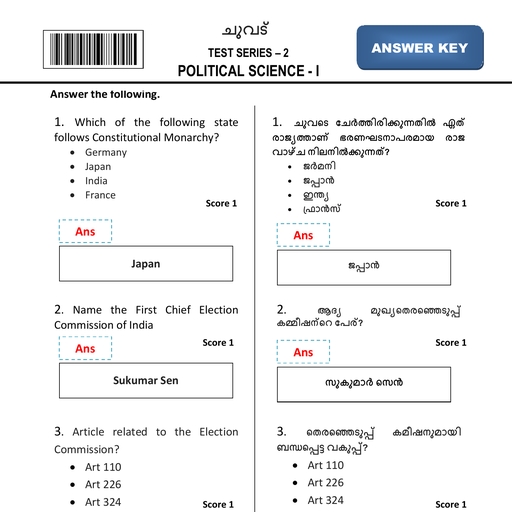
2. ERA OF ONE PARTY DOMINANCE, After the end of colonial rule, many newly independent states in Asia, and Africa have chosen non - democratic forms of governments to ensure national, unity. But India has chosen a more difficult path, democracy . India opted, democracy because of the following reasons:, In order to keep the promises made to the people during the freedom struggle., The belief that democratic government is better to ensure national, development., The people were interested in democratic government., , FOCUS AREA 2022, GENERAL ELECTION IN INDIA., The Election Commission of India was set up in January, 1950 to hold general elections in India. Sukumar Sen was the first Chief Election, Commissioner., , THE FIRST GENERAL ELECTIONS IN INDIA, Following are the preparations made by the Election, Commission before the first general elections in India., 1., The boundaries of the 489 Lok Sabha constituencies and over 3200 assembly, constituencies had been drawn., 2., Voter lists of 17 crore eligible voters had been prepared., 3., Trained more than 3 lakh officers and polling staff to conduct election., The first general elections in India took place between, October 1951 and February 1952., , FEATURES OF FIRST GENERAL ELECTION, -, , In India's first general election, more than half the electorate voted., On an average, four candidates were contesting in each, constituency., The elections were generally peaceful., In a country like India, the first general election that was, well-received was the reply to those who criticized the election as impractical in, India., , ELECTION RESULT, The Congress got a clear majority in the first general, election by winning 364 seats. The CPI came next with only 16 seats., , FOCUS AREA 2022, The Reasons for Congress Victory in the First Three General, Elections, 1., 2., 3., , Role of the Congress in the National Movement., Strong organizational structure of the Congress party., The Congress was a nationwide political party., E PLUS KERALA IN YOUTUBE
Page 6 :
4., 5., , Charismatic leadership of Jawaharlal Nehru., The non-Congress parties were not united., , THE NATURE OF CONGRESS DOMINANCE, The Congress party's dominance in Indian politics was, different from the one party dominance in many other countries. In China, Syria and, Cuba, the constitution permits only a single party to rule the country. In Egypt,, Belarus and Myanmar, the one-party rule was supported by the military. India gives, complete freedom to function all political parties. Thus, the dominance of the, Congress in India was democratic. This was similar to the dominance of African, National Congress in South Africa after the end of apartheid., , Congress as Social and Ideological Coaliation, Congress evolved as a political party of the English, speaking and the elite section of Indian society. But struggles such as the civil, disobedience movement transformed the class party into a mass movement. Many of, the common people joined in Congress. Even people with different opinions and, interests became part of the party. The presence of different caste, religious, class and, religious sects in India made the Congress a rainbow like social coalition. Even some, political parties which have their own constitutions have got a place inside the, Congress., The coalition character of the Congress made the party, stronger. In many respects, Congress had been able to maintain coherence and, consensus. Many of the ideas put forward by the opposition parties were already, adopted by the Congress party. So the opposition parties had difficulty in attracting, people with different ideologies. The Congress Party was able to democratise the, internal issues that existed within the party., , THE COMMUNIST VICTORY IN KERALA, In March 1957, the Communist Party won the first election, to the Kerala Legislative Assembly. EMS Namboodiripad, who took over as the, Chief Minister of Kerala, was the first Communist leader in the world to come to, power through elections. The Congress party, which lost power in the state, began, the ‘liberation struggle’ against the Communist government. . Various communal, organisations participated in the strike. The central Congress Government has, dismissed the Communist Government under Article 356 of the Constitution. Central, government declared that the law and order situation in the state had collapsed., , OPPOSITION PARTIES IN EARLY YEARS, (IMPORTANCE OF OPPOSITION PARTIES), Opposition parties have been present in Indian, politics since the first general election. But only a handful of opposition candidates, won the first elections. The presence of opposition members strengthened, democracy. The presence of opposition members has helped in making healthy, criticism on the government's actions. The opposition parties also acted as defenders, of democracy. Opposition parties also contributed to the emergence of new leaders. In, the early years of independence, the ruling and opposition parties had a good, relationship., E PLUS KERALA IN YOUTUBE
Page 7 :
The Socialist Party, The Congress Socialist Party was worked within the Congress, Party from 1934 to 1948. The party was led by the idea of ’democratic socialism’., After 1955, the Congress party began to support socialist ideas, which made the, socialist party in crisis. The party did not succeed in electoral politics. Split in the, party led to the collapse of CSP. The prominent socialist leaders were Jayaprakash, Narayan, Ram Manohar Lohia, Ashok Mehta, Achyut Patwardhan, Acharya, Narendra Dev and SM Joshi., , Communist Party of India, Communist ideas spread in India after the Russian Revolution., Until 1942, the Communists were part of the Congress party. The armed struggle in, Telangana region negatively affected the party's image. This forced the party to, rethink and decided to abandon violent revolution and decided to participate in the, approaching general elections. The early leaders of the Communist Party were AK, Gopalan, SA Dange, EMS Namboodiripad, PC Joshi, Ajay Ghosh and P, Sundarayya. The CPI went through a split in 1964. Those who supported the Soviet, ideas remained as the CPI. The supporters of Chinese ideas formed a new party called, the CPI – M., , Bharatiya Jan Sangh, The Bharatiya Jan Sangh was established in 1951 under the, chairmanship of Shyam Prasad Mukherjee. The Rashtriya Swayamsevak Sangh and, the Hindu Mahasabha were instrumental in the formation of the Jan Sangh. The, party's main concern was one country, one culture and one nation. Another key, demand of the party was the formation of Akhand Bharat, a reunion of Pakistan and, India. The party has taken a strong stand to promote Hindi language and Indian, culture. Another demand was that India should develop atomic energy. Shyama, Prasad Mukherjee, Deen Dayal Upadhyay, Balraj Madhok were the prominent Jana, Sangh leaders. The Bharatiya Janata Party has its roots in the Bharatiya Jan Sangh., , Swaantra Party, The Swatantra party was formed in 1959 after the Nagpur resolution of, the Congress Party which called for land ceilings. The party's position was to reduce, government control over economic matters. The party demanded that the private, sector be given more importance. The party, which criticized the non-aligned, movement and India's friendship with the Soviet Union, asked to establish greater, relations with the US .Party gained the support of the landlords and businessmen., But the inability to attract common people affect the party's growth. The party was, led by C Rajagopalachari, KM Munshi , NG Rango and Minoo Masani., , CLICK ON THE IMAGES, TO WATCH CLASS VIDEOS, , E PLUS KERALA IN YOUTUBE
Page 8 :
3. POLITICS OF PLANNED DEVELOPMENT, Two centuries of colonial rule destroyed the Indian economy. One of the, major challenges facing independent India was to strengthen the economy., Everybody agreed that India should adopt a development model that would ensure, social development and economic justice along with economic growth. It was also, accepted without contradiction that the Government should lead the development, process of India., FOCUS AREA 2022, , Ideas of Development, Prominent development models of the period were the liberalcapitalist system followed by the US and Western European countries and the, socialist system that followed the Soviet Union and Eastern European countries. A, large section of the people and leaders of Indian society were supporters of the, socialist model. India has adopted a mixed economy that combines the positive, aspects of both models., FOCUS AREA 2022, , Planning, There was generally little interest in Indian society in, handing over financial planning to the private sector. There was little disagreement, about the development process being led by the government. In 1944 major Indian, businessmen assembled in Mumbai and drafted a joint proposal demanded, government investment heavily in the industrial and economic sectors. These, proposals, known as the Bombay Plan, supported the planned economy., , Planning Commission, After the independence, the Planning Commission was set up under the, chairmanship of the Prime Minister. In 2015, the Planning Commission ceased work, and a new system called Justice NITI Aayog was introduced., FOCUS AREA 2022, , Five Year Plans, India adopted the concept of Five Year Plans from the Soviet, Union. The government of India is supposed to prepare a document that has a plan, for its income and expenditure for the next five years. Budget of the Central and, State Governments are divided into plan part and non plan part. Non plan budget is, spent on routine items on a yearly basis. Plan budget is spent on a five year basis as, per the priorities fixed by the plan., , First Five Year Plan (1951-1956) The first five-year plan aimed at poverty alleviation and it, focused on the development of agriculture. The motto of the First Five Year Plan,, which was planned by a young economist named KN Raj, was to ‘hasten slowly’., E PLUS KERALA IN YOUTUBE
Page 9 :
Construction of dams and irrigation projects were carried out as part of the plan., Land Reforms were proposed to ensure economic development. The plan also, contained the effort to develop the habit of saving among the people., , Second Five Year Plan (1956-1961), The Second Five Year Plan focused on the development of the, industrial sector. The motto of the Second Five Year Plan was "Quick, Transformation." PC Mahalanobis was the major brain behind the second plan., The central government's decision to impose high levels of import tariff had, strengthened the public and private sectors. Development in various sectors such as, Power, Railways, Steel and Communication had contributed to the growth of the, Indian economy., , FOCUS AREA 2022, , Key Controversies, Agriculture versus Industry, In the early years of independence, there was a dispute, over the importance of agriculture or industry. One section of the society came, forward to support agriculture and the other sector., Supporters of Agriculture -Leaders like J C Kumarappa and Charan Singh, supported rural and agricultural development. Supporters of agricultural sector, argued that, - Majority of Indians depends agriculture as their source of income., - Negligence towards agriculture may affect the lives of many., - Stable agricultural sector is essential to ensure food security, , Supporters of Industry, Others thought that, - Industrialisation is essential or rapid economic development of the country., - Proper industrial development is helpful to remove rural poverty., -Industrialisation generate more employment opportunities., -Industrialisation helps India to earn more foreign exchange., - Industrial development modernise agricultural sector., , Public versus Private Sector, Indian economy is described as mixed economy. The mixed model is, subjected to criticisms from the supporters of private as well as public sector., Supporters of Private SectorSupporters of Private Sector complained that not enough space and support to, private sector in India., They also pointed out many hurdles before private sector – difficulty to get, licences and permits, corrupted government officials etc., Restrictions on foreign import denied the opportunities for Indian firms to, compete with multi national companies. So Indian companies had no, incentives to improve., E PLUS KERALA IN YOUTUBE
Page 10 :
Supporters of public sector -The supporters of the public sector were also not, satisfied., Inefficiency and corruption were considered as the main demerits of public, sector., Another complaint was that state is inactive in public education and health, care., Another criticism is that the state intervened only in less profitable sectors. Many believed that state intervention is not enough to help the poor. It created, a middle class who enjoyed high government salaries without much, responsibility., , Major Outcomes, Third objective of the independent India proved most difficult to realise., Land reforms were not effective in most part of the country. Political power remained, in the hands of landowning classes. Business class were the major beneficiaries of, governmental projects. Poverty did not reduce much in India. Early phase of planned, development laid the foundations of India’s future economic growth. Some of the, largest developmental projects like the construction of mega dams and heavy, industries were undertaken during this period. Improvement in transport and land, reforms were another major achievements., , Land Reforms, Abolition of zamindari system was a bold step taken by the, Indian government to ensure economic justice. Land reforms aimed to release land, from landlords and re distribute it among landless peasants. It Reduced the role of, landlords in politics. Land reforms were not successful in many parts of India. Upper, limit on holding agricultural land and security against eviction were not properly, implemented., , The Green Revolution, The Indian government introduced a new strategy named ‘Green, Revolution’ to ensure food security. As part of the project government put more, resources into those areas which already had irrigation and the beneficiaries were, rich farmers. And government argued that the already developed areas can rapidly, increase food production n short run. Government offered high yielding varieties of, seeds, fertilizers, pesticides, better irrigation at subsidised prices. Government also, ensured a reasonable price for the agricultural products. But the major criticism, against the green revolution is that it concentrated only on already developed, wheat agricultural areas in Punjab, Haryana and western Uttar Pradesh. Other, regions remained backward. Rich peasants were the only beneficiaries of the plan., Green revolution led to the growth of left wing organisations in many parts of India., Green revolution also responsible for the rise of middle class in Indian society., , The White Revolution, The white revolution is a breakthrough made by Varghese, Kurian and Gujarat Cooperative Milk and Marketing Federation Limited in the field, E PLUS KERALA IN YOUTUBE
Page 11 :
of dairy farming. Amul is a Anand based cooperative movement of more than 2.5, lakh dairy farmers in Gujarat. The project aims at rural development and poverty, alleviation. Through the ‘Operation Flood’ , the group was successful to increase, milk production, to eliminate middlemen and provide more and regular income to the, farmers. Varghese Kurien is known by the nickname 'Milk of India'., , Later Developments, -, , More restrictions on private sector after 1960s., Nationalisation of private banks., Pro poor polices were announced., Stress on socialist pattern, Introduction of new economic policy in 1991, , Main Problems of Indian Economy, -, , Slow economic growth, Inefficiency and corruption in bureaucracy, People lost faith in bureaucracy, , CLICK ON THE IMAGES TO WATCH CLASS VIDEOS, , E PLUS KERALA IN YOUTUBE
Page 12 :
4. India’s External Relations, India gained independence at a time when the world was, facing great challenges. The devastating World War II caused huge economic, problems. Following the end of colonial rule, new independent states were, formed in Africa and Asia. The main challenges faced by the new countries, were the establishment of democracy and the elimination of poverty. Partitionrelated issues along with international issues and economic backwardness have, challenged India. Domestic and external circumstances have influenced India's, foreign policy making., , Objectives of Indian Foreign Policy, -, , Promote world peace., Maintain better relations between countries., Respect international law., Settle disputes between countries., Resist the colonialism., Oppose the racist issues., Propagate Non Alignment policy., Strengthen the United Nations., , Non Alignment policy, After World War II, the capitalist bloc under the United States, and the socialist bloc under the Soviet Union were formed. Most of the states, had joined any blocs to receive financial and military aid. In return, member, states were forced to surrender the sovereignty and independence powers of the, country to the super powers. But Jawaharlal Nehru, India's first foreign, minister, refused to lose the independence and sovereignty won by foreign, powers. India decided to adopt a non-salignment policy of equal distance from, the two power blocs. India has encouraged the newly independent countries of, Asia, Africa and to adopt a non-aligned policy., The first meeting of the countries that decided to adopt a nonaligned policy was convened in April 1955 in Bandung. The first meeting of the, Non Alignment Movement was held in Belgrade in 1961. The name Non, Alignment Movement was proposed by VK Krishna Menon., , FOCUS AREA 2022, Objectives of Jawaharlal Nehru's foreign policy, Jawaharlal Nehru, India's first foreign minister, put forward a foreign, policy with three main objectives., Protect the hard earned sovereignty of india., Protect the territorial integrity of India., Promote the rapid economic development of India., , E PLUS KERALA IN YOUTUBE
Page 13 :
FOCUS AREA 2022, , India and China, India was one of the first countries to recognize the communist, government that came to power after the Chinese Revolution of 1949. The two, countries initially enjoyed good relations. The Panchasheel Agreement was, signed on April 29, 1954 by Indian Prime Minister Jawaharlal Nehru and, Chinese Prime Minister Chou En-lai. Jawaharlal Nehru, who had good, relations with Chinese leaders, was not interested in deploying troops on the, Indo-China border. Nehru entrusted border protection to the paramilitary unit., But leaders like Sardar Vallabhbhai Patel pointed out the possibility of an, attack from the Chinese side. Nehru completely ruled out such a possibility., But relations with China soon deteriorated. Two issues had seriously affected, India-China relations., 1. The Tibetan Issue - China invaded Tibet in the 1950s and tried to, suppress Tibetan culture. Initially, India was involved in the Tibetan issue. But, after the signing of the Pentateuch, India was forced to remain silent on the, Tibetan issue. India accepted China’s claims over Tibet after signing, Panchasheeel agreement. One of its clause was about respecting each other’s, territorial integrity and sovereignty. As the situation in Tibet deteriorated,, Dalai Lama, the spiritual leader of Tibet, and his followers sought political, asylum in India. China has accused India of providing support to anti-China, activities.., 2. Boundary Dispute - China refused to accept the Mac Mahon Line, the, Indo-Chinese border settled during British rule. China has claimed the Aksai, Chin area in the Ladakh region of Jammu and Kashmir and Arunachal Pradesh., , The Sino-Indian War of 1962, The Indo-China conflict turned into a war in 1962. China invades, Ladakh and the NEFA region. China has made clear progress in both areas., The war ended on November 21, 1962, when China unilaterally declared a, ceasefire., , Consequences of war, 1., The image of India inside and outside the country has faded., 2., Failure caused national humiliation., 3., National consciousness was strengthened., 4., Defense Minister VK Krishna Menon and top military officials had, resigned., 5., The image of Nehru faded., 6., The first no-confidence motion against the Central Government was, introduced in the Lok Sabha., 7., The Congress lost some post-war by-elections., 8., Split in the Communist Party of India. The CPI (M) was formed., E PLUS KERALA IN YOUTUBE
Page 14 :
9., 10., , Nagaland got state status., Manipur and Tripura got the right to elect legislatures, , FOCUS AREA 2022, , India-Pakistan relations, The relationship between India and Pakistan has been complicated, from the beginning for various historical reasons. In October 1947, tribal, infiltrators from Pakistan invaded Kashmir. Despite the ongoing India-Pakistan, dispute over Kashmir, countries have been able to co-operate in at least some, areas., 1., The two countries co-operated in returning women abducted, during the, Partition period to their original families., 2., India and Pakistan signed the Indus Water Treaty in1960 ., , The War of 1965, In 1965, Pakistan invades the Rann of Kutch region of Gujarat and, Jammu and Kashmir. The Indian army counter attacked and reached near, Lahore. The United Nations intervened and the war ended. The Tashkent, Agreement was signed by the Prime Minister of India Lal Bahadur Shastri and, the ruler of Pakistan Ayub Khan on January 10, 1960., , The 1971 war, Pakistan was made up of East Pakistan and West Pakistan. The, centres of power in Pakistan were taken over by leaders from West Pakistan., The people of East Pakistan were considered as second class citizens. In 1970,, Pakistan held its first general election. The people of East Pakistan have given, a verdict against the neglect of West Pakistan. The Awami League, the political, party of East Pakistan, defeated the Pakistan People's Party, the political party, of West Pakistan. But the Pakistani military government refused to hand over, power to Awami League leader Sheikh Mujib Ur Rahman. The Pakistani, military regime arrested Mujib Ur Rahman and unleashed a reign of terror in, East Pakistan. The people of East Pakistan, came together under the Mukti, Bahini and stood firm for a separate nation named Bangladesh. The US and, China supported Pakistan. India signed a 20-year Treaty of Peace and, friendship with the Soviet Union. In December 1971, the Pakistani army, invaded India. The Pakistani army had to surrender in the face of a strong, Indian counter attack with the support of the people of East Pakistan. The, independent nation of Bangladesh was formed. The Shimla Agreement was, signed between the Prime Minister of India, Indira Gandhi, and the President, of Pakistan, Zulfikar Ali Bhutto on July 3, 1972., , Consequences of war, 1., 2., 3., , Formation of Bangladesh., Nationwide Jubiliation., National pride increased, E PLUS KERALA IN YOUTUBE
Page 15 :
4., 5., , Indira Gandhi's popularity increased., The Congress won the Assembly elections held after the war, , India's Nuclear policy, Jawaharlal Nehru played an important role to develop the, nuclear policy of India. Homi J bhabha, a scientist, gave precise advice to, Jawaharlal Nehru. Nehru sought to shape modern India with the help of science, and technology. India's position was that nuclear energy should be used for, peaceful purposes. But India has argued that the Nuclear Non-Proliferation, Treaty, led by the United States, the Soviet Union, Britain, France and China,, which own nuclear weapons, is discriminatory. Therefore, India refused to sign, such agreements. Following China's nuclear test, India also decided to test, nuclear weapons. On May 18, 1974, India conducted its first nuclear test in the, Pokhran Desert in Rajasthan under the secret name of Smiling Budha. In May, 1998, India conducted its second nuclear test, Operation Shakti. Important, principles of Indian nuclear policy are given below., 1., Ensure nuclear disarmament., 2., Nuclear weapons will not be used first by India., 3., India will not use nuclear weapons against countries that do not have, nuclear, weapons., 4., India's goal is a nuclear-free world., , CLICK ON THE IMAGES TO WATCH CLASS VIDEOS, , E PLUS KERALA IN YOUTUBE
Page 16 :
5. CHALLENGES TO AND RESTORATION, OF THE CONGRESS SYSTEM, Jawaharlal Nehru, the first Prime Minister of India, died on May, 27, 1964. Two important questions arose from different sections of society. Who, would lead India after Nehru and whether democracy would survive in India were the, two questions widely discussed in India after the death of Nehru., , Lal Bahadur Shastri, K Kamaraj nominated Lal Bahadur Shastri as Nehru's successor and the, Congress leadership approved the decision. The following are the main reasons for, electing Lal Bahadur Shastri as the next Prime Minister., A leader who does not create controversy, Experienced administrator., Simple lifestyle., High moral commitment., The agrarian crisis and the Indo- Pakistan war had a profound effect on, the country's economy during the prime ministership of Shastri. Shastri was ready to, face these challenges with the slogan Jai Jawan Jai Kisan. Shastri died within hours, of signing the historic Tashkent agreement., , Indira Gandhi, Following Shastri's death, there was an intense competition between, Morarji Desai and Indira Gandhi for the post of Prime Minister., Indira Gandhi, daughter of Jawaharlal Nehru, was elected as the Prime Minister with, the support of senior leaders. Below are the key factors that favoured Indira Gandhi., Senior leaders expected Indira Gandhi would rely on them for, governance due to her political inexperience., Morarji Desai's harsh nature., The Congress party’s loyalty towards Nehru family., , FOCUS AREA 2022, Fourth General Election, The 1967 general election was a milestone in the political history of, India. The fourth general election came at a time when the Congress party, which, had won a resounding victory in the first three general elections, was going through, strong challenges., Major challenges faced by the Congress party are listed below., - Congress lost two prime ministers in a short period of time., - Inexperienced Prime Minister (Indira Gandhi)., - Financial crisis., - Decline in the agro-industrial sector., - Increase in military expenditure., - Inflation., - High unemployment., - Nationwide anti-government protests., - Hindu-Muslim riots., E PLUS KERALA IN YOUTUBE
Page 17 :
- Unity among Opposition parties., , Non-Congressism, Recognizing that the unity of the opposition parties was the basis for the, success of the Congress, the non Congress parties decided to work together against, the Congress. The opposition parties expected that Indira Gandhi's inexperience and, infighting within the Congress would help them to defeat the Congress in the, election. So they decided to form, electoral fronts, forgetting the ideological, differences. Ram Manohar Lohia described the opposition coalition as nonCongressism. Lohia, who described the Congress as anti-democratic, asked the, opposition parties to unite to protect democracy., , Election Result, Although the political, social and economic conditions were not, favourable to the ruling party, the Congress was able to come to power at the Centre, with a slight majority. But the failure of more than half of the ministers in Indira's, cabinet and many other prominent leaders left the Congress exhausted. The, Congress lost power in 9 states. The Dravida Munnetra Kazhagam, which came to, power in Madras, became the first non-Congress party to rule an Indian state with, clear majority. Coalition ministries were formed in the other 8 states., , Coaliations, The government formed by the non-Congress parties were known as the, SVD (Samyukt Vidhayak Dal) Governments. Many non-Congress governments, have not been able to complete their terms due to differences of opinion., , FOCUS AREA 2022, , The Split in Congress, Syndicate, The syndicate was a group of senior leaders of the Congress party. K, Kamaraj was the leader of the syndicate. The syndicate elected Indira Gandhi as, Prime Minister, hoping to follow their advice. But Indira Gandhi ignored the advice, of the syndicate leaders and began to take advice from friends who were not, members of the Congress party. Indira Gandhi's adoption of leftist policies that were, not in the interest of the syndicate leaders also created unrest within the party., Ten Point Programme, In May 1967, Indira Gandhi presented the Ten Point Programme left, oriented program. The following were the major projects of the Ten Point, Programme presented by Indira Gandhi., - Social control of banks., - Nationalization of General Insurance., - Ceiling on urban property, - Public distribution of food grains., - Land Reforms, E PLUS KERALA IN YOUTUBE
Page 18 :
- Provision of house sites to the rural poor., , 1969 Presidential Election, In the 1969 presidential election, the Congress party fielded Neelam, Sanjeeva Reddy and Indira Gandhi supported V V Giri . Congress President S, Nijalingappa gave a whip to Congress MPs and MLAs to vote for N Sanjeeva, Reddy, the official candidate of the Congress. Indira Gandhi called on Congress MPs, and MLAs to cast their votes of conscience. V V Giri won the presidential election., , CLICK ON THE IMAGES TO WATCH CLASS VIDEOS, , E PLUS KERALA IN YOUTUBE
Page 19 :
6. THE CRISIS OF DEMOCRATIC ORDER, FOCUS AREA 2022, BACKGROUND OF THE EMERGENCY, After the 1971 elections, Indira Gandhi became a powerful leader in, government and in the party. It was during this period that divisions within the, Congress party increased. The country has also witnessed tensions between the, Supreme Court and Parliament. Indira Gandhi, who came to power by propagating, the slogan 'Poverty Alleviation', had not been able to bring enough progress in the, economic and social spheres of the country. This created dissatisfaction among the, people., Refugees who migrated to India after the Bangladesh war and the, cost of the war devastated India financially. Things got worse when the US cut off, financial aid to India. Inflation, food scarcity and unemployment had made life more, miserable for many Indians. The freezing of the wages of government employees, created dissatisfaction among them. Decreased monsoon rainfall had severely, affected the agricultural sector. The decline in agricultural production had left, farmers in dire straits. There was no progress in the industrial sector either. In short,, it must be said that various sections of the society were dissatisfied because of the, prevailing economic condition., Dissatisfaction in the community led to nationwide protests., Opposition parties, youths, farmers, Naxalite groups and government employees, started agitations against the Indira government., , Gujarat Movement, In January 1974, a student agitation began in Gujarat, against the rising prices of food grains, cooking oil and other essential commodities., They also started agitation against corruption in high places. The Center imposed, Presidential rule in Gujarat to check the protests. Opposition parties were against the, presidential rule. The strike soon turned violent. Morarji Desai announced indefinite, fast if fresh elections were not held in the state . Under intense pressure assembly, elections were held in June 1875. The Congress party lost the assembly elections ., , Bihar Movement, In March 1974, a student agitation began in Bihar. The, protests were against inflation, food shortages, unemployment and corruption., Jayaprakash Narayan, a Gandhian and social activist, took the lead in the, struggle following strong popular pressure. With the return of Jayaprakash, Narayanan to active politics, the struggle intensified and the agitation in Bihar, attracted national attention. Jayaprakash Narayan demanded the resignation of, the Congress governments at the Centre and in Bihar. Jayaprakash Narayan, called for a total revolution in the social, economic and political spheres. He, demanded that the agitation in Bihar be extended to other parts of the country., With the support of the Opposition parties, the Bihar agitation spread to other, E PLUS KERALA IN YOUTUBE
Page 20 :
parts of the country as an anti - Indira agitation. Indira Gandhi was disturbed, by attempts to elevate Jayaprakash Narayanan as an alternative leader to her., , Conflict with the Judiciary, The Indira Gandhi government and the Supreme Court took, different positions on issues of fundamental rights and directive principles of, state policy, which led to tensions between the two organs. When the post of, Chief Justice of the Supreme Court fell vacant in 1973, the appointment of, Justice A N Roy as the Chief Justice, bypassing 3 senior judges of the Supreme, Court, became a political controversy. In the conflict between Indira Gandhi, and the court, Justice A N Rai was with Indira Gandhi and three senior judges, stood against the Prime Minister., , FOCUS AREA 2022, Declaration of Emergency, Three main events led to the declaration of a state of emergency., , 1. Allahabad High Court Judgment., Indira Gandhi's opponent Raj Narain has filed a petition in the Allahabad High, Court alleging that Indira gandhi misused government machinery and used, government officials in the 1971 general election. In the case, the verdict, announcing the cancellation of Indira Gandhi's election was pronounced., Indira Gandhi was also barred from contesting elections for six years. On June, 24, 1975, the Supreme Court granted partial stay on the High Court judgment., Indira Gandhi was allowed to continue as Prime Minister until the final, verdict. However, the court barred Indira Gandhi from attending the, parliamentary session., , 2. Election results in Gujarat, Indira Gandhi was upset on the failure of Congress in Gujarat Assembly, elections which declared the day after the Allahabad verdict (June 13, 1975), The Janata Party came to power in Gujarat., , 3. Opposition movement, On June 25, 1975, the day after the Supreme Court verdict against Indira, Gandhi, the opposition parties , led by Jayaprakash Narayanan, staged a, massive rally at Ramlila Maidan in Delhi demanding Indira Gandhi's, resignation. The political mood in India had turned against Indira Gandhi., On the night of June 25, 1975, President Fakhruddin Ali Ahmed, declared a state of emergency on the instructions of Prime Minister Indira, Gandhi. When a state of emergency is declared under Article 352 of the, Constitution, the powers of the State Government will be reduced and the, Central Government will be strengthened with more powers. The Central, Government will also have the power to impose restrictions on fundamental, E PLUS KERALA IN YOUTUBE
Page 21 :
rights. The central government had declared a state of emergency, citing the, country's internal problems as a threat to national security. But the opposition, claimed that Indira Gandhi had misused the Constitution., As soon as the state of emergency was declared, the, electricityr to the newspaper offices was cut off. Due to this the next day's, newspaper could not be printed. Prominent opposition leaders were arrested, and jailed overnight. The cabinet ministers were informed about the emergency, e only at a special cabinet meeting convened at 6 a. m June 26., , Consequences of Emergency, -, , Civil rights were denied., Prominent opposition leaders jailed., Agitations were ended., Freedom of the press was denied., RSS and Jamaat-e-Islami were banned., Fundamental rights were restricted., Preventive detention was widely used., Elections postponed., , Resistance to Emergency, There were strong defensive efforts by the opposition against the, emergency., Opposition leaders who were not arrested in the early stages of the, emergency went underground and led protests., Newspapers such as the Indian Express and The Statesman, protested against the censorship by leaving blank spaces where, news items had been censored., Magazines such as Mainstream and Seminar choose to close, down rather than submit to censorship., Many publications have started underground publications to, bypass censorship., Writers like Sivarama Karanth and Fanishwaranath Renu protested, by returning their Padma awards., , Constitutional Amendments during Emergency, The constitutional amendments implemented during the, Emergency were also subject of hot debate. The two most notable amendments, were the 39th and 42nd Amendments. The Thirty-ninth Amendment to the, Constitution of 1975 removed jurisdiction of courts over matters relating to the, election of the President, Vice-President, Prime Minister and Speaker of the, Lok Sabha. The 42nd Amendment made other important changes to the, Constitution. The 42nd Amendment to the Constitution empowered Parliament, to change any provision, including the basic structure of the Constitution,. 42 nd, amendment inserted the words secular and socialist in the preamble to the, Constitution and extented the term of the legislature to six years., E PLUS KERALA IN YOUTUBE
Page 22 :
Controversies regarding Emergency, The declaration of a state of emergency is one of the most, controversial events in Indian history. Let’s examine what are the major, controversies related to the emergency., Was the emergency necessary?, The Congress Party and the CPI justified the state of emergency., The main arguments of the Congress Party are given below., The state of emergency was declared to counter the strong challenge, to Indian democracy and the functioning of the government due to, the ongoing struggles., Opposition struggles have forced the government to use its energy, to maintain law and order, which has slowed down the country's, development activities., The purpose of declaring a state of emergency was to prevent the, opposition from overthrowing the government in unconstitutional, ways., The purpose of the emergency was to maintain the stability of the, government., During the Emergency, the CPI supported both the Congress, and the Emergency. The arguments put forward by the CPI are as follows., There is an international conspiracy behind the opposition struggles., Opposition struggles were a protest of the middle class against the, welfare schemes introduced by Indira Gandhi for the poor., The CPI later admitted that it had erred in assessing the, emergency and had gone wrong in supporting it., Following are the arguments of the opposition parties who, criticized the state of emergency., In a democracy, people have the right to protest against, governmental policies., Opposition agitations were not anti-national. The protest was only, against Indira Gandhi., The Home Ministry had not reported any serious law and order, problems in the country., The government had the democratic means to control the agitation., Indira Gandhi misused the Constitution to retain power.., , What happened during the emergency?, There is also a different opinion on what happened during the, emergency. The Congress party had argued that the government tried to, increase the efficiency of the government, to maintain law and order in the, country and to improve the living standards of the poor. The Congress party, cited the 20-day program announced by the central government as an example, of this effort., E PLUS KERALA IN YOUTUBE
Page 23 :
The middle class in the society supported the Central, Government in the early days of the Emergency. They were happy on the fact, that agitations came to an end and discipline was enforced on the government, officials ., The Congress also received the support of the poorer sections, of the society. They hoped that the government would implement welfare, schemes for them., The main allegations of the opposition against the emergency are given, below., The government has failed to fulfil its promises., The Preventive e Detention Act has been misused., Freedom of press was denied., Sanjay Gandhi, the son of the Prime Minister, controlled the, administration despite having no position in the government., Implemented compulsory family planning., The slums where poor people lived were forcibly demolished., There were many custodial deaths and torture during the, emergency., , Lessons of the Emergency, 1. Indian democracy, which was buried during the Emergency, was, restored shortly thereafter. This incident proved that it is not easy to, overthrow democracy from India., 2. The ambiguities in the Constitution regarding the state of emergency, were noted. The provisions on the Emergency have been made more, transparent by amending the Constitution that a state of emergency can, only be declared on the basis of written advice from the Cabinet in the, event of an armed conflict., 3. After the Emergency, the people became aware of the importance of, civil liberties . Various organisations for civil rights were formed., Some unresolved issues were also discussed following the, emergency., 1. The ambiguity regarding the balance between the operational, independence of political parties and other organizations and the, functioning of the government continued., 2. The government officials and policemen were compelled to act in, the interest of the ruling party., , Politics after Emergency, On January 18, 1977, Indira Gandhi declared general elections in India., The 1977 general election was considered a referendum on the state of emergency., The Janata Party was formed by various opposition parties under the slogan 'Save, Democracy'. Another party in the election field was the ‘Congress for Democracy,, formed under the leadership of Jagjivan Ram. Later the 'Congress for Democracy', merged with the Janata Party., E PLUS KERALA IN YOUTUBE
Page 24 :
The Janata Party won 330 of the 542 seats. Public sentiment against the, Emergency, the leadership of Jayaprakash Narayanan and the unity of the nonCongress parties were the main reasons that led to the victory of the Janata Party., The Congress won only 154 constituencies. In the northern states, the, Congress suffered heavy losses. The losers included Indira Gandhi and Sanjay, Gandhi. The withdrawal of the middle class from northern India from the Congress, also weakened the party. But in the South, the Congress party did better. Issues, related to the emergency were less in South India became a positive factor for the, Congress party., , Janata Government, Leaders Morarji Desai, Charan Singh and Jagjivan Ram were in strong competition, for the post of Prime Minister. Jayaprakash Narayan intervened and elected Morarji, Desai as the Prime Minister. Morarji Desai is the first non-Congress Prime Minister, of India. But the problems in the Janata Party did not end there. Within 18 months,, the Janata Party split. Morarji Desai resigned . Charan Singh was sworn in as Prime, Minister on the assurance of Congress support. Later the Congress party withdrew its, support for the Charan Singh government. Charan Singh resigned after losing the, chance to prove majority in the Lok Sabha. With this, Charan Singh became the, Prime Minister who did not face the Lok Sabha., Lack of direction, strong leadership and a common programme were the, main reasons for the failure of the Janata Government. The janata government could, not develop influence among the people because it just followed the policies of the, Congress., A general election was held in the country in January 1980 following the, resignation of Charan Singh. The Congress party, led by Indira Gandhi, returned to, power with a victory of 353 seats. The instability of the Janata government and the, power struggle between the leaders were the main reasons for the failure of the Janata, Party., , CLICK ON THE IMAGES TO WATCH CLASS VIDEOS, , E PLUS KERALA IN YOUTUBE
Page 25 :
7. Rise of Popular Movements, People's movements have been formed in different parts, of India to solve different problems in the society. There are movements, that work with political goals and organizations that aim only at social, upliftment., , FOCUS AREA 2022, , Chipko Movement, The Chipko Movement was started by the people of, Uttarakhand in the 1970s against illegal logging. Locals were outraged, when the forest department denied permission to farmers to cut down, ash trees to make farm equipment and gave the right to cut down trees, in the same area to a sports equipment manufacturing company. The, majority of the members of the organization were illiterate villagers., They were led by Sunderlal Bahuguna. The high female presence in the, struggle was noted. The distribution of liquor to men by forest, contractors in the area also led to women going on strike. Protesters also, demanded that local community should have more control and rights, over natural resources. The different methods of struggle carried out by, women by hugging trees have gained international attention. The, Chipco Movement was one of the earliest environmental campaigns in, the world. The government's order banning logging in the Himalayan, region for 15 years following persistent protests can be considered a, victory for the Chipko Movement., , Dalit Panthers, The Dalit Panthers was a movement launched by the first, generation of educated dalit youth in Maharashtra in 1972 against the caste, system. Examples of caste-based atrocities include the denial of permission to, dalits to live in important settlements in cities and villages, the denial of water, from public wells, the denial of permission to temples and the sexual, exploitation of dalit women. Graduated dalit youth from Mumbai came, forward to write stories, poems and biographies against such atrocities., Following the strong protests, laws were enacted in Maharashtra to ensure, severe punishment for atrocities against dalits., , Bharatiya Kisan Union, The Bharatiya Kisan Union is one of the leading, organizations for the needs of the farmers. Farmers in Haryana, Punjab and, western Uttar Pradesh, who benefited from the Green Revolution, were, behind the formation of the Bharatiya Kisan Union. The main demands of the, E PLUS KERALA IN YOUTUBE
Page 26 :
Kisan Union were to set higher prices for agricultural products, to allow, agricultural products to be sold in other states, to provide electricity at, cheaper rates, to write off agricultural loans and to grant farmers' pensions., Rallies, demonstrations, sit-ins and jail bharo were held under the leadership, of the union to put pressure on the government. As most of the members of, the organization belong to a particular community, the organization has been, able to utilize the caste panchayats to improve fund raising and better, organize activities. Pressure from farmers' organizations has led to many, government decisions in favor of farmers., , FOCUS AREA 2022, , Anti- Arrack Movement, In 1992, a group of women from rural villages in, Nellore district of Andhra Pradesh staged a protest against the sale of, liquor. It attracted national attention. The formation of the Anti Arrack movement was prompted by discussions in literacy classes about, the health, economic and social problems caused by alcoholism in men., The liquor auction in Nellore district had to be postponed 17 times due, to continuous anti-alcohol protests. Various issues such as domestic, violence, dowry system and sexual harassment were also discussed., Through this, the agitators were able to create a clearer awareness in, the society about gender equality and women empowerment. The, success of the movement can be attributed to the schemes implemented, by the government to energise women empowerment schemes following, the strong struggle of rural women., , National Fishers Workers Forum, The National Fish Workers Forum is a movement started by, traditional fishermen in India against mechanized deep sea fishing., Fishermen's unions started at the state level have constantly put pressure on, the government to ensure better living conditions for fishermen. Following the, decision of the Central Government to implement the policy of liberalization,, the Fisheries Workers formed a national organization. There was a nationwide, agitation against the decision to allow foreign companies in the fisheries, sector. In addition to protecting the rights of fisheries workers, environmental, protection was also part of the forum's activities., , Narmada Bachao Andolan, The Narmada Bachao Andolan is a movement formed against, the government's plan to build 30 large dams, 135 dams and 3000 small dams, on the Narmada River and its tributaries. Proponents of the project argued, E PLUS KERALA IN YOUTUBE
Page 27 :
that the project would benefit millions of people in Gujarat, Maharashtra,, Rajasthan and Madhya Pradesh by enabling large-scale irrigation and largescale power generation. But the Narmada Bachao Andolan, led by Medha, Patkar, alleged that the flooding of 3,750 hectares of land and 245 villages, would cause more than 2.5 lakh people to lose their homes and biodiversity in, the area. The organization called for the abandonment of the antienvironmental project, which is destroying the livelihoods and cultural, heritage of a large section of the population. The organization led events such, as legal battles, public rallies and jalasamadhi to achieve the goals. The, activities of the organization did not get the support of the political parties., Although the project could not be halted, the organization's success in, ensuring rehabilitation plans for the victims is credited., , FOCUS AREA 2022, , Movement for the Right to Information, The RTI campaign in India was initiated by a petition, filed by Mazdoor Kissan Shakti Sangeethan in Rajasthan seeking, documents related to development activities in the area. The, Government of Rajasthan has directed that attested copies of the project, documents be made available to the public. RTI movements were, formed in different parts of the country. The Right to Information Act, came into force in India in June 2005 following popular protests., , Lessons from popular movements, (Importance of popular movements), 1., , Popular movements are an integral part of democracy because they, help to address the shortcomings of party politics., 2., Popular movements exist to protect the needs of different sections, of the population, especially the backward classes., 3., Popular movements protect the democracy by ensuring greater, people's participation in the democratic process., 4., Popular movements increase civic sense of citizens., 5., Popular movements arrangae better forums to discuss public, issues., , Criticisms of popular movements, 1., 2., 3., , Popular movements disturb with the functioning of the, governments., Interventions by popular movements may delay government, decisions., Popular agitations destabilise democracy., E PLUS KERALA IN YOUTUBE
Page 28 :
8. REGIONAL ASPIRATIONS, India witnessed many regional movements., Many of these long struggles were concluded after negotiations and peace, accords. India never treated regional aspirations as anti national., , FOCUS AREA 2022, , JAMMU AND KASHMIR, Jammu and Kashmir comprised Jammu,, Kashmir and Ladakh. Kashmir was a princely state before 1947., Kashmir was ruled by Hari Singh, a hindu ruler. He tried to have an, independent status after the end of British rule. Pakistan leaders, thought Muslim dominated Kashmir belonged to Pakistan. People, of Kashmir wanted to get rid of the Maharaja but was against, joining Pakistan. In1947 October, Pakistan sent tribal infiltrators to, Kashmir. Maharaja was forced to seek Indian military help. India, was ready to help the Maharaja and asked him to sign the, 'Instrument of Accession'. He signed the agreement. India agreed to, conduct a plebiscite when the situation is normalised. Sheikh, Abdullah took over as the Prime Minister of Jammu and Kashmir., , External and Internal Disputes, , External Disputes - Pakistan has always claimed that Kashmir as, their territory. One part of the state is under Pakistani control since, 1947 tribal invasion. Pakistan described this area as Azad Kashmir., Internal Disputes - There is a dispute over special status given to, Kashmir by article 370 in our Constitution. People outside the, Kashmir believed that article 370 is against the federal principles., People inside the Kashmir believed that article 370 is not enough. On, 5 August 2019, the Government of India issued a constitutional order, which made all the provisions of the Indian constitution applicable to, Jammu and Kashmir. The resolution was passed by both houses of, India's parliament with 2/3 majority., A section of Kashmiris have three major grievances., 1. Plebiscite offered by the central is not conducted in, Kashmir., 2. Greater state autonomy given to Kashmir is eroded in, practise., E PLUS KERALA IN YOUTUBE
Page 29 :
3., , Democracy is not properly implemented in the state., , Politics since 1948., Sheikh Abdullah initiated a number people friendly, programmes. But there was a growing differences between him and, centre on the special status of Kashmir. Sheikh Abdullah was, dismissed by the centre in 1953 and kept in detention. A fraction of, National Conference remained in power with the support of, Congress. During that period Congress had direct control over state, administration. Sheikh Abdullah returned to power in 1974 after a, series of attempts by him and central government to resolve the, issue. Farooq Abdullah became the chief minister after the death of, his father. Farooq Abdullah was soon dismissed by the centre. The, Kasmiris lost faith in democratic process due the unnecessary centre, intervention., 1987 Election - National Conference – Congress alliance won the, 1987 election. By 1989 militant movements became very strong and, they demanded a separate Kashmiri state. They got all type of support, from Pakistan., , Various strands of separatists, -, , demand., , One section demanded a separate Kashmir nation., Another group want to merge with Pakistan., Another demand is greater autonomy to Jammu and, Kashmir., Greater autonomy to Jammu and Ladakh is another, , The Jammu and Kashmir Reorganisation Act,, 2019 was passed by the parliament On 5 August 2019. The Jammu, and Kashmir is divided into two union territories named Union, Territory of Jammu and Kashmir and Union Territory of Ladakh. The, reorganisation took place on 31 October 2019., , PUNJAB, Punjab was divided into three states in 1966 Punjab, Haryana and Himachal Pradesh. Akali Dal, formed in 1920,, which is a political party of Sikh community demanded the formation, of ‘Punjabi Suba”. Akali Dal formed coaliation governments in Punjab, in 1967 and 1977. After the partition, Punjab became a Sikh majority, E PLUS KERALA IN YOUTUBE
Page 30 :
state. Akali Dal was politically weak even after the partition of Punjab., The main difficulties faced by Akali Dal are given below., 1., Their government was dismissed by the centre., 2. They did not enjoy strong support among the hindus, 3. Internal differences in the sikh community, 4. Congress got more support among dalits., In this context a section of Akalis demanded political, autonomy of Punjab. It was reflected in the Anandpur Sahib Resolution, passed in1973. The resolution asked the authorities to redefine centre, -state relations. The resolution spoke the aspirations of the sikh qaum, (community or nation). The resolution declared the goal is to attain, the bolbala (dominance or hegemony) of the sikhs. Resolution had a, limited appeal among sikhs. In 1980, Akali Dal started a movement, for proper distribution of river water., Extremist section of the sikh community and, leaders started a movement for a separate sikh nation named, ‘Khalistan’.They started armed insurgency. The militants made golden, temple in Amritsar as their head quarters and turned it into a armed, fortress. Government of India carried out ‘Operation Blue Star’ in June, 1984 to flush out militants from the golden temple and it was, successful. Temple was damaged in the military operation and it hurt, the sentiments of sikhs. Prime Minister Indira Gandhi was, assassinated buy her sikh body guards. They did it as a revenge against, ‘Operation Blue Star’. Violence broke out in North India against the, sikhs and hundreds of Sikhs were killed. In July 1985 Punjab Accord, was signed by Rajiv Gandhi (Prime Minister of India) and Harchand, Singh Longowal (President of Akali Dal). The main provisions of the, Punjab Accord is given below., Chandigarh should be transferred to Punjab, A separate commission to solve Punjab – Hariyana border, dispute., Tribunal to settle the sharing of Ravi – Beas river among, Punjab, Haryana and Rajasthan., Compensation to the victims of militancy in Punjab, Withdrawal of armed forces special powers act in Punjab, Situation gradually normalised in Punjab., Now Punjab is one of the most prosperous states in India., , E PLUS KERALA IN YOUTUBE
Page 31 :
FOCUS AREA 2022, , THE NORTH EAST INDIA, North East India consists of seven states also referred, to as the “seven sisters.” The region has only 4% of the country's, population. A small corridor of 22 kms connects the region to the, mainland of India. Major problems of North East are isolation of the, region, complex social character, vast international border, weak, communication with rest of India influx of migrants. This made the, people in the region unhappy. Three major issues dominated the, politics of North East India : demands for autonomy , secessionist, movements ,opposition to outsiders., , 1. Demands for Autonomy, At independence Mizoram, Arunachal Pradesh,, Meghalaya and Nagaland were part of Assam. Non - Assamese, protested against the imposition of Assamese language. Tribal, communities demanded a separate tribal state. They formed All Party, Hill Leaders Conference in 1960. Instead of one tribal states, several, states got carved out of Assam . Demands for separate state by, various tribal group are not ended. Different tribal groups want, separate states of their own. It is not possible to form smaller states., District councils and autonomous councils are formed to satisfy, different groups., , 2. Secessionist Movements, , Some groups in North East demanded a, separate country., , Mizoram, , After independence, Mizo Hills Area was made an autonomous, district within Assam. Some mizos believed that they are not Indians., Secessionist movement became stronger after the failure of Assam, government to respond adequately to the great famine of 1959 in Mizo, hills. Laldenga formed Mizo National Front and led the movement. MNF, started armed campaign for independence. They fought guerilla war. They, got support from Pakistani government. The Indian security forces, strongly countered the movement. In 1986 Rajiv Gandhi and Laldenga, signed the peace accord. As per the accord, Mizoram was granted full fledged statehood and MNF gave up secessionist movement. Laldenga, became the chief minister of Mizoram. Now mizoram is one of the most, peaceful place in the region with a high literacy rate., E PLUS KERALA IN YOUTUBE
Page 32 :
Nagaland, A section of Nagas under the leadership of Angami, Zaphu Phizo declared independence from India in 1951. Naga, National Council started an armed struggle for sovereignty. After a, period a section of Nagas signed peace agreement with India. But, problem still continues by other rebels., , 3. Movements against outsiders, , North East witnessed large scale migration to, the region. Local communities started agitation against the outsiders, and migrants. These latecomers, either from India or abroad are seen, as encroachers on scarce resources. Assam movement (1979 -1985), against illegal Bengali Muslims settlers from Bangladesh is the best, example of movement against outsiders. Local people feared that, illegal migration indigenous Assamese would reduce to be minority., They also protested against poverty and unemployment. In 1979, All, Assam Students' Union started anti foreign movement . In 1985, Rajiv, Gandhi signed peace accord with AASU and ensured that migrants, entered after 1971 would be deported., The Citizenship (Amendment) Act, 2019 was, passed by the Parliament of India on 11 December 2019. It amended, the Citizenship Act, 1955 by providing a path to Indian citizenship for, illegal migrants of Hindu, Sikh, Buddhist, Jain, Parsi, and Christian, religious minorities who had fled persecution from Pakistan,, Bangladesh and Afghanistan before December 2014. Muslims from, those countries were not given such eligibility. Assam and other, north eastern states have seen violent demonstrations against the bill, over fears that granting Indian citizenship to refugees and immigrants, will cause a loss of their "political rights, culture and land rights" and, motivate further migration from Banglades, , Dravidian Movement, Dravidian movement is one of the earliest regional, movements India. Dravida Kazhagam led by E V Ramasami ’Periyar’, raised voice against domination of Brahmins and North Indians in, political, social and cultural spheres. There was also opposition against, the craft education scheme and msking Hindi the national language ., They also demanded greater importance to Tamil cutural history in, school curricula., E PLUS KERALA IN YOUTUBE
Page 33 :
Sikkim’s Merger, At the time of Independence, Sikkim was a, ‘protectorate’ of India. That means Sikkim was neither an integral part, of India nor a sovereign state. Sikkim’s internal administration was, with Chogyal, Sikkim’s monarch. Majority of the population was, against monarchy. The first election in Sikkim was swept by Sikkim, Congress and the party stood for greater integration with India., Chogyal protested against the merger. Sikkim became the 22 nd state of, India after a referendum., , Goa’s Liberation, Portugal refused to withdraw from their, colony in India even after the end of British colonialism in 1947., People of Goa were denied civil rights and compelled to forced, religious conversions. Goa, Diu and daman got independence after a, two day military action by Indian army. Goa got statehood in 1987., , Lessons from Regional Movements, 1., , 2., 3., 4., 5., , Regional aspirations are very much, part of, democratic politics., Best Way to respond to regional aspirations is through, democratic negotiations., Regions should have adequate share in the national level, decision making., Regional imbalance in economic development, contributes to the feeling of regional discrimination., The federal system adopted by India is a flexible, arrangement to deal regional aspirations ., , Click the images for videos., , E PLUS KERALA IN YOUTUBE
Page 34 :
9. Recent Developments in Indian Politics, FOCUS AREA 2022, Some developments in Indian politics since the 1990s, have caused significant social, economic and political changes in the country., The major developments during this period are listed below., , 1. The end of the Congress system and the, beginning of coaliation politics, In the 1989 elections, the Congress lost and the Janata Dal-led National, Front, a coalition government, came to power. Thereafter, the United Front,, National Democratic Alliance and the United Progressive Alliance came to, power at the Centre. Many of the prime ministers who led the coalition, ministries could not complete their five years terms. Lack of common, gobjectives, ideological differences and power struggles among the parties, have adversely affected the functioning of the coalition governments. At the, same time coaliation politics led to the growth of regional political parties in, India., , 2. Mandal Issue, In 1990, the VP Singh government decided to introduce reservation for other, backward classes at the national level and in the north Indian states. The, Central Government has decided to implement 27% OBC reservation in, educational, institutions, and, government, employment, on, the, recommendation of the Second Backward Classes Commission headed by BP, Mandal to address the social and educational backwardness of other, backward classes. There were massive protests in various parts of the country, for and against the decision to implement the Mandal Commission report., The Supreme Court ruled in favor of the government in a case filed against, the decision to implement OBC reservation. Developments on reservation, have made OBCs more active in the political and social spheres of India. The, Mandal issue also paved the way for the growth of political parties such as, the Bahujan Samajwadi Party, which stood for the upliftment of the, backward classes., , 3. Communalism, Secularism and Democracy, The Ayodhya issue and the Shabanu case are the two main events that have, changed the social and communal equation in Indian society in 1990s., Ayodhya Dispute: Some Hindu organizations and political parties have, demanded the demolition of the Babri Masjid in Ayodhya, which is, E PLUS KERALA IN YOUTUBE
Page 35 :
considered to be the birthplace of Lord Rama, according to Hindu beliefs., These groups alleged that the mosque was built by demolishing the Ram, temple. Some Muslim groups have called for the reopening of the mosque,, which has been closed for decades. In 1992, the BJP, with the support of the, RSS and VHP, organized a Rathyatra from Somnath in Gujarat to Ayodhya to, generate public support on building a Ram temple. On December 6, 1992, a, group of Karsevaks arrived in Ayodhya and demolished the Babri Masjid. This, was followed by widespread Hindu-Muslim riots across the country. More, than a thousand people were killed in a week. The central government has, dissolved BJP governments in various states. The Ayodhya incident had a, profound effect on the secular character of Indian society., Shah Bano Case: The Supreme Court has ruled in favor of Shah bano, a, Muslim woman, seeking alimony from her ex-husband. The Supreme Court, ruled in her favour. The orthodox Muslims saw the Supreme Court’s order as, an interference in Muslim Personal Law. On the demand of some Muslim, leaders, the government passed the Muslim Women (Protection of Rights on, Divorce) Act, 1986 that nullified the Supreme Court’s judgment. The BJP and, several women's organizations have come out and accused the central, government of unnecessarily appeasing the minority groups., , 4. New Economic Policy -, , The New Economic Policy was, implemented in 1991 under the guidance of Manmohan Singh, who was the, Finance Minister in the Narasimha Rao government. Policies of liberalization,, privatization and globalization have revolutionized the Indian economy., Several organizations and political parties have started protests, alleging that, the influx of multinational companies will seriously affect small businesses, groups and farmers in India. But successive governments have pursued New, Economic Policy., , 5. Political Assassination of Rajiv Gandhi, Rajiv Gandhi, who was campaigning in Sriperumbudur, Tamil Nadu, was, assassinated by LTTE militants. Rajiv Gandhi's assassination was a reaction, for the Rajiv Gandhi government's decision to send Indian troops to resolve, the ethnic conflict in Sri Lanka. Elections have been postponed following the, assassination of Rajiv Gandhi. The Congress won the elections and PV, Narasimha Rao became the Prime Minister of India., , Prepared By, Mathew Joseph / GHSS Kozhichal, KANNUR, 9656924894, , E PLUS KERALA IN YOUTUBE