Notes of Physics Class 12, Physics Unit 8 BINDING Energy .pdf - Study Material
Page 1 :
Relation between a.m.u. and MeV. According to Einstein, mass and energy are equivalent, , so that one can be converted into the other. Therefore, using Einstein equation E = mc’, we can, have energy equivalent of mass of 1 a.m.u., , E=me, Here m = 1 amu. = 1.66 x 10⁷” kg ; c =3 x 10° ms?, = E= 166 x 107 x 3 x 10°? J=149 x 103, Now 1 MeV = 1.6 x 10° J, , -10, = Let MeV = 931.5 MeV, 1.6 x10, or 1 amu. = 931.5 MeV, , Similarly, the electron mass ( = 9.0 x 10°! kg) can be shown to be equivalent to, 0511 MeV. In nuclear physics, the masses are often specified in terms of MeV., , , , MASS DEFECT, , , , , , , , The difference between the sum of the masses of nucleons (protons and neutrons) in the, nucleus and the actual mass of the nucleus is called mass defect i.e., , Mass defect, Am = Zn, + Nm, - Maye, or Am = [Zm, + (A ~Z) m,] - Muy., where m, = Mass of proton in the free state, m, = Mass of neutron in the free state, Myye = Actual mass of the assembled nucleus, ‘Binding energy of nucleus = (Am)c”, , This is the energy with which the nucleons (protons and neutrons) are bound in the nucleus,, , This tums out to be a huge amount of energy. In order to separate the constituent nucleons of the, nucleus, this much external energy is needed,
Page 2 :
Ilustration. The deuteron nucleus contains only one neutron an one proton. Deuteron (,4/), is an isotope of hydrogen., Neutron mass, m, = 1.008665 a.m.u. |, Proton mass, m, = 1.007825 a.m.u. |, Sum = 2.016490 amu |, Mass of deuteron = 2.014103 a.m.u., .. Mass defect, Am = 2.016490 - 2.014103 = 0.002387 a.m.u., We know that mass of | a.m.u. is equivalent to an energy of 931.5 MeV, , <. Binding energy of nucleus = Am x 931.5 MeV = 0.002387 x 931.5 = 2.2 MeV, , Therefore, in order to break the deuteron nucleus into its constituent nucleons, an extern, energy of 2.2 MeV is required., , Td, , QI. Are all nuclei of the same size?, , No, all nuclei are not of the same size, The size (fj lius) of | ie nucleus. is di ectly proportional b, , AY where A is the mass number. In other words) R e A "Jor IR = Ry A |where R, = constany, , = 12x10" m., , Define the atomic mass unit (a.m.u.)., Q2. 1 amu. is defined as 1/12th of a mass of an atom of ye isotope. 1 a.m.u. = 1.66 x 10⁷ kp, Show that 1 a.m.u, = 931 MeV., Lamu (< 1.66 x 10” i can be expressed in terms of its equivalent energy as :, , E = me? = (1.66 x 107) x 3 x 10°), _ 166x107 x9 x10!°, 16x10, What hold nucleons together in a nucleus?, , The strong attractive nuclear forces among the nucleons in a nucleus. The nuclear forces are about, 100 times stronger than the electrostatic forces of repulsion between the protons., , , , , , , , , , , , , , , , , , , , Q3., , , , MeV =931MeV [v 1 MeV = 16 x 10°” J |
Page 3 :
NUCLEAR BINDING ENERGY, , , , , , , , The total energy required to liberate all the nucleons from the Nucleus ( separating the, protons and neutrons of the nucleus infinite distance apart) is called nuclear binding energy., , This is the same energy with which the nucleons are held together within the nucleus., 2511. EXPRESSION FOR BINDING ENERGY, Consider the nucleus x It contains Z protons (A — Z) neutrons., Let m, = Mass of proton, m,, = Mass of neutron, My: = Mass of nucleus PX, “. Mass defect, Am = Zm, + (A - Z)m, — Myc --(i), From Einsteins’s mass-energy equivalence relation, the binding energy of the nucleus is, Binding energy, E, = Ame? = (2m, + (A - Z) m, - Mycle? «(ii), Ea. ii) gives the expression for the binding energy of the nucleus., , , , , , Another expression for binding energy. Tene defect of a nucleus can also be expressed, in another form., , Adding and subtracting the mass of Z electrons (i.e. Zm, where m, is the mass of electron) on, the RHS of eq. (i), we get,, Am = [Zm, + (A - Z)m, + Zm,} - Myye ~ Zm,, = [Z(m, + m,) + (A - Z)m,) - [Myye + Zm,), Mass of neutral hydrogen atom = m,, | and — My + Zm, = Mass m of atom 7X‘ = m (,X*), S Am = [Zmy + (A — Z)m, — m (;X*), .. Binding energy of a nucleus can be expressed as :, Binding energy, E, = Amc? = [Zmy + (A — Z)m, — m (XI iii), Note that atomic masses are used in eq. (iii) rather than nuclear masses since tables usually, give atomic masses., Binding energy per nucleon of a nucleus. The binding energy per nucleon (B.E/nucleon), , is the average energy required to extract one nucleon from the nucleus to infinite distance. It is, given by the total binding energy of a nucleus divided by the mass number of the nucleus i.e., , , , Now m, +m,, , Total binding energy _ Ey, , Mass number A ;, , In order to compare the stability of the nuclei of different atoms, we determine the binding, energy per nucleon of the nucleus. The greater the binding energy per nucleon, the more stable is, the nucleus and vice-versa., , B.E/nucleon =
Page 4 :
BINDING ENERGY CURVE, , , , The curve between binding enegybper nucleon and the mass number A for various nuclie, is called Binding energy curve., , Fig. 25.1 shows the binding energy curve. At first, the curve rises, steeply and then mor, gradually till it reaches a maximum value of 8.8 MeV/nucleon for Fe". After this, the curve, drops slowly. The binding energy curve reveals the following facts :, , Ss, , , , Se] ho dor | aby den boy, , 00, , Binding energy per nucleon (MeV), x, , 0 25 50 75 100 125 150 175 200 225 250, Mass number (4), , Fig. 25.1, , @ Except for lighter nuclei (A < 30), the average binding energy per nucleon is about 8 MeV, for all nuclei., , (ii) The nuclei with A ~ 60 have large binding energy per nucleon and are also very stable., , (iii) The binding energy per nucleon is small for both light nuclei (A < 30) and heavy nuclei, (A > 170)., , (iv) The binding energy per nucleon is practically constant (i.e. practically independent of, mass number) for nuclei of middle mass number (A = Between 30 and 170)., , Importance of binding energy curve. The binding energy curve has the following importance :, , @ The binding energy curve is an indicator of the stability of the nucleus. The greater the, binding energy per nucleon of a nucleus, the more stable the nucleus is and vice-versa., , (a The binding energy per nucleon is smaller for heavier nuclei than the middle ones. When, a heavier nucleus splits into comparatively lighter nuclei, the binding energy per nucleon will, increase. The greater binding energy of the product nuclei results in the liberation of energy. Thus, energy is released when a heavy nucleus (A ~ 240) breaks into two middle mass number nuclei, (A = 120). This process is called nuclear fission., , (iii) When two light nuclei combine to form a heavier micens, the binding energy per nucleon, , will increase. As a result, energy will be released. This process is called nuclear fusion. This is, the energy source of the sun.
Page 5 :
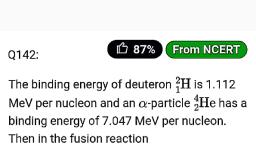
25.13. PACKING FRACTION |, It has been found that the actual mass M of a nucleus differs from its mass mumber A by a, small amount. This mass difference (i.e. mass defect) per nucleon is called packing fraction of the, nucleus., The packing fraction of nucleus is defined as the mass defect per nucleon of the nucleus iz., Mass defect M—A |, Mass number A |, If packing fraction is positive (as for nuclei having A less than 20 and more than 200),, then the nucleus is unstable. If packing fraction is negative (as for nuclei having A between, , 20 and 200), the nucleus is stable. Thus packing fraction of a nucleus is a measure of the, stability of the nucleus. |, , Packing fraction, P, =, , NUMERICAL PROBLEMS, , Example 25.7. Find @ mass defect (ii) binding energy and bind! energy nucleon, for a helium nucleus. Given that mass of helium nucleus = eases fone proton, = 1.007277 a.m.u. and mass of neutron = 1.008666 a.m.u., , Solution. A helium nucleus has 2 protons and 2 neutrons., Actual mass of helium nucleus, M = 4.001509 a.m.u., Mass number, A = mass of protons + mass of neutrons, = 2 (1.007277) + 2 (1.008666) = 4.031886 amu., , , , @ Mass defect, AM = A — M = 4.031886 — 4.001509 = 0.030377 amu., 0.030377 x 1.66 x 10-7” x (3 x 10°)?, (® _Binding energy, #, = AM x === C210 y ev, , = 28.3 x 10° eV = 28.3 MeV, , Binding energy _ 28.3, No. of nucleons 4, Example 25.8. Calculate the binding energy when (i) one neutron and one proton combine, to form a deuteron nucleus, (ii) two neutrons and two protons combine to form an, «particle. Given that :, Mass of neutron = 1.00893 a.m.u. ; Mass of proton = 1.00813 amu., Mass of deuteron = 2.01473 a.m.u. ; Mass of a-particle = 4.00389 a.m.u., Solution. (i) Mass defect, A m = (Sum of masses of n and p) — (Mass of deuteron), = (1.00893 + 1.00813) — (2.01473) = 0.00233 a.m.u, Am x 931.5 MeV (+ Lamu. =931.5 MeV), 0.00233 x 931.5 = 2.17 MeV, (ii) Mass defect, Am = (2 x 1.00893 + 2 x 1.00813) ~ 4.00389 = 0.03023 am.u., Binding energy, E, = 4m x 931.5 MeV = 0.03023 x 931.5 = 28.1 MeV, , Binding energy/nucleon. = = 7.07 MeV, , , , Binding energy, E,



 Learn better on this topic