Notes of 12th Physics- Khodade Sir, Physics Physics Model Paper 3.pdf - Study Material
Page 1 :
Physics, Model Set - 3, Academic Year: 2020-2021, Date: April 2021, Duration: 3h, , Marks: 70, , 1. The question paper is divided into four sections., 2. Section A: Q. No. 1 contains Ten multiple-choice type of questions carrying One, mark each., 3. Section A: Q. No. 2 contains Eight very short answer type of questions carrying One, mark each., 4. Section B: Q. No. 3 to Q. No. 14 contains Twelve short answer type of questions, carrying Two marks each. (Attempt any Eight)., 5. Section C: Q. No.15 to Q. No. 26 contains Twelve short answer type of questions, carrying Three marks each. (Attempt any Eight)., 6. Section D: Q.No. 27 to Q. No. 31 contains Five long answer type of questions, carrying Four marks each. (Attempt any Three)., 7. Use of log table is allowed. Use of calculator is not allowed., 8. Figures to the right indicate full marks., 9. For each MCQ, correct answer must be written along with its alphabet., e.g., (a) ..... / (b ) .... / ( c ) .... / ( d) ..... Only first attempt will be considered for, evaluation., 10. Physical constants:, a. Latent heat of vaporisation, Lvap = 2256 kJ/kg, b. Acceleration due to gravity, g = 9.8 m/s2, , Q. 1 | Select and write the correct answer:, 1.i Acceleration of a particle executing S.H.M. at its mean position., 1. Is infinity, 2. Varies, 3. Is maximum, 4. Is zero, 1.ii Which of the following cannot produce two coherent sources?, 1. Lloyd’s mirror, 2. Fresnel biprism, 3. Young’s double-slit, 4. Prism, 1.iii Light follows wave nature because ______
Page 2 :
1. Light rays travel in a straight line, 2. Light exhibits the phenomenon of reflection and refraction, 3. Light exhibits the phenomenon of interference, 4. Light causes the phenomenon of the photoelectric effect, 1.iv If an electron is brought towards another electron, the electric potential energy of the, system ______, 1. decreases, 2. increases, 3. Becomes zero, 4. Remains same, 1.v Relative permeability of iron 5500, then its magnetic susceptibility will be ______, 1. 5500 × 107, 2. 5501, 3. 5499, 4. 5500 × 10-7, 1.vi According to the right-hand rule, the direction of magnetic induction if the current is, directed in an anticlockwise direction is ______, 1. perpendicular and inwards, 2. perpendicular and outwards, 3. same as current, 4. opposite to that of current, 1.vii Choose the correct option., Solar cell operates on the principle of:, 1. diffusion, 2. recombination, 3. photovoltaic action, 4. carrier flow, 1.viii In a common base configuration, the transistor has an emitter current of 10 mA and a, collector current of 9.8 mA. The value of base current is ______, 1. 0.1 mA, 2. 0.2 mA, 3. 0.3 mA, 4. 0.4 mA, 1.ix An electric bulb operates 10 V d.c. If this bulb is connected to an a.c. source and gives, normal brightness, then the peak value of the source is ______, 1. 141.4 V, 2. 14.14 V
Page 3 :
3. 1.414 V, 4. 0.1414 V, 1.x In the expression e = –dΦ/dt, the -ve sign signifies ______, 1. The induced emf is produced only when magnetic flux decreases, 2. The induced emf opposes the change in the magnetic flux., 3. The induced emf is opposite to the direction of the flux., 4. The induced emf is independent of change in magnetic flux., Q. 2 | Answer the following:, 2.i What is the surface film?, Ans. A layer of the surface of a liquid whose thickness is equal to the range of an, intermolecular force is called surface film., 2.ii Why wave motion is doubly periodic?, Ans. Wave motion is doubly periodic because it repeats itself after an equal interval of time, and space., 2.iii What are harmonics?, Ans. The frequencies of a particular overtone which are the integral multiples of the, fundamental frequency are known as harmonics., 2.iv A group of objects that can form a unit which may have the ability to exchange energy, with its surrounding is called what?, Ans. A group of objects that can form a unit which may have the ability to exchange energy, with its surrounding is called as a thermodynamic system., 2.v In Young’s double-slit experiment, if there is no initial phase difference between the, light from the two slits, a point on the screen corresponds to the 5th minimum. What is the, path difference?, Ans., , 2.vi Which physical quantity has its unit as J/C? Is it a scalar or vector?, Ans. The electrostatic potential has its unit as J/C and it is a scalar quantity., 2.vii The relative velocity between two parallel layers of water is 8 cm/s and the, perpendicular distance between them is 0.1 cm. Calculate the velocity gradient.
Page 4 :
Ans., , 2.viii The radius of the smallest orbit of the electron( aO) in a hydrogen atom is 0.053 nm., What is the radius of the 4th orbit of the electron in a hydrogen atom?, Ans. Radius of the 4th orbit of the electron in hydrogen atom, r4 = a0 n2 = 0.053 × (4)2 =, 0.848 nm, Q. 3 | Attempt Any Eight:, State the assumptions made for thermodynamic processes., Ans. Assumptions made for studying various thermodynamic processes:, i., , ii., iii., , The majority of the thermodynamic processes are reversible. That is, they are quasistatic in nature. They are extremely slow and the system undergoes an infinitesimal, change at every stage except the adiabatic processes. The system is, therefore, in, thermodynamic equilibrium during all the changes., The system involved in all the processes is an ideal gas enclosed in a cylinder having, a movable, frictionless, and massless piston., The ideal gas equation is applicable to the system., , Q. 4 Obtain the differential equation of linear simple harmonic motion., Ans. (A)Differential equation of linear S.H.M:, a. Let a particle of mass ‘m’ undergo S.H.M about its mean position O. At any instant ‘t’,, displacement of the particle be ‘x’ as shown in the following figure.
Page 5 :
f. Equations (3) and (4) represent differential equation of linear S.H.M., Ans. (B), i. In a linear S.H.M., the force is directed towards the mean position and its magnitude, is directly proportional to the displacement of the body from the mean position., ∴ f ∝ –x, ∴ f = –kx ….(1), where k is force constant and x is the displacement from the mean position., ii. According to Newton’s second law of motion,, f = ma ….(2), From equations (1) and (2),, ma = –kx ….(3)
Page 6 :
This is the differential equation of linear S.H.M., Q. 5 State any two laws of the simple pendulum., Ans. Laws of the simple pendulum:, i., , The period of a simple pendulum is directly proportional to the square root of its, length., , The period of a simple pendulum is inversely proportional to the square root of, acceleration due to gravity., , i., ii., , The period of a simple pendulum does not depend on its mass., The period of a simple pendulum does not depend on its amplitude (for small, amplitude)., , Q. 6 Show the graphical representation of radiant power of a black body per unit range of, wavelength as a function of wavelength., Ans.
Page 7 :
Q. 7 Draw a neat labeled diagram of Ferry’s black body., Ans., , Q. 8 State any four applications of beats., Ans., i. The phenomenon of beats is used for matching the frequencies of different musical, instruments by artists., ii. The speed of an airplane can be determined by using Doppler RADAR. The, phenomenon of beats, arising due to the difference in frequencies produced by the, source and received at the source after reflection from the airplane, allows us to, calculate the velocity of the airplane., iii. Doppler ultrasonography and echocardiogram works on the principle of the, phenomenon of beats., iv., The unknown frequency of a sound note can be determined by using the, phenomenon of beats., Q. 9 Define: Ionization energy., Ans. The ionization energy of an atom is the minimum amount of energy required to be, given to an electron in the ground state of that atom to set the electron free.
Page 8 :
Q. 10 A raindrop of radius 0.3 mm falls through the air with a terminal velocity of 1 m/s., The viscosity of air is 18 x 10-6 N-s /m2. Find the viscous force on the raindrop., Ans. Given:, r = 0.3 mm = 3 × 10⁻⁴ m,, v = 1 m/s,, η = 18 × 10−6 Ns/m2, To find: Viscous force (F), Formula: F = 6πηrv, Calculation: From formula,, F = 6 × 3.142 × 18 × 10−6 × 3 × 10−4 × 1, = 324 × 3.142 × 10−10, = antilog {log 324 + log 3.142} × 10−10, = antilog {2.5105 + 0.4972} × 10−10, = antilog {3.0077} × 10−10, = 1.017 × 103 × 10−10, = 1.017 × 10⁻⁷ N, The viscous force is 1.017 × 10⁻⁷ N, Q. 11 The optical path of a ray of light of a given wavelength travelling a distance of 3 cm in, flint glass having refractive index 1.6 is the same as that on travelling a distance x cm, through a medium having a refractive index 1.25. Determine the value of x., Ans. (A) Let dfg and dm m be the distances by the ray of light in the flint glass and the, medium respectively. Also, let nfg and nm be the refractive indices of the flint glass and the, medium respectively., Data: dfg = 3 cm, nfg = 1.6, nm = 1.25,
Page 9 :
Ans. (B) Given:, d1 = 3 cm, n1 = 1.6, n2 = 1.25, To find: Optical path in medium 2 (d2), Formula: n1d1 = n2d2, Calculation:, From formula,, 1.6 × 3 = 1.25 × d2, , The value of x is 3.84 cm., Q. 12 A Plane Wavefront of light of wavelength 5500 A.U. is incident on two slits in a screen, perpendicular to the direction of light rays. If the total separation of 10 bright fringes on a, screen 2 m away is 2 cm. Find the distance between the slits., Ans. Given:, λ = 5500 A.U.= 5500 × 10-10 m, D = 2 m, Distance between 10 fringes = 2 cm = 0.02 m., Fringe width W = 0.02/10 = 0.002 m = 2 × 10⁻³ m, To find: Distance between slits (d), , Q. 13 Explain De Broglie’s Hypothesis.
Page 10 :
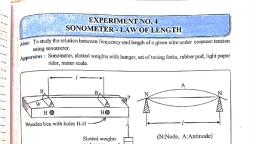
Ans., i., ii., , De Broglie proposed that a moving material particle of total energy E and, momentum p has a wave associated with it (analogous to a photon)., He suggested a relation between properties of the wave, like frequency and, wavelength, with that of a particle, like energy and momentum., , Thus, the frequency and wavelength of a wave associated with a material particle, of mass, m moving with a velocity v, are given as, , i., , De Broglie referred to these waves associated with material particles as matter, waves. The wavelength of the matter waves, given by equation (1), is now known as, de Broglie wavelength and the equation is known as de Broglie relation., , Q. 14 A sonometer wire of length 1 m is stretched by a weight of 10 kg. The fundamental, frequency of vibration is 100 Hz. Determine the linear density of the material of the wire., Ans. Given:, L = 1 m, M = 10 kg, n0 = 100 Hz, To find: Linear density of wire (m), Formulae:, , Calculation:, From formula (i),, T = 10 × 9.8 = 98 N, From formula (ii),, , Squaring both sides, we get
Page 11 :
The linear density of the wire is 2.45 × 10⁻³ kg/m., Q. 15 | Attempt Any Eight:, Derive an expression for the difference in tensions at the highest and lowest point for a, particle performing the vertical circular motion., Ans., i., , Suppose a body of mass ‘m’ performs V.C.M on a circle of radius r as shown in the, figure., , ii., , Let,, TL = tension at the lowest point, TH = tension at the highest point, vL = velocity at the lowest point, vH = velocity at the highest point, At lowest point L,, , iii., , Subtracting (1) by (2),
Page 12 :
Q. 16 Obtain an expression for the capillary rise or fall using the forces method., Ans., i., , ii., , iii., , iv., , When a glass capillary tube is dipped into a liquid, then the liquid rises in the, capillary against gravity., Hence, the weight of the liquid column must be equal and opposite to the, component of force due to surface tension at the point of contact., The length of liquid in contact inside the capillary is the circumference 2πr., Let, r = radius of the capillary tube, h = height of liquid level in the tube, T = surface tension of the liquid, r = density of liquid, g = acceleration due to gravity, The force of magnitude fT acts tangentially on a unit length of liquid surface which is, in contact with the wall of the capillary tube and is given as fT = T × 2πr, This force can be resolved into two components:, a. fT cosθ-vertically upward and, b. fT sinθ-along horizontal, The vertical component is effective. The horizontal component is not responsible for, the capillary rise.
Page 13 :
v., vi., , vii., , The vertical component of force acting on the liquid column, (fT)v = force per unit length × circumference, = T cosθ × 2πr, Upward force balances the weight of the liquid in the capillary., W = mg = Vrg = πr2hρg, where V = volume of liquid rise in the tube (ignoring the liquid in the concave, meniscus.), m = mass of the liquid in the capillary rise. This must be equal and opposite to the, vertical component of the force due to surface tension., If the liquid in the meniscus is neglected, then for equilibrium.,, , This is the required expression for the rising or fall of liquid in a capillary tube., , Rise of liquid in a capillary tube, Q. 17 Calculate the ratio of two specific heats of polyatomic gas molecules., Ans., i., ii., iii., , Gases that have molecules containing more than two atoms are termed polyatomic, gases., Each molecule of the polyatomic gas has 3 translational degrees of freedom. Only, linear molecules have 2 degrees of freedom for rotation. All other polyatomic, molecules have 3 degrees of freedom for rotation., The number of degrees of freedom (f), for the vibrational motion of a polyatomic, molecule, depends on the geometric structure of the molecule i.e., the arrangement, of atoms in a molecule.
Page 14 :
Q. 18 What is a potential gradient? How is it measured? Explain., Ans. (A)The potential gradient is defined as the fall of potential per unit length of, potentiometer wire. The gradient of potential energy is a force (measured in newtons)., Consider a potentiometer consisting of a long uniform wire AB of length L and resistance R,, stretched on a wooden board and connected in series with a cell of stable emf E and, internal resistance rand a plug key K as shown in the following figure., , Let I be the current flowing through the wire when the circuit is closed., , Potential difference across AB. VAB = IR, , The potential difference (the fall of potential from the high potential end) per unit length of, the wire,, , is denoted by K. Thus the potential gradient is calculated by measuring the potential, difference between ends of the potentiometer wire and dividing it by the length of the wire.
Page 15 :
Let P be any point on the wire between A and B and AP= l =length of the wire between A, and P., , Ans. (B), i. Potential gradient (K) is defined as a potential difference per unit length of wire., , where V = Potential difference between two points, L = Length (distance) between two points, Explanation:, a. A potentiometer consists of a long wire AB of length L and resistance R having uniform, cross-sectional area A., b. A cell of emf E having internal resistance r is connected across AB as shown in the figure., , d. Potential difference across AB,, VAB = IR, , e. Therefore, the potential difference per unit length of the wire is,
Page 16 :
The potential gradient can be defined as a potential difference per unit length of wire., Q. 19 Explain with a neat circuit diagram. How you will determine the unknown, resistances using a meter bridge., Ans. Construction:, i., ii., iii., iv., v., , Metrebridge consists of a one-metre long wire of uniform cross-section, stretched, on a metre scale which is fixed on a wooden table., The ends of the wire are fixed below two L shaped metallic strips. A single metallic, stripe separates the two L-shaped strips leaving two gaps, left gap and right gap., iii. Usually, an unknown resistance X is connected in the left gap and a resistance box, is connected in the other gap., One terminal of a galvanometer is connected to point C on the central strip, while, the other terminal of the galvanometer carries the jockey (J). Temporary contact, with the wire AB can be established with the help of the jockey., A cell of emf E along with a key and a rheostat is connected between points A and B., , Working:, i., ii., iii., iv., , A suitable resistance R is selected from the resistance box., The jockey is brought in contact with AB at various points on the wire AB and the, balance point (null point), D is obtained. The galvanometer shows no deflection, when the jockey is at the balance point (point D)., Let the respective lengths of the wire between A and D, and that between D and C be, lx and lR., Then using the balancing conditions,
Page 17 :
i., ii., , where RAD and RDB are a resistance of the parts AD and DB of the wire respectively., If l is the length of the wire, ρ is its specific resistance, and A is its area of crosssection then, , From equations (1), (2) and (3),, , Thus, knowing R, lx and lR, the value of the unknown resistance can be determined., Q. 20 Determine the motional emf induced in a straight conductor moving in a uniform, magnetic field with constant velocity on the basis of Lorentz force., Ans.
Page 18 :
i., ii., , For maximum induced emf, sinθ = 1, emax = Blv ….(2), Thus, from equations (1) and (2), for any circuit whose parts move in a fixed, magnetic field, the induced emf is the time derivative of flux (ϕ) regardless of the, shape of the circuit., , Q. 21 What is a logic gate? Draw the symbol and give the truth table for NOT gate. Why, NOT the gate is called an inverter?, Ans. Logic gate: A digital circuit with one or more input signals but only one output signal, is called a logic gate. It is a switching circuit that follows a certain logical relationship, between the input and output voltages., Schematic symbol:, , NOT gate symbol, The truth table for NOT gate:
Page 19 :
Input, , Output, , X, , Y, , 0, , 1, , 1, , 0, , Reason:, i., ii., iii., , NOT gate has one input and one output., It produces a ‘high’ output or output ‘1’ if the input is ‘0’. When the input is ‘high’ or, ‘1’, its output is ‘low’ or ‘0’., That is, it produces a negated version of the input at its output., Hence, NOT gate is called an inverter., , Q. 22 The magnetic field at the centre of a circular loop of radius 12.3 cm is 6.4 x 10⁻⁶ T., What will be the magnetic moment of the loop?, Ans. Given:, B = 6.4 × 10⁻⁶ T,, R = 12.3 cm, = 12.3 × 10⁻² m, To find: Magnetic moment (m), Formula:
Page 20 :
= 5.954 × 10⁻² Am2, The magnetic moment of the loop is 5.954 × 10⁻² Am2., Q. 23 A plane of a coil of 10 turns is tightly wound around a solenoid of diameter 2 cm, having 400 turns per centimeter. The relative permeability of the core is 800. Calculate the, inductance of the solenoid., Ans. Given:, N = 10, d = 2 cm = 0.02 m, N = 400 turns/cm = 4 × 10⁴ turns/m, μr = 800, To find: Inductance of solenoid (L), Formulae:
Page 21 :
Calculation:, From formula (i), (ii) and (iii),, , = 0.1264 H, The inductance of the solenoid is 0.1264 H., Q. 24 What is the capacitive reactance of a capacitor of 5µF at a frequency of (1) 50 Hz and, (2) 20KHZ?, Ans. Given:, C = 5 μF = 5 × 10⁻⁶ F, f1 = 50 Hz, f2 = 20 kHz, To find:
Page 22 :
i., ii., , When the frequency is 50 Hz, the capacitive reactance is 636.94 Ω., When the frequency is 20 kHz, the capacitive reactance is 1.59 Ω., , Q. 24 What is the capacitive reactance of a capacitor of 5µF at a frequency of (1) 50 Hz and, (2) 20KHZ?, Ans. Given:, C = 5 μF = 5 × 10⁻⁶ F, f1 = 50 Hz, f2 = 20 kHz, , i., i., , = 1.59 Ω, When the frequency is 50 Hz, the capacitive reactance is 636.94 Ω.
Page 23 :
ii., , When the frequency is 20 kHz, the capacitive reactance is 1.59 Ω., , Q. 25 The energy of a photon is 2 eV. Find its frequency and wavelength., Ans. Given:, E = 2 eV = 2 × 1.6 × 10−19 = 3.2 × 10⁻¹⁹ J, To find:, i., ii., , Frequency (ν), Wavelength (λ), , Formulae:
Page 24 :
= 6216 Å, i., ii., , The frequency of photons is 4.826 × 10¹⁴ Hz., The wavelength of the photon is 6216 Å., , Q. 26 A radioactive substance decays to (1/10)th of its original value in 56 days. Calculate, its decay constant., Ans.
Page 25 :
The decay constant is 4.113 × 10⁻² per day., Q. 27 | Attempt Any Three:, What is a conical pendulum? Obtain an expression for its time period, Ans. A tiny mass (assumed to be a point object and called a bob) connected to a long,, flexible, massless, inextensible string, and suspended to rigid support revolves in such a, way that the string moves along the surface of a right circular cone of the vertical axis and, the point object performs a uniform horizontal circular motion. Such a system is called, a conical pendulum., Expression for its time period:, i., , ii., iii., , Consider the vertical section of a conical pendulum having bob (point mass) of mass, m and string of length ‘L’., Here, θ is the angle made by the string with the vertical, at any position (semivertical angle of the cone), In a given position B, the forces acting on the bob are, a. its weight ‘mg’ directed vertically downwards, b. the force ‘T0’ due to the tension in the string, directed along the string, towards, the support A., , In an inertial frame
Page 26 :
iv., , As the motion of the bob is a horizontal circular motion, the resultant force must be, horizontal and directed towards the centre C of the circular motion., For this, tension (T0) in the string is resolved into, a. T0 cos θ: vertical component, b. T0 sin θ: horizontal component, v., The vertical component (T0 cos θ) balances the weight ‘mg’., ∴ mg = T0 cosθ …..............(1), The horizontal component T0 sinθ then becomes the resultant force which is centripetal., mrω2 = T0 sinθ …..............(2), Dividing equation (2) by equation (1),, , Q. 28 Explain the thermodynamics of the isobaric process., Ans., i., ii., iii., iv., v., vi., , A thermodynamic process that is carried out at constant pressure i.e., Δp = 0 is, called the isobaric process., For an isobaric process, none of the quantities ΔU, Q, and W is zero., The temperature of the system changes, i.e., ΔT ≠ 0., The energy exchanged is used to do work as well as to change internal energy, causing an increase in temperature. Thus, Q = ΔU + W., As work is done volume changes during the process., Heat exchanged in case of an isobaric process:, a. Consider an ideal gas undergoing volume expansion at constant pressure., b. If Vi and Ti are its volume and temperature in the initial state of a system and, Vf and Tf are its final volume and temperature respectively, the work done in the, expansion is given by,
Page 27 :
vii., , W = pdV = p(Vf – Vi) = nR(Tf – Ti) ….(1), c. Also, the change in the internal energy of a system is given by, ΔU = nCVΔT =, nCV(Tf – Ti) ….(2), Where, CV is the specific heat at constant volume, and ΔT = (Tf – Ti) is the change in, its temperature during the isobaric process., d. According to the first law of thermodynamics, the heat exchanged is given by, Q =, ΔU + W, Using equations (1) and (2) we get,, Q = nCV(Tf – Ti) + nR(Tf – Ti), ∴ Q = (nCV + nR) (Tf – Ti), ∴ Q = nCp(Tf – Ti) .............(∵ Cp = CV + R), Where, Cp is the specific heat at constant pressure., , viii., , The p-V diagram for an isobaric process is called isobar. It is shown in the figure, below., , Q. 29, 29.i Explain the principle of a capacitor., Ans. Consider a metal plate P1 having area A with some positive charge +Q be given to the, plate. Let its potential be V., , Now consider another insulated metal plate P2 held near plate P1. By induction, a negative, charge is produced on the nearer face and an equal positive charge develops on the farther, face of P2 as shown in figure (a) below.
Page 28 :
i., ii., iii., , iv., , v., , (a), The induced negative charge lowers the potential of plate P1, while the induced, positive charge raises its potential., As the induced negative charge is closer to P1 it is more effective, and thus there is a, net reduction in the potential of plate P1. If the outer surface of P2 is connected to, the earth, the induced positive charges on P2 being free, flows to earth. The induced, negative charge on P2 stays on it, as it is bound to the positive charge of P1. This, greatly reduces the potential of P2 as shown in figure (b) below., , (b), If V1 is the potential on plate P2 due to charge (–Q) then the net potential of the, system will now be +V – V1., , Thus, the capacity of metal plate P1 is increased by placing an identical earthconnected metal plate P2 near it., , 29.ii Three-point charges +q, +2q and Q are placed at the three vertices of an equilateral, triangle. Find the value of charge Q (in terms of q), so that the electric potential energy of, the system is zero., Ans.
Page 29 :
Let ‘r’ be the side of the equilateral triangle,
Page 30 :
Q. 30, 30.i A solenoid has a core of material with relative permeability 500 and its windings carry, a current of 1 A. The number of turns of the solenoid is 500 per meter. Calculate the, magnetization of the material., Ans. Given: μr = 500, I = 1 A, n = 500, To find: Magnetization (M), Formula: M = (μr - 1)nI, Calculation:, From formula,, M = (500 - 1) × 500 × 1, = 2.495 × 10⁵ Am-1, The magnetization of the material is 2.495 × 10⁵ Am-1., 30.ii A solenoid of length π m and 5 cm in diameter has a winding of 1000 turns and carries, a current of 5 A. Calculate the magnetic field at its centre along the radius., Ans. Given:, l = π m, diameter = 5 cm,, N = 1000 turns, i = 5 A, We know that, μ0 = 4π × 10-7 Tm/A, To find: Magnetic field (B), Formulae:
Page 31 :
Calculation:, From formula (i),, , The magnetic field is 2 × 10⁻³ T., Q. 31, Q. 31.i State any two characteristics of a series LCR AC resonance circuit., Ans., , i., ii., iii., , Impedance is minimum and the circuit is purely resistive., Current has a maximum value., When a number of frequencies are fed to it, it accepts only one frequency (fr) and, rejects the other frequencies. The current is maximum for this frequency. Hence it is, called the acceptor circuit., , 31.ii A magnet of magnetic moment 3Am2 weighs 75 g. The density of the material of the, magnet is 7500 kg/m3. what is magnetization?, Ans. Given:, mnet = 3 Am2, mass = 75 g = 75 × 10-3 kg, Density, d = 7500 kg/m3, To find: Magnetization (M)
Page 32 :
The magnetization is 3 × 10⁵ A/m.



 Learn better on this topic