Page 1 :
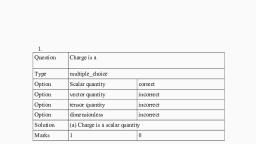
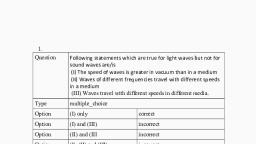
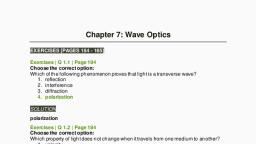
1., Question, , Which of the following phenomenon proves that light is a, transverse wave?, , Type, , multiple_choice, , Option, , reflection, , incorrect, , Option, , interference, , incorrect, , Option, , diffraction, , incorrect, , Option, , polarization, , correct, , Solution, Marks, 2., Question, , (d), 4, , 1, , Which property of light does not change when it travels from, one medium to another?, , Type, , multiple_choice, , Option, , velocity, , incorrect, , Option, , wavelength, , incorrect, , Option, , amplitude, , incorrect, , Option, , frequency, , correct, , Solution, , (d), , Marks, , 4, , 3., Question, , 1, , When unpolarized light is passed through a polarizer, its, intensity, , Type, , multiple_choice, , Option, , increases, , incorrect, , Option, , decreases, , correct
Page 2 :
Option, , remains unchanged, , incorrect, , Option, , depends on the orientation, of the polarizer, , incorrect, , Solution, , (b), , Marks, , 4, , 1, , 4., Question, , In Young's double slit experiment, the two coherent sources, have different intensities. If the ratio of maximum intensity to, the minimum intensity in the interference pattern produced is, 25:1. What was the ratio of intensities of the two sources?, , Type, , multiple_choice, , Option, , 5:1, , incorrect, , Option, , 25 : 1, , incorrect, , Option, , 3:2, , incorrect, , Option, , 9:4, , correct, , Solution, , (d), , I max, I min, 2, , 25, 1, , 2, , 2, , 2, , but,, , I, , a2
Page 3 :
Marks, , 4, , 1, , 5., Question, , In Young's double slit experiment, a thin uniform sheet of glass, is kept in front of the two slits, parallel to the screen having the, slits. The resulting interference pattern will satisfy, , Type, , multiple_choice, , Option, , The interference pattern, will remain unchanged, , incorrect, , Option, , The fringe width will, decrease, , incorrect, , Option, , The fringe width will, increase, , incorrect, , Option, , The fringes will shift, , correct, , Solution, , (d), , Marks, , 4, , 1, , 6., Question, , For which of the following colour, refractive index is least, , Type, , multiple_choice, , Option, , violet, , incorrect, , Option, , red, , correct, , Option, , green, , incorrect, , Option, , orange, , incorrect, , Solution, , (b), , Marks, , 4, , 1
Page 4 :
7., Question, , According to Newton's corpuscular theory of light, light is, propagated in the form of, , Type, , multiple_choice, , Option, , corpuscles, , correct, , Option, , waves, , incorrect, , Option, , photons, , incorrect, , Option, , electrons, , incorrect, , Solution, , (a), , Marks, , 4, , 1, , 8., Question, , The different sizes and masses of the corpuscles is responsible, for, , Type, , multiple_choice, , Option, , colour of light, , correct, , Option, , frequency of light, , incorrect, , Option, , velocity of light, , incorrect, , Option, , intensity of light, , incorrect, , Solution, , (a), , Marks, , 4, , 1, , 9., Question, , If the phase difference between the two light waves interfering at, a point of the medium is equal to odd multiple of n then that, point appears as, , Type, , multiple_choice, , Option, , bright, , incorrect
Page 5 :
Option, , dark, , correct, , Option, , may be bright or dark, , incorrect, , Option, , none of these, , incorrect, , Solution, , (b), , Marks, , 4, , 1, , 10., Question, , The region or locus of all the dark points produced due to, interference of two identical light waves is, , Type, , multiple_choice, , Option, , bright band or bright fringe incorrect, , Option, , dark band or dark fringe, , correct, , Option, , band width, , incorrect, , Option, , spectrum, , incorrect, , Solution, , (b), , Marks, , 4, , 11., Question, , 1, , In interference with two coherent beams of light in fringe width, is, , Type, , multiple_choice, , Option, , proportional to the, wavelength, , correct, , Option, , inversely proportional to, the wavelength, , incorrect, , Option, , proportional to the square, of the wavelength, , incorrect, , Option, , inversely proportional to, the square of the, , incorrect
Page 6 :
wavelength, Solution, , (a), , Marks, , 4, , 12., Question, , 1, , In an experiment similar to Young's experiment, interference is, observed using waves associated with electrons. The electrons, are being produced in an electron gun. In order to increase the, fringe width, , Type, , multiple_choice, , Option, , electron gun voltage is, increased, , incorrect, , Option, , electron gun voltage is, decreased, , correct, , Option, , the slits be moved away, , incorrect, , Option, , the screen be moved closer incorrect, to interfering slits,, , Solution, , (b), eV = hc/λ, hc/eV, From above equation as V decreases λ increases., Therefore, bandwidth also increases., , Marks, , 4, , 13., Question, , 1, , The phenomenon of bouncing back of the light energy from the, surface of the mirror is, , Type, , multiple_choice, , Option, , reflection, , correct, , Option, , refraction, , incorrect, , Option, , diffraction, , incorrect
Page 7 :
Option, , interference, , Solution, , (a), , Marks, , 4, , incorrect, , 1, , 14., Question, , A biprism arrangement in air is immersed completely in a liquid., The fringe width, , Type, , multiple_choice, , Option, , remains same, , incorrect, , Option, , increases, , correct, , Option, , decreases, , incorrect, , Option, , none of these, , incorrect, , Solution, , (b), , Marks, , 4, , 1, , 15., Question, , Phenomenon of bending of waves without change in medium is, called, , Type, , multiple_choice, , Option, , reflection, , incorrect, , Option, , refraction, , incorrect, , Option, , interference, , incorrect, , Option, , diffraction, , correct, , Solution, , (d), , Marks, , 4, , 16., , 1
Page 8 :
Question, , The size of the obstacle in order to observe diffraction of light, must be, , Type, , multiple_choice, , Option, , of any order, , incorrect, , Option, , of the order of wavelength, , correct, , Option, , much larger than, wavelength, , incorrect, , Option, , much smaller than, wavelength, , incorrect, , Solution, , (b), , Marks, , 4, , 1, , 17., Question, , Both light and sound waves produce diffraction. It is more, difficult to observe the diffraction with light waves because, , Type, , multiple_choice, , Option, , light wave do not require, medium, , incorrect, , Option, , wavelength of light waves, is far smaller, , correct, , Option, , light waves are transverse, , incorrect, , Option, , speed of light is far greater incorrect, , Solution, , (b), , Marks, , 4, , 1, , 18., Question, , Diffraction pattern is obtained using red light. What will happen, if it is replaced by violet light ?, , Type, , multiple_choice
Page 9 :
Option, , bands will disappear, , incorrect, , Option, , bands will become narrow, , correct, , Option, , bands will get spaced apart incorrect, , Option, , bands will remain, unchanged, , Solution, , (b), , Marks, , 4, , incorrect, , 1, , 19., Question, , The ability of n optical Instrument to how the Image of two, adjacent point objects as separate Is called, , Type, , multiple_choice, , Option, , dispersive power, , incorrect, , Option, , magnifying power, , incorrect, , Option, , resolving power, , correct, , Option, , none of these, , incorrect, , Solution, , (c), , Marks, , 4, , 1, , 20., Question, , Resolving power of telescope can be increased by, , Type, , multiple_choice, , Option, , increasing diameter of the, objective of the telescope, , incorrect, , Option, , decreasing the wavelength, of light, , incorrect, , Option, , decreasing diameter of the, , incorrect
Page 10 :
objective of the telescope, Option, , both 'a' and 'b', , Solution, , (d), , Marks, , 4, , 21., Question, , The transverse nature of light is shown by, , Type, , multiple_choice, , Option, , interference of light, , incorrect, , Option, , refraction of light, , incorrect, , Option, , polarisation of light, , correct, , Option, , dispersion of light, , incorrect, , Solution, , (c), , Marks, , 4, , 22., Question, , correct, , 1, , 1, , When the analyser is rotated to complete one rotation, one, observes, , Type, , multiple_choice, , Option, , one extinction and two, brightness, , incorrect, , Option, , one brightness and two, extinctions, , incorrect, , Option, , two extinctions and two, brightness, , correct, , Option, , no change in the brightness incorrect, , Solution, , (c), , Marks, , 4, , 1
Page 11 :
23., Question, , The relation between refractive index of the medium and angle, of polarisation is called, , Type, , multiple_choice, , Option, , Brewster's law, , incorrect, , Option, , Malus law, , incorrect, , Option, , Brewster's law, , correct, , Option, , Malus law, , incorrect, , Solution, , (c), , Marks, , 4, , 1, , 24., Question, , Refractive index of material is equal to tangent of polarising, angle. It is called, , Type, , multiple_choice, , Option, , Lambert's law, , incorrect, , Option, , Bragg's law, , incorrect, , Option, , Brewster's law, , correct, , Option, , Malus law, , incorrect, , Solution, , (c), , Marks, , 4, , 1, , 25., Question, , The phenomenon of nonuniform distribution of energy due to, the superposition of two light waves is, , Type, , multiple_choice, , Option, , reflection of light, , incorrect
Page 12 :
Option, , interference of light, , correct, , Option, , diffraction of light, , incorrect, , Option, , polarisation of light, , incorrect, , Solution, , (b), , Marks, , 4, , 1, , 26., Question, , Which of the following polaroid is formed by stretching, polyvinyl alcohol by the stress?, , Type, , multiple_choice, , Option, , P-polaroid, , incorrect, , Option, , H-polaroid, , correct, , Option, , K-polaroid, , incorrect, , Option, , N-polaroid, , incorrect, , Solution, , (b), , Marks, , 4, , 1, , 27., Question, , The term red shift is used for, , Type, , multiple_choice, , Option, , increase in frequency, and increase in, wavelength, , incorrect, , Option, , decrease in frequency and, decrease in wavelength, , incorrect, , Option, , increase in frequency and correct, decrease in wavelength, , Option, , decrease in frequency and incorrect
Page 13 :
increase in wavelength, Solution, , (c), , Marks, , 4, , 1, , 28., Question, , Young's experiment is performed in air and then performed in, water, the fringe width, , Type, , multiple_choice, , Option, , will remain same, , incorrect, , Option, , will decrease, , correct, , Option, , will increase, , incorrect, , Option, , data are insufficient, , incorrect, , Solution, , (b), , Marks, , 4, , 1, , 29., Question, , A source of light is said lo be monochromatic if it will emit light, waves of, , Type, , multiple_choice, , Option, , same wavelengths, , correct, , Option, , different wavelengths, , incorrect, , Option, , decreasing wavelengths, , incorrect, , Option, , increasing wavelengths, , incorrect, , Solution, , (a), , Marks, , 4, , 30., , 1
Page 14 :
Question, , A beam of light of wavelength 6400 Å is incident normally on a, parallel glass plate of 5 cm thick and R.I. 1.6. The beam takes, the same time to travel from source to incident surface and, through the glass plate. The distance of source from incident, surface is, , Type, , multiple_choice, , Option, , 7.5 cm, , incorrect, , Option, , 6 cm, , incorrect, , Option, , 10 cm, , incorrect, , Option, , 8 cm, , correct, , Solution, , (d), da, va, , vg, vg, , Marks, , 4, , 1, , 31., Question, , The wavelength of green colour in air and violet colour in water, are 5381 Å and 3042 Å respectively. If the wavelength of green, colour in water is the same as the wavelength of violet colour in, air, find its value. (Assume that refractive index for green and, violet colour is approximately same), , Type, , multiple_choice, , Option, , 4049 Å, , correct, , Option, , 3046 Å, , incorrect, , Option, , 3000 Å, , incorrect, , Option, , 2000 Å, , incorrect, , Solution, , (a)
Page 15 :
Marks, , 32., Question, , Type, , 4, , 1, , A ray of light travelling through air is incident on the surface of, water in a lake. If the ray is inclined at 30° with the surface and, if the refractive index of water is 4/3 then the angle through, which the ray deviates is, multiple_choice, , Option, , incorrect, , Option, , correct, , Option, , incorrect, , Option, , incorrect, , Solution, , (b)
Page 16 :
µ, sin r, , Marks, 33., Question, , 4, , 1, , Refractive index of glass with respect to medium is 4/3., If vm – vg = 6.25 × 10⁷ m, then velocity of light in medium is, , Type, , multiple_choice, , Option, , 2.5 × 10⁸ m/sec, , correct, , Option, , 1.5 × 10⁷ m/sec, , incorrect, , Option, , 2.25 × 10⁸ m/sec, , incorrect, , Option, , 4.5 × 10⁷ m/sec, , incorrect, , Solution, , (a), m, , µg, m, , Marks, , 4, , 1, , 34., Question, , Light enters from air into a medium of R.I. 1,5. Percentage
Page 17 :
change in its wavelength is, Type, , multiple_choice, , Option, , 66.66%, , incorrect, , Option, , 50%, , incorrect, , Option, , 33.33%, , correct, , Option, , 25%, , incorrect, , Solution, , (c), µm, , Change in wavelength = λa – λm, % change in wavelength =, , =33.33%, Marks, , 4, , 1, , 35., Question, , In a biprism experiment, the distance between the slit and the, focal plane of the eyepiece is 1.2 m and the wavelength of light, used is 5000Å. When a convex lens is interposed (between the, biprism and eyepiece) the images of the silts in the two positions, are 5 mm and 1.8 mm apart. The distance between the centre of, the pattern and twelfth dark band is, , Type, , multiple_choice, , Option, , 1.3 × 10⁻³ m, , incorrect, , Option, , 2.2 × 10⁻³ m, , incorrect, , Option, , 3.3 × 10⁻³ m, , incorrect, , Option, , 2.3 × 10⁻³ m, , correct, , Solution, , (d)
Page 18 :
Marks, , 4, , 1, , 36., Question, , A monochromatic light of λ = 5000 Å is incident on two slits, separated by a distance of 5 × 10⁻⁴ m. If a thin glass of thickness, 1.5 × 10⁻⁶ m and refractive index 1.5 placed between one of the, slits and screen. The phase difference introduced at the position, of central maxima is, , Type, , multiple_choice, , Option, , 3π, , correct, , Option, , 2π, , incorrect, , Option, , π/2, , incorrect, , Option, , π/3, , incorrect, –6, , Phase difference =, , Marks, , 4, , 2, , 1, , 37., Question, , In a biprism experiment, the slit is illuminated by a light of, wavelength 5000 Å. The distance between the slit and eyepiece, is 1m. If the distance between the two virtual sources is 0.25 cm,, then distance between fifth bright band on one side and the sixth, dark band on the other side of the central bright band will be, , Type, , multiple_choice, , Option, , 1.1 mm, , incorrect
Page 19 :
Option, , 2.2 mm, , incorrect, , Option, , 2.1 mm, , correct, , Option, , 3.1 mm, , incorrect, , Solution, , (c), , Marks, , 4, , 1, , 38., Question, , The distance between two consecutive dark bands in a Young's, experiment is 0.32 mm when red light of wavelength 6400 Å is, used. By how much will this distance change if yellow light of, wavelength 5900 Å is used with the same setting,, , Type, , multiple_choice, , Option, , 0.25 mm, , incorrect, , Option, , 0.025 mm, , correct, , Option, , 1.025 mm, , incorrect, , Option, , 1.25 mm, , incorrect, , Marks, , 4, , 1, , 39., Question, , In Young's double slit experiment, the distance between two slits, is 0.1 mm. The distance between the screen and slits is 20 cm. If, the slit is Illuminated by a light of wavelength 5460 Å then the, angular position of the first dark fringe is
Page 20 :
Type, , multiple_choice, , Option, , 0.08°, , incorrect, , Option, , 0.16°, , correct, , Option, , 0.20°, , incorrect, , Option, , 0.32°, , incorrect, , Solution, , (b), , Distance of first dark band = 0.5 β, Angular width =, , Marks, , 4, , 1, , 40., Question, , In a Young's double slit experiment, the fringe width is found to, be 0.4 mm. If the whole apparatus is dipped in water of, refractive index 4/3. Without disturbing the arrangement, the, new fringe width will be, , Type, , multiple_choice, , Option, , 0.30 mm, , correct, , Option, , 0.40 mm, , incorrect, , Option, , 0.53 mm, , incorrect, , Option, , 0.2 mm, , incorrect, , Solution, , (a)
Page 21 :
µ, , Marks, , 4, , 1, , 41., Question, , White light is used to illuminate the two slits in a Young's, double slit experiment. The separation between the slits is b and, the screen is at a distance d ( d >> b ) from the slits. At a point, on the screen directly in front of one of the slits, certain, wavelengths are missing. Some of these missing wavelengths are, , Type, , multiple_choice, , Option, , 2, , incorrect, , Option, , 2, , incorrect, , Option, , incorrect, , 2, , Option, , both ‘a’ and ‘b’, , Solution, , (d), , correct, , Position of nth minima is,, , b2, , Thus, correct option is d., , Marks, , 4, , 1
Page 22 :
42., Question, , In a biprism experiment, the band width is found to be increased, by 25 % of the initial. If the distance between slit and eyepiece is, increased by 20 cm then the initial distance between slit and, eyepiece is, , Type, , multiple_choice, , Option, , 80 cm, , correct, , Option, , 90 cm, , incorrect, , Option, , 70 cm, , incorrect, , Option, , 60 cm, , incorrect, , Solution, , (a), , Marks, , 4, , 43., Question, , 1, , In a biprism experiment, the distance between the virtual images, of the slits is 2.5 mm and the eyepiece is at a distance of 1 m, from the slits. If the fringe width is 0.3 mm then the frequency of, source of light is, , Type, , multiple_choice, , Option, , 4 × 10¹⁴ Hz, , correct, , Option, , 2 × 10¹⁵ Hz, , incorrect, , Option, , 4 × 10¹² Hz, , incorrect, , Option, , 2 × 10¹² Hz, , incorrect, , Solution, , (a)
Page 23 :
Marks, 44., Question, , 4, , 1, , In single slit diffraction a = 0.14 mm, D - 2 m and distance of, second dark band from central maxima is 1.6 cm. The, wavelength of light is, , Type, , multiple_choice, , Option, , 6500 Å, , incorrect, , Option, , 7500 Å, , correct, , Option, , 5600 Å, , incorrect, , Option, , 8500 Å, , incorrect, , Solution, , (c), , Marks, , 4, , 1, , 45., Question, , Two stars distant two light years are just resolved by a telescope., The diameter of the telescope lens is 0.25 m. If the wavelength, of light used in 5000 A, then the minimum distance between the, stars is, , Type, , multiple_choice, , Option, , 1.22 × 10¹¹ m, , incorrect, , Option, , 2.44 × 10¹¹ m, , incorrect
Page 24 :
Option, , 3.66 × 10¹⁰ m, , incorrect, , Option, , 4.88 × 10¹⁰ m, , correct, , Solution, , (d), , Marks, , 4, , 1