Page 1 :
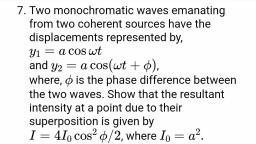
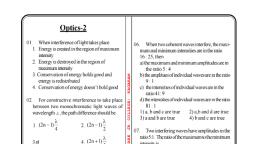
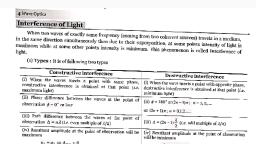
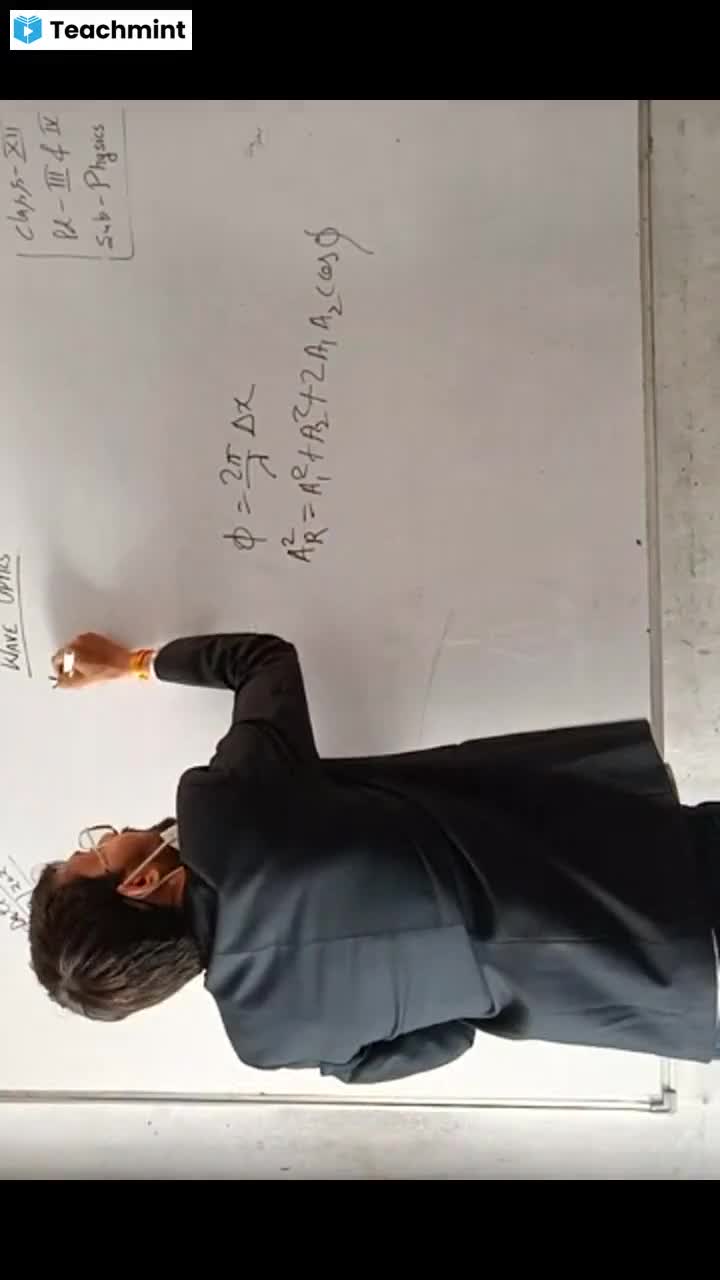
optics ar, wav, , , , , , , , , , , , , , , , , , Fi ependent sources cannot be coherent. This, e of the following reasons :, , e, us is emitted by individual atoms and not by, , t, m1 bak ulk of matter acting as a whole., , Even a tiniest source consists of millions of, atoms, and emission of light by them takes, Jace independently., , 3, Even an atom emits an unbroken wave of about, ean? second due to its transition from a hi bhet, , energy State to a lower energy state., , the millions of atoms of a source cannot emit, yes in the same phase. The light emitted by the, ane used monochromatic Soe (a sodium, ) remains coherent for about 10°°s. After this, ant? the atoms responsible for emission of light get, , . The phase difference and hence the interpattern changes 10° times in one second. Our, cannot see such rapid changes and a uniform, , ‘i mination is seen on the screen. So two indepen, ‘petigsoure cannot produce a sustained interference., Two coherent sources can be obtained from a single, , "arent source. Some of the ed of POET, , "herent sources are as follows :, , 1, In Young’s double slit eben the two sources, , __‘ S,and S, get light from the same source S. |i c, , _ Whatever phase changes occur in S,, the same “Formulae Used, , ___ phase changes occur in S,. The relative phase — r Wear? <2, «cna, , Bros Baca a el 5, pee constant aa ef! Resultant amplitude, a=./a, + 4; + 2a, 4, cos >, , with time. So they act as pone sources. art | Bs a Resultant intensity, I=1J,+ 1,+2,], Pe cos >, , For Your Knowledge, , V, , To observe interference of light, the two sources of, light must be coherent., , In contrast to light from an ordinary source, the laser, light is highly monochromatic and coherent. So two, independent laser sources can produce interference fringes, , and the path difference may be several metres in this, case., , Vv, , V, , Methods of producing coherent source. There are, two general methods of producing coherent sources :, , 1. By division of wavefront. In this method, a, wavefront is divided into two or more parts by use, of slits, mirrors, lenses or prisms. For example,, Young’s double slit method, Frenel’s biprism and, Lloyd's mirror., , 2. By division of amplitude. Here the armplitude of, the wave is divided into two or more parts by, partial reflection or refraction. The divided parts, travel along different paths and are made to, superpose to produce interference. For example, the, brilliant colours seen in thin films of transparent, materials like soap film, oil film, etc., , __ Examples based on, , 2 InFresnel’s biprism method, two coherent sources ’ 2 When I = 1p = Ip, 1= 2h (1+ cos 6) = 4 J, 00 na =, ____ are obtained from the same Pant source, on 2, ____ Tefraction. -* BUnits, Used, a 2. In Lloyd's $ mirror method, a source and its reflected E ae "Amplitudes @, a and @ are in metre and, ' image act as two coherent sources. > aap intensities I, | and I, in watt / m?, - State the conditions, which must be patisfied ft ve Example 8. Two plane monochromatic waves propagating, "sources to be coherent. = in the same direction with amplitudes A and 2 Aand diffe are, lg _Cindon for obtaining two coherent suites of in phase by m/3 rad superpose. eee’ the amplitude of the, _resultant wave., , ‘ _ Solution, Here A, = A As =24 o=7/, , Be oy some hase, , lifer method. ey P, , cig A, , _ ran ct th geese 4, , Th two sources must, iver Patan Aa geo rs, i ge Pat difference b etween the w pave, , Ber ct Ree sources lie ws, , nib tales, , qT, (|, pe, o, j, ie, , F i Ti two sources of light must be obtained fro om nasing le, , , , Tt, , , , , , , , , , , Fea 2 Ax2Acos *, , f in = bare aa 3-74" =V7A, , ity I and 4 I are used in, Brame 9. Two sources of intensity ¢ ‘ ib ge, , h a phase, , =, 3, 2, i, , erfe rence experiment. Find the int :, es from two sources superimpose, , mt) zero (ii) m/2 and (iti) ™