Page 1 :
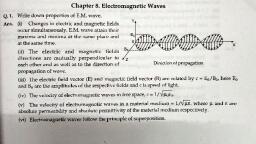
1 Electromagnetic Waves, . The wav propagating in space through electric, , and magnetic fields varying in space and time, are called electromagnetic waves, 5 irying in space and time, , gimultancously, tromagnetic waves are produced by an, , a _ accelerated or decelerated charge or LC circuit., {EM waves is, , ‘The elec, The frequency ©, , , , 2. Characteristics of Electromagnetic Waves, , (i) The electromagnetic waves travel in free-space with the speed of light (¢ = 3 x 10° m/s), irrespective of their wavelength., (ix) Electromagnetic waves are neutral, so they are not deflected by electric and magnetic fields., (iii) The electromagnetic waves show properties of reflection, refraction, interference, diffraction, and polarisation., (iv) In electromagnetic wave the electric and magnetic fields are always in the same phase., (v) The ratio of magnitudes of electric and magnetic field vectors in free space is constant equal, loc,, E 1, 3 =c=3%10'm/s, , © tee, , (vi) The speed of electromagnetic waves in a material medium is given by, _ 1] _. 6, VRE He,, , (vii) In an electromagnetic wave the energy is propagated by means of electric and magnetic field, vectors in the direction of propagation of wave., (viii) In electromagnetic wave the average values of electric energy density and magnetic energy, , density are equal, Loe) (Be, (5 Sok ), 7 (zr, au, , (x) The electric vector of electromagnetic wave is responsible for optical effects and is also called, the light vector,, , , , ¢ : ar, v = 7 where n is the refractive index., , UL, pre zinc, , , , (x) Electromagnetic waves carry energy and momentun E =, , 3. ., Transverse Nature of Electromagnetic Waves . ., € electromagnetic waves are transverse in nature. In electromagnetic waves the electric and, , Magnetic fields are mutually perpendicular and also perpendicular to the direction of wave, Propagation, such that E , B and K forma right handed set (K is propagation vector along the, , direction of propagation)., [Notes We, "We also use y for relractive Index], , Scanned with CamScanner
Page 2 :
4. Electromagnetic Spectrum, () Electromagnetic waves include radio waves, microwaves, visible light waves, infrared wave, > 7 aves, ultraviolet rays, X rays and gamma ra ‘, (i) The basic difference between various types of electromagnetic waves lies in their wavelengths, or frequencies since all of them travel through vacuum with the same speed, Consequently, the, waves differ considerably in their mode of interaction with matter. :, , , , , , , , , , Git) The classi ion of electromagnetic waves according to frequency is the electromagnetic, spectrum. There in no sharp division between one kind of wave and the next. The classification, is based roughly on how the waves are produced and/or detected., , B Radio waves, (i) Radio waves are produced by the accelerated motion of charges in conducting wires., , (i) They are generally in the frequency range from 500 kHz to about 1000 MHz., , (iii) The AM (Amplitude Modulated) band used for short distance radio transmission is from, 530 kHz to 1710 kHz. The SW (Short Wave) band involve frequencies between 1500 kHz, to 50 MHz and is used for long range radio broadcast., , (iv) TV transmission uses VHF (Very High Frequency) band and frequency modulation is, done. The VHF band extend from 50 MHz to 900 MHz., , (v) Cellular phones use radio waves to transmit voice communication in the UHF (Ultra High, Frequency) band. The UHF band extend from 900 MHz to 5 x 10° Hz or 5000 MHz., , @ Microwaves, (i) Microwaves are high frequency radio waves of fre, , 4x 10'? Hz and of wavelength 3 x 10° mto4 x 107! m., , (ii) Microwaves are produced by special vacuum tubes namely, klystrons, magnetrons and, Gunn diodes., , (iii) Microwaves are used in, (a) Radar systems used in aircraft navigation., (6) Speed guns to determine speed of moving automobiles, cricket ball, tennis ball, etc., , quency range from 3 X 10° Hz to, , (c) In the study of atomic and molecular structure., , (d) In communication via satellite., , (e) In microwave ovens for cooking. (In microwave ovens, the frequency of microwave, produced is matched with natural frequency of water molecules so that resonance, occurs and water molecules in the material vibrates at higher amplitude and transfer, energy to nearby food molecules, resulting in heating up of the food.), , g Infrared waves, , (i) Infrared waves are heat radiations also known as heat waves, and are of frequency range, 3 x 10'? Hzto4 x 10" Hz and of wavelength 8 x 1077 m to 3 x 10⁷ m., , (a) Infrared waves are produced by hot bodies and molecules., , (iii) Infrared waves does heating because water molecules present in most of the materials, readily absorb infrared waves and their thermal motion increases, so they heat themselves, up and also heat up the surroundings., , (iv) Inft, , (a) Physical therapy to treat muscular strain, , d waves are used in, , , , (6) Taking photographs during conditions of fog, smoke, etc., as these waves are scattered, , less than visible rays and hence can travel longer distances through atmosphere., visible light ', The radiations, in rise, , (c) Keeping earth’s surface warm by greenhouse effect. (Incoming, absorbed by earth’s surface and earth radiates infrared radiations., are trapped by greenhouse gases such as COy and water vapours which results, of temperature of earth's atmosphere)., , Scanned with CamScanner
Page 3 :
d) Infrared detectors are ysed j i ( i, , () Ctors are used in earth satellites, both for military purpose and to, observe growth of crops, , (e) To provide electrical ener, , () Used in remote sy, recorders, , by by using solar cells,, , i * Switches of household electronic systems such as TV sets, video, and hi-fi systems, :, , a Visible Rays, () Visible rays are of frequency r., range from 700 nm to 400 nm, , (i) iis part of the spectrum that i, from objects around us proy;, , ange from 4 x 10" Hz to 7 x 10" Hz and wavelength of, , s detected by human e:, ides us information, (ii) Different animals are sensitive to diffe;, , detect infrared waves, and the, , ye. Visible light emitted or reflected, about the world,, rent range of wavelengths. For example, snakes can, , visible’ Tange of many insects extends well into the ultraviolet., , @ Ultraviolet Rays, (i) Ultraviolet rays are of frequency range § x 1014 Hz to 5 x 10" Hz of wavelength, 3x 10° mto 4 x 10⁷m,, (ii) Ultraviolet rays are produced by special lamps like mercury and from arc lamps and by, very hot bodies like sun., (ii) Ultraviolet rays in solar radiations on re, , atmosphere at an altitude of about 40have harmful effects on humans., , ‘aching earth are absorbed by the ozone layer in, 50 km. Ultraviolet radiations in large quantities, , () Ultraviolet rays are used in, (a) Study of molecular structure, (6) In sterilization to destroy bacteria, , (c) In burglar alarms, etc., as they can cause photoelectric effect., , (v) UV radiation is absorbed by ordinary glass. Hence glass window, , can protect us from UV, rays., , (vi) UV radiations can be focussed into very narrow beams for high precision applications, such as LASIK (Laser-assisted in situ keratomileusis) eye surgery., , @ X-Rays, (i) X-rays are of frequency range 8 x 10°° Hz to 3 x 10⁸! Hz and of wavelength 3 x 10° m, tod x 10° m., , (it) X-rays are produced by Coolidge X-rays tube by bombarding a metal target by high energy, electrons., , (iii) X-rays are used in, , (a) Medical applications like detections of fractures, formation of stones, etc., in human, bodies., , (6) Radio-therapy to cure skin disease and certain form of cancers., (¢) To scan luggage for explosives, guns, etc. — ;, (d) Engineering for detection of faults, cracks, etc., in finished metal products,, (e) To study crystal structure of solids. ;, f) Over exposure of X-rays damages living tissues and organisms., = Gamma Rays 7 t on, (’) Gamma Tays are of frequency range 3 x 10° Hz to 5 x 10™ Hz and of wavelength, 6 x 10° m to 107! m. : ee ;, (i) Gamma rays are produced in nuclear reactions and are also emitted by radioactive nuclei., (ii) Gamma rays are used in, (a) Radiotherapy to treat certain cancers and tumors., (b) To produce nuclear reactions., , Scanned with CamScanner
Page 4 :
oS, , , , THE ELECTROMAGNETIC SPECTRUM, , , , , , , , , , , , , , , , , , ‘Type Frequency Wavelength Production Detection, Range (Hz) Range, Radiowaves 10 to 10° >0.m Rapid acceleration | Receiver’s aerials., and — de-accelerations, of electrons in aerials /, antenna., Microwaves | 10° to 10" 0.1 mtolmm Klystron value or | Point contact diodes., magnetron valve., Infrared 102 to 5 x 10 | 1 mm to 700 nm Vibration of atoms and | Thermopiles, molecules. Bolometer, Infrared, photographic film., Visible light | 4X 1044 700 nm to 400 nm | Electrons in atoms emit | Human eye, to7 x 10!" light when they move photocells,, from one energy level | Photographic film., toa lower energy level., Ultraviolet 10" to 10° 400nmtolnm | Inner shell electrons | Photocells,, in atoms moving from | Photographic film., , one energy level to a, lower level., , , , Photographic, film, Geiger tubes,, Ionization chamber., , ‘X-rays 10! to 10?! I nm to 10% nm X-ray tubes or inner, shell electrons., , , , , , Photographic, , Radioactive decay of, film, Geiger tubes,, , Gamma rays | 10'* to 10” < 10% nm, the nucleus., , , , , , , , , , , , , , Ionization chamber. q, , , , , , Ans., , Ans., , LECTED NCERT TEXTBOOK QUESTIONS, , What physical quantity is the same for X-rays of wavelength 107° m, red light of wavelength, 6800 A and radio waves of wavelength 500 m?, X-rays, red light and radio waves are all electromagnetic waves. The speed of propagation in, , vacuum is same for all these waves. This speed is equal toc = 3 x 10° mis., ectromagnetic wave travels in vacuum along Z-direction. What can you say about the, , A plane el y, d magnetic field vectors? If the frequency of the wave is 30 MHz, what, , directions of electric an, , is its wavelength? ee, In an electromagnetic wave propagation, vector K., electric field vector E and magnetic field, a ie, , a right handed system. As the propagation vector i i i, be along X-direction and magnetic field vector will a —, -direction,, , 30 MHz= 30 x 10° Hz, , c=3éX 10°ms7, , vector B form, field vector will, , Frequency Vv =, , speed of light,, __ Bt 12 10° tox, Wavelength, Ae Soxca0e ad, A radio can tune into any station in the 7.5 MHz to 12 MHz band, ee, S, , wavelength band ? aif : catering, Speed of wave ¢ = 3 x 10° ms, , 5 MHz = 7.5 Si wu, When frequency Vt = 7.5 MHz = 7.5 x 10° Hz, Wavelength Aye a: SX 108, , Mv 7.5 * 195 = 40m, , Scanned with CamScanner, , |
Page 5 :
Ans., , Ans., , Ans., , ~, , Ans,, , , , When frequency vy = 12 MHz, w:, , avelength d, = £3108, , th band is fr Yo 12 10°, Wavelength band is from 25 m to 40 m., , Acharged particle oscillate, What is the frequency, , 25m, , S . alice ror ., about its mean (equilibrium) position with a frequency of 10° Hz., , of ° i, ‘ the electromagnetic waves produced by the oscillator?, According to Maxwell's theory, an oscillating, , 4 a charged particle with a frequency v radiates, electromagnetic waves of frequency Vv. en mee ., , i equency of electroms ic wav 6 . ¢, So, frequency agneuc waves produced by the oscillator is v = 10° Hz., , . The amplitude of the magnetic field of, , ; : ; a harmonic electromagnetic wave in vacuum is, By=510 nT. What is the amplitude of the electric field part of the wave?, ‘The relation between magnitudes of magnetic and electric field vectors in vacuum is, Ez,, a =¢ = E,= Byc, Here, By = 510nT = 510X10™ T,c = 3x 10⁸ ms"!, , ) = 510 10° x3x 108 = 153NI/C., , Suppose that the electric field amplitude of an electromagnetic wave is Ey = 120 N/C and that, its frequency v = 50.0 MHz. (a) Determine Bo, , k and 2 (b) Find expressions for E and B., , E E,, 0 0 120, (a2) Wehave >-=c => B,=—=—~—=4x10"T, : Bo ® 6 3x 10⁸, = nv = 2X 3.1450 x 10° = 3.14 x 10⁸ rads, 9 x 8, = 2 = SNE = 1 05 red, c 3x10, 8, Wavelength, \ = f= i = 6.00 m., Vv 50.0 x 10), , (b) If wave is propagating along X-axis, electric field will be along Y-axis and magnetic field, along Z-axis., , E= E,sin (kx -— wt)j where x is in m and tins, , => E=120sin(1.05 x—3.14*10°s) j N/C, B= Bysin (kx — we)k, , = (4X10⁷) sin (1.05 x —3.14x10°t)k tesla., Ina plane electromagnetic wave, the electric field oscillates sinusoidally at a frequency of, 2.0 x 10!° Hz and amplitude 48 Vm™., (a) What is the wavelength of a wave?, (6) What is the amplitude of the oscillating magnetic field?, (c) Show that the average energy density of the electric field equals the average energy density, of the B field. [c = 3 x 10° ms“), , q 8 24, (@) Wavelength = = 3x0 =1.5x10%m, vo 2x10, , @). B= 0 . 48, ¢ 3x10⁸, , , , = 1.6107" tesla, , Scanned with CamScanner