Page 1 :
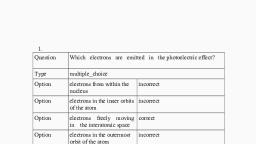
JAWAHAR NAVODAYA VIDYALAYA AMBA-PARTUR, JALNA, CLASS XII, PHYSICS THEORY, UT- 03, SESSION 2021 - 22, M.M : 35, , TIME : 1 ½ Hours, , General Instructions:, (i) There are 12 questions in all. All questions are compulsory., (ii) This question paper has three sections: Section A, Section B and Section C., (iii) Section A contains three questions of two marks each, Section B contains eight questions of, three marks each, Section C contains one case study-based question of five marks., (iv)There is no overall choice. However, an internal choice has been provided in one question of, two marks and two questions of three marks. You have to attempt only one of the, choices in such questions., (v) You may use log tables if necessary but use of calculator is not allowed., , 1., , 2., , SECTION A, Explain how does (i) photoelectric current and (ii) kinetic energy of the photoelectrons emitted in a photocell vary if, the frequency of incident radiation is doubled, but keeping the intensity same? Show the graphical variation in the, above two cases., A glass lens of refractive index 1.45 disappears when immersed in a liquid. What is the value of refractive, index of the liquid? State the conditions for the phenomenon of total internal reflection to occur., Or, , The photoelectric cut-off voltage in a certain experiment is 1.5V.What is the maximum, kinetic energy of photoelectrons emitted?, -11, 3. The radius of innermost electron orbit of a hydrogen atom is 5.3 × 10 m. What is the radius of orbit in the, second excited state? Two nuclei have mass numbers in the ratio 2:5. What is the ratio of their nuclear, densities?, SECTION B, 1. Two nuclei have mass numbers in the ratio 8:125. What is the ratio of their nuclear radii? Write any two, characteristic properties of nuclear force. Distinguish between nuclear fission and fusion., 2. The ground state energy of hydrogen atom is -13.6 eV. What are the kinetic and potential energies of, electron in this state? Calculate the shortest wavelength of the spectral lines emitted in Balmer, 7, -1, series.[Given Rydberg constant, R = 10 m ], 3. Ultraviolet light is incident on two photosensitive materials having work functionϕ1 and ϕ2 (ϕ1>ϕ2). In which, of the case will K.E. of emitted electrons be greater? Why? Show graphically how the stopping potential for, a given photosensitive surface varies with the frequency of incident radiations., 4. A ray of light, incident on an equilateral glass prism (µg = √3 ) moves parallel to the base line of the prism, inside it. Find the angle of incidence for this ray. An illuminated object and a screen are placed 90 cm apart., Determine the focal length and nature of the lens required to produce a clear image on the screen, twice, the size of the object., Or
Page 2 :
5., 6., , The threshold frequency for a certain metal is 3.3×10143.3×1014 Hz. If light of frequency, 8.2×10148.2×1014 Hz is incident on the metal, predict the cut-off voltage for the photoelectric emission., Write two important limitations of Rutherford nuclear model of the atom. State the postulates of Bohr’s, model of atom?, Calculate, the, energy release, in, MeV, in, the, deuterium-tritium fusion, reaction, :, , 7., , Assume that the frequency of the radiation incident on a metal plate is greater than its threshold frequency., How will the following change, if the incident radiation is doubled?, (1) Kinetic energy of electrons, (2) Photoelectric current, (3) Stopping potential, 8. (a) A converging lens of refractive index 1.5 is kept in a liquid medium having, same refractive index. What would be the focal length of the lens in this, medium?, (b) Define power of lens. Write it’s SI unit., Or, The, ground, state, energy, of, hydrogen, atom, is, -13.6, eV., rd, (i), What, is, the, total, energy, of, an, electron, in, the, 3 excited, state?, rd, (ii) If the electron jumps to the ground state from the 3 excited state, calculate the wavelength of the, photon emitted., SECTION C, Case based questions:, According to wave theory of light, the light of any frequency can emit electrons from metallic surface, provided the intensity of light be sufficient to provide necessary energy for emission of electrons, but, according to experimental observations, the light of frequency less than threshold frequency can not emit, electrons; whatever be the intensity of incident light. Einstein also proposed that electromagnetic radiation, is quantized.If photoelectrons are ejected from a surface when light of wavelength λ1 = 550 nm is incident, on it. The stopping potential for such electrons is Vs =0.19 . Suppose the radiation of wavelength λ2 = 190, nm is incident on the surface., (i) Photoelectric effect supports quantum nature of light because, (A) there is a minimum frequency of light below which no photoelectrons are emitted., (B) the maximum K.E. of photoelectric depends only on the frequency of light and not on its intensity., (C) even when the metal surface is faintly illuminated, the photo electrons leave the surface immediately., (D) electric charge of the photoelectrons is quantized., (a) A, B, C, (b) B, C, (c) C, D, (d) A, D, C, (ii) In photoelectric effect, electrons are ejected from metals, if the incident light has a certain minimum, (a) wavelength, (b) frequency, (c) amplitude, (d) angle of incidence, (iii) Calculate the stopping potential Vs2 of surface., (a) 4.47
Page 3 :
(b) 3.16, (c) 2.76, (d) 5.28, (iv) Calculate the work function of the surface., (a) 3.75, (b) 2.07, (c) 4.20, (d) 3.60, (v) Calculate the threshold frequency for the surface., (a) 500 x 1012 Hz, (b) 480 x 1013 Hz, (c) 520 x 1011 Hz, (d) 460 x 1013 Hz