Page 1 :
1|Page, , Physics Notes for Class 12 Chapter 10 Wave, s, Optics, Wave optics describes the connection between waves and rays of light. According to wave, theory of light, the light is a form of energy which travels through a medium in the form of, transverse wave motion. The speed of light in a medium depends upon the nature of medium., , Newton’s Corpuscular Theory, , Light consists of very small invisible elastic particles which travel in vacuum with a speed of 3, x 10° m/s., , The theory could explain reflection and refraction., , The size of corpuscular of different colours of light are different., , It could not explain interference, diffraction, polarisation. photoelectric effect and Compton, effect. The theory failed as it could not explain why light travels faster in a rarer medium than, in a denser medium., , Wavefront, , A wavefront is defined as the continuous locus of all the particles of a medium, which are, vibrating in the same phase., , These are three types, (i) Spherical wavefront, (ii) Cylindrical wavefront, , (iii) Plane wavefront
Page 2 :
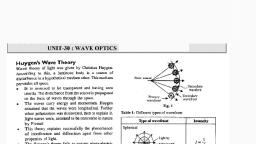
2| Page, , S = scurce of bghit, AB - wavefrom: anc SP SQ, and SR are rays of light, Huygen’s Wave Theory, Light travel in a medium in the form of wavefront., , A wavefront is the locus of all the particles vibrating in same phase., , All particles on a wavefront behaves as a secondary source of light, which emits secondary, wavelets., , The envelope of secondary wavelets represents the new position of a wavefront., When source of light is a point source,the wavefront is spherical., , Amplitude (A) is inversely proportional to distance (x) i.g., A 1/x., , -. Intensity (I) « (Amplitude)*, , When SOurce of light is linear, the wavefront is cylindrical., , Amplitude (A) o 1 / Vx, , : Intensity o (Amplitude)? « 1/x, , Huygen’s Principle, , (i) Every point on given wavefront (called primary wavefront) acts as a fresh source of new, disturbance called secondary wavelets., , (ii) The secondary wavelets travels in all the directions with the speed of light in the medium., , (iii) A surface touching these secondary wavelets tangentially in the forward direction at any, instant gives the new (secondary) wave front of that instant.
Page 3 :
3| Page, , Maxwell’s Electromagnetic Wave Theory, , (i) Light waves are electromagnetic waves which do not require a material medium for their, propagation., , (ii) Due to transverse nature, light wave undergo polarisation., , (iii) The velocity of electromagnetic wave in vacuum is c= 1 / Vy &, , (iv) The velocity of electromagnetic waves in medium is less than that of light, v < c, V=1/V blo & & r= C/ Vio &, , (v) The velocity of electromagnetic waves in a medium depend upon the electric and magnetic, properties of the medium., , where, Lo = absolute magnetic permeability and, & = absolute electrical permittivity of free space., , (vi) It failed to explain the phenomenon of photoelectric effect, Compton effect and Raman, effect., , Max Planck’s Quantum Theory, (i) Light emits from a source in the form of packets of energy called quanta or photon., , (ii) The energy of a photon is E = hv, where h is Planck’s constant and v is the frequency of, light., , (iii) Quantum theory could explain photoelectric effect, Compton effect and Raman effect., (iii) Quantum theory failed to explain interference, diffraction and polarisation of light., de — Broglie’s Dual Theory, , Light waves have dual nature, wave nature according to Maxwell’s electromagnetic wave, theory and particle nature according to Max-Planck’s quantum theory., , Two natures of light are like the two faces of a coin. In anyone phenomena only its one nature, appears., , Energy of photon = hv = he / A, , where, h = Planck’s constant 6.6 * 10<sup-34 J /s
Page 4 :
4|Page, , de-Broglie wave equation is4=h/p=h/ mv, where h denotes Planck’s constant., Superposition of Waves, , When two similar waves propagate in a medium simultaneously, then at any point the resultant, displacement is equal to the vector sum of displacement produced by individual waves., , yRyi ty, , Interference of Light, , When two light waves of similar frequency having a zero or constant phase difference, propagate in a medium simultaneously in the same direction, then due to their superposition, , maximum intensity is obtained at few points and minimum intensity at other few points., , This phenomena of redistribution of energy due to superposition of waves is called interference, of light waves., , The interference taking place at points of maximum intensity is called constructive, interference., , The interference taking place at points of minimum intensity is destructive interference., Fringe Width, , The distance between the centres of two consecutive bright or dark fringes is called the fringe, width., , The angular fringe width is given by 0=A/d., , where A is the wavelength of light d is the distance between two coherent sources., Conditions for Constructive and Destructive Interference, , For Constructive Interference, , Phase difference, @ = 2na, , Path difference, Ax = nd, , where, n= 0, 1,.2,.3,..., , For Destructive Interference
Page 5 :
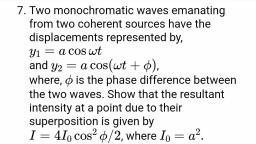
S|Page, , Phase difference, ~ = (2n— 1)a, Path difference, Ax = (2n—1)a/2, where, n = 1, 2,3, ..., , If two waves of exactly same frequency and of amplitude a and b interfere, then amplitude of, resultant wave is given by, , R= Va? + b? + 2ab cos @, , where ¢ is the phase difference between two waves., Rwax = (a + b), , Rmin = (a—b), , Intensity of wave, , “1T=a? +b’ + 2ab cos @, , =1,+h+2VI, I, cos @, , where I and I, are intensities of two waves., eh/h=a/b'=0;/a2, , Where @, and @, are width of slits., , Energy remains conserved during interference., Interference fringe width, , B=Dia/d, , where, D = distance of screen from slits, 4 = wavelength of light and d = distance between two, slits., , Distance of nth bright fringe from central fringe x, =nDA/d, Distance of nth dark fringe from central fringe x’, = (2n— 1) DA/ 2d, Coherent Sources of Light, , The sources of light emitting light of same wavelength, same frequency having a zero or, constant phase difference are called coherent sources of licht.