Page 1 :
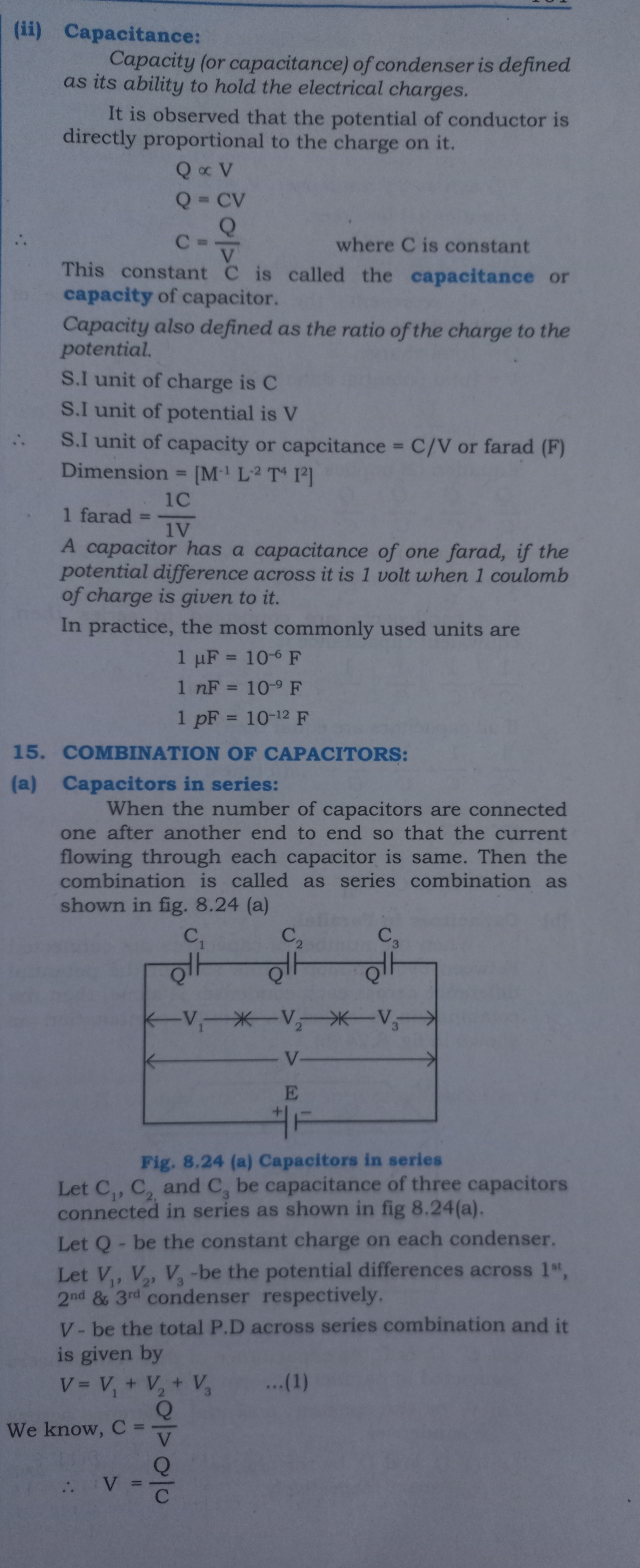
BO oT Re Ne pegene eee SN eT, (ii) Capacitance: :, Capacity (or capacitance) of condenser is defined, as its ability to hold the electrical charges., , __ It is observed that the potential of conductor is, directly proportional to the charge on it., , Q«V, , Q=CV, , C= Vv where C is constant, This constant C is called the capacitance or, capacity of capacitor., , potential., S.l unit of charge is C, S.I unit of potential is V, , S.I unit of capacity or capcitance = C/V or farad (F), Dimension = [M* L? T* [?], , Capacity also defined as the ratio of the charge to the, , 1 farad ~, ara iv, , A capacitor has a capacitance of one farad, if the, potential difference across it is 1 volt when 1 coulomb, of charge is given to it., , In practice, the most commonly used units are, , 1 uF = 10°F, 1 nF=10°F, 1 pF = 10°F, , 15. COMBINATION OF CAPACITORS:, (a) Capacitors in series:, , When the number of capacitors are connected, one after another end to end so that the current, flowing through each capacitor is same. Then the, combination is called as series combination as, shown in fig. 8.24 (a), , C Cc A, , ll al O, , 3, , Fig. 8.24 (a) Capacitors in series, Let C,, C, and C, be capacitance of three capacitors, connected in series as shown in fig 8.24(a)., Let Q - be the constant charge on each condenser., Let V,, V,, V, -be the potential differences across 1",, 2-4 & 3" condenser respectively., V - be the total P.D across series combination and it, is given by, V=V,+V,+ V, wall, , Q, We know, C = =, , oo ‘ i, ae Q, ? 3, . iV oe, $ oe : Cc