Page 1 :
Study Materials, • JEE Main & Advanced – Free Study Material, • NEET UG – Free Study Material, • NCERT Solutions for Class 1 to 12, • NCERT Books PDF for Class 1 to 12, • ICSE & ISC Free Study Material, • Free Study Material for Kids Learning (Grade 1 to 5), • Olympiad Free Study Material, • Reference Books (RS Aggarwal, RD Sharma, HC Verma, Lakhmir, Singh, Exemplar and More), • Previous Year Question Paper CBSE & State Boards, • Sample Papers, • Access All Free Study Material Here, , Vedantu Innovations Pvt. Ltd., Score high with a personal teacher, Learn LIVE Online!, www.vedantu.com
Page 2 :
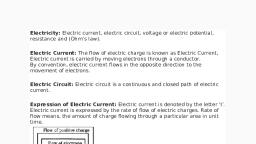
CURRENT ELECTRICITY, , CURRENT ELECTRICITY, 3. DRIFT VELOCITY, , 1. ELECTRIC CURRENT, , G G G, G, “If u1 , u2 , u3 , ...u n are random thermal velocities of n free, , “The flow of charge in a definite direction constitutes the, electric current and the time rate of flow of charge through, any cross-section of a conductor is the measure of current”., i.e.,, net charge flown, Electric current , I=, time taken, , q, t, , G G, G, G, u1 � u � u3 � ... � u n, n, , dq, dt, , 1., , Though the “electric current represents the direction of flow, of positive charge”., , 2., , Yet it is treated as a scalar quantity., , 3., , Current follows, the laws of scalar addition and not the laws, of vector addition., , 4., , Because the angle between the wires carrying currents does, not affect the total current in the circuit., , 2. CURRENT CARRIERS, (a), , Current carriers in solid conductors :, , 1., , In solid conductors like metals, the valence electrons of the, atoms do not remain attached to individual atoms but are, free to move throughout the volume of the conductor., , 2., , Under the effect of an external electric field, the valence, electrons move in a definite direction causing electric current, in the conductors., , 3., , Thus, valence electrons are the current carriers in solid, conductors., , (b), , Current carriers in liquids :, , 1., , In an electrolyte like CuSO4, NaCl etc., there are positively, ��, , electrons in the metal conductor, then the average thermal, velocity of electrons is, , ��, 4, , �, , As a result, there will be no net flow of electrons of charge, in one particular direction in a metal conductor, hence no, current”., “Drift velocity is defined as the average velocity with which, the free electrons get drifted towards the positive end of, the conductor under the influence of an external electric, field applied”., , 3., , Thus, in liquids, the current carriers are positively and, negatively charged ions., , (c), , Current carriers in gases :, , 1., , Ordinarily, the gases are insulators of electricity., , 2., , They can be ionized by applying a high potential difference, at low pressure, , 3., , Thus, positive ions and electrons are the current carriers in, gases., , –1, , The drift velocity of electons is of the order of 10 ms ., , 2., , If V is the potential difference applied across the ends of the, conductor of length l, the magnitude of electric field set up is, E, , Potential difference V, length, A, , 3., , Each free electrons in the conductor experience a force,, G, G, F �e E., , 4., , The acceleration of each electron is, G, G eE, a, ., m, , 5., , At any instant of time, the velocity acquired by electron, G, having thermal velocity u1 will be, , and negatively charged ions (like Cu , SO , Na , Cl )., These are forced to move in definite directions under the, effect of an external electric field, causing electric current., , –4, , 1., , �, , 2., , G, 0, , G, v1, , G G, u1 � aW1, , where W1 is the time elapsed since it has suffered its last, collision with ion/atom of the conductor.
Page 3 :
CURRENT ELECTRICITY, 6., , 7., , Similarly, the velocities acquired by other electrons in the, conductor will be, G, G G, G, G G, G, G G, v 2 u 2 � aW 2 , v3 u 3 � aW3 , ....., v n u n � aW n ., The average velocity of all the free electrons in the conductor, under the effect of external electric field is the drift velocity, G, vd of the free electrons., G, Thus, v d, , G G, G, v � v 2 � ... � v n, n, , n, G, 0 � aW, , G, aW, , W � W2 � ... � Wn, = average time that has elapsed, n, since each electron suffered its last collision with the ion/, atom of conductor and is called average relaxation time., , 9., , NA x d, A, where N A = Avogrado number, x = number of free, electrons per atom, d = density of metal and A = Atomic, weight of metal., , Free electron density in a metal is given by n, , where, W, , 8., , The small value of drift velocity produces a large amount of, electric current, due to the presence of extremely large, number of free electrons in a conductor. The propagation of, current is almost at the speed of light and involves, electromagnetic process. It is due to this reason that the, electric bulb glows immediately when switch is on., In the absence of electric field, the paths of electrons between, successive collisions are straight line while in presence of, electric field the paths are generally curved., , G, G G, G G, G, u � aW1 � u 2 � aW 2 � ... u n � aWn, G G, G, § u1 � u 2 � ... � u n · G W � W2 � ... � W n, ¨, ¸�a, n, n, ©, ¹, , The drift velocity of electrons is small because of the frequent, collisions suffered by electrons., , 1., , –14, , Its value is the order of 10 second., G, Putting the value of a in the above relation, we have, G, vd, , G, �e EW, m, , Average drift speed, vd, , The time interval between two successive collisions of, electrons with the positive ions in the metallic lattice is defined, mean free path, r.m.s. velocity of electrons, , drift velocity, electric field, , vd, E, , qEW/m, E, , qW, m, , e We, me, , 2., , Mobility of electron, Pe, , 3., , The total current in the conducting material is the sum of, the currents due to positive current carriers and negative, current carriers., vd, , 4., , Pe E, 2 –1, , –1, , –1, , –1, , SI unit of mobility is m S V or ms N C, , 3.3 Relation between current and Drift Velocity, , 3.1 Relaxation time (W�), , as relaxation time W, , P, , eE, W, m, , G, The negative sign show that vd is opposite to the direction, G, of E ., , O, . With, v rms, , 1., , Consider a conductor (say a copper wire) of length l and of, uniform area of cross-section, , ?, , Volume of the conductor = Al., , 2., , If n is the number density of electrons, i.e., the number of, free electrons perunit volume of the conductor, then total, number of free electrons in the conducture = Aln., , 3., , Then total charge on all the free electrons in the conductor,, , rise in temperature vrms increases consequently W decreases., 3.2 Mobility, , q, , Drift velocity per unit electric field is called mobility of electron i.e., P, , Mobility of charge carrier (P), responsible for current is, defined as the magnitude of drift velocity of charge per unit, electic filed applied, i.e.,, , m2, vd, It’s unit is, volt � sec, E, , If cross-section is constant, I v J i.e. for a given cross-sectional, area, greater the current density, larger will be current., , AAne, , 4., , The electric field set up across the conductor is given by, E = V/l (in magnitude), , 5., , Due to this field, the free electrons present in the conductor, will begin to move with a drift velocity vd towards the left, hand side as shown in figure
Page 4 :
CURRENT ELECTRICITY, , or, , V, I, , mA, = R = a constant for a given conductor for a, A n e2 W, , given value of n, l and at a given temperature. It is known as, the electrical resistance of the conductor., Thus, V = RI, 6., , Time taken by the free electrons to cross the conductors,, t = l/vd, Hence, current, dI, , or, 7., , I, , q, t, , (1), , Ohm’s law is not a universal law, the substances, which, obey ohm’s law are known as ohmic substance., , (2), , Graph between V and i for a metallic conductor is a straight, line as shown. At different temperatures V-i curves are, different., , A n e vd, , §, Putting the value of vd ¨, ©, I, , AAne, A, t, vd, , this is Ohm’s law., , e EW ·, ¸ , we have, m ¹, , Ane 2 WE, m, , 4. OHM’S LAW, (A) Slope of the line, Ohm’s law states that the current (I) flowing through a, conductor is directly proportional to the potential difference, (V) across the ends of the conductor”., , = tan T, (3), , V, i, , R, , R, , V, i, , Dynamic resistance R dyn, , i.e., I v V or V v I or V = RI, , V, I, , So, R1 > R2 i.e., T1 > T2, , The device or substances which don’t obey ohm’s law, e.g. gases, crystal rectifiers, thermoionic valve, transistors, etc. are known as non-ohmic or non-linear conductors., For these V-i curve is not linear., Static resistance R st, , or, , (B) Here tanT1 > tanT2, , 1, tan T, , 'V, 'I, , 1, tan I, , constant, , 4.1 Deduction of Ohm’s law, We know that v d, , But E = V/l ? v d, , eE, W, m, eV, W, mA, , 5. ELECTRICAL RESISTANCE, “The electrical resistance of a conductor is the obstruction, posed by the conductor to the flow of electric current, through it”., , Also, I = A n e vd, ?, , § eV ·, W¸, I = An e ¨, © mA ¹, , § A n e2 W ·, ¨, ¸V, © mA ¹, , 1., , i.e., R = V/I
Page 5 :
CURRENT ELECTRICITY, , 2., , volt, The SI unit of electrical resistance is ohm or, ., amp, , 3., , Dimensions of electric resistance, Pot. diff., current, 2, , (vi), , Resistivity increases with impurity and mechanical stress., , (vii), , Magnetic field increases the resistivity of all metals except, iron, cobalt and nickel., , (viii) Resistivity of certain substances like selenium, cadmium,, sulphides is inversely proportional to intensity of light, falling upon them., , work done/charge, current, , 3., , �2, , ML T / AT, A, , V, I, , We have, R, , ª¬ M1 2 T �3 A �2 º¼, , (i), , Length (l) : The resistance (R) of a conductor is directly, proportional to its length (l), i.e., R v l, , (ii), , Area of cross-section (A) : The resistance (R) of a, conductor is inversely proportional to the area of crosssection (A). of the conductor, i.e., R v 1/A, , (iii) The resistance of conductor also depends upon the nature, of material and temperature of the conductor., A, or R, From above ; R v, A, , m, A, u, 2, ne W A, , comparing the above relation with the relation, R, , 5.1 Electrical, Resistivity or Specific Resistance, “The resistance of a conductor depends upon the following, factors :, , mA, Ane2 W, , 4., , U, , A, ., A, , We have, the resistivity of the material of a conductor,, , U, , m, ne2 W, , 5.3 Conductivity, Reciprocal of resistivity is called conductivity (V) i.e. V, , 1, with, U, , unit mho/m and dimensions [M �1 L�3 T 3 A 2 ] ., 5.4 Conductance, , UA, .”, A, , Reciprocal of resistance is known as conductance. C, , 5.2 Resistivity (U, U), unit is, , 1, It’ss, R, , 1, or :–1 or “Siemen”., :, , 1, , Where U is constant of proportionality and is known as, specific resistance or electrical resistivity of the material of, the conductor, , 2., , Specific resistance (or electrical resistivity) of the material, of a conductor is defined as the resistance of a unit length, with unit areas of cross section of the material of the, conductor., , (i), , Unit and dimension : It’s S.I. unit is ohm × m and, dimension is [ML3T–3A–2], , (ii), , It’s formula : U, , (iii), , Resistivity is the intrinsic property of the substance. It is, independent of shape and size of the body (i.e. l and A)., , Suppose for a conducting wire before stretching it’s length = l1,, area of cross–section = A1, radius = r1, diameter = d1, and, , (iv), , For different substances their resistivity is also different, e.g. Usilver = minimum = 1.6 u 10 –8 : -m and, , resistance = R1, , If a conducting wire stretches, it’s length increases, area of crosssection decreases so resistance increases but volume remain, constant., , m, ne 2 W, , Ufused quartz = maximum | 1016 : -m, U, , insulator, (Maximum for fused quartz), , (v), , ! Ualloy ! Usemi -conductor !, , U, , conductor, (Minimum for silver ), , Resistivity depends on the temperature. For metals, Ut, , 5.5 Stretching of Wire, , U 0 (1 � D't) i.e. resitivity increases with temperature., , U, , l1, A1
Page 6 :
CURRENT ELECTRICITY, Volume remains constant i.e., A1l1 = A2l2, , 3., , After stretching length = l2, area of cross-section = A2,, radius = r2, diameter = d2 and resistance, , Semiconductors can conduct charges but not so easily as is, in case of conductors. When a small potential difference is, applied across the ends of a semiconductor, a weak current, flows through semiconductor due to motion of electrons and, holes., , l, U 2, A2, , R2, , Ratio of resistances before and after stretching, 2, , 2, , 4, , R1 l1 A 2 § l1 · § A2 · § r2 · § d 2 ·, = ×, =¨ ¸ =¨, ¸ =¨ ¸ =¨ ¸, R 2 l2 A1 © l2 ¹ © A1 ¹ © r1 ¹ © d1 ¹, , Semiconductors : These are those material whose electrical, conductivity lies inbetween that of insulators and conductors., , 4, , Examples of semiconductors are germanium, silicon etc., The value of elecrical resistance R increases with rise of, temperature., 2, , (1), , If length is given then R v l 2 , , R1, R2, , § l1 ·, ¨ ¸, © l2 ¹, , (2), , R, 1, If radius is given then R v 4 1, R2, r, , § r2 ·, ¨ ¸, © r1 ¹, , D, 4, , Rt � R0, R0 u t, , increase in resistance, original resistance × rise of temp., , Thus, temperature coefficient of resistance is defined as the, increase in resistance per unit original resistance per degree, celsium or kelvin rise of temperature., , 6. CURRENT DENSITY, CONDUCTANCE, AND ELECTRIAL CONDUCTIVITY, , 1., , For metals like silver, copper, etc., the value of a is positive,, therefore, resistance of a metal increases with rise in, –1, –1, temperature. The unit of D is K or °C ., , 6.1 Relation between J, V and E, , 2., , For insulators and semiconductors D is negative,, therefore, the resistance decreases with rise in temperature., , eE, We know, I = n Aevd = nAe §¨ W ¸·, ©m ¹, , or, ?, , 1., , A, J, , ne 2 WE, m, , or J, , n Ae2 WE, m, , 6.2 Non-Ohmic Devices, Those devices which do not obey Ohm’s law are called nonohmic devices. For example, vaccum tubes, semiconductor, diode, liquid electrolyte, transistor etc., , 1, E, U, , For all non-ohmic devices (where there will be failure of, Ohm’s law), V–I graph has one or more of the following, characteristics :, , VE, , Insulators : These are those materials whose electrical, conducticity is either very very small or nil., , (a), , The relation between V and I is non-linear, figure, , (b), , The relation between V and I depends on the sign of V. It, means, if I is the current for a certain value of V, then, reversing the direction of V, keeping its magnitude fixed,, does not produce a current of same magnitude I, in the, opposite direction, figure., , Insulators do not conduct charges. When a small potential, difference is applied across the two ends of an insulator, the, current through the insulator is zero., Examples of insulators are glass, rubber, wood etc., Variation of R, U with T, 2., , Conductors : These are those materials whose electrical, conductivity is very high, Conductor conduct charges very easily. When a small, potential difference is applied across the two ends of, conductor, a strong current flows through the conductor., For super-conductor, the value of electrical conductivity is, infinite and electrical resistivity is zero., Examples of conductors are all metals like copper, silver,, aluminium, tungsten etc.
Page 7 :
CURRENT ELECTRICITY, To remember the value of colour coding used for carbon, resistor, the following sentences are found to be of great, help (where bold letters stand for colours)., B B ROY Green, Britain Very Good Wife Gold Silver., Way of finding the resistance of carbon resistor from its, colour coding., In the system of colour coding, Strips of different colours, are given on the body of the resistor, figure. The colours on, strips are noted from left to right., (c), , Therelation between V and I isnot unique, i.e., there is more, than one value of V for the same current I, figure., , The colour code for carbon resistance is given in the, following table., , Black, , 0, , Brown, Red, , B, B, R, , Mulitplier Colour, , 1, 2, , 10, , Gold, , 5%, , 1, , Silver, , 10%, , 2, , No colour, , 20%, , 10, , 10, , O, , 3, , 10, , Yellow, , Y, , 4, , 10, , 4, , 5, , 10, , 5, , 6, , 10, , 6, , Violet, , B, V, , Grey, White, Gold, Silver, , W, , Tolerance, , 0, , Orange, , Blue, , Colour of the second strip B indicate the second significant, figure of resistance in ohm., , (iv) The colour of fourth strip R indicates the tolerance limit, of the resistance value of percentage accuracy of resistance., , 8.1 Resistances in Series, Resistors are said to be connected in series, if the same, current is flowing through each resistor when some poential, difference is applied across the combination., , 3, , Green, , (ii), , 8. COMBINATION OF RESISTORS, , Colour code of carbon resistors, No., , Colour of the first stip A from the end indicates the first, significant figure of resistance in ohm., , (iii) The colour of the third strip C indicates the multiplier,, i.e., the number of zeros that will follow after the two, significant figure., , 7. COLOUR CODE FOR CARBON RESISTORS, , Colour Letter as, anAid to, memory, , (i), , 1., , Let V be the potential difference applied across A and B, using the battery H. In series combination, the same current, (say I) will be passing through each resistance., , 2., , Let V1, V2, V3 be the potential difference across R1, R2 and, R3 respectively. According to Ohm’s law, , 7, , 7, , 10, , 8, , 10, , 9, , 10, , 8, 9, , 10, , –1, –2, , 10, , V1 = IR1, V2 = IR2, V3 = IR3, 3., , Here, V = V1 + V2 + V3 = IR1 + IR2 + IR3 = I (R1 + R2 + R3)
Page 8 :
CURRENT ELECTRICITY, branches are different and I1, I2, I3 be the current through, the resistances R1, R2 and R3 respectively. Then,, I = I2 + I2 + I3, 3., 4., , If R s is the equivalent resistance of the given series, combination of resistances, figure, then the potential, difference across A and B is,, , Here, potential difference across each resistor is V, therefore, V = I1R1 = I2 R2 = I3R3, , or, , I1, , V = IRs., We have, , Rs, , I, , R1 � R 2 � R 3, , Memory note, , V, , I3, R2, , V, R3, , Putting values, we get, , IRs = I (R1 + R2 + R3), or, , V, , I2, R1, , 4., , V, V, V, �, �, R1 R 2 R 3, , If Rp is the equivalent resistance of the given parallel, combination of resistance, figure, then, , In a series resistance circuit, it should be noted that :, (i), , the current is same in every resistor., , (ii) the current in the circuit is independent of the relative, positions of the various resistors in the series., (iii) the voltage across any resistor is directly proportional to, the resistance of the resistor., (iv) the total resistance of the circuit is equal to the sum of the, individual resistances, plus the internal resistance of a cell, if any., , V = IRp or I = V/Rp, , (v) The total resistance in the series circuit is obviously more, than the greatest resistance in the circuit., , V, Rp, , we have, , 1, 1, 1, �, �, R1 R 2 R 3, , Thus, the reciprocal of equivalent resistance of a number of, resistor connected in parallel is equal to the sum of the, reciprocals of the individual resistances., , 8.2 Resistances in Parallel, Any number of resistors are said to be connected in parallel, if potential difference across each of them is the same and, is equal to the applied potential difference., , 1, V V, V, �, �, R 1 R 2 R 3 or R p, , Memory note, In a parallel resistance circuit, it should be noted that :, (i), , the potential difference across each resistor is the same, and is equal to the applied potential difference., , (ii) the current through each resistor is inversely proportional, to the resistance of that resistor., (iii) total current through the parallel combination is the sum, of the individual currents through the various resistors., (iv) The reciprocal of the total resistance of the parallel, combination is equal to the sum of the reciprocals of the, individual resistances., 1., , Let V be the potential difference applied across A and B, with the help of a battery H., , 2., , Let I be the main current in the circuit from battery. I divides, itself into three unequal parts because the resistances of these, , (v) The total resistances are connected in series, the current, through each resistance is same. When the resistance are, in parallel, the pot-diff. accross each resistance is the same, and not the current.
Page 9 :
CURRENT ELECTRICITY, , 9. CELL, The device which converts chemical energy into electrical energy, is known as electric cell. Cell is a source of constant emf but not, constant current., , (iii), , Potential drop inside the cell = ir, , (iv), , Equation of cell E, , (v), , Internal resistance of the cell r, , (vi), , Power dissipated in external resistance (load), P, , Vi, , i2R, , V2, R, , V � ir (E > V), , §E ·, ¨ � 1¸ R, ©V ¹, , 2, , § E ·, ¨R�r¸ . R, ©, ¹, , Power delivered will be maximum when R, , r so Pmax, , E2, ., 4r, , This statement in generalised from is called “maximum, power transfer theorem”., , (1), , Emf of cell (E) : The potential difference across the, terminals of a cell when it is not supplying any current is, called it’s emf., , (2), , Potential difference (V) : The voltage across the, terminals of a cell when it is supplying current to external, resistance is called potential difference or terminal, voltage. Potential difference is equal to the product of, current and resistance of that given part i.e. V = iR., , (3), , Internal resistance (r) : In case of a cell the opposition, of electrolyte to the flow of current through it is called, internal resistance of the cell. The internal resistance of a, , (vii), , When the cell is being charged i.e. current is given to the, cell then E = V – ir and E < V., , (2), , Open circuit : When no current is taken from the cell it, is said to be in open circuit., , (i), , Current through the circuit i = 0, , (ii), , Potential difference between A and B, VAB = E, , (iii), , Potential difference between C and D, VCD = 0, , (3), , Short circuit : If two terminals of cell are join together, by a thick conducting wire, , cell depends on the distance between electrodes (r v d),, area of electrodes [r v (1/A)] and nature, concentration, (r v C) and temperature of electrolyte [r v (1/ temp.)]., A cell is said to be ideal, if it has zero internal resistance., 9.1 Cell in Various Positions, (1), , Closed circuit : Cell supplies a constant current in the, circuit., , E, R�r, , (i), , Current given by the cell i, , (ii), , Potential difference across the resistance V, , iR
Page 10 :
CURRENT ELECTRICITY, (i), , Maximum current (called short circuit current) flows, momentarily isc, , (ii), , E, r, , plates of cells are connected together their emf’s are added to, each other while if their similar plates are connected together, their emf’s are subtractive., , Potential difference V = 0, , Memory note, 1., , It is important to note that during charging of a cell, the, positive electrode of the cell is connected to positive, terminal of battery charger and negative electrodes of the, cell is connected to negative terminal of battery charger., In this process, current flows from positive electrode to, negative electrode through the cell. Refer figure, , (1), , Series grouping : In series grouping anode of one cell is, connected to cathode of other cell and so on. If n identical, cells are connected in series, , (i), , Equivalent emf of the combination E eq, , (ii), , Equivalent internal resistance req, , (iii), , Main current = Current from each cell, , (iv), , Potential difference across external resistance V, , (v), , Potential difference across each cell V ', , V, n, , (vi), , Power dissipated in the external circuit, , § nE ·, ¨, ¸ .R, © R � nr ¹, , (vii), , Condition for maximum power R nr and Pmax, , ? V = H + Ir, , Hence, the terminal potential difference becomes greater, than the emf of the cell., 2., , The difference of emf and terminal voltage is called lost, voltage as it is not indicated by a voltmeter. It is equal to Ir., , 9.2 Distinction between E.M.E. and Potential Difference, E.M.F. of a Cell, 1, , 2., , 3., , 4., , Potential Difference, , The emf of a cells is the, maximum potential, difference between the, two electrodes of a cell, when the cell is in the, open circuit., , 1. The potential difference, between the two points is, the difference of potential, between those two points, in a closed circuit., , It is independent of the, resistance of the circuit, and depends upon the, nature of electrodes and, the nature of electrolyte, of the cell., , 2. It depends upon the resistance between the two points, of the circuit and current, flowing through the, circuit., , The term emf is used for, the source of electric, current., , 3. The potential difference is, measured between any two, points of the electric circuit., , It is a cause., , 4. It is an effect., , In series grouping of cell’s their emf’s are additive or subtractive, while their internal resistances are always additive. If dissimilar, , nr, , i, , nE, R � nr, iR, , 2, , § E2 ·, n¨ ¸, © 4r ¹, , (viii) This type of combination is used when nr << R., (2), , Parallel grouping : In parallel grouping all anodes are, connected at one point and all cathode are connected together, at other point. If n identical cells are connected in parallel, E, r, E, r, E, r, , 9.3 Grouping of Cells, , nE, , i, R
Page 11 :
CURRENT ELECTRICITY, (i), , Equivalent emf Eeq = E, , (ii), , Equivalent internal resistance Req, , (iii), , Main current flowing through the load, , r/n, , i, E, R �r/n, , (iii), , Main current i, , (iv), , Potential difference across external resistance = p.d., across each cell = V = iR, , (v), , Current from each cell i ', , i, n, 2, , (vi), , (vii), , Power dissipated in the circuit P, , Condition for max. power is R, , § E ·, ¨, ¸ .R, © R �r/n ¹, , r / n and Pmax, , nE, nr, R�, m, , (iv), , Potential difference across load V = iR, , (v), , Potential difference across each cell V ', , (vi), , Current from each cell i ', , (vii), , Condition for maximum power R, , § E2 ·, n¨ ¸, © 4r ¹, , (viii) This type of combination is used when nr >> R, , Pmax, (viii), , Generalized Parallel Battery, , mnE, mR � nr, , (mn), , V, n, , i, n, nr, and, m, , E2, 4r, , Total number of cell = mn, , Memory note, Note that (i) If the wo cells connected in parallel are of the, same emf H and same internal resistance r, then, , E eq, , (3), , E1 E 2, E, �, � ... n, r1, r2, rn, 1, and, 1 1, 1, req, � � ..., r1 r2, rn, , H eq, , Hr � Hr, r�r, , 1, req, , 1 1, �, r r, , H, r, 2, , 2, or req, r, , (ii) If n identical cells are connected in parallel, then the, equivalent emf of all the cells is equal to the emf of one, cell., , 1 1, 1, � � ... ., r1 r2, rn, , 1, req, , Mixed Grouping : If n identical cell’s are connected in a, row and such m row’s are connected in parallel as shown., , 1 1, � � ... � n terms, r r, , n or r = r/n, eq, r, , 10. ELECTRIC CURRENT, (1), , The time rate of flow of charge through any cross-section, is called current. i, , then i, , Lim, Δt o 0, , ΔQ, Δt, , dQ, . If flow is uniform, dt, , Q, . Current is a scalar quantity. It’s S.I. unit is, t, , ampere (A) and C.G.S. unit is emu and is called biot (Bi),, or ab ampere. 1A = (1/10) Bi (ab amp.), (i), , Equivalent emf of the combination Eeq = nE, , (ii), , Equivalent internal resistance of the combination req, , nr, m, , (2), , Ampere of current means the flow of 6.25 u 10 18, electrons/sec through any cross–section of the conductor., , (3), , The conventional direction of current is taken to be the, direction of flow of positive charge, i.e. field and is
Page 12 :
CURRENT ELECTRICITY, opposite to the direction of flow of negative charge as, shown below., , (4), , The net charge in a current carrying conductor is zero., , (5), , For a given conductor current does not change with, change in cross-sectional area. In the following figure, i1 = i2 = i3, , (i), , Solids : In solid conductors like metals current carriers, are free electrons., , (ii), , Liquids : In liquids current carriers are positive and, negative ions., , (iii), , Gases : In gases current carriers are positive ions and, free electrons., , (iv), , Semi conductor : In semi conductors current carriers are, holes and free electrons., , (v), , The amount of charge flowing through a crossection of a, conductor from t = ti to t = tf is given by :, q, , tf, , ³ti, , I dt, , From Graphs, , (6), , (i), , Slope of Q vs t graph gives instantaneous current., , (ii), , Area under the I vs t graph gives net charge flown., , Current due to translatory motion of charge : If n, particle each having a charge q, pass through a given area, in time t then, , If n particles each having a charge q pass per second per, unit area, the current associated with cross-sectional area A, is i = nqA, If there are n particle per unit volume each having a charge, q and moving with velocity v, the current thorough, cross, section A is i = nqvA, (7), , Current due to rotatory motion of charge : If a point, charge q is moving in a circle of radius r with speed v, (frequency Q, angular speed, , Z and time period T) then, , corresponding current i = qν =, , q qv qω, =, =, T 2πr 2π, , 11. KIRCHHOFF’S LAW, 11.1 Kirchhoff’s first law or Kirchhoff’s junction law, or Kirchhoff’s current law., 1., , the algebraic sum of the currents meeting at a junction in a, closed electric circuit is zero, i.e., ¦ I, , (8), , Current carriers : The charged particles whose flow in, a definite direction constitutes the electric current are, called current carriers. In different situation current, carriers are different., , 2., , 0, , Consider a junction O in the electrical circuit at which, the five conductors are meeting. Let I1, I2, I3, I4 and I5 be, the currents in these conductors in directions, shown in, figure,
Page 13 :
CURRENT ELECTRICITY, , 3., , 4., , Let us adopt the following sign convention : the current, flowing in a conductor towards the junction is taken as, positive and the current flowing away from the junction is, taken as negative., , We adopt the following sign convention :, Traverse a closed path of a circuit once completely in, clockwise or anticlockwise direction., , According to Kirchhoff’s first law, at junction O, (–I1) + (–I2) + I3 + (–I4) + I5 = 0, , Difference between Kirchhoff’s I and II laws, , or, , –I1 – I2 + I3 – I4 + I5 = 0, , or, , ¦I, , or, , I 3 + I5 = I 1 + I2 + I 4, , 5., , i.e., total current flowing towards the junction is equal to, total current flowing out of the junction., , 6., , Current cannot be stored at a junction. It means, no point/, junction in a circuit can act as a source or sink of charge., , 7., , Kirchhoff’s first law supports law of conservation of, charge., , First Law, , 0, , 11.2 Kirchhoff’s Second law or Kirchhoff’s loop law, or Kirchhoff’s voltage law., The algebraic sum of changes in potential around any closed, path of electric circuit (or closed loop) involving resistors, and cells in the loop is zero, i.e., ¦ 'V, , 0., , In a closed loop, the algebraic sum of the emfs and algebraic, sum of the products of current and resistance in the various, arms of the loop is zero, i.e., ¦ H � ¦ IR, , 0., , Kirchhoff’s second law supports the law of conservation of, energy, i.e., the net change in the energy of a charge, after, the charge completes a closed path must be zero., Kirchhoff’s second law follows from the fact that the, electrostatic force is a conservative force and work done by, it in any closed path is zero., Consider a closed electrical circuit as shown in figure., containing two cells of emfs. H1 and H2 and three resistors of, resistances R1, R2 and R3., , Second Law, , 1. This law supports the, law of conservation of, charge., , 1. This law supports the law, of conservation of energy., , 2. According to this law, , 2. According to this law, , ¦I, , 0�, , ¦H, , ¦ IR, , 3. This law can be used in 3. This law can be used in, open and closed circuits., closed circuit only., , 12. EXPERIMENTS, 12.1 Galvanometer, It is an instrument used to detect small current passing through it, by showing deflection. Galvanometers are of different types e.g., moving coil galvanometer, moving magnet galvanometer, hot wire, galvanometer. In dc circuit usually moving coil galvanometer, are used., (i), , It’s symbol :, , ; where G is the total, , internal resistance of the galvanometer., (ii), , Full scale deflection current : The current required for, full scale deflection in a galvanometer is called full scale, deflection current and is represented by ig., , (iii), , Shunt : The small resistance connected in parallel to, galvanometer coil, in order to control current flowing, through the galvanometer is known as shunt.
Page 14 :
CURRENT ELECTRICITY, Table : Merits and demerits of shunt, (c), Merits of shunt, , To pass nth part of main current (i.e. i g, , Demerits of shunt, , To protect the galvano-, , Shunt resistance decreases the, , meter coil from burning ., , sensitivity of galvanometer., , galvanometer, required shunt S =, , i, ) through the, n, , G, ., (n –1), , 12.3 Voltmeter, , It can be used to convert, , It is a device used to measure potential difference and is always, put in parallel with the ‘circuit element’ across which potential, difference is to be measured., , any galvanometer into, ammeter of desired range., 12.2 Ammeter, It is a device used to measure current and is always connected, in series with the ‘element’ through which current is to be, measured., , (i), , The reading of an ammeter is always lesser than actual, current in the circuit., , (ii), , Smaller the resistance of an ammeter more accurate will, be its reading. An ammeter is said to be ideal if its, resistance r is zero., , (iii), , Conversion of galvanometer into ammeter : A, galvanometer may be converted into an ammeter by, connecting a low resistance (called shunt S) in parallel to, the galvanometer G as shown in figure., , (i), , The reading of a voltmeter is always lesser than true value., , (ii), , Greater the resistance of voltmeter, more accurate will, be its reading. A voltmeter is said to be ideal if its, resistance is infinite, i.e., it draws no current from the, circuit element for its operation., , (iii), , Conversion of galvanometer into voltmeter : A, galvanometer may be converted into a voltmeter by, connecting a large resistance R in series with the, galvanometer as shown in the figure., , (a), , Equivalent resistance of the combination = G + R, , (b), , According to ohm’s law Maximum reading of V which, can be taken V = ig (G + R); which gives, Required series resistance R =, , (c), GS, G �S, , (a), , Equivalent resistance of the combination, , (b), , G and S are parallel to each other hence both will have, equal potential difference i.e. i g G, gives, Required shunt S =, , ig, (i – i g ), , G, , (i � i g ) S ; which, , §V, ·, V, –G =¨, – 1¸ G, ¨, ¸, ig, © Vg, ¹, , If nth part of applied voltage appeared across galvanometer, (i.e. Vg, , V, ) then required series resistance R = (n – 1) G.., n, , 12.4 Wheatstone Bridge Principle, Wheatstone Bridge Principle states that if four resistances, P, Q, R and S are arranged to form a bridge as shown in, figure, if galvanometer shows no deflection, the bridge is, balanced.
Page 15 :
CURRENT ELECTRICITY, In that case, , through the galvanometer or in other words VB = VD. In the, , P, Q, , balanced condition, , R, S, , P R, = , on mutually changing the, Q S, , position of cell and galvanometer this condition will not, change., (ii), , Unbalanced bridge : If the bridge is not balanced current, will flow from D to B if VD > VB i.e. (VA � VD ) � (VA � VB ), which gives PS > RQ., , (iii) Applications of wheatstone bridge : Meter bridge, post, office box and Carey Foster bridge are instruments based, on the principle of wheatstone bridge and are used to, measure unknown resistance., 12.5 Slide Wire Bridge or Meter Bridge, Proof :, , A slide wire bridge is a practical form of Wheatstone bridge., , Let I be the total current given out by the cell. On reaching, the point A, it is divided into two parts :, , It consists of a wire AC of constantan or manganin of 1, metre length and of uniform area of cross-section., , 1., , I1 is flowing through P, , 2., , (I – I1) through R., , A meter scale is also fitted on the wooden board parallel to, the length of the wire., , At B, the current I1 is divided into two parts, Ig through the, galvanometer G and (I1 – Ig) through Q., , Copper strip fitted on the wooden board in order to provide, two gaps in strips., , A current (I – I1 + Ig) through S., , Across one gap, a resistance box R and in another gap the, unknown resistance S are connected., , Applying Kirchhoff’s Second Law to the closed circuit, ABDA, we get, I1P + Ig G – (I – I1) R = 0, , ...(1), , where G is the resistance of galvanometer., Again applying Kirchhoff’s Second Law to the closed circuit, BCDB, we get, (I1 – Ig) Q – (I – I1 + Ig) S – IgG = 0, , The positive pole of the battery E is connected to terminal, A and the negative pole of the battery to terminal C through, one way key K., The circuit is now exactly the same as that of the Wheatstone, bridge figure., , ...(2), , The value of R is adjusted such that the galvanometer shows, no deflection, i.e., Ig = 0. Now, the bridge is balanced. Putting, Ig = 0 in (1) and (2) we have, I1P – (I – I1) R = 0 or I1P = (I – I1) R, , ...(3), , and I1Q – (I – I1) S = 0 or I1Q = (I – I1) S, , ...(4), , Dividing (3) by (4), we get, , (i), , P, Q, , R, S, , Note that in Wheatstone bridge circuit, arms AB and BC, having resistances P and Q form ratio arm. The arm AD,, having a resistance R, is a known variable resistance arm and, arm DC, having a resistance S is unknown resistance arm., , Adjust the position of jockey on the wire (say at B) where, on pressing, galvanometer shows no deflection., , Balanced bridge : The bridge is said to be balanced when, deflection in galvanometer is zero i.e. no current flows, , Note the length AB ( = l say) to the wire. Find the length BC, ( = 100 – l) of the wire.
Page 16 :
CURRENT ELECTRICITY, According to Wheatstone bridge principle, , P, Q, , R, S, , If r is the resistance per cm length of wire, then, P = resistance of the length l of the wire AB = lr, Q = resistance of the length (100–l) of the wire BC=(100 – l) r., ?, , Ar, 100 � A r, , R, § 100 � A ·, or S ¨, ¸u R, S, © A ¹, , Knowing l and R, we can calculate S., 12.6 Potentiometer and its principle of working, Potentiometer is an apparatus used for measuring the emf, of a cells or potential difference between two points in an, electrical circuit accurately., A potentiometer consists of a long uniform wire generally, made of manganin or constantan, stretched on a wooden, board., , If I is the current flowing through the wire, then from Ohm’s, law; V = IR; As, R = Ul/A, IU, , ?, , V, , or, , Vvl, , A, , KA,, , §, ¨ where K, ©, , IU ·, ¸, ¹, , (if I and A are constant), , i.e., potential difference across any portion of potentiometer, wire is directly proportional to length of the wire of that, protion., Here, V/l = K = is called potential gradient, i.e., the fall of, potential per unit length of wire., 12.7 Determination of Potential Difference, using Potentiometer, A battery of emf H is connected between the end terminals A, and B of potentiometer wire with ammeter A1, resistance, box R and key K in series. This circuit is called an auxillary, circuit. The ends of resistance R1 are connected to terminals, A and Jockey J through galvanometer G. A cell H1 and key, K1 are connected across R1 as shown in figure., , Its ends are connected to the binding screws A and B. A, meter scale is fixed on the board parallel to the length of the, wire. The potentiometer is provided with a jockey J with, the help of which, the contact can be made at any point on, the wire, figure. A battery H (called driving cell), connected, across A and B sends the current through the wire which is, kept constant by using a rheostat Rh., , Working and Theory : Close key K and take out suitable, resistance R from resistance box so that the fall of potential, across the potentiometer wire is greater than the potential, difference to be measured., It can be checked by pressing, firstly the jockey J on, potentiometer wire near end A and later on near end B, the, deflections in galvanometer are in opposite directions., Principle : The working of a potentiometer is based on the, fact that the fall of potential across any portion of the wire, is directly proportional to the length of that portion provided, the wire is of uniform area of cross-section and a constant, current is flowing through it., Suppose A and U are respectively the area of cross-section, and specific resistance of the material of the wire., Let V be the potential difference across the portion of the, wire of length l whose resistance is R., , Close key K1. The current flows through R1. A potential, difference is developed across R1. Adjust the position of, jockey on potentiometer wire where if pressed, the, galvanometer shows no deflection. Let it be when jockey is, at J. Note the length AJ (= l) of potentiometer wire. This, would happen when potential difference across R1 is equal, to the fall of potential across the potentiometer wire of length, l. If K is the potential gradient of potentiometer wire, then, potential difference across R1, i.e.,, V = Kl
Page 17 :
CURRENT ELECTRICITY, i.e., H1 = Kl1, , If r is the resistance of potentiometer wire of length L, then, current through potentiometer wire is, I, , where K is the potential gradient across the potentiometer, wire., , H, R�r, , Potential drop across potentiometer wire, , Ir, , Now remove the plug from the gap between 1 and 3 and, insert in the gap between 2 and 3 of two way key so that, cells of emf H2 comes into the circuit. Again find the position, of jockey on potentiometer wire, where galvanometer shows, no deflection. Let it be at J2. Note the length of the wire AJ2, ( = l2 say). Then, , § H ·, ¨, ¸r, ©R�r¹, , Potential gradient of potentiometer wire, i.e., fall of potential, per unit length is, , K, , § H ·r, ¨, ¸ ., ©R�r¹L, , V, , H2 = Kl2, , § H ·r, ¨, ¸ A, ©R�r ¹L, , Dividing (1) by (2), we get, , Hence, V can be calculated., 12.8 Comparison of emfs of two cells using Potentiometer, A battery of emf H is connected between the end terminals A, and B of potentiometer wire with rheostat Rh, ammeter A1, and key K in series., The positive terminals of both the cells are connected to, point A of the potentiometer. Their negative terminals are, connected to two terminals 1 and 2 of two ways key, while, its common terminal 3 is connected to jockey J through a, galvanometer G., Insert the plug in the gap between the terminals 1 and 3 of, two way key so that the cell of emf H1 is in the circuit., Adjust the position of jockey on potentiometer wire, where, if pressed, the galvanometer shows no deflection. Let it be, when jockey be at J1. Note the length AJ1 (= l1 say) of the wire., There is no current in arm AH1J1. It means the potential of, positive terminal of cell = potential of the point A, and the, potential of negative terminal of cell = potential of the point J1., , ...(1), , ...(2), H1, H2, , A1, A2, , 12.9 Precautions of experiment, 1., , The current in the potentiometer wire from driving cell must, be kept constant during experiment., , 2., , While adjusting the position of jockey on potentiometer wire,, the edge of jockey should not be rubbed on the wire,, otherwise area of cross-section of wire will not be uniform, and constant., , 3., , The current in the potentiometer wire from driving cell, should not be passed for long time as this would cause, heating effect, resulting the change in resistance of wire., , Memory note, A balance point is obtained on the potentiometer wire if, the fall of potential along the potentiometer wire, due to, driving cell is greater than the e.m.f. of the cells to be balanced., 12.10 Determination of Internal Resistance, of a Cell by Potentiometer Method, To find the internal resistance r of a cell of emf H using, potentiometer, set up the circuit as shown in figure., , Therefore, the e.m.f. of the cell ( =�H1) is equal to potential, difference between the points A and J1 of the potentiometer, wire.
Page 18 :
CURRENT ELECTRICITY, Close key K and maintain suitable constant current in the, potentiometer wire with the help of rheostat Rh. Adjust the, position of jockey on the potentiometer wire where if, pressed, the galvanometer show no deflection. Let it be when, jockey is as J1. Note the length AJ1 (= l1) of the potentiometer, wire. Now emf of the cell, H = potential difference across, the length l1 of the potentiometer wire., or, , H = Kl1, , ...(1), , where K is the potential gradient across the wire., Close key K1 and take out suitable resistance R from the, resistance box in the cell circuit. Again find the position of, the jockey on the potentiometer wire where galvanometer, shows no deflection. Let it be at J2. Note the length of the, wire AJ2 ( = l2 say). As current is being drawn from the cell,, its terminal potential difference V is balanced and not emf, H. Therefore, potential difference between two poles of the, cell, V = potential difference across the length l2 of the, potentiometer wire, i.e. V = Kl2, , potentiometer wire circuit with the help of rheostat and using, a single cell., Difference between Potentiometer and Voltmeter, Potentiometer, , Voltmere, , 1. It measures the emf of, a cell very accurately., , 1., , It measures the emf of a, cell approximately., , 2. While measuring emf it, does not draw any current, from the source of, known emf., , 2., , While measuring emf, it, drws some current from, the source of emf., , 3. While measuring emf,, 3., the resistance of potentiometer becomes infinite., , While measuring emf the, resistance of voltmeter is, high but finite., , 4. Its sensitivity is high., , 4., , Its sensitivity is low., , 5. It is based on null, deflection method., , 5., , It is based on deflection, method., , 6. It can be used for, various purposes., , 6., , ...(2), , It can be used only to, measure emf or potential, difference., , ...(3), , 13. HEATING EFFECT OF CURRENT, , Dividing (1) by (2), we have, H, V, , A1, A2, , We know that the internal resistance r of a cell of emf H,, when a resistance R is connected in its circuit is given by, , r, , H�V, uR, V, , §H, ·, ¨ � 1¸ R, ©V ¹, , When some potential difference V is applied across a resistance, R then the work done by the electric field on charge q to flow, through the circuit in time t will be, , ...(4), W = qV = Vit = i2R, , Putting the value (3) in (4), we get, r, , § A1, ·, ¨ � 1¸ R, A, © 2, ¹, , V2 t, Joule ., R, , A1 � A 2, uR, A2, , Thus, knowing the values of l1, l2 and R, the internal, resistance r of the cell can be determined., 12.11 Sensitiveness of Potentiometer, The sensitiveness of potentiometer means the smallest, potential difference that can be measured with its help., The sensitiveness of a potentiometer can be increased by, decreasing its potential gradient. The same can be achieved., (i), , By increasing the length of potentiometer wire., , (ii), , If the potentiometer wire is of fixed length, the potential, gradient can be decreased by reducing the current in the, , This work appears as thermal energy in the resistor., Heat produced by the resistance R is, , H, , W, J, , Vit, 4 2, , i 2 Rt, 42, , V2 t, Cal. This relation is called joules, 4 2R, , heating., Some important relations for solving objective questions are as, follow :
Page 19 :
CURRENT ELECTRICITY, Condition, , of any electrical appliance can be calculated by rated, , Graph, , power and rated voltage i.e. by using R =, , If R and t are constant, 2, H v i 2 and H v V, , Resistance of 100W, 220 volt bulb is R, If i and t are constant (series grouping), , (4), , HvR, , 220 u 220, 484 :, 100, , Power consumed (illumination) : An electrical appliance, (Bulb, heater, …. etc.) consume rated power (PR) only if, applied voltage (VA) is equal to rated voltage (VR) i.e. If, VA2, R, , VA = VR so Pconsumed = PR. If VA < VR then Pconsumed, , If V and t are constant (Parallel grouping), Hv, , VR2, e.g., PR, , 1, R, , VR2, so, PR, , also we have R, , If V, i and R constant H v t, , Pconsumed (Brightness), , § VA2 ·, ¨ 2 ¸ .PR, © VR ¹, , Pconsumed v (Brightness), , 13.1 Electric Power, , e.g., , If 100 W, 220 V bulb operates on 110 volt supply then, 2, , The rate at which electrical energy is dissipated into other, forms of energy is called electrical power i.e., , P=, (1), , Pconsumed, , Units : It’s S.I. unit is Joule/sec or Watt, , If VA < VR then % drop in output power, (PR � Pconsumed ), u100, PR, , remember 1 HP = 746 Watt, Rated values : On electrical appliances, , For the series combination of bulbs, current through, them will be same so they will consume power in the, ratio of resistance i.e., P v R {By P = i2R) while if they, are connected in parallel i.e. V is constant so power, consumed by them is in the reverse ratio of their, , (Bulbs, Heater … etc.), , resistance i.e. P v, Wattage, voltage, ……. etc. are printed called rated values, e.g. If suppose we have a bulb of 40 W, 220 V then rated, power (PR) = 40 W while rated voltage (VR) = 220 V. It, means that on operating the bulb at 220 volt, the power, dissipated will be 40 W or in other words 40 J of electrical, energy will be converted into heat and light per second., (3), , 25 W, , W, V2, = Vi = i 2 R =, t, R, , Bigger S.I. units are KW, MW and HP,, (2), , § 110 ·, ¨, ¸ u 100, © 220 ¹, , Resistance of electrical appliance : If variation of, resistance with temperature is neglected then resistance, , (5), , 1, R, , Thickness of filament of bulb : We know that resistance, of filament of bulb is given by R, , hence we can say that, , A, , Thickness, , VR2, , also R, PR, , v PR v, , U, , l, ,, A, , 1, i.e. If rated, R, , power of a bulb is more, thickness of it’s filament is also, more and it’s resistance will be less.
Page 20 :
CURRENT ELECTRICITY, , If applied voltage is constant then P(consumed) v, , 1, R, If quantity of water is given n litre then, , VA2, ). Hence if different bulbs (electrical, R, appliance) operated at same voltage supply then, , (By P, , Pconsumed v PR v thickness v, , 1, R, , t, , 4180(4200) n 'T, p, , 13.2 Electric Energy, The total electric work done or energy supplied by the, source of emf in maintaining the current in an electric circuit, for a given time is called electric energy consumed in the, circuit., , Different bulbs, , ?, , Electric energy, W = VIt = P.t, , ?, , Electric energy = electric power × time, , , , Resistance, , R25 > R100 > R1000, , SI unit of electric energy is joule, wherre, , , , Thickness of filament, , t1000– > t100 > t40, , 1 joule = 1 volt × 1 ampere × 1 second = 1 watt × 1 second, , , , Brightness, , B1000 > B100 > B25, , The commercial unit of electric energy is called a kilowatthour (kWh) or Board to Trade Unit (BOT) or UNIT of, Electricity, in brief, where, , (6), , Long distance power transmission : When power is, transmitted through a power line of resistance R, power-, , 1 kWh = 1 kilo watt × 1 hour = 1000 watt × 1 hour, , loss will be i 2 R, Now if the power P is transmitted at voltage V, P = Vi i.e. i = (P/V) So, Power loss, , Thus 1 kilo watt hour is the total electric energy consumed, when an electrical appliance of power 1 kilo-watt works for, one hours., , P2, uR, V2, , 6, , 1 kWh = 1000 Wh = (1000 W) × (60 × 60 s) = 3.6 × 10 J., , Now as for a given power and line, P and R are constant, so Power loss v (1/V2), , Note that the number of units of electricity consumed = No., , So if power is transmitted at high voltage, power loss, , of kWh =, , will be small and vice-versa. e.g., power loss at 22 kV, , watt u hour, 1000, , is 10 –4 times than at 220 V. This is why long distance, Electric energy, , power transmission is carried out at high voltage., (7), , Time taken by heater to boil the water : We know that, heat required to raise the temperature 'T of any, substance of mass m and specific heat S is H = m.S.'T, , i.e., , p u t = J u m.S.'T � t, , for m kg water t, , 4180 ( or 4200) m 'T, p, , {S = 1000 cal/kgoC), , V2t / R, , (1), , The price of electricity consumed is calculated on the, basis of electrical energy and not on the basis of electrical, power., , (2), , The unit Joule for energy is very small hence a big, practical unit is considered known as kilowatt hour, (KWH) or board of trade unit (B.T.U.) or simple unit., , (3), , 1 KWH or 1 unit is the quantity of electrical energy which, dissipates in one hour in an electrical circuit when the, electrical power in the circuit is 1 KWH thus, , J(m.S.'T), p, , {J = 4.18 or 4.2 J/cal), , I 2 Rt, , 13.3 Electricity Consumption, , Here heat produced by the heater = Heat required to raise, the temp. 'T of water., , VI t, , 1 KWH = 1000 W u 3600 sec = 3.6 u 106 J.
Page 21 :
CURRENT ELECTRICITY, (4), , Important formulae to calculate the no. of consumed units, Total watt u Total hours, 1000, , is n, , 13.4 Combination of Bulbs (or Electrical Appliances), Bulbs (Heater etc.), are in series, (1) Total power consumed, 1, Ptotal, , 1 1, � � ...., P1 P2, , , , Bulbs (Heater etc.), are in parallel, , If they are connected, , If they are connected, , in series, , in parallel, , 1, PS, , PP = P1 + P2, , 1, HS / t S, , 1 1, �, P1 P2, 1, 1, �, H1 / t1 H2 / t 2, , , , HP, tp, , ' HS=H1= H2, , ' Hp = H 1 = H2, , so ts = t1+ t2, , so, , (1) Total power consumed, Ptotal = P1 + P2 + P3 .... + Pn, , (2) In ‘n’ bulbs are identical,, Ptotal, , P, N, , in parallel. Ptotal = nP, , Pconsumed Brightness, vV v R v, , (2) If ‘n’ identical bulbs are, , 1, Prated, , 1, tp, , 1 1, �, t1 t 2, , i.e. time taken by, , i.e. time taken by parallel, , combinationto boil the, , combination to boil the, , same quantity of water, , same quantity of water, , ts = t1 + t2, (3), , H1 H 2, �, t1, t2, , tp, , t1t 2, t1 � t 2, , If three identical bulbs are connected in series as shown, in figure then on closing the switch S. Bulb C short, circuited and hence illumination of bulbs A and B, increases, , Pconsumed Brightness, v PR v i v, , 1, R, , i.e. in series combination, , i.e. in parallel combination, , bulb of lesser wattage will, , bulb of greater wattage will, , give more bright light and, , give more bright light and, , p.d. appeared across it will, , more current will pass, , combination as shown, then illumination of bulb A, , be more., , through it., , decreases if either B or C gets fused, , Reason : Voltage on A and B increased., (4), , If three bulbs A, B and C are connected in mixed, , Some Standard Cases for Series and Parallel Combination, , (1), , If n identical bulbs first connected in series so PS, , then connected in parallel. So PP = nP hence, (2), , PP, PS, , P, and, n, n2, , An electric kettle has two coils when one coil is switched, on it takes time t1 to boil water and when the second coil, is switched on it takes time t2 to boil the same water., , Reason : Voltage on A decreases., (5), , If two identical bulb A and B are connected in parallel, with ammeter A and key K as shown in figure.
Page 22 :
CURRENT ELECTRICITY, It should be remembered that on pressing key reading of, ammeter becomes twice., , Reason : Total resistance becomes half., , 14. ELECTRICAL CONDUCTING, MATERIALS FOR SPECIFIC USE, (1), , Filament of electric bulb : Is made up of tungsten which, has high resistivity, high melting point., , (2), , Element of heating devices (such as heater, geyser or, press) : Is made up of nichrome which has high resistivity, and high melting point., , (3), , Resistances of resistance boxes (standard resistances) :, Are made up of alloys (manganin, constantan or nichrome), these materials have moderate resistivity which is, practically independent of temperature so that the, specified value of resistance does not alter with minor, changes in temperature., , (4), , Fuse-wire : Is made up of tin-lead alloy (63% tin + 37%, lead). It should have low melting point and high resistivity., It is used in series as a safety device in an electric circuit, and is designed so as to melt and thereby open the circuit, if the current exceeds a predetermined value due to some, fault. The function of a fuse is independent of its length., , Concepts, When a heavy current appliance such us motor, heater, or geyser is switched on, it will draw a heavy current, from the source so that terminal voltage of source, decreases. Hence power consumed by the bulb, decreases, so the light of bulb becomes less., , Safe current of fuse wire relates with it’s radius as i v r 3/2, (5), 13.5 Some aspects of heating effects of current, 1., , The wire supplying current to an electric lamp are not, practically heated while the filament of lamp becomes white, hot., We know that in series connections the heat produced due, to a current in a conductor is proportional to its resistance, (i.e. H v R). The filament of the lamp and the supply wires, are in series. The resistance of the wire supplying the current, to the lamp is very small as compared to that of the filament, of the lamp. Therefore, there is more heating effect in the, filament of the lamp than that in the supply wires. Due to it,, the filament of the lamp becomes white hot whereas the, wires remain practically unheated., , 2., , Electric Iron, , 3., , Electric Arc, , 4., , Incandescent electric lamp, , 5., , Fuse wire, , Thermistors : A thermistor is a heat sensitive resistor, usually prepared from oxides of various metals such as, nickel, copper, cobalt, iron etc. These compounds are also, semi-conductor. For thermistors D is very high which, may be positive or negative. The resistance of thermistors, changes very rapidly with change of temperature., , Thermistors are used to detect small temperature change, and to measure very low temperature., , 15. SUPER CONDUCTIVITY, Prof. K. Onnes, in 1911, discovered that certain metals and alloys, at very low temperature lose their resistance considerably. This, phenomenon is known as super-conductivity. As the temperature, decreases, the resistance of the material also decreases, but when, the temperature reaches a certain critical value (called critical, temperature or transition temperature), the resistance of the, material completely disappears i.e., it becomes zero. Then the, material behaves as if it is a super-conductor and there will be, flow of electrons without any resistance whatsoever. The critical, temperature is different for different materials. It has been found
Page 23 :
CURRENT ELECTRICITY, that mercury at critical temperature 4.2 K, lead at 7.25 K and, niobium at critical temperature 9.2 K become super-conductors., , V = potential difference across the conductor and l =, length of the conductor. Electric field out side the current, carrying conductor is zero., , A team of scientists discovered that an alloy of plutonium, cobalt, and gallium exhibits super conductivity at temperatures below, 18.5 K. Since 1987, many superconductors have been prepared, with critical temperature upto 125 K, as listed below, Bi2Ca2Sr2Cu3O10 at 105 K and Tl2Ca2Ba2Cu3O10 at 125 K., The super-conductivity shown by materials can be verified by, simple experiment. If a current is once set up in a closed ring of, super-conducting material, it continues flowing for several weeks, after the source of e.m.f. has been withdrawn., The cause of super-conductivity is that, the free electrons in superconductor are no longer independent but become mutually, dependent and coherent when the critical temperature is reached., The ionic vibrations which could deflect free electrons in metals, are unable to deflect this coherent or co-operative cloud of, electrons in super-conductors. It means the coherent cloud of, electrons makes no collisions with ions of the super-conductor, and, as such, there is no resistance offered by the super-conductor, to the flow of electrons., Super-conductivity is a very interesting field of research all over, the world these days. The scientists have been working actively, to prepare super-conductor at room temperature and they have, met with some success only., , 4., , Super conductors are used for making very strong, electromagnets., , 2., , Super conductivity is playing an important role in material, science research and high energy partical physics., , 3., , Super conductivity is used to produce very high speed, computers., , 4., , Super conductors are used for the transmission of electric, power., , 5., , The drift velocity of electrons is small because of the, frequent Collisions suffered by electrons., , 6., , The small value of drift velocity produces a large amount, of electric current, due to the presence of extremely large, number of free electrons in a conductor. The propagation, of current is almost at the speed of light and involves, electromagnetic process. It is due to this reason that the, electric bulb glows immediately when switch is on., , 7., , In the absence of electric field, the paths of electrons, between successive collisions are straight line while in, presence of electric field the paths are generally curved., , 8., , TIPS AND TRICKS, 1., , 2., , 3., , Human body, though has a large resistance of the order of, k: (say 10 k:), is very sensitive to minute currents even, as low as a few mA. Electrocution, excites and disorders, the nervous system of the body and hence one fails to, control the activity of the body., dc flows uniformly throughout the cross-section of, conductor while ac mainly flows through the outer surface, area of the conductor. This is known as skin effect., , 9., , V, , 10., , A, , In the absence of radiation loss, the time in which a fuse will, melt does not depends on it’s length but varies with radius, , If length (l) and mass (m) of a conducting wire is given, then R v, , 11., , A2, m, , Macroscopic form of Ohm’s law is R, , V, , while it’ss, i, , microscopic form is J = V E., 12., , where, , NA x d, A, where N A = Avogadro number, x = number of free, electrons per atom, d = density of metal and A = Atomic, weight of metal., , Free electron density in a metal is given by n, , as t v r 4, , It is worth noting that electric field inside a charged, conductor is zero, but it is non zero inside a current, carrying conductor and is given by E, , 1, A, , i.e., J1 A1 = J2 A2 ; this is called equation of continuity, , Application of super conductors, 1., , For a given conductor JA = i = constant so that J v, , After stretching if length increases by n times then, resistance will increase by n 2 times i.e. R 2, , n 2 R1
Page 24 :
CURRENT ELECTRICITY, Similarly if radius be reduced to 1/n times then area of, cross-section decreases 1/n2 times so the resistance, becomes n4 times i.e. R 2, , n 4 R1, , 13., , After stretching if length of a conductor increases by x%, then resistance will increases by 2x % (valid only if x < 10%), , 14., , Decoration of lightning in festivals is an example of series, grouping whereas all household appliances connected in, parallel grouping., , 15., , Using n conductors of equal resistance, the number of, possible combinations is 2n – 1., , 16., , If the resistance of n conductors are totally different, then, the number of possible combinations will be 2n., , 17., , If n identical resistances are first connected in series and, then in parallel, the ratio of the equivalent resistance is, given by, , 18., , Rp, Rs, , n2, 1, , If a wire of resistance R, cut in n equal parts and then, these parts are collected to form a bundle then equivalent, resistance of combination will be, , 19., , 20., , 24., , Resistance of a conducting body is not unique but, depends on it’s length and area of cross-section i.e. how, the potential difference is applied. See the following, figures, , Length = a, , Length = b, , Area of cross-section = b u c, , Area of cross-section = a u c, , a ·, Resistance R U §¨, ¸, © buc ¹, , b ·, Resistance R U §¨, ¸, ©auc¹, , 25., , Some standard results for equivalent resistance, , R, ., n2, , If equivalent resistance of R1 and R2 in series and parallel, be Rs and Rp respectively then, R1, , 1ª, R s � R s2 � 4R s R p º» and, ¼, 2 «¬, , R2, , 1ª, R s � R s2 � 4R s R p º», ¼, 2 ¬«, , R AB, , R1R 2 (R 3 � R 4 ) � (R1 � R 2 )R 3R 4 � R 5 (R1 � R 2 ) (R 3 � R 4 ), R 5 (R1 � R 2 � R 3 � R 4 ) � (R1 � R 3 )(R 2 � R 4 ), , If a skeleton cube is made with 12 equal resistance each, having resistance R then the net resistance across, , R AB, 5, R, 6, , 21., , The longest diagonal (EC or AG), , 22., , The diagonal of face (e.g. AC, ED, ....), , 23., , A side (e.g. AB, BC.....), , 7, R, 12, , 3, R, 4, , 2R 1R 2 � R 3 (R 1 � R 2 ), 2R 3 � R1 � R 2
Page 25 :
CURRENT ELECTRICITY, , R AB, , R AB, , 1/ 2, 1, 1, (R 1 � R 2 ) � ¬ª(R 1 � R 2 ) 2 � 4R 3 (R 1 � R 2 ) ¼º, 2, 2, , §R, 1 ª, R 1 «1 � 1 � 4 ¨ 2, 2 «, © R1, ¬, , ·º, ¸», ¹ »¼, , 26., , It is a common misconception that “current in the circuit, will be maximum when power consumed by the load is, maximum.”, , 27., , Actually current i = E/(R + r) is maximum (= E/r) when, R = min = 0 with PL = (E/r)2 × 0 = 0 min. while power, consumed by the load E2R/(R + r)2 is maximum (= E2/4r), when R = r and i, , If n identical cells are connected in a loop in order, then, emf between any two points is zero., , 33., , In parallel grouping of two identical cell having no internal, resistance, , 34., , When two cell’s of different emf and no internal resistance, are connected in parallel then equivalent emf is, indeterminate, note that connecting a wire with a cell with, no resistance is equivalent to short circuiting. Therefore, the total current that will be flowing will be infinity., , 35., , In the parallel combination of non-identical cell’s if they, are connected with reversed polarity as shown then, equivalent emf, , (E / 2r) z max ( E / r)., , 28., , Emf is independent of the resistance of the circuit and, depends upon the nature of electrolyte of the cell while, potential difference depends upon the resistance between, the two points of the circuit and current flowing through, the circuit., , 29., , Whenever a cell or battery is present in a branch there, must be some resistance (internal or external or both), present in that branch. In practical situation it always, happen because we can never have an ideal cell or battery, with zero resistance., , 30., , In series grouping of identical cells. If one cell is wrongly, connected then it will cancel out the effect of two cells, e.g. If in the combination of n identical cells (each having, emf E and internal resistance r) if x cell are wrongly, connected then equivalent emf Eeq, equivalent internal resistance req, , 31., , 32., , (n � 2 x ) E and, , nr, , Graphical view of open circuit and closed circuit of a, cell., , E eq, , E1r2 � E 2 r1, r1 � r2
Page 26 :
CURRENT ELECTRICITY, 36., , Wheatstone bridge is most sensitive if all the arms of, bridge have equal resistances i.e. P = Q = R = S, , 39., , The measurement of resistance by Wheatstone bridge is, not affected by the internal resistance of the cell., , 37., , If the temperature of the conductor placed in the right, gap of metre bridge is increased, then the balancing length, decreases and the jockey moves towards left., , 40., , In case of zero deflection in the galvanometer current, flows in the primary circuit of the potentiometer, not in, the galvanometer circuit., , 38., , In Wheatstone bridge to avoid inductive effects the battery, key should be pressed first and the galvanometer key, afterwards., , 41., , A potentiometer can act as an ideal voltmeter.
Page 27 :
, , Thank You, for downloading the PDF, , FREE LIVE ONLINE, , MASTER CLASSES, FREE Webinars by Expert Teachers, , FREE MASTER CLASS SERIES, , , For Grades 6-12th targeting JEE, CBSE, ICSE & much more, , , , Free 60 Minutes Live Interactive classes everyday, , , , Learn from the Master Teachers - India’s best, , Register for FREE, Limited Seats!