Page 1 :
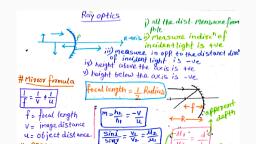
Class- XII-CBSE-Physics, , Ray Optics and Optical Instruments, , CBSE NCERT Solutions for Class 12 Physics Chapter 9, Back of Chapter Questions, 9.1., , A small candle, 2.5 cm in size is placed at 27 cm in front of a concave mirror of, radius of curvature 36 cm. At what distance from the mirror should a screen be, placed in order to obtain a sharp image? Describe the nature and size of the image., If the candle is moved closer to the mirror, how would the screen have to be moved?, Solution:, , Given,, The Object distance 𝑢𝑢 = −27 cm, 𝑅𝑅, , Focal length 𝑓𝑓 = − 2 = −, From the mirror formula,, , 36 cm, 2, , = −18 cm, , 1 1 1, + =, 𝑣𝑣 𝑢𝑢 𝑓𝑓, ⇒ 𝑣𝑣 =, ⇒ 𝑣𝑣 =, , 𝑢𝑢𝑢𝑢, 𝑢𝑢 − 𝑓𝑓, , (−27)(−18), = −54 cm, (−27) − (−18), 𝑣𝑣, , −54, , Magnification 𝑚𝑚 = − 𝑢𝑢 = − −27 = −2, , ∴ image height = 𝑚𝑚 × height of the oject = −2 × 2.5 = −5 cm, , The screen must be placed at a distance of 54 cm from the mirror on the same side, as the object. The image formed is inverted and twice the size of the object., , As the candle is moved close to the mirror, object approaches the focal point. Hence, image will approach infinity. Therefore, the screen has to move away from the, mirror to get the image on it., , Practice more on Ray Optics and Optical Instruments, , Page - 1, , www.embibe.com
Page 2 :
Class- XII-CBSE-Physics, , 9.2., , Ray Optics and Optical Instruments, , A 4.5 cm needle is placed 12 cm away from a convex mirror of focal length 15 cm., Give the location of the image and the magnification. Describe what happens as the, needle is moved farther from the mirror., Solution:, , Given,, The Object distance 𝑢𝑢 = −12 cm, Focal length 𝑓𝑓 = +15 cm, From the mirror formula,, 1 1 1, + =, 𝑣𝑣 𝑢𝑢 𝑓𝑓, ⇒ 𝑣𝑣 =, , (−12 ) × 15, 𝑢𝑢𝑢𝑢, =, = 6.7 cm, 𝑢𝑢 − 𝑓𝑓 (−12 ) − 15, 𝑣𝑣, , 6.7, , Magnification 𝑚𝑚 = − 𝑢𝑢 = − −12 = 0.56, , The image will be formed at a distance of 6.7 cm right to the mirror. Magnification, produced is 0.56., , As the needle moved away from the object image approaches the focal point, or, image moves away from the mirror. Size of the image decreases continuously as, the object moves away from the mirror., 9.3., , A tank is filled with water to a height of 12.5 cm. The apparent depth of a needle, lying at the bottom of the tank is measured by a microscope to be 9.4 cm. What is, the refractive index of water? If water is replaced by a liquid of refractive index, 1.63 up to the same height, by what distance would the microscope have to be, moved to focus on the needle again?, Solution:, Given,, the apparent depth of the needle 𝑑𝑑𝑎𝑎 = 9.4 cm, , Height of the water or real depth of the object 𝑑𝑑𝑟𝑟 = 12.5 cm, , Practice more on Ray Optics and Optical Instruments, , Page - 2, , www.embibe.com
Page 3 :
Class- XII-CBSE-Physics, , Ray Optics and Optical Instruments, 𝑑𝑑, , From the relation 𝑑𝑑𝑎𝑎 =, ⇒, , 9.4, 1, =, 12.5 𝜇𝜇𝑤𝑤, , 𝑟𝑟, , 1, , 1 𝜇𝜇2, , ⇒ 𝜇𝜇𝑤𝑤 = 1.33, , ∴ the refractive index of the water is 1.33, , If water is replaced by a liquid of refractive index 1.63,, , 𝑑𝑑𝑎𝑎, 1, 12.5, =, ⇒ 𝑑𝑑𝑎𝑎 =, = 7.7 cm, 1.63, 𝑑𝑑𝑟𝑟, 1 𝜇𝜇2, 9.4., , The microscope must be moved by a distance of 9.4 cm − 7.7 cm = 1.7 cm to, focus the object again., , Figures 9.34(a) and (b) show refraction of a ray in air incident at 60° with the, normal to a glass-air and water-air interface, respectively. Predict the angle of, refraction in glass when the angle of incidence in water is 45° with the normal to a, water-glass interface [Fig. 9.34(c)]., , Solution:, From the figure 9.34(a),, 𝜇𝜇𝑎𝑎 sin 60° = 𝜇𝜇𝑔𝑔 sin 35°, ⇒ 𝜇𝜇𝑔𝑔𝑔𝑔 =, , sin 60°, sin 35°, , ⇒ 𝜇𝜇𝑔𝑔𝑔𝑔 = 1.51, , From figure 9.34(b),, 𝜇𝜇𝑎𝑎 sin 60° = 𝜇𝜇𝑤𝑤 sin 47°, Practice more on Ray Optics and Optical Instruments, , Page - 3, , www.embibe.com
Page 4 :
Class- XII-CBSE-Physics, , ⇒ 𝜇𝜇𝑤𝑤𝑤𝑤 =, , Ray Optics and Optical Instruments, , sin 60°, sin 47°, , ⇒ 𝜇𝜇𝑤𝑤𝑤𝑤 = 1.18, , ⇒ 𝜇𝜇𝑔𝑔𝑔𝑔 =, , 1.51, = 1.27, 1.18, , From figure 9.34(c),, , 𝜇𝜇𝑤𝑤 sin 45° = 𝜇𝜇𝑔𝑔 sin 𝜃𝜃, , sin 45° = 𝜇𝜇𝑔𝑔𝑔𝑔 sin 𝜃𝜃, 9.5., , ⇒ 𝜃𝜃 ≃ 34°, , A small bulb is placed at the bottom of a tank containing water to a depth of 80 cm., What is the area of the surface of water through which light from the bulb can, emerge out? Refractive index of water is 1.33. (Consider the bulb to be a point, source.), Solution:, , Light comes out from a circle on the surface of the water, known as the circle of, illuminance, The light ray from the source incident with a critical angle on the border of this, circle., From Snell’s law,, 𝜇𝜇𝑤𝑤 sin 𝜃𝜃𝑐𝑐 = 𝜇𝜇𝑎𝑎 sin 90°, , ⇒ 1.33 ×, , 𝑅𝑅, , √𝑅𝑅 2 + 802, , =1, , ⇒ 𝑅𝑅 = 91 cm = 91 m, Area= 2.6 m2, , Practice more on Ray Optics and Optical Instruments, , Page - 4, , www.embibe.com
Page 5 :
Class- XII-CBSE-Physics, , 9.6., , Ray Optics and Optical Instruments, , A prism is made of glass of unknown refractive index. A parallel beam of light is, incident on a face of the prism. The angle of minimum deviation is measured to be, 40°. What is the refractive index of the material of the prism? The refracting angle, of the prism is 60°. If the prism is placed in water (refractive index 1.33), predict, the new angle of minimum deviation of a parallel beam of light., Solution:, , The angle of minimum deviation is related to the relative refractive index of the, prism as, 𝜇𝜇𝑔𝑔,𝑚𝑚𝑚𝑚𝑚𝑚𝑚𝑚𝑚𝑚𝑚𝑚 =, , 𝐴𝐴 + 𝛿𝛿𝑚𝑚, 2 �, 𝐴𝐴, sin � 2 �, , sin �, , If the prism is placed in the air, 𝜇𝜇𝑔𝑔,𝑎𝑎 =, , 60°+40°, �, 2, 60°, sin� �, 2, , sin�, , ………………(i), , 𝜇𝜇𝑔𝑔,𝑎𝑎 ≃ 1.53, , If the prism is placed in water, ⇒ 𝜇𝜇𝑔𝑔,𝑤𝑤, 𝜇𝜇𝑔𝑔,𝑎𝑎, , 60° + 𝛿𝛿𝑚𝑚, �, 𝜇𝜇𝑔𝑔,𝑎𝑎 sin �, 2, =, =, 60°, 𝜇𝜇𝑤𝑤,𝑎𝑎, sin � 2 �, , ⇒ 1.33 =, , 60°+𝛿𝛿𝑚𝑚, �, 2, 60°, sin� �, 2, , sin�, , ………………… (ii), , From (i) and (ii), , 60° + 40°, �, 2, 1.33 =, 60° + 𝛿𝛿𝑚𝑚, sin �, �, 2, sin �, , sin �, , sin 50°, 60° + 𝛿𝛿𝑚𝑚, �=, = 0.56, 2, 1.33, , ⇒ 𝛿𝛿𝑚𝑚 ≃ 10°, , 9.7., , ∴ Refractive index of the prism ≃ 1.53 and minimum deviation when placed in, water is 10°, , Double-convex lenses are to be manufactured from a glass of refractive index 1.55,, with both faces of the same radius of curvature. What is the radius of curvature, required if the focal length is to be 20 cm?, , Solution:, , Practice more on Ray Optics and Optical Instruments, , Page - 5, , www.embibe.com
Page 6 :
Class- XII-CBSE-Physics, , Ray Optics and Optical Instruments, , From the lens makers formula, 1, 1, 1, = �𝜇𝜇𝑔𝑔,𝑚𝑚𝑚𝑚𝑚𝑚𝑚𝑚𝑚𝑚𝑚𝑚 − 1� � − �, 𝑓𝑓, 𝑅𝑅1 𝑅𝑅2, , For convex lens,, , 𝑅𝑅1 = 𝑅𝑅 and 𝑅𝑅2 = −𝑅𝑅, ⇒, , 1, 1, 1, = (1.55 − 1) � −, �, 20, 𝑅𝑅 −𝑅𝑅, , ⇒ 𝑅𝑅 = 22 cm, , 9.8., , ∴ The radius of curvature required is 22 cm., , A beam of light converges at a point P. Now a lens is placed in the path of the, convergent beam 12 cm from P. At what point does the beam converge if the lens, is, (a), , (b), , a convex lens of focal length 20 cm, and, a concave lens of focal length 16 cm?, , Solution:, (a), , Here the object is virtual, From the diagram, Object distance 𝑢𝑢 = 12 cm, , Focal length 𝑓𝑓 = 20 cm, , From the thin lens formula,, 1 1 1, − =, 𝑣𝑣 𝑢𝑢 𝑓𝑓, Practice more on Ray Optics and Optical Instruments, , Page - 6, , www.embibe.com
Page 7 :
Class- XII-CBSE-Physics, , ⇒ 𝑣𝑣 =, , Ray Optics and Optical Instruments, , 𝑢𝑢𝑢𝑢, 12 × 20, =, = 7.5 cm, 𝑢𝑢 + 𝑓𝑓 12 + 20, , The image formed is real and located at a distance of 7.5 cm right side from the, lens, (b), , Here the object is virtual, From the diagram, Object distance 𝑢𝑢 = 12 cm, , Focal length 𝑓𝑓 = −16 cm, , From the thin lens formula,, 1 1 1, − =, 𝑣𝑣 𝑢𝑢 𝑓𝑓, ⇒ 𝑣𝑣 =, 9.9., , 𝑢𝑢𝑢𝑢, 12 × (−16), =, = 48 cm, 𝑢𝑢 + 𝑓𝑓, 12 − 16, , The image formed is real and located at a distance of 48 cm right side from the lens, An object of size 3.0 cm is placed 14 cm in front of a concave lens of focal length, 21 cm. Describe the image produced by the lens. What happens if the object is, moved further away from the lens?, Solution:, , Practice more on Ray Optics and Optical Instruments, , Page - 7, , www.embibe.com
Page 8 :
Class- XII-CBSE-Physics, , Ray Optics and Optical Instruments, , Given,, Object distance 𝑢𝑢 = −14 cm, Focal length 𝑓𝑓 = −21 cm, , From the thin lens formula,, 1 1 1, − =, 𝑣𝑣 𝑢𝑢 𝑓𝑓, ⇒ 𝑣𝑣 =, , (−14) × (−21), 𝑢𝑢𝑢𝑢, =, = −8.4 cm, 𝑢𝑢 + 𝑓𝑓, −14 − 21, 𝑣𝑣, , Magnification 𝑚𝑚 = 𝑢𝑢 =, , −8.4, −14, , = 0.6, , ⇒ size of the image = 0.6 × 3.0 = 1.8 cm, , Image is formed at a distance 8.4 cm left to the lens. The image formed is virtual,, erect, diminished to the size 1.8 cm., 9.10., , As the object moves away from the lens, the image moves towards the focal point, (𝑢𝑢 → ∞ ⇒ 𝑣𝑣 → 𝑓𝑓) and the magnification approaches zero (𝑚𝑚 → 0), , What is the focal length of a convex lens of focal length 30 cm in contact with a, concave lens of focal length 20 cm? Is the system a converging or a diverging lens?, Ignore thickness of the lenses., , Solution:, Given, , The focal length of the convex lens 𝑓𝑓1 = 30 cm, , The focal length of the concave lens 𝑓𝑓2 = −20 cm, Combined lens focal length 𝑓𝑓𝑒𝑒𝑒𝑒 is related as, 1, 1 1, = +, 𝑓𝑓𝑒𝑒𝑒𝑒 𝑓𝑓1 𝑓𝑓2, ⇒, , 1, 1, 1, 1, =, +, =−, 𝑓𝑓𝑒𝑒𝑒𝑒 30 −20, 60, , ⇒ 𝑓𝑓𝑒𝑒𝑒𝑒 = −60 cm, 9.11., , ∴ The combined lens acts as a diverging lens with a focal length of 60 cm., , A compound microscope consists of an objective lens of focal length 2.0 cm and, an eyepiece of focal length 6.25 cm separated by a distance of 15 cm. How far, from the objective should an object be placed in order to obtain the final image at, (a), , the least distance of distinct vision (25cm), and, , Practice more on Ray Optics and Optical Instruments, , Page - 8, , www.embibe.com
Page 9 :
Class- XII-CBSE-Physics, , (b), , Ray Optics and Optical Instruments, , at infinity? What is the magnifying power of the microscope in each case?, , Solution:, Given,, The focal length of the objective lens 𝑓𝑓𝑜𝑜 = 2 cm, The focal length of the eyepiece 𝑓𝑓𝑒𝑒 = 6.25 cm, (a), , To form the final image at 25 cm from the eyepiece, 𝑣𝑣𝑒𝑒 = −25 cm, From thin lens formula, 1 1 1, − =, 𝑣𝑣 𝑢𝑢 𝑓𝑓, , 1, 1, 1, −, =, −25 𝑢𝑢𝑒𝑒 6.25, ⇒ 𝑢𝑢𝑒𝑒 = −5 cm, , Image distance to the objective 𝑣𝑣𝑜𝑜 = 15 − 5 = 10 cm, From thin lens formula, 1 1 1, − =, 𝑣𝑣 𝑢𝑢 𝑓𝑓, , 1, 1, 1, −, =, 10 𝑢𝑢𝑜𝑜 2, , 𝑢𝑢𝑜𝑜 = −2.5 cm, , Hence object must be placed at a distance of 2.5 cm from the objective, The magnifying power of the compound microscope, , (b), , 𝑚𝑚 =, , 𝑣𝑣𝑜𝑜, 𝐷𝐷, 10, 25, �1 + � =, �1 +, � = 20, 𝑢𝑢𝑜𝑜, 𝑓𝑓𝑒𝑒, 2.5, 6.25, , To form the final image at ∞, 𝑣𝑣𝑒𝑒 = ∞, From thin lens formula, 1 1 1, − =, 𝑣𝑣 𝑢𝑢 𝑓𝑓, , 1, 1, 1, −, =, ∞ 𝑢𝑢𝑒𝑒 6.25, , ⇒ 𝑢𝑢𝑒𝑒 = −6.25 cm, , Image distance to the objective 𝑣𝑣𝑜𝑜 = 15 − 6.25 = 8.75 cm, Practice more on Ray Optics and Optical Instruments, , Page - 9, , www.embibe.com
Page 10 :
Class- XII-CBSE-Physics, , Ray Optics and Optical Instruments, , From thin lens formula, 1 1 1, − =, 𝑣𝑣 𝑢𝑢 𝑓𝑓, , 1, 1, 1, −, =, 8.75 𝑢𝑢𝑜𝑜 2, , 𝑢𝑢𝑜𝑜 = −2.59 cm, , Hence object must be placed at a distance of 2.59 cm from the objective, 𝑣𝑣, , 𝐷𝐷, , The magnifying power of the compound microscope 𝑚𝑚 = 𝑢𝑢𝑜𝑜 �𝑓𝑓 � =, , 9.12., , 8.75, , �, , 25, , � = 13.5, , 2.59 6.25, , 𝑜𝑜, , 𝑒𝑒, , A person with a normal near point (25 cm) using a compound microscope with, objective of focal length 8.0 mm and an eyepiece of focal length 2.5 cm can bring, an object placed at 9.0 mm from the objective in sharp focus. What is the separation, between the two lenses? Calculate the magnifying power of the microscope., Solution:, Given,, The focal length of the objective lens 𝑓𝑓𝑜𝑜 = 8 mm = 0.8 cm, The focal length of the eyepiece 𝑓𝑓𝑒𝑒 = 2.5 cm, , Object distance from the objective 𝑢𝑢𝑜𝑜 = −9 mm = −0.9 cm, Let the image formed by the objective is at a distance 𝑣𝑣𝑜𝑜, From thin lens formula, 1 1 1, − =, 𝑣𝑣 𝑢𝑢 𝑓𝑓, , 1, 1, 1, −, =, 𝑣𝑣𝑜𝑜 −0.9 0.8, ⇒ 𝑣𝑣𝑜𝑜 = 7.2 cm, , Image distance for the eyepiece 𝑣𝑣𝑒𝑒 = −25 cm, From thin lens formula, 1, 1, 1, −, =, −25 𝑢𝑢𝑒𝑒 2.5, , ⇒ 𝑢𝑢𝑒𝑒 = −2.27 cm, , ∴ the separation between the two lenses = 𝑣𝑣𝑜𝑜 + |𝑢𝑢𝑒𝑒 | = 7.2 + 2.27 = 9.47 cm, Practice more on Ray Optics and Optical Instruments, , Page - 10, , www.embibe.com
Page 11 :
Class- XII-CBSE-Physics, , Ray Optics and Optical Instruments, 𝑣𝑣, , 9.13., , 𝐷𝐷, , 7.2, , 25, , Magnifying power 𝑚𝑚 = |𝑢𝑢𝑜𝑜 | �1 + 𝑓𝑓 � = 0.9 �1 + 2.5� = 88, 𝑜𝑜, , 𝑒𝑒, , A small telescope has an objective lens of focal length 144 cm and an eyepiece of, focal length 6.0 cm. What is the magnifying power of the telescope? What is the, separation between the objective and the eyepiece?, Solution:, Given,, The focal length of the objective 𝑓𝑓𝑜𝑜 = 144 cm, , The focal length of the eyepiece 𝑓𝑓𝑒𝑒 = 6.0 cm, , 𝑓𝑓, , The magnifying power of the telescope 𝑚𝑚 = 𝑓𝑓𝑜𝑜 =, 9.14., , 𝑒𝑒, , 144, 6.0, , = 24, , Length of the telescope 𝐿𝐿 = 𝑓𝑓𝑜𝑜 + 𝑓𝑓𝑒𝑒 = 144 + 6.0 = 150 cm, , (a), , (b), , A giant refracting telescope at an observatory has an objective lens of focal, length 15 m. If an eyepiece of focal length 1.0 cm is used, what is the, angular magnification of the telescope?, If this telescope is used to view the moon, what is the diameter of the image, of the moon formed by the objective lens? The diameter of the moon is, 3.48 × 10⁶ m, and the radius of lunar orbit is 3.8 × 10⁸ m., , Solution:, (a), , Given,, The focal length of the objective 𝑓𝑓𝑜𝑜 = 15 m = 1500 cm, The focal length of the eyepiece 𝑓𝑓𝑒𝑒 = 1.0 cm, , (b), , Angular magnification 𝑚𝑚 =, Given,, , 𝑓𝑓𝑜𝑜, 𝑓𝑓𝑒𝑒, , =, , 1500, 1, , = 1500, , The diameter of the moon 𝐷𝐷 = 3.48 × 10⁶ m, , The radius of the lunar orbit 𝑅𝑅 = 3.8 × 10⁸ m, , The angle subtended by the moon’s diameter is equal to the angle subtended, by its image diameter at the objective lens, , Practice more on Ray Optics and Optical Instruments, , Page - 11, , www.embibe.com
Page 12 :
Class- XII-CBSE-Physics, , Ray Optics and Optical Instruments, , 𝐷𝐷 𝑑𝑑, =, 𝑅𝑅 𝑓𝑓𝑜𝑜, , 9.15., , 3.48 × 10⁶, × 15 m = 13.7 cm, ⇒ 𝑑𝑑 =, 3.8 × 10⁸, , The diameter of the image formed 𝑑𝑑 = 13.7 cm, , Use the mirror equation to deduce that:, (a), (b), , an object placed between 𝑓𝑓 and 2𝑓𝑓 of a concave mirror produces a real, image beyond 2𝑓𝑓., , a convex mirror always produces a virtual image independent of the location, of the object., , (c), , the virtual image produced by a convex mirror is always diminished in size, and is located between the focus and the pole., , (d), , an object placed between the pole and focus of a concave mirror produces, a virtual and enlarged image. [Note: This exercise helps you deduce, algebraically properties of images that one obtains from explicit ray, diagrams.], , Solution:, (a), , Given that the object is placed between 𝑓𝑓 and 2𝑓𝑓 ⇒ 2𝑓𝑓 < 𝑢𝑢 < 𝑓𝑓 and 𝑢𝑢 <, 0, 𝑓𝑓 < 0, From the mirror formula,, 1 1 1, + =, 𝑣𝑣 𝑢𝑢 𝑓𝑓, ⇒ 𝑣𝑣 =, , 𝑢𝑢𝑢𝑢, 𝑢𝑢 − 𝑓𝑓, , If 𝑢𝑢 = −𝑓𝑓, , Practice more on Ray Optics and Optical Instruments, , Page - 12, , www.embibe.com
Page 14 :
Class- XII-CBSE-Physics, , Ray Optics and Optical Instruments, , 1 1 1, + =, 𝑣𝑣 𝑢𝑢 𝑓𝑓, ⇒, , 1 1 1, = − >0, 𝑣𝑣 𝑓𝑓 𝑢𝑢, , Or 𝑣𝑣 > 0, , 𝑣𝑣, , 𝑓𝑓, , Magnification 𝑚𝑚 = − 𝑢𝑢 = 𝑓𝑓−𝑢𝑢 > 1, , Hence, an object placed between the focus and pole of a concave mirror, produces a virtual and enlarged image., 9.16., , A small pin fixed on a table top is viewed from above from a distance of 50 cm., By what distance would the pin appear to be raised if it is viewed from the same, point through a 15 cm thick glass slab held parallel to the table? Refractive index, of glass = 1.5. Does the answer depend on the location of the slab?, Solution:, Given,, The thickness of the glass slab 𝑡𝑡 = 15 cm, Refractive index of the glass 𝜇𝜇 = 1.5, , 1, , Shift in the object position due to the slab 𝑠𝑠 = 𝑡𝑡 �1 − 𝜇𝜇�, ⇒ 𝑠𝑠 = 15 �1 −, , 1, � = 5 cm, 1.5, , The shift is independent of the location of the slab for a small angle of incidence., 9.17., , (a), , Figure 9.35 shows a cross-section of a ‘light pipe’ made of a glass fibre of, refractive index 1.68. The outer covering of the pipe is made of a material, of refractive index 1.44. What is the range of the angles of the incident rays, with the axis of the pipe for which total reflections inside the pipe take place,, as shown in the figure., , (b), , What is the answer if there is no outer covering of the pipe?, , Practice more on Ray Optics and Optical Instruments, , Page - 14, , www.embibe.com
Page 15 :
Class- XII-CBSE-Physics, , Ray Optics and Optical Instruments, , Solution:, (a), , For total internal reflection, near the wall 𝑖𝑖 ′ > 𝜃𝜃𝑐𝑐, , sin 𝜃𝜃𝑐𝑐 =, , 1, 1.44, =, = 0.86, 𝜇𝜇21 1.68, , 𝜃𝜃𝑐𝑐 = 59°, , ⇒ 𝑖𝑖 ′ > 59°, ⇒ 𝑟𝑟 < 31°, , From Snell’s law, 1 × sin 𝑖𝑖 = 1.68 × sin 𝑟𝑟, , As 𝑟𝑟 < 31° ⇒ sin 𝑖𝑖 < 1.68 × sin 31°, 𝑖𝑖 < 60°, , (b), , Therefore, the range of angle of incidence with the axis is 0 < 𝑖𝑖 < 60°, , If there is no outer covering,, , For total internal reflection, near the wall 𝑖𝑖 ′ > 𝜃𝜃𝑐𝑐, , sin 𝜃𝜃𝑐𝑐 =, , 1, 1, =, = 0.60, 𝜇𝜇21 1.68, , 𝜃𝜃𝑐𝑐 = 36.5°, , ⇒ 𝑖𝑖 ′ > 36.5°, ⇒ 𝑟𝑟 < 53.5°, , From Snell’s law, for the angle of incidence of 90°, , 1 × sin 90° = 1.68 × sin 𝑟𝑟, , ⇒ 𝑟𝑟 = 36.5° and𝑖𝑖 ′ = 53.5° Which is greater than 𝜃𝜃𝑐𝑐 ., Practice more on Ray Optics and Optical Instruments, , Page - 15, , www.embibe.com
Page 16 :
Class- XII-CBSE-Physics, , 9.18., , Ray Optics and Optical Instruments, , This gives the upper limit as 90° and all the incident rays suffer total internal, reflection, , Answer the following questions:, (a), , You have learnt that plane and convex mirrors produce virtual images of, objects. Can they produce real images under some circumstances? Explain., , (b), , A virtual image, we always say, cannot be caught on a screen. Yet when we, ‘see’ a virtual image, we are obviously bringing it on to the ‘screen’ (i.e.,, the retina) of our eye. Is there a contradiction?, , (c), , A diver under water, looks obliquely at a fisherman standing on the bank of, a lake. Would the fisherman look taller or shorter to the diver than what he, actually is?, , (d), , Does the apparent depth of a tank of water change if viewed obliquely? If, so, does the apparent depth increase or decrease?, , (e), , The refractive index of diamond is much greater than that of ordinary glass., Is this fact of some use to a diamond cutter?, , Solution:, (a), , The plane mirror always forms a real image for a virtual object, irrespective, of object position. The convex mirror forms a real image of a virtual object, if it is between pole and focus., , (b), , When we see the virtual image, it acts as an object for our eye lens. Eye lens, forms a real image of it on the retina. Hence there is no contradiction., , (c), , For the diver the fisherman appears taller than he actually is., , (d), , Apparent depth decreases if viewed obliquely. For the near normal view, apparent depth is maximum., , (e), , The diamond refractive index is about 2.42, much bigger than the regular, glass index (about 1.5). Diamond's critical angle is about 24°, much lower, than glass. A skilled diamond cutter takes advantage of the wider range of, incidence angles (in the diamond), 24° to 90°, to guarantee that light, , Practice more on Ray Optics and Optical Instruments, , Page - 16, , www.embibe.com
Page 17 :
Class- XII-CBSE-Physics, , Ray Optics and Optical Instruments, , entering the diamond is fully reflected from many faces before getting out, to produce a sparkling effect., 9.19., , The image of a small electric bulb fixed on the wall of a room is to be obtained on, the opposite wall 3 m away by means of a large convex lens. What is the maximum, possible focal length of the lens required for the purpose?, Solution:, , Give that, the separation between object and the image is 3 m, , Let the object distance from the lens be 𝑥𝑥, this implies that the image distance is, 3 − 𝑥𝑥. Let the required focal length be 𝑓𝑓., 𝑢𝑢 = −𝑥𝑥, , 𝑣𝑣 = 3 − 𝑥𝑥, 𝑓𝑓 = 𝑓𝑓, , From the thin lens formula, 1 1 1, − =, 𝑣𝑣 𝑢𝑢 𝑓𝑓, , ⇒, , 1, 1, 1, −, =, 3 − 𝑥𝑥 −𝑥𝑥 𝑓𝑓, , 𝑥𝑥 2, ⇒ 𝑓𝑓 = 𝑥𝑥 −, 3, , 𝑑𝑑𝑑𝑑, , To find the maximum of 𝑓𝑓, 𝑑𝑑𝑑𝑑 = 0, 𝑑𝑑𝑑𝑑, 2𝑥𝑥, = 1−, =0, 𝑑𝑑𝑑𝑑, 3, 3, ⇒ 𝑥𝑥 = m, 2, , ⇒, , 9.20., , 3, , And 𝑓𝑓 = 2 −, , 3 2, 2, , � �, 3, , = 0.75 m, , A screen is placed 90 cm from an object. The image of the object on the screen is, formed by a convex lens at two different locations separated by 20 cm. Determine, the focal length of the lens., Solution:, , The separation between the object and the image 𝐷𝐷 = 90 cm, , The separation between two locations of the object 𝑑𝑑 = 20 cm, , Let the object distance from the lens be 𝑥𝑥, this implies that the Image distance is, 𝐷𝐷 − 𝑥𝑥, , Practice more on Ray Optics and Optical Instruments, , Page - 17, , www.embibe.com
Page 18 :
Class- XII-CBSE-Physics, , Ray Optics and Optical Instruments, , 𝑢𝑢 = −𝑥𝑥, , 𝑣𝑣 = 𝐷𝐷 − 𝑥𝑥, 𝑓𝑓 = 𝑓𝑓, , From the thin lens formula, 1 1 1, − =, 𝑣𝑣 𝑢𝑢 𝑓𝑓, , ⇒, , 1, 1, 1, −, =, 𝐷𝐷 − 𝑥𝑥 −𝑥𝑥 𝑓𝑓, , ⇒ 𝑥𝑥 2 − 𝐷𝐷𝐷𝐷 + 𝐷𝐷𝐷𝐷 = 0, , 𝐷𝐷 ± �𝐷𝐷2 − 4𝐷𝐷𝐷𝐷, ⇒ 𝑥𝑥 =, 2, , ⇒The two positions of the object are,, , 𝐷𝐷+�𝐷𝐷2 −4𝐷𝐷𝐷𝐷, 2, , and, , 𝐷𝐷−�𝐷𝐷 2 −4𝐷𝐷𝐷𝐷, , The separation between them = �𝐷𝐷2 − 4𝐷𝐷𝐷𝐷 = 𝑑𝑑, ⇒ 𝑓𝑓 =, , 9.21., , 2, , 𝐷𝐷2 − 𝑑𝑑 2 902 − 202, =, = 21.4 cm, 4𝐷𝐷, 4 × 90, , The focal length of the lens 𝑓𝑓 = 21.4 cm, (a), , Determine the ‘effective focal length’ of the combination of the two lenses, in Exercise 9.10, if they are placed 8.0 cm apart with their principal axes, coincident. Does the answer depend on which side of the combination a, beam of parallel light is incident? Is the notion of effective focal length of, this system useful at all?, , (b), , An object 1.5 cm in size is placed on the side of the convex lens in the, arrangement (a) above. The distance between the object and the convex lens, is 40 cm. Determine the magnification produced by the two-lens system,, and the size of the image., , Solution:, (a), , The focal length of the convex lens = 30 cm, , The focal length of the concave lens = −20 cm, The separation between the lenses 𝑑𝑑 = 8.0 cm, , Consider a parallel beam of light incident on the first lens, 𝑢𝑢1 = ∞, 𝑓𝑓1 = 𝑓𝑓1, , Practice more on Ray Optics and Optical Instruments, , Page - 18, , www.embibe.com
Page 20 :
Class- XII-CBSE-Physics, , Ray Optics and Optical Instruments, , Hence the answer depends on the side of the combination on which a, beam of parallel light is incident. Therefore, the notion of the effective, focal length of this system not useful., (b), , Size of the object ℎ𝑜𝑜 = 1.5 cm, , Distance between the object and convex lens is 40 cm, , For the convex lens, 𝑢𝑢 = −40 cm, 𝑓𝑓 = 30 cm, , From the thin lens formula, 1 1 1, − =, 𝑣𝑣 𝑢𝑢 𝑓𝑓, , 𝑣𝑣 =, , 𝑓𝑓 × 𝑢𝑢 30 × (−40), =, = 120 cm, 𝑓𝑓 + 𝑢𝑢, 30 − 40, , 𝑣𝑣, , 𝑓𝑓, , 𝑣𝑣, , 𝑓𝑓, , 30, , Magnification produced by convex lens 𝑚𝑚1 = 𝑢𝑢 = 𝑓𝑓+𝑢𝑢 = 30−40 = −3, For the concave lens, , 𝑢𝑢 = 120 − 8 = 112 cm, 𝑓𝑓 = −20 cm, , −20, , 20, , Magnification produced by convex lens 𝑚𝑚1 = 𝑢𝑢 = 𝑓𝑓+𝑢𝑢 = −20+112 = − 92, Net magnification produced 𝑚𝑚 = 0.652, 9.22., , Size of the image ℎ𝑖𝑖 = 0.652 × 1.5 = 0.98 cm, , At what angle should a ray of light be incident on the face of a prism of refracting, angle 60° so that it just suffers total internal reflection at the other face? The, refractive index of the material of the prism is 1.524., Solution:, , Practice more on Ray Optics and Optical Instruments, , Page - 20, , www.embibe.com
Page 21 :
Class- XII-CBSE-Physics, , Ray Optics and Optical Instruments, , Given,, The refracting angle of prism 𝐴𝐴 = 60, , Refractive index of the prism 𝜇𝜇 = 1.524, , At the second surface, angle of incidence 𝑟𝑟2 must be greater than the critical angle, 𝜃𝜃𝑐𝑐, 1, 1, 𝜃𝜃𝑐𝑐 = sin−1 � � = sin−1 �, � = 41°, 𝜇𝜇, 1.524, , ∴ 𝑟𝑟2 > 41° ⇒ 𝑟𝑟1 < 19° (∵ 𝑟𝑟1 + 𝑟𝑟2 = 𝐴𝐴 = 60°), From Snell’s law,, , sin 𝑖𝑖 = 𝜇𝜇 sin 𝑟𝑟1 ⇒ sin 𝑖𝑖 < 1.524 sin 19°, , ⇒ 𝑖𝑖 < 30° (approximately), 9.23., , Therefore, the beam will be total internal reflected at the second surface if the angle, of incidence at the first surface is lesser than 30°, You are given prisms made of crown glass and flint glass with a wide variety of, angles. Suggest a combination of prisms which will, (a), , deviate a pencil of white light without much dispersion., , (b), , disperse (and displace) a pencil of white light without much deviation., , Solution:, , Practice more on Ray Optics and Optical Instruments, , Page - 21, , www.embibe.com
Page 22 :
Class- XII-CBSE-Physics, , 9.24., , Ray Optics and Optical Instruments, , (a), , Combine two prisms inverted as shown in figure without a gap between, them. Pencil of white light falls on the left side of the first prism which gets, dispersed and deviated. Dispersed light falls on the left side of the second, prism in which, it will recombine and pencil of white light comes out of the, second surface., , (b), , Combine two prisms inverted as shown in figure without a gap between, them. The angle of flint glass prism should increased so that the deviation, produced by both prisms is equal. The combination disperse the pencil of, white light without much deviation., , For a normal eye, the far point is at infinity and the near point of distinct vision is, about 25 cm in front of the eye. The cornea of the eye provides a converging power, of about 40 dioptres, and the least converging power of the eye-lens behind the, cornea is about 20 dioptres. From this rough data estimate the range of, accommodation (i.e., the range of converging power of the eye-lens) of a normal, eye., Solution:, Given,, The near point of distinct vision 𝑑𝑑 = 25 cm, , Converging power of the cornea 𝑃𝑃1 = 40 diopters, , Least converging power of the eye-lens 𝑃𝑃2,𝑚𝑚𝑚𝑚𝑚𝑚 = 20 diopters, , Converging power of the eye-lens is least when the object is at infinity, Total power 𝑃𝑃𝑚𝑚𝑚𝑚𝑚𝑚 = 40 + 20 = 60 diopters, , Focal length 𝑓𝑓 = 𝑃𝑃, , 1, , 𝑚𝑚𝑚𝑚𝑚𝑚, , 1, , 5, , × 100 cm = 60 × 100 cm = 3 cm, , Object distance 𝑢𝑢 = ∞, , From the thin lens formula,, , Practice more on Ray Optics and Optical Instruments, , Page - 22, , www.embibe.com
Page 23 :
Class- XII-CBSE-Physics, , 1 1 1, − =, 𝑣𝑣 𝑢𝑢 𝑓𝑓, , ⇒ 𝑣𝑣 = 𝑓𝑓 =, , Ray Optics and Optical Instruments, , 5, cm, 3, , As the image is always formed on the retina, the distance between the lens and the, 5, retina = 3 cm, When the object is at the near point, 𝑢𝑢 = −25 cm, 𝑣𝑣 =, , 5, cm, 3, , Let the effective focal length be 𝑓𝑓, From the thin lens formula,, 1 1 1, − =, 𝑣𝑣 𝑢𝑢 𝑓𝑓, ⇒, , 1 3 1, 16, = +, =, 𝑓𝑓 5 25 25, , 1, , Maximum converging power 𝑃𝑃𝑚𝑚𝑚𝑚𝑚𝑚 = 𝑓𝑓(𝑖𝑖𝑖𝑖 cm) × 100 diopters = 64 diopters, Hence converging power of the eye lens = 64 − 40 = 24 diopters, 9.25., , ∴ Range of accommodation is 20 diopters to 24 diopters., , Does short-sightedness (myopia) or long-sightedness (hypermetropia) imply, necessarily that the eye has partially lost its ability of accommodation? If not, what, might cause these defects of vision?, Solution:, It is not necessary that the eye with short-sightedness or long-sightedness imply a, partial loss in the ability of accommodation. Short-sightedness or myopia may, occur when the eye-balls get elongated from front to back and Hypermetropia may, occur when eye-ball get shortened. The defect of vision in which the eye has, partially lost its ability of accommodation is termed as presbyopia., , 9.26., , A myopic person has been using spectacles of power – 1.0 dioptre for distant, vision. During old age he also needs to use separate reading glass of power, + 2.0 dioptres. Explain what may have happened., , Solution:, Given, , Practice more on Ray Optics and Optical Instruments, , Page - 23, , www.embibe.com
Page 24 :
Class- XII-CBSE-Physics, , Ray Optics and Optical Instruments, , The power of spectacles of the person 𝑃𝑃1 = −1.0 diopters, 1, , The focal length of the lens used 𝑓𝑓1 = 𝑃𝑃 × 100 = −100 cm, 1, , This implies that, he has a far point of 100 cm and normal near point of 25 cm, In his old age he needed separate reading glasses of power +2.0 diopters, 1, , ⇒The focal length of the lens 𝑓𝑓2 = 2 × 100 = 50 cm, , This implies that in his old age his near-point increased from 25 cm, 𝑢𝑢 = −25 cm, 𝑣𝑣 = 𝑣𝑣, , 𝑓𝑓 = 50 cm, , From the thin lens formula,, 1 1 1, − =, 𝑣𝑣 𝑢𝑢 𝑓𝑓, , 1, 1, 1, −, =, 𝑣𝑣 −25 50, 𝑢𝑢 = −50 cm, , 9.27., , Therefore, his near-point has changed from 25 cm to 50 cm. In the old age he, partially lost the ability of accommodation. This defect is known as presbyopia., Due to this he cannot see the objects placed in front of him clearly up to the distance, 50 cm., , A person looking at a person wearing a shirt with a pattern comprising vertical and, horizontal lines is able to see the vertical lines more distinctly than the horizontal, ones. What is this defect due to? How is such a defect of vision corrected?, Solution:, In the given situation the person can see the vertical lines more distinctly than the, horizontal ones. The type of defect is called astigmatism. This occurs when the, cornea is not spherical in shape. In the given situation he is not able to focus the, horizontal lines, hence the curvature of the cornea in the horizontal plane is not, sufficient compared to the curvature in the vertical plane. Astigmatism can be, corrected by using a cylindrical lens of the desired radius of curvature with an, appropriately directed axis, , 9.28., , A man with normal near point (25 cm) reads a book with small print using a, magnifying glass: a thin convex lens of focal length 5 cm., , (a), , What is the closest and the farthest distance at which he should keep the, lens from the page so that he can read the book when viewing through the, magnifying glass?, , Practice more on Ray Optics and Optical Instruments, , Page - 24, , www.embibe.com
Page 25 :
Class- XII-CBSE-Physics, , (b), , Ray Optics and Optical Instruments, , What is the maximum and the minimum angular magnification (magnifying, power) possible using the above simple microscope?, , Solution:, (a), , The focal length of the lens 𝑓𝑓 = 5 cm, , The image can be formed between 25 cm and infinity, From the thin lens formula, 1 1 1, − =, 𝑣𝑣 𝑢𝑢 𝑓𝑓, , For 𝑣𝑣 = −25 cm, ⇒ 𝑢𝑢 =, , 𝑓𝑓𝑓𝑓, 5(−25), =, = −4.16 cm, 𝑓𝑓 − 𝑣𝑣, 5 + 25, , For 𝑣𝑣 = ∞, 𝑢𝑢 = −5 cm, (b), , Hence the closest distance he should keep the lens from the page is, 4.167 cm, and the farthest distance is 5 cm, Minimum magnifying power is when the image formed at infinity., 𝑚𝑚𝑚𝑚𝑚𝑚𝑚𝑚 =, , 𝐷𝐷 25 cm, =, =5, 𝑓𝑓, 5 cm, , Maximum magnifying power is when the image is formed at the nearpoint, , 9.29., , 𝑚𝑚𝑚𝑚𝑚𝑚𝑚𝑚 = 1 +, , 𝐷𝐷, =6, 𝑓𝑓, , A card sheet divided into squares each of size 1 mm2 is being viewed at a distance, of 9 cm through a magnifying glass (a converging lens of focal length 10 cm) held, close to the eye., , (a), , What is the magnification produced by the lens? How much is the area of, each square in the virtual image?, , (b), , What is the angular magnification (magnifying power) of the lens?, , (c), , Is the magnification in (a) equal to the magnifying power in (b)? Explain., , (Note: Data in the question is modified to get the proper answers), Solution:, (a), , Given,, The area of each square 𝐴𝐴 = 1 mm2, , The distance between card sheet and the lens 𝑢𝑢 = −9 cm, , Practice more on Ray Optics and Optical Instruments, , Page - 25, , www.embibe.com
Page 26 :
Class- XII-CBSE-Physics, , Ray Optics and Optical Instruments, , The focal length of the lens 𝑓𝑓 = 10 cm, From thin lens formula, 1 1 1, − =, 𝑣𝑣 𝑢𝑢 𝑓𝑓, , 𝑣𝑣 =, , 𝑢𝑢𝑢𝑢, −9 × 10, =, = −90 cm, 𝑢𝑢 + 𝑓𝑓 −9 + 10, 𝑣𝑣, , Magnification produced 𝑚𝑚 = 𝑢𝑢 =, , −90, −9, , = 10, , ⇒ length and breadth of the square increases 10 times, , (b), (c), , Area of each square box = 10 mm × 10 mm = 100 mm2, 𝐷𝐷, , Angular magnification 𝑚𝑚′ = |𝑢𝑢| =, , 25, 9, , = 2.8, , No. Magnification and angular magnification of an optical instrument are, two separate things. Angular magnification is defined as the ratio of the, angular size of the object to the angular size of the object when placed at, near point (25 cm)., 𝑣𝑣, , 25, , Magnification 𝑚𝑚 = �𝑢𝑢� and angular magnification 𝑚𝑚′ = |𝑢𝑢|, , 9.30., , (a), , Their magnitudes are equal only when the image of an object is formed at, near point (25 cm), , (b), , What is the magnification in this case?, , (c), , Is the magnification equal to the magnifying power in this case? Explain., , At what distance should the lens be held from the figure in Exercise 9.29 in, order to view the squares distinctly with the maximum possible magnifying, power?, , Solution:, (a), , Given,, The area of each square 𝐴𝐴 = 1 mm2, , The focal length of the lens 𝑓𝑓 = 10 cm, , Magnifying power is maximum when the image of the given object is, formed at the near point (25 cm), ⇒ 𝑣𝑣 = −25 cm, , From thin lens formula, 1 1 1, − =, 𝑣𝑣 𝑢𝑢 𝑓𝑓, , Practice more on Ray Optics and Optical Instruments, , Page - 26, , www.embibe.com
Page 27 :
Class- XII-CBSE-Physics, , 𝑢𝑢 =, (b), (c), , 9.31., , Ray Optics and Optical Instruments, , 𝑣𝑣𝑣𝑣, −25 × 10, =, = −7.14 cm, 𝑓𝑓 − 𝑣𝑣, 10 + 25, , the magnifying power of the lens is maximum when the sheet is placed at, 7.14 cm in front of the lens, 𝑣𝑣, , −25, , Magnification 𝑚𝑚 = 𝑢𝑢 = −7.14 = 3.5, 25, , 25, , Magnifying power 𝑚𝑚′ = |𝑢𝑢| = 7.14 = 3.5, , Magnitudes of magnifying power and magnification are equal in this case., If the image of an object is formed at the near point (25 cm), magnitudes of, magnifying power and magnification are equal., , What should be the distance between the object in Exercise 9.30 and the magnifying, glass if the virtual image of each square in the figure is to have an area of 6.25 mm2 ., Would you be able to see the squares distinctly with your eyes very close to the, magnifier? [Note: Exercises 9.29 to 9.31 will help you clearly understand the, difference between magnification in absolute size and the angular magnification (or, magnifying power) of an instrument.], Solution:, Given,, The area of each square = 6.25 mm2, , ⇒ The side length of the square = 2.5 mm, 𝑣𝑣, , Magnification required 𝑚𝑚 = 𝑢𝑢 =, ⇒ 𝑣𝑣 = 2.5𝑢𝑢, , 2.5 mm, 1 mm, , = 2.5, , From the thin lens formula, 1 1 1, − =, 𝑣𝑣 𝑢𝑢 𝑓𝑓, , 1, 1, 1, − =, 2.5𝑢𝑢 𝑢𝑢 10, ⇒ 𝑢𝑢 = −6 cm, , And 𝑣𝑣 = −15 cm, which is less than near-point (25 cm), , Hence, we cannot see the square distinctly with our eyes very close to the magnifier, 9.32., , Answer the following questions:, (a), , The angle subtended at the eye by an object is equal to the angle subtended, at the eye by the virtual image produced by a magnifying glass. In what, sense then does a magnifying glass provide angular magnification?, , Practice more on Ray Optics and Optical Instruments, , Page - 27, , www.embibe.com
Page 28 :
Class- XII-CBSE-Physics, , Ray Optics and Optical Instruments, , (b), , In viewing through a magnifying glass, one usually positions one’s eyes, very close to the lens. Does angular magnification change if the eye is, moved back?, , (c), , Magnifying power of a simple microscope is inversely proportional to the, focal length of the lens. What then stops us from using a convex lens of, smaller and smaller focal length and achieving greater and greater, magnifying power?, , (d), , Why must both the objective and the eyepiece of a compound microscope, have short focal lengths?, , (e), , When viewing through a compound microscope, our eyes should be, positioned not on the eyepiece but a short distance away from it for best, viewing. Why? How much should be that short distance between the eye, and eyepiece?, , Solution:, (a), , (b), , The angular size of the object and the image are the same. The advantage, of the magnifying glass is that, the object can be placed closer than near, point (25 cm). Hence it gives a larger angular size than the object placed at, near point. In this sense a magnifying glass provides angular magnification., , As the angle subtended by the image at the eye is slightly less than the angle, subtended at the lens Angular magnification decreases a little. If the image, is at a very large distance away this effect is negligible., , (c), , The focal length of a convex lens cannot be decreased to a greater amount., If we reduce the focal length, spherical and chromatic aberrations will, become more pronounced. So, in practice one cannot get a magnifying, power of more than 3 for a simple convex lens. However, using a system of, lenses which corrects the aberration one can increase this limit by a factor, 10., , (d), , The magnifying power of the eyepiece 𝑚𝑚𝑒𝑒 = �1 + 𝑓𝑓 �, , 𝐷𝐷, , 𝑒𝑒, , Hence magnifying power of eyepiece increases with smaller 𝑓𝑓𝑒𝑒, 𝑣𝑣, , Magnification of the objective can be written as |𝑢𝑢𝑜𝑜 |, , (e), , 𝑜𝑜, , Objects are placed close to the focal point of the objective. This gives |𝑢𝑢𝑜𝑜 | ≈, 𝑓𝑓𝑜𝑜 . Hence to increase the magnification, the focal length of the eyepiece is, maintained small., The image of the objective in the eyepiece is called eye-ring. If we place, our eye too close to the eyepiece, our eye cannot collect much of the light, and also the field of view gets reduced. If we position our eye at the eye ring, which is slightly above the eyepiece, the area of the pupil of our eye is, , Practice more on Ray Optics and Optical Instruments, , Page - 28, , www.embibe.com
Page 29 :
Class- XII-CBSE-Physics, , Ray Optics and Optical Instruments, , greater or equal to the area of the eye ring and our eyes will collect all the, light refracted by the objective., The precise location of the eye-ring naturally depends on the separation, between the objective and the eyepiece., 9.33., , An angular magnification (magnifying power) of 30X is desired using an objective, of focal length 1.25 cm and an eyepiece of focal length 5 cm. How will you set up, the compound microscope?, Solution:, Given,, The focal length of the objective 𝑓𝑓𝑜𝑜 = 1.25 cm, , The focal length of the eyepiece 𝑓𝑓𝑒𝑒 = 5 cm, , The magnifying power of a compound microscope 𝑚𝑚 = 𝑚𝑚𝑜𝑜 × 𝑚𝑚𝑒𝑒, Assuming near point adjustment,, 𝑚𝑚 =, ⇒, , 𝑣𝑣𝑜𝑜, 𝐷𝐷, �1 + � = 30 cm, −𝑢𝑢𝑜𝑜, 𝑓𝑓𝑒𝑒, , 𝑣𝑣𝑜𝑜, 25, �1 + � = 30, −𝑢𝑢𝑜𝑜, 5, , ⇒ 𝑣𝑣𝑜𝑜 = −5𝑢𝑢𝑜𝑜, , From the thin lens formula, 1 1 1, − =, 𝑣𝑣 𝑢𝑢 𝑓𝑓, , 5, 1, 1, + =, 𝑣𝑣𝑜𝑜 𝑣𝑣𝑜𝑜 1.25, , ⇒ 𝑣𝑣𝑜𝑜 = 7.5 cm, and 𝑢𝑢𝑜𝑜 = −1.5 cm, Similarly, for the eyepiece,, 1 1 1, − =, 𝑣𝑣 𝑢𝑢 𝑓𝑓, , 1, 1, 1, +, =, −25 𝑢𝑢𝑒𝑒 5, , ⇒ 𝑢𝑢𝑒𝑒 = 4.17 cm, , Therefore, the separation between objective and the eyepiece 𝐿𝐿 = 7.5 + 1.17 =, 11.67 cm, And the object must be placed at 1.5 cm to get the given magnification., , Practice more on Ray Optics and Optical Instruments, , Page - 29, , www.embibe.com
Page 30 :
Class- XII-CBSE-Physics, , 9.34., , Ray Optics and Optical Instruments, , A small telescope has an objective lens of focal length 140 cm and an eyepiece of, focal length 5.0 cm. What is the magnifying power of the telescope for viewing, distant objects when, (a), , the telescope is in normal adjustment (i.e., when the final image is at, infinity)?, , (b), , the final image is formed at the least distance of distinct vision (25cm)?, , Solution:, Given,, The focal length of the objective 𝑓𝑓𝑜𝑜 = 140 cm, , The focal length of the eyepiece 𝑓𝑓𝑒𝑒 = 5.0 cm, , 9.35., , (a), , For normal adjustment,, , 𝑓𝑓𝑜𝑜, , (b), , Magnifying power 𝑚𝑚 =, , 𝑓𝑓𝑜𝑜, , (a), , Magnifying power 𝑚𝑚 =, , (b), (c), , 𝑓𝑓𝑒𝑒, , For near-point adjustment,, 𝑓𝑓𝑒𝑒, , =, , 140, 5.0, , = 28, , 𝑓𝑓, , �1 + 𝐷𝐷𝑒𝑒� =, , 140, 5.0, , 5.0, , �1 + 25 � = 33.6, , For the telescope described in Exercise 9.34 (a), what is the separation, between the objective lens and the eyepiece?, If this telescope is used to view a 100 m tall tower 3 km away, what is the, height of the image of the tower formed by the objective lens?, What is the height of the final image of the tower if it is formed at 25 cm?, , Solution:, (a), , From Exercise 9.34 (a),, The focal length of the objective 𝑓𝑓𝑜𝑜 = 140 cm, , The focal length of the eyepiece 𝑓𝑓𝑒𝑒 = 5.0 cm, , For normal adjustment, the separation between the objective and the eyepiece, 𝐿𝐿 = 𝑓𝑓𝑜𝑜 + 𝑓𝑓𝑒𝑒, , (b), , 𝐿𝐿 = 140 + 5 = 145 cm, Given,, , The Height of the tower ℎ𝑜𝑜 = 100 m, , The distance of the tower 𝑢𝑢𝑜𝑜 = 3 km = 3000 m, Practice more on Ray Optics and Optical Instruments, , Page - 30, , www.embibe.com
Page 31 :
Class- XII-CBSE-Physics, , Ray Optics and Optical Instruments, , The angle subtended by the tower at the objective = Angle subtended by the, image of the objective, ℎ, , ⇒ Height of the image formed by the objective ℎ1 = 𝑓𝑓𝑜𝑜 × 𝑢𝑢𝑜𝑜 = 140 ×, , (c), , 100, , 3000, , = 4.7 cm, , 𝑜𝑜, , For the eyepiece,, 1 1 1, − =, 𝑢𝑢 𝑣𝑣 𝑓𝑓, ⇒, , 1, 1, 1, −, =, 𝑢𝑢𝑒𝑒 −25 5, , ⇒ 𝑢𝑢𝑒𝑒 = 6.5 cm, , The angle subtended by the image of the objective at the eyepiece = Angle, subtended by the image of the eyepiece, ⇒, , 4.7 cm, ℎ2, =, 6.5 cm 25 cm, , ⇒ ℎ2 = 18.07 cm, , 9.36., , Height of the final image of the tower = 18.07 cm, , A Cassegrain telescope uses two mirrors as shown in Fig. 9.33. Such a telescope is, built with the mirrors 20 mm apart. If the radius of curvature of the large mirror is, 220 mm and the small mirror is 140 mm, where will the final image of an object, at infinity be?, , Fig. 9.33, Solution:, Given,, The radius of the curvature of the large mirror 𝑅𝑅1 = 220 mm, Its focal length = 110 mm = 11 cm, , The radius of the curvature of the small mirror 𝑅𝑅1 = −140 mm, Its focal length = 70 mm = 7 cm, , Practice more on Ray Optics and Optical Instruments, , Page - 31, , www.embibe.com
Page 32 :
Class- XII-CBSE-Physics, , Ray Optics and Optical Instruments, , The separation between the mirrors = 20 mm = 2 cm, For the large mirror, 𝑢𝑢1 = ∞, , 𝑓𝑓1 = −11 cm, , From mirror formula,, 1 1 1, + =, 𝑣𝑣 𝑢𝑢 𝑓𝑓, , 1, 1, 1, + =, 𝑣𝑣1 ∞ −11, 𝑣𝑣1 = −11 cm, , The image formed by the large mirror serves as an object to the small mirror, For the small mirror,, 𝑢𝑢2 = 11 − 2 = 9 cm, , 𝑓𝑓2 = 7 cm, , From mirror formula,, 1 1 1, + =, 𝑣𝑣 𝑢𝑢 𝑓𝑓, , 1 1 1, + =, 𝑣𝑣2 9 7, , 𝑣𝑣2 = 31.5 cm = 315 mm, , 9.37., , Hence the final image will be formed at a distance 315 mm left to the small mirror, , Light incident normally on a plane mirror attached to a galvanometer coil retraces, backwards as shown in Fig. 9.36. A current in the coil produces a deflection of 3.5°, of the mirror. What is the displacement of the reflected spot of light on a screen, placed 1.5 m away?, , Practice more on Ray Optics and Optical Instruments, , Page - 32, , www.embibe.com
Page 33 :
Class- XII-CBSE-Physics, , Ray Optics and Optical Instruments, , Fig. 9.36, Solution:, 𝜋𝜋, , Given that the reflection in the mirror 𝜃𝜃 = 3.5° = �180 × 3.5°� rad, , When the mirror is rotated through an angle 𝜃𝜃 the reflected light beam from it, rotates through an angle 2𝜃𝜃, 𝜋𝜋, , Thus, the angle rotated by the reflected light beam = 2 × �180 × 3.5°� rad, 𝜋𝜋, , 9.38., , Distance moved by the spot on the screen 𝑑𝑑 = 1.5 × 2 × �180 × 3.5°� m =, 18.3 cm, , Figure 9.37 shows an equiconvex lens (of refractive index 1.50) in contact with a, liquid layer on top of a plane mirror. A small needle with its tip on the principal, axis is moved along the axis until its inverted image is found at the position of the, needle. The distance of the needle from the lens is measured to be 45.0 cm. The, liquid is removed and the experiment is repeated. The new distance is measured to, be 30.0 cm. What is the refractive index of the liquid?, , Figure 9.37, Solution:, Given:, The refractive index of the convex lens = 1.50, Let the refractive index of the liquid be 𝜇𝜇, , In both cases, object distance and image distances are the same. This implies, incoming rays are retracing the same path after reflecting from the mirror, or rays, from the pin tip going parallel after refracting from the lens and water., Let the radius of curvature of the equiconvex lens be 𝑅𝑅, , Practice more on Ray Optics and Optical Instruments, , Page - 33, , www.embibe.com
Page 35 :
Class- XII-CBSE-Physics, , Ray Optics and Optical Instruments, ⧫⧫⧫, , Practice more on Ray Optics and Optical Instruments, , Page - 35, , www.embibe.com