Page 1 :
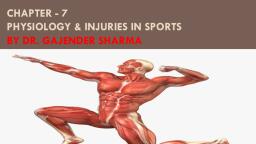
Physiology and, 7 Injuries in Sports, CONTENT, 7.1, 7.2, 7.3, 7.4, 7.5, , 7.6, , Physiological Factors Determining the Components of Physical Fitness, Effects of Exercise on Cardiovascular System, Effects of Exercise on Muscular System, Physiological Changes due to Ageing, Sports Injuries : Classification, Causes and Prevention, Soft Tissue Injuries : Abrasion, Contusion, Laceration, Incision, Sprain and, Strain, Bone and Joint Injuries : Dislocation, Fractures : Stress Fracture, Green, Stick, Comminuted, Transverse, Oblique and Impacted, First Aid-Aims and Objectives, , 7.1 PHYSIOLOGICAL FACTORS DETERMINING THE , COMPONENT OF PHYSICAL FITNESS, INTRODUCTION, “Physiology is the scientific study of functioning of living organism”., It includes how any organism, organ systems, cells, organs and bio-molecules do the, chemical or physical functions. It focuses on various functions and activities of the living, organisms. We can further understand it as the organic processes and phenomena of an, organism. It is the study of tissues and functions of living organisms. Through regular, exercise the physiological functions of body system improve and thus body efficiency, increases a lot., There are various physiological factors, which determine the components of physical, fitness such as strength, speed, endurance and flexibility, etc. As a matter of fact, different, physiological factors determine the different components of physical fitness, which are, described below :, , A. PHYSIOLOGICAL FACTORS DETERMINING STRENGTH, The various physiological factors which determine the strength of an individual of are, stated below :, 1. Size of the muscle: The strength is determined by the size of the muscle. The, bigger and larger muscles can produce more force. With the help of different, methods of strength training such as weight training the size of the muscle can, be increased and as a result of that strength is improved.
Page 2 :
166, , Physical Education-XII, , 2., , 3., , 4., , 5., , Body Weight: The individuals who are heavier are stronger than the individuals, who are lighter. The heavier weightlifters lift the heavier weight. Thus, body, weight also determines the strength of an individual., Muscle Composition : Each muscle consists of two types of muscle fibers, i.e. fast, twitch fibers (white fibers) and slow twitch fibers (red fibers). The percentage of, fast twitch fibers and slow twitch fiber is genetically determined and cannot be, changed through training. The muscle having more percentage of fast twitch, fibers , can produce more strength., Intensity of the nerve impulse: A muscle is composed of a number of motor, units. The total force of the muscle depends on the number of contracting motor, units. The stronger nerve impulse from central nervous system excites more, number of motor units, the muscle will contract more strongly or it can be said, that the muscle will produce more force or strength. So, the intensity of the nerve, impulse also determines the amount of strength., Gender and Age : Gender and age also determines the strength. Males tend to be, more powerful than females. It is also trainable. It can be enhanced with the help, of weight training, isometric and isotonic exercises, etc., , B. PHYSIOLOGICAL FACTORS DETERMINING SPEED, 1., , 2., , 3., , 4., 5., , 6., , Mobility of the nervous system: Our muscles contract and relax at maximum, possible speed. Through the raid excitation and inhibition of concerned motor, centers, the rapid contraction and relaxation is made possible. This is called the, mobility of nervous system. The mobility of a nervous system can be trained to, a limit. It is genetic., Large amount of fast fibers: The high percentage of fast twitch fibers are playing, good role in muscle contraction with more speed than lower percentage of fast, twitch fibers. It cannot be changed by training., Explosion Strength: Explosive strength depends on muscle composition, muscle, size and co-ordination. It also depends on metabolic process. Except the muscle, composition, the remaining factors can be improved by training which ultimately, improve the speed up to limited extent., Flexibility: Flexibility also determines the speed. In fact, good flexibility allows, maximum range of movement without much internal resistance., ATP source: For maximum speed performance the muscle require more amount, of energy at a very high rate of consumption. For this purpose the phosphogen, (adenosine triphosphate) (ATP) and creatine phosphate., Gender and Age: Gender and age also determines the speed. Males tend to be, more flexible than females. It is trainable. It can be enhanced with the help of, training as strength and endurance are enhanced.
Page 3 :
Physiology and Injuries in Sports, , 167, , C. PHYSIOLOGICAL FACTORS DETERMINE FLEXIBILITY, There are many factors which determine the flexibility are mentioned here :, 1. Muscle Strength : The muscles should have a minimum level of strength to make, the movement possible specially against gravity or external force. In sprinting, running the legs or knees cannot be lifted to the required height or angle if the, related muscles (abdominal muscles) are weak., 2. Gender and Age : Gender and age also determines the flexibility. Females tend to, be more flexible than males. As a matter of fact that flexibility decreases with the, advancement of age. It is trainable. It can be enhanced with the help of training, as strength and endurance are enhanced., 3. Joint Structure : In human body, many different types of joints are there. Some, the joints intrinsically have a greater range of motion than others., 4. Stretchability of muscles : This factor is also limiting the range of movements., For making any movement at a joint the muscle must contract to execute the, movement. If muscles are not regularly stretched, they tend to get shorter and, finally lead to restrict the range of movement possible at a joint. The stretchability, of muscles is trainable up to some extent., 5. Internal Environment : Internal environment of the athlete influences the, flexibility. For example, 10 minutes in a warm bath increased body temperature, and flexibility whereas, 10 minutes stay outside in 10°C reduces body temperature, and flexibility., , D. PHYSIOLOGICAL FACTORS DETERMINING ENDURANCE, Endurance is also an important component which is determined by the following, physiological factors :, 1. Aerobic Capacity : The muscles require the energy to perform an activity, continuously. And this energy can be supplied in the presence of oxygen. The, amount of the oxygen can be taken by the lungs from atmosphere. This amount, of oxygen taken into blood from lungs has to be transported to the working, muscles., 2. Lactic Acid Tolerance : The lactic tolerance is important for activities that last, for about 40 seconds or more. It can help in improving endurance. It can be, improved by training., 3. Movement Economy : The economical movements are significant for endurance, performance. A good technique in endurance sports can save energy., 4. Muscle Composition : The slow twitch fibers are best used for aerobic activities, or endurance activities. They produce small levels of force for long periods of, time and that is why, they are better suited for endurance activities., , FACTORS AFFECTING PHYSIOLOGICAL FITNESS, 1., , Heredity : Heredity or genes play an important role in individual’s growth and
Page 4 :
168, , Physical Education-XII, , development like shape, size, structure, height of individual, muscle fiber type., Physical fitness is greatly dependent upon heredity or genes factors of individual, thus affects physiological systems., 2. Regular Exercise : Regular exercise is very important to keep physically fit, and live longer than those who do not. Exercise prevents many illness such as, cancer, Diabetes, fatigue and heart diseases. It increases the good cholesterol and, decreases the bad cholesterol. Regular exercise enables a person to stay fit and, healthy. It brings positive changes in physiological systems of body., 3. Diet : Diet plays an important role in affecting the components of physical fitness., Your diet should include vegetables, fruits, whole grains, eggs, meat, beans and, nuts. It should be low in fat, cholesterol, salt and sugar. You should always avoid, fast food such as burgers, chips, cookies, pastries and fried food, etc. A healthy, balanced food is central to maintain fitness. It provides right vitamins, minerals,, proteins, fats and carbos which your body needs., 4. Gender and Age : Older person has low level of physical fitness because older, person has less efficiency of physiological systems. Gender or sex difference is, also considered in evaluating the components of physical fitness., 5. Health Problems : A healthy person has better physical fitness whereas an ill,, sick or weak person has low level of physical fitness. It has a direct relation with, physiological systems of the body., 6. Stress and Tension : Stress has numerous effects on our body. Overstress, tension, and worries result in decline of physical fitness. This can be managed by yogic, techniques, play and recreation or spiritual guidance to improve physical fitness., Tensed people have the symptoms of moodiness, nervousness, irritability, lack, of concentration, overreactive, coping problems, argumentative and memory, problems, etc. whereas a stress free person always remains charming and, glowing., 7. Intoxicants : Use of drugs, alcohol and tobaco (smoking) reduces the physical, efficiency. Moreover, it leads to many types of health problems. They affect, physiological functioning of various systems., 8. Lifestyle : The lifestyle of a person also affects his wellness and fitness. A person, having habits like regular exercise, adequate and proper nutrition, personal, hygiene, etc. has positive effects on physical fitness., 9. Safe Environment : Safe, clean and healthy environment helps improve physical, fitness whereas pollution, dirty or unsafe environment is hazardous for physical, fitness, it also affects physiological systems., 10. Posture : Good sitting, standing, sleeping postures of an individual contributes a, lot to towards his physical fitness, whereas a poor and bad body posture restricts, it., 11. Rest and Relaxation : Sufficient rest is required after heavy workout, it refreshes,, re-energies and refills us for next workout. It should neither be short nor very
Page 5 :
Physiology and Injuries in Sports, , 169, , long. Proper rest, normal sleep, enjoyable recreational activities like reading, novels, watching television, going for movie or outing, spending time with, family or friends or going on a trip, etc. boost the energy to keep you mentally, alert and physically fit., 12. Hygienic Habits : Hygienic habits help develop physical fitness whereas wrong, habits or unhygienic conditions hinder physical fitness., 13. Motivation and Feedback : The psychological factors like motivation, anxiety, and feedback help to improve physical fitness and physiological functioning of, body., , 7.2 EFFECTS OF EXERCISE ON CARDIOVASCULAR SYSTEM, , Cardiovascular system consist of the heart, blood vessels and approximately 5 litres of, blood that the blood vessels transport. Cardiovascular system undergoes. Many drastic, changes during and immediately after intense exercise. The exercise leaves short term as, well as long term effects on the cardiovascular system, which are discussed ahead :, , A. SHORT-TERM EFFECTS, 1., , 2., , 3., , 4., 5., , Increase in heart rate : Generally the resting heart rate of an adult remains at, 72 beats per minute. Basically, before exercise, the heart rate begins to increase,, which is called ‘anticipatory response’. During vigorous exercise, the heart rate, increases as per the intensity and duration of the exercise., Increase in stroke volume : Stroke volume is the amount of blood ejected per beat, from the heart. Stroke volume increases proportionally with exercise intensity., In untrained individuals the stroke volume at rest remains at 50 to 70 ml beat., The stroke volume of experienced athletes at rest remains at 90 to 110 ml/beat. It, increases up 150 to 220 ml/beat during intensive exercise., Increasing in cardiac output : Cardiac output is the amount of blood pumped, by the heart in one minute. It is the product of stroke volume and heart rate (SV, × HR = CO). At rest, the cardiac output is about 5L/min. During intense exercise,, this can increase upto 20-40 L/min., Increase in blood flow : The cardiovascular system can redistributed more blood, to those tissues which have immediate demand and less blood to those tissues, which have less demand for oxygen., Increase in Blood Pressure : At the rest, the systolic blood pressure of a healthy, individual ranges from 110-140 mm Hg and diastolic blood pressure ranges 60-90, mm Hg. During exercise the systolic blood pressure can increase to over 200mm, Hg. The diastolic pressure on the other land remains unchanged irrespective of, exercise intensity., , B. LONG-TERM EFFECTS, After performing exercise for long term, certain adaptations take place in our cardiovascular, system. These are called long term effects of exercise. The various long term effects of, exercise are stated below :
Page 6 :
170, , Physical Education-XII, , 1., 2., 3., 4., 5., 6., 7., , Increase in the size of the heart : When you perform regular exercise the muscles, of the heart increase in size and strength. In fact, the left ventricle adapts to the, greatest extent. The walls of heart grow stronger and thicker., Decrease in resting heart rate : Regular exercise decreases the resting heart rate., Eventually, the heart becomes more efficient and no longer needs to beat as, quickly to supply the body with blood while at rest., Increase of stroke volume in rest : The resting heart rate is able to slow down, because the heart is now trained to pump a larger quantity of blood every beat., Decrease of blood pressure : Regular exercise decreases the blood pressure., Thus, it decreases the chances of hypertension and other diseases due to increase, in blood pressure., Increase in blood volume : During heavy exercises, the body produces a greater, number of red blood cells to keep the muscles supplied with oxygen. In fact,, there is an increase in plasma volume which enhances the blood volume., Quicker recovery rate : Regular exercise quickens the recovery rate. A trained, athlete’s heart rate becomes normal earlier in comparison to a beginner.So, the, recovery becomes fast., Reduced risk of heart diseases: Regular exercise gradually reduces stress-related, hormones from circulating in the blood. This increases the blood vessel path,, which in turn lowers the risk for the build up of plaque that can lead to coronary, heart diseases. Hence, exercises reduce the risk of heart diseases., , 7.3 EFFECTS OF EXERCISE ON MUSCULAR SYSTEM, , The muscles need food after continuous exercise. This food they get by the increased speed, of blood circulation. This causes chemical change in muscles. As a result temperature, increases., A part of the energy generated in this process is consumed in expansion and, contraction of muscles and the other in increasing the temperature. The roughage is, excreted from the body through blood circulation, sweating or excretion system. Exercise, increases the speed of all these systems. Regular exercise causes following effects on our, muscular system :, 1. Change in Size and Shape of Muscle : Regular exercise helps in enlarging cells, of muscles which inturn helps in changing size and shape of muscles., 2. Increase in the Strength of Muscles : A person who does exercise daily has, stronger muscles and such muscles work more. These become stronger by getting, more nutritious food in the form of oxygen., 3. Increase in Co-ordination : Regular exercise increases coordination in the, muscles. These become stronger by doing exercise. As a result a person does, not feel fatigue even by working for a long time. If the muscles do not have, co-ordination or have incomplete co-ordination then the working becomes, impossible.
Page 7 :
Physiology and Injuries in Sports, , 4., , 5., , 6., , 7., 8., , 9., , 171, , Increase in Supply of Blood : Muscles get chemical substances like, glycogenephoscoratine, potassium, etc. by doing regular exercise. These chemical, substances increase the speed of blood., Effects on Bones and Joints : By doing exercise our bones become hard and they, can work for more time. It also have effects on our joints. Thus, the bones and, muscles become strong by doing exercise. Children’s bones happen to be very, soft and fragile. Activities of muscles effect these a lot. By the lack of these the, bones remain soft and deformity take place in them., Helpful in old age : Old age leads to many deformities in our body as hump in, back, pain in joints or swelling, etc. But we can keep away from problems in old, age, if we keep on exercising regularly from the young age., Healthy and sound body : Our body becomes balanced and flexible by doing, regular exercise and looks beautiful., Delays fatigue : Regular exercise increases the muscles capacity and thus less, lactic acid is produced by the muscles. When formation of lactic acid in muscles, decreases in that case fatigue also decreases. Thus, muscles can work for long, time and with greater efficiency., Controls extra fat : Regular exercise helps in controlling extra body fat. Exercises, burn the calories which is taken in the form of fat., , 7.4 PHYSIOLOGICAL CHANGES DUE TO AGEING, Meaning of Ageing : Ageing is an inevitable and extremely complex, multi-factorial, process. It is characterized by the progressive degeneration of organ systems and tissues., It is largely determined by genetic and influenced by a wide range of environmental, factors such as diet, exercise, exposure to micro-organism, pollutants and radiation, etc., In fact, ageing is a process of gradual changes in the body with the passage of time. These, changes are noticeable usually after 30s. Ageing, in its broadest sense is the continuous, and irreversible decline in the efficiency of various physiological functions., Physiological Changes due to Ageing : Due to ageing following physiological, changes are observed :, 1. Skin : With the increase in age, the skin becomes less elastic, wrinkled and more, lined. The growth of nails also slow lined. The growth of nails also slow down., The production of oil in the gold glands also decreases. As a result, the skin, becomes drier than before., 2. Bones : Throughout adulthood, all people gradually lose some minerals from, their bones, as a result the bones become weak and less dense. Due to weak and, less density of bones, there is risk of osteoporosis in old age., 3. Vision : Most people when they reach in their 40s develop a need for reading, glasses as the lenses in the eyes become less flexible. It is very normal for night, vision. As a result the visual sharpness declines.
Page 8 :
172, , Physical Education-XII, , 4., , 5., , 6., , 7., , 8., 9., , 10., , 11., , 12., 13, , Metabolism and Body Composition : With ageing body needs lesser energy, hence the metabolism slows down. Due to changes in hormones in the old age,, people have less body fat and muscle mass., Changes in muscle size and strength: When an individual gets older, muscles, become weaker. There is a decrease in muscle mass and increase in overall body, fat. Due to decrease in muscle size, the strength of the muscles also decreases. The, decrease in strength gradually occurs during the age of 35 to 45 years. However,, even at the age of the decrease in strength does not appear to exceed 20% of an, individual’s maximum strength., Sleep : With ageing, there are changes in sleep system. Aged people have less, sleep at night and even their sleep is not so deep. As a result, old people wake up, more frequently at night or wake up very early in the morning., Hearing : Hearing loss is common with ageing. The sense of balance weakens, with ageing. The older persons may complain of dizziness and find it difficult, to move quickly without losing their balance. Tinnitus is more common among, older adults., Smell : After the age of 50, the sense of smell decreases rapidly. In fact, the, number of functioning smell receptors in the upper sinus decreases., Taste : Taste also dimnishes with increasing age. In fact, total number of taste, buds are reduced with ageing so the elderly persons experience some decline in, the ability to taste. It can cause less interest of food., Flexibility : The elasticity of tendons, ligaments and joint capsules is decreased, with ageing. The elderly persons lose 8-10 cm of lower ack and hip flexibility, according to a research study. The range of movement is restricted as the age, increased., Brain and Nervous system : Aging affects the brain and nervous system. With, aging the brains’s weight, the size of its nervous network and its blood flow, decreases. Memory changes and loss of memory are normal part of ageing, process., Urinary Incontinence : Ageing decreases the urinary continency. There is also a, change in urinary system and mobility of urine decreases., Heart and Blood Circulation : The efficiency of heart becomes less with ageing., During activities, the heart has to work harder as a result the heart muscles, become a little larger. The blood circulation also slows down. Heart valves, become less flexible., , 7.5 SPORTS INJURIES : CLASSIFICATION, CAUSES AND , PREVENTION, , Sports injuries are common in the field of games and sports. During practice, training or, competition, any player can be injured. These injuries may occur in teens for a variety of
Page 9 :
Physiology and Injuries in Sports, , 173, , reasons, including improper training, lack of appropriate footwear or safety equipment, and rapid growth during puberty. Though coaches, physical trainer and sports doctor, have been making their best possible efforts to prevent injuries but they have not got a, complete success so far. Though it is certain that if the appropriate steps are taken during, the game, the chances of getting injuries can be reduced. First aid means immediate, treatment provided to injured player on the spot in the ground is called first aid of sports, injury. To play according to rules and proper officiating can be preformed before training, and competition. The scientific knowledge can also be beneficial in preventing sports, injuries upto some extent. There are various types of common sports injuries which are, as follows :, (A) Soft Tissue Injuries (B) Bone Injuries (C) Joint Injuries, (A) Soft Tissue Injuries, There are following types of soft tissue injuries :, 1. Contusion 2. Strain 3. Sprain 4. Abrasion, 1. Contusion : Contusion is a muscle injury. A direct hit with or without any sports, equipment can be the reason of contusion. Contusion is common in boxing,, wrestling and kabaddi., , Sign & Symptoms, (i), Swelling and pain on the contused part., (ii), Stiffness over the area, (iii), Discoloration under skin. This starts from redness to turning blue or black, gradually., Treatment, (i), Apply a compression of ice or lint soaked in equal parts of spirit and water, at the time of injury., (ii), Continue ice massage three to four times a day., (iii), After three days, apply heat instead of ice massage and massage gently to, reduce swelling., (iv), For the purpose of rehabilitation, the flexibility exercises should be, performed carefully., 2. Strain : It is muscles injury. This injury causes tearing or over stretching of muscle, fibers. Mostly sudden over stretching in athletics cause tearing of quadriceps, gymnastics, weight lifting, track and field., , Sign & Symptoms, (i), Swelling in the area, (ii), Pain in moving the body part such as arm or leg, (iii), Loss of strength in movement, Treatment, (i), The injured limb should be kept in a comfortable position.
Page 10 :
174, , Physical Education-XII, , (ii), , Cold compression should be used immediately for 20 to 30 minutes. Direct, application of ice is not recommended. The ice pieces should be wrapped, in cotton or cloth., (iii), If pain still persists, some painkiller may be given to the injured player., (iv), The injured person should be elevated., (v), After 5 days warm water should be applied., (vi), If many muscles or organs are damaged, a doctor should be consulted, immediately., 3. Sprain : It is a ligament injury. It may occur due to overstretching or tearing of, ligament. Generally, sprain occurs at wrist joint and ankle joint. In such injury,, swelling, inflammation, severe pain and tenderness are common symptoms., , Sign & Symptoms, (i), Swelling on the spot, (ii), Acute pain at the injured spot, (iii), Softness at the spot and pain on touching., Treatment, (i), Don’t move the injured part and go for medical advice., (ii), In mild sprain apply ice compression 3 to 4 times a day for three days and, cover the, (iii), After three days apply heat, (iv), Light massage should be performed., (v), In case of ankle sprain, ‘8’ type bandage should be tightened., (vi), If pain still persists painkiller should be given to the injured person., 4. Abrasian : Abrasion is a superficial injury of skin. Abrasion occurs due to friction, with certain equipment or fall over the area where the bone is very close to skin., It occurs to the upper part of the skin. Such injuries occur in sports like Wrestling,, Football, Cricket, Hockey and track and field, etc., , Sign & Sympotm, (i), Scraping of skin with some burning pain., (ii), Some bleeding or oozing at the abrasion spot., Treatment, (i), Wash affected area with soap and warm water., (ii), The injured part should be dressed up if abrasion is severe. Dressing, should not be done, (iii), Anti-tetanus injection should be given as early as possible., (iv), If there is severe pain, painkiller may be given., 5. Cramp : Cramp is inability of muscles to contract properly causing severe pain, over affected part. In other words, this is unbalance contraction of muscles. The
Page 11 :
Physiology and Injuries in Sports, , 175, , causes of the cramp are due to over straining (without rest), loss of body water by, sweating; physical activity during sickness, loss or lack of body slots or minerals,, not performing proper warm-up, etc., Treatment, (i), Complete rest to the affected individual., (ii), Drink sufficient water (preferably salty or juices) during prolonged, activity., (iii), Massage over affected part after sometime., (iv), If pain is more, apply ice or cold compression for some duration., (v), Preventing overexertion of muscles in excessive hot or cold climate., 6. Laceration : A injury that cause an irregular cut on skin is called laceration., This cut takes the form of wound. Laceration may have bleeding and mild pain., Deep Laceration usually have severe bleeding and pain. Tear in skin, bleeding,, wounds, etc. are the symptoms of laceration., Treatment, (i), Try to stop bleeding by compression., (ii), Clean the wound with water., (iii), Apply band-aid on the wound., (iv), Repeat dressing of the wound., (v), In case of severe injury take medical help., 7. Incision : Incision tend to heal sooner than laceration. Incision are cut on skin, with sharp edges which can bleed freely. Usually this cuts are made from sharp, cutting object such as broken glass., Treatment, (i), Clean the cut with iodine tincture, so that germ may be removed from the, wound., (ii), Bandage the cut with the help of cotton and band-aid., (iii), In case of excessive bleeding bandage the cut tightly and if necessary, visit, the doctor immediately.�, B. Bone, Injuries, (Dislocation,, Fracture) : Bone injury is a serious, injury and it is very painful., If bone injury is not handled, properly, it may lead to permanent, disability thus, to he handled by, an expert Doctor. Bone injury can, be classified in two categories as, follows :, Fracture of Radius
Page 12 :
176, , Physical Education-XII, , Various Types of Fractures, , Fracture : Fracture is a broken or cracked bone mainly caused by terrible force due, to accidents. It is caused due to direct or indirect impact, collision, falls, accidents etc. in, different sports. Fracture can be categorized as follows :, 1. Simple Fracture : The fracture without any wound is called simple fracture., 2. Compound or open fracture : In this fracture there is cut over the skin by the, sharp edges of broken bone or by external object along with broken bones., Generally, the broken bone comes out through the skin by tearing it., 3. Green Stick Fracture : These fractures are commonly seen in children because, their bone are very soft and delicate whenever there is any stress on the bone or, it is bent., 4. Comminuted Fracture : When a bone is broken up into many small pieces. It, is called comminuted fracture. Such type of fracture is possible in cycle race or, motor cycle race., 5. Impacted Fracture : The broken bone is driven into another bone. It is called, impacted fracture., 6. Complicated Fracture : Bone is crushed, moreover, the delicate organs like brain,, heart, liver, kidney nerves, blood vessels, etc. are damaged by it. These types of, fractures are complicated and dangerous. Such fractures are common in high, jump and pole vault., 7. Stress Fracture : It is small crack in bone. It can caused due to overuse of a stretch, activities. That is why what it is common in athletes and runners., 8. Transverse Fracture : It is a fracture that occurs in the spinal bone. It is severly, painfull. Medical help is necessary to rectify this injury. Sometime even a surgery, or an operation may be required to treat this fracture., 9. Obligue bone fracture : These are slanted fractures that occur when a force is, applied at any angle other than a right angle on bone., Symptoms, There is severe pain, swelling, numbness, tenderness and bruising at the site of the, fracture. The affected parts are painful and can’t be moved easily.
Page 13 :
Physiology and Injuries in Sports, , 177, , Treatment, (i), The mobility of damaged fragments of bone should be prevented by using, splints, slings and bandage., (ii), Try to locate the fracture by touching very gently., (iii), If there is a compound fracture neither use any antiseptic nor wash the, wound. At that time, use the dry and disinfectant bandages., (iv), Careful and comfortable transportation of injured should be planned to, the hospital to seek medical treatment., (v), In the case of fractures, with appreciable displacement, the immobilization, is done after a satisfactory corrective reduction. Immobilization is done, by using plaster of Paris casts., (vi), If there is fracture in femur, anesthetics should be given to the injured, athlete and the affected should be immobilised., C. Joint Injuries : Dislocation of a joints is a main, injury. Intact, it is a dislocation of surface of bones., There are following types of dislocations :, Dislocation : When the bones displaced from, its original position, it’s called dislocation., Dislocation is main injuries of joints., Symptoms : Intense pain, total loss of functioning,, swelling of the joints, tenderness, may be, temporary paralysis of the injured limb, etc., Treatment �, (i), All movements of the patient should be, restricted to prevent complications., (ii), Ice packs could help relative pain, or to, Dislocation of Right Shoulder, reduce the inflammatory swelling., (iii), Patient must be rushed the hospital, to seek medical treatment. �, (i), Dislocation of lower Jaw : Generally,, it occurs when the chin strikes to, any other object. It may also occur if, mouth is opened excessively., (ii), Dislocation of Shoulder Joint :, Dislocation of shoulder joint may, occur due to sudden jerk or a fall on, hard surface. The end of the humerus, comes out from the socket., (iii), Dislocation of Hip Joint : By putting, maximum strength spontaneously, Dislocation of Right Hip Shoulder
Page 14 :
178, , Physical Education-XII, , may cause dislocating of hip joint. The end of the femur is displaced from, the socket., Prevention, 1 . Adequate warm-up should be performed prior to any physical activity., 2. Proper conditioning should be done in preparatory period., 3. Protective equipments should be used as per requirement of the game/sport., 4. Always obey the rules and regulations., 5. The affected limb should be immobilised immediately by bandages. You should, not try to adjust the dislocated limb., 6. The victim should be taken to hospital promptly on a stretcher., , PREVENTION OF SPORTS INJURIES, The risk of injury accompanies participation in almost all sporting activities. As the number, of participants a both competitive and recreational sports has increased, there has been a, corresponding increase in the number of injuries. Sports injuries can have profound, long, lasting effects on sportsperson. Injuries, particularly these not properly cared for, may, develop into conditions that can last a lifetime. Some of these conditions are chronic for, example Tennis Elbow. Runner’s knee or obsterthritis. Even sometimes, due to injury, a, sportsperson can not take part in sports competition. It may have a negative impact on, the sports performance. The famous scientists suggest that the injury rate can be reduced, by 25% if sportsperson takes appropriate steps for the prevention of sports injuries which, are described below :
Page 15 :
Physiology and Injuries in Sports, , 1., , 179, , Proper Warming : Proper warmup is essential for the sportspersons before taking, the part in training or sports competition. It definately reduces the chances of, getting injury because muscles remain in tone up position after getting proper, warm-up. A proper warm up routine should be of atleast ten minutes. Such type, of warm-up is always helpful in reducing the chances of sports injury., 2. Balanced Diet : Balanced diet is necessary for all the players or athletes because, the lack of essential minerals and vitamins like calcium, phosphorus and vitamin, ‘D’, etc. make bones weak. And weak bones cause sports injuries. So, balanced, diet is helpful in the prevention of sports injuries., 3. Use of Protective Equipments : The best way to prevent from sports injuries, the, use of protective equipment is essential. The stress should be laid down on the, quality of protective equipment., 4. Use of proper Technique : The sportsperson should learn the proper technique, of sports or games from a qualified coach or trainer so that the risk of getting, injuries may be reduced., 5. Obeying the rules : The athletes or players should obey the rules of games/sports, properly so that the sports injuries can be prevented upto some extent., 6. Proper knowledge of sports skills : If a player has deep knowledge of sports skills, and is efficient completely in performing those skills you can prevent injuries, upto some extent. For example, a high jumper should have proper knowledge, and efficiency in landing skill. If he is not efficient in this skill he may get injury, while landing., 7. Proper Conditioning : It is a fact that many injuries are caused by weak muscles, which are not ready to meet the demand of your sports or games. So, for getting, proper muscular strength, proper conditioning of your body is essential., Weight training and circuit training methods are important methods of proper, conditioning. These methods improve the neuro-coordination which is also, helpful in preventing sports injuries., 8. Proper Sports Facilities : Infact, sports injuries can be prevented, if good quality, of sports equipments and proper sports grounds are available for practice and, competition. If playground are maintained properly, the chances of getting, injury on the playground will be reduced., 9. Unbiased officiating : Good officiating is also essential in preventing sports, injuries during a match. If the officials of the match are biased, there may be, more chances of indiscipline among players which may further lead to injuries., 10. Proper Cooling Down : Cooling down should be proper. Atleast for 5 to 10 minutes, light aerobic activity such as slow running or jogging should be performed. After, that stretching exercises should be done for five minutes. Proper cooling down, helps in removing the waste products like lactic acid, etc.
Page 16 :
180, , Physical Education-XII, , TIPS FOR PREVENTING SPORTS INJURIES, 1., 2., 3., 4., 5., 6., 7., 8., 9., 10., 11., 12., 13., 14., 15., 16., 1., , 2., , Avoid training when you are tired., Any increase in training load should be preceded by an increase in strengthening., It you experience pain during training period. Stop your training session, immediately., Pay attention to hydration and nutrition., Equipment should be appropriate and safe to use., Allow lots of time for warming up and cooling off., Carbohydrate during periods of heavy training, Increase in training should be matched with increase in resting., Treat even seemingly minor injuries very carefully to prevent them becoming a, big problem., Training and competition areas should be clear of hazards., Introduce new activities very gradually., Check overtraining and competition courses beforehand., Stay away from infectious areas when training or competing very hard., Be extremely fussy about hygiene in hot weather., Have regular hot massage., Never train hard if you are stiff from the previous effort., Soft Tissue Injuries Treatment, (i), Apply a compression of ice or lint soaked in equal parts of spirit and water, at the time of injury., (ii), Continue ice massage three to four times a day., (iii), After three days, apply heat instead of ice massage and massage gently to, reduce swelling., (iv), For the purpose of rehabilitation, the flexibility exercises should be, performed carefully., Strain Treatment, (i), The injured limb should be kept in a comfortable position., (ii), Cold compression should be used immediately for 20 to 30 minutes. Direct, application of ice is not recommended. The ice pieces should be wrapped, in cotton or cloth., (iii), If pain still persists, some painkiller may be given to the injured player., (iv), The injured person should be elevated., (v), After 5 days warm water should be applied., (vi), If many muscles or organs are damaged, a doctor should be consulted, immediately.
Page 17 :
Physiology and Injuries in Sports, , 3., , 4., , 5., , 6., , 7., , 181, , Sprain Treatment, (i), Don’t move the injured part and go for medical advice., (ii), In mild sprain apply ice compression 3 to 4 times a day for three days and, cover the, (iii), After three days apply heat., (iv), Light massage should be performed., (v), In case of ankle sprain, ‘8’ type bandage should be tightened., (vi), If pain still persists painkiller should be given to the injured person., Abrasian Treatment, (i), Wash the affected area with soap and warm water., (ii), The injured part should be dressed up if abrasion is severe. Dressing, should not be done, (iii), Anti-tetanus injection should be given as early as possible., (iv), If there is a severe pain, painkiller may be given., Cramp Treatment, (i), Complete rest to the affected individual., (ii), Drink sufficient water (preferably salty or juices) during prolonged, activity., (iii), Massage over affected part after sometime., (iv), If pain is more, apply ice or cold compression for some duration., (v), Preventing overexertion of muscles in excessive hot or cold climate., Bone Injury Management Treatment, (i), The mobility of damaged fragments of bone should be prevented by using, splints, slings and bandage., (ii), Try to locate the fracture by touching very gently., (iii), If there is a compound fracture neither use any antiseptic nor wash the, wound. At that time, use the dry and disinfectant bandages., (iv), Careful and comfortable transportation of injured should be planned to, the hospital to seek medical treatment., (v), In the case of fractures, with appreciable displacement, the immobilization, is done after a satisfactory corrective reduction. Immobilization is done, by using plaster of Paris casts., (vi), If there is fracture infemur, anesthetics should be given to the injured, athlete and the affected should be immobilised., Management of Joint Injuries Treatment, (i), All movements of the patient should be restricted to prevent complications., (ii), Ice packs could help relative pain, or to reduce the inflammatory swelling., (iii), Patient must be rushed to the hospital to seek medical treatment.
Page 18 :
182, , Physical Education-XII, , 7.6 FIRST AID-AIMS AND OBJECTIVES, , Meaning of First Aid : First-Aid is the assistance given to person suffering a sudden, injury. Before the final treatment., In other words it can be said the help given by a trained or untrained person with, available resources is called First-Aid., Modern time is a technical period. It is a time full of scientific inventions. On the, one hand the inventions of science has made our life simple and easy. On the other hand, because. A same inventions our life has become full of complexities and accidents. Today,, any time accidents may occur anytime on the road, just because of increasing transports., In the same way, any accident can happen during household work or by any electric, shock, etc. Some injury may happen while playing. In this situation, the victim need, immediate medical help. This is done by First-Aid. It sometimes proves to be life-saver.., , AIM AND OBJECTIVE OF FIRST-AID, 1., 2., 3., , 4., 5., , To preserve life : The first aim of first aid is to pressure the life of an injured, person. But there are some limitation which are necessary to understand. Such, as rebandage on the injury is not in the range of first-aid., To reduce pain : Reducing the pain of an injured person is also an important, objective of first-aid. Pain is a common phenomenon in any accident. This pain, can be reduced with the help of First-Aid., Helpful in improving Plight : It is necessary to keep the condition of patient but, of pain before any medical help. If there is strong blood flow, the condition may, worsen. Then it must be controlled. To control this condition the speed of blood, flow should be reduced. The speed of blood flow can be reduced by keeping the, person in stationary position., Prevent injury becoming worse : First-aid is helpful in prevention of further, worsening of existing injury. It this prevention is not endured on right time, it, may get more severe and more complications may arise., Immediate Medical help : Medical help is necessary in severe injury. The injured, person should be taken to the hospital as soon as possible. But if the person, helping him is alone or the injured person is not in condition to take him at, hospital at the time of injury. First-aid should be provided and then he should be, taken to hospital at the earliest.
Page 19 :
Physiology and Injuries in Sports, , Important Questions, VERY SHORT ANSWER TYPE QUESTIONS, 1., 2., 3., 4., 5., 6., 7., 8., 9., 10., 11., 12., 13., 14., 15., 16., 17., 18., 19., , Define Physiology., What is Flexibility ?, What do you mean by cardiovascular system ?, Write a short note on capillaries., What is cardiac output ?, What do you mean by stroke volume ?, What is circulatory system ?, What do you understand by blood pooling ?, Can you define ageing ?, What is strain?, What is contusion?, What is fracture?, What is dislocation of joint?, What are soft tissue injuries?, What is strain ?, What do you mean by contusion ?, What is abrasion ?, What is green stick fracture ?, What do you mean by compound fracture ?, , SHORT ANSWER TYPE QUESTIONS (3 MARKS), 1., 2., 3., 4., 5., 6., 7., 8., 9., 10., 11., 12., , What do you mean by oxygen intake and oxygen uptake ?, How does heredity and diet affect the physical fitness ?, Does joint structure determine the flexibility ?, Discuss the blood., Write a note on heart., Write any two effects of exercise on cardiovascular system., Briefly explain about ageing., Briefly discuss the circulatory system., Write any two effects of exercise on circulatory system., Briefly explain about ageing., Discuss the effects of ageing on the size and strength of muscles., Elaborate the effects of ageing on bone density., , 183
Page 20 :
184, , Physical Education-XII, , 13. Explain any three physiological factors determining speed., 14. Elaborate any three physiological factors determining endurance., 15. How does exercise affect the cardiovascular system? Write any three short term, effects., 16. Discuss how does exercise affect the circulatory system., 17. Elaborate any three physiological changes occuring due to ageing., 18. What steps should be taken to prevent sports injuries ?, 19. What are soft tissue injuries ? What are its types ?, 20. What is contusion ? Mention the first aid for contusion ?, 21. Explain the tips for preventing sports injuries ?, 22. What is strain ? Write its symptoms and prevention., 23. What is Abrasion ? What are its symptoms and prevention ?, 24. What do you mean by bone injuries ? Explain the types of fracture., 25. What do you mean by joint injuries ? Explain the types of dislocations of joints., , LONG ANSWER TYPE QUESTIONS (5 MARKS), 1., 2., 3., 4., 5., 6., 7., 8., , , What is physiology? Discuss about he various physiological factors determining, physical fitness., Discuss the physiological factors determining ‘strength’ as a component of, physical fitness., Discuss any five effects of exercise on cardio-vascular system., Elucidate any five physiological changes due to ageing., Elaborate the role of regular exercise on ageing process., Explain the soft tissue injuries in detail., What steps should be taken to prevent sports injuries ?, Write a short note on the following :, (a) Contusion (b) Sprain (c) Strain (d) Bone Injuries (e) Joint Injuries or Dislocation
Page 21 :
Physiology and Injuries in Sports, , 185, , Solved Practice Questions, VERY SHORT ANSWER TYPE QUESTIONS, Q1. What do you mean by physiology?, Ans. Physiology is the scientific study of functions in living organism. It includes how, any organism, organ systems, cells, organs and bio-molecules do the chemical or, physical functions., Q2. State any one physiological factor which determines flexibilty ?, Ans. This factor is also limiting the range of movements. For making any movement, at a joint the muscle must contract to execute the movement. If muscles are not, regularly stretched, they tend to get shorter and finally lead to restrict the range, of movement possible at a joint. The stretchability of muscles is trainable up to, some extent., Q3. What do you mean by cardiac output?, Ans. Cardiac output is the amount of blood pumped by the heart in one minute, measured in min. It is product of stroke volume and heart rate (SV × HR = CO)., At rest, the cardiac output is about 5L/min. During intense exercise, this can, increase upto 20-40 L/min., Q4. What do you mean by cardiovascular system?, Ans. Cardiovascular system consist of the heart, blood vessels and approximately 5, litres of blood that the blood vessels transport. Cardiovascular system undergoes., Many drastic changes during and immediately after intense exercise. The exercise, leaves short term as well as long term effects on the cardiovascular system., Q5. What do you mean by ageing ?, Ans. Ageing is an inevitable and extremely complex, multi-factorial process. It is, characterised by the progressive degeneration of organ systems and tissues. It is, largely determined by genetic and influenced by a wide range of environmental, factors such as diet, exercise, exposure to micro-organism, pollutants and, radiation, etc. In fact, ageing is a process of gradual changes in the body with, the passage of time. These changes are noticeable usually after 30s. Ageing, in, its broadest sense is the continuous and irreversible decline in the efficiency of, various physiological functions., Q6. Write about first aid to be given in any sport injury., Ans. The first aid to be given in any sports injury are :, (a) First thing should be done first. Respond quickly for the assistance without, wasting any time., (b) Adopt a calm and methodical approach to the injured., (c) Quick and confident examination will be helpful to the injured. Time spent, on long and elaborate examination of a injured may be time lost in his, ultimate recovery.
Page 22 :
186, , Physical Education-XII, , (d) Treat obvious injuries and conditions endangering life, i.e. sever bleeding,, shock, etc. before making a complete diagnosis., , SHORT ANSWER TYPE QUESTIONS (3 MARKS), Q1. Explain any three physiological factors determining speed., Ans. The physiological factors determining speed are given below :, 1., Mobility of the nervous system : Our muscles contract and relax at, maximum possible speed. Through the raid excitation and inhibition of, concerned motor centres, the rapid contraction and relaxation is made, possible. This is called the mobility of nervous system. The mobility of a, nervous system can be trained to a limit. It is genetic., 2., Muscle Composition : Each muscle consists of two types of muscle fibres,, i.e. fast twitch fibres (white fibres) and slow twitch fibres (red fibres). The, percentage of fast twitch fibres., 3., Flexibility : Flexibility also determines the speed. In fact, good flexibility, allows maximum range of movement without much internal resistance., Q2. How does exercise affect the cardiovascular system? write any three short term, effects., Ans. Cardiovascular system consist of the heart, blood vessels and approximately 5, litres of blood that the blood vessels transport. Cardiovascular system undergoes., Many drastic changes during and immediately after intense exercise. The exercise, leaves short term as well as long term effects on the cardiovascular system, which, are mentioned here :, (A) Short-term Effects, 1., Increase in heart rate : Generally the resting heart rate of an adult remains, at 72 beats per minute. The elite endurance athletes usually have 28 to 40, beats per minute. Basically, before exercise, the heart rate begins to increase,, which is called ‘anticipatory response’., 2., Increase in stroke volume : Stroke volume is the amount of blood ejected, per beat from the left verticle. It is measured in mil beat. Stroke volume, increases proportionally with exercise intensity. In untrained individuals, the stroke volume at rest remains at 50 to 70 mil beat. It increases upto 110, to 130 ml/beat during intense exercise. The stroke volume of experienced, athletes at rest remains at 90 to 110 ml/beat. It increases up 150 to 220 ml/, beat during intensive exercise., 3., Increasing in cardiac output : Cardiac output is the amount of blood, pumped by the heart in one minute measured in min. It is product of stroke, volume and heart rate (SV × HR = CO). At rest, the cardiac output is about, 5L/min. During intense exercise, this can increase upto 20-40 L/min., Q3. Discuss any three physiological factors determining endurance., Ans. Endurance is also an important component which is determined by the following, physiological factors :
Page 23 :
Physiology and Injuries in Sports, , 1., , Q4., Ans., , Q5., Ans., , 187, , Lactic Acid Tolerance : The lactic tolerance is important for activities that, last for about 40 seconds or more. It can help in improving endurance. It can, be improved by training., 2., Movement Economy : The economical movements are significant for, endurance performance. A good technique in endurance sports can save, energy., 3., Muscle Composition : The slow twitch fibres are best used for aerobic, activities or endurance activities. They produce small levels of force for, long periods of time and that is why, they are better suited for endurance, activities., Mention any three physiological factors which determine physical fitness., 1., Heredity : Heredity or genes play an important role in individual’s growth, and development like shape, size, structure, height of individual, muscle, fibre type. Physical fitness is greatly dependent upon heredity or gene, factors of individual thus, affects physiological systems., 2., Diet : Diet plays an important role in affecting the components of physical, fitness. Your diet should include vegetables, fruits, whole grains, eggs,, meat, beans and nuts. It should be low in fat, cholestrol, salt and sugar., You should always avoid fast food such as burgers, chips, cookies, pastries, and fried food, etc. A healthy balanced food is central to maintain fitness., It provides right vitamins, minerals, proteins, fats and carbos which your, body needs., 3., Lifestyle : The lifestyle of a person also affects his wellness and fitness. A, person having habits like regular exercise, adequate and proper nutrition,, personal hygiene, etc. has positive effects on physical fitness., Elaborate any four physiological changes in human body due to ageing., Due to ageing following physiological changes are observed :, 1., Metabolism and Body Composition : With ageing body needs lesser energy, hence the metabolism slows down. Due to changes in hormones in the old, age, people have less body fat and muscle mass., 2., Brain and Nervous system : Aging affects the brain and nervous system., With aging the brains’s weight, the size of its nervous network and its, blood flow decreases. Memory changes and loss of memory are normal, part of ageing process. Recalling of recent memories becomes less and, remembering names and details becomes slower., 3., Urinary Incontinence : Ageing decreases the urinary continency. There is, also change in urinary system and mobility of urin decreases., 4., Heart and Blood Circulation : The efficiency of heart becomes less with, ageing. During activities, the heart has to work harder as a result the heart, muscles become a little larger. The blood circulation also slows down. Heart, valves become less flexible.
Page 24 :
188, , Physical Education-XII, , LONG ANSWER TYPE QUESTIONS (5 MARKS), Q1. Discuss physiological factors determining the flexibillity as a component of, physical fitness., Ans. There are many factors which determine the flexibility are mentioned here :, 1., Muscle Strength : The muscles should have a minimum level of strength to, make the movement possible specially against gravity or external force. In, sprinting runnings the legs or knees can not be lifted to the required height, or angle if the related muscles (abdominal muscles) are weak., 2., Gender and Age : Gender and age also determines the flexibility. Females, tend to be more flexible than males. As a matter of fact that flexibility, decreases with the advancement of age. It is trainable. It can be enhanced, with the help of training as strength and endurance are enhanced., 3., Joint Structure : In human body, many different types of joints are there., Some the joints intrinsically have a greater range of motion than others., 4., Stretchability of muscles : This factor is also limiting the range of, movements. For making any movement at a joint the muscle must contract, to execute the movement. If muscles are not regularly stretched, they tend, to get shorter and finally lead to restrict the range of movement possible at, a joint. The stretchability of muscles is trainable up to some extent., 5., Internal Environment : Internal environment of the athlete influences, the flexibility. For example 10 minutes in a warm bath increased body, temperature and flexibility whereas, 10 minutes stay outside in 10oC, reduces body temperature and flexibility., Q2. Enumerate any five effects of exercise on circulatory system., Ans. Circulatory system is a biological phenomenon which circulates the blood and, lymph through the body. It is consist of heart, blood vessels, blood lymph,, lympathic vessels and glands., The circulatory system transports the nutrients like amino acids, electrolytes,, oxygen, carbondioxide, hormones, blood cells, etc. to and from cell in our body. It, helps in nourishment of body help fight the diseases, stabilize body temperature,, pH and to maintain homeostasis., Effects of exercise on the circulatory system, 1., Increase in oxygen circulation to muscles : Blood contains three different, types of cells, i.e. white blood cells which fight infection, red blood cells that, transport oxygen and platelets which help in blood clotting. All these cells, float in blood plasma. When you exercise your red blood cells are saturated, with oxygen and increases the transportation of enough oxygen to the, muscles., 2., Expansion of blood vessels : When you exercise, adrenaline hormone, expands the blood vessels and allows to pass a greater volume of blood
Page 25 :
Physiology and Injuries in Sports, , 189, , than normal. Expansion of blood vessels become more prominent during, exercise., 3., Blood Pooling : When you exercise, blood is diverted from non-essential, organs like digestive system or reproductive system to the working, musceles. This is called blood pooling. When the strenuous exercise is over,, the pooled blood moves out of the muscles back into general circulation,, particularly after cooling down., 4., Increase in the size of heart : You cannot do the exercise of your heart, directly, but when you perform any exercise regularly, your heart rate, increases. It means your heart performs exercise automatically. This process, develops the muscles of the heart. Hence, exercise increases the size of the, heart. Along this, heart is strengthened and becomes efficient in doing its, job., 5., Increase in stroke volume : Stroke volume is a volume (quantity) which the, heart pumps out, the blood in one single stroke in aorta. Heart’s efficiency, and big size (after regular exercise) increase the stroke volume. Although, it is a fact that higher the heart rate, lesser the stroke volume and lower the, heart rate, more the stroke volume. If two individuals (an experienced and, a beginner) perform exercises, the experienced one will have greater stroke, volume in comparison to the beginner., Q3. Elaborate the role of regular exercise on ageing process., Ans. Ageing is an inevitable and extremely complex, multi-fatorial process. It is, characterised by the progressive degeneration of organ systems and tissues., One of the most important physiological law is that the efficiency of an organ, improves with use and diminishes with disuse. Moreover the benefits of exercise, are not permanent and they disappear slowly if exercising is discontinued. The, benefits of exercise an ageing process are as follows :, 1., Maintaining the muscle mass : Muscle mass decreases with advancing age., Ageing has a negative effect on metabolism. Regular exercise decreases the, loss of lean body mass and drop in the metabolic rate. Regular exercise also, reduces the accumulation of fats., 2., Looking Younger : Regular exercise develops the cells in the body which, help look younger on molecular level., 3., Improved brain function : Exercise and physical activities increase the, blood and oxygen flow to the brain by 15%. It improves the functions of, brain and keeps your brain sharp to some extent. It also keeps the memory, maintained., 4., Helps in maintaining bone density : Exercise makes the bone stronger. Bone, density decreases with age. It usually leads to fracture and osteoporosis., Physical exercise helps maintain bone mass and prevents osteoporosis., Strength exercises improve the resistance and make the muscles work, stronger. It also improves density.
Page 26 :
190, , Physical Education-XII, , 5., , , , Q4., Ans., , , , , Reduces the risk of age-related diseases : Regular exercise reduces the risk, of a member of health problems which ageing persons face like obesity,, hypertension, type 2 diabetes and heart diseases, etc. Regular exercise, decreases blood sugar level, decreases bad cholesterol, increases good, cholestrol, decreases blood pressure and decreases blood vessel stiffness., 6., Improves sleep : Regular exercise prevent many neurological and, psychological changes of ageing. Endurance exercises boost the mood and, improve sleep. They also help keep away from anxiety and depression and, preventing memory loss., 7., Improves Balance and Stability : Exercise and regular physical activities, aerobic and flexibility exercises improve the balance, flexibility, stability, and stamina and help slow down the ageing process. Exercise will help the, aged people moving gracefully, avoid injuries and prevent the falls., 8., Enhances the capacity of Lungs : Regular physical exercise enhances the, capacity of lungs. It reduces the loss of elasticity of the lungs and chest, wall. It also plays a key role in keeping the lungs strong. Regular exercise, increases oxygen uptake and oxygen exchange., 9., Reduces stress and tension : Regular exercise has a unique capacity to, exhilarate and relax to depression and reduce stress and tension. In fact,, regular exercise also stimulates the production of endorphins, the body’s, natural painkillers and mood elevators. Such benefits of exercise help in, delaying the ageing process., In conclusion, we can say that regular exercise play a significant role on ageing, process because it has an ample benefits which usually help in delaying the, ageing process. Yoga, pranayam moderately aerobic activities, etc. are best for, the elderly adults., Explain Soft tissue injuries in detail?, There are various types of common sports injuries which are as following :, (a) Soft tissue injuries, (b) Bone injuries, (c) Joint injuries, Soft Tissue Injuries : There are three types of soft tissue injuries, (i) Contusion (ii) Strain (iii) Sprain (iv) Abrasion, (i) Contusion : Contusion is a muscle injury. A direct hit with or without any, sports equipment can be the reason of contusion. Contusion is common in, boxing, wrestling and kabaddi., Symptoms :, (i) Swelling and pain, (ii) Stifness, (iii) Discoloration of sking
Page 27 :
Physiology and Injuries in Sports, , , , 191, , Treatment :, (i) Apply a compression of ice., (ii) Continue ice massage three to four times a days., (iii) After three days, apply heat instead of ice massage and massage gently, to reduce swelling., 2., Strain : It s a muscle injury. This injury causes or overstretching of muscle, fibre. Mostly sudden overstretching in athletics cause tearing of quadriceps, as in gymnastics, weight rifting, track and field., , Sign & Symptoms, (i) Swelling in the area, (ii) Pain in arms or legs, (iii) Loose of strength in movement, Treatment, (i) The injured limb should be kept in comfortable position., (ii) Cold compression should be used for 20 to 30 minutes., (iii) If pain still persists, painkiller may be given., (iv) After 5 days warm water should be applied., (v) If injury is far beyond repairable by these measures, doctor should be, consulted immediately., 3., Strain : It is a ligament injury. It may occur due to overstretching or tearing, of ligament generally it occurs at wrist joint or ankle joints., Symptoms : Swelling, inflamation, severe pain, tenderness, etc., Treatment :, (i) Do not move the injured part and go for medical advice., (ii) In mild sprain apply ice compression 3 to 4 times a days for three days, and cover the affected area., (iii) After three days apply heat., (iv) Light massage should be performed., 4., Abrasian : Abrasian is a superficial injury of skin. Abrasian occurs due to, friction with certain equipment of fall over the area where the bone is very, close to skin. It occurs to the upper part of the skin. Such injuries occurs in, sports like wrestling, football, cricket, hockey and tracks and field, etc., Symptoms : Scraping of skin with burning pain, bleeding or dozing at the, abrasion point., , Treatment :, (i) Wash the affected area with soap and water., (ii) The injured part should be dressed up if abrasion is severe. Dressing, should not be done.
Page 28 :
192, , Physical Education-XII, , (iii) Anti-tetanus injection should be given as early as possible., (iv) If pain persists, pain killer may be given., Q5. Write a note on :, (a) Contusion (b) Sprain (c) Strain (d) Bones Injuries (e) Joint Injuries or, dislocation, Ans. (a) Contusion : Contusion is a muscle injury. A direct hit with or without any, sports equipment can be the reason of contusion. Contusion is common in, boxing, wrestling and kabaddi., , Symptoms :, (i) Swelling and pain, (ii) Stifness, (iii) Discoloration of sking, , Treatment :, (i) Apply a compression of ice., (ii) Continue ice massage three to four times a days., (iii) After three days, apply heat instead of ice massage and massage gently, to reduce swelling., (b) Strain : It s a muscle injury. This injury causes or over stretching of muscle, fibre. Mostly sudden over stretching in athletics cause tearing of quadriceps, as in gymnastics, weight rifting, track & field., , Sign & Symptoms, (i) Swelling in the area, (ii) Pain in arms or legs, (iii) Loose of strength in movement, Treatment, (i) The injured limb should be kept in comfortable position., (ii) Cold compression should be used for 20 to 30 minutes., (iii) If pain still persists, painkiller may be given., (iv) After 5 days warm water should be applied., (v) If injury is far beyond repairablility by these measures, doctor should, be consulted immediately., (c) Strain : It is a ligament injury. It may occur due to overstretching or tearing, of ligament generally it occurs at wrist joint or ankle joints., Symptoms : Swelling, inflamation, severe pain, tenderness, etc., , Treatment :, (i) Do not move the injured part and go for medical advice., (ii) In mild sprain apply ice compression 3 to 4 times a days for three days, and cover the affected area.
Page 29 :
Physiology and Injuries in Sports, , 193, , (iii) After three days apply heat., (iv) Light massage should be performed., (d) Bone Injuries : It is a serious injury and it is very painful. If bone injury is, not handled properly, it may lead to permanent disability thus, it should be, handled by expert doctor. Bone injury can be classified in three categories :, (i) Dislocation, (ii) Fracture, (iii) Joint injuries, (i) Dislocation : When the bones displaced from its original position, it’s, called dislocation. Dislocation is the main injury of joints., , Symptoms : intense pain, total loss of functioning, swelling of the, joints, tenderness and temporary paralysis of injured limb etc., (ii) Fracture : Fracture is a broken or cracked bone mainly caused by, terrible force due to accidents. It is caused due to a direct or an indirect, impact, collision, falls, accidents, etc. fracture can be categorized as, follows :, (i) Simple Fracture, (ii) Compound or open fracture., (iii) Green and fracture., (iv) Comminuted fracture., (v) Impacted fracture., (vi) Complicated fracture., , Symptoms : Severe pain, swelling, numbers, tenderness, bruising at, the side of fracture., (iii) Joint Injuries or Dislocation : Dislocation of a joints is main injury., Infact, it is a dislocation of surface of bones. There are following types, of dislocation :, (i) Dislocation of lower joint, (ii) Dislocation of shoulder joint, (iii) Dislocation of Hip joint, , Prevention :, 1., Adequate warm up should be performed prior to any physical, activity., 2., Proper conditioning should be done in preparatory period., 3., Protective equipments should be used as per requirement of the, games/spotrts., 4., Always obey the rules and regulations., 5., The victim should be taken to hospital immediately on a stretcher.
Page 30 :
194, , Physical Education-XII, , (e), , , , Joint Injuries or Dislocation : Dislocation of a joints is main injury. Infact, it, is a dislocation of surface of bones. These are following types of dislocation:, (i) Dislocation of lower joint, (ii) Dislocation of shoulder joint, (iii) Dislocation of hip joint, Prevention :, 1., Adequate warm up should be performed prior to any physical activity., 2., Proper conditioning should be done in preparatory period., 3., Protective equipments should be used as per requirement of the, games/spotrts., 4., Always obey the rules and regulations., 5., The victim should be taken to hospital immediately on a stretcher.
Page 31 :
Physiology and Injuries in Sports, , Multiple Choice Question, 1., , Physiology is the studies of, (a) animal science, (b) living organisms, (c) dead and decayed things, (d) plant science, 2. Percentage of fast and slow twitch fibre, (a) can be reduced, (b) can be increased, (c) cannot be changed, (d) can be changed, 3. What is responsible for enhancing muscles contraction with more speed?, (a) High percentage of fault twich fibre, (b) Low percentage of fault twich fibre, (c) High percentage of slow twich fibre, (d) Low percentage of slow twich fibre, 4. Who determines physical fitness?, (a) Strength and speed, (b) Inflexibility, (c) Weekness, (d) Bad posture, 5. What happen to blood pressure during exercise?, (a) It increases., (b) It decreases., (c) It stops., (d) It flows for sometime and then stops abruptly., 6. The capacity of the muscles to absorb and consume oxygen is called, (a) oxygen intake, (b) oxygen gain, (c) oxygen uptake, (d) oxygen transfer, 7. What is important to maintain fitness?, (a) Protein-rich food, (b) Fibres and minerals, (c) Fats, (d) A balanced diet, 8. Stroke volume at rest in an untrained individual is, (a) 90 to 110 ml/beat, (b) 70 to 110 ml/beat, (c) 50 to 70 ml/beat, (d) 50 to 90 ml/beat, 9. Stroke volume at rest in an experienced athlete, (a) 74 to 110 ml/beat, (b) 50 to 70 ml/beat, (c) 90 to 110 ml/beat, (d) 50 to 90 ml/beat, 10. Systolic blood pressure of a healthy person, (a) Ranges from 60-90 mm Hg, (b) Ranges from 200 mm Hg, (c) Ranges from 50-90 mm Hg, (d) Ranges from 110-140 mm Hg, , 195
Page 32 :
196, , Physical Education-XII, , 11. What happens when muscle size decreases?, (a) The strength of muscles begins to change., (b) The strength of muscles decreases., (c) The strength of muscles increases., (d) The strength of muscles remains same., 12. Regular exercise over a period of time leads to, (a) slower heart rate, (b) decreased heart size, (c) less oxygen, (d) less blood volume, 13. At which age strength decreases gradually?, (a) 30 to 35, (b) 35 to 40, (c) 35 to 45, (d) 45 to 50, 14. At what age sense of smell decreases?, (a) At the age of 30 years, (b) At the age of 40 years, (c) At the age of 50 years, (d) At the age of 20 years, 15. Sprains can be classified into .... grades, (a) three, (b) two, (c) four, (d) one, 16. Sprain is, (a) muscle injury, (b) bone injury, (c) brain injury, (d) ligament injury, 17. RICE is the standard treatment for ...., (a) fracture, (b) abrasion, (c) contusion, (d) sprains, 18. When does abrasion occur, (a) Due to friction, (b) due to strain, (c) Due to unbalanced contradaction of muscles, (d) Due to fracture, 19. Which of the following is an immediate help?, (a) Physiotherapy, (b) Operation, (c) First Aid, (d) Surgery, 20. In sports injuries, the three ‘D’ are the aim of ...., (a) Exercise, (b) First aid, (c) Fracture treatment, (d) Operation, 21. The science of how living things function normally is called:, (a) Psychology, (b) Physiology, (c) Kinesiology, (d) Biomechanics
Page 33 :
Physiology and Injuries in Sports, , 197, , 22. What is the ability to perform cardiovascular exercises like running, aerobic, exercise or swimming, for an extended period of time called?, (a) Speed, (b) Strength, (c) Endurance, (d) Flexibility, 23. Endurance athletes generally possess high percentages of:, (a) fast twitch muscle fibres, (b) slow twitch muscle fibres, (c) flexibility, (d) Fat, 24. The slow-twitch muscles, which predominantly are supplied with red fibres,, are adapted for, (a) strength, (b) speed, (c) endurance, (d) dynamic balance, 25. Physical exercise done in the presence of oxygen is called, (a) aerobic, (b) d, (c) isometric, (d) isokinetic, , ANSWER :, 1. (b), 11. (b), 21. (b), , 2. (c), 12. (a), 22. (c), , 3. (a), 13. (c), 23. (b), , 4. (a), 14. (c), 24. (c), , 5. (a), 15. (a), 25. (a), , 6. (b), 7. (d) 8. (c), 16. (d) 17. (d) 18. (a), , 9. (c), 19. (c), , 10. (d), 20. (b)