Page 1 :
Chapter, , 7, , INTEGRALS, 7.1 Overview, , d, F (x) = f (x). Then, we write ∫ f ( x ) dx = F (x) + C. These integrals are, dx, called indefinite integrals or general integrals, C is called a constant of integration. All, these integrals differ by a constant., 7.1.1, , Let, , 7.1.2, , If two functions differ by a constant, they have the same derivative., , 7.1.3, , Geometrically, the statement, , ∫ f ( x ) dx = F (x) + C = y (say) represents a, , family of curves. The different values of C correspond to different members of this, family and these members can be obtained by shifting any one of the curves parallel to, itself. Further, the tangents to the curves at the points of intersection of a line x = a with, the curves are parallel., 7.1.4, (i), , Some properties of indefinite integrals, The process of differentiation and integration are inverse of each other,, , d, f ( x ) dx = f ( x ) and, dx ∫, arbitrary constant., , i.e.,, , (ii), , ∫ f ' ( x ) dx = f ( x ) + C ,, , Two indefinite integrals with the same derivative lead to the same family of, curves and so they are equivalent. So if f and g are two functions such that, , d, d, f ( x ) dx =, g ( x) dx , then, ∫, dx, dx ∫, (iii), , where C is any, , ∫ f ( x ) dx, , and ∫ g ( x ) dx are equivalent., , The integral of the sum of two functions equals the sum of the integrals of, the functions i.e.,, , ∫ ( f ( x ) + g ( x ) ) dx = ∫ f ( x ) dx + ∫ g ( x ) dx ., , 20/04/2018
Page 2 :
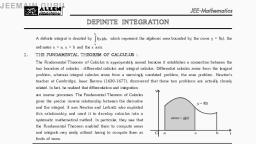
144, , MATHEMATICS, , (iv), , A constant factor may be written either before or after the integral sign, i.e.,, , ∫ a f ( x ) dx = a ∫ f ( x ) dx , where ‘a’ is a constant., (v), , ∫ (k, , Properties (iii) and (iv) can be generalised to a finite number of functions, f1, f2, ..., fn and the real numbers, k1, k2, ..., kn giving, f ( x ) + k 2 f 2 ( x ) + ...+, kn f n ( x )) dx = k1 ∫ f1 ( x ) dx + k 2 ∫ f 2 ( x ) dx + ... + kn ∫ f n ( x ) dx, , 1 1, , 7.1.5, , Methods of integration, , There are some methods or techniques for finding the integral where we can not, directly select the antiderivative of function f by reducing them into standard forms., Some of these methods are based on, 1., Integration by substitution, 2., Integration using partial fractions, 3., Integration by parts., 7.1.6, , Definite integral, b, , The definite integral is denoted by, , ∫ f ( x ) dx , where a is the lower limit of the integral, a, , and b is the upper limit of the integral. The definite integral is evaluated in the following, two ways:, (i), , The definite integral as the limit of the sum, b, , (ii), , ∫ f ( x ) dx = F(b) – F(a), if F is an antiderivative of f (x)., a, , 7.1.7, , The definite integral as the limit of the sum, b, , The definite integral, , ∫ f ( x ) dx is the area bounded by the curve y = f (x), the ordia, , nates x = a, x = b and the x-axis and given by, b, , ∫ f ( x ) dx = (b – a), a, , 1, lim f (a ) + f ( a + h ) + ... f ( a + (n – 1) h ), n →∞ n, , 20/04/2018
Page 3 :
INTEGRALS, , 145, , or, b, , ∫ f ( x ) dx = lim h f (a) + f ( a + h ) + ... + f ( a + ( n – 1) h ) ,, h →0, , a, , where h =, 7.1.8, (i), , b–a, → 0 as n → ∞ ., n, , Fundamental Theorem of Calculus, Area function : The function A (x) denotes the area function and is given, x, , by A (x) =, , ∫ f ( x ) dx ., a, , (ii), , First Fundamental Theorem of integral Calculus, Let f be a continuous function on the closed interval [a, b] and let A (x) be, the area function . Then A′ (x) = f (x) for all x ∈ [a, b] ., , (iii), , Second Fundamental Theorem of Integral Calculus, Let f be continuous function defined on the closed interval [a, b] and F be, an antiderivative of f., b, , ∫ f ( x ) dx = [F ( x )], , b, a, , a, , 7.1.9, , = F(b) – F(a)., , Some properties of Definite Integrals, b, , P0 :, , ∫, a, , b, , P1 :, , P2 :, , ∫, a, , b, , f ( x ) dx =, , ∫ f (t ) dt, a, , a, , f ( x ) dx = – ∫ f ( x ) dx , in particular,, b, , b, , c, , b, , a, , a, , c, , a, , ∫ f ( x ) dx = 0, a, , ∫ f ( x ) dx = ∫ f ( x ) dx + ∫ f ( x ) dx, , 20/04/2018
Page 4 :
146, , MATHEMATICS, , b, , P3 :, , b, , ∫, , f ( x ) dx =, , a, , a, , a, , P4 :, , ∫ f (a + b – x ) dx, a, , ∫, , f ( x ) dx =, , 0, , ∫ f ( a – x ) dx, 0, , 2a, , a, , ∫, , 2a, , a, f ( x ) dx = 2 f ( x ) dx,if f (2a − x ) = f ( x ) ,, ∫, 0, 0, if f (2a − x ) = − f ( x)., , , P5 :, , f ( x ) dx +, , 0, , 0, , ∫, , P6 :, , ∫, , a, , f ( x ) dx =, , 0, , 0, , a, , P7 : (i), , ∫, , –a, , ∫ f ( 2a – x ) dx, , a, , f ( x ) dx = 2 f ( x ) dx , if f is an even function i.e., f (–x) = f (x), ∫, 0, , a, , (ii), , ∫, , f ( x ) dx = 0, if f is an odd function i.e., f (–x) = –f (x), , –a, , 7.2, , Solved Examples, , Short Answer (S.A.), , 2a b, , – 2 + 3c 3 x 2 w.r.t. x, Example 1 Integrate , x x, , , Solution, , 2a b, , – 2 + 3c 3 x 2 dx, x, x, , , ∫ , =, , ∫ 2a ( x ), , –1, 2, , 2, 3, , dx – ∫ bx dx + ∫ 3c x dx, –2, , 5, 3, = 4a x + b + 9 cx + C ., x, 5, , 20/04/2018
Page 8 :
150, , MATHEMATICS, , Put tanx = t so that sec2x dx = dt. Then, , 1, , dt, , I=, , =, , =, , ∫ 2t 2 + 5 = 2 ∫, , dt, 5, t +, , 2, , 2, , 2, , 2t , 1 2, tan –1 , + C, 2 5, 5, , , , 2 tan x , tan –1 , + C., , 10, 5 , , 1, , 2, , Example 9 Evaluate, , ( 7 x – 5) dx as a limit of sums., , –1, , Solution Here a = –1 , b = 2, and h =, , 2 +1, , i.e, nh = 3 and f (x) = 7x – 5., n, , Now, we have, 2, , ∫ (7 x – 5) dx = lim h f ( –1) + f (–1 + h) + f ( –1 + 2h ) + ... + f ( –1 + ( n – 1) h ), h→ 0, , –1, , Note that, f (–1) = –7 – 5 = –12, f (–1 + h) = –7 + 7h – 5 = –12 + 7h, f (–1 + (n –1) h) = 7 (n – 1) h – 12., Therefore,, 2, , ∫ (7 x –5) dx = lim h ( –12) + (7h – 12) + (14h –12) + ... + (7 (n –1 ) h –12) ., , –1, , h →0, , h 7h 1 + 2 + ... + ( n – 1) – 12n , = lim, h →0 , , 20/04/2018
Page 9 :
INTEGRALS, , 151, , ( n – 1) n, , 7, , h 7 h, – .12n = lim ( nh )( nh – h ) – 12nh , = lim, h →0, h →0 2, 2, , , , , , =, , 7, 7×9, –9, – 36 =, (3)(3 – 0) – 12 × 3 =, ., 2, 2, 2, π, 2, , Example 10 Evaluate, , tan 7 x, ∫ cot 7 x + tan 7 x dx, 0, , Solution We have, π, 2, , I=, , tan 7 x, ∫ cot 7 x + tan 7 x dx, 0, , ...(1), , π, , tan 7 – x , 2, , , dx, = ∫, π, , , π, , 7, 7, 0 cot, – x + tan – x , 2, , 2, , π, 2, , , 2, , =, , ∫ cot, 0, , cot 7 ( x ) dx, 7, , by (P4), , ...(2), , x dx + tan 7 x, , Adding (1) and (2), we get, , 2, , tan 7 x + cot 7 x , 2I = ∫ , dx, 7, 7, 0 tan x + cot x , , 2, , = ∫ dx which gives I =, 0, , , ., 4, , 20/04/2018
Page 10 :
152, , MATHEMATICS, , 8, , Example 11 Find, , ∫, 2, , 10 – x, x + 10 – x, , dx, , Solution We have, 8, , I=, , 10 – x, , ∫, , x + 10 – x, , 2, , 8, , ...(1), , 10 – (10 – x ), , =, , 10 – x + 10 – (10 – x ), , 2, , 8, , ⇒, , dx, , x, , I=∫, , 10 – x + x, , 2, , dx, , dx, , by (P3), , (2), , Adding (1) and (2), we get, 8, , 2I = 1dx = 8 – 2 = 6, 2, , Hence, , I=3, π, 4, , Example 12 Find, , ∫, , 1 + sin 2x dx, , 0, , Solution We have, π, 4, , I=, , ∫, , 1+ sin 2 x dx =, , 0, , π, 4, , 2, ∫ (sin x + cos x ) dx, 0, , π, 4, , =, , ∫ (sin x + cos x ) dx, 0, , 20/04/2018
Page 11 :
INTEGRALS, , 153, , π, , =, , ( − cos x + sin x )04, , I = 1., x 2 tan –1 x dx ., , Example 13 Find, , 2, –1, Solution I = x tan x dx, , = tan –1 x ∫ x 2 dx –, , 1, x3, ., ∫ 1 + x2 3 dx, , x3, 1 , x , –1, = 3 tan x – 3 ∫ x − 1 + x 2 dx, , , , =, , x3, x2 1, tan –1 x – + log 1 + x 2 + C ., 3, 6 6, , Example 14 Find, , ∫, , 10 – 4 x + 4 x 2 dx, , Solution We have, , 10 – 4 x + 4 x 2 dx, , I=, , =, , ( 2 x – 1), , 2, , + (3) dx, 2, , Put t = 2x – 1, then dt = 2dx., Therefore,, , I=, , 1, 2, t 2 + (3) dt, ∫, 2, t2 + 9 9, + log t + t 2 + 9 + C, 2, 4, , =, , 1, t, 2, , =, , 1, ( 2 x – 1), 4, , ( 2 x – 1), , 2, , +9 +, , 9, log ( 2 x – 1) +, 4, , ( 2 x – 1) 2 + 9, , +C., , 20/04/2018
Page 12 :
154, , MATHEMATICS, , Long Answer (L.A.), x 2 dx, Example 15 Evaluate ∫ 4 2, ., x + x −2, , Solution Let x2 = t. Then, x2, t, t, A, B, = 2, =, =, +, 4, 2, (, t, +, 2), (, t, −, 1), t, +, 2, t, −1, x + x −2 t +t −2, , So, , t = A (t – 1) + B (t + 2), , Comparing coefficients, we get A =, , 2, 1, , B= ., 3, 3, , x2, 2 1, 1 1, =, +, 4, 2, 2, 3, x + x −2, x + 2 3 x 2 −1, , So, Therefore,, , 2, x2, ∫ x4 + x 2 − 2 dx = 3, , 1, , 1, , dx, , ∫ x 2 + 2 dx + 3 ∫ x 2 −1, , 2 1, x, 1, x −1, tan –1, + log, +C, = 3, x +1, 2, 2 6, , Example16 Evaluate, , x3 + x, dx, x4 – 9, , Solution We have, I=, , x3 + x, dx =, x4 – 9, , x3, x dx, = I1+ I2 ., dx + 4, 4, x –9, x –9, , 20/04/2018
Page 14 :
156, , MATHEMATICS, , , sin 2 – x , 2, , dx, = ∫0, , , sin – x + cos – x , 2, , 2, , π, , 2, , ⇒, , Thus, we get, , (by P4), , , 2, , cos2 x, ∫0 sin x + cos x dx, , I=, , 2I =, , 1, , , 2, , dx, , , 0 cos x –, , , 4, , , ∫, 2, , , 2, , π, , 1 , , 2, 1, , , , , log, sec, +, tan, x, –, x, –, =, =, dx, sec, x, –, , , , , , , , , ∫ 4, 4, 4 0, , , 2 , 20, , =, , 1 , , , , , log sec + tan – log sec – + tan − , , 4, 4 , 4, 4 , 2 , , =, , 1, , log ( 2 + 1) – log ( 2 −1) , , 2, , =, , 1, log, 2, , 2 +1, 2 –1, , ( 2 + 1)2 , 1, 2, log, log ( 2 + 1), , =, =, 2, 2, , , 1, , Hence, , I=, , 1, 2, , 1, , Example 18, , Find, , ∫ x ( tan, , –1, , log ( 2 + 1) ., , x ) dx, 2, , 0, , 20/04/2018
Page 15 :
INTEGRALS, , 1, , Solution, , I=, , ∫ x ( tan, , –1, , 157, , x ) dx ., 2, , 0, , Integrating by parts, we have, 1, , 1, 1, tan –1 x, x2, dx, ( tan –1 x )2 – ∫ x 2 .2, 0 2 0, 1 + x2, 2 , , I=, , 2, x2, –, .tan –1 x dx, =, 32 ∫0 1 + x 2, 1, , 1, , 2, , x, 2, tan –1 xdx, =, – I1 , where I1 = ∫, 2, 1, +, x, 32, 0, x2 + 1 – 1, ∫0 1 + x 2 tan–1x dx, 1, , Now, , I1 =, 1, , 1, , 1, tan –1 x dx, 2, +, x, 1, 0, , –1, = ∫ tan x dx – ∫, 0, , = I2 –, , 1, 1, (, ( tan –1 x )2 )0, 2, , = I2 –, , 1, , Here, , I2 =, , =, , Thus, , I1 =, , 2, 32, , 1, , x, dx, 2, 0 1+ x, , –1, ∫ tan x dx = ( x tan –1 x )0 – ∫, 1, , 0, , 1, – log 1 + x 2, 4 2, , (, , ), , 1, 0, , =, , 1, – log 2 ., 4 2, , 1, 2, – log 2 −, 4 2, 32, , 20/04/2018
Page 16 :
158, , MATHEMATICS, , Therefore,, , I =, , =, , 2 1, 2, 2 1, – + log 2 +, – + log 2, =, 32 4 2, 32, 16 4 2, 2 – 4, + log 2 ., 16, 2, , Example 19 Evaluate, , ∫ f ( x) dx , where f (x) = |x + 1| + |x| + |x – 1|., , –1, , 2 – x, if, , as f ( x ) = x + 2, if, 3x , if, , , Solution We can redefine f, , 2, , ∫, , Therefore,, , –1, , 0, , 1, , 2, , –1, , 0, , 1, , –1 < x ≤ 0, 0 < x ≤1, 1< x ≤ 2, , f ( x ) dx = ∫ ( 2 – x ) dx + ∫ ( x + 2 ) dx + ∫ 3 x dx, 0, , (by P2), , 1, , 2, , =, , 5 5 9 19, + + =, ., 2 2 2 2, , , x2, 3x 2 , x2 , +, x, x, 2, –, 2, +, =, , , +, , 2 –1 2, , 0 2 1, 1 1, , , 4 1, = 0 – –2 – + + 2 + 3 – , , 2 2, , 2 2, , Objective Type Questions, Choose the correct answer from the given four options in each of the Examples from, 20 to 30., Example 20, , ∫ e (cos x – sin x ) dx is equal to, x, , (A) e x cos x + C, , (B) e x sin x + C, , (C) – e x cos x + C, , (D) – e x sin x + C, , 20/04/2018
Page 17 :
INTEGRALS, , 159, , x, x, Solution (A) is the correct answer since ∫ e f ( x ) + f '( x ) dx = e f ( x ) + C . Here, f (x) = cosx, f′ (x) = – sin x., , ∫ sin, , Example 21, , 2, , dx, is equal to, x cos 2 x, , (A) tanx + cotx + C, , (B) (tanx + cotx)2 + C, , (C) tanx – cotx + C, , (D) (tanx – cotx)2 + C, , Solution (C) is the correct answer, since, , dx, I= ∫ 2, =, sin x cos 2 x, , ∫, , (sin 2 x + cos2 x ) dx, sin 2 x cos 2 x, , 2, 2, = ∫ sec x dx + ∫ cosec x dx = tanx – cotx + C, , Example 22 If, , 3ex – 5 e– x, ∫ 4 e x + 5 e – x dx = ax + b log |4ex + 5e–x| + C, then, , (A) a =, , –1, 7, , b=, 8, 8, , 1, 7, (B) a = , b =, 8, 8, , (C) a =, , –1, –7, , b=, 8, 8, , 1, –7, (D) a = , b =, 8, 8, , Solution (C) is the correct answer, since differentiating both sides, we have, 3ex – 5 e– x, ( 4 e x – 5 e– x ) ,, =, a, +, b, 4 e x + 5 e– x, 4 e x + 5 e– x, , giving 3ex – 5e–x = a (4ex + 5e–x) + b (4ex – 5e–x). Comparing coefficients on both, sides, we get 3 = 4a + 4b and –5 = 5a – 5b. This verifies a =, , –1, 7, , b= ., 8, 8, , 20/04/2018
Page 18 :
160, , MATHEMATICS, , b+c, , Example 23, , ∫, , f ( x ) dx is equal to, , a+ c, , b, , (A), , ∫, , b, , f ( x – c ) dx, , (B), , a, , a, , b –c, , b, , (C), , ∫, , ∫ f ( x + c ) dx, , f ( x ) dx, , (D), , ∫, , f ( x ) dx, , a–c, , a, , Solution (B) is the correct answer, since by putting x = t + c, we get, , I=, , b, , b, , a, , a, , ∫ f (c + t ) dt = ∫ f ( x + c ) dx ., , Example 24 If f and g are continuous functions in [0, 1] satisfying f (x) = f (a – x), a, , and g (x) + g (a – x) = a, then, , ∫ f ( x ). g ( x ) dx, , is equal to, , 0, , (A), , a, 2, , (B), , a, , (C), , ∫, , a, , a, 2, , ∫ f ( x ) dx, 0, , a, , (D) a ∫ f ( x ) dx, , f ( x ) dx, , 0, , 0, , a, , Solution B is the correct answer. Since I =, , ∫ f ( x ). g ( x ) dx, 0, , a, , =, , ∫, , a, , f ( a – x ) g ( a – x ) dx =, , 0, , ∫ f ( x ) ( a – g ( x )) dx, 0, , a, , a, , a, , 0, , 0, , 0, , = a ∫ f ( x ) dx – ∫ f ( x ). g ( x ) dx = a ∫ f ( x ) dx – I, , 20/04/2018
Page 19 :
INTEGRALS, , 161, , a, , or, , I, , a, f ( x ) dx ., 2 ∫0, , =, , y, , ∫, , Example 25 If x =, , 0, , (A) 3, , dt, 1 + 9t 2, , and, , d2y, = ay, then a is equal to, dx 2, , (B) 6, , (C) 9, y, , ∫, , Solution (C) is the correct answer, since x =, , 0, , which gives, , 18 y, dy, d2y, =, = 9y., 2 ., 2, +, y, 2, 1, 9, dx, dx, , Example 26, , x3 + x +1, dx is equal to, ∫ 2, –1 x + 2 x + 1, , dt, 1 + 9t 2, , (D) 1, ⇒, , dx, 1, =, dy, 1 + 9 y2, , 1, , (A) log 2, , (B) 2 log 2, , (C), , 1, log 2, 2, , (D) 4 log 2, , x3 + x +1, dx, Solution (B) is the correct answer, since I = ∫ 2, –1 x + 2 x + 1, 1, , x3, x +1, dx = 0 + 2, +∫ 2, = ∫ 2, –1 x + 2 x + 1, –1 x + 2 x + 1, 1, , 1, , 1, , x +1, , ∫ ( x +1), , 2, , dx, , 0, , [odd function + even function], 1, , =2, , x+1, , ∫ ( x +1), 0, , 1, , dx = 2 ∫, 2, 0, , 1, dx, x +1, , 1, , = 2 log x + 1 0 = 2 log 2., , 20/04/2018
Page 20 :
162, , MATHEMATICS, , 1, , Example 27, , (A) a – 1 +, , If, , et, ∫0 1 + t dt = a, then, , e, 2, , 1, , et, , ∫ (1 + t ), , 2, , dt is equal to, , 0, , e, 2, , (B) a + 1 –, , (C) a – 1 –, , e, 2, , (D) a + 1 +, , e, 2, , 1, , et, dt, Solution (B) is the correct answer, since I = ∫, 0 1+ t, 1, , 1, , et, 1 t, dt = a (given), e +∫, =, 2, 1 + t 0 0 (1 + t ), 1, , Therefore,, , et, , ∫ (1 + t ), , 2, , =a–, , 0, , e, + 1., 2, , 2, , Example 28, , ∫ x cos πx dx is equal to, , –2, , (A), , 8, π, , (B), , 4, π, , (C), 2, , Solution (A) is the correct answer, since I =, , ∫, , –2, , 2, π, , (D), , 1, π, , 2, , x cos πx dx = 2 ∫ x cos πx dx, , 3, 21, , 2, 2, , , = 2 ∫ x cos πx dx + ∫ x cos πx dx + ∫ x cos πx dx =, 1, 3, 0, , 2, 2, , , , 0, , 8, ., π, , Fill in the blanks in each of the Examples 29 to 32., Example 29, , sin 6 x, ∫ cos8 x dx = _______., , 20/04/2018
Page 23 :
INTEGRALS, , 24., , ∫, , 26., , ∫x, , x, 3, , a –x, , 3, , dx, , dx, , 25., , ∫, , 165, , cos x – cos 2 x, dx, 1 – cos x, , (Hint : Put x2 = sec θ), , x4 – 1, , Evaluate the following as limit of sums:, 2, , 27., , 2, , ∫ ( x 2 + 3) dx, , 28., , 0, , ∫e, , x, , dx, , 0, , Evaluate the following:, , 2, , 1, , 29., , dx, ∫0 e x + e – x, 2, , 31., , 30., , tan x dx, 2, tan 2 x, , ∫1+ m, 0, , 1, , dx, , ∫ ( x – 1) (2 − x), , 32., , xdx, , ∫, , 1+ x 2, , 0, , 1, , 1, 2, , π, , 33., , ∫ x sin x cos, , 2, , xdx, , 34., , 0, , ∫ (1+ x, 0, , dx, 2, , ) 1− x 2, , (Hint: let x = sinθ), Long Answer (L.A.), , 35., , x 2 dx, ∫ x4 – x2 – 12, , , 37., , x, , ∫ 1 + sin x, 0, , 36., , x 2 dx, ( x 2 + a 2 )( x 2 + b 2 ), , 2x – 1, , 38., , ∫ ( x – 1)( x + 2)( x – 3) dx, , 20/04/2018
Page 25 :
INTEGRALS, , 49., , dx, is equal to, sin ( x – a ) sin ( x – b), , (A) sin (b – a) log, , sin( x – b), +C, sin( x – a), , (C) cosec (b – a) log, , 50., , 167, , ∫ tan, , –1, , sin( x – b), +C, sin( x – a), , (D) sin (b – a) log, , sin( x – a ), +C, sin( x – b), sin( x – a ), +C, sin( x – b), , x dx is equal to, , (A) (x + 1) tan –1 x – x + C, x – x tan –1 x + C, , (C), , (B) cosec (b – a) log, , (B) x tan –1 x – x + C, (D), , x – ( x + 1) tan –1 x + C, , 2, , 51., , x 1– x , ∫ e 1 + x2 dx is equal to, , ex, +C, (A), 1 + x2, ex, , (C), , 52., , (1 + x 2 )2, , ∫ (4x, , x9, 2, , + 1), , 6, , –ex, +C, (B), 1 + x2, , +C, , (D), , (1 + x 2 )2, , +C, , dx is equal to, , –5, , 1 , 1 , (A), 4+ 2 + C, 5x , x , , (C), , –ex, , 1, (1 + 4 )–5 + C, 10x, , –5, , 1, 1 , (B) 4 + 2 + C, 5, x , –5, , (D), , 1 1, , 2 + 4 + C, 10 x, , , 20/04/2018
Page 26 :
168, , MATHEMATICS, , dx, , 53., , 54., , 55., , If, , ∫ ( x + 2)( x, , 2, , + 1), , = a log |1 + x2| + b tan–1x +, , (A) a =, , –1, –2, ,b=, 10, 5, , (B) a =, , 1, 2, ,b=–, 10, 5, , (C) a =, , –1, 2, ,b=, 10, 5, , (D) a =, , 1, 2, ,b=, 10, 5, , x3, ∫ x + 1 is equal to, (A) x +, , x2 x3, + – log 1 – x + C, 2, 3, , (B) x +, , x 2 x3, – – log 1 – x + C, 2, 3, , (C) x –, , x 2 x3, – – log 1 + x + C, 2, 3, , (D) x –, , x 2 x3, + – log 1 + x + C, 2, 3, , x + sin x, , ∫ 1 + cos x dx is equal to, (A) log 1 + cos x + C, (C) x – tan, , 56., , 1, log |x + 2| + C, then, 5, , If, , x3 dx, 1 + x2, , (B) log x + sin x + C, , x, +C, 2, , (D) x .tan, , x, +C, 2, , 3, , = a (1 + x 2 ) 2 + b 1 + x 2 + C, then, , (A) a =, , 1, ,, 3, , b=1, , (B) a =, , –1, ,, 3, , b=1, , (C) a =, , –1, ,, 3, , b = –1, , (D) a =, , 1, ,, 3, , b = –1, , 20/04/2018
Page 27 :
INTEGRALS, , , 4, , 57., , dx, , ∫ 1 + cos2x, , 169, , is equal to, , –, 4, , (A) 1, , (B) 2, , (C) 3, , (D) 4, , (C) 2, , (D) 2 ( 2 –1), , , 2, , 58., , ∫, , 1 – sin 2xdx is equal to, , 0, , (A) 2 2, , (B) 2, , (, , 2 +1), , , 2, , 59., , ∫ cos x e, , sin x, , dx is equal to _______., , 0, , 60., , x+3, , ∫ ( x + 4), , 2, , e x dx = ________., , Fill in the blanks in each of the following Exercise 60 to 63., a, , 61., , If, , 1, , ∫ 1 + 4x, , 2, , dx =, , 0, , , , then a = ________., 8, , sin x, , 62., , ∫ 3 + 4cos2 x dx, , = ________., , π, , 63., , The value of, , ∫, , sin3x cos2x dx is _______., , −π, , 20/04/2018