Page 1 :
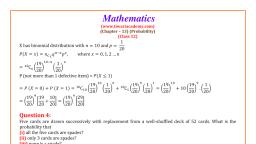
Mathematics, , (www.tiwariacademy.com), (Chapter - 13) (Probability), (Class 12), , &Answer 5:, Let X represent the number of bulbs that will fuse after 150 days of use in an experiment of 5 trials. The trials, are Bernoulli trials. It is given that, p = 0.05 andq = 1—p = 1—0.05 = 0.95., X has a binomial distribution with n = 5 and p = 0.95., P(X =x) =1¢,q" *p*, where x = 0,1,2...n, = 5¢,(0.95)>-*(0.05)*, (i) P (none) = P (X = 0) = 5¢,(0.95)5(0.05)° = (0.95)*, (ii) P (not more than one) = P (X < 1) = P (X = 0) + P(X =1), = 5¢9(0.95)°(0.05)° + 5¢,(0.95)*(0.05)*, = 1 (0.95)5 + 5 x (0.95)*(0.05)*, = (0.95)*[0.95 + 0.25], = (0.95)* x 1.2 = 1.2(0.95)*, (iii) P (more than one) = P (X > 1), = 1-P(X <1) =1-P(not more than 1) = 1 — 1.2(0.95)*, (iv) P (at least one) = P(X > 1), =1-PX <1) =1-P(X = 0) =1—5¢,(0.95)5(0.05)? = 1—(0.95)°, , Question 6:, , A bag consists of 10 balls each marked with one of the digits 0 to 9. If four balls are drawn successively with, replacement from the bag, what is the probability that none is marked with the digit 0?, , #.Answer 6:, , Let X denote the number of balls marked with the digit 0 among the 4 balls are drawn. Since the balls are, drawn with replacement, the trials are Bernoulli trials., , 1, X has a binomial distribution with n = 4 and p = To, 1 9, , “q=1-p =1-= to, P(X =x) =1¢,q"“*p*, where x = 0,1,2...n, , 9\* 741, =4ex(i5) (io), P (none marked with 0) = P (X = 0), , 4 0 4, , = +0(50) (io) = Go), , Question 7:, , In an examination, 20 questions of true-false type are asked. Suppose a student tosses a fair coin to determine, his answer to each question. If the coin falls heads, he answers 'true’; if it falls tails, he answers ‘false’. Find, the probability that he answers at least 12 questions correctly., , €.Answer 7:, , Let X represent the number of correctly answered questions out of 20 questions. The repeated tosses of a, coin are Bernoulli trails. Since ‘head’ on a coin represents the true answer and ‘tail’ represent the false, answer, the correctly answered are Bernoulli trials. Therefore,, , x, , =i dq=1 =1 i, p=5 and q= p= 2, , 1, X has a binomial distribution with n = 0 and p = 3, , P(X =x) =1¢,q" *p*, where x = 0,1,2...n, www.tiwariacademy.com, A Free web support in education, , a, 3