Page 1 :
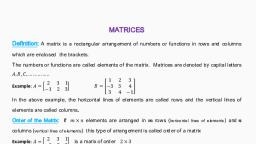
Chapter, , 3, , Matrices, 3.1 Overview, 3.1.1, , A matrix is an ordered rectangular array of numbers (or functions). For example,, , x 4 3, A= 4 3 x, 3 x 4, The numbers (or functions) are called the elements or the entries of the matrix., The horizontal lines of elements are said to constitute rows of the matrix and the, vertical lines of elements are said to constitute columns of the matrix., 3.1.2, , Order of a Matrix, , A matrix having m rows and n columns is called a matrix of order m × n or simply, m × n matrix (read as an m by n matrix)., In the above example, we have A as a matrix of order 3 × 3 i.e.,, 3 × 3 matrix., In general, an m × n matrix has the following rectangular array :, , A = [aij]m × n, , a11, a, 21, = , , am1, , a12, , a13, , a22, , a23, , am 2, , am 3, , a1n , a2 n , 1≤ i ≤ m, 1≤ j ≤ n i, j ∈ N., , amn m × n, , The element, aij is an element lying in the ith row and jth column and is known as the, (i, j)th element of A. The number of elements in an m × n matrix will be equal to mn., 3.1.3, , Types of Matrices, (i), , A matrix is said to be a row matrix if it has only one row., , 20/04/2018
Page 2 :
MATRICES, , (ii), , 43, , A matrix is said to be a column matrix if it has only one column., , (iii) A matrix in which the number of rows are equal to the number of columns,, is said to be a square matrix. Thus, an m × n matrix is said to be a square, matrix if m = n and is known as a square matrix of order ‘n’., (iv) A square matrix B = [bij]n×n is said to be a diagonal matrix if its all non, diagonal elements are zero, that is a matrix B = [bij]n×n is said to be a, diagonal matrix if bij = 0, when i ≠ j., (v), , A diagonal matrix is said to be a scalar matrix if its diagonal elements are, equal, that is, a square matrix B = [bij]n×n is said to be a scalar matrix if, bij = 0, when i ≠ j, bij = k, when i = j, for some constant k., , (vi) A square matrix in which elements in the diagonal are all 1 and rest are, all zeroes is called an identity matrix., In other words, the square matrix A = [aij]n×n is an identity matrix, if, aij = 1, when i = j and aij = 0, when i ≠ j., (vii) A matrix is said to be zero matrix or null matrix if all its elements are, zeroes. We denote zero matrix by O., (ix) Two matrices A = [aij] and B = [bij] are said to be equal if, (a) they are of the same order, and, (b) each element of A is equal to the corresponding element of B, that is,, aij = bij for all i and j., 3.1.4, , Additon of Matrices, , Two matrices can be added if they are of the same order., 3.1.5, , Multiplication of Matrix by a Scalar, , If A = [aij] m×n is a matrix and k is a scalar, then kA is another matrix which is obtained, by multiplying each element of A by a scalar k, i.e. kA = [kaij]m×n, 3.1.6, , Negative of a Matrix, , The negative of a matrix A is denoted by –A. We define –A = (–1)A., 3.1.7, , Multiplication of Matrices, , The multiplication of two matrices A and B is defined if the number of columns of A is, equal to the number of rows of B., , 20/04/2018
Page 3 :
44, , MATHEMATICS, , Let A = [aij] be an m × n matrix and B = [bjk] be an n × p matrix. Then the product of, the matrices A and B is the matrix C of order m × p. To get the, (i, k)th element cik of the matrix C, we take the ith row of A and kth column of B,, multiply them elementwise and take the sum of all these products i.e.,, cik = ai1 b1k + ai2 b2k + ai3 b3k + ... + ain bnk, The matrix C = [cik]m×p is the product of A and B., Notes:, , 3.1.8, , 1., , If AB is defined, then BA need not be defined., , 2., , If A, B are, respectively m × n, k × l matrices, then both AB and BA are, defined if and only if n = k and l = m., , 3., , If AB and BA are both defined, it is not necessary that AB = BA., , 4., , If the product of two matrices is a zero matrix, it is not necessary that, one of the matrices is a zero matrix., , 5., , For three matrices A, B and C of the same order, if A = B, then, AC = BC, but converse is not true., , 6., , A. A = A2, A. A. A = A3, so on, , Transpose of a Matrix, 1., , If A = [aij] be an m × n matrix, then the matrix obtained by interchanging, the rows and columns of A is called the transpose of A., Transpose of the matrix A is denoted by A′ or (AT). In other words, if, A = [aij]m×n, then AT = [aji]n×m., , 2., , Properties of transpose of the matrices, , For any matrices A and B of suitable orders, we have, (i) (AT)T = A,, (ii) (kA)T = kAT (where k is any constant), (iii) (A + B)T = AT + BT, (iv) (AB)T = BT AT, 3.1.9, , Symmetric Matrix and Skew Symmetric Matrix, (i), , A square matrix A = [aij] is said to be symmetric if AT = A, that is,, aij = aji for all possible values of i and j., , 20/04/2018
Page 4 :
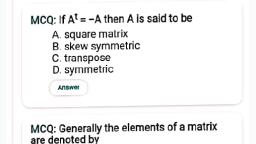
MATRICES, , (ii), , 45, , A square matrix A = [aij] is said to be skew symmetric matrix if AT = –A,, that is aji = –aij for all possible values of i and j., , Note : Diagonal elements of a skew symmetric matrix are zero., (iii) Theorem 1: For any square matrix A with real number entries, A + AT is, a symmetric matrix and A – AT is a skew symmetric matrix., (iv) Theorem 2: Any square matrix A can be expressed as the sum of a, symmetric matrix and a skew symmetric matrix, that is, A=, , (A + A T ) (A − AT ), +, 2, 2, , 3.1.10 Invertible Matrices, (i), , If A is a square matrix of order m × m, and if there exists another square, matrix B of the same order m × m, such that AB = BA = Im, then, A is said, to be invertible matrix and B is called the inverse matrix of A and it is, denoted by A–1., , Note :, 1., , A rectangular matrix does not possess its inverse, since for the products, BA and AB to be defined and to be equal, it is necessary that matrices A, and B should be square matrices of the same order., , 2., , If B is the inverse of A, then A is also the inverse of B., , (ii), , Theorem 3 (Uniqueness of inverse) Inverse of a square matrix, if it, exists, is unique., , (iii) Theorem 4 : If A and B are invertible matrices of same order, then, (AB)–1 = B–1A–1., 3.1.11 Inverse of a Matrix using Elementary Row or Column Operations, To find A–1 using elementary row operations, write A = IA and apply a sequence of, row operations on (A = IA) till we get, I = BA. The matrix B will be the inverse of A., Similarly, if we wish to find A–1 using column operations, then, write A = AI and apply a, sequence of column operations on A = AI till we get, I = AB., Note : In case, after applying one or more elementary row (or column) operations on, A = IA (or A = AI), if we obtain all zeros in one or more rows of the matrix A on L.H.S.,, then A–1 does not exist., , 20/04/2018
Page 5 :
46, , MATHEMATICS, , 3.2 Solved Examples, Short Answer (S.A.), Example 1 Construct a matrix A = [a ij]2×2 whose elements aij are given by, aij = e 2ix sin jx ., Solution, , Thus, , For, , i = 1, j = 1,, , a 11, , =, , e2x sin x, , For, , i = 1, j = 2,, , a 12, , =, , e2x sin 2x, , For, , i = 2, j = 1,, , a 21, , =, , e4x sin x, , For, , i = 2, j = 2,, , a 22, , =, , e4x sin 2x, , e 2 x sin x e 2 x sin 2 x , , A = 4x, 4x, e sin x e sin 2 x , , Example 2 If A =, , 2 3, 1 3 2, 1, 4 6 8, ,B=, ,C=, ,D=, , then, 1 2, 4 3 1, 2, 5 7 9, , which of the sums A + B, B + C, C + D and B + D is defined?, Solution Only B + D is defined since matrices of the same order can only be added., Example 3 Show that a matrix which is both symmetric and skew symmetric is a zero, matrix., Solution Let A = [aij] be a matrix which is both symmetric and skew symmetric., Since A is a skew symmetric matrix, so A′ = –A., Thus for all i and j, we have aij = – aji., , (1), , Again, since A is a symmetric matrix, so A′ = A., Thus, for all i and j, we have, aji = aij, , (2), , Therefore, from (1) and (2), we get, aij = –aij for all i and j, or, , 2aij = 0,, , i.e.,, , aij = 0 for all i and j. Hence A is a zero matrix., , 20/04/2018
Page 6 :
MATRICES, , 47, , 1 2 x , Example 4 If [2 x 3] , = O , find the value of x., –3 0 8 , , Solution We have, , [2 x, or, or, , 1 2 x, 3] , = O ⇒ [2 x − 9 4 x], –3 0 8 , , x, 8, , = [ 0], , = [ 0] ⇒ 2 x 2 + 23x = 0, , 2 x 2 − 9 x +32 x, x(2 x + 23) = 0, , ⇒, , −23, 2, , x = 0, x =, , Example 5 If A is 3 × 3 invertible matrix, then show that for any scalar k (non-zero),, kA is invertible and (kA)–1 =, , 1 –1, A, k, , Solution We have, (kA), , 1 –1, A, k, , Hence (kA) is inverse of, , k., , =, , 1 –1, A, k, , 1, k, , (A. A–1) = 1 (I) = I, , or, , (kA)–1 =, , 1 –1, A, k, , Long Answer (L.A.), Example 6 Express the matrix A as the sum of a symmetric and a skew symmetric, matrix, where, , 2, , −6, , 4, , A= 7 3, 1 −2, , 5 ., 4, , Solution We have, , 2, , 4, , A= 7 3, 1 −2, , −6, 5 ,, 4, , then A′ =, , 2, , 7, , 4, , 3 −2, , −6 5, , 1, 4, , 20/04/2018
Page 7 :
48, , MATHEMATICS, , 2, , A + A′, 1, =, 2, 2, , Hence, , 4 11 −5, 11, 11 6 3 =, 2, −5 3 8, −5, 2, , 0, , A – A′, 1, =, 2, 2, , and, , 0 −3 −7, 3, 3 0, 7 =, 2, 7 −7 0, 7, 2, , 11, 2, 3, , −5, 2, 3, 2, , 3, 2, , −3, 2, 0, −7, 2, , 4, , −7, 2, 7, 2, 0, , Therefore,, , 11, , 2, 2, , A + A′ A − A′ 11, +, =, 3, 2, 2, 2, , −5 3, 2, 2, , 1 3, Example 7 If A =, , −5 , 0, 2 , , 3 3, +, 2 2, , 7, 4 , 2, , −3, 2, 0, −7, 2, , −7 , 2 2 4 −6 , , 7 , = 7 3 5 = A, 2 , ., 1 −2 4 , 0, , , 2, , 2 0 −1 , then show that A satisfies the equation, 1 2 3, , A3–4A2–3A+11I = O., , 1 3, Solution, , A2 = A × A =, , 2, , 1 3, , 2, , 2 0 −1 × 2 0 −1, 1 2 3, 1 2 3, , 20/04/2018
Page 8 :
MATRICES, , 1 + 6 + 2, 2 + 0 −1, = , 1 + 4 + 3, , 3+0+4, , 49, , 2 − 3 + 6, 4 + 0 − 3, 2 − 2 + 9, , 6+0−2, 3+0+6, , 9 7 5, = 1 4 1, 8 9 9, , 9 7 5, and, , 2, , 1 4 1 × 2 0 −1, , A3 = A2 × A =, , 8 9 9, , =, , 1 3, 1 2, , 3, , 9 + 14 + 5, , 27 + 0 + 10, , 18 − 7 + 15, , 1+ 8 +1, , 3+ 0 + 2, , 2−4+3, , 8 + 18 + 9, , 24 + 0 + 18, , 16 − 9 + 27, , 28 37 26, = 10 5 1, 35 42 34, Now, , A3 – 4A2 – 3A + 11(I), 28 37 26, 10 5 1 – 4, , = , 35 42 34 , , 9 7 5 , 1 3 2 , 1 0 0 , 1 4 1 –3 2 0 −1 +11 0 1 0 , , , , , , , 8 9 9, 1 2 3 , 0 0 1 , , 28 − 36 − 3 + 11, 10 − 4 − 6 + 0, = , 35 − 32 − 3 + 0, , 37 − 28 − 9 + 0, 5 − 16 + 0 + 11, 42 − 36 − 6 + 0, , 26 − 20 − 6 + 0 , 1− 4 + 3+ 0 , , 34 − 36 − 9 + 11, , 20/04/2018
Page 10 :
MATRICES, , 51, , Objective Type Questions, Choose the correct answer from the given four options in Examples 9 to 12., Example 9 If A and B are square matrices of the same order, then, (A + B) (A – B) is equal to, (A) A2 – B2, , (B), , A2 – BA – AB – B2, , (C) A2 – B2 + BA – AB, , (D), , A2 – BA + B2 + AB, , Solution (C) is correct answer. (A + B) (A – B) = A (A – B) + B (A – B), = A2 – AB + BA – B2, , 2, Example 10 If A =, −4, , 2 3, 3, and B = 4 −2 , then, 1, 1 5, , −1, 5, , (A) only AB is defined, , (B) only BA is defined, , (C) AB and BA both are defined (D) AB and BA both are not defined., Solution, defined., , (C) is correct answer. Let A = [aij]2×3 B = [bij]3×2. Both AB and BA are, , 0 0 5, Example 11 The matrix A = 0 5 0 is a, 5 0 0, (A) scalar matrix, , (B), , diagonal matrix, , (C) unit matrix, , (D), , square matrix, , Solution (D) is correct answer., Example 12 If A and B are symmetric matrices of the same order, then (AB′ –BA′), is a, (A) Skew symmetric matrix, , (B), , Null matrix, , (C) Symmetric matrix, , (D), , None of these, , Solution (A) is correct answer since, (AB′ –BA′)′ = (AB′)′ – (BA′)′, , 20/04/2018
Page 11 :
52, , MATHEMATICS, , = (BA′ – AB′), = – (AB′ –BA′), Fill in the blanks in each of the Examples 13 to 15:, Example 13 If A and B are two skew symmetric matrices of same order, then AB is, symmetric matrix if ________., Solution AB = BA., Example 14 If A and B are matrices of same order, then (3A –2B)′ is equal to, ________., Solution 3A′ –2B′., Example 15 Addition of matrices is defined if order of the matrices is ________, Solution Same., State whether the statements in each of the Examples 16 to 19 is true or false:, Example 16 If two matrices A and B are of the same order, then 2A + B = B + 2A., Solution True, Example 17 Matrix subtraction is associative, Solution False, Example 18 For the non singular matrix A, (A′)–1 = (A–1)′., Solution True, Example 19 AB = AC ⇒ B = C for any three matrices of same order., Solution False, 3.3 EXERCISE, Short Answer (S.A.), 1., , If a matrix has 28 elements, what are the possible orders it can have? What if it, has 13 elements?, , a, 2, 2., , 1, 3, , In the matrix A =, , 0, , 5, , x, x2 − y, , write :, −2, 5, , 20/04/2018
Page 12 :
MATRICES, , (i), , The order of the matrix A, , (ii), , The number of elements, , 53, , (iii) Write elements a23, a31, a12, 3., , Construct a2 × 2 matrix where, (i − 2 j )2, 2, , (i), , aij =, , (ii), , aij = | −2i + 3 j |, , 4., , Construct a 3 × 2 matrix whose elements are given by aij = ei.xsinjx, , 5., , Find values of a and b if A = B, where, a + 4 3b, A=, ,, 8, −6, , B=, , 2a + 2, , b2 + 2, , 8, , b2 − 5b, 3, , 6., , If possible, find the sum of the matrices A and B, where A =, , and B =, , 7., , 8., , If X =, , x, a, 3, 5, , y, b, 1, −2, , 3 ,, , z, 6, −1, 2, and Y =, −3, 7, , (ii), , 1, 2, , −1, , find, 4, , (i), , X +Y, , 2X – 3Y, , (iii), , A matrix Z such that X + Y + Z is a zero matrix., , Find non-zero values of x satisfying the matrix equation:, ( x 2 + 8), 2x 2, 8 5 x , x, +, 2, =, 2, , , 4 4 x , 3 x, , , (10), , 9., , 2, , 1, , If A =, , 24 , ., 6x, , 0 1, 0 −1, and B =, , show that (A + B) (A – B) ≠ A2 – B2., 1 1, 1 0, , 20/04/2018
Page 13 :
54, , MATHEMATICS, , 10. Find the value of x if, , 1, , [1, , x 1], , 3 2, , 1, , 2 5 1, 15 3 2, , 11. Show that A =, , 2 = O., x, , 5 3, satisfies the equation A2 – 3A – 7I = O and hence, −1 −2, , find A–1., 12. Find the matrix A satisfying the matrix equation:, 2 1, −3 2, 1 0, A, =, 3 2, 5 −3, 0 1, , 4, , −4 8 4, , 13. Find A, if 1, 3, , A = −1 2 1, −3 6 3, , 3 −4, 14. If A = 1, 2, , 1, , and B =, , 0, , 2 1 2, , then verify (BA)2 ≠ B2A2, 1 2 4, , 15. If possible, find BA and AB, where, , 4 1, 2 1 2, ,B=, A=, 1 2 4, , 2 3 ., 1 2, , 16. Show by an example that for A ≠ O, B ≠ O, AB = O., , 1 4, 2 4 0, 2 8 . Is (AB)′ = B′A′?, 17. Given A = , and B =, 3 9 6, 1 3, 18. Solve for x and y:, , 20/04/2018
Page 14 :
MATRICES, , 55, , 2, 3, −8 , x + y + , = O., 1 , 5, −11, , 19. If X and Y are 2 × 2 matrices, then solve the following matrix equations for X and Y, 2X + 3Y =, , 2 3, −2 2, , 3X + 2Y =, ., 4 0, 1 −5, , 20. If A = [3 5] , B = [7 3] , then find a non-zero matrix C such that AC = BC., 21. Give an example of matrices A, B and C such that AB = AC, where A is nonzero matrix, but B ≠ C., 1 2, 2 3, 1 0, , B=, and C =, , verify :, −2 1, 3 −4, −1 0, , 22. If A =, , (i) (AB) C = A (BC) (ii) A (B + C) = AB + AC., , x 0 0, , a 0 0, , 23. If P = 0 y 0 and Q = 0 b 0 , prove that, 0 0 z, 0 0 c, , xa, , 0, , 0, 0, , yb 0 = QP., 0 zc, , PQ =, , 24. If : [ 2 1 3], , 25. If A =, , [2 1] ,, , 0, , −1 0 −1, , 1, , −1 1, , 0, , 0, , 0, , 1, , −1, , 1, , B =, , 5 3, 8 7, , = A, find A., , 4, 6 and C =, , −1 2, 1 0, , 1, 2 , verify that, , A (B + C) = (AB + AC)., , 20/04/2018
Page 15 :
56, , MATHEMATICS, , 1 0 −1, 26. If A = 2 1, 0 1, , 3 , then verify that A2 + A = A (A + I), where I is 3 × 3 unit, 1, , matrix., 0 −1 2, 27. If A = 4 3 −4 and, , (i), , (A′)′ = A, , (ii), , (AB)′ = B′A′, , (iii), , (kA)′ = (kA′)., , 1, , 2, , 1, , 4 0, B=, , 1 3, , , then verify that :, , 2 6, , 2, , 28. If A = 4 1 , B = 6 4 , then verify that :, 5 6, 7 3, (i), , (2A + B)′ = 2A′ + B′, , (ii), , (A – B)′ = A′ – B′., , 29. Show that A′A and AA′ are both symmetric matrices for any matrix A., 30. Let A and B be square matrices of the order 3 × 3. Is (AB)2 = A2 B2 ? Give, reasons., 31. Show that if A and B are square matrices such that AB = BA, then, (A + B)2 = A2 + 2AB + B2., 32. Let A =, , 1 2, 4 0, 2 0, , B=, , C =, and a = 4, b = –2., −1 3, 1 5, 1 −2, , Show that:, (a), , A + (B + C) = (A + B) + C, , (b), , A (BC) = (AB) C, , 20/04/2018
Page 16 :
MATRICES, , (c), , (a + b)B = aB + bB, , (d), , a (C–A) = aC – aA, , (e), , (AT)T = A, , (f), , (bA)T = b AT, , (g), , (AB)T = BT AT, , (h), , (A –B)C = AC – BC, , (i), , (A – B)T = AT – BT, , 57, , cos sin , cos2 sin2 , 33. If A = , , then show that A2 = , , ., – sin cos , – sin2 cos2 , , 34. If A =, , 0 −x, 0 1, , B=, x 0, 1 0, , and x2 = –1, then show that (A + B)2 = A2 + B2., , 0, , 1, , 35. Verify that A2 = I when A = 4 −3, 3 −3, , −1, 4 ., 4, , 36. Prove by Mathematical Induction that (A′)n = (An)′, where n ∈ N for any square, matrix A., 37. Find inverse, by elementary row operations (if possible), of the following matrices, 1 3, −5 7, , (i), , 38. If, , xy, z+6, , 39. If A =, , (ii), , 1 −3, ., −2 6, , 4, 8 w, =, , then find values of x, y, z and w., x+ y, 0 6, , 1 5, 9 1, and B =, , find a matrix C such that 3A + 5B + 2C is a null, 7 12, 7 8, , matrix., , 20/04/2018
Page 17 :
58, , MATHEMATICS, , 3 −5, , then find A2 – 5A – 14I. Hence, obtain A3., −4 2, , 40. If A =, , 41. Find the values of a, b, c and d, if, 3, , a b, a, 6, =, c d, −1 2 d, , +, , 4, c+d, , a+b, ., 3, , 42. Find the matrix A such that, , 2, , −1, , 1, , 0, , −3, , 4, , 43. If A =, , −1 −8 −10, A =, , 1, , −2, , 9, , 22, , −5 ., 15, , 1 2, , find A2 + 2A + 7I., 4 1, , cos sin , 44. If A = , , and A – 1 = A′ , find value of α., −sin cos , , 0 a, , 3, , 45. If the matrix 2 b −1 is a skew symmetric matrix, find the values of a, b and c., c 1 0, cos x sinx , 46. If P (x) = , , then show that, −sinx cosx , , P (x) . P (y) = P (x + y) = P (y) . P (x)., 47. If A is square matrix such that A2 = A, show that (I + A)3 = 7A + I., 48. If A, B are square matrices of same order and B is a skew-symmetric matrix,, show that A′BA is skew symmetric., Long Answer (L.A.), 49. If AB = BA for any two sqaure matrices, prove by mathematical induction that, (AB)n = An Bn., , 20/04/2018
Page 18 :
MATRICES, , 59, , 0 2 y z , 50. Find x, y, z if A = x y − z satisfies A′ = A–1., x − y z , 51. If possible, using elementary row transformations, find the inverse of the following, matrices, , (i), , 2, , −1 3, , −5, −3, , 3, 2, , 2, , 1, 3, , (ii), , 2, , 3, , 4, , 1, , −3, , −1 −2 2, 1 1 −1, , 2 0 −1, (iii), , 5 1, 0 1, , 0, 3, , 1, , 1 −1 2, , 52. Express the matrix, , 3, , as the sum of a symmetric and a skew symmetric, , 2, , matrix., Objective Type Questions, Choose the correct answer from the given four options in each of the Exercises, 53 to 67., , 0 0 4, 53. The matrix P = 0 4 0 is a, 4 0 0, (A), , square matrix, , (B), , diagonal matrix, , (C), , unit matrix, , (D), , none, , 54. Total number of possible matrices of order 3 × 3 with each entry 2 or 0 is, (A), 55. If, , 9, , (B), , 27, , (C), , 81, , (D), , 512, , 2 x + y 4x, 7 7 y − 13, =, , then the value of x + y is, 5x − 7 4x, y, x+6, , (A), , x = 3, y = 1, , (B), , x = 2, y = 3, , (C), , x = 2, y = 4, , (D), , x = 3, y = 3, , 20/04/2018
Page 19 :
60, , MATHEMATICS, , 1, 56. If A = π, , x, , sin −1 ( xπ ) tan −1, sin −1, , x, , π, , cot −1 (π x ), , π, , 1, , − cos −1 ( xπ ), , , B = π, , sin −1, , x, , π, , tan −1, , x, , π, , − tan −1 (π x ), , , then, , A – B is equal to, (A), , I, , (B), , O, , (C), , 2I, , (D), , 1, I, 2, , 57. If A and B are two matrices of the order 3 × m and 3 × n, respectively, and, m = n, then the order of matrix (5A – 2B) is, (A), 58. If A =, , m×3, , (B) 3 × 3, , (C) m × n, , (D) 3 × n, , 0 1, , then A2 is equal to, 1 0, , (A), , 0 1, 1 0, , (B), , 1 0, 1 0, , (C), , 0 1, 0 1, , (D), , 1 0, 0 1, , 59. If matrix A = [aij]2 × 2, where aij = 1 if i ≠ j, = 0 if i = j, then A2 is equal to, (A), , I, , (B), , A, , (C), , 0, , (D), , None of these, , 1 0 0, 60. The matrix 0 2 0 is a, 0 0 4, (A), , identity matrix, , (B), , symmetric matrix, , (C), , skew symmetric matrix, , (D), , none of these, , 20/04/2018
Page 20 :
MATRICES, , 0, 61. The matrix, , −5, , 61, , 8, , 5, 0 12 is a, −8 −12 0, , (A), , diagonal matrix, , (B), , symmetric matrix, , (C), , skew symmetric matrix, , (D), , scalar matrix, , 62. If A is matrix of order m × n and B is a matrix such that AB′ and B′A are both, defined, then order of matrix B is, (A), , m×m, , (B), , n×n, , (C), , n×m, , (D), , m×n, , 63. If A and B are matrices of same order, then (AB′–BA′) is a, (A), , skew symmetric matrix, , (B), , null matrix, , (C), , symmetric matrix, , (D), , unit matrix, , 64. If A is a square matrix such that A2 = I, then (A–I)3 + (A + I)3 –7A is equal to, (A), , A, , (B), , I–A, , (C), , I+A, , (D), , 3A, , 65. For any two matrices A and B, we have, (A), , AB = BA, , (B), , AB ≠ BA, , (C), , AB = O, , (D), , None of the above, , 66. On using elementary column operations C2 → C2 – 2C1 in the following matrix, equation, 1 −3, 1 −1, =, 2 4, 0 1, , 3 1, , we have :, 2 4, , (A), , 1 −1, 1 −5, 0 4 = −2 2, , , , 3 −5, 2 0 , , , , (B), , 1 −1, 1 −5, 0 4 = 0 1, , , , 3 −5, −0 2 , , , , 20/04/2018
Page 21 :
62, , MATHEMATICS, , (C), , 1 −5, 1 −3, =, 2 0, 0 1, , 3 1, −2 4, , (D), , 1 −5, 1 −1, =, 2 0, 0 1, , 3 −5 , 2 0 , , , , 67. On using elementary row operation R1 → R1 – 3R2 in the following matrix equation:, 4 2, 1 2, =, 3 3, 0 3, , 2 0, , we have :, 1 1, , (A), , −5 −7, 1 −7, =, 3, 3, 0 3, , 2 0, 1 1, , (B), , −5 −7, 1 2, =, 3, 3, 0 3, , −1 −3, 1 1, , (C), , −5 −7, 1 2, =, 3, 3, 1 −7, , 2 0, 1 1, , (D), , 4, 2, 1 2, = , , −5 −7, −3 −3, , 2 0, 1 1, , Fill in the blanks in each of the Exercises 68–81., 68. _________ matrix is both symmetric and skew symmetric matrix., 69. Sum of two skew symmetric matrices is always _________ matrix., 70. The negative of a matrix is obtained by multiplying it by _________., 71. The product of any matrix by the scalar _________ is the null matrix., 72. A matrix which is not a square matrix is called a _________ matrix., 73. Matrix multiplication is _________ over addition., 74. If A is a symmetric matrix, then A3 is a _________ matrix., 75. If A is a skew symmetric matrix, then A2 is a _________., , 20/04/2018
Page 22 :
MATRICES, , 63, , 76. If A and B are square matrices of the same order, then, (i), , (AB)′ = _________., , (ii), , (kA)′ = _________., , (iii), , [k (A – B)]′ = _________., , (k is any scalar), , 77. If A is skew symmetric, then kA is a _________. (k is any scalar), 78. If A and B are symmetric matrices, then, (i), , AB – BA is a _________., , (ii), , BA – 2AB is a _________., , 79. If A is symmetric matrix, then B′AB is _________., 80. If A and B are symmetric matrices of same order, then AB is symmetric if and, only if _________., 81. In applying one or more row operations while finding A–1 by elementary row, operations, we obtain all zeros in one or more, then A–1 _________., State Exercises 82 to 101 which of the following statements are True or False, 82. A matrix denotes a number., 83. Matrices of any order can be added., 84. Two matrices are equal if they have same number of rows and same number of, columns., 85. Matrices of different order can not be subtracted., 86. Matrix addition is associative as well as commutative., 87. Matrix multiplication is commutative., 88. A square matrix where every element is unity is called an identity matrix., 89. If A and B are two square matrices of the same order, then A + B = B + A., 90. If A and B are two matrices of the same order, then A – B = B – A., 91. If matrix AB = O, then A = O or B = O or both A and B are null matrices., 92. Transpose of a column matrix is a column matrix., 93. If A and B are two square matrices of the same order, then AB = BA., 94. If each of the three matrices of the same order are symmetric, then their sum is, a symmetric matrix., , 20/04/2018
Page 23 :
64, , MATHEMATICS, , 95. If A and B are any two matrices of the same order, then (AB)′ = A′B′., 96. If (AB)′ = B′ A′, where A and B are not square matrices, then number of rows, in A is equal to number of columns in B and number of columns in A is equal to, number of rows in B., 97. If A, B and C are square matrices of same order, then AB = AC always implies, that B = C., 98. AA′ is always a symmetric matrix for any matrix A., , 2, 99. If A =, 1, , 3, 4, , 2, −1, and B = 4, 2, 2, , 3, 5 , then AB and BA are defined and equal., 1, , 100. If A is skew symmetric matrix, then A2 is a symmetric matrix., 101. (AB)–1 = A–1. B–1, where A and B are invertible matrices satisfying commutative, property with respect to multiplication., , 20/04/2018