Page 1 :
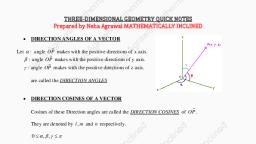
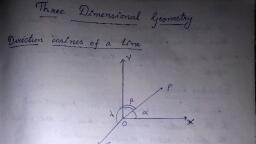
THREE DIMENSIONAL GEOMETRY., One mark questions:, 1), , If a line makes angles 900, 1350 and 450 with the x, y and z axes respectively., Find its direction cosines., Solution:, Let = 900, = 135, = 450, Let l, m, n are the direction cosines of a line, l = cos =cos 900 = 0, m=cos = cos 1350 = 1 ,, 2, , n = cos = cos 450 1, , 2, , 2), , If a line has direction ratio’s -18, 12, -4. Then what are its direction cosines., Solution:, x = - 18, y = 12, z = -4, , r x2 y 2 z 2 18 12 4 324 144 16 484 22, 2, , 2, , 2, , x 18 9, , , r 22 11, y 12 6, m , and, r 22 11, z 4 2, n , , r 22 11, , Direction cosines are l , , 3), , Find the direction cosines of x, y and z axis., Solution:, The x – axis makes angles 00, 900, 900 with the positive direction of, x, y and z – axis., Direction cosines of x – axis are cos 00, cos 900, cos 900 i.e. 1, 0, 0., Similarly direction cosines of y axis are cos 900, cos 00, cos 900 i.e. 0, 1, 0, and direction cosines of z – axis are cos 900, cos 900, cos 00, i.e. 0, 0, 1, , 4), , Find the direction cosines of a line which makes equal angles with the coordinate axes., Solution:, Let , , be the angles made by the line with the positive direction of x-axis,, y –axis and z – axis, Also = = and cos2 + cos2 + cos2 = 1, cos2 + cos2 + cos2 = 1, 3 cos2 = 1 cos2 =, , 1, 1, cos = , 3, 3, , 1, 1, 1, , , , 3, 3, 3, Find the equation of the plane having intercept 3 on the y-axis and parallel to, ZOX plane, , The direction cosines are, , 5), ,
Page 2 :
Solution:, Y – intercept = b = 3, Any plane parallel to ZOX is y = b, The equation of the plane is y = 3, 6), , Find the distance of the plane 2x – 3y + 4z - 6 = 0 from the origin., Solution:, Consider 2x – 3y + 4z – 6 = 0, 2x – 3y + 4z = 6, – (1), The Direction ratios are (2, -3, 4) = (x1, y1, z1), , , r 22 3 42 4 9 16 29, 2, , x1, 2, r, 29, y, m 1 3, r, 29, z, n 1 4, r, 29, , The Direction cosines are l , , Divide equation (1) by 29, , , , 2 x 3 y y z 6, 29, 29, 29, 29, , and is of the form lx + my + nz = d, The distance of the plane from origin is d , 7), , Find the equation of the plane which makes intercepts 1, -1 and 2 on the x, y and, z axes respectively., Solution:, a = x – intercept = 1, b = y – intercept = -1 and c = z – intercept = 2, The equation of the line is, , 8), , x y z 1, a b c, , i.e., , x y z 1, 1 1 2, , Determine the direction cosines of the normal to the plane and the distance from, the origin is x + y + z = 1, Solution:, Consider x + y + z = 1, - (1), Direction ratio’s of the plane are 1, 1, 1, , l 1, 3, x y z 1, 3 3 3, 3, , r 12 12 12 111 3, Divide equation (1) by 3, , It is of the form lx + my + nz = p, P = distance from origin = 1, 3, Find the intercepts cut off by the plane 2x + y – z = 5, Solution:, , , 9), , 6, 29, , m 1 n 1, 3, 3
Page 3 :
Consider 2x + y – z = 5, , 2x y z 1, 5 5 5, , i.e., , x y z 1, 5/ 2 5 5, , a = x– intercept = 5/2, , b = y – intercept = 5, , c = z – intercept = -5, , 10) Show that the planes 2x + y + 3z – 2 = 0 and x – 2y + 5 = 0 are perpendicular., Solution:, Consider 2x + y + 3z - 2 = 0, i.e. 2x + y + 3z = 2, And x – 2y + 5 = 0, i.e. x – 2y + 0.z = - 5, The normals to the plane are, , P1 2i j 3k, , and P2 i 2 j, , P1. P2 2 1 1 2 30 2 2 0 0, The planes P1 and P2 are perpendicular, 11) Show that the planes 2x – y + 3z – 1 = 0 and 2x – y + 3z + 3 = 0 are parallel., Solution:, Consider 2x – y + 3z – 1 = 0, i.e. 2x – y + 3z = 1, And 2x – y + 3z + 3 = 0, i.e. 2x – y + 3z = -3, The normals to the plane are, , P1 2i j 3k and P2 2i j 3k, a1 2, b, c, , 1, 1 1 1 and 1 3 1, a1 2, c2 3, b1 1, , , , a1 b1 c1, 1, a2 b2 c2, , The planes P1 and P2 are parallel., 12) Find the equation of the plane parallel to x – axis and passing through the origin., Solution:, The direction ratio’s of x-axis is 1, 0, 0, The equation of the line through origin and parallel to x-axis, x0 y0 z 0, x y z, is, , , i.e., , 1, 0, 0, 1 0 0, 13) Find the vector equation of the straight line passing through (1.2.3) and, perpendicular to the plane r. i 2 j 5k 9 0, Solution:, The required line passes through (1, 2, 3) and perpendicular to the plane, , r. i 2 j 5k 9 0 is, , r i 2 j 3k i 2 j 5k
Page 4 :
14) Find the equation of the plane passing through (a, b, c) and parallel to the plane, r. i j k 2, , Solution:, , , , , , Consider r. i j k 2, , x y z 2, , Any plane parallel to the given plane is x + y + z = , and is pass through (a, b, c), a+b+c=, Hence the equation of the plane parallel to the given plane is, x+y+z=a+b+c, 15) Find the distance between the two planes 2x+3y+4z=4 and 4x+6y+8z= 12., Solution:, Consider, 2x + 3y + 4z = 4, - (1), And 4x + 6y + 8z = 12, i.e. 2x + 3y + 4z – 6 = 0, - (2), Distance from the point to the plane (2) =, , , , 2x 3 y 4z 6, 22 32 42, , 4 6 2 2, 4 9 16, 29, 29, , Two mark questions:, 1), , Show that the points (2, 3, 4) (-1, -2, 1) and (5, 8, 7) are collinear., Solution:, A = (2, 3, 4) B = (-1, -2, 1) and C = (5, 8, 7), Direction ratio’s of the line joining A & B are, 2+1, 3+2, 4-1, i.e. 3, 5, 3, Direction ratio’s of the line joining B & C are -1-5, -2-8, 1-7, i.e. -6, -10, -6, The direction ratio’s of AB & BC are proportional & B is the common point, of AB & BC, The points A, B, C are collinear, , 2), , Show that the line through the points (1, -1, 2) (3, 4, -2) is perpendicular to the, line through the points (0, 3, 2) and (3, 5, 6), Solution:, Let A = (1, -1, 2), B = (3, 4, -2), C = (0, 3, 2) and, D = (3, 5, 6), Direction ratio’s of AB are, a1 = 3-1=2, b1 = 4- (-1) = 4+1=5 & C1 = -2-2 = -4, Direction ratio’s of CD are a2 = 3-0=3, b2 = 5-3=2, C2 = 6-2=4, Now a1a2 + b1b2 + c1c2 = 2 (3) + 5 (2) + (-4) 4, = 6+10 - 16 = 0, AB is perpendicular to CD, , 3), , Show that the line through the points (4, 7, 8) (2, 3, 4) is parallel to the line, through the points (-1, -2, 1) (1, 2, 5)., Solution:, Let A = (4, 7, 8), B = (2, 3, 4), C = (-1, -2, 1), D = (1, 2, 5)
Page 5 :
Direction ratio’s of AB are a1 = 2 – 4 = -2, b1 = 3-7=-4, c1 = 4 – 8 = -4, Direction ratio’s of CD are a2 = 1- (-1) =1+1=2, b2 = 2-(-2) = 2+2=4, c2 = 5-1 =4, , 4), , , , a1 2, 1,, a2 2, , , , a1 b1 c1, , a2 b2 c2, , b1 4, 1,, b2 4, , Hence AB is parallel to CD, , The Cartesian equation of a line is, vector form., Solution:, Consider, , c1 4, 1, c2 2, , x 5 y 4 z 6 . Write its equation in, 7, 3, 2, , x 5 y 4 z 6, 7, 3, 2, , a = (5, -4, 6) and b = (3, 7, 2) are the direction ratio’s, , r ab, r 5i 4 j 6k 3i 7 j 2k , , Vector equation of the line is, , , 5), , , , , , , , Find the distance of the point (2, 3, -5) from the plane r i 2 j 2k 9, Solution:, , , , , , Consider r. i 2 j 2k 9 and a 2i 3 j 5k, and N i 2 j 2k, , and d 9, , a.N 2 1 3 2 5 2 2 6 10 18, N 12 22 2 1 4 4 9 3, 2, , Distance of a point from the plane = d =, , a.N d, N, , 6), , 18 9 9 3, 3, 3, , Find the equation of the plane passing through the line of intersection of the, plane x + y + z = 6 and 2x + 3y + 4z – 5 = 0 and the point (1, 1, 1), Solution:, Consider x + y + z = 6, x + y + z -6 = 0 and 2x + 3y + 4z – 5 = 0, The equation of the plane passing through the intersection of the two planes, is x + y + z – 6 + (2x + 3y + 4z – 5) = 0 and is pass through (1, 1, 1), , 1 + 1 + 1 – 6 + (2+3+4-5) = 0, - 3 + 4 = 0 4 = 3, =¾, The equation is (x + y + z – 6) +, , 3, (2x + 3y + 4z – 5) = 0 (multiply by 4), 4, , 4x + 4y + 4z – 24 + 3 (2x + 3y + 4z – 5) = 0, 4x + 4y + 4z – 24 + 6x + 9y + 12z – 15 = 0, 10x + 13y + 16z – 39 = 0
Page 6 :
7), , Derive the direction cosine of a line passing through two points., Solution:, Let l, m, n be the direction cosines of a line PQ and the line PQ makes , , and with positive directions of x, y and z axes respectively. Draw the, perpendiculars from P and Q to xy – plane to meet at R & S and draw PN, perpendicular to QS., ˆ , From the le PNQ, PQN, , QN ON OQ Z2 Z1, , , PQ, PQ, PQ, x x, y y, Similarly cos 2 1 and cos 2 1, PQ, PQ, cos , , , , Where PQ x2 x1 y2 y1 z2 z1 , 2, , 8), , 2, , 2, , x 3 y 5 z 6, 2, 4, 2, , The Cartesian equation of a line is, Find the vector equation of the line, Solution:, , x 3 y 5 z 6, 2, 4, 2, x 3 y 5 z 6, , , 2, 4, 2, , Consider, , , , x1 = -3, , y1 = 5, , z1 = -6 and a = 2 b = 4 and c = 2, , a x1, y1, z1 3, 5, 6, , , , b a, b, c 2, 4, 2 are direction ratio’s, The vector equation of a line is r a b, , r 3i 5 j 6k 2i 4 j 2k , , 9), , Find the vector equation of the plane which is at a distance of 7 units from the, origin and normal to the vector 3i + 5j – 6k, Solution:, , let n 3i 5 j 6k, and nˆ , , and n 32 52 6 9 25 36 70, , n 3i 5 j 6k 3, 5, 6 , , , i, j, k, 70, 70, 70, 70, n, , , , The equation of the plane r .nˆ d and d 7, , , , 3, , r., , 70, , i, , 5, 6 , j, k7, 70, 70 , , 2
Page 7 :
10) Find the distance of the point (3, -2, 1) from the plane 2x – y + 2z + 3 = 0, Solution:, Consider 2x – y + 2z + 3 = 0, , , d, , , , ax1 by1 cz1 d, a 2 b2 c 2, , , , 2 3 1 2 2 1 3, 22 1 22, 2, , 6 2 2 3 13, , 3, 4 1 4, , Three mark questions, 1), , Find the vector and Cartesian equations of the line that passes through the, points (3, -2, -5) and (3, -2, 6), Solution:, Let A = (3, -2, -5) B = (3, -2, 6), Direction ratio’s of AB are, a = 3 – 3 = 0, b = -2 – (-2) = - 2+2 = 0, c = 6 – (-5) = 6 + 5 = 11, b ai bj ck 0.i 0. j 11k 11k and a 3, 2, 5 = 3i – 2j – 5k, Vector equation of a line passing through two points is r a b, , r 3i 2 j 5k 11k , , Cartesian equation of a line is, , x x1 y y1 z z1, , , a, b, c, , x 3 y 2 z 5, x 3 y 2 z 5, , , i.e., , , 0, 0, 11, 0, 0, 11, , 2), , Show that three lines with direction cosine, , 12 3 4 4 12 3 3 4 12, ,, ,, ;, , , ; ,, ,, 13 13 13 13 13 13 13 13 13, , are mutually perpendicular., Solution:, L1, L2, L3 are three lines., 12 3 4 , , ,, l1, m1, n1, 13 13 13 , , , , The direction cosine of the line L1 , , 4 12, , , , 3, l2 , m2 , n2 , 13, 13, 13, , , 3 4 12 , Direction cosines of the line L3 , , l3 , m3 , n3 , 13 13 13 , Direction cosines of the line L2 , , ,, , ,, , 12 4 3 12 4 3 48 36 12, , 0, , , 13 13 13 , 169, 13 13 13 , L1 is perpendicular to L2, , l1 l2 m1m2 n1n2 , , , l2 l3 m2m3 n2n3 , , , , 4 3 12 4 3 12 12 48 36 48 48, ., , ., , , 0, 13 13 13 13 13 13 , 169, 169, , L2 is perpendicular to L3
Page 8 :
3 12 4 3 12 4 36 12 48 48 48, ., , , 0, , , , 13 13 13 , 169, 169, 13 13 13 , L3 is perpendicular to L1, , l3 l1 m3m1 n3n1 , , , , Hence the three lines are mutually perpendicular, 3), , , , , , Find the angle between the pair of lines r 3i 5 j k i j k and, , r 7i 4k 2i 2 j 2k , Solution:, , , , Consider r 3i 5 j k i j k, , , , , , r 7i 4k 2i 2 j 2k , , , b2 2i 2 j 2k, , b1.b2 1 2 1 2 1 2 2 2 2 6, b1 12 12 12 3, , 4), , b1 i j k, , , , cos , , , , 00, , b2 4 4 4 12 2 3, , b1.b2, 6, 6, 6, , , 1 cos00, b1 b2 2 3. 3 2 3 6, , Find the equation of the line which passes through the point (1, 2, 3) and is, parallel to the vector 3i + 2j – 2k, both in vector form and Cartesian form., Solution:, Let a 1, 2, 3 i 2 j 3k and b 3i 2 j 2k, The vector equation of the line is r a b, , , , r i 2 j 3k 3i 2 j 2k , , Let r be the position vector of the point and r xi yj zk, , , , xi yj zk i 2 j 3k 3i 2 j 2k , , i 2 j 3k 3 i 2 j 2k, 1 3 i 2 2 j 3 2 k, , , , , , x 1 3, 2 2 y and z 3 2, x 1 3, 2 y 2, z 3 2, x 1, y2, z 3, , , , , 3, 2, 2, x 1 y 2 z 3, , , is the equation of the line in Cartesian form., 3, 2, 2
Page 9 :
5), , , , , , Find the distance between parallel lines r i 2 j 4k 2i 3 j 6k and, , r 3i 3 j 5k 2i 3 j 6k , Solution:, , , , Consider, , r i 2 j 4k 2i 3 j 6k , , And, , r 3i 3 j 5k 2i 3 j 6k , , a1 i 2 j 4k, , b1 2i 3 j 6k, , a2 3i 3 j 5k, , and, , b2 2i 3 j 6k, , , , b1 b2 The lines are parallel, , , , b b1 b2 2i 3 j 6k, , , , a2 a1 2i j 10k, , , , i j k, b a 2 a1 2 3 6 i 3 6 j 2 12 k 2 6 9i 14 j 4k, 2 1 1, , , , , , and b 22 32 62, 4 9 36 49 7, , , , 9 4 4, 2, , b a2 a1 , , 2, , 2, , Distance between parallel lines = d =, , 6), , Find, , the, , angle, , between, , 81 196 16 293, , , , b a 2 a1, , , , b, , the, , pair, , of, , 293, 7, , lines, , x 3 y 1 z 3, , , 3, 5, 4, , x 1 y 4 z 5, , , 1, 1, 2, Solution:, and, , Consider, and, , x 3 y 1 z 3, , , 3, 5, 4, x 1 y 4 z 5, , , 1, 1, 2, , 1, 2, , Direction ratios of b1 3, 5, 4 , Direction ratio ' s of b2 1, 1, 2 , , b1.b2 3 1 5 1 4 2 3 5 8 16, , b1 32 52 42 9 25 16 50 25 2 5 2, b 2 12 12 22 1 1 4 6, , , cos , , b1.b 2, , , , b1 b 2, , , 8 , , 5 3, , cos 1 , , 16, 16, 16, 16, 8, , , , , 5 2 6 5 12 5 4 3 5 2 3 5 3
Page 10 :
7), , Find the shortest distance between the lines, x 1 y 1 z 1, x 3 y 5 z 7, , , and, , , 7, 6, 1, 1, 2, 1, , Solution:, x 1 y 1 z 1, , , and, 7, 6, 1, x 1 y 1 z 1, , , 7, 6, 1, a1 i j k, , x 3 y 5 z 7, , , 1, 2, 1, , Consider, i.e., , , , , a 2 3i 5 j 7k, b2 i 2 j k, , b1 7i 6 j k, , a2 a1 3i 5 j 7k i j k 4i 6 j 8k, i, , j, , k, , b1 b 2 7 6 1 i 6 2 j 7 1 k 14 6 , 1 2 1, 4i 6 j 8k, , 4, , b1 b2 , , 2, , 6 8 16 36 64 116, 2, , 2, , Shortest distance = d , , , 8), , b b . a, 1, , 2, , 2, , a1, , b1 b 2, , 16 36 64, 116, , 116, 116 4 29 2 29, 116, , Find the equation of the planes passing through three points (1, 1, 0), (1, 2, 1) and (-2, 2, -1), Solution:, b = (1, 2, 1) and c = (-2, 2, -1) and r xi yj zk, Let a = (1, 1, 0), r a x 1 i y 1 j z 0 k, AB b a 0, 1, 1 and, , AC c a 3, 1, 1, , The vector equation of the plane is r a . AB AC 0, , 9), , x 1 y 1, 0, 1, , z, 1 0, , 3, , 1, , 1, , (x-1) (-1-1) – (y-1) (0+3) + z (0 + 3) = 0, -2(x-1) -3 (y-1) + 3z = 0, -2x + 2 – 3y + 3 + 3z = 0, -2x – 3y + 3z + 5 = 0, 2x + 3y - 3z - 5 = 0, 2x + 3y – 3z = 5 is the equation of the plane, Find the angle between the pair of lines given by r 3i 2 j 4k i 2 j 2k , and r 5i 2 j 3i 2 j 6k ., Solution:, cos , , b1 i 2 j 2k b2 3i 2 j 6k, , b1.b 2, b1 b 2, , , , 3 4 12 19, 19 , , cos 1 , 21, 9 49, 21
Page 11 :
10) Prove that if a plane has intercepts a, b, c and is at a distance of p units from the, origin then, , 1 1 1, 1, 2, a2 b2 c2 p, , Solution:, Let a, b, c, are the intercepts of the plane, And the equation is, , x y z, 1, a b c, , 1, , P = The distance of the plane (1) from (0, 0, 0), 0 0 0 1, , 1 1 1, , a 2 b2 c 2, 1, P2 , 1 1 1, , a 2 b2 c 2, , P, , 1, 1, , 1 1 1, 1 1 1, 2 2, , 2, a b c, a 2 b2 c2, 1, 1 1 1, 2 2 2 2, p, a b c, , Five mark questions:, 1), , Derive the equation of the line in space passing through a point and parallel to a, vector, both in the vector form and Cartesian form., Solution:, Let a be the position vector of the given point A. w.r. to, the origin O of the rectangular co-ordinate system. Let l, be the line which passes through the point A and is, parallel to the given vector b . Let r be the position, vector of an arbitrary point P on the line. Then AP is, parallel to b ., i.e. AP b where is a real number, OP OA b, r a b, r a b is the vector equation of the line, , Let A = (x1, y1, z1) be the co-ordinates of the given point and the direction ratio’s of the, line are a, b, c., Let P = (x, y, z) be the co-ordinate of any point, Then r xi yj zk and a x1i y1 j z1k and b ai bj ck and r a b, xi + yj + zk = (x1i + y1j + z1k) + (ai + bj + ck), = x1i + y1j + z1k + ai + bj + ck, = (x1 + a) i + (y1 + b) j + (z1 + c) k, Equating the coefficients of i, j and k we get, x = x1 + a, y = y1 + b, and z = z1 + c, these are the parametric equations of a line, x – x1 = a, y – y1 = b, and z – z1 = c, , , , , x x1, y y1, z z1, , , , a, b, c, x x1 y y1 z z1, , , . This is the Cartesian equation of the line., a, b, c