Page 1 :
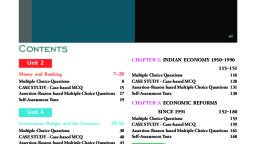
vii, , Contents, CHAPTER-2: INDIAN ECONOMY 1950–1990 , , Unit 2, Money and Banking, , 7–28, , Multiple Choice Questions, 8, CASE STUDY - Case-based MCQ, 15, Assertion-Reason based Multiple Choice Questions 17, Self-Assessment Tests, 19, , Unit 4, , 115–151, Multiple Choice Questions, CASE STUDY - Case-based MCQ, Assertion-Reason based Multiple Choice Questions, Self-Assessment Tests, , CHAPTER-3: ECONOMIC REFORMS, SINCE 1991, , Government Budget and the Economy, , 29-56, , Multiple Choice Questions, CASE STUDY - Case-based MCQ, Assertion-Reason based Multiple Choice Questions, Self-Assessment Tests, , 30, 40, 43, 45, , Unit 5, Balance of Payments, , 57-86, , Multiple Choice Questions, CASE STUDY - Case-based MCQ, Assertion-Reason based Multiple Choice Questions, Self-Assessment Tests, , 58, 69, 71, 75, , Unit 6, , 116, 128, 131, 138, , 152–180, , Multiple Choice Questions, CASE STUDY - Case-based MCQ, Assertion-Reason based Multiple Choice Questions, Self-Assessment Tests, , 153, 159, 161, 168, , Unit 7, Current challenges facing Indian Economy, , 181-238, , CHAPTER-4: POVERTY, , 182–200, , Multiple Choice Questions, CASE STUDY - Case-based MCQ, Assertion-Reason based Multiple Choice Questions, Self-Assessment Tests, , 182, 188, 190, 192, , CHAPTER-5: HUMAN CAPITAL, FORMATION IN INDIA, , Development Experience (1947-90) and, Economic Reforms since 1991, , 87-180, , CHAPTER-1: INDIAN ECONOMY ON THE, EVE OF INDEPENDENCE 88–114, Multiple Choice Questions, CASE STUDY - Case-based MCQ, Assertion-Reason based Multiple Choice Questions, Self-Assessment Tests, , 89, 95, 98, 105, , 201–219, , Multiple Choice Questions, CASE STUDY - Case-based MCQ, Assertion-Reason based Multiple Choice Questions, Self-Assessment Tests, , CHAPTER-6: RURAL DEVELOPMENT, , 201, 202, 205, 207, , 220–238, , Multiple Choice Questions, CASE STUDY - Case-based MCQ, Assertion-Reason based Multiple Choice Questions, Self-Assessment Tests, , 220, 223, 226, 227, , CBSE Sample Question Paper 2021-22 (Term-I), , 239-250, , 10 Sample Question Papers (for Practice), , 251-336
Page 2 :
Unit, , EXAM HANDBOOK Economics XII, , (for CBSE Term-I Examination November-December 2021), , 2, , Money and Banking, , Rationalised CBSE Syllabus 2021-22, , 7, , 6 Marks, , UNIT-2 Money and Banking, , For CBSE Term-I Examination, (November - December 2021), , Money - meaning and supply of money - Currency held by the public and net demand, deposits held by commercial banks., Money creation by the commercial banking system., Central bank and its functions (example of the Reserve Bank of India): Bank of issue, Govt., Bank, Banker's Bank, Control of Credit
Page 3 :
8, , EXAM HANDBOOK Economics XII, , (for CBSE Term-I Examination November-December 2021), , Shree Radhey Publications (Subhash Dey), , Multiple Choice Questions (MCQs), 1. Value of Money Multiplier _______ with an increase in Cash Reserve Ratio., (a) increases, (b) decreases, (c) remains unchanged, (d) None of these, 2. Supply of money refers to _________., (a) currency held by the public, (b) currency held by Reserve Bank of India (RBI), (c) currency held by the public and demand deposits of the public with commercial banks, (d) currency held in the government account, 3. The value of money multiplier is equal to ___________., (a) 1/Cash Reserve Ratio, (b) 1/Legal Reserve Ratio, (c) 1/Statutory Liquidity Ratio, (d) All of these, 4. Loans offered by commercial banks _________ the money supply in the economy., (a) increase, (b) decrease, (c) does not change, (d) All of these, 5. __________ is the main source of money in an economy., (a) Central bank, (b) Commercial banks, (c) Both (a) and (b), (d) Government, 6. The interest rate paid by the banks to depositors is lower than the rate charged from the borrowers. This difference, between these two types of interest rates is called ______., (a) Bank Rate, (b) Lending Rate, (c) Repo Rate, (d) Spread, 7. When the banks lend to any person, a new deposit is opened in that person’s name. Thus, money supply in the, economy increases to old deposits plus new deposits plus _______., (a) Currency held by the public, (b) Bank Money, (c) High Powered Money, (d) Legal Reserves, 8. There is a limit to money or credit creation by banks, and this is determined by the central bank (RBI). The RBI, decides a certain percentage of _______ which every bank must keep as reserves, called Legal Reserve Ratio, (LRR)., (a) Demand deposits, (b) Time deposits, (c) Net total demand and time deposits, (d) Current account deposits, 9. If the Reserve Ratio is 20% and the primary deposits are `100, the total lending by the banking system will be, ______., (a) `500, (b) `400, (c) `100, (d) `20, 10. M1 measure of money supply is defined as follows:, M1= CU +DD where, CU is Currency (notes plus coins) held by the public and DD is ‘net’ demand deposits held, by commercial banks. What does word ‘net’ imply here?, (a) Only deposits of the public held by the banks are to be included in money supply., (b) The interbank deposits, which a commercial bank holds in other commercial banks, are not to be regarded as, part of money supply., (c) Both (a) and (b), (d) It implies aggregate monetary resources., 11. The currency issued by the central bank can be held by the public or by the commercial bank, and is called the, ______ ., (a) Credit money, (b) Bank money, (c) High powered money, (d) Fiat money
Page 4 :
UNIT-2 Money and Banking, , EXAM HANDBOOK Economics XII, , (for CBSE Term-I Examination November-December 2021), , 9, , 12. Demand deposits include _______., (a) Saving account deposits and fixed deposits, (b) Saving account deposits and current account deposits, (c) Current account deposits and fixed deposits, (d) All types of deposits, 13. Deposit creation by banks comes to an end when _____., (a) fresh deposits with banks become zero (b) legal reserve ratio becomes zero, (c) money multiplier becomes zero, (d) total reserves equal initial deposits, 14. The ratio of net total deposits that a commercial bank has to keep with Reserve Bank of India is called:, (a) Statutory liquidity ratio, (b) Deposit ratio, (c) Cash reserve ratio, (d) Legal reserve ratio, 15. Which of the following is not a Quantitative Method of credit control?, (a) Open Market Operation, (b) Margin Requirements, (c) Variable Reserve Ratio, (d) Bank Rate Policy, 16. Who regulates money supply?, (a) Government of India, (b) Reserve Bank of India, (c) Commercial Banks, (d) Planning Commission, 17. Signature of _______ appears on a `2,000 currency note., (a) The Central Bank, (b) Governor of Reserve Bank of India (RBI), (c) Finance Minister of India, (d) Chief Justice of India, 18. The formula used for calculating Credit multiplier :, (a) 1/Cash Reserve Ratio, (b) 1/Statutory Liquidity Ratio, (c) 1/Legal Reserve Deposit Ratio, (d) All of the above, 19. Repo rate relates to ________., (a) Short-term borrowings by commercial banks, (b) Long-term borrowing by commercial banks, (c) Disinvestments, (d) Dis-savings, 20. Total deposits created by commercial banks is `20,000 crore and LRR is 20%. Calculate the amount of initial, deposits., (a) `6000 crore, (b) `4000 crore, (c) `5000 crore, (d) `3000 crore, 21. __________ measures the amount of money that the banks are able to create in the form of deposits with every, initial deposit., (a) Money supply, (b) Demand deposits, (c) Deposit multiplier, (d) High powered money, 22. If Reserve Deposit Ratio is 12.5%, the value of money multiplier will be:, (a) 2, (b) 5, (c) 8, (d) 10, 23. ______________ is the rate of interest at which central bank lends to the commercial banks for long-term., (a) Bank Rate, (b) Repo Rate, (c) Reverse Repo Rate, (d) Prime Lending Rate, 24. _____ is the agent and adviser to the Government of India., (a) Central Bank of India, (b) State Bank of India, (c) Reserve Bank of India, (d) Punjab National Bank, 25. _______ are called legal tenders., (a) Demand deposits, (b) Time deposits, (c) Inter-bank deposits, (d) Currency notes and coins
Page 5 :
10, , EXAM HANDBOOK Economics XII, , (for CBSE Term-I Examination November-December 2021), , Shree Radhey Publications (Subhash Dey), , 26. Supply of money refers to quantity of money ____________ . , (a) as on 31st March, (b) during any specified period of time, (c) as on any point of time, (d) during a fiscal year, 27. Fixed deposit is also termed as:, (a) Chequeable deposits, (b) Demand deposit, (c) Time deposit, (d) Non-chequeable deposits, 28. Which of the following is not a function of the Reserve Bank of India?, (a) It issues the currency of the country., (b) It acts as a bank to the banking system., (c) It is the custodian of the foreign exchange reserves of the economy., (d) None of the above, 29. LRR and money creation has ____________., (a) positive relation, (b) negative relation, (c) No relation, (d) Both (a) and (b), 30. Monetary policy is the policy of, (a) Government, (b) Central Bank, (c) Commercial Bank, (d) NABARD, 31. The bank that operates without any profit motive in public interest is, (a) Central Bank, (b) Nationalised Commercial Bank, (c) Canara Bank, (d) Punjab National Bank, 32. CRR stands for, (a) Credit Reserve Ratio, (b) Cash Reserve Ratio, (c) Commercial Reserve Ratio, (d) Central Reserve Ratio, 33. Which of the following is the function of the Central Bank?, (a) Accepting deposits from the general public, (b) Giving loans to general public, (c) Bankers’ Bank, (d) Credit Creation, 34. The RBI can influence money supply by changing the rate at which it gives loans to the commercial banks for, long-term periods. This rate is called the ___________ in India. , (a) Bank Rate, (b) Repo Rate, (c) High powered money, (d) Lending Rate, 35. The ratio of net total demand and time deposits that a commercial bank has to keep with Reserve Bank of India is, called:, (a) Statutory liquidity ratio, (b) Deposit ratio, (c) Cash reserve ratio, (d) Legal reserve ratio, 36. Which of the following is not a Quantitative Method of credit control?, (a) Open Market Operations, (b) Margin Requirements, (c) Variable Reserve Ratio, (d) Bank Rate Policy, 37. __________ is the rate at which the Central Bank borrows funds from commercial banks., (a) Cash Reserve Ratio, (b) Statutory Liquidity Ratio, (c) Bank Rate, (d) Reverse Repo Rate, 38. __________ is the ratio of deposits which banks keep with themselves., (a) Cash Reserve Ratio, (b) Statutory Liquidity Ratio, (c) Bank Rate, (d) Reverse Repo Rate
Page 6 :
UNIT-2 Money and Banking, , EXAM HANDBOOK Economics XII, , (for CBSE Term-I Examination November-December 2021), , 11, , 39. __________ is the rate at which commercial banks borrow short-term funds from the Central Bank by selling, their financial securities to the Central Bank., (a) Cash Reserve Ratio, (b) Statutory Liquidity Ratio, (c) Bank Rate, (d) Repo Rate, 40. What will be the effect of increase in the ‘Repo Rate’ on the money supply?, (a) Money supply will increase, (b) Money supply will decrease, (c) Money supply will remain same, (d) Money supply will initially increase and then it will decrease, 41. The central bank can increase availability of credit by:, (a) Raising repo rate, (b) Raising reverse repo rate, (c) Buying government securities, (d) Selling government securities, 42. Qualitative instruments of credit control includes:, (a) Margin Requirement, (b) Bank Rate, (c) CRR, (d) Open Money Operations, 43. Quantitative instrument of monetary policy includes:, (a) Margin Requirement, (b) Bank Rate, (c) Statutory Liquidity Ratio, (d) Both (b) and (c), 44. Which of the following will increase the supply of money?, (a) Fall in bank rate, (b) Sale of securities in open market, (c) Increase in the cash reserve ratio, (d) Increase in Repo rate, 45. To curb inflation, the RBI should____________., (a) Reduce the bank rate, (b) Reduce the Repo rate, (c) Sell the government securities, (d) Reduce the Reverse Repo rate, 46. To soak the liquidity from the market ___________., (a) Government securities should be purchased, (b) Government securities should be sold, (c) Repo rate should be decreased, (d) Cash reserve ratio should be decreased, 47. Which of the following changes by the Central Bank can increase the money supply?, (a) Increase in Repo Rate, (b) Increase in CRR, (c) Purchase of government securities in the open market, (d) Sale of government securities in the open market, 48. Name the credit control method which refers to the difference between the amount of loan and market value of, the securities offered by the borrower against the loan., (a) Selective credit control, (b) Moral Suasion, (c) Margin requirement, (d) Legal reserve requirements, 49. Demand deposits created by commercial banks are called ________., (a) Credit money, (b) Bank money, (c) High powered money, (d) Legal tenders, 50. Bank deposits which have fixed period to maturity, e.g. fixed deposits are referred to as _______., (a) Saving account deposits, (b) Current account deposits, (c) Time deposits, (d) Recurring deposits, 51. ____________ is the only institution which can issue currency notes in India., (a) State Bank of India (SBI), (b) Reserve Bank of India (RBI), (c) Central Bank of India (CBI), (d) Government of India (GOI)
Page 7 :
12, , EXAM HANDBOOK Economics XII, , (for CBSE Term-I Examination November-December 2021), , Shree Radhey Publications (Subhash Dey), , 52. Central Bank is a very important institution in a modern economy. Almost every country has one central, bank. India got its central bank in 1935. Its name is ____________., (a) State Bank of India (SBI), (b) Reserve Bank of India (RBI), (c) Central Bank of India (CBI), (d) Punjab National Bank (PNB), 53. Apart from the CRR, banks are also required to keep some reserves in liquid form in the short term. This ratio is, called __________________., (a) Reserve Ratio, (b) Legal Reserve Ratio, (c) Statutory Liquidity Ratio, (d) Reserve Deposit Ratio, 54. The central bank controls money supply of the country through various methods, like bank rate, open market, operations and variations in _________., (a) Cash reserve ratio, (b) Statutory Liquidity Ratio, (c) Legal Reserve Deposit Ratio, (d) All of these, 55. ____________ refers to buying and selling of bonds issued by the Government in the open market by the central, bank on behalf of the Government., (a) Open Market Operations, (b) Stock trading, (c) Official reserve transactions, (d) None of these, 56. When RBI buys a Government bond in the open market, it ___________ the money supply in the economy., (a) increases, (b) decreases, (c) does not change, (d) None of these, 57. If the RBI increases the bank rate, money supply in the economy __________. , (a) increases, (b) decreases, (c) does not change, (d) None of these, 58. Demand deposits created by the commercial banks are called _________ ., (a) High powered money, (b) Money, (c) Bank money, (d) Time deposits, 59. Which of the following is not included in money supply?, (a) High powered money, (b) Bank money, (c) Time deposits, (d) Inter-bank deposits, 60. __________ is the main source of money in an economy., (a) Central bank of the economy, (b) Commercial banking system, (c) Both (a) and (b), (d) Government, 61. Currency issued by the central bank is called:, (a) Fiat money, (b) Legal tenders, (c) High powered money, (d) All of the above, 62. Apart from currency notes and coins, the balance in___________, held by the public in commercial banks is, also considered money since the amount in these accounts can be used to settle transactions. Such deposits, are called demand deposits because they are payable by the bank on demand from the account-holder., (a) Saving account deposits, (b) Current account deposits, (c) savings and current account deposits, (d) None of these, 63. High Powered Money is also called:, (a) Reserve Money, (b) Monetary Base, (c) Bank Money, (d) Credit Money, 64. Since banks earn interest from loans they make, any bank would like to land the maximum possible. But there is a, limit to money or credit creation by banks and this is determined by ___________., (a) Commercial bank, (b) the central bank (RBI), (c) Both (a) and (b), (d) None of these
Page 8 :
UNIT-2 Money and Banking, , 65., , , 66., , EXAM HANDBOOK Economics XII, , (for CBSE Term-I Examination November-December 2021), , 13, , The value of credit multiplier will be high when __________., (a) Legal reserve ratio is high, (b) Legal reserve ratio is low, (c) Legal reserve ratio is zero, (d) Legal reserve ratio is infinity, When commercial banks need more funds in order to be able to create more credit, they may go to market, for such funds or go to the Central Bank. Central Bank provides them funds through various instruments. This, role of RBI, that of being ready to lend to banks at all times is a important function of the central bank, and, due to this central bank is said to be the _______________., (a) Bankers’ Bank, (b) The Supreme Power, (c) Lender of last resort, (d) None of these, 67. The RBI can influence money supply by changing the rate at which it gives loans to the commercial banks for, long-term periods. This rate is called the ___________ in India., (a) Bank Rate, (b) Repo Rate, (c) High powered money, (d) Lending Rate, 68. When the central bank buys the government security through an agreement which has a specification about date, and price of resale of this security. This type of agreement is called a Repurchase agreement . The interest rate at, which the money is lent in this way is called the_____ ., (a) Bank Rate, (b) Repo Rate, (c) High powered money, (d) Lending Rate, 69. When the Central bank sells the government security through an agreement which has a specification about the, date and price at which it will be repurchased. This type of agreement is called a Reverse Repurchase Agreement., The rate at which the money is withdrawn in this manner is called the (ii)_______ ., (a) Bank Rate, (b) Repo Rate, (c) Reverse Repo Rate, (d) Lending Rate, 70. Repo rate is the rate at which, (a) commercial banks purchase government securities from the central bank, (b) commercial banks can take loans from the central bank, (c) commercial banks can keep their deposits with the central bank, (d) short-term loans are given by commercial banks, 71. If an economy is to control recession, which of the following can be appropriate? , (a) Reducing Repo Rate, (b) Reducing CRR, (c) Both (a) and (b), (d) None of (a) and (b), 72. During deflation, it is advisable to ___________., (a) Lower the bank rate and purchase of securities in the open market, (b) Increase the bank rate and purchase of securities in the open market, (c) Decrease in bank rate and sale of securities in the open market, (d) Increase in bank rate and sale of securities in the open market, 73. To curb inflation, the RBI should____________., (a) Reduce the bank rate, (b) Reduce the Repo rate, (c) Sell the government securities, (d) Reduce the Reverse Repo rate, 74. To soak the liquidity from the market ___________., (a) Government securities should be purchased, (b) Government securities should be sold, (c) Repo rate should be decreased, (d) Cash reserve ratio should be decreased, 75. If the Reserve Deposit Ratio is 25% and the initial deposits of the public are `2,000, what is the value of deposit, multiplier, total deposit creation and total lending by the banking system?, , (a) Deposit multiplier = 4; Total deposit creation = `8,000 and total lending by the banking system `6,000
Page 9 :
14, , EXAM HANDBOOK Economics XII, , Shree Radhey Publications (Subhash Dey), , (for CBSE Term-I Examination November-December 2021), , , (b) Deposit multiplier = 5; Total deposit creation = `10,000 and total lending by the banking system `10,000, , (c) Deposit multiplier = 4; Total deposit creation = `10,000 and total lending by the banking system `10,000, (d) Deposit multiplier = 5; Total deposit creation = `8,000 and total lending by the banking system `6,000, 76. Total deposits created by commercial banks is `12,000 crore and LRR is 25%. The amount of initial deposits was:, (a) `15,000 crore, (b) `12,000 crore, (c) `3,000 crore, (d) `25,000 crore, 77. What will be the legal reserve ratio if the initial deposit of ` 25,000 crore lead to a creation of total deposits of, `1,25,000 crore?, (a) 25%, (b) 20%, (c) 125%, (d) 12.5%, 78. The Reserve Bank of India (RBI), cut Repo Rate to 4.4%, the lowest in at least 15 years. Also, it reduced the, Cash Reserve Ratio (CRR) maintained by the banks for the first time in over seven years. CRR for all banks, was cut by 100 basis points to release `1.37 lakh crores across the banking system. RBI governor Dr. Shaktikanta, Das predicted a big global recession and said India will not be immune. It all depends how India responds to the, situation. Aggregate demand may weaken and ease core inflation., Cut in Repo rate by RBI is likely to ___________ the demand for goods and services in the economy., (a) Increase, (b) Decrease, (c) Double, (d) None of these, , Answer Key, 1., 9., 17., 25., 33., 41., 49., 57., 65., 73., , (b), (b), (b), (d), (c), (c), (b), (b), (b), (c), , 2., 10., 18., 26., 34., 42., 50., 58., 66., 74., , (c), (c), (c), (c), (a), (a), (c), (c), (c), (b), , 3., 11., 19., 27., 35., 43., 51., 59., 67., 75., , (b), (c), (a), (c), (c), (d), (b), (d), (a), (a), , 4., 12., 20., 28., 36., 44., 52., 60., 68., 76., , (a), (b), (b), (d), (b), (a), (b), (c), (b), (c), , 5., 13., 21., 29., 37., 45., 53., 61., 69., 77., , (c), (d), (c), (b), (d), (c), (c), (d), (c), (b), , 6., 14., 22., 30., 38., 46., 54., 62., 70., 78., , (d), (c), (c), (b), (b), (b), (d), (c), (b), (a), , 7., 15., 23., 31., 39., 47., 55., 63., 71., , (a), (b), (a), (a), (d), (c), (a), (a), (b), (c), , 8., 16., 24., 32., 40., 48., 56., 64., 72., , (c), (b), (c), (b), (b), (c), (a), (b), (a)
Page 10 :
UNIT-2 Money and Banking, , Case Study, 1, , Case Study, , EXAM HANDBOOK Economics XII, , (for CBSE Term-I Examination November-December 2021), , 15, , Case-based Multiple Choice Questions (MCQs), Read the following News Report and answer Q. 1-4 on the basis of the same:, , The Monetary Policy Committee of the Reserve Bank of India kept interest rates on hold Thursday even as it vowed to, keep policy sufficiently loose to help revive the coronavirus-battered economy. Accepting a key demand of lenders and, the corporate sector, the central bank cleared a one-time restructuring of loan accounts to bail out stressed borrowers,, including personal, small and medium loans., The details of the loan restructuring scheme — expected to kick in after the moratorium on loan repayments ends August, 31 — will be worked out by a committee headed by former ICICI Bank Chairman KV Kamath. The RBI also continued, to provide support on the liquidity front and opened a new targeted window for small lenders., The central bank kept the repo rate unchanged at 4 per cent and reduced the reverse repo rate to 3.35 per cent., Q.1 Suppose you are a member of the Monetary Policy Committee of the RBI. You have suggested the ________, of the money supply be ensured to help revive the coronavirus-battered economy., (a) restriction, (b) release, (c) doubling, (d) no change, Q.2 “The Monetary Policy Committee of the RBI kept interest rates on hold...” Which of the following is, highlighted above by the term ‘interest rates’?, (a) Bank Rate and Repo Rate, (b) Bank Rate and Lending Rate, (c) Repo Rate and Reverse Repo Rate, (d) Bank Rate and Reverse Repo Rate, Q.3 What does the ‘Repo Rate’ mean?, (a) Rate at which banks borrow from the RBI for short-term., (b) Rate at which banks borrow from the RBI for long-term., (c) Rate at which banks deposit excess funds with the RBI., (d) Rate at which banks lend funds to the public., Q.4 ‘Reduction in Repo Rate by RBI’ is likely to _________ the demand for goods and services in the economy., (a) increase, (b) decrease, (c) double, (d) not affect, , 2, , Case Study, , Read the following News Report and answer Q. 5-8 on the basis of the same:, , RBI Monetary Policy 2020, The key indicators of RBI Monetary Policy along with their current rates in the table given below:, Indicator, CRR, SLR, Repo Rate, Reverse Repo Rate, Bank Rate, , Current Rate, 3%, 18.50%, 4.00%, 3.35%, 4.65%, , On 9th October 2020, RBI has kept the Repo Rate unchanged at 4.00% and reduced reverse repo rate to 3.35%. In, addition to that, the bank rate stands at 4.65%. This has been done to limit the damage to the economy caused by the, Covid-19 and subsequent lockdowns.
Page 11 :
16, , EXAM HANDBOOK Economics XII, , (for CBSE Term-I Examination November-December 2021), , Shree Radhey Publications (Subhash Dey), , Q.5 What does RBI Monetary Policy 2020 mean?, (a) It is the policy formulated by the RBI in 2020 related to expenditure and taxation of the government., (b) It is the policy formulated by the RBI in 2020 related to money matters of the country,, (c) It is the policy formulated by the RBI in 2020 related to the government budget., (d) It is the policy formulated by the RBI in 2020 related to the distribution of credit among users as well as, the rate of interest on borrowing and lending., Q.6 What does the ‘Bank Rate’ mean?, (a) Rate at which banks borrow from the RBI for short-term., (b) Rate at which banks borrow from the RBI for long-term., (c) Rate at which banks deposit excess funds with the RBI., (d) Rate at which banks lend funds to the public., Q.7 Which of the following is a quantitative credit control technique of RBI?, (a) CRR, (b) SLR, (c) Repo Rate, (d) All of these, Q.8 Cut in Reverse Repo Rate is likely to __________ the demand for goods and services in the economy during, Covid-19 lockdowns., , (a) increase, (b) decrease, (c) double, (d) not affect, , 3, , Case Study, , Read the following News Report and answer Q. 9-12 on the basis of the same:, , RBI extends CRR and SLR relaxations for three more months., Keeping in view the continuing of hardships faced by banks in terms of social distancing of staff and consequent strains, on reporting requirements, the Reserve Bank of India has extended the relaxation of the minimum daily maintenance, of the CRR of 80% for up to September 25, 2020. Currently CRR is 3% and SLR is 18.50%., “As announced in the Statement of Developmental and Regulatory Policies of March 27, 2020, the minimum daily, maintenance of CRR was reduced from 90% of the prescribed CRR to 80% effective the fortnight beginning March, 28, 2020 till June 26, 2020 that has now been extended up to September 25, 2020,” said the RBI., Q.9 The full forms of CRR and SLR are:, (a) Current Reserve Ratio and Statutory Legal Reserves, (b) Cash Reserve Ratio and Statutory Legal Reserves, (c) Current Required Ratio and Statutory Legal Reserves, (d) Cash Reserve Ratio and Statutory Liquidity Ratio, Q.10 What will be the value of money multiplier?, (a) 33.33, (b) 5.4, (c) 4.65, (d) None of these, Q.11 SLR implies:, (a) Certain percentage of the total bank’s deposits has to be kept in the current account with RBI., (b) Certain percentage of net total demand and time deposits has to be kept by the bank with themselves., (c) Certain percentage of net demand deposits has to be kept by the banks with RBI., (d) None of the above, Q.12 Decrease in CRR will lead to __________., (a) fall in aggregate demand in the economy, (b) rise in aggregate demand in the economy, (c) no change in aggregate demand in the economy, (d) fall in general price level in the economy
Page 12 :
EXAM HANDBOOK Economics XII, , UNIT-2 Money and Banking, , 4, , Case Study, , (for CBSE Term-I Examination November-December 2021), , 17, , Read the following News Report and answer Q. 13-16 on the basis of the same:, , Due to Covid-19, the Reserve Bank of India (RBI), cut Repo Rate to 4.4 % the lowest in at least 15 years. Also, it, reduced the CRR by 100 basis points. Previously, it was 4%. RBI governor Dr. Shaktikanta Das predicted a big global, recession and said India will not be immune. It all depends how India responds to the situation. Aggregate demand, may weaken and ease core inflation., Q.13 CRR stands for: , (a) Cash Reserve Ratio, (b) Current Reserve Ratio, (c) Cash Required Rate, (d) Current Required Rate, Q.14 Cut in Repo Rate by RBI is likely to _____________ the aggregate demand in the Indian economy., (a) increase, (b) decrease, (c) double, (d) not affect, Q.15 “... reduced the CRR by 100 basis points. Previously, it was 4%.” Thus, CRR is reduced to ___________., (a) 5%, (b) 3%, (c) 96%, (d) 104%, Q.16 Besides reduction in CRR and Repo Rate, what other measures can be taken by the Government of India, through its budgetary policy to combat recession?, (a) Decrease the bank rate, (b) Sell government securities in the open market, (c) Increase margin requirements on secured loans, (d) Decrease taxes and increase government expenditure, , Answer Key, 1. (b), 9. (d), , 2. (c), 10. (c), , 3. (a), 11. (b), , 4. (a), 12. (b), , 5. (b), (d), 13. (a), , 6. (b), 14. (a), , 7. (d), 15. (b), , 8. (a), 16. (d), , Multiple Choice Questions (MCQ) on Assertion-Reasoning Type, Read the following statements-Assertion (A) and Reason (R), and select the correct alternative in each case:, (a) Both Assertion (A) and Reason (R) are true and Reason (R) is the correct explanation of Assertion (A)., (b) Both Assertion (A) and Reason (R) are true but Reason (R) is not the correct explanation of Assertion (A), (c) Assertion (A) is true but Reason(R) is false., (d) Assertion (A) is false but Reason(R) is true., 1. Assertion (A): Currency created by the Central Bank Is called bank Money., , Reason (R): Central Bank of a country has monopoly over the currency issue. It has the sole responsibility of, printing and putting in circulation all types of currency notes (with a few exceptions)., 2. Assertion (A): An increase in Legal Reserve Deposit Ratio increases the credit creation power of the commercial, banks (banking system)., Reason (R): Credit creation = Primary deposits × 1/ Legal Reserve Ratio, 3. Assertion (A): Currency notes and coins are called fiat money., , Reason (R): RBI is responsible for giving the bearer of the currency equal purchasing power., 4. Assertion (A): Currency notes and coins are called legal tenders.
Page 13 :
EXAM HANDBOOK Economics XII, , 18, , (for CBSE Term-I Examination November-December 2021), , Shree Radhey Publications (Subhash Dey), , , Reason (R): They cannot be refused by any citizen of the country for settlement of any kind of transaction., 5. Assertion (A): Money supply is a flow variable., , Reason (R): Money supply is the total stock of money in circulation among the public point of time., 6. Assertion (A): Statutory liquidity ratio is the ratio of demand deposits of a commercial bank which it has to, keep in the form of specified liquid assets., , Reason (R): Statutory liquidity ratio is a component of legal reserve ratio, which affects the credit creation in the, economy., 7. Assertion (A): Reverse repo rate is the rate at which the Central Bank lends funds to banks., , Reason (R): When Reverse Repo Rate is raised, it encourages the commercial banks to park their funds with the, central bank., 8. Assertion (A): To increase the money supply in the economy, Central Bank reduces the margin requirement., , Reason (R): Decrease in margin requirements enhances the borrowing capacity of public, which raises the, money supply in the economy., 9. Assertion (A): Demand deposits are not legal tenders., Reason (R): Demand deposits are the deposits which can be easily withdrawable on demand, by cheque or, otherwise, by the depositor from his/her bank account., 10. Assertion (A): In a modern economy, money comprises cash and bank deposits., Reason (R): Money supply includes currency held by the public and net demand deposits held by commercial, banks., 11. Assertion (A): Besides central bank, commercial banks are the other type of institutions which are a part of the, money-creating system of the economy., , Reason (R): Commercial banksaccept deposits from the public and lend out part of these funds to those who, want to borrow., 12. Assertion (A): Quantitative tools include persuasion by the central bank in order to make commercial banks, discourage or encourage lending., , Reason (R): Quantitative tools control the extent of money supply by changing the Cash Reserve Ratio (CRR), or Statutory Liquidity Ratio (SLR) or Bank Rate or Repo Rate or Reverse Repo Rate, or through Open market, operations (OMO)., 13. Assertion (A): Qualitative credit control tools control the extent of money supply., Reason (R): Qualitative tools discourage or encourage lending which is done through margin requirement,, moral suasion, etc., 14. Assertion (A): M1 measure of money supply is defined as follows: M1 = CU +DD,where CU is Currency (notes, plus coins) held by the public and DD is ‘net’ demand deposits held by commercial banks. The word ‘net’ here, implies that only deposits of the public held by the banks are to be included in money supply., Reason (R): The interbank deposits, which a commercial bank holds in other commercial banks, are not to be, regarded as part of money supply., 15. Assertion (A): Credit creation is inversely related to the legal reserve ratio., , Reason (R): Credit creation = Initial Deposits × 1/LRR .Any increase in LRR will decrease the credit creation, power of the commercial banks (banking system)., 16. Assertion (A): Credit creation is inversely related to money multiplier., , Reason (R): Credit creation = Initial deposits × Money Multipler (1/LRR), With the same initial deposit total credit creation decreases with a decrease in the value of money multiplier., , Answer Key, 1., 6., 11., 16., , (d), (d), (a), (d), , 2. (d), 7. (d), 12. (d), , 3. (a), 8. (a), 13. (d), , 4. (a), 9. (b), 14. (a), , 5. (d), 10. (a), 15. (a)
Page 14 :
UNIT-2 Money and Banking, , EXAM HANDBOOK Economics XII, , (for CBSE Term-I Examination November-December 2021), , 19, , Self Assessment Test 1, , Money and Banking, Time allowed : 45 min, , Maximum Marks : 20, , Q.1 Read the following statements-Assertion (A) and Reason (R):, , Assertion (A): Currency created by the Central Bank Is called bank Money., , Reason (R): Central Bank of a country has monopoly over the currency issue. It has the sole responsibility of, printing and putting in circulation all types of currency notes (with a few exceptions)., , Select the correct alternative:, (a) Both Assertion (A) and Reason (R) are true and Reason (R) is the correct explanation of Assertion (A)., (b) Both Assertion (A) and Reason (R) are true but Reason (R) is not the correct explanation of Assertion (A), (c) Assertion (A) is true but Reason (R) is false., (d) Assertion (A) is false but Reason (R) is true., Q.2 Value of Money Multiplier _______ with an increase in Cash Reserve Ratio., (a) increases, (b) decreases, (c) remains unchanged, (d) None of these, Q.3 Supply of money refers to _________., (a) currency held by the public, (b) currency held by Reserve Bank of India (RBI), (c) currency held by the public and demand deposits of the public with commercial banks, (d) currency held in the government account, Q.4 Loans offered by commercial banks _________ the money supply in the economy., (a) increase, (b) decrease, (c) does not change, (d) All of these, Q.5 __________ is the main source of money in an economy., (a) Central bank, (b) Commercial banks, (c) Both (a) and (b), (d) Government, Q.6 The interest rate paid by the banks to depositors is lower than the rate charged from the borrowers. This, difference between these two types of interest rates is called ______., (a) Bank Rate, (b) Lending Rate, (c) Repo Rate, (d) Spread, Q.7 When the banks lend to any person, a new deposit is opened in that person’s name. Thus, money supply in the, economy increases to old deposits plus new deposits plus _______., (a) Currency held by the public, (b) Bank Money, (c) High Powered Money, (d) Legal Reserves, Q.8 There is a limit to money or credit creation by banks, and this is determined by the central bank (RBI). The, RBI decides a certain percentage of _______ which every bank must keep as reserves, called Legal Reserve, Ratio (LRR)., (a) Demand deposits, (b) Time deposits, (c) Net total demand and time deposits, (d) Current account deposits, Q.9 If the Reserve Ratio is 20% and the primary deposits are `100, the total lending by the banking system will be, ______., (a) `500, (b) `400, (c) `100, (d) `20
Page 15 :
20, , EXAM HANDBOOK Economics XII, , (for CBSE Term-I Examination November-December 2021), , Shree Radhey Publications (Subhash Dey), , The value of credit multiplier will be high when __________., (a) Legal reserve ratio is high, (b) Legal reserve ratio is low, (c) Legal reserve ratio is zero, (d) Legal reserve ratio is infinity, When commercial banks need more funds in order to be able to create more credit, they may go to market for, such funds or go to the Central Bank. Central Bank provides them funds through various instruments. This, role of RBI, that of being ready to lend to banks at all times is a important function of the central bank, and, due to this central bank is said to be the _______________., (a) Bankers’ Bank, (b) The Supreme Power, (c) Lender of last resort, (d) None of these, Q.12 The RBI can influence money supply by changing the rate at which it gives loans to the commercial banks for, long-term periods. This rate is called the ___________ in India., (a) Bank Rate, (b) Repo Rate, (c) High powered money, (d) Lending Rate, Q.13 When the central bank buys the government security through an agreement which has a specification about, date and price of resale of this security. This type of agreement is called a Repurchase agreement . The interest, rate at which the money is lent in this way is called the_____ ., (a) Bank Rate, (b) Repo Rate, (c) High powered money, (d) Lending Rate, Q.14 Repo rate is the rate at which, (a) commercial banks purchase government securities from the central bank, (b) commercial banks can take loans from the central bank, (c) commercial banks can keep their deposits with the central bank, (d) short-term loans are given by commercial banks, Q.15 What will be the legal reserve ratio if the initial deposit of ` 25,000 crore lead to a creation of total deposits of, `1,25,000 crore?, (a) 25%, (b) 20%, (c) 125%, (d) 12.5%, Q.16 Read the following statements-Assertion (A) and Reason (R):, Assertion (A): Demand deposits are not legal tenders., Reason (R): Demand deposits are the deposits which can be easily withdrawable on demand, by cheque or, otherwise, by the depositor from his/her bank account., , Select the correct alternative:, (a) Both Assertion (A) and Reason (R) are true and Reason (R) is the correct explanation of Assertion (A)., (b) Both Assertion (A) and Reason (R) are true but Reason (R) is not the correct explanation of Assertion (A), (c) Assertion (A) is true but Reason(R) is false., (d) Assertion (A) is false but Reason(R) is true., Q.10, , , Q.11, , Read the following News Report and answer Q. 17-20 on the basis of the same:, The Monetary Policy Committee of the Reserve Bank of India kept interest rates on hold Thursday even as it vowed to, keep policy sufficiently loose to help revive the coronavirus-battered economy. Accepting a key demand of lenders and, the corporate sector, the central bank cleared a one-time restructuring of loan accounts to bail out stressed borrowers,, including personal, small and medium loans., The details of the loan restructuring scheme — expected to kick in after the moratorium on loan repayments ends, August 31 — will be worked out by a committee headed by former ICICI Bank Chairman KV Kamath. The RBI also, continued to provide support on the liquidity front and opened a new targeted window for small lenders., The central bank kept the repo rate unchanged at 4 per cent and reduced the reverse repo rate to 3.35 per cent.
Page 16 :
UNIT-2 Money and Banking, , EXAM HANDBOOK Economics XII, , (for CBSE Term-I Examination November-December 2021), , 21, , Q.17 Suppose you are a member of the Monetary Policy Committee of the RBI. You have suggested the ________, of the money supply be ensured to help revive the coronavirus-battered economy., (a) restriction, (b) release, (c) doubling, (d) no change, Q.18 “The Monetary Policy Committee of the RBI kept interest rates on hold...” Which of the following is highlighted, above by the term ‘interest rates’?, (a) Bank Rate and Repo Rate, (b) Bank Rate and Lending Rate, (c) Repo Rate and Reverse Repo Rate, (d) Bank Rate and Reverse Repo Rate, Q.19 ‘Reduction in Repo Rate by RBI’ is likely to _________ the demand for goods and services in the economy., (a) increase, (b) decrease, (c) double, (d) not affect, Q.20 Demand deposits created by commercial banks are called ________., (a) Credit money, (b) Bank money, (c) High powered money, (d) Legal tenders
Page 17 :
22, , EXAM HANDBOOK Economics XII, , (for CBSE Term-I Examination November-December 2021), , Shree Radhey Publications (Subhash Dey), , Self Assessment Test 2, , Money and Banking, Time allowed : 45 min, , Maximum Marks : 20, , Q.1 The value of money multiplier is equal to ___________., (a) 1/Cash Reserve Ratio, (b) 1/Legal Reserve Ratio, (c) 1/Statutory Liquidity Ratio, (d) All of these, Q.2 M1 measure of money supply is defined as follows:, M1 = CU + DD where, CU is Currency (notes plus coins) held by the public and DD is ‘net’ demand deposits, held by commercial banks. What does word ‘net’ imply here?, (a) Only deposits of the public held by the banks are to be included in money supply., (b) The interbank deposits, which a commercial bank holds in other commercial banks, are not to be regarded, as part of money supply., (c) Both (a) and (b), (d) It implies aggregate monetary resources., Q.3 The currency issued by the central bank can be held by the public or by the commercial bank, and is called the, ______ ., (a) Credit money, (b) Bank money, (c) High powered money, (d) Fiat money, Q.4 Demand deposits include _______., (a) Saving account deposits and fixed deposits, (b) Saving account deposits and current account deposits, (c) Current account deposits and fixed deposits, (d) All types of deposits, Q.5 Deposit creation by banks comes to an end when _____., (a) fresh deposits with banks become zero (b) legal reserve ratio becomes zero, (c) money multiplier becomes zero, (d) total reserves equal initial deposits, Q.6 The ratio of net total deposits that a commercial bank has to keep with Reserve Bank of India is called:, (a) Statutory liquidity ratio, (b) Deposit ratio, (c) Cash reserve ratio, (d) Legal reserve ratio, Q.7 Which of the following is not a Quantitative Method of credit control?, (a) Open Market Operation, (b) Margin Requirements, (c) Variable Reserve Ratio, (d) Bank Rate Policy, Q.8 Who regulates money supply?, (a) Government of India, (b) Reserve Bank of India, (c) Commercial Banks, (d) Planning Commission, Q.9 Signature of _______ appears on a `2,000 currency note., (a) The Central Bank, (b) Governor of Reserve Bank of India (RBI), (c) Finance Minister of India, (d) Chief Justice of India, Q.10 Repo rate relates to ________., (a) Short-term borrowings by commercial banks, (b) Long-term borrowing by commercial banks, (c) Disinvestments, (d) Dis-savings
Page 18 :
UNIT-2 Money and Banking, , EXAM HANDBOOK Economics XII, , (for CBSE Term-I Examination November-December 2021), , 23, , Q.11 Total deposits created by commercial banks is `20,000 crore and LRR is 20%. Calculate the amount of initial, deposits., (a) `6000 crore, (b) `4000 crore, (c) `5000 crore, (d) `3000 crore, Q.12 __________ measures the amount of money that the banks are able to create in the form of deposits with, every initial deposit., (a) Money supply, (b) Demand deposits, (c) Deposit multiplier, (d) High powered money, Q.13 When the Central bank sells the government security through an agreement which has a specification about, the date and price at which it will be repurchased. This type of agreement is called a Reverse Repurchase, Agreement. The rate at which the money is withdrawn in this manner is called the (ii)_______ ., (a) Bank Rate, (b) Repo Rate, (c) Reverse Repo Rate, (d) Lending Rate, Q.14 The Reserve Bank of India (RBI), cut Repo Rate to 4.4%, the lowest in at least 15 years. Also, it reduced, the Cash Reserve Ratio (CRR) maintained by the banks for the first time in over seven years. CRR for all, banks was cut by 100 basis points to release `1.37 lakh crores across the banking system. RBI governor Dr., Shaktikanta Das predicted a big global recession and said India will not be immune. It all depends how India, responds to the situation. Aggregate demand may weaken and ease core inflation., Cut in Repo rate by RBI is likely to ___________ the demand for goods and services in the economy., (a) Increase, (b) Decrease, (c) Double, (d) None of these, Q.15Read the following statements-Assertion (A) and Reason (R):, Assertion (A): Currency notes and coins are called fiat money., , Reason (R): RBI is responsible for giving the bearer of the currency equal purchasing power., , Select the correct alternative:, (a) Both Assertion (A) and Reason (R) are true and Reason (R) is the correct explanation of Assertion (A)., (b) Both Assertion (A) and Reason (R) are true but Reason (R) is not the correct explanation of Assertion (A), (c) Assertion (A) is true but Reason(R) is false., (d) Assertion (A) is false but Reason(R) is true., Q.16 Read the following statements-Assertion (A) and Reason (R):, Assertion (A): Besides central bank, commercial banks are the other type of institutions which are a part of the, money-creating system of the economy., Reason (R): Commercial banksaccept deposits from the public and lend out part of these funds to those who, want to borrow., , Select the correct alternative:, (a) Both Assertion (A) and Reason (R) are true and Reason (R) is the correct explanation of Assertion (A)., (b) Both Assertion (A) and Reason (R) are true but Reason (R) is not the correct explanation of Assertion (A), (c) Assertion (A) is true but Reason(R) is false., (d) Assertion (A) is false but Reason(R) is true., Read the following News Report and answer Q. 17-20 on the basis of the same:, Due to Covid-19, the Reserve Bank of India (RBI), cut Repo Rate to 4.4 % the lowest in at least 15 years. Also, it, reduced the CRR by 100 basis points. Previously, it was 4%. RBI governor Dr. Shaktikanta Das predicted a big global, recession and said India will not be immune. It all depends how India responds to the situation. Aggregate demand, may weaken and ease core inflation.
Page 19 :
24, , EXAM HANDBOOK Economics XII, , (for CBSE Term-I Examination November-December 2021), , Shree Radhey Publications (Subhash Dey), , Q.17 CRR stands for: , (a) Cash Reserve Ratio, (b) Current Reserve Ratio, (c) Cash Required Rate, (c) Current Required Rate, Q.18 Cut in Repo Rate by RBI is likely to _____________ the aggregate demand in the Indian economy., (a) increase, (b) decrease, (c) double, (d) not affect, Q.19 “... reduced the CRR by 100 basis points. Previously, it was 4%.” Thus, CRR is reduced to ___________., (a) 5%, (b) 3%, (c) 96%, (d) 104%, Q.20 Besides reduction in CRR and Repo Rate, what other measures can be taken by the Government of India, through its budgetary policy to combat recession?, (a) Decrease the bank rate, (b) Sell government securities in the open market, (c) Increase margin requirements on secured loans, (d) Decrease taxes and increase government expenditure
Page 20 :
UNIT-2 Money and Banking, , EXAM HANDBOOK Economics XII, , (for CBSE Term-I Examination November-December 2021), , 25, , Self Assessment Test 3, , Money and Banking, Time allowed : 45 min, , Maximum Marks : 20, , Q.1 Read the following statements-Assertion (A) and Reason (R):, Assertion (A): Credit creation is inversely related to money multiplier., , Reason (R): Credit creation = Initial deposits × Money Multipler (1/LRR), With the same initial deposit total credit creation decreases with a decrease in the value of money multiplier., , Select the correct alternative:, (a) Both Assertion (A) and Reason (R) are true and Reason (R) is the correct explanation of Assertion (A)., (b) Both Assertion (A) and Reason (R) are true but Reason (R) is not the correct explanation of Assertion (A), (c) Assertion (A) is true but Reason(R) is false., (d) Assertion (A) is false but Reason(R) is true., Q.2 Read the following statements-Assertion (A) and Reason (R):, Assertion (A): M1 measure of money supply is defined as follows: M1 = CU +DD,where CU is Currency (notes, plus coins) held by the public and DD is ‘net’ demand deposits held by commercial banks. The word ‘net’ here, implies that only deposits of the public held by the banks are to be included in money supply., Reason (R): The interbank deposits, which a commercial bank holds in other commercial banks, are not to be, regarded as part of money supply., , Select the correct alternative:, (a) Both Assertion (A) and Reason (R) are true and Reason (R) is the correct explanation of Assertion (A)., (b) Both Assertion (A) and Reason (R) are true but Reason (R) is not the correct explanation of Assertion (A), (c) Assertion (A) is true but Reason(R) is false., (d) Assertion (A) is false but Reason(R) is true., Q.3 The formula used for calculating Credit multiplier :, (a) 1/Cash Reserve Ratio, (b) 1/Statutory Liquidity Ratio, (c) 1/Legal Reserve Deposit Ratio, (d) All of the above, Q.4 If Reserve Deposit Ratio is 12.5%, the value of money multiplier will be:, (a) 2, (b) 5, (c) 8, (d) 10, Q.5 ______________ is the rate of interest at which central bank lends to the commercial banks for long-term., (a) Bank Rate, (b) Repo Rate, (c) Reverse Repo Rate, (d) Prime Lending Rate, Q.6 _____ is the agent and adviser to the Government of India., (a) Central Bank of India, (b) State Bank of India, (c) Reserve Bank of India, (d) Punjab National Bank, Q.7 _______ are called legal tenders., (a) Demand deposits, (b) Time deposits, (c) Inter-bank deposits, (d) Currency notes and coins, Q.8 Supply of money refers to quantity of money ____________ . , (a) as on 31st March, (b) during any specified period of time, (c) as on any point of time, (d) during a fiscal year, Q.9 Which of the following is not a function of the Reserve Bank of India?, (a) It issues the currency of the country., (b) It acts as a bank to the banking system.
Page 21 :
26, , EXAM HANDBOOK Economics XII, , (for CBSE Term-I Examination November-December 2021), , Shree Radhey Publications (Subhash Dey), , (c) It is the custodian of the foreign exchange reserves of the economy., (d) None of the above, Q.10 The RBI can influence money supply by changing the rate at which it gives loans to the commercial banks for, long-term periods. This rate is called the ___________ in India. , (a) Bank Rate, (b) Repo Rate, (c) High powered money, (d) Lending Rate, Q.11 The ratio of net total demand and time deposits that a commercial bank has to keep with Reserve Bank of India, is called:, (a) Statutory liquidity ratio, (b) Deposit ratio, (c) Cash reserve ratio, (d) Legal reserve ratio, Q.12 Which of the following is not a Quantitative Method of credit control?, (a) Open Market Operations, (b) Margin Requirements, (c) Variable Reserve Ratio, (d) Bank Rate Policy, Q.13 ____________ is the only institution which can issue currency notes in India., (a) State Bank of India (SBI), (b) Reserve Bank of India (RBI), (c) Central Bank of India (CBI), (d) Government of India (GOI), Q.14 Apart from the CRR, banks are also required to keep some reserves in liquid form in the short term. This ratio, is called __________________., (a) Reserve Ratio, (b) Legal Reserve Ratio, (c) Statutory Liquidity Ratio, (d) Reserve Deposit Ratio, Q.15 To soak the liquidity from the market ___________., (a) Government securities should be purchased, (b) Government securities should be sold, (c) Repo rate should be decreased, (d) Cash reserve ratio should be decreased, Q.16 If the Reserve Deposit Ratio is 25% and the initial deposits of the public are `2,000, what is the value of deposit, multiplier, total deposit creation and total lending by the banking system?, , (a) Deposit multiplier = 4; Total deposit creation = `8,000 and total lending by the banking system `6,000, (b) Deposit multiplier = 5; Total deposit creation = `10,000 and total lending by the banking system `10,000, (c) Deposit multiplier = 4; Total deposit creation = `10,000 and total lending by the banking system `10,000, (d) Deposit multiplier = 5; Total deposit creation = `8,000 and total lending by the banking system `6,000, Q. 16 Total deposits created by commercial banks is `12,000 crore and LRR is 25%. The amount of initial deposits was:, (a) `15,000 crore, (b) `12,000 crore, (c) `3,000 crore, (d) `25,000 crore, Read the following News Report and answer Q. 17-20 on the basis of the same:, RBI Monetary Policy 2020, The key indicators of RBI Monetary Policy along with their current rates in the table given below:, Indicator, CRR, SLR, Repo Rate, Reverse Repo Rate, Bank Rate, , Current Rate, 3%, 18.50%, 4.00%, 3.35%, 4.65%
Page 22 :
UNIT-2 Money and Banking, , EXAM HANDBOOK Economics XII, , (for CBSE Term-I Examination November-December 2021), , 27, , On 9th October 2020, RBI has kept the Repo Rate unchanged at 4.00% and reduced reverse repo rate to, 3.35%. In addition to that, the bank rate stands at 4.65%. This has been done to limit the damage to the, economy caused by the Covid-19 and subsequent lockdowns., Q.17 What does RBI Monetary Policy 2020 mean?, (a) It is the policy formulated by the RBI in 2020 related to expenditure and taxation of the government., (b) It is the policy formulated by the RBI in 2020 related to money matters of the country,, (c) It is the policy formulated by the RBI in 2020 related to the government budget., (d) It is the policy formulated by the RBI in 2020 related to the distribution of credit among users as well as, the rate of interest on borrowing and lending., Q.18 What does the ‘Bank Rate’ mean?, (a) Rate at which banks borrow from the RBI for short-term., (b) Rate at which banks borrow from the RBI for long-term., (c) Rate at which banks deposit excess funds with the RBI., (d) Rate at which banks lend funds to the public., Q.19 Which of the following is a quantitative credit control technique of RBI?, (a) CRR, (b) SLR, (c) Repo Rate, (d) All of these, Q.20 Cut in Reverse Repo Rate is likely to __________ the demand for goods and services in the economy during, Covid-19 lockdowns., (a) increase, (b decrease, (c) double, (d) not affect
Page 23 :
28, , EXAM HANDBOOK Economics XII, , Shree Radhey Publications (Subhash Dey), , (for CBSE Term-I Examination November-December 2021), , Answers to Self Assessment Tests Questions, Self Assessment Test 1, 1. (d), 9. (b), 17. (b), , 2. (b), 10. (b), 18. (c), , 3. (c), 11. (c), 19. (a), , 4. (a), 12. (a), 20. (b), , 5. (c), 13. (b), , 6. (d), 14. (b), , 7. (a), 15. (b), , 8. (c), 16. (b), , 3. (c), 11. (b), 19. (a), , 4. (b), 12. (c), 20. (d), , 5. (d), 13. (c), , 6. (c), 14. (a), , 7. (b), 15. (a), , 8. (b), 16. (a), , 3. (c), 11. (c), 19. (d), , 4. (c), 12. (b), 20. (a), , 5. (a), 13. (b), , 6. (c), 14. (c), , 7. (d), 15. (b), , 8. (c), 16. (a), , Self Assessment Test 2, 1. (b), 9. (b), 17. (d), , 2. (c), 10. (a), 18. (a), , Self Assessment Test 3, 1. (d), 9. (d), 17. (d), , 2. (a), 10. (a), 18. (d)
Page 24 :
Unit, , EXAM HANDBOOK Economics XII, , (for CBSE Term-I Examination November-December 2021), , 6, , Development Experience (1947-90), and Economic Reforms since 1991, Rationalised CBSE Syllabus 2021-22, , 87, , 12 Marks, , UNIT-6 Development Experience (1947-90) and, Economic Reforms since 1991, , For CBSE Term-I Examination, (November - December 2021), , A brief introduction of the state of Indian economy on the eve of independence., Indian economic system and common goals of Five Year Plans., Main features, problems and policies of agriculture (institutional aspects and new agricultural, strategy), industry (IPR 1956; SSI – role & importance) and foreign trade., Economic Reforms since 1991: Features and appraisals of liberalisation, globalisation and, privatisation (LPG policy);, Concepts of Demonetization and GST
Page 25 :
88, , EXAM HANDBOOK Economics XII, , (for CBSE Term-I Examination November-December 2021), , Chapter, , 1, , Shree Radhey Publications (Subhash Dey), , Indian Economy on the Eve of Independence, Definitions of KEY TERMS, , 1. Commercialisation of agriculture: Change in the cropping pattern from food crops to commercial crops/cash crops, is called commercialisation of agriculture. It implies production of crops for the market rather than for selfconsumption i.e. family consumption., 2. Capital goods industry: Capital goods industry means the industry which can produce machine tools which, are, in turn, used for producing articles for current consumption., 3. Life Expectancy: Life Expectancy is defined as number of years, on an average an individual is expected to live., 4. Occupational Structure: It refers to the distribution of working persons across different industries and sectors, – agriculture, manufacturing and services sectors., 5. Morbidity : It is the propensity to fall ill. It affects a person’s work by making him/her temporarily disabled., Prolonged morbidity may lead to mortality. Prolonged morbidity may lead to mortality. Morbidity rate refers, to the number of people who have a disease compared to the total population., 6. Mortality rate : The word ‘mortality’ refers to the annual number of deaths (from a disease or in general) per 1,000 people., 7. Infant Mortality Rate : It is the number of deaths of infants before reaching the age of one, in a particular year,, per 1,000 live births during that year., 8. Maternal Mortality Rate : It is the relationship between the number of maternal deaths due to childbearing by, the number of live births or by the sum of live births and foetal deaths in a given year., 9. Land/Revenue Settlement: It refers to different systems in which revenues were to be collected from each parcel, of land – (i) system of permanent settlement, which is also known as the zamindari system (ii) ryotwari system, (a system of revenue settlement entered into by the government with individual tenants) (iii) mahalwari system, (a system of revenue settlement entered into by the government with a mahal)., 10. Agricultural Productivity: Agricultural Productivity refers to output per hectare of land., , SEQUENCE OF EVENTS, I, , Introduction of the railways in India by the British, , 1850, , II, , Opening of the Suez Canal, , 1869, , III, , Various details about the population of British India were first collected through a census, , 1881, , IV, , The Tata Iron and Steel Company (TISCO) was incorporated, , 1907, , V, , Second stage of demographic transition in India, , 1921
Page 26 :
UNIT-6 Development Experience (1947-90) and, Economic Reforms since 1991, , EXAM HANDBOOK Economics XII, , (for CBSE Term-I Examination November-December 2021), , 89, , MULTIPLE CHOICE QUESTIONS (MCQ), , 1., , , , , _________ is one of the main positive contribution made by the British in India., (a) Construction of all weather roads, (b) Introduction of railways, (c) Development of inland trade and sea lanes, (d) None of these, 2. Opening of __________ Canal significantly reduced the cost of transportation of goods between Britain and India., (a) Agra, (b) Munak, (c) Suez, (d) Conolly, 3. India entered the ____________ stage of Demographic Transition after the year 1921., (a) fourth, (b) second, (c) third, (d) first, 4. Read the following statements relating to industrial sector during British rule and choose the correct sequence of, these statements., (i) Cheap imports of British manufactured goods increased in the country., (ii) The growth rate of Industrial sector was very small., (iii) India was reduced to be mere exporter of raw material., (iv) India faced shortage of locally made goods., Alternatives:, (a) (i), (ii), (iii), (iv), (b) (iv), (iii), (ii), (i), (c) (iii), (iv), (ii), (i), (d) (iii), (iv), (i), (ii), 5. Read the following statements relating to foreign trade during British rule and choose the correct sequence of these, statements., (i) India was exporter of products like raw silk, cotton etc., (ii) Britain maintained monopoly control over India’s foreign trade., (iii) India generated large export surplus, (iv) Exports did not result in any flow of wealth into the country., Alternatives:, (a) (i), (ii), (iii), (iv), (b) (iv), (iii), (ii), (i), (c) (ii), (i), (iii), (iv), (d) (iv), (i), (ii), (iii), 6. Read the following statements relating to demographic condition of India during British Rule and choose the, correct sequence of these statements., (i) Overall mortality rate was very high, (ii) Water and airborne diseases were rampant, (iii) Public health services were either unavailable or were inadequate, (iv) Infant mortality was at alarming level, Alternatives:, (a) (i), (ii), (iii), (iv), (b) (iii), (ii), (i), (iv), (c) (ii), (i), (iii), (iv), (d) (iv), (i), (ii), (iii), 7. Arrange the following events of India before the independence in chronological order:, (i) The opening of the Suez Canal, (ii) Introduction of the railways, (iii) Second stage of demographic transition, (iv) Incorporation of the Tata Iron and Steel Company
Page 27 :
90, , EXAM HANDBOOK Economics XII, , (for CBSE Term-I Examination November-December 2021), , Shree Radhey Publications (Subhash Dey), , Alternatives:, (a) (i), (ii), (iii), (iv), (b) (iii), (ii), (i), (iv), (c) (ii), (i), (iv), (iii), (d) (iv), (i), (ii), (iii), 8. Write the correct sequence of alternatives given in Column II by matching them with respective terms in Column I:, Column I, A. India’s first official census, B. Introduction of the railways in India, C. India’s annual growth rate of aggregate real output during colonial period, D. Female literacy level at the time of independence, , Column II, (i) less than 2%, (ii) about 7%, (iii) 1850, (iv) 1881, , (a) (i), (ii), (iii), (iv), (b) (iii), (ii), (i), (iv), (c) (ii), (i), (iv), (iii), (d) (iv), (iii), (i), (ii), 9. Write the correct sequence of alternatives given in Column II by matching them with respective terms in Column I:, Column I, Column II, A. Focus of the economic, policies, (i) To use a large export surplus to make payments for the, pursued by the colonial government in, expenses incurred by an office set-up in British, expenses on, India, war, and import of invisible items., B. Motive of the British behind the, (ii) To reduce India to the status of a mere exporter of, systematic de-industrialisation in India, important raw materials for the upcoming modern, industries in Britain., C. Motive of the British behind, (iii) Protection and promotion of the economic interests of their home, infrastructural development in India, country then withe the development of the Indian economy., D. Motive of the British behind, (iv) To subserve various colonial interests, e.g. mobilising the, monopoly control over India’s exports, army within India and drawing out raw materials from the, and imports, countryside to the nearest railway station or the port to send, these to England., , , 10., , , , , 11., , , 12., , , , , 13., , , , (a) (i), (ii), (iii), (iv), (b) (iii), (ii), (iv), (i), (c) (ii), (i), (iv), (iii), (d) (iv), (i), (ii), (iii), The opening of the Suez Canal in 1869:, (a) �Raised the cost of transportation between Britain and India., (b) Intensified British control over India’s foreign trade., (c) �Reduced the cost of transportation and made access to the Indian market easier., (d) Both (b) and (c), One of the significant drawbacks of the industrial policy pursued by the British colonial administration was the, very limited area of operation of the public sector. This sector remained confined only to the ____________., (a) railways, (b) power generation, (c) communications, (d) All of these, India’s demographic condition on the eve of independence was characterised by:, (a) �High level of literacy, high mortality rates, high life expectancy and high level of poverty., (b) �Low level of literacy, low mortality rates, low life expectancy and Low level of poverty., (c) �Low level of literacy, low mortality rates, high life expectancy and high level of poverty., (d) �Low level of literacy, high mortality rates, low life expectancy and high level of poverty., The notable economist whose estimates India’s per capita income during the colonial period was considered very, significant:, (a) Dadabhai Naoroji (b) William Digby, (c) V.K.R.V Rao (d) R.C Desai
Page 28 :
UNIT-6 Development Experience (1947-90) and, Economic Reforms since 1991, , EXAM HANDBOOK Economics XII, , (for CBSE Term-I Examination November-December 2021), , 91, , 14. Which of the following industries were in operation in our country at the time of independence?, (a) Cotton and Jute textile industries, (b) Iron and steel industries, (c) Sugar, cement and paper industries, (d) All of these, 15. When was India’s first official census operation undertaken?, (a) 1850, (b) 1869, (c) 1881, (d) 1921, 16. Which is regarded as the defining year to mark the demographic transition from its first to the second decisive, stage?, (a) 1850, (b) 1869, (c) 1881, (d) 1921, 17. The economic policies pursued by the colonial government in India were concerned with the protection and, promotion of the economic interests of their home country. How did these policies affect the Indian Economy?, (a) Higher rate of growth of industries, especially Handicraft Industries., (b) It transformed the country into supplier of raw materials., (c) The country became consumer of finished products from Britain., (d) Both (b) and (c), 18. Which of the following is the cause of India’s agricultural stagnation and low productivity?, (a) Various systems or terms of revenue settlement., (b) Low levels of technology and lack of irrigation facilities., (c) Lack of resources to investing terracing flood control, drainage and desalinisation of soil., (d) All of the above, 19. Various details about the population of British India were first collected through a census in __________ ., (a) 1881, (b) 1911, (c) 1921, (d) 1931, 20. __________ is considered as one of the most important contributions of the British., (a) Construction of all-weather roads, (b) Introduction of the railways in 1850, (c) Introduction of electric telegraph in India, (d) The postal services, 21. What percent of India’s population was dependent on agriculture on the eve of independence?, , (a) 75%, (b) 50%, (c) 85%, (d) 65%, 22. Which of the following statements is not true about India’s economic development during British rule? , (a) Handicraft products were well known worldwide., (b) Agriculture was the main source of livelihood., (c) India transformed into supplier and consumer of finished industrial products., (d) Per capita income grew by half percent in the first half of twentieth century., 23. Commercialisation of agriculture during British rule led to:, (a) More production of food crops, (b) Improvement in the economic condition of farmers, (c) More production of cash crops used by Britishers as raw material, (d) The aggregate area under cultivation expanded, 24. Which one of the following statements does not characterise the condition of Indian Agricultural condition on the, eve of independence?, (a) Agricultural sector was experiencing stagnation., (b) Aggregate area under cultivation was contracting.
Page 29 :
92, , EXAM HANDBOOK Economics XII, , (for CBSE Term-I Examination November-December 2021), , Shree Radhey Publications (Subhash Dey), , (c) Agricultural productivity became low in absolute terms., (d) Cash crops were more produced., 25. Most of the studies disclosed that India’s growth of aggregate real output during the first half of the twentieth, century was less than, (a) 0.5%, (b) 5%, (c) 2%, (d) 1.5%, 26. Railways were introduced in India in:, (a) 1947, (b) 1868, (c) 1850, (d) 1821, 27. During the British rule, the agricultural sector experienced stagnation mainly due to the:, (a) Land settlement systems, (b) Foreign trade, (c) Infrastructure, (d) Industries, 28. The sole purpose of the British colonial rule in India was __________ ., (a) To reduce the country to being a raw material supplier for Great Britain’s own rapidly expanding modern, industrial base., (b) To transform the country into consumer of finished industrial products from Britain., (c) To turn India into a sprawling market for the finished products of those industries so that their continued, expansion could be ensured to the maximum advantage of their home country — Britain., (d) All of the above, 29. The country’s growth rate of aggregate real output during the first half of the twentieth century was only (i), __________ and per capita real output was (ii) __________., (a) (i) less than 1% per year (ii) about 1% per year, (b) (i) less than 2% per year (ii) about 0.5% per year, (c) (i) less than 3% per year (ii) about 0.25% per year, (d) (i) less than 4% per year (ii) about 5% per year, 30. The stagnation in the agricultural sector during the colonial rule was caused mainly because of __________ ., (a) Lack of irrigation facilities, (b) land settlement systems, (c) Low levels of technology, (d) Lack of resources, 31. Under the zamindari system, the main interest of the zamindars was only to collect rent regardless of the economic, condition of the cultivators. To a very great extent, the terms of ___________ were responsible for the zamindars, adopting such an attitude., (a) Rent, (b) Revenue settlement, (c) Cropping pattern, (d) None of these, 32. During the British colonial rule, though agricultural productivity became low, there was some evidence of a, relatively higher yield of cash crops in certain areas of the country due to __________ ., (a) Commercialisation of agriculture, (b) Government support, (c) Irrigation facilities, (d) Increased resources, 33. During the second half of the 19th century, the cotton textile mills, mainly dominated by Indians, were located in, ___________, (a) the western parts of the country, namely Maharashtra and Gujarat, (b) Bengal, (c) Orissa, (d) None of these, 34. During the British rule, the iron and steel industries began coming up in the beginning of the twentieth century., _______________ was incorporated in 1907., (a) Cotton and Jute Textile Mills Ltd, (b) Tata Iron and Steel Company, (c) AN Steels India Ltd, (d) Sharan Iron Steel Industries Ltd
Page 30 :
UNIT-6 Development Experience (1947-90) and, Economic Reforms since 1991, , EXAM HANDBOOK Economics XII, , (for CBSE Term-I Examination November-December 2021), , 93, , 35. Before 1921, India was in the first stage of ___________ . The second stage began after 1921. However, neither, the total population of India nor the rate of population growth at this stage was very high., (a) Population Growth, (b) Development, (c) Demographic transition, (d) Economic Growth, 36. During the British colonial rule, the various social development indicators were not quite encouraging. The overall, literacy level was _____________ ., (a) Less than 16%, (b) About 7%, (c) About 1%, (d) Less than 5%, 37. During the British colonial rule, the overall mortality rate was very high and in that, particularly, the infant, mortality rate was quite alarming about __________ per thousand in contrast to the present rate of 40 per, thousand., (a) 118, (b) 218, (c) 40, (d) 68, 38. During the British colonial rule,Life expectancy was also very low ____________ in contrast to the present 69, years., (a) 33 years, (b) 44 years, (c) 55 years, (d) 66 year, 39. During the colonial period, the occupational structure of India showed little sign of change. The agricultural, sector accounted for the largest share of workforce, which usually remained at a high of (i)_________ percent, while the manufacturing and the service sectors accounted for only (ii)________ and (iii)________ percent, respectively., , (a) (i) 55-60 (ii) 8 (iii) 5 – 10, (b) (i) 60-65 (ii) 9 (iii) 10 – 15, (c) (i) 65-70 (ii) 10 (iii) 15 – 20, (d) (i) 70-75 (ii) 10 (iii) 15 – 20, 40. During the colonial period, there was regional variation in the occupational structure. Parts of the then Madras, Presidency, Bombay and Bengal witnessed a decline in the dependence of the workforce on the agricultural sector, with a commensurate increase in the manufacturing and the services sectors. However, there had been an increase, in the share of workforce in agriculture in states such as ___________ ., , (a) Orissa, (b) Rajasthan, (c) Punjab, (d) All of these, 41. The second stage of demographic transition began after ________., (a) 1907, (b) 1921, (c) 1930, (d) 1850, 42. Growth rate of ____________ sector was very small in GDP., , (a) agriculture, (b) industrial, (c) service, (d) All of these, 43. The Tata Iron and Steel Company was incorporated in ________., (a) 1907, (b) 1910, (c) 1921, (d) 1850, 44. Before the advent of the British rule, India was well-known for its handicraft industries in the fields of cotton and, silk textiles, metal and precious works etc. These products enjoyed a worldwide market due to: , (a) reputation of the fine quality of material used., (b) high standards of craftsmanship seen in all imports from India, (c) Both (a) and (b), (d) wide exports market.
Page 31 :
EXAM HANDBOOK Economics XII, , 94, , Shree Radhey Publications (Subhash Dey), , (for CBSE Term-I Examination November-December 2021), , 45. The British rule led to the collapse of India’s world famous handicraft industries. What was its effect on Indian, economy, (a) Massive unemployment in India, (b) Increasing imports of cheap manufactured goods from Britain., (c) Both (a) and (b), (d) Neither (a) nor (b), 46. Which of the following statements does not characterise demographic condition of India on the eve of, independence?, (a) Literacy level was less than 16%., (b) Water and air borne diseases were rampant., (c) Mortality rate was low, (d) Life expectancy was 44 years., 47. Choose the statements which truly state about infrastructure condition on the eve of India’s independence. , (a) Roads were constructed by Britishers primarily for movement of army., (b) Railways were introduced in 1820., (c) Indian exports expanded during this period., (d) Britishers took measures to develop inland trade and sea routes., 48. The opening of the Suez Canal in 1869:, (a) Raised the cost of transportation between Britain and India., (b) Intensified British control over India’s foreign trade., (c) Reduced the cost of transportation and made access to the Indian market easier., (d) Both (b) and (c), 49. Which one of the following was high during British rules in India?, (a) Literacy Rate, (b) Female literacy, (c) Infant Mortality Rate, (d) Life Expectancy, , Answer Key, 1. (b), 9., 17., 25., 33., 41., 48., , (b), (d), (c), (a), (b), (d), , 2. (c), 10., 18., 26., 34., 42., 49., , (d), (d), (c), (b), (b), (c), , 3. (b), 11., 19., 27., 35., 43., , (d), (a), (a), (c), (a), , 4. (d), 12., 20., 28., 36., 44., , (d), (b), (d), (a), (c), , 5. (c), 13., 21., 29., 37., 45., , (c), (c), (b), (b), (c), , 6. (b), 14., 22., 30., 38., 46., , 7. (c), , (d), 15., (c) �23., (b), 31., (b), 39., (c), 47., , 8. (d), , (c), 16. (d), (c) �24. (b), (b), 32. (a), (d), 40. (d), (a), (c) and (d)
Page 32 :
UNIT-6 Development Experience (1947-90) and, Economic Reforms since 1991, , Case Study, 1, , EXAM HANDBOOK Economics XII, , (for CBSE Term-I Examination November-December 2021), , 95, , Case-based Multiple Choice Questions (MCQs), , Case Study Read the following and answer Q. 1-4 on the basis of the same:, , Various details about the population of British India were first collected through a census in 1881. Though suffering, from certain limitations, it revealed the unevenness in India’s population growth. Subsequently, every ten years such, vcensus operations were carried out. Before 1921, India was in the first stage of demographic transition. The second, stage of transition began after 1921., However, neither the total population of India nor the rate of population growth at this stage was very high. The, various social development indicators were also not quite encouraging. The overall literacy level was less than 16 per, cent. Out of this, the female literacy level was at a negligible low of about seven per cent. Public health facilities were, either unavailable to large chunks of population or, when available, were highly inadequate. Consequently, water and, air-borne diseases were rampant and took a huge, toll on life. No wonder, the overall mortality rate was very high and in that, particularly, the infant mortality rate, was quite alarming—about 218 per thousand in contrast to the present infant mortality rate of 33 per thousand. Life, expectancy was also very low—44 years in contrast to the present 69 years. In the absence of reliable data, it is difficult, to specify the extent of poverty at that time but there is no doubt that extensive poverty prevailed in India during the, colonial period which contributed to the worsening profile of India’s population of the time., Q.1 'Mortality rate' refers to:, , (a) Number of years, on an average an individual is expected to live., (b) The propensity to fall ill., (c) The number of people who have a disease compared to the total population., (d) The annual number of deaths (from a disease or in general) per 1,000 people., Q.2 Which of the following refers to the number of people who have a disease compared to the total population?, (a) Morbidity rate, (b) Mortality rate, (c) Infant Mortality Rate, (d) Maternal Mortality Rate, Q.3 ________ during the colonial period which contributed to the worsening profile of India’s population of the, time., (a) High morbidity rate, (b) High Infant Mortality Rate, (c) Low level of life expectancy, (d) Extensive poverty, Q.4 The overall mortality rate was very high during the British colonial period, because:, (a) The overall literacy level was less than 16 per cent., (b) Public health facilities were either unavailable to large chunks of population or, when available, were highly, inadequate., (c) The infant mortality rate was quite alarming—about 218 per thousand in contrast to the present infant, mortality rate of 33 per thousand., (d) Life expectancy was very low—44 years in contrast to the present 69 years., , 2, , Case Study, , Read the following and answer Q. 5-8 on the basis of the same:, , India could not develop a sound industrial base under the colonial rule. Even as the country’s world famous handicraft, industries declined, no corresponding modern industrial base was allowed to come up to take pride of place so, long enjoyed by the former. The primary motive of the colonial government behind this policy of systematically, deindustrialising India was two-fold. The intention was, first, to reduce India to the status of a mere exporter of
Page 33 :
96, , EXAM HANDBOOK Economics XII, , (for CBSE Term-I Examination November-December 2021), , Shree Radhey Publications (Subhash Dey), , important raw materials for the upcoming modern industries in Britain and, second, to turn India into a sprawling, market for the finished products of those industries so that their continued expansion could be ensured to the, maximum advantage of their home country — Britain., In the unfolding economic scenario, the decline of the indigenous handicraft industries created not only massive, unemployment in India but also a new demand in the Indian consumer market, which was now deprived, of the supply of locally made goods. This demand was profitably met by the increasing imports of cheap, manufactured goods from Britain. During the second half of the nineteenth century, modern industry began, to take root in India but its progress remained very slow. Initially, this development was confined to the setting, up of cotton and jute textile mills. The cotton textile mills, mainly dominated by Indians, were located in, the western parts of the country, namely, Maharashtra and Gujarat, while the jute mills dominated by the, foreigners were mainly concentrated in Bengal. Subsequently, the iron and steel industries began coming up in, the beginning of the twentieth century. The Tata Iron and Steel Company (TISCO) was incorporated. A few, other industries in the fields of sugar, cement, paper etc. came up after the Second World War., However, there was hardly any capital goods industry to help promote further industrialisation in India. Capital, goods industry means industries which can produce machine tools which are, in turn, used for producing, articles for current consumption. The establishment of a few manufacturing units here and there was no, substitute to the near wholesale displacement of the country’s traditional handicraft industries. Furthermore,, the growth rate of the new industrial sector and its contribution to the Gross Domestic Product (GDP) or, Gross Value Added remained very small. Another significant drawback of the new industrial sector was the, very limited area of operation of the public sector. This sector remained confined only to the railways, power, generation, communications, ports and some other departmental undertakings., Q.5 The traditional handicrafts industries were ruined under the British rule. Which of the following statement, justify this?, (a) The decline of the indigenous handicraft industries created not only massive unemployment in India but, also a new demand in the Indian consumer market, which was now deprived of the supply of locally made, goods., (b) Even as the country’s world famous handicraft industries declined, no corresponding modern industrial, base was allowed to come up to take pride of place so long enjoyed by the former., (c) The primary motive of the colonial government behind the policy of systematically deindustrialising India, was to reduce India to the status of a mere exporter of important raw materials for the upcoming modern, industries in Britain, (d) None of these, Q.6 _________ industries help promote further industrialisation in India., (a) Cotton and Jute Textile, (b) Iron and Steel, (c) Capital goods, (d) Consumer goods, Q.7 The primary motive of the colonial government behind the policy of systematically deindustrialising India was:, (a) To reduce India to the status of a mere exporter of important raw materials for the upcoming modern, industries in Britain., (b) To turn India into a sprawling market for the finished products of those industries so that their continued, expansion could be ensured to the maximum advantage of their home country — Britain., (c) Both (a) and (b), (d) Decline of traditional handicrafts industries in India., Q.8 The Tata Iron and Steel Company (TISCO) was incorporated in:, , (a) 1907, (b) 1910, (c) 1921, (d) 1850
Page 34 :
UNIT-6 Development Experience (1947-90) and, Economic Reforms since 1991, , 3, , Case Study, , EXAM HANDBOOK Economics XII, , (for CBSE Term-I Examination November-December 2021), , 97, , Read the following and answer Q. 9-12 on the basis of the same:, , India’s economy under the British colonial rule remained fundamentally agrarian. However, despite being the, occupation of such a large population, the agricultural sector continued to experience stagnation and, not infrequently,, unusual deterioration. Agricultural productivity became low though, in absolute terms, the sector experienced some, growth due to the expansion of the aggregate area under cultivation. This stagnation in the agricultural sector was, caused mainly because of the various systems of land settlement that were introduced by the colonial government., Particularly, under the zamindari system which was implemented in the then Bengal Presidency comprising parts of, India’s present-day eastern states, the profit accruing out of the agriculture sector went to the zamindars instead of, the cultivators. However, a considerable number of zamindars, and not just the colonial government, did nothing, to improve the condition of agriculture. The main interest of the zamindars was only to collect rent regardless of the, economic condition of the cultivators; this caused immense misery and social tension among the latter. To a very great, extent, the terms of the revenue settlement were also responsible for the zamindars adopting such an attitude; dates for, depositing specified sums of revenue were fixed, failing which the zamindars were to lose their rights. Besides this, low, levels of technology, lack of irrigation facilities and negligible use of fertilisers, all added up to aggravate the plight of, the farmers and contributed to the dismal level of agricultural productivity. There was, of course, some evidence of a, relatively higher yield of cash crops in certain areas of the country due to commercialisation of agriculture., Q.9 India’s economy under the British colonial rule remained fundamentally agrarian. Which of the following, justify this statement?, (a) About 85 per cent of the country’s population lived mostly in villages., (b) Most of the population derived livelihood directly or indirectly from agriculture., (c) Both (a) and (b), (d) The agricultural sector continued to experience stagnation and, not infrequently, unusual deterioration., Q.10 Which one of the following statements does not characterise the condition of Indian Agricultural condition on, the eve of independence?, (a) Agricultural sector was experiencing stagnation., (b) Aggregate area under cultivation was contracting., (c) Agricultural productivity became low in absolute terms., (d) Cash crops were more produced., Q.11 Commercialisation of agriculture during British rule led to :, (a) More production of food crops, (b) Improvement in the economic condition of farmers, (c) More production of cash crops used by Britishers as raw material, (d) The aggregate area under cultivation expanded, Q.12 The stagnation in the agricultural sector during the colonial rule was caused mainly because of ______ ., , (a) Lack of irrigation facilities, (b) Land settlement systems, (c) Low levels of technology, (d) Lack of resources, , Answer Key, 1. (d), 9. (c), , 2. (a), 10. (b), , 3. (d), 11. (c), , 4. (b), 12. (b), , 5. (c), , 6. (c), , 7., , (c), , 8. (a)
Page 35 :
98, , EXAM HANDBOOK Economics XII, , (for CBSE Term-I Examination November-December 2021), , Shree Radhey Publications (Subhash Dey), , Multiple Choice Questions (MCQ) on Assertion-Reasoning Type, Read the following statements-Assertion (A) and Reason (R), and select the correct alternative in each case:, (a) Both Assertion (A) and Reason (R) are true and Reason (R) is the correct explanation of Assertion (A)., (b) Both Assertion (A) and Reason (R) are true but Reason (R) is not the correct explanation of Assertion (A), (c) Assertion (A) is true but Reason(R) is false., (d) Assertion (A) is false but Reason(R) is true., 1. Assertion (A): India became an exporter of primary products and an importer of finished consumer and capital, goods produced in Britain., , Reason (R): Restrictive policies of commodity production, trade and tariff pursued by the colonial government, adversely affected the structure, composition and volume of India’s foreign trade., �2. Assertion (A): Britishers destroyed indigenous handicraft market in India, , Reason (R) : India was made market for British manufactured products, 3. Assertion (A): During British rule, India saw huge drain of wealth., , Reason (R): India generated large export surplus during the period., 4. Assertion (A): During the British colonial rule in India, Britishers built roads extensively to cover the nation., , Reason (R): Roads were built by Britishers primarily to mobilise army., 5. Assertion (A):Under the British colonial rule, the agricultural production decreased., , Reason (R): In absolute terms, the agricultural sector experienced some growth due to the expansion of the , aggregate area under cultivation., 6. Assertion (A): Commercialisation of agriculture helped farmers in improving their economic condition., , Reason (R): Instead of producing food crops, now they were producing cash crops which were to be ultimately, used by British industries back home., 7. Assertion (A):India developed a sound industrial base under the colonial rule., Reason (R): The country’s world famous handicraft industries declined., 8. Assertion (A):During the second half of the 19th century, modern industry began to take root in India., , Reason (R): Initially, this development was confined to the setting up of cotton and jute textile mills., Subsequently, the iron and steel industries began coming up in the beginning of the 20th century. A few other, industries in the fields of sugar, cement, paper, etc. came up after the Second World War., 9. Assertion (A): The restrictive policies of commodity production, trade and tariff pursued by the colonial, government adversely affected the structure and composition of India’s foreign trade., , Reason (R): India became an exporter of primary products such as raw silk, cotton, wool, sugar, indigo, jute, etc. and an importer of finished consumer goods like cotton, silk and woollen clothes and capital goods like light, machinery produced in the factories of Britain., 10. Assertion (A): India’s foreign trade during the colonial period generated a large export surplus. But it came at , a huge cost to the country’s economy., , Reason (R):The essential commodities like food grains, clothes, kerosene etc. were scarcely available in the, domestic market. Secondly, the export surplus did not result in any flow of gold or silver into India. Rather, this, was used to meet war expenses, payment for imports of invisible items, etc. by the British Government (leading, to the drain of India’s wealth)., 11. Assertion (A): Under the colonial regime, there was no infrastructure development., , Reason (R): Under the colonial regime, basic infrastructure such as railways, ports, water transport, posts and, telegraphs did develop though these efforts were spiced with selfish motives.
Page 36 :
UNIT-6 Development Experience (1947-90) and, Economic Reforms since 1991, , EXAM HANDBOOK Economics XII, , (for CBSE Term-I Examination November-December 2021), , 99, , 12. Assertion (A): Under the colonial regime, the motive behind infrastructure development was to provide basic, amenities to the people., , Reason (R): The real motive behind infrastructure development was to subserve various colonial interests., 13. Assertion (A): During the colonial rule, there always remained an acute shortage of all weather roads., , Reason (R): People mostly living in rural areas suffered grievously during natural calamities and famines., 14. Assertion (A):The social benefits, which the Indian people gained owing to the introduction of the railways were, out-weighted by the country’s huge economic loss., Reason (R): It fostered commercialisation of Indian agriculture which adversely affected the self-sufficiency of, the village economies in India. Secondly, the benefits of increase in India’s exports did not accrue to the Indian, people., 15. Assertion (A):The colonial government also took measures for developing the inland trade and sea lanes., However, these measures were far from satisfactory., Reason (R): The inland waterways proved uneconomical as in the case of the coast canal on the Orissa coast., Though the canal was built at a huge cost, yet it failed to compete with the railways, which soon transversed the, region running parallel to the canal, and had to be ultimately abandoned., 16. Assertion (A): On the eve of independence, the social and economic challenges before the country were, enormous., Reason (R): The agricultural sector suffered from extremely low productivity. The industrial sector was crying, for modernisation, diversification, capacity building and increased public investment. Infrastructure facilities, needed up-gradation and expansion. There was a prevalence of rampant poverty and unemployment., 17. Assertion (A):The sole purpose of the British colonial rule in India was to reduce the country to being a raw, material supplier., Reason (R): The intention was to reduce India to the status of a mere exporter of important raw materials for, the upcoming modern industries in Britain and,to turn India into a sprawling market for the finished products, of those industries so that their continued expansion could be ensured to the maximum advantage of their home, country — Britain., 18. Assertion (A): An understanding of the Indian economy before independence is necessary., Reason (R):It will help to know and appreciate the level of economic development achieved during the postindependence period., 19. Assertion (A): Agriculture was the main source of livelihood for most people., Reason (R): About 65 per cent of the country’s population lived mostly in villages and derived livelihood directly, or indirectly from agriculture., 20 Assertion (A): India’s economy under the British colonial rule remained fundamentally agrarian., Reason (R):About 85% of the country’s population derived livelihood directly or indirectly from agriculture., 21. Assertion (A):The main cause of the stagnation in the agricultural sector in India under the British colonial, rule was the zamindari system., Reason (R):The stagnation in the agricultural sector was caused mainly because of the various systems of land, settlement that were introduced by the colonial government, particularly the zamindari system., 22. Assertion (A):The zamindari system of revenue settlement introduced by the colonial government caused, immense misery and social tension among the cultivators., Reason (R):The main interest of the zamindars was only to collect rent regardless of the economic condition of, the cultivators., 23. Assertion (A): The main interest of the zamindars was only to collect rent regardless of the economic condition, of the cultivators, which caused immense misery and social tension among the cultivators., Reason (R): Dates for depositing specified sums of revenue were fixed by the British, failing which the zamindars, were to lose their rights., 24. Assertion (A): More than Half of India’s Foreign trade was restricted to Britain, Reason (R): Britain maintained Monopoly control on India’s Import and Export
Page 37 :
100, , EXAM HANDBOOK Economics XII, , (for CBSE Term-I Examination November-December 2021), , Shree Radhey Publications (Subhash Dey), , Assertion: (A): India was more of a consumer than a supplier of materials for finished goods, Reason : British policies were more directed towards their own economic interests., Assertion (A): The construction of railways led to huge economic losses to the Indian economy., Reason (R): It enhanced commercialization of Indian agriculture, which adversely affected the comparative selfsufficiency of the village economies in India., 27. Assertion (A): India could not develop a sound industrial base under the colonial rule, Reason (R): Because the intention of colonial rule was to reduce India to the status of a mere exporter of, important raw materials for the upcoming modern industries in Britain., 28. Assertion (A): During the colonial period, balance of trade remained unfavourable., Reason (R): There was a large export surplus during the colonial period., 29. Assertion (A): India had an independent economy before the advent of British rule. Though agriculture was the, main source of livelihood for most people, yet, the economy of the country was characterised by various kinds of, manufacturing activities., Reason (R): There was lack of capital goods industries in India., 30. Assertion (A): Indian agriculture sector suffered due to partition., Reason (R): A sizeable proportion of the undivided countries highly irrigated and fertilizers land went to, Pakistan., 31. Assertion (A): Colonial government levied 0% import duty on British goods imported in India., Reason (R): Colonial government systematically destroyed Indian handicraft industry., 32. Assertion (A): Some efforts were made by the Colonial Regime to improve infrastructure facilities in India., Reason (R): The real objective of the British was to subserve various Colonial interests, 33. Assertion (A):There was hardly any capital goods industry to help promote further industrialisation in India., Reason (R): Machinery and manufacturing equipment fall under the category of capital goods., 34. Assertion(A): Under the British raj discriminatory tariff policy was perused with a view to protect domestic, industry., Reason (R): It was perused to get an access to the Indian market for the British industrial products., 35. Assertion: India was well known for its handicraft industries before the advent of British rule., Reason: India’s handicraft industries enjoyed worldwide reputation., 36. Assertion (A): Britishers pursued ‘dual motive’ strategy to de-industrialise India’s handicraft industry., Reason (R): Indian became a mere exporter of raw materials and importer of finished goods., 37. Assertion (A): The British introduced the railways in India in 1850 and it is considered as one of their most, important contributions., Reason (R): Along with the development of roads and railways, the colonial dispensation also took measures for, developing the inland trade and sea lanes., 38. Assertion (A):- The major policy initiatives that is land reforms and green revolution helped India to become, self-sufficient in food grains production., Reason (R): The proportion of people depending on agriculture did not decline as expected., 39. Assertion (A): the agricultural sector on the eve of independence suffered from low productivity., Reason (R): due to decline in handicrafts, people were pushed back into agriculture and so it becomes, overcrowded., 40. Assertion (A) : British colonial government developed railways in India., Reason (R) : The main objective behind development of railways was the development of Indian economy., 41. Assertion (A): The primary motive of the colonial government behind the policy of de-industrialisation was, two-fold., Reason (R): The decline of the handicraft industry not only created large unemployment but also a large demand, in the Indian consumer market., 25., , 26.
Page 38 :
UNIT-6 Development Experience (1947-90) and, Economic Reforms since 1991, , EXAM HANDBOOK Economics XII, , (for CBSE Term-I Examination November-December 2021), , 101, , 42. Assertion (A): The British introduced the railways in India in 1850 and it is considered as one of their most, important contributions., Reason (R): Along with the development of roads and railways, the colonial dispensation also took measures for, developing the inland trade and sea lanes., 43. Assertion (A): Introduction of railways enabled the people to undertake long-distance travel., Reason (R): This facilitated the breaking of the geographical and cultural barriers., 44. Assertion (A): The major policy initiatives that is land reforms and green revolution helped India to become selfsufficient in food grains production., Reason (R): The proportion of people depending on agriculture did not decline as expected., 45. Assertion (A): India had an independent economy before the advent of British rule. Though agriculture was the, main source of livelihood for most people, yet, the economy of the country was characterised by various kinds of, manufacturing activities., Reason (R): There was lack of capital goods industries in India., 46. Assertion (A): During the British rule in India, Britishers built roads extensively to cover the nation., Reason (R): Roads were built by Britishers primarily to mobilise army., 47. Assertion (A): During the second half of the 19th century, several modern industries came up like Cotton, Textiles Mills came up in the western part i.e., Gujarat and Maharashtra. Jute Industries came up in Bengal,, TISCO came up in 1907 in Jamshedpur. Many other industries like sugar, cement, paper etc came up after 2nd, world war., Reason (R): British Government made an investment in industries., 48. Assertion (A): The Zamindars were declared as owners of the soil. They were supposed to pay a fixed sum to the, government while they could extract as much as they wanted from the actual tillers of the soil., Reason (R): Agriculture was exploited through Zamindari system of Land Revenue, 49. Assertion (A): The two important industries which were adversely affected by partition were Cotton textile and, Jute industry., Reason (R): India faced problem of rehabilitation of large number of refugees from Pakistan., 50. Assertion (A): Britishers destroyed indigenous handicraft market in India., Reason (R): India was made market for British manufactured products., 51. Assertion (A): Indian economy under British rule was completely agrarian., Reason (R): About 85% of the country’s population lived in villages and were completely dependent on, agriculture., 52. Assertion (A): During the British rule in India, Britishers built roads extensively to cover the nation., Reason (R): Roads were built by Britishers primarily to mobilise army., 53. Assertion (A): Zamindari system of land revenue gave incentives to tillers of soil to increase their productivity., Reason (R): Under zamindari system, the tillers lacked ownership rights. As a result, they had no interest in, improving the agriculture., 54. Assertion (A) : Railways adversely affected the self -sufficiency of the village economies in India, Reason (R): Indian agriculture was hugely commercialised due to the introduction of Railways., 55. Assertion (A): Zamindari system of land revenue gave incentives to tillers of soil to increase their productivity., Reason (R): Under zamindari system, the tillers lacked ownership rights. As a result, they had no interest in, improving the agriculture., 56. Assertion (A): Agriculture sector of the economy was backward, stagnant and non-vibrant. It was a crucial, economic change., Reason (R): There was an urgent need of modernisation, diversification, capacity building and increased public, investment in industrial sector., 57. Assertion (A): During the British colonial rule in India, Britishers built roads extensively to cover the nation., Reason (R): Roads were built by Britishers primarily to mobilize army.
Page 39 :
102, , EXAM HANDBOOK Economics XII, , (for CBSE Term-I Examination November-December 2021), , Shree Radhey Publications (Subhash Dey), , 58. Assertion (A) : With commercialization of agriculture in pre-independence India, a small section of farmers, changed their cropping pattern from food crops to commercial., Reason (R) : Commercialization of agriculture during the Colonial Rule helped the farmers improve their, financial position, 59. Assertion (A): India became an exporter of primary products and an importer of finished consumer goods and, capital goods produced in Britain., Reason (R): Restrictive policies of commodity production, trade and tariff pursued by the colonial government, adversely affected the structure, composition and volume of India’s foreign trade., 60. Assertion (A): Suez canal was opened in 1969, Reason (R): provide direct route For ship between India and Britain, 61. Assertion (A): Britain maintained a monopoly control over India’s exports and imports., Reason (R): The opening of Suez Canal further intensified British control over India’s foreign trade., 62. Assertion (A): During British rule, India saw huge drain of wealth., Reason(R): India generated large export surplus during the period., 63. Assertion (A): Railways adversely affected the self -sufficiency of the village economies in India., Reason (R): Indian agriculture was hugely commercialised due to the introduction of Railways., 64. Assertion(A): During the entire colonial period, India’s exports exceed its imports., Reason (R): India became a exporter of primary products such as cotton, jute, indigo ,raw silk, wool etc. and, imports of consumer goods, e.g. cotton ,silk, capital goods like machinery etc., 65. Assertion (A): During British rule there was tremendous drain of resources from India to Britain, Reason (R): Britishers main concern was to develop India’s industries., 66. Assertion (A): Railways and roads were really built to serve interests of the local people., Reason (R): They were designed to carry raw materials from the hinterland into the ports to be shipped to, Britain., 67. Assertion (A): British maintained the Monopoly control over India’s export and import, Reason (R): Opening of Suez Canal in 1869 reduce the cost of transportation and made access to Indian market, easier., 68. Assertion (A): Indian economy became stagnant and underdeveloped during the colonial period., Reason (R): The colonial government developed the good infrastructure like, railways, postage and telegraphs, etc. For the development of India., 69. Assertion (A): The structure of India’s present day economy is not just of current making, it has its roots stepped, in history., Reason (R) : The sole motive of the British was to reduce India to a mere raw material supplier rather than step, up developmental activities in India., 70. Assertion (A): The contribution from agricultural contribution experienced some growth during colonial period., Reason (R) : There was expansion of the aggregate area under cultivation during this period., 71. Assertion (A): During colonial rule, Britishers had monopoly control over India’s foreign trade., Reason(R): A discriminatory tariff policy leads to drain of India’s wealth., 72. Assertion(A): Postal services in colonial India were replaced by the expensive electric telegraph., Reason (R): Electric telegraph was introduced primarily to serve the Britisher’s interest., 73. Assertion (A): During British rule India saw a huge drain of wealth., Reason (R): India generated huge export surplus during the period., 74. Assertion (A) : Britishers destroyed indigenous handicraft market in India., Reason (R) : India was made market for British manufactured products., 75. Assertion (A): Railways moderated the impact of famines during the colonial period., Reason (R): Railways facilitated the movement of food grains from surplus zones to afflicted areas.
Page 40 :
UNIT-6 Development Experience (1947-90) and, Economic Reforms since 1991, , EXAM HANDBOOK Economics XII, , (for CBSE Term-I Examination November-December 2021), , 103, , 76. Assertion (A): There was a huge drain of wealth from India under the British rule., Reason (R): Surplus generated in trade was used by the British government to meet administrative expenses in, India., 77. Assertion (A) : Indian economy faced a decline in its Handicraft industry, Reason (R) : Discriminatory Tariff Policy adopted by government aimed at free export of raw materials from, India and free import of final goods British Industry to India., 78. Assertion (A): British maintained the Monopoly control over India’s export and import, Reason (R): Opening of Suez Canal in 1869 reduce the cost of transportation and made access to Indian market, easier., 79. Assertion(A): The British rulers succeeded in killing the domestic market for Indian manufactured products., Reason(R): British rulers allowed duty-free imports to India of their products from England., 80. Assertion (A) : The restrictive policies of commodity production, trade and tariff pursued by the Colonial, government adversely affected the structure, composition and volume of India’s foreign trade., Reason (R) : The export surplus generated during colonial period did not result in any flow of gold or silver into, India., 81. Assertion (A): India entered into II stage of demographic transition theory in 1921, Reason (R): British colonial government was forced to increase medical facility and food security due to severe, famines in 1920’s which lead to decrease in death rate., 82. Assertion (A): British colonial government followed systematic de-industrialisation in India., Reason (R): Their main objective was to convert India into an exporter of raw material for British Industries., 83. Assertion (A) : The land revenue system particularly the zamindari system introduced by the Britishers caused a, lot of misery and social tension among the cultivators of land., Reason (R ): Low level of productivity of agriculture land on account of the tillers not having any surplus fund, to spend on fertilizer, Irrigation facilities etc., 84. Assertion (A): British rule exploited India in many ways., Reason (R): Their exploitative programmes and policies resulted in some positive impact on India., 85. Assertion (A): De-industrialization – decline of handicraft industry., Reason (R): The primary motive of British rule was twofold, that is to make India a mere raw-material supplier, to the British industries and sell finished products of British industries in Indian market at high price., 86. Assertion (A): Aviation Sector in India was established post / independence., Reason (R): British Government did not introduce aviation in India like it did for Railways., 87. Assertion (A) : Muslin is a type of cotton textile which had its origin in Kerala., Reason (R) : The finest variety of muslin was called malmal., 88. Assertion (A): In India, agriculture is a seasonal activity., Reason (R): More than required people are engaged in agriculture., 89. Assertion (A): India inherited a well-developed infrastructure from the British., Reason (R): Britishers developed roads and introduced railways in India., 90. Assertion (A): The traditional handicrafts industries were ruined under the British rule., Reason (R): Decline of India’s handicraft industry due to ‘Discriminatory tariff policy’ i.e free export of raw, materials from India and free import of final goods of British industry to India., 91. Assertion (A) : Statistical methods help analyze economic problem and formulate policies to solve them., Reason (R) : Once the causes of the problem is identified it is easier to formulate a policy to solve it., 92. Assertion (A): Electric telegraph and postal services were expensive system introduced by British., Reason (R): Prevalence of rampant poverty and unemployment required welfare orientation of public economic, policy.
Page 41 :
EXAM HANDBOOK Economics XII, , 104, , 93., , 94., , 95., , 96., , 97., , 98., , 99., , 100., , Shree Radhey Publications (Subhash Dey), , (for CBSE Term-I Examination November-December 2021), , Assertion (A) : By introducing Indian railways, British government dug its own grave in India., Reason (R) : Indian railways allowed Indians to get help from foreign countries., Assertion (A): Railways was the most important infrastructure developed during the British period., Reason (R) : Railways enabled people to undertake long distance travel. It broke geographical and cultural, barriers which promoted national integration., Assertion (A): Electric telegraph and postal services were expensive system introduced by British., Reason (R): Prevalence of rampant poverty and unemployment required welfare orientation of public economic, policy., Assertion (A): During the colonial rule, the British built roads to create good infrastructure in the country, Reason (R): The main motive of building of roads by the British in India was to mobilise the army, Assertion (A): Agriculture is the main source of livelihood of people in India., Reason (R): Measures for agricultural development should be undertaken., Assertion (A): The export surplus did not result in any flow of gold or silver into India., Reason (R):The export surplus was used to make payments for the expenses incurred by an office set up by the, colonial government in Britain, expenses on war, and the import of invisible items. All of these led to the drain, of Indian wealth., Assertion (A): The real motive of the British behind infrastructure development in India was economic, development of India., Reason (R):The real motive of the British behind infrastructure development in India was to subserve various, colonial interests, and not to provide basic amenities to the people., Assertion (A): The main purpose of the British behind construction of all weather roads in India was only, mobilising the army within India., Reason (R): They also drew out raw materials from the countryside to the nearest railway station or the port to, send these to England or other foreign destinations., , Answer Key, 1., 9., 17., 25., 33., 41., 49., 57., 65., 73., 81., 89., 97., , (a), (a), (a), (a), (b), (b), (b), (a), (c), (b), (a), (d), (a), , 2., 10., 18., 26., 34., 42., 50., 58., 66., 74., 82., 90., 98., , (a), (a), (a), (d), (d), (b), (b), (c), (d), (a), (b), (a), (a), , 3., 11., 19., 27., 35., 43., 51., 59., 67., 75., 83 ., 91., 99., , (b), (d), (c), (a), (a), (a), (a), (a), (a), (a), (b), (a), (d), , 4., 12., 20., 28., 36., 44., 52., 60., 68., 76., 84., 92., 100., , (d), (d), (a), (d), (a), (b), (d), (c), (c), (a), (b), (b), (d), , 5., 13., 21., 29., 37., 45., 53., 61., 69., 77., 85., 93., , (d), (a), (a), (b), (b), (b), (d), (b), (d), (a), (a), (c), , 6., 14., 22., 30., 38., 46., 54., 62., 70., 78., 86., 94., , (d), (a), (a), (a), (b), (d), (a), (b), (a), (a), (c), (a), , 7., 15., 23., 31., 39., 47., 55., 63., 71., 79., 87., 95., , (d), (a), (b), (a), (a), (c), (b), (a), (b), (a), (a), (b), , 8., 16., 24., 32., 40., 48., 56., 64., 72., 80., 88., 96., , (a), (a), (a), (a), (c), (a), (b), (a), (d), (b), (b), (d)
Page 42 :
UNIT-6 Development Experience (1947-90) and, Economic Reforms since 1991, , EXAM HANDBOOK Economics XII, , (for CBSE Term-I Examination November-December 2021), , 105, , Self Assessment Test 1, , Indian Economy on the Eve of Independence, Time allowed : 45 min, , Maximum Marks : 20, , _________ is one of the main positive contribution made by the British in India., (a) Construction of all weather roads, (b) Introduction of railways, (c) Development of inland trade and sea lanes, (d) None of these, Opening of __________ Canal significantly reduced the cost of transportation of goods between Britain and, India., (a) Agra, (b) Munak, (c) Suez, (d) Conolly, Q.3 India entered the ____________ stage of Demographic Transition after the year 1921., (a) fourth, (b) second, (c) third, (d) first, Q.4 Read the following statements relating to industrial sector during British rule and choose the correct sequence of, these statements., (i) Cheap imports of British manufactured goods increased in the country., (ii) The growth rate of Industrial sector was very small., (iii) India was reduced to be mere exporter of raw material., (iv) India faced shortage of locally made goods., , Alternatives:, (a) (i), (ii), (iii), (iv), (b) (iv), (iii), (ii), (i), (c) (iii), (iv), (ii), (i), (d) (iii), (iv), (i), (ii), Q.5 Write the correct sequence of alternatives given in Column II by matching them with respective terms in Column I:, Q.1, , , , , Q.2, , , , Q.6, , , , , Q.7, , , Q.8, , , Column I, Column II, A. India’s first official census, (i) less than 2%, B. Introduction of the railways in India, (ii) about 7%, C. India’s annual growth rate of aggregate real output during colonial period (iii) 1850, D. Female literacy level at the time of independence, (iv) 1881, (a) (i), (ii), (iii), (iv), (b) (iii), (ii), (i), (iv), (c) (ii), (i), (iv), (iii), (d) (iv), (iii), (i), (ii), The opening of the Suez Canal in 1869:, (a) Raised the cost of transportation between Britain and India., (b) Intensified British control over India’s foreign trade., (c) Reduced the cost of transportation and made access to the Indian market easier, (d) Both (b) and (c), One of the significant drawbacks of the industrial policy pursued by the British colonial administration was the, very limited area of operation of the public sector. This sector remained confined only to the ____________., (a) railways, (b) power generation, (c) communications, (d) All of these, India’s demographic condition on the eve of independence was characterised by:, (a) High level of literacy, high mortality rates, high life expectancy and high level of poverty.
Page 43 :
106, , , , , Q.9, , EXAM HANDBOOK Economics XII, , (for CBSE Term-I Examination November-December 2021), , Shree Radhey Publications (Subhash Dey), , (b) �Low level of literacy, low mortality rates, low life expectancy and Low level of poverty., (c) �Low level of literacy, low mortality rates, high life expectancy and high level of poverty., (d) Low level of literacy, high mortality rates, low life expectancy and high level of poverty., The notable economist whose estimates India’s per capita income during the colonial period was considered very, significant:, (a) Dadabhai Naoroji, (b) William Digby, (c) V.K.R.V Rao, (d) R.C Desai, Q.10 Which of the following industries were in operation in our country at the time of independence?, (a) Cotton and Jute textile industries, (b) Iron and steel industries, (c) Sugar, cement and paper industries, (d) All of these, Q.11 When was India’s first official census operation undertaken?, (a) 1850, (b) 1869, (c) 1881, (d) 1921, Q.12 __________ is considered as one of the most important contributions of the British., (a) Construction of all-weather roads , (b) Introduction of the railways in 1850, (c) Introduction of electric telegraph in India, (d) The postal services., Q.13 What percent of India’s population was dependent on agriculture on the eve of independence?, (a) 75%, (b) 50%, (c) 85%, (d) 65%, Q.14 Which of the following statements is not true about India’s economic development during British rule?, (a) Handicraft products were well known worldwide., (b) Agriculture was the main source of livelihood, (c) India transformed into supplier and consumer of finished industrial products, (d) Per capita income grew by half percent in the first half of twentieth century, Q.15 Read the following statements-Assertion (A) and Reason (R):, , Assertion (A): Britishers destroyed indigenous handicraft market in India, , Reason (R): India was made market for British manufactured products, Select the correct alternative:, (a) Both Assertion (A) and Reason (R) are true and Reason (R) is the correct explanation of Assertion (A)., (b) Both Assertion (A) and Reason (R) are true but Reason (R) is not the correct explanation of Assertion (A), (c) Assertion (A) is true but Reason(R) is false., (d) Assertion (A) is false but Reason(R) is true., Q.16 Read the following statements-Assertion (A) and Reason (R):, Assertion (A): During British rule, India saw huge drain of wealth., , Reason (R): India generated large export surplus during the period. , Select the correct alternative:, (a) Both Assertion (A) and Reason (R) are true and Reason (R) is the correct explanation of Assertion (A)., (b) Both Assertion (A) and Reason (R) are true but Reason (R) is not the correct explanation of Assertion (A), (c) Assertion (A) is true but Reason(R) is false., (d) Assertion (A) is false but Reason(R) is true.
Page 44 :
UNIT-6 Development Experience (1947-90) and, Economic Reforms since 1991, , EXAM HANDBOOK Economics XII, , (for CBSE Term-I Examination November-December 2021), , 107, , Read the following and answer Q. 17-20 on the basis of the same:, Various details about the population of British India were first collected through a census in 1881. Though suffering, from certain limitations, it revealed the unevenness in India’s population growth. Subsequently, every ten years such, census operations were carried out. Before 1921, India was in the first stage of demographic transition. The second stage, of transition began after 1921. However, neither the total population of India nor the rate of population growth at this, stage was very high. The various social development indicators were also not quite encouraging. The overall literacy, level was less than 16 per cent. Out of this, the female literacy level was at a negligible low of about seven per cent., Public health facilities were either unavailable to large chunks of population or, when available, were highly inadequate., Consequently, water and air-borne diseases were rampant and took a huge toll on life. No wonder, the overall, mortalityrate was very high and in that, particularly, the infant mortality rate was quite alarming—about 218 per, thousand in contrast to the present infant mortality rate of 33 per thousand. Life expectancy was also very low—44, years in contrast to the present 69 years. In the absence of reliable data, it is difficult to specify the extent of poverty at, that time but thereis no doubt that extensive poverty prevailed in India during the colonial period which contributed to, the worsening profile of India’s population of the time., Q. 17 'Mortality rate' refers to:, (a) Number of years, on an average an individual is expected to live., (b) The propensity to fall ill., (c) The number of people who have a disease compared to the total population., (d) The annual number of deaths (from a disease or in general) per 1,000 people., Q.18 Which of the following refers to the number of people who have a disease compared to the total population?, (a) Morbidity rate, (b) Mortality rate, (c) Infant Mortality Rate, (d) Maternal Mortality Rate, Q.19 ________ during the colonial period which contributed to the worsening profile of India’s population of the, time., (a) High morbidity rate, (b) High Infant Mortality Rate, (c) Low level of life expectancy, (d) Extensive poverty, Q.20 The overall mortality rate was very high during the British colonial period, because:, (a) The overall literacy level was less than 16 per cent., (b) Public health facilities were either unavailable to large chunks of population or, when available, were highly, inadequate., (c) The infant mortality rate was quite alarming—about 218 per thousand in contrast to the present infant, mortality rate of 33 per thousand., (d) Life expectancy was very low—44 years in contrast to the present 69 years.
Page 45 :
108, , EXAM HANDBOOK Economics XII, , (for CBSE Term-I Examination November-December 2021), , Shree Radhey Publications (Subhash Dey), , Self Assessment Test 2, , Indian Economy on the Eve of Independence, Time allowed : 45 min, , Maximum Marks : 20, , Q.1 Read the following statements-Assertion (A) and Reason (R):, , Assertion (A):During the second half of the 19th century, modern industry began to take root in India., , Reason (R): Initially, this development was confined to the setting up of cotton and jute textile mills., Subsequently, the iron and steel industries began coming up in the beginning of the 20th century. A few other, industries in the fields of sugar, cement, paper, etc. came up after the Second World War., Select the correct alternative:, (a) Both Assertion (A) and Reason (R) are true and Reason (R) is the correct explanation of Assertion (A)., (b) Both Assertion (A) and Reason (R) are true but Reason (R) is not the correct explanation of Assertion (A), (c) Assertion (A) is true but Reason(R) is false., (d) Assertion (A) is false but Reason(R) is true., Q.2 Read the following statements relating to foreign trade during British rule and choose the correct sequence of, these statements., (i) India was exporter of products like raw silk, cotton etc., (ii) Britain maintained monopoly control over India’s foreign trade., (iii) India generated large export surplus, (iv) Exports did not result in any flow of wealth into the country., Alternatives:, (a) (i), (ii), (iii), (iv), (b) (iv), (iii), (ii), (i), (c) (ii), (i), (iii), (iv), (d) (iv), (i), (ii), (iii), Q.3 Write the correct sequence of alternatives given in Column II by matching them with respective terms in, Column I:, Column I, Column II, A. Focus of the economic policies, (i) To use a large export surplus to make payments for the, pursued by the colonial government, expenses incurred by an office set-up in British, expenses, in India, on war, and import of invisible items., B. Motive of the British behind the, (ii) To reduce India to the status of a mere exporter of, systematic deindustrialisation in India, important raw materials for the upcoming modern, industries in Britain., C. Motive of the British behind, (iii) Protection and promotion of the economic interests of their, infrastructural development in India, home country then withe the development of the Indian, economy., D. Motive of the British behind, (iv) To subserve various colonial interests, e.g. mobilising the, monopoly control over India’s, army within India and drawing out raw materials from the, exports and imports, countryside to the nearest railway station or the port to, send these to England., (a) (i), (ii), (iii), (iv), (b) (iii), (ii), (iv), (i), (c) (ii), (i), (iv), (iii), (d) (iv), (i), (ii), (iii), Q.4 Which is regarded as the defining year to mark the demographic transition from its first to the second decisive, stage?, (a) 1850, (b) 1869, (c) 1881, (d) 1921
Page 46 :
UNIT-6 Development Experience (1947-90) and, Economic Reforms since 1991, , EXAM HANDBOOK Economics XII, , (for CBSE Term-I Examination November-December 2021), , 109, , Q.5 The economic policies pursued by the colonial government in India were concerned with the protection and, promotion of the economic interests of their home country. How did these policies affect the Indian Economy?, (a) Higher rate of growth of industries, especially Handicraft Industries., (b) It transformed the country into supplier of raw materials., (c) The country became consumer of finished products from Britain., (d) Both (b) and (c), Q.6 Which of the following is the cause of India’s agricultural stagnation and low productivity?, (a) Various systems or terms of revenue settlement., (b) Low levels of technology and lack of irrigation facilities., (c) Lack of resources to investing terracing flood control, drainage and desalinisation of soil., (d) All of the above, Q.7 Read the following statements-Assertion (A) and Reason (R):, , Assertion (A): Agriculture was the main source of livelihood for most people., , Reason (R): About 65 per cent of the country’s population lived mostly in villages and derived livelihood directly, or indirectly from agriculture., Select the correct alternative:, (a) Both Assertion (A) and Reason (R) are true and Reason (R) is the correct explanation of Assertion (A)., (b) Both Assertion (A) and Reason (R) are true but Reason (R) is not the correct explanation of Assertion (A), (c) Assertion (A) is true but Reason(R) is false., (d) Assertion (A) is false but Reason(R) is true., Q.8 Various details about the population of British India were first collected through a census in __________ ., (a) 1881, (b) 1911, (c) 1921, (d) 1931, Q.9 Commercialisation of agriculture during British rule led to :, (a) More production of food crops, (b) Improvement in the economic condition of farmers, (c) More production of cash crops used by Britishers as raw material, (d) The aggregate area under cultivation expanded, Q.10 Which one of the following statements does not characterise the condition of Indian Agricultural condition on, the eve of independence?, (a) Agricultural sector was experiencing stagnation., (b) Aggregate area under cultivation was contracting., (c) Agricultural productivity became low in absolute terms., (d) Cash crops were more produced., Q.11 Most of the studies disclosed that India’s growth of aggregate real output during the first half of the twentieth, century was less than, (a) 0.5%, (b) 5%, (c) 2%, (d) 1.5%, Q.12 Railways were introduced in India in:, (a) 1947, (b) 1868, (c) 1850, (d) 1821, Q.13 During the British rule, the agricultural sector experienced stagnation mainly due to the:, (a) Land settlement systems, (b) Foreign trade, (c) Infrastructure, (d) Industries
Page 47 :
110, , EXAM HANDBOOK Economics XII, , (for CBSE Term-I Examination November-December 2021), , Shree Radhey Publications (Subhash Dey), , Q.14 The sole purpose of the British colonial rule in India was __________ ., (a) To reduce the country to being a raw material supplier for Great Britain’s own rapidly expanding modern, industrial base., (b) To transform the country into consumer of finished industrial products from Britain., (c) To turn India into a sprawling market for the finished products of those industries so that their continued, expansion could be ensured to the maximum advantage of their home country — Britain., (d) All of the above, Q.15 The country’s growth rate of aggregate real output during the first half of the twentieth century was only (i) , __________ and per capita real output was (ii) __________., (a) (i) less than 1% per year (ii) about 1% per year, (b) (i) less than 2% per year (ii) about 0.5% per year, (c) (i) less than 3% per year (ii) about 0.25% per year, (d) (i) less than 4% per year (ii) about 5% per year, Q.16 During the British colonial rule,Life expectancy was also very low ____________ in contrast to the present 69, years., (a) 33 years, (b) 44 years, (c) 55 years, (d) 66 years, Read the following and answer Q. 17-20 on the basis of the same:, India could not develop a sound industrial base under the colonial rule. Even as the country’s world famous handicraft, industries declined, no corresponding modern industrial base was allowed to come up to take pride of place so, long enjoyed by the former. The primary motive of the colonial government behind this policy of systematically, deindustrialising India was two-fold. The intention was, first, to reduce India to the status of a mere exporter of important, raw materials for the upcoming modern industries in Britain and, second, to turn India into a sprawling market for the, finished products of those industries so that their continued expansion could be ensured to the maximum advantage of, their home country — Britain. In the unfolding economic scenario, the decline of the indigenous handicraft industries, created not only massive unemployment in India but also a new demand in the Indian consumer market, which was, now deprived of the supply of locally made goods. This demand was profitably met by the increasing imports of cheap, manufactured goods from Britain. During the second half of the nineteenth century, modern industry began to take, root in India but its progress remained very slow. Initially, this development was confined to the setting up of cotton, and jute textile mills. The cotton textile mills, mainly dominated by Indians, were located in the western parts of the, country, namely, Maharashtra and Gujarat, while the jute mills dominated by the foreigners were mainly concentrated, in Bengal. Subsequently, the iron and steel industries began coming up in the beginning of the twentieth century., The Tata Iron and Steel Company (TISCO) was incorporated. A few other industries in the fields of sugar, cement,, paper etc. came up after the Second World War. However, there was hardly any capital goods industry to help promote, further industrialisation in India. Capital goods industry means industries which can produce machine tools which, are, in turn, used for producing articles for current consumption. The establishment of a few manufacturing units, here and there was no substitute to the near wholesale displacement of the country’s traditional handicraft industries., Furthermore, the growth rate of the new industrial sector and its contribution to the Gross Domestic Product (GDP), or Gross Value Added remained very small. Another significant drawback of the new industrial sector was the very, limited area of operation of the public sector. This sector remained confined only to the railways, power generation,, communications, ports and some other departmental undertakings., Q.17 The traditional handicrafts industries were ruined under the British rule. Which of the following statement, justify this?, (a) The decline of the indigenous handicraft industries created not only massive unemployment in India but, also a new demand in the Indian consumer market, which was now deprived of the supply of locally made, goods., (b) Even as the country’s world famous handicraft industries declined, no corresponding modern industrial base, was allowed to come up to take pride of place so long enjoyed by the former.
Page 48 :
UNIT-6 Development Experience (1947-90) and, Economic Reforms since 1991, , EXAM HANDBOOK Economics XII, , (for CBSE Term-I Examination November-December 2021), , 111, , (c) The primary motive of the colonial government behind the policy of systematically deindustrialising India, was to reduce India to the status of a mere exporter of important raw materials for the upcoming modern, industries in Britain, (d) None of these, Q.18 _________ industries help promote further industrialisation in India., (a) Cotton and Jute Textile, (b) Iron and Steel, (c) Capital goods, 1(d) Consumer goods, Q.19 The primary motive of the colonial government behind the policy of systematically deindustrialising India was:, (a) To reduce India to the status of a mere exporter of important raw materials for the upcoming modern, industries in Britain., (b) To turn India into a sprawling market for the finished products of those industries so that their continued, expansion could be ensured to the maximum advantage of their home country — Britain., (c) Both (a) and (b), (d) Decline of traditional handicrafts industries in India., Q.20 The Tata Iron and Steel Company (TISCO) was incorporated in:, (a) 1907, (b) 1910, (c) 1921, (d) 1850
Page 49 :
112, , EXAM HANDBOOK Economics XII, , (for CBSE Term-I Examination November-December 2021), , Shree Radhey Publications (Subhash Dey), , Self Assessment Test 3, , Indian Economy on the Eve of Independence, Time allowed : 45 min, , Maximum Marks : 20, , Q.1 Read the following statements-Assertion (A) and Reason (R):, Assertion (A): The export surplus did not result in any flow of gold or silver into India., , Reason (R): The export surplus was used to make payments for the expenses incurred by an office set up by the, colonial government in Britain, expenses on war, and the import of invisible items. All of these led to the drain, of Indian wealth., , Select the correct alternative:, (a) Both Assertion (A) and Reason (R) are true and Reason (R) is the correct explanation of Assertion (A)., (b) Both Assertion (A) and Reason (R) are true but Reason (R) is not the correct explanation of Assertion (A), (c) Assertion (A) is true but Reason(R) is false., (d) Assertion (A) is false but Reason(R) is true., Q.2 Read the following statements-Assertion (A) and Reason (R):, , Assertion (A): The real motive of the British behind infrastructure development in India was economic, development of India., Reason (R): The real motive of the British behind infrastructure development in India was to subserve various, colonial interests, and not to provide basic amenities to the people., , Select the correct alternative:, (a) Both Assertion (A) and Reason (R) are true and Reason (R) is the correct explanation of Assertion (A)., (b) Both Assertion (A) and Reason (R) are true but Reason (R) is not the correct explanation of Assertion (A), (c) Assertion (A) is true but Reason(R) is false., (d) Assertion (A) is false but Reason(R) is true., Q.3 The stagnation in the agricultural sector during the colonial rule was caused mainly because of __________ ., (a) Lack of irrigation facilities, (b) Land settlement systems, (c) Low levels of technology, (d) Lack of resources, Q.4 Under the zamindari system, the main interest of the zamindars was only to collect rent regardless of the, economic condition of the cultivators. To a very great extent, the terms of ___________ were responsible for, the zamindars adopting such an attitude., (a) Rent, (b) Revenue settlement, (c) Cropping pattern, (d) None of these, Q.5 During the British colonial rule, though agricultural productivity became low, there was some evidence of a, relatively higher yield of cash crops in certain areas of the country due to __________ ., (a) Commercialisation of agriculture, (b) Government support, (c) Irrigation facilities, (d) Increased resources, Q.6 During the second half of the 19th century, the cotton textile mills, mainly dominated by Indians, were located, in ___________., (a) the western parts of the country, namely Maharashtra and Gujarat, (b) Bengal, (c) Orissa, (d) None of these, Q.7 During the British rule, the iron and steel industries began coming up in the beginning of the twentieth century., _______________ was incorporated in 1907., (a) Cotton and Jute Textile Mills Ltd, (b) Tata Iron and Steel Company, (c) An Steels India Ltd, (d) Sharan Iron Steel Industries Ltd
Page 50 :
UNIT-6 Development Experience (1947-90) and, Economic Reforms since 1991, , EXAM HANDBOOK Economics XII, , (for CBSE Term-I Examination November-December 2021), , 113, , Q.8 Before 1921, India was in the first stage of ___________ . The second stage began after 1921. However,, neither the total population of India nor the rate of population growth at this stage was very high., (a) Population Growth, (b) Development, (c) Demographic transition, (d) Economic Growth, Q.9 During the colonial period, there was regional variation in the occupational structure. Parts of the then Madras, Presidency, Bombay and Bengal witnessed a decline in the dependence of the workforce on the agricultural, sector with a commensurate increase in the manufacturing and the services sectors. However, there had been an, increase in the share of workforce in agriculture in states such as ___________ ., (a) Orissa, (b) Rajasthan, (c) Punjab, (d) All of these, Q.10 The second stage of demographic transition began after ________., (a) 1907, (b) 1921, (c) 1930, (d) 1850, Q.11 Growth rate of ____________ sector was very small in GDP., (a) agriculture, (b) industrial, (c) Service, (d) All of these, Q.12 The British rule led to the collapse of India’s world famous handicraft industries. What was its effect on Indian, economy?, (a) Massive unemployment in India, (b) Increasing imports of cheap manufactured goods from Britain., (c) Both (a) and (b), (d) Neither (a) nor (b), Q.13 Which of the following statements does not characterise demographic condition of India on the eve of, independence?, (a) Literacy level was less than 16%., (b) Water and air borne diseases were rampant., (c) Mortality rate was low, (d) Life expectancy was 44 years., Q.14 Choose the statements which truly state about infrastructure condition on the eve of India’s independence., (a) Roads were constructed by Britishers primarily for movement of army., (b) Railways were introduced in 1820., (c) Indian exports expanded during this period., (d) Britishers took measures to develop inland trade and sea routes., Q.15 The opening of the Suez Canal in 1869:, (a) Raised the cost of transportation between Britain and India., (b) Intensified British control over India’s foreign trade., (c) Reduced the cost of transportation and made access to the Indian market easier., (d) Both (b) and (c), Q.16 Which one of the following was high during British rules in India?, (a) Literacy Rate, (b) Female literacy, (c) Infant Mortality Rate, (d) Life Expectancy, Read the following and answer Q. 17-20 on the basis of the same:, India’s economy under the British colonial rule remained fundamentally agrarian. However, despite being the, occupation of such a large population, the agricultural sector continued to experience stagnation and, not infrequently,, unusual deterioration., Agricultural productivity became low though, in absolute terms, the sector experienced some growth due to the, expansion of the aggregate area under cultivation. This stagnation in the agricultural sector was caused mainly because, of the various systems of land settlement that were introduced by the colonial government. Particularly, under the, zamindari system which was implemented in the then Bengal Presidency comprising parts of India’s present‑day eastern
Page 51 :
114, , EXAM HANDBOOK Economics XII, , (for CBSE Term-I Examination November-December 2021), , Shree Radhey Publications (Subhash Dey), , states, the profit accruing out of the agriculture sector went to the zamindars instead of the cultivators. However, a, considerable number of zamindars, and not just the colonial government, did nothing to improve the condition of, agriculture. The main interest of the zamindars was only to collect rent regardless of the economic condition of the, cultivators; this caused immense misery and social tension among the latter. To a very great extent, the terms of the, revenue settlement were also responsible for the zamindars adopting such an attitude; dates for depositing specified, sums of revenue were fixed, failing which the zamindars were to lose their rights. Besides this, low levels of technology,, lack of irrigation facilities and negligible use of fertilisers, all added up to aggravate the plight of the farmers and, contributed to the dismal level of agricultural productivity. There was, of course, some evidence of a relatively higher, yield of cash crops in certain areas of the country due to commercialisation of agriculture., Q.17 India’s economy under the British colonial rule remained fundamentally agrarian. Which of the following, justify this statement?, (a) About 85 per cent of the country’s population lived mostly in villages., (b) Most of the population derived livelihood directly or indirectly from agriculture., (c) Both (a) and (b), (d) The agricultural sector continued to experience stagnation and, not infrequently, unusual deterioration., Q.18 Which one of the following statements does not characterise the condition of Indian Agricultural condition on, the eve of independence?, (a) Agricultural sector was experiencing stagnation., (b) Aggregate area under cultivation was contracting., (c) Agricultural productivity became low in absolute terms., (d) Cash crops were more produced., Q.19 Commercialisation of agriculture during British rule led to :, (a) More production of food crops, (b) Improvement in the economic condition of farmers, (c) More production of cash crops used by Britishers as raw material, (d) The aggregate area under cultivation expanded, Q.20 The stagnation in the agricultural sector during the colonial rule was caused mainly because of __________ ., (a) Lack of irrigation facilities, (b) land settlement systems, (c) Low levels of technology, (d) Lack of resources, , Answers to Self Assessment Tests Questions, Self Assessment Test 1, 1. (b), 9. (c), 17. (d), , 2. (c), 10. (d), 18. (a), , 3. (b), 11. (c), 19. (d), , 4. (d), 12. (b), 20. (b), , 5. (d), 13. (c), , 6. (d), 14. (c), , 7. (d), 15. (a), , 8. (d), 16. (b), , 3. (b), 11. (c), 19. (c), , 4. (d), 12. (c), 20. (a), , 5. (d), 13. (a), , 6. (d), 14. (d), , 7. (c), 15. (b), , 8. (a), 16. (b), , 3. (b), 11. (b), 18. (b), , 4. (b), 12. (c), 19. (c), , 5. (a), 13. (c), 20. (b), , 6. (a), 7. (b), 14. (a), (c) and (d) , , 8. (c), 15. (d), , Self Assessment Test 2, 1. (a), 2. (c), 9. (c) �10. (b), 17. (c), 18. (c), , Self Assessment Test 3, 1. (a), 9. (d), 16. (c), , 2. (d), 10. (b), 17. (c)
Page 52 :
Sample Question Papers for Economics, Term-I Examination 2021, , EXAM HANDBOOK Economics XII, , (for CBSE Term-I Examination November-December 2021), , 239, , Sample Question Papers, , CBSE Sample Question Paper 2021, (for CBSE Term I Nov-Dec 2021 Economics XII Examination), Maximum Marks – 40, , Time – 90 Minutes, , GENERAL INSTRUCTIONS, 1., 2., , , , 3., 4., , Q.1, , Q.2, , Q.3, , Q.4, , There are a total 60 questions in this paper out of which 50 questions are to be attempted., This paper is divided into three Sections:, a. Section A – Contains 24 questions. Attempt any 20 questions., b. Section B – Contains 24 questions. Attempt any 20 questions., c. Section C – Contains 12 questions. Attempt any 10 questions., All questions carry equal marks., There is no negative marking., SECTION-A, (20 questions out of 24 questions are to be attempted), The Government can achieve its budget objective of ‘Redistribution of Income’ by____________, (a) managing the General Price Level in the economy to the desired level., (b) increasing the Gross Domestic Products (GDP) of the economy., (c) bringing the production of goods and services under its direct and absolute control., (d) rationalisation of taxes in pro-poor direction., Balance of Payments of an economy records_____________ for a fiscal year., (a) income and expenditure of the government, (b) inflow and outflow of funds of the government, (c) inflow and outflow of foreign exchange to/from the economy, (d) inflow and outflow of loans to/from the rest of the world, Identify which of the following bank does not interact directly with the general public?, (a) Bank of India, (b) State Bank of India, (c) Central Bank of India, (d) Reserve Bank of India, Identify which of the following is not an example of ‘invisible item’ under Current Account of the Balance of, Payments transactions:, (a) Air and sea transport, (b) Postal and courier services, (c) Education-related travel, (d) Merchandise linked transactions
Page 53 :
240, , EXAM HANDBOOK Economics XII, , (for CBSE Term-I Examination November-December 2021), , Shree Radhey Publications (Subhash Dey), , Q.5 Read the following statements carefully and choose the correct alternative from the following:, , Statement 1 – Demonetization was the step taken by the Government of India in order to tackle the problems, of corruption, black money, terrorism and circulation of fake currency in the Indian Economy., , Statement 2 – Demonetization has ensured improved tax compliance in India over the period of time., , Alternatives:, (a) Both the statements are true., (b) Both the statements are false., (c) Statement 1 is true and Statement 2 is false, (d) Statement 2 is true and Statement 1 is false, Q.6 Ms. Sakshi, an economics teacher, was explaining the concept of ‘minimum percentage of the total deposits to be, kept by any commercial bank with the Central Bank of the country, as per norms and statute prevailing in the, country’., From the following, choose the correct alternative which specifies towards the concept explained by her?, (a) Cash Reserve Ratio, (b) Repo Rate, (c) Bank Rate, (d) Statutory Liquidity Ratio, Q.7 Two friends Mira and Sindhu were discussing the exchange rate systems., ‘Under this system, the exchange rates are determined by the market forces of demand and supply. However,, deliberate efforts are made by the competent authority to keep the exchange rates within a specific range’., The above-mentioned statement was given by Sindhu, identify the type of exchange rate system was she talking, about?, (a) Fixed Exchange Rate, (b) Floating Exchange Rate, (c) Managed Floating Exchange Rate, (d) Managed Fixed Exchange Rate, Q.8 Read the following statements carefully and choose the correct alternative from the following:, , Statement 1 – Public goods are those goods and services that are collectively consumed by the public., , Statement 2 – Public goods are excludable and rivalrous in nature., , Alternatives:, (a) Both the statements are true., (b) Both the statements are false., (c) Statement 1 is true and Statement 2 is false, (d) Statement 2 is true and Statement 1 is false, Q.9 Under the Balance of Payments structure of a nation, the two main categories of accounts for the classification of, the transactions are __________ and __________., i. current account, ii. unilateral transfer account, iii. capital account, iv. loan account, Identify the correct alternatives from the following:, (a) i and ii, (b) i and iii, (c) iii and iv, (d) iv and i, Q.10 Identify which of the following is not a function of the Reserve Bank of India?, (a) To act as the banker to the Government of India., (b) To act as the custodian of the gold reserve of India, (c) To act as the financial advisor to the Government of India, (d) To issue coins and one rupee note, Q.11 Industrial Policy Resolution (IPR) 1956 formed the basis of the _________ Five Year Plan., (a) First , (b) Fourth, (c) Second, (a) Third
Page 54 :
Sample Question Papers for Economics, Term-I Examination 2021, , EXAM HANDBOOK Economics XII, , (for CBSE Term-I Examination November-December 2021), , 241, , Q.12 Occupational structure refers to___________ (Fill in the blank with correct alternative), (a) size of labour force in a country, (b) number of people living in a country, (c) distribution of workforce among different sectors of an economy, (d) nature of different occupations, Q.13 _____________ is the portion of agricultural produce which is sold in the market by the farmers, after meeting, their self-consumption requirements. (Fill in the blank with correct alternative), (a) Trade Surplus, (b) Marketable Surplus, (c) Producer Surplus, (d) Consumer Surplus, Q.14 Read the following statements carefully and choose the correct alternatives given below:, , Statement 1 – Poverty line in India is defined in terms of monetary value of the minimum nutritional (calorific), requirements of an individual in a day., Statement 2 – The definition of poverty line in monetary terms has not changed over the years., Alternatives:, (a) Both the statements are true., (b) Both the statements are false., (c) Statement 1 is true and Statement 2 is false, (d) Statement 2 is true and Statement 1 is false, Q.15 Read the following statements carefully and choose the correct alternatives given below:, Statement 1 – India is often called as the ‘outsourcing hub’ of the world., Statement 2 – Availability of skilled manpower is one of the prime factors responsible for the status gained by, India at the international platform., Alternatives:, (a) Both the statements are true., (b) Both the statements are false., (c) Statement 1 is true and Statement 2 is false, (d) Statement 2 is true and Statement 1 is false, Q.16 Before the advent of Green Revolution in 1960’s, India was primarily dependent on _________ for the supply, of food grains. (Fill in the blank with correct alternative), (a) United States of America (USA), (b) Britain (United Kingdom), (c) Mexico, (d) Union of Soviet Socialist Republics (USSR), Q.17 From the following given sets of statements in column I and II, choose the correct pair of statements., Column I, Column II, A. Exports of goods and services, i. Excess of Exports of goods over the Imports of goods, B. Trade Surplus, ii. An element of invisible items, C. Current Transfers to rest of the world, iii. Recorded as a positive item in the BOP account, D. Portfolio Investments, iv Foreign Institutional Investors, (a) A-i , (b) B-ii, (c) C-iii , (d) D-iv, Q.18 National Bank for Agricultural and Rural Development (NABARD) was set up in 1982 as a/the _________, body to coordinate the activities of all institutions involved in the rural financing system., (a) cooperative, (b) apex, (c) micro credit, (d) private credit, Q.19 The Government of India has decided to vaccinate the adult population of India (with Covaxin/Covishield),, without any charge. This would be categorized as ____________, (a) revenue nature income, (b) capital nature expenditure, (c) revenue nature expenditure, (d) capital nature income
Page 55 :
242, , EXAM HANDBOOK Economics XII, , (for CBSE Term-I Examination November-December 2021), , Shree Radhey Publications (Subhash Dey), , Q.20 ____________ is not a reason for poverty in India., (a) population explosion, (b) rise in per capita GDP, (c) low capital formation, (d) socio-economic exclusion, Q.21 In a hypothetical economy, Mr. Neeraj has deposited `100 in the bank. If it is assumed that there is no other, currency circulation in the economy, then the total money supply in the economy will be ________________, (a) zero , (b) ` 100, (c) not defined, (d) ` 120, Q.22 ‘Since independence, India has witnessed a considerable fall in the Infant Mortality Rate in India’ Identify which, of the following may not be one of the reasons for the fall in the Infant Mortality Rate?, (a) Improvement in health facilities over the years, (b) Improvement in educational standards over the years, (c) Fall in standard of living of the population of the nation over the years, (d) Technological expansion over the years, Q.23 Read the following statements carefully and choose the correct alternatives given below:, Statement 1 – Subsidies do not add any burden on the financial health of a nation., Statement 2 – Complete removal of subsidies may violate the aim of equitable distribution of income., Alternatives:, (a) Both the statements are true., (b) Both the statements are false., (c) Statement 1 is true and Statement 2 is false, (d) Statement 2 is true and Statement 1 is false, Q.24 Prior to India’s independence, the stagnation in the agricultural sector was mainly caused by ___________., (a) investment in technology, (b) investment in agriculture facilities, (c) advanced infrastructural facilities, (d) land settlement system, SECTION B, (20 questions out of 24 questions are to be attempted), Q.25 Read the following statements - Assertion (A) and Reason (R):, , Assertion (A) – Acquisition of a domestic (Indian) company by a foreign (Australian) company will be recorded, on the credit side of Balance of Payment Account., , Reason(R) – It leads to outflow of foreign exchange from the domestic economy., From the given alternatives choose the correct one:, Alternatives:, (a) Both Assertion (A) and Reason (R) are true and Reason (R) is the correct explanation of Assertion (A)., (b) Both Assertion (A) and Reason (R) are true and Reason (R) is not the correct explanation of Assertion (A)., (c) Assertion (A) is true but Reason (R) is false., (d) Assertion (A) is false but Reason (R) is true., Q.26 Suppose in an economy, the initial deposits of ` 400 crores lead to the creation of total deposits worth ` 4000 crores., Under the given situation the value of reserve requirements would be________, (a) 0.01 , (b) 1, (c) 0.1 , (d) 0.4, Q.27 Read the following statements - Assertion (A) and Reason (R):, Assertion (A) – Major policy initiatives (land reforms and Green Revolution) helped India to become selfsufficient in food grains production., Reason(R) – Proportion of people depending on agriculture did not decline as expected after the Green Revolution., From the given alternatives choose the correct one:, (a) Both Assertion (A) and Reason (R) are true and Reason (R) is the correct explanation of Assertion (A).
Page 56 :
EXAM HANDBOOK Economics XII, , Sample Question Papers for Economics, Term-I Examination 2021, , (for CBSE Term-I Examination November-December 2021), , 243, , (b) Both Assertion (A) and Reason (R) are true and Reason (R) is not the correct explanation of Assertion (A)., (c) Assertion (A) is true but Reason (R) is false., (d) Assertion (A) is false but Reason (R) is true., Q.28 Identify the incorrect statement from the following:, (a) Diversification in agriculture sector provides sustainable livelihood rural population., (b) Diversification includes - change in cropping pattern, shift of workforce from agriculture to other allied, activities and non-agriculture sector., (c) Objective of investment in new agricultural avenues (non-farm activities) increases financial risks for the, rural population., (d) Diversification reduces the proportion of unemployed population in the rural areas to considerable limits., Q.29 Read the following statements - Assertion (A) and Reason (R):, Assertion (A) – Human capital treats human beings as a means to an end (increase in productivity)., Reason(R) – Human Capital Formation decreases by way of investments in education and health., From the given alternatives choose the correct one:, (a) Both Assertion (A) and Reason (R) are true and Reason (R) is the correct explanation of Assertion (A)., (b) Both Assertion (A) and Reason (R) are true and Reason (R) is not the correct explanation of Assertion (A)., (c) Assertion (A) is true but Reason (R) is false., (d) Assertion (A) is false but Reason (R) is true., Q.30 From the set of statements given in Column I (Name of the Scheme) and Column II (Objective of Poverty, Alleviation Program), choose the correct pair of statements:, Column I (Name of the Scheme), Column II (Objective of Poverty Alleviation Program), A. Mahatma Gandhi National Rural, i. developing infrastructure and housing conditions, Employment Guarantee Act, B. Poshan Abhiyan (Mid Day Meal Programme) ii. guaranteed wage employment to rural unskilled, worker, C. National Social Assistance Programme, iii. helping specific group – elderlypeople by giving, them pensions, D. Valmiki Ambedkar Awas Yojana, iv. improving food and nutritional status of the poor, , Alternatives:, (a) A-i , (b) B-ii, (c) C-iii , (d) D-iv, Q.31, 70, , 66, 62, 54, , 46, , 30, 24, 16, , Odisha, , Maharashtra, , Madhya Pradhesh, , Gujarat, , Bihar, , 11, , Andhra Pradhesh, , 1973-74, 23, , 16, , Population Below Poverty Line in Some Large States, 1973-2012 (%), , West Bengal, , 25, , Uttar Pradhesh, , 22, , 20, , 36, , 36, , 34, , 30, , O, , 55, , 48, , 40, , 10, , 53, , 57, , Tamil Nadu, , 49, , Karnataka, , 50, , 63, , Rajasthan, , 60, , 62, , 2011-12
Page 57 :
244, , EXAM HANDBOOK Economics XII, , (for CBSE Term-I Examination November-December 2021), , Shree Radhey Publications (Subhash Dey), , On the basis of the given bar diagram, identify the states which are able to reduce the poverty level as compared, to other states between 1973, (a) Tamil Nadu, Gujrat, Bihar, Andhra Pradesh, (b) Bihar, Madhya Pradesh, West Bengal and Orissa, (c) Rajasthan, Madhya Pradesh, Bihar and Uttar Pradesh, (d) Andhra Pradesh, Rajasthan, West Bengal and Tamil Nadu, Q.32, , On the basis of the above-mentioned information answer the following question:, The Real Per Capita Income of India (as per the given data) has increased by _______________ (approximately), between 1951 and 2016-17., (a) 915 %, (b) 1015 %, (c) 815 %, (d) 715 %, Q.33 Read the following statements - Assertion (A) and Reason (R):, Assertion (A) – The goal of equitable distribution of land was fully served by abolition of intermediaries, in the, post-independence India., Reason(R) – Big landlords challenged the land ceiling legislation, delaying the implementation and subsequently, escaping from the legislation, From the given alternatives choose the correct one:, (a) Both Assertion (A) and Reason (R) are true and Reason (R) is the correct explanation of Assertion (A)., (b) Both Assertion (A) and Reason (R) are true and Reason (R) is not the correct explanation of Assertion (A)., (c) Assertion (A) is true but Reason (R) is false., (d) Assertion (A) is false but Reason (R) is true., Q.34 Read the following statements carefully and choose the correct alternatives given below:, Statement 1 – The emergence of Self-Help Groups (SHG’s) ensured the reduction in the fissures of the formal, credit system., Statement 2 – The borrowings from SHGs mainly confined to consumption purposes by its members., Alternatives:, (a) Both the statements are true., (b) Both the statements are false., (c) Statement 1 is true and Statement 2 is false, (d) Statement 2 is true and Statement 1 is false, Q.35 Read the following statements carefully and choose the correct alternatives given below:, Statement 1 – The value of money multiplier is determined by the reserve ratio prevailing in the monetary, system., Statement 2 – The process of credit creation directly relates to the value of reserve ratio., Alternatives:, (a) Both the statements are true., (b) Both the statements are false.
Page 58 :
Sample Question Papers for Economics, Term-I Examination 2021, , EXAM HANDBOOK Economics XII, , (for CBSE Term-I Examination November-December 2021), , 245, , (c) Statement 1 is true and Statement 2 is false, (d) Statement 2 is true and Statement 1 is false, Q.36 Arrange the following event in the correct chronological order:, i. The year of great divide, ii. Establishment of Tata Iron and Steel Company (TISCO), iii. Introduction of Railways in India by the British, iv. Opening of Suez Canal, Alternatives:, (a) iv, ii, i, iii, (b) i, iv, iii, ii, (c) ii, iii, iv, i, (d) iii, iv, ii, i, Q.37 Read the following statements -Assertion (A) and Reason(R), choose one of the correct alternatives given below:, , Assertion (A): Trade of invisible items between two nations is a part of capital account of Balance of Payment, , Reason(R): Transactions that affect the asset-liability status of a country in relation to the rest of the world are, known as Capital Account transaction., Alternatives:, (a) Both Assertion (A) and Reason (R) are true and Reason (R) is the correct explanation of Assertion (A)., (b) Both Assertion (A) and Reason (R) are true and Reason (R) is not the correct explanation of Assertion (A)., (c) Assertion (A) is true but Reason (R)is false., (d) Assertion (A) is false but Reason (R)is true., Q.38 Demand Deposits include______ and _________., i. Saving account deposits, ii. Fixed deposits, iii. Current Account Deposits, iv. Post Office Savings, Alternatives:, (a) i and ii, (b) ii and iii, (c) i and iii, (d) i and iv, Q.39 Read the following statements -Assertion (A) and Reason(R), Choose one of the correct alternatives given below:, , Assertion (A): Since the default rates of farm loans have become chronically high due to multiple reasons, the, rural banks are facing a lot of cash crunch., , Reason(R): Due to lack of proper storage facilities a lot of farm produce is wasted., Alternatives:, (a) Both Assertion (A) and Reason (R) are true and Reason (R) is the correct explanation of Assertion (A)., (b) Both Assertion (A) and Reason (R) are true and Reason (R) is not the correct explanation of Assertion (A)., (c) Assertion (A) is true but Reason (R)is false., (d) Assertion (A) is false but Reason (R)is true., Q.40 Read the following statements -Assertion (A) and Reason(R), Choose one of the correct alternatives given below:, , Assertion (A): Since Independence, the economic condition of many farmers across India has improved as they, have adopted horticulture as a secondary source of income., , Reason(R): Varying climatic and soil conditions have given India an added advantage to be the producer of, diverse horticultural crops., Alternatives:, (a) Both Assertion (A) and Reason (R) are true and Reason (R) is the correct explanation of Assertion (A)., (b) Both Assertion (A) and Reason (R) are true and Reason (R) is not the correct explanation of Assertion (A)., (c) Assertion (A) is true but Reason (R) is false., (d) Assertion (A) is false but Reason (R) is true., Q.41 Read the following statements -Assertion (A) and Reason(R), Choose one of the correct alternatives given below:, , Assertion (A): Demand Deposits are considered as a convenient mode of payment for execution of even the, high value transactions.
Page 59 :
246, , EXAM HANDBOOK Economics XII, , (for CBSE Term-I Examination November-December 2021), , Shree Radhey Publications (Subhash Dey), , , Reason(R): Demand Deposits are non-withdrawable in nature and cannot be withdrawn againstissue of cheques, and other similar instruments of payment., Alternatives:, (a) Both Assertion (A) and Reason (R) are true and Reason (R) is the correct explanation of Assertion (A)., (b) Both Assertion (A) and Reason (R) are true and Reason (R) is not the correct explanation of Assertion (A)., (c) Assertion (A) is true but Reason (R)is false., (d) Assertion (A) is false but Reason (R)is true., Q.42 Choose the correct alternatives to be filled in given blanks A and B., , , (a) Low level of income and Low level of investment, (b) Low level of investment and Low level of Income, (c) Low Mobilization of savings and Low level of investment, (d) Low level of Investment and Low savings, Q.43 Ms Ramanpreet has started a new business venture, she intends to spend a huge amount towards ‘on-the-job, training’ of her workers before putting them to work. It exhibits the right step in the direction of Human, Capital Formation. Spot which of the following does not directly contributes to the process of human capital formation, by Ms Ramanpreet:, (a) adds skills and expertise, (b) improves efficiency, (c) ensures gender equity, (d) increases output productivity, Q.44 Suppose that the Balance of Trade (BOT) of a nation, exhibits a surplus of ` 20,000 crores. The import of, merchandise of the nation is half of the exports of merchandise to the rest of the world., The value of exports would be `______ crores., (a) 30,000, (b) 40,000, (c) 24,000, (d) 35,000, Q.45 Read the following statements carefully and choose the correct alternatives given below:, Statement 1 – Government of India adopted ‘Trickle Down Approach’ to alleviate poverty to benefit the last, man at the bottom of the pyramid., Statement 2 – Empirical data over the years have shown that trickle-down theory did not yield desired results in India., Alternatives:, (a) Both the statements are true., (b) Both the statements are false., (c) Statement 1 is true and Statement 2 is false, (d) Statement 2 is true and Statement 1 is false, Q.46 Read the following statements -Assertion (A) and Reason(R), Choose one of the correct alternatives given below:, , Assertion (A): If the receipts and payments on the current account are equal to each other, it depicts a situation, of Current Account Surplus., , Reason(R): A surplus current account means that the nation is a lender to other countries and a deficit current, account means that the nation is a borrower from other countries.
Page 60 :
EXAM HANDBOOK Economics XII, , Sample Question Papers for Economics, Term-I Examination 2021, , (for CBSE Term-I Examination November-December 2021), , 247, , Alternatives:, (a) Both Assertion (A) and Reason (R) are true and Reason (R) is the correct explanation of Assertion (A)., (b) Both Assertion (A) and Reason (R) are true and Reason (R) is not the correct explanation of Assertion (A)., (c) Assertion (A) is true but Reason (R) is false., (d) Assertion (A) is false but Reason (R) is true., Q.47 Identify the correct statement from the following:, (a) Restrictive policies of commodity production, trade and tariff pursued by the colonial government adversely, affected the structure, composition and volume of India’s foreign trade., (b) Effective trade policies of commodity production, trade and tariff pursued by the colonial government, favorably affected the structure, composition and volume of India’s foreign trade., (c) Liberal policies of commodity production, trade and tariff pursued by the colonial government adversely, affected the structure, composition and volume of India’s foreign trade., (d) Restrictive policies of commodity production, trade and tariff pursued by the colonial government favorably, affected the structure, composition and volume of India’s foreign trade., Q.48 Match the situations given in Column I with their respective implications given in Column II:, A., B., C., D, , Migration, Low level of academic standards, Population- High Growth rate, Lack of proper manpower planning, , (a) A-ii; B-iii; C-iv; D-i, (c) A-i; B-ii; C-iii; D-iv, , i., ii., iii., iv., , Reduced in per capita economic growth, Imbalance between demand and supply of human resource, Brain Drain, Mismatch between required skill and academic standards, , (b) A-iii; B-iv; C-i; D-ii, (d) A-ii; B-iv, C-i; D-iii, , SECTION C, (10 questions out of 12 questions are to be attempted), Q.No. 49 – 54 are to be answered on the basis of the following data:, , Source: indiabudget.gov.in, , (in ` Crores)
Page 61 :
248, , EXAM HANDBOOK Economics XII, , (for CBSE Term-I Examination November-December 2021), , Shree Radhey Publications (Subhash Dey), , Q.49 The value of recovery of loans has ___________ crores between 2019-20 (Actual) and 2020-21 (Budgeted, Estimate)., (a) fallen by ` 3349, (b) risen by ` 3349, (c) fallen by ` 3439, (d) risen by ` 3439, Q.50 The percentage change in the Non-Tax Revenue, between 2019-20 (Actual) and 2020-21(Budgeted Estimate),, taking the 2019-20 as base, would be ____________., (a) 15.02%, (b) 16.20%, (c) 17.68%, (d) 20.01%, Q.51 Identify which of the following is not an example of tax revenue for the government:, (a) Wealth Tax, (b) Special Assessments, (c) Income Tax, (d) Corporate Tax, Q.52 Identify the correct formula to calculate Fiscal Deficit, (a) Total expenditure – Total Receipt (other than borrowings), (b) Revenue Expenditure – Revenue Receipt, (c) Capital Expenditure – Capital Receipt, (d) Revenue Expenditure + Capital expenditure – Revenue Receipt, Q.53 Read the following statements carefully and choose the correct alternatives given below:, Statement 1 – Revenue and Capital receipts are increasing but borrowings and other liabilities are reducing., Statement 2 – Grants and aid for creation of capital assets decreased from 2019 to 2021, Alternatives:, (a) Both the statements are true., (b) Both the statements are false., (c) Statement 1 is true and Statement 2 is false, (d) Statement 2 is true and Statement 1 is false, Q.54 The value of Primary Deficit for the year 2020-21, would be `_____________ crores., (a) 88134, (b) 321581, (c) 96133, (d) 609219, Q.No. 55-60 are to be answered on the basis of the following data:, India’s post-1990 economic strategy entailed three important breaks with the past:, • To dismantle the vast network of controls and permits that dominated the economic system., • To redefine the role of the state as a facilitator of economic transactions and as a neutral regulator rather than the, primary provider of goods and services., • To move away from a regime of import substitution and to integrate fully with the global trading system., The 1991 reforms unleashed the energies of Indian entrepreneurs and gave untold choice to the consumers and changed, the face of the Indian economy. The reform agenda constituted a paradigm shift, and has defined the broad contours, of economic policymaking for three decades. Liberalization was adopted as the guiding principle of governance and all, governments since 1991, have broadly stuck to that path., Today we don’t need a paradigm shift. We need to look at individual sectors and see which one of these needs, reforms to, create a competitive environment and improve efficiency. The power sector, the financial system, governance structures, and even agricultural marketing need reforms., Today’s reforms also require much more discussion and consensus-building. The central government needs to work in, tandem with state governments and consult different stakeholders impacted by reform decisions. Timing and sequencing, are critically important in the new reforms’ agenda., Source: Excerpts from ‘Like 1991, the 2021 crisis presents an opportunity, by C.Rangarajan, 22nd January 2021(livemint.com), Q.55 According to the given text, ________ was adopted as the guiding principle of governance and all governments, since 1991., (a) Modernization, (b) Liberalisation, (c) Privatization, (d) Globalization
Page 62 :
Sample Question Papers for Economics, Term-I Examination 2021, , EXAM HANDBOOK Economics XII, , (for CBSE Term-I Examination November-December 2021), , 249, , Q.56 Read the following statements carefully and choose the correct alternatives given below:, Statement 1 – 1991 was a landmark moment in India’s post-independence history as that changed the nature of, the economy in fundamental ways., , Statement 2 – India’s economic establishment launched a multipronged reforms agenda to repair India’s, macroeconomic balance sheet and ignite growth., Alternatives:, (a) Both the statements are true., (b) Both the statements are false., (c) Statement 1 is true and Statement 2 is false, (d) Statement 2 is true and Statement 1 is false, Q.57 Read the following statements - Assertion (A) and Reason (R):, Assertion (A) – India’s pre-1990 economic strategy dismantles the vast network of controls and permits that, dominated the economic system., Reason (R) – The 1991 reforms unleashed the energies of Indian entrepreneurs, gave untold choice to consumers, and changed the face of the Indian economy., From the given alternatives choose the correct one:, (a) Both Assertion (A) and Reason (R) are true and Reason (R) is the correct explanation of Assertion (A)., (b) Both Assertion (A) and Reason (R) are true and Reason (R) is not the correct explanation of Assertion (A)., (c) Assertion (A) is true but Reason (R) is false., (d) Assertion (A) is false but Reason (R) is true., Q.58 In the light of the given text and common knowledge, identify the incorrect statement: (a) A severe balance of payments problem triggered an acute economic crisis in 1991., (b) In 1991, the economic and political leadership launched a multipronged reforms agenda to repair the, macroeconomic situation of the nation., (c) In post 1991 situation, the state was given the role of primary regulator of the economy., (d) Post pandemic, individual sectors should be looked closely. Sectors that need reforms should be identified, and corrective action should be taken., Q.59 Read the following statements carefully and choose the correct alternatives given below:, Statement 1 – Timing and sequencing are critically important in the post-economic reform agenda., Statement 2 – Post pandemic reforms in India require a paradigm shift., Alternatives:, (a) Both the statements are true., (b) Both the statements are false., (c) Statement 1 is true and Statement 2 is false, (d) Statement 2 is true and Statement 1 is false, Q.60 Read the following statements - Assertion (A) and Reason (R):, Assertion (A) – The 1991 reforms released the vitalities of Indian businesspersons., Reason (R) – The reform agenda established a paradigm shift and defined the broad outlines of economic, policymaking for years to come., , From the given alternatives choose the correct one:, (a) Both Assertion (A) and Reason (R) are true and Reason (R) is the correct explanation of Assertion (A)., (b) Both Assertion (A) and Reason (R) are true and Reason (R) is not the correct explanation of Assertion (A)., (c) Assertion (A) is true but Reason (R) is false., (d) Assertion (A) is false but Reason (R) is true.
Page 63 :
250, , EXAM HANDBOOK Economics XII, , (for CBSE Term-I Examination November-December 2021), , Shree Radhey Publications (Subhash Dey), , Answer Key, 1 (d), , 21 (b), , 41 (c), , 2 (c), , 22 (c), , 42 (a), , 3 (d), , 23 (d), , 43 (c), , 4 (d), , 24 (d), , 44 (b), , 5 (a), , 25 (c), , 45 (a), , 6 (a), , 26 (c), , 46 (d), , 7 (c), , 27 (b), , 47 (a), , 8 (c), , 28 (c), , 48 (b), , 9 (b), , 29 (c), , 49 (a), , 10 (d), , 30 (c), , 50 (c), , 11 (c), , 31 (d), , 51 (b), , 12 (c), , 32 (a), , 52 (a), , 13 (b), , 33 (d), , 53 (c), , 14 (c), , 34 (a), , 54 (a), , 15 (a), , 35 (c), , 55 (b), , 16 (a), , 36 (d), , 56 (a), , 17 (d), , 37 (d), , 57 (d), , 18 (b), , 38 (c), , 58 (c), , 19 (c), , 39 (b), , 59 (c), , 20 (b), , 40 (a), , 60 (a)
Page 64 :
Sample Question Papers for Economics, Term-I Examination 2021, , EXAM HANDBOOK Economics XII, , (for CBSE Term-I Examination November-December 2021), , 251, , Sample Question Paper-1 (for practice), (Effective for Term I Economics XII Examination), Maximum Marks – 40, , Time – 90 Minutes, , Section-A, , (20 questions out of 24 questions are to be attempted), Q.1 Value of Money Multiplier _______ with an increase in Cash Reserve Ratio., (a) increases, (b) decreases, (c) remains unchanged, (d) None of these, Q.2 Supply of money refers to _________., (a) currency held by the public, (b) currency held by Reserve Bank of India (RBI), (c) currency held by the public and demand deposits of the public with commercial banks, (d) currency held in the government account, Q.3 Loans offered by commercial banks _________ the money supply in the economy., (a) increase, (b) decrease, (c) does not change, (d) All of these, Q.4 __________ is a group of people who regularly move in and out of poverty (example: small farmers and seasonal, workers)., (a) Chronic poor, (b) Churning poor, (c) Occasionally poor, (d) Transient poor, Q.5 Which of the following is an example of self-employment programme?, (a) Rural Employment Generation Programme (REGP), (b) Prime Minister’s Rozgar Yojana (PMRY), (c) Swarna Jayanti Shahari Rozgar Yojana (SJSRY), (d) All of these, Q.6 Given the following data estimate the value of Fiscal Deficit:, Details, , Q.7, , Q.8, , , , (in ` crores), 1,000, 150, 780, 50, 1,500, 480, , (i) Tax Revenue, (ii) Non-Tax Revenue, (iii) Net Borrowings by Government, (iv) Disinvestments Proceeds, (v) Revenue Expenditure, (vi) Capital Expenditure, (a) `350 crores, (b) `980 crores, (c) `780 crores, (d) None of these, An Indian real estate company receives rent from Google in New York. This transaction would be recorded on, ______ side of ______ account of BoP., (a) credit, current, (b) credit, capital, (c) debit, capital, (d) debit, current, __________ measures the amount of money that the banks are able to create in the form of deposits with, every initial deposit., (a) Money supply, (b) Demand deposits, (c) Deposit multiplier, (d) High powered money
Page 65 :
252, , EXAM HANDBOOK Economics XII, , (for CBSE Term-I Examination November-December 2021), , Shree Radhey Publications (Subhash Dey), , Q.9 Read the following statements-Assertion (A) and Reason (R):, Assertion (A):Recently the Government of India has decided to merge MTNL and BSNL on account of rising, losses., Reason (R): The Government has merged the two loss incurring businesses, with a motive to achieve higher, economic and functional efficiency, and to minimise possible losses., Select the correct alternative:, (a) Both Assertion (A) and Reason (R) are true and Reason (R) is the correct explanation of Assertion (A)., (b) Both Assertion (A) and Reason (R) are true but Reason (R) is not the correct explanation of Assertion (A), (c) Assertion (A) is true but Reason(R) is false., (d) Assertion (A) is false but Reason(R) is true., Q.10 Read the following statements carefully and choose the correct alternative from the following:, Statement 1 – Currency created by the Central Bank is called Bank Money., Statement 2 – Central Bank of a country has monopoly over the currency issue., Alternatives:, (a) Both the statements are true., (b) Both the statements are false., (c) Statement 1 is true and Statement 2 is false, (d) Statement 2 is true and Statement 1 is false, Q.11 Which of the following is not recorded in the Capital Account of Balance of Payments?, (a) Equity capital, (b) Gifts, Remittances and Grants, (c) Government Aid, (d) Offshore Funds, Q.12 India entered the ____________ stage of Demographic Transition after the year 1921., (a) fourth, (b) second, (c) third, (d) first, Q.13 Read the following statements relating to industrial sector during British rule and choose the correct sequence of, these statements., (i) Cheap imports of British manufactured goods increased in the country., (ii) The growth rate of Industrial sector was very small., (iii) India was reduced to be mere exporter of raw material., (iv) India faced shortage of locally made goods., Alternatives:, (a) (i), (ii), (iii), (iv), (b) (iv), (iii), (ii), (i), (c) (iii), (iv), (ii), (i), (d) (iii), (iv), (i), (ii), Q.14 _______________ was the Indian Finance Minister in 1991, acknowledged for his capabilities to steer away the, economic crisis looming large on the erstwhile Indian Economy., (a) Dr. Subramanian Swamy, (b) Dr. Manmohan Singh, (c) Pranab Mukherjee, (d) Dr. Urjit Patel, Q.15 Read the following statements-Assertion (A) and Reason (R):, Assertion (A): The government’s approach to poverty reduction was of three dimensions., Reason (R): The government has been following three approaches to reduce poverty in India : growth oriented, development, specific poverty alleviation programmes and meeting the minimum needs of the poor., Select the correct alternative:, (a) Both Assertion (A) and Reason (R) are true and Reason (R) is the correct explanation of Assertion (A)., (b) Both Assertion (A) and Reason (R) are true but Reason (R) is not the correct explanation of Assertion (A), (c) Assertion (A) is true but Reason(R) is false., (d) Assertion (A) is false but Reason(R) is true.
Page 66 :
Sample Question Papers for Economics, Term-I Examination 2021, , EXAM HANDBOOK Economics XII, , (for CBSE Term-I Examination November-December 2021), , 253, , Q.16 Equilibrium in Balance of Payments is achieved when the net value of all the receipts and payments is _________, (a) zero , (b) positive, (c) negative, (d) equal, Q.17 Identify which of the following statements is true?, (a) The flexible exchange rate system gives the government more flexibility to maintain large stocks of foreign, exchange reserves., (b) In the Managed floating exchange rate system, the government intervenes to buy and sell foreign currencies., (c) In the Managed floating exchange rate system, the central bank intervenes to moderate exchange rate, fluctuations., (d) In the Fixed exchange rate system, market forces fix the exchange rate., Q.18 _____ represents enhanced labour productivity which is an acquired ability and an outcome of deliberate, investment decisions with an expectation that it will increase future income sources., (a) Human capital, (b) Human capital formation, (c) Efficiency, (d) Effectiveness, Q.19 Read the following statements-Assertion (A) and Reason (R):, Assertion (A): Health expenditure is a source of human capital formation., Reason (R): Health expenditure directly increases the supply of healthy labour force and is, thus, a source of, human capital formation., Select the correct alternative:, (a) Both Assertion (A) and Reason (R) are true and Reason (R) is the correct explanation of Assertion (A)., (b) Both Assertion (A) and Reason (R) are true but Reason (R) is not the correct explanation of Assertion (A), (c) Assertion (A) is true but Reason(R) is false., (d) Assertion (A) is false but Reason(R) is true., Q.20 One of the significant drawbacks of the industrial policy pursued by the British colonial administration was the, very limited area of operation of the public sector. This sector remained confined only to the ____________., (a) railways, (b) power generation, (c) communications, (d) All of these, Q.21 GST will result into higher economic growth as GDP is expected to rise by about ___________ ., (a) 0.5% (b) 1%, (c) 2% (d) 3%, Q.22 It is difficult to record all international transactions accurately. Thus, a third element of BoP, called ________, reflects this., (a) Current account, (b) Capital account, (c) Official reserve transactions, (d) Errors and omissions, Q.23 _________ is one of the main positive contribution made by the British in India., (a) Construction of all weather roads, (b) Introduction of railways, (c) Development of inland trade and sea lanes (d) None of these, Q.24 ___________ , in realising fair prices for farmers’ products, is one of the initiatives taken by the government., (a) Co-operative marketing (b) Regional rural banks (RRBs), (c) Cooperatives and land development banks (d) All of these, , Section-B, , (20 questions out of 24 questions are to be attempted), Q.25__________ is the main source of money in an economy., (a) Central bank, (b) Commercial banks, (c) Both (a and (b), (d) Government
Page 67 :
254, , EXAM HANDBOOK Economics XII, , (for CBSE Term-I Examination November-December 2021), , Shree Radhey Publications (Subhash Dey), , Q.26 The interest rate paid by the banks to depositors is lower than the rate charged from the borrowers. This, difference between these two types of interest rates is called ______., (a) Bank Rate, (b) Lending Rate, (c) Repo Rate, (d) Spread, Q.27 Read the following statements and choose the correct alternative from the following, Statement 1: Economists identify the poor on the basis of their occupation and ownership of assest., Statement 2: Urban poor are mostly an overflow of rural poor., Alternatives:, (a) Both the statements are true., (b) Both the statements are false., (c) Statement 1 is true and Statement 2 is false, (d) Statement 2 is true and Statement 1 is false, Q.28 Identify which of the following statements given below, is not true, regarding the poor people?, (a) lack assets as well as income, (b) lack human capital, (c) work in formal sector, (d) too much dependency on public health facilities, Q.29 Read the following statements carefully and choose the correct alternative from the following:, Statement 1 – Fiscal deficit equals borrowings of the government., Statement 2 – Fiscal deficits are always inflationary., Alternatives:, (a) Both the statements are true., (b) Both the statements are false., (c) Statement 1 is true and Statement 2 is false, (d) Statement 2 is true and Statement 1 is false, Q.30 Read the following statements-Assertion (A) and Reason (R):, Assertion (A): A country with trade deficit cannot have current account surplus in its Balance of Payments., Reason (R): Trade deficit occurs when value of goods/visibles imported is more than the value of goods/visibles, exported. Current Account Surplus in this situation will arise when the deficit on trade account is less than the, surplus on account of invisibles., Select the correct alternative:, (a) Both Assertion (A) and Reason (R) are true and Reason (R) is the correct explanation of Assertion (A)., (b) Both Assertion (A) and Reason (R) are true but Reason (R) is not the correct explanation of Assertion (A), (c) Assertion (A) is true but Reason(R) is false., (d) Assertion (A) is false but Reason(R) is true., Q.31 __________ is the difference between the value of exports and value of imports of services, transfer and flows of, income of a country in a given period of time., (a) Balance of Trade, (b) Net invisibles, (c) Trade Surplus, (d) Current Account Surplus, Q.32 “Many large Multinational Corporations (MNCs) have recently shifted their investments from China and have, started their production in India, thereby boosting the Make in India plans of the Government.”, Presuming other factors being constant, state the effect of the given statement on Foreign Exchange rates with, reference to the Indian Economy., (a) New equilibrium rate of foreign exchange will be determined which will be higher than the prevailing, foreign exchange rate, leading to depreciation of domestic currency., (b) New equilibrium rate of foreign exchange will be determined which will be lower than the prevailing foreign, exchange rate, leading to Appreciation of domestic currency.
Page 68 :
EXAM HANDBOOK Economics XII, , Sample Question Papers for Economics, Term-I Examination 2021, , (for CBSE Term-I Examination November-December 2021), , 255, , (c) New equilibrium rate of foreign exchange will be determined which will be higher than the prevailing, foreign exchange rate, leading to devaluation of domestic currency., (d) New equilibrium rate of foreign exchange will be determined which will be lower than the prevailing foreign, exchange rate, leading to revaluation of domestic currency., Q.33 The origin of the financial crisis in India in the 1980s can be traced from the ________., (a) challenges like unemployment, poverty and population explosion., (b) insufficient revenue generation from internal sources such as taxation., (c) sharp rise in the prices of essential goods., (d) inefficient management of the Indian economy., Q.34 Read the following statements carefully and choose the correct alternative from the following:, Statement 1 – Indebtedness is one of the significant factors of poverty., , Statement 2 – Indebtedness, due to unemployment, causes poverty., Alternatives:, (a) Both the statements are true., (b) Both the statements are false., (c) Statement 1 is true and Statement 2 is false, (d) Statement 2 is true and Statement 1 is false, Q.35 __________ exchange rate system gives the government more flexibility and they do not need to maintain, large stock of foreign exchange reserves., (a) flexible, (b) fixed, (c) pegged, (d) managed floating, Q.36 Bank deposits which have fixed period to maturity, e.g. fixed deposits are referred to as _______., (a) Saving account deposits, (b) Current account deposits, (c) Time deposits, (d) Recurring deposits, Q.37 Which of the following is an example of Navratna?, , (a), , (b), , (c), , (d), , Q.38 Identify and match the correct sequence of alternatives of organisations given in column I with their respective, functions in column II:, Column I, , Column II, , A. WTO, , (i) Provides short-term loans to solve the Balance of Payments problem., , B. RBI, , (ii) is a multilateral trade negotiating body., , C. IMF, , (iii) facilitates lending for reconstruction and development., , D. IBRD, , (iv) is the Central Bank of India., , Choose the correct alternative from the following :, (a) A-(ii), B-(i), C-(iii), D-(iv), (b) A-(ii), B-(iv), C-(iii), D-(i), (c) A-(ii), B-(iii), C-(iv), D-(i), (d) A-(ii), B-(iv), C-(i), D-(iii)
Page 69 :
256, , EXAM HANDBOOK Economics XII, , (for CBSE Term-I Examination November-December 2021), , Shree Radhey Publications (Subhash Dey), , Q.39 Today, total fish production accounts for __________ of the GDP., (a) 1% , (b) 2%, (c) 0.8%, (d) 1.8%, Q.40 Choose the correct alternatives to be filled in given blanks A and B., , , (a) Low productivity and Low demand, (b) Low demand and Low productivity, (c) Low demand and Low savings, (d) Low Mobilization of savings and Low demand, Q.41 Performance of the Indian dairy sector has been quite impressive. Milk production in the country has increased, by more than 8 times between 1951-2014. This can be attributed mainly to the successful implementation of, ______________., (a) Operation Flood, (b) White revolution, (c) Golden revolution, (d) None of these, Q.42 Which of the following is a major source of Human Capital Formation in a country?, (a) Expenditure on defence, (b) Expenditure on subsidy, (c) Expenditure on education, (d) Expenditure on fertilizers, Q.43 Read the following statements-Assertion (A) and Reason (R):, Assertion (A):The IT has a positive impact on the agriculture sector., Reason (R): As it can disseminate information regarding emerging technologies and its applications, prices,, weather and soil conditions for growing different crops etc., Select the correct alternative:, (a) Both Assertion (A) and Reason (R) are true and Reason (R) is the correct explanation of Assertion (A)., (b) Both Assertion (A) and Reason (R) are true but Reason (R) is not the correct explanation of Assertion (A), (c) Assertion (A) is true but Reason(R) is false., (d) Assertion (A) is false but Reason(R) is true., Q.44 ____________ is the only institution which can issue currency notes in India., (a) State Bank of India (SBI), (b) Reserve Bank of India (RBI), (c) Central Bank of India (CBI), (d) Government of India (GOI), Q.45 ____________ of Balance of Payments records all international transactions of assets., (a) Current account, (b) Capital account, (c) Official reserve transactions, (d) Errors and omissions, Q.46 Read the following statements carefully and choose the correct alternative from the following:, , Statement 1 – India is often called as outsourcing hub/favourite outsourcing destination of the world., , Statement 2 – India has vast skilled manpower which enhances the faith of MNCs for investment in India., , Alternatives:, (a) Both the statements are true., (b) Both the statements are false., (c) Statement 1 is true and Statement 2 is false, (d) Statement 2 is true and Statement 1 is false
Page 70 :
Sample Question Papers for Economics, Term-I Examination 2021, , EXAM HANDBOOK Economics XII, , (for CBSE Term-I Examination November-December 2021), , 257, , Q.47 People who are always poor and those who are usually poor but who may sometimes have a little more money, (example: casual workers) are grouped together as the___________ ., (a) Chronic poor, (b) Churning poor, (c) Occasionally poor, (d) Transient poor, Q.48 Prior to independence, the farmers did not have proper storage facilities to keep back their produce for selling, later at a better price. Even today, more than _______________ of goods produced in forms are wasted due to, lack of storage. , (a) 10 per cent, (b) 5 per cent, (c) 2 per cent, (d) 1per cent, , Section-C, , (10 questions out of 12 questions are to be attempted), Q.No. 49 – 54 are to be answered on the basis of the following data:, FM Niramala Sitharaman proposed a new optional personal income tax system and announced multi-billion dollar, farm, infra, and a healthcare package to revive growth in the country, on Saturday. Emphasising on capacity building, and empowerment of marginalised sections of the society while protecting the wealth creators, Sitharaman said this, Budget will boost income and purchasing power of the people., Taxable income slabs, , Tax rates, , Nil, Up to `5 lakh, 10%, `5 lakh to `7.5 lakh, 15%, `7.5 lakh to `10 lakh, 20%, `10 lakh to `12.5 lakh, 25%, `12.5 lakh to `15 lakh, 30%, Above `15 lakh, To simplify the tax system and lower tax rates, around 70 of more than 100 income tax deductions and exemptions have, been removed. Dividend Distribution Tax (DDT) abolished; Companies will not be required to pay DDT; dividend, to be taxed only at the hands of recipients, at applicable rates. 15% concessional tax rate for new power generation, companies. 100% tax concession to sovereign wealth funds on investment in infrastructure projects., Q.49 What objective has been fulfilled by the Govt. of India through its Progressive Personal Income Tax Policy as, highlighted in the given case?, (a) Reallocation of resources, (b) Redistribution of income, (c) Economic stability, (d) Economic growth, Q.50 Personal Income Tax is a __________, (a) Direct tax, (b) Indirect tax, (c) Paper tax, (d) None of these, Q.51 “15% concessional tax rate for new power generation companies. 100% tax concession to sovereign wealth funds, on investment in infrastructure projects.” What objective of government budget has been highlighted in the, above lines?, (a) Reallocation of resources, (b) Redistribution of income, (c) Economic stability, (d) None of these, Q.52 Suggest the measure to control the rising revenue deficit of the government., (a) Reduce the burden of subsidy, (b) Reduce government administrative expenses, (c) Increase taxes, (d) All of these, Q.53 The formula to calculate Primary deficit is __________ ., (a) Primary deficit = Borrowings, (b) Primary deficit = Fiscal Deficit + Interest Payments, (c) Primary deficit = Fiscal Deficit - Interest Payments, (d) Primary deficit = Revenue Deficit - Interest Payments
Page 71 :
258, , EXAM HANDBOOK Economics XII, , (for CBSE Term-I Examination November-December 2021), , Shree Radhey Publications (Subhash Dey), , Q.54 Disinvestment is a _________ receipt of the government., (a) Revenue, (b) Capital, (c) Plan, (d) Non-plan, Read the following and answer Q. 55-60 on the basis of the same:, India’s Micro, Small and Medium Enterprises (MSME) sector is poised for a mega transformation in 2020, with the, launch of an Alibaba-like e- marketplace, trendy yet affordable khadi products to appeal to the masses and digital, data-based credit ratings to help entrepreneurs avail loans.However, the MSME sector, often considered the bulwark, of the economy as it contributes around 29% to the GDP and 48% to the Indian exports. There is an urgent need, of major reforms and policy interventions towards ensuring timely availability of low cost credit, improving ease of, doing business and technological up gradation, to take on the formidable challenge of creating millions of jobs, ensure, equitable distribution of national income and achieving large-scale import substitution.The World Bank has recently, approved loan worth $750 million to address the immediate liquidity and credit needs of India’s MSME sector that, has been severely impacted by the Covid-19 crisis. This will give a push to the Atmanirbhar Bharat vision of the, government., Q.55 Identify which of the following is not an advantage of the MSME sector?, (a) It is suited for the utilization of local resources., (b) It is helpful in creation of employment opportunities, (c) It requires more capital than labour, (d) It ensures equitable distribution of income in the country., Q.56 MSME sector suffered to a large extent in COVID-19 pandemic situation due to________., (a) Liquidity crunch, (b) Limited resources, (c) Government’s restricted policy, (d) None of these, Q.57 Read the following statements - Assertion (A) and Reason ( R):, Assertion (A): Small scale industries ensure a more equitable distribution of national income and wealth., Reason (R): The ownership of small scale industries is more wide spread than the ownership of large scale, industries., Select the correct alternative from the following:, (a) Both Assertion (A) and Reason ( R) are true., (b) Both Assertion (A) and Reason (R) are false., (c) Assertion (A) is true and Reason ( R) is false., (d) Assertion (A)is false and Reason (R) is true., Q.58 In 1950, a small-scale industrial unit was one which invested a maximum of _____________ while at present, the maximum investment allowed is `1 crore., (a) `1 lakh, (b) `2 lakh, (c) `5 lakh, (d) `10 lakh, Q.59 How did the government promote and protect small-scale industry?, (a) The production of a number of products was reserved for the small-scale industry, (b) They were also given concessions such as lower excise duty and bank loans at lower interest rates., (c) The government purchased a large quantity of goods from them., (d) Both (a) and (b), Q.60 In 1955, the Village and Small-Scale Industries Committee, also called the_________, noted the possibility of, using small-scale industries for promoting rural development., (a) Karve Committee, (b) S.L. Kapur Committee, (c) Abid Hussain Committee, (d) Nayak Committee
Page 72 :
324, , EXAM HANDBOOK Economics XII, , (for CBSE Term-I Examination November-December 2021), , Shree Radhey Publications (Subhash Dey), , Sample Question Paper-10 (for practice), (Effective for Term I Economics XII Examination), Maximum Marks – 40, , Time – 90 Minutes, , Section-A, , (20 questions out of 24 questions are to be attempted), Q.1 The value of credit multiplier will be high when __________., (a) Legal reserve ratio is high, (b) Legal reserve ratio is low, (c) Legal reserve ratio is zero, (d) Legal reserve ratio is infinity, Q.2 When commercial banks need more funds in order to be able to create more credit, they may go to market for, such funds or go to the Central Bank. Central Bank provides them funds through various instruments. This role, of RBI, that of being ready to lend to banks at all times is a important function of the central bank, and due to, this central bank is said to be the _______________., (a) Bankers’ Bank, (b) The Supreme Power, (c) Lender of last resort, (d) None of these, Q.3 If the Reserve Deposit Ratio is 25% and the initial deposits of the public are `2,000, what is the value of deposit, multiplier, total deposit creation and total lending by the banking system?, (a) Deposit multiplier = 4; Total deposit creation = `8,000 and total lending by the banking system `6,000, (b) Deposit multiplier = 5; Total deposit creation = `10,000 and total lending by the banking system `10,000, (c) Deposit multiplier = 4; Total deposit creation = `10,000 and total lending by the banking system `10,000, (d) Deposit multiplier = 5; Total deposit creation = `8,000 and total lending by the banking system `6,000, Q.4 From the following data about a government budget calculate Primary deficit:, Details, (i) Revenue deficit, (ii) Non-debt creating capital receipts, (iii) Tax Revenue, (iv) Capital expenditure, (v) Interest payments, , (` in Arab), 40, 190, 125, 220, 20, , (a) `70 Arab, (b) `50 Arab, (c) `450 Arab, (d) `10 Arab, Q.5 The contribution made by different sectors of the economy in the GDP of the country is called:, (a) Self-reliance, (b) Structural composition, (c) Economic development, (d) National income, Q.6 The first seven five year plans gave importance to __________ which means avoiding imports of those goods, which could be produced in India itself., (a) Growth, (b) Modernisation, (c) Self-reliance, (d) Equity, Q.7 Current Account Surplus (CAS) means:, (a) The value of exports of goods is more than the value of imports of goods., (b) The nation is a lender to the rest of the world, (c) Both (a) and (b), (d) The nation is a borrower from other countries., Q.8 In _________, Indian Parliament passed three laws to reform agriculture marketing system. While some, section of farmers support these reforms, the rest of the farmers oppose and these Acts are still being debated., (a) 2019, (b) 2020, (c) 2021, (d) 2018
Page 73 :
EXAM HANDBOOK Economics XII, , Sample Question Papers for Economics, Term-I Examination 2021, , (for CBSE Term-I Examination November-December 2021), , 325, , Q.9 Read the following statements carefully and choose the correct alternative from the following:, Statement 1 – Besides promoting savings habit, Pradhan Mantri Jan-Dhan Yojana scheme (2014) intends to, transfer all the benefits of government schemes and subsidies to account holders directly., Statement 2 – Under Pradhan Mantri Jan-Dhan Yojana scheme (2014), each bank account holder is also, entitled to Rs. 1- 2 lakh accidental insurance cover., Alternatives:, (a) Both the statements are true., (b) Both the statements are false., (c) Statement 1 is true and Statement 2 is false, (d) Statement 2 is true and Statement 1 is false, Q.10 Loans to State Governments and Union Territory Governments are a part of __________., (a) Revenue receipts, (b) Capital receipts, (c) Capital expenditure, (d) Plan revenue expenditure, Q.11 Which of the following is the reason for the decelerating growth rate of agriculture during the reform period?, (a) Public investment in agriculture sector especially infrastructure has fallen in the reform period., (b) Removal of fertiliser subsidy has led to increase in the cost of production., (c) Due to a number of policy changes such as reduction in import duties on agricultural products, etc. Indian, farmers now have to face increased international competition., (d) All of the above, Q.12 The educated unemployed from low income families in rural and urban areas could get financial help to set up, any kind of enterprise that generates employment under __________., (a) Prime Minister’s Rozgar Yojana (PMRY), (b) Swarna Jayanti Shahari Rozgar Yojana (SJSRY), (c) Both (a) and (b), (d) Mahatma Gandhi National Rural Employment Guarantee Act (MNREGA), Q.13 The major programme that aims at improving the food and nutritional status of the poor:, (a) Public Distribution System, (b) Integrated Child Development Scheme, (c) Midday Meal Scheme, (d) All of these, Q.14 Match the following:, (i) Fiscal deficit, (ii) Primary deficit, (iii) Revenue deficit, , (A), (B), (C), (D), , Total expenditure – Total receipts, Revenue expenditure – Revenue receipts, Total expenditure – Total receipts excluding borrowings, Fiscal deficit – Interest payment, , (a) (i) –(C), (ii) –(D), (iii) –(B), (b) (i) –(B), (ii) –(C), (iii) –(D), (c) (i) –(B), (ii) –(D), (iii) –(C), (d) (i) –(A), (ii) –(B), (iii) –(C), Q.15 Read the following statements carefully and choose the correct alternative from the following:, , Statement 1 – The restrictive policies of commodity production, trade and tariff pursued by the colonial, government adversely affected the structure and composition of India’s foreign trade., Statement 2 – India became an exporter of primary products such as raw silk, cotton, wool, sugar, indigo, jute, etc. and an importer of finished consumer goods like cotton, silk and woollen clothes and capital goods like light, machinery produced in the factories of Britain., Alternatives:, (a) Both the statements are true., (b) Both the statements are false., (c) Statement 1 is true and Statement 2 is false, (d) Statement 2 is true and Statement 1 is false
Page 74 :
326, , EXAM HANDBOOK Economics XII, , (for CBSE Term-I Examination November-December 2021), , Shree Radhey Publications (Subhash Dey), , Q.16 __________ make imported goods more expensive and discourage their use., (a) Tariffs, (b) Quotas, (c) Import duties, (d) Custom duties, Q.17 The purpose of ______________ was to reduce the concentration of land ownership in a few hands., (a) Land reforms, (b) Land ceiling, (c) Green revolution, (d) All of these, Q.18 In 1950, a small-scale industrial unit was one which invested a maximum of _____________ while at present, the maximum investment allowed is `1 crore., (a) `1 lakh, (b) `2 lakh, (c) `5 lakh, (d) `10 lakh, Q.19 Match the following and choose the correct alternative:, 1. Prime Minister, , A. The money value of all the final goods and services produced within the, economy in one year, , 2. Gross Domestic, 3. Modernisation, 4. Self-sufficiency, , B. Adoption of new Product technology, C. Chairperson of the planning commission, D. Avoiding imports of those goods which could be produced in India itself., , (a) 1- D, 2-A, 3-B, 4-C, (b) 1-C, 2- A, 3- B, 4-D, (c) 1-D, 2-A, 3- C, 4-B, (d) 1-C, 2-B, 3-A, 4- D, Q.20 Read the following statements carefully and choose the correct alternative from the following:, Statement 1 – The National Education Policy 2020 states that with various dramatic scientific and technological, advances, such as the rise of big data, machine learning, and artificial intelligence, many unskilled jobs worldwide, may be taken over by machines, while the need for a skilled workforce, particularly involving mathematics,, computer science, and data science, in conjunction with multidisciplinary abilities across the sciences and social, sciences, and humanities, will be increasingly in greater demand., Statement 2 – The growing emergence of epidemics and pandemics will also call for collaborative research in, infectious disease management and development of vaccines and the resultant social issues heightens the need, for multidisciplinary learning. There will be a growing demand for humanities and art, as India moves towards, becoming a developed country as well as among the three largest economies in the world., Alternatives:, (a) Both the statements are true., (b) Both the statements are false., (c) Statement 1 is true and Statement 2 is false, (d) Statement 2 is true and Statement 1 is false, Q.21 Read the following statements carefully and choose the correct alternative from the following:, Statement 1 – The Tata Iron and Steel Company was incorporated in 1921., , Statement 2 – Life expectancy was also very low—32 years in contrast to the present 69 years., , Alternatives:, (a) Both the statements are true., (b) Both the statements are false., (c) Statement 1 is true and Statement 2 is false, (d) Statement 2 is true and Statement 1 is false
Page 75 :
Sample Question Papers for Economics, Term-I Examination 2021, , EXAM HANDBOOK Economics XII, , (for CBSE Term-I Examination November-December 2021), , 327, , Q.22 Read the following statements carefully and choose the correct alternative from the following:, Statement 1 – The expansion and promotion of the rural banking sector has taken a backseat after reforms. To, improve the situation, in recent years, all the adults are encouraged to open bank accounts as a part of a scheme, known as Jan- Dhan Yojana. Those bank holders can get `1-2 lakh accidental insurance coverage and overdraft, facilities for `10,000 and get their wages, old age pension and other social security payments of the government, transferred to bank accounts. There is no need to keep minimum bank balance., Statement 2 – Under Jan- Dhan Yojana, more than 40 crore people opening bank accounts; indirectly it has, promoted thrift habit and efficient allocation of financial resources particularly in rural areas. Banks also could, mobile funds of more than ` 1,40,000 crores through these accounts., , Alternatives:, (a) Both the statements are true., (b) Both the statements are false., (c) Statement 1 is true and Statement 2 is false, (d) Statement 2 is true and Statement 1 is false, Q.23 Read the following statement-Assertion (A) and Reason (R):, , Assertion (A): Increase in revenue deficit will always lead to higher fiscal deficit., , Reason (R): Fiscal deficit = Revenue deficit + Capital expenditure – Non-debt creating capital receipts., Select the correct alternative:, (a) Both Assertion (A) and Reason (R) are true and Reason (R) is the correct explanation of Assertion (A)., (b) Both Assertion (A) and Reason (R) are true but Reason (R) is not the correct explanation of Assertion (A), (c) Assertion (A) is true but Reason(R) is false., (d) Assertion (A) is false but Reason(R) is true., Q.24 Which of the following is not a characteristic of public goods?, (a) Public goods are non-excludable., (b) It is difficult and sometimes impossible to collect fees for the public goods., (c) The consumption of public goods by several individuals is rivalrous., (d) None of the above., , Section-B, , (20 questions out of 24 questions are to be attempted), Q.25 Total deposits created by commercial banks is `12,000 crore and LRR is 25%. The amount of initial deposits was:, (a) `15,000 crore, (b) `12,000 crore, (c) `3,000 crore, (d) `25,000 crore, Q.26 What will be the legal reserve ratio if the initial deposit of ` 25,000 crore lead to a creation of total deposits of, `1,25,000 crore?, (a) 25% , (b) 20%, (c) 125%, (d) 12.5%, Q.27 Read the following statements carefully and choose the correct alternative from the following:, Statement 1 – Livestock production provides increased stability in income, food security, transport, fuel and, nutrition for the family without disrupting other food-producing activities. Today, livestock sector alone provides, alternate livelihood options to over 70 million small and marginal farmers including landless labourers., Statement 2 – Poultry accounts for the largest share with 61 per cent followed by others.v Other animals which, include camels, asses, horses, ponies and mules are in the lowest rung. India had about 303 million cattle,, including 110 million buffaloes in 2019., Alternatives:, (a) Both the statements are true., (b) Both the statements are false., (c) Statement 1 is true and Statement 2 is false, (d) Statement 2 is true and Statement 1 is false
Page 76 :
328, , EXAM HANDBOOK Economics XII, , (for CBSE Term-I Examination November-December 2021), , Shree Radhey Publications (Subhash Dey), , Q.28 Read the following statements carefully and choose the correct alternative from the following:, , Statement 1 – The Government Budget of a country cannot have fiscal deficit without the existence of revenue, deficit., , Statement 2 – Fiscal deficit is the sum of primary deficit and interest payments on past loans., , Alternatives:, (a) Both the statements are true., (b) Both the statements are false., (c) Statement 1 is true and Statement 2 is false, (d) Statement 2 is true and Statement 1 is false, Q.29 __________ is the difference between the value of exports and value of imports of services, transfers and flows, of income of a country in a given period of time., (a) Balance of Trade, (b) Net invisibles, (c) Trade Surplus, (d) Current Account Surplus, Q.30 Which of the following items is not included in the current account of the Balance of Payments of a country?, (a) Interest, profits and dividends on assets abroad, (b) Income from software services, (c) Remittances from abroad, (d) Foreign direct investment, Q.31 Study the following table and answer the question that follows:, Growth of GDP and Major Sectors (in %), Sector, , 1980-91, , 1992-2001, , 2002-07, , 2007-12, , 2012-13, , 2013-14, , 2014-15, , Agriculture, , 3.6, , 3.3, , 2.3, , 3.2, , 1.5, , 4.2, , –0.2, , Industry, , 7.1, , 6.5, , 9.4, , 7.4, , 3.6, , 5, , 7.0, , Services, , 6.7, , 8.2, , 7.8, , 10, , 8.1, , 7.8, , 9.8, , Total, , 5.6, , 6.4, , 7.8, , 8.2, , 5.6, , 6.6, , 7.4, , During the reform period, the growth of_______ sector has declined. While the ________ sector reported, fluctuation, the growth of the _______ sector has gone up., (a) Industrial, Agricultural, Service, (b) Agricultural, Industrial, Service, (c) Service,Agricultural, Industrial, (d) Industrial, Service,Agricultural, Q.32 ____________ is initiated by the central government, under which elderly people who do not have anyone to, take care of them are given pension to sustain themselves. Poor women who are destitute and widows are also, covered under this scheme., (a) Pradhan Mantri Jan-Dhan Yojana, (b) National Social Assistance Programme, (c) Public Distribution System, (d) National Rural Livelihoods Mission, Q.33 ____________ is the outcome of investment in education, health, on-the-job training, migration and, information., (a) Human Capital, (b) Human Capital Formation, (c) Economic Growth, (d) None of these, Q.34 The intervention of the government whether to raise the level of aggregate demand or reduce it constitutes the, _________________ of government budget., (a) Allocation function, (b) Redistribution function, (c) Stabilisation function, (d) None of these.
Page 77 :
EXAM HANDBOOK Economics XII, , Sample Question Papers for Economics, Term-I Examination 2021, , 70, , 66, 62, , 46, , 30, 24, , Odisha, , Maharashtra, , Gujarat, , 16, , 2011-12, , West Bengal, , 16, , Bihar, , 1973-74, 23, , 11, , Andhra Pradhesh, , O, , 25, , Uttar Pradhesh, , 22, , 20, , 36, , 36, , 34, , 30, , 10, , 55, , 48, , 40, , 57, , Tamil Nadu, , 49, , 53, , Madhya Pradhesh, , 50, , 54, , 329, , 63, , Rajasthan, , 60, , 62, , Karnataka, , Q.35, , (for CBSE Term-I Examination November-December 2021), , Population Below Poverty Line in Some Large States, 1973-2012 (%), , On the basis of the given bar diagram, fill up the blank with correct option:, During 1973- 2012, many Indian states reduced the poverty levels to a considerable extent. Yet, the poverty, levels in four states - ____________are still far above the national poverty level., (a) Tamil Nadu, Gujrat, Bihar, Andhra Pradesh, (b) Bihar, Madhya Pradesh, Uttar Pradesh and Orissa, (c) Rajasthan, Madhya Pradesh, Bihar and Uttar Pradesh, (d) Andhra Pradesh, Rajasthan, West Bengal and Tamil Nadu, Q.36 In the first phase of the green revolution (approximately mid 1960s, up to mid 1970s), the use of HYV seeds, primarily benefited the __________ growing regions only., (a) Wheat, (b) Rice, (c) Sugar, (d) Cotton, Q.37 Read the following statements carefully and choose the correct alternative from the following:, , Statement 1 – Since 1991, India is seen as a successful exporter of auto parts, pharmaceutical goods engineering, goods, IT software and textiles., , Statement 2 – The opening of the economy has led to a rapid increase in foreign direct investment and foreign, exchange reserves., , Alternatives:, (a) Both the statements are true., (b) Both the statements are false., (c) Statement 1 is true and Statement 2 is false, (d) Statement 2 is true and Statement 1 is false, Q.38 The financial sector includes financial institutions, such as commercial banks, investment banks, stock exchange, operations and foreign exchange market. The financial sector in India is regulated by ___________., (a) Government of India, (b) Reserve Bank of India, (c) Central Bank of India, (d) State Bank of India, Q.39 Poverty is explained by general, economy-wide problems. Which of the following is included in such problems?, (a) low capital formation, (b) lack of infrastructure, (c) lack of demand, (d) All of these
Page 78 :
330, , EXAM HANDBOOK Economics XII, , (for CBSE Term-I Examination November-December 2021), , Shree Radhey Publications (Subhash Dey), , Q.40 The portion of agricultural produce which is sold in the market by the farmers is called ______________ ., (a) Marketed surplus, (b) Marketable surplus, (c) Consumer surplus, (d) Producer surplus, Q.41 Match the following and choose the correct alternative:, (i) Turning the world into one whole or creating a borderless world., (A) Privatisation, (ii) Outright sale of public sector companies., (B) Liberalisation, (iii) Putting an end to those restrictions, rule and laws which were aimed at regulating (C) Globalisation, the economic activities but became major hindrances in growth and development., (a) (i)–(A); (ii)–(C); (iii)–(B), (b) (i)–(C); (ii)–(A); (iii)–(B), (c) (i)–(C); (ii)–(B); (iii)–(A), (d) (i)–(A); (ii)–(B); (iii)–(C), Q.42 Some scholars question the usefulness of India being a member of the WTO because:, (a) a major volume of international trade occurs among the developed nations., (b) they are forced to open their markets for developed countries but are not allowed access to the markets of, developed countries., (c) both (a) and (b), (d) India has not kept its commitments towards liberalisation of trade., Q.43 Fiscal deficit in a government budget equals:, (a) Interest payments, (b) Borrowings, (c) Interest payments less Borrowings, (d) None of these, Q.44 Primary deficit is borrowing requirement of government for making, (a) interest payment, (b) other than interest payment, (c) payments of public debts, (d) payment of borrowing from RBI, Q.45 Read the following statements carefully and choose the correct alternative from the following:, Statement 1 – Globalisation is the outcome of Privatisation and Liberalisation., Statement 2 – Since 1991, public investment in agriculture sector especially in infrastructure, which includes, irrigation, power, roads, market linkages and research and extension has increased., Alternatives:, (a) Both the statements are true., (b) Both the statements are false., (c) Statement 1 is true and Statement 2 is false, (d) Statement 2 is true and Statement 1 is false, Q.46 _______ is a system whereby all the farmers can pool their milk produced according to different grading (based, on quality) and the same is processed and marketed to urban centres through cooperatives., (a) Agricultural diversification, (b) Agricultural Marketing, (c) Operation flood, (d) None of these, Q.47 Before the advent of the British rule, India was well-known for its handicraft industries in the fields of cotton, and silk textiles, metal and precious works etc. These products enjoyed a worldwide market due to: , (a) reputation of the fine quality of material used., (b) high standards of craftsmanship seen in all imports from India, (c) Both (a) and (b), (d) wide exports market., Q.48 The opening of the Suez Canal in 1869:, (a) Raised the cost of transportation between Britain and India., (b) Intensified British control over India’s foreign trade., (c) Reduced the cost of transportation and made access to the Indian market easier., (d) Both (b) and (c)
Page 79 :
Sample Question Papers for Economics, Term-I Examination 2021, , EXAM HANDBOOK Economics XII, , (for CBSE Term-I Examination November-December 2021), , 331, , Section-C, , (10 questions out of 12 questions are to be attempted), Read the following News Report and answer Q. 49-54 on the basis of the same:, “Foreign Institutional Investors (FIIs) remained net seller in the Indian capital markets over the last few weeks.”, “Many large Multinational Corporations (MNCs) have recently shifted their investments from China and have started, their production in India, thereby boosting the Make in India plans of the Government.”, “Indian rupee (`) plunged to all time low of ` 74.48 against the US Dollar ($)”, – The Economic Times, Q.49 “Foreign Institutional Investors (FIIs) remained net seller in the Indian capital markets over the last few weeks.”, What will be its likely effect on the foreign exchange rate and the value of domestic currency?, (a) Foreign exchange rate is likely to fall leading to appreciation of domestic currency., (b) Foreign exchange rate is likely to remain unchanged, leading to no effect on the value of domestic currency., (c) Foreign exchange rate is likely to rise leading to depreciation of domestic currency., (d) None of the above, Q.50 “Many large Multinational Corporations (MNCs) have recently shifted their investments from China and have, started their production in India, thereby boosting the Make in India plans of the Government.”, What will be its likely effect on the foreign exchange rate and the value of domestic currency?, (a) Foreign exchange rate is likely to fall leading to appreciation of domestic currency., (b) Foreign exchange rate is likely to remain unchanged, leading to no effect on the value of domestic currency., (c) Foreign exchange rate is likely to rise leading to depreciation of domestic currency., (d) None of the above, Q.51 “Indian rupee (`) plunged to all time low of ` 74.48 against the US Dollar ($).” State the impact of the situation, on Indian Exports., (a) Increase in exports of India, (b) Decrease in exports of India, (c) No effect on Indian exports, (d) None of these, Q.52 “Indian rupee (`) plunged to all time low of `74.48 against the US Dollar ($).” What will be effect on National, Income of India, other things remaining the same?, (a) National Income will rise., (b) National Income will fall., (c) National Income may or may not fall. (d) National Income may or may not rise., Q.53 Which of the following items are included in current account BoP?, (a) Foreign Investment, (b) External Borrowings, (c) External Assistance, (d) Non-factor income, Q.54 A country that has a deficit in its current account may finance it:, (a) by selling assets, (b) by borrowing abroad, (c) by selling foreign exchange (called official reserve sale), (d) All of the above, Read, the following hypothetical Case Study, carefully and answer the question numbers 55-60 on the basis of the same., Since ages, farmers in India have taken recourse to debt. In the earlier times the same was from informal sources. Since, independence with the efforts of the government, formal sector has actively come into picture. Farmers borrow not only, to meet their investment needs but also to satisfy their personal needs. Uncertainty of income caused by factors likes crop, failure caused by irregular rainfall, reduction in ground water table, locust/other pest attack etc. These reasons push them, into the clutches of the private money lenders, who charge exorbitant rates of interest which add to their miseries., Various governments in India, at different times for different reasons, introduced debt relief/waiver schemes. These, schemes are used by governments as a quick means to extricate farmers from their indebtedness, helping to restore their, capacity to invest and produce, in short to lessen the miseries of the farmers across India. The costs and benefits of such, debt relief schemes are, however, a widely debated topic among economists. Some economists argue that such schemes, are extremely beneficial to the poor and marginalised farmers while others argue that these schemes add to the fiscal
Page 80 :
332, , EXAM HANDBOOK Economics XII, , (for CBSE Term-I Examination November-December 2021), , Shree Radhey Publications (Subhash Dey), , burden of the government, others believe that these schemes may develop the expectation of repeated bailouts among, farmers which may spoil the credit culture among farmers., Q.55 Uncertainty of income for farmers in India is majorly caused by __________., (a) Irregular rainfall, (b) Unavailability of loans, (c) Lack of government support, (d) All of these, Q.56 Some economists argue that debt waiver schemes are extremely beneficial to the poor and marginalised farmers,, as these schemes reduce the burden of ____________., (a) Personal expenditures, (b) Indebtedness, (c) Poverty, (d) Unemployment, Q.57 The rural banking structure in India consists of a set of multi-agency institutions. _______________ is expected, to dispense credit at cheaper rates for agricultural purposes to farmers., (a) The National Bank for Agriculture and Rural Development (NABARD), (b) Non-Banking Finance Corporation(NBFC), (c) Regional Rural Banks (RRBs), (d) Small Industries Development Bank of India (SIDBI), Q.58 _____________ is the most prominent body responsible for providing loans for long term land development., (a) The National Bank for Agriculture and Rural Development (NABARD), (b) Land Development Banks, (c) Regional Rural Banks (RRBs), (d) Small Industries Development Bank of India (SIDBI), Q.59 ________ was set up in 1982 as an apex body to coordinate the activities of all institutions involved in the rural, financing system., (a) The National Bank for Agriculture and Rural Development (NABARD), (b) Regional Rural Bank (RRB), (c) Non-Banking Finance Corporation(NBFC), (d) All of the above, Q.60 The _____________ was a harbinger of major changes in the credit system as it led to the diversification of the, portfolio of rural credit towards production oriented lending., (a) Green Revolution, (b) Golden Revolution, (c) White Revolution, (d) None of these
Page 81 :
EXAM HANDBOOK Economics XII, , Sample Question Papers for Economics, Term-I Examination 2021, , (for CBSE Term-I Examination November-December 2021), , 333, , ANSWER KEY, Sample Question Paper-1, 1., 9., 17., 25., 33., 41., 49., 57., , (b), (a), (c), (c), (d), (a), (b), (a), , 2., 10., 18., 26., 34., 42., 50., 58., , (c), (d), (a), (d), (a), (c), (a), (c), , 3., 11., 19., 27., 35., 43., 51., 59., , (a), (b), (a), (a), (a), (a), (a), (d), , 4., 12., 20., 28., 36., 44., 52., 60., , (b), (b), (d), (c), (c), (b), (d), (a), , 5., 13., 21., 29., 37., 45., 53., , (d), (d), (c), (c), (c), (b), (c), , 6., 14., 22., 30., 38., 46., 54., , (c), (b), (d), (d), (d), (a), (b), , 7., 15., 23., 31., 39., 47., 55., , (a), (a), (b), (b), (c), (a), (c), , 8., 16., 24., 32., 40., 48., 56., , (c), (a), (a), (b), (b), (a), (a), , 3., 11., 19., 27., 35., 43., 51., 59., , (d), (b), (b), (b), (a), (d), (d), (d), , 4., 12., 20., 28., 36., 44., 52., 60., , (c), (c), (a), (b), (d), (d), (b), (a), , 5., 13., 21., 29., 37., 45., 53., , (b), (a), (d), (a), (d), (b), (b), , 6., 14., 22., 30., 38., 46., 54., , (b), (d), (d), (b), (c), (a), (b), , 7., 15., 23., 31., 39., 47., 55., , (d), (a), (a), (a), (a), (d), (d), , 8., 16., 24., 32., 40., 48., 56., , (a), (c), (a), (c), (a)/(b), (b), (a), , 3., 11., 19., 27., 35., 43., 51., 59., , (a), (c), (a), (d), (c), (b), (c), (d), , 4., 12., 20., 28., 36., 44., 52., 60., , (c), (a), (a), (c), (c), (d), (a), (c), , 5., 13., 21., 29., 37., 45., 53., , (c), (c), (b), (a), (c), (a), (a), , 6., 14., 22., 30., 38., 46., 54., , (a), (d), (a), (a), (a), (d), (a), , 7., 15., 23., 31., 39., 47., 55., , (c), (b), (a), (c), (a), (d), (a), , 8., 16., 24., 32., 40., 48., 56., , (a), (d), (d), (b), (b), (d), (b), , 3., 11., 19., 27., 35., 43., 51., 59., , (b), (c), (b), (c), (a), (a), (b), (c), , 4., 12., 20., 28., 36., 44., 52., 60., , (d), (c), (d), (a), (a), (a), (b), (a), , 5., 13., 21., 29., 37., 45., 53., , (a), (c), (d), (c), (c), (d), (c), , 6., 14., 22., 30., 38., 46., 54., , (c), (c), (b), (c), (c), (a), (d), , 7., 15., 23., 31., 39., 47., 55., , (a), (d), (b), (c), (b), (a), (c), , 8., 16., 24., 32., 40., 48., 56., , (d), (a), (a), (b), (b), (b), (d), , Sample Question Paper-2, 1., 9., 17., 25., 33., 41., 49., 57., , (b), (a), (a), (c), (a), (a), (b)/(d), (d), , 2., 10., 18., 26., 34., 42., 50., 58., , (a), (b), (a), (d), (d), (b), (b), (b), , Sample Question Paper-3, 1., 9., 17., 25., 33., 41., 49., 57., , (c), (d), (c), (a), (a), (a), (b), (d), , 2., 10., 18., 26., 34., 42., 50., 58., , (d), (b), (b), (b), (c), (a), (c), (a), , Sample Question Paper-4, 1., 9., 17., 25., 33., 41., 49., 57., , (b), (a), (c), (b), (b), (c), (b), (a), , 2., 10., 18., 26., 34., 42., 50., 58., , (b), (a), (b), (d), (c), (d), (b), (d)
Page 82 :
EXAM HANDBOOK Economics XII, , Sample Question Papers for Economics, Term-I Examination 2021, , (for CBSE Term-I Examination November-December 2021), , 335, , Sample Question Paper-9, 1., 9., 17., 25., 33., 41., 49., 57., , (d), (d), (d), (a)/(b), (b), (d), (a), (c), , 2., 10., 18., 26., 34., 42., 50., 58., , (c), (c), (a), (b), (d), (b), (b), (c), , 3., 11., 19., 27., 35., 43., 51., 59., , (b), (d), (a), (b), (b), (a), (b), (a), , 4., 12., 20., 28., 36., 44., 52., 60., , (c), (b), (d), (c), (d), (a), (c), (d), , 5., 13., 21., 29., 37., 45., 53., , (c), (c), (a), (b), (d), (d), (a), , 6., 14., 22., 30., 38., 46., 54., , (a), (d), (a), (d), (d), (c), (c), , 7., 15., 23., 31., 39., 47., 55., , (b), (a), (c), (c), (a), (a), (a), , 8., 16., 24., 32., 40., 48., 56., , (d), (b), (d), (d), (c), (d), (a), , (a), (d), (b), (a), (b), (b), (a), (a), , 4., 12., 20., 28., 36., 44., 52., 60., , (b), (a), (a), (d), (a), (b), (a), (a), , 5., 13., 21., 29., 37., 45., 53., , (b), (d), (d), (b), (a), (c), (d), , 6., 14., 22., 30., 38., 46., 54., , (c), (a), (a), (d), (b), (c), (d), , 7., 15., 23., 31., 39., 47., 55., , (b), (a), (d), (b), (d), (c), (a), , 8., 16., 24., 32., 40., 48., 56., , (b), (a), (d), (b), (a)/(b), (d), (b), , Sample Question Paper-10, 1., 9., 17., 25., 33., 41., 49., 57., , (b), (a), (b), (c), (b), (b), (c), (c), , 2., 10., 18., 26., 34., 42., 50., 58., , (c), (c), (c), (b), (c), (c), (a), (b), , 3., 11., 19., 27., 35., 43., 51., 59.