Page 7 :
iii), iv), , 1, 2, 3, 4, 5, 6, 7, 8, , 1, , 2, 3, 4, 5, 6, 1, 2, 3, 4, 5, 6, 7, 8, , BUSINESS LETTERS, LETTERS OF JOB, APPLICATIONS, i), REPORTWRITING, ii), FACTUAL, DESCRIPTION, i), ARTICLE, WRITING, ii), DEBATE, iii), SPEECH, TEXTBOOK- FLAMINGO PROSE THE LAST LESSON, LOST SPRING, DEEP, WATER, THE RATTRAP, INDIGO, Poets and Pancakes, THE INTERVIEW PART-I, PART-II, GOING PLACES, POETRY, , NO, YES, , LETTERS OF JOB APPLICATIONS, , NO, YES, NO, , FACTUAL DESCRIPTION, , NO, , SPEECH, , DEBATE, , YES, YES, YES, NO, YES, NO, NO, YES, , REDUCED SYLLABUS-2020-21, YES, MY MOTHER AT SIXTY SIX, AN ELEMENTARY SCHOOL, CLASSROOM IN A SLUM, YES, KEEPING QUIET, YES, A THING OF BEAUTY, YES, A ROAD SIDE STAND, NO, AUNT JENNIFER'S TIGERS, NO, TEXT BOOK-VISTAS, THE THIRD LEVEL, NO, THE TIGER KING, YES, JOURNEY TO THE END OF, THE EARTH, YES, THE ENEMY, YES, SHOULD WIZARD HIT, MOMMY, NO, ON THE FACE OF IT, YES, EVANS TRIES AN O-LEVEL, NO, MEMORIES OF, CHILDHOOD, YES, i) THE CUTTING OF MY, i) THE CUTTING OF MY LONG HAIR
Page 8 :
LONG HAIR, ii) WE TOO ARE HUMAN, BEINGS, , English Elective, , 1, 2, 3, 4, 5, 1, 2, 3, 4, 5, 6, 7, 8, 1, , UNSEEN PASSAGE, UNSEEN POEM, AN ESSSAY ON, ARGUMENTATIVE/, DISCURSIVE, TOPIC, COMPOSITIONARTICLE/REPORT/, SPEECH, EDITING, NARRATION, TEXT BOOKKALEIDOSCOPE, SHORT STORIES, I SELL MY DREAMS, EVELINE, A WEDDING IN, BROWNSVILLE, TOMORROW, ONE CENTIMETRE, POETRY, A LECTURE UPON, THE SHADOW, POEMS BY MILTON, POEMS BY BLAKE, KUBLA KHAN, TREES, THE WILD SWANS, OF COOLE, TIME AND TIME, AGAIN, BLOOD, NON-FICTION, FREEDOM, , YES, NO, YES, , YES, ARTICLE, SPEECH, YES, YES, , YES, YES, YES, NO, NO, YES, YES, NO, YES, NO, YES, YES, YES, YES
Page 15 :
(Arts, Commerce, Science), , Units/Areas of Learning, A. Advanced Reading Skills., B. Effective Writing Skills., C. Applied Grammar, D. Literature, , 10, 20, 20, 50, , Section A: Advanced reading Skills, 10, An unseen passage of 80 words followed by 2-3 short questions to test comprehension., 2 Marks may be allocated for testing vocabulary., 1 Marks may be allocated for providing a suitable headings., Section B: Effective Writing Skills, In this section versions questions on given input will be asked as under:, I. Letter Writing/ essay Writing, II. Objective type question will be asked, , 20, , Section C: Applied Grammar, 1. Definition of the following with examples, I. Nouns, II. Pronouns, III. Prepositions, IV. Verb, 2. Formation of the following forms the infinitives imperatives., , 20, 10, , Section D: Literature, A. Prose : Lesson to be studied :, 1. Tarrar –e - Amanatdar, 2. Qissa I Kodar –ie- Mossa (Part I), 3. Qissa I Kodar –ie- Mossa (Part II), 4. Shobban wa Gusfand, 5. Qissa I Yule Khandan wa Durre Giryan Part I,II,III, , 50, , B. Poetry : To be Studied, 1. Mazandaram, 2. Kitab, , 10, 10, , 10
Page 17 :
(MB), (Arts,Science, Commerce), , =, , + =, , (Elective), (Arts,Science, Commerce)
Page 18 :
(i), (ii), (iii), , (i), (ii), (iii), (iv), (v), , (i), (ii), (iii), (iv), (v), (vi), (vii), (viii)
Page 19 :
(Arts,Science, Commerce), , (Arts,Science, Commerce), , ‘
Page 20 :
1X10 = 10, 2.5X04 = 20, = 20, = 20, = 10, = 10, = 20, , Arts/Science/Commerce
Page 21 :
i., ii.
Page 23 :
II
Page 24 :
Elective
Page 25 :
Elective, , (Arts,Science, Commerce)
Page 32 :
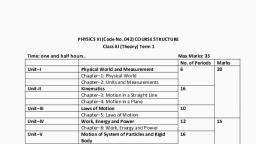
Chapter, name, , Whether the, chapter is, selected or, not, , Selected topics, , Deleted topics, , Yes, , Electric charges and their, properties. Coulomb’s law –, force between two point, charges, continuous charge, distribution. Electric field,, electric field due to a point, charge, electric field lines,, electric dipole, electric dipole, moment electric field due to, a dipole (on axial and, equatorial lines only), torque, on a dipole in a uniform, electric field. Electric flux,, statement of Gauss’s, theorem statement ,proof, and its applications to find, field due to infinitely long, straight wire and uniformly, charged thin spherical shell, (field inside and outside)., , forces between multiple, charges; superposition, principle electric Field due to, charged infinite plane sheet, , Electric, charge and, field, , Electric, potential and, capacitance, , Yes, , Electric potential, potential, difference, electric potential, due to a point, charge,capacitors and, capacitance, energy stored, in a capacitor., , Yes, , Electric current, flow of, electric charges in a metallic, conductor, drift velocity and, mobility, and relation, between drift velocity and, electric current; Ohm’s law,, series and parallel, combinations of resistors;, Internal resistance of a cell,, , Current, Electricity, , electric potential due to a, dipole and system of, charges; capacitance of a, parallel plate capacitor with, and without dielectric, medium between the plates,, Van de Graaff, generator.equipotential, surfaces, electrical potential, energy of a system of two, point charges and of electric, dipoles in an electrostatic, field.combination of, capacitors in series and in, parallel, Conductors and, insulators, free charges and, bound charges inside a, conductor. Dielectrics, and electric polarisation,, electrical energy and power,, electrical resistivity and, conductivity. Carbon, resistors, colour code for, carbon resistors;, temperature dependence of, resistance.electrical, resistance, V-I, characteristics (linear and
Page 33 :
Chapter, name, , Whether the, chapter is, selected or, not, , Magnetic, effect of, current, , Yes, , Selected topics, , Deleted topics, , potential difference and emf, of a cell, combination of cells, in series and in parallel., Kirchhoff ’s laws and simple, applications. Wheatstone, bridge, metre bridge., Biot - Savart law and its, application to current, carrying circular loop., Ampere’s law its proof and, applications to infinitely long, straight wire, straight and, toroidal solenoids., Force on a moving charge in, uniform magnetic and, electric fields. Cyclotron., Force on a current-carrying, conductor in a uniform, magnetic field., Torque experienced by a, current loop in a magnetic, field; moving coil, galvanometer ; Earth’s, magnetic field and magnetic, elements., , non-linear),Potentiometer –, principle and applications to, measure potential difference,, and for comparing emf of two, cells; measurement of, internal resistance of a cell., , Magnetism, and matter, , Concept of magnetic field,, Oersted’s experiment. bar, magnet as an equivalent, solenoid, magnetic field, lines; Force between two, parallel current-carrying, conductors – definition of, ampere.–, current sensitivity and, conversion to ammeter &, voltmeter of Moving coil, Galvanometer, Current loop as a magnetic, dipole and its magnetic, dipole moment. Magnetic, dipole moment of a revolving, electron., , Yes, , Electromagnetic, induction(definition) ;, Faraday’s law, induced emf, and current; Lenz’s Law, Self, and mutual inductance. AC, generator and transformer., , Magnetic field intensity due, to a magnetic dipole (bar, magnet) along its axis and, perpendicular to its axis., Torque on a magnetic dipole, (bar magnet) in a uniform, magnetic fieldPara-, dia- and, ferro - magnetic substances,, with, examples.Electromagnets, and factors affecting their, strengths. Permanent, magnets., , Yes, , Electromagnetic, induction(definition) ;, Faraday’s law, induced emf, and current; Lenz’s Law, Self, and mutual inductance., , Eddy currents, , AC generator and, transformer., , Alternating currents, peak, and rms value of alternating, current /voltage; reactance, and impedance; LC, oscillations (qualitative, treatment only), LCR series, , Electromagne, tic induction, , Alternating, current, Yes
Page 34 :
Chapter, name, , Whether the, chapter is, selected or, not, , Selected topics, , Deleted topics, circuit, resonance; power in, AC circuits, wattless current, , Electromagne, tic waves, , Yes, , Ray optics, , Yes, , Wave Optics, , Yes, , Dual Nature, of Matter and, Radiation, , Yes, , Electromagnetic waves and, their characteristics, (qualitative ideas, only).Electromagnetic, spectrum (radio waves,, microwaves, infrared, visible,, ultraviolet, x-rays, gamma, rays) including elementary, facts about their uses., , Transverse nature of, electromagnetic waves., Need for displacement, current.Modified ampere’s, circuital law, , Reflection of light, spherical, mirrors, mirror formula, lenses, thin lensformula,, Refraction of light, refraction, Magnification, power of a, at spherical surface, lens, dispersion of light, ( µ2/v)-(µ1/u)=(µ2-µ1)/R, through a prism. Scattering, lensmaker's formula, of light – blue colour of the, sky and reddish appearance, of the sun at sunrise and, sunset.Optical instruments:, Combination of thin lenses in Human eye, image formation, contact. Refraction of light, and accommodation,, through a prism. Derive, correction of eye defects, prism formula, (myopia, hypermetropia,, presbyopia and astigmatism), using lenses. total internal, Microscopes and their, reflection and its, magnifying powers., applications, optical fibres,, astronomical, telescopes (reflecting and, refracting) and their, magnifying powers., Reflection and refraction of, Wavefront and Huygens’, plane wave at a plane, principle Proof of laws of, surface using wavefronts., refraction using Huygens’, Proof of laws of reflection, principle. Interference,, using Huygens’ principle., Young’s double slit, coherent sources and, experiment and expression, sustained interference of, for fringe width, Polarization,, light. Diffraction due to a, plane polarized light;, single slit, width of central, Brewster’s law, uses of plane maximum. Resolving power, polarized light and Polaroids., of microscopes and, astronomical telescopes., Photoelectric effect,, Hertz and Lenard’s, Einstein’s photoelectric, observations; Davissonequation Matter waves –, Germer experiment. Particle, wave nature of particles, de, nature of light(photon
Page 35 :
Chapter, name, , Whether the, chapter is, selected or, not, , Selected topics, , Deleted topics, , Broglie relation., , picture), Alpha - particle scattering, experiment; Rutherford’s, model of atom; Bohr model,, energy levels, hydrogen, spectrum., , Atoms, No, , Nuclei, Radioactivity –Radioactive, decay law, Yes, , Semiconduct, or, Electronics:, Material, devices and, simple, circuits, , Mass-energy relation, mass, defect; binding energy per, nucleon, , Yes, , Semiconductors;, semiconductor diode – I-V, characteristics in forward, and reverse bias, diode as a, rectifier; Logic gates (OR,, AND, NOT, NAND and, NOR)., , Yes, , Elements of a, communication system, (block diagram only);, , Communicati, ons system, , Unit, , Solid state, , Selected topics, Classification of solids based on, different binding forces: molecular,, ionic, covalent and metallic solids,, amorphous and crystalline solids,crystal, lattice and unit cell: primitive, bcc, fcc,, end centred cubic, bravais lattices,, calculation of no. Of atoms per unit, cell,radius and density,coordination, number,point defects- frenkel ans, , Composition and size of, nucleus, atomic masses,, isotopes, isobars;, isotones.alpha, beta and, gamma particles/rays and, their properties; nuclear, , I-V characteristics of LED,, photodiode, solar cell, and, Zener diode; Zener diode as, a voltage regulator. Junction, transistor, transistor action,, characteristics of a, transistor; transistor as an, amplifier (common, emitterconfiguration) and, oscillator, Transistor as a, switch., bandwidth of transmission, medium. Propagation of, electromagnetic waves inthe, atmosphere, sky and space, wave propagation. Need for, modulation. Production and, detection of an amplitudemodulated wave., , Deleted topics, Closed packed structure,, voids,, packing, effeciency,inpurity, defects,non-stoichiometric, defects, electrical properties,, conduction of electricity in, solid,conduction of electricity, in, semiconductors,application of n-
Page 36 :
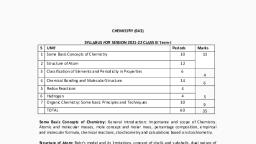
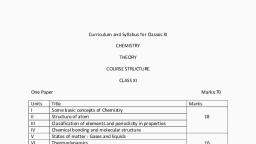
Unit, , Selected topics, Deleted topics, schottky, only,magnetic, properties: type, p- type semi-conductor,, paramagnetism,diamagnetism, and magnitic, properties,antiferromagnetism., ferromagnetism,ferrimagneti, sm., Types of solutions, expression of Solubility, of, gases, in, concentration of solutions of solids in liquids(henry's law),osmotic, liquids, vapour pressure of liquid pressure reverse osmosis, solutions (raoult's law), ideal and non and, water, ideal solutions, colligative properties purification,abnormal molar, Solutions, and determination of molecular mass mass, van't hoff factor, using, colligative, properties(relative, lowering of vapour pressure ,elevation, of boiling point, depression of freezing, point), Redox reactions, conductance in Nernst equation , equilibrium, electrolytic, solutions,molar constant, from, nernst, conductivity,kohlrausch's, equation,gibb's free energy, law,electrolysis and faraday's laws of ,measurement, of, Electrochemistry, electrolysis,electrochemical, conductivity, of, ionic, cell,differece between galvanic and solutions,batteries,fuel, electrolytic, cell,measurement, of cells,corrosion, electrode potential and emf of the cell, Rate of reaction: average and Pseudo first order reaction, instantaneous rate,factors affecting rate ,temperature dependence of, of reaction(concentration only),rate law rate of reaction,arrhenius, Chemical kinetics rate expression and rate constant, order equation,effect, of, and, molecularity,integrated, rate catalyst,collision theory., equations and half life period (zero and, first order only), Adsorption,, distinguish, between Mechanism, of, adsorption and absorption,types of adsorption,adsorption, adsorption:physisorption, and isotherm,catalysis,macromol, chemisorption,distinguish between true ecular, multimolecular and, solution,colloids, and associated, Surface, suspension,classification of colloids colloids,preparation, of, chemistry, based on physical state and nature of colloids, ,purification, of, interaction between dispersed phase colloids ,charge on colloidal, and dispersion medium,properties of particles,coagulation,protecti, colloid: tyndall effect,browian movement on of colloids, ,electrophoresis ,emulsions(oil in water, and water in oil), Occurrence of metals, concentration of Thermodynamic principles of, ores : hydraulic washing ,magnetic metallurgy,ellingham, General, separation,froth, floation diagram,metallurgy and uses, principles and, method,leaching,metallurgy, of of iron and zinc, processes of, aluminium, and, copper,refining:, isolation of, liquation,, electrolysis,zone, refining, elements, ,vapour phase refining(mond's process, and van arkel method)
Page 37 :
Unit, , P-block elements, , D- & f- block, elements, , Co-ordination, compounds, , Haloalkanes and, haloarenes, , Selected topics, Group, 15, elements, :electronic, configuration, occurrence,, trends in, physical, and, chemical, properties,preparation properties and, uses of ammonia,oxides of nitrogen, (structure, only),oxoacids, of, phosphorous, (structure, only), group 16 elements:, occurrence, ,electronic configuration, trends in, physical and chemical properties, ,preparation(by, contact, process), properties and uses of sulphuric acid, ,oxoacids of sulphur(structure only), group 17 elements: occurrence, ,electronic, configuration, trends in, physical and chemical properties,, structure of oxoacids of halogens and, interhalogen, compounds., Group 18 elements :occurrence ,, electronic configuration ,trends in, physical and chemical properties,, structure of xef2 , xef4,xef6, xeo3 and, xeof4, Introduction, ,, electronic, configuration,general, trends, in, properties of 1st row of transition, elements : metallic character,oxidation, state, colour, ,, catalytic, properties,magnetic properties intertitial, compounds, ,alloy, formation, ,preparation and properties of kmno4, Introduction,ligands,coordination, number,oxidation, state,iupac, nomenclature of mononuclear coordination, compounds,, isomerism(structural only), , Haloalkanes :nomenclature , nature of, c-x bond,method of preparation :from, alkanes, by, free, radical, halogenation,from alkenes and halogen, exchange(finkelstein, and, swarts, reaction),physical properties ,chemical, properties, sn1 and sn2 reactions, wurtz, reaction, haloarenes: nature of c-x bond,method, of, preparation:from, amine, by, sandmeyer, reaction, only,physical, properties ,electrophilic substitution, , Deleted topics, Group 15, elements:preparation, properties and uses of, dinitrogen,nitric acid,method, of preparation of oxides of, nitrogen allotropic forms of, phosphorous,preparation,, properties and uses of, phosphine ,pcl5 and pcl3, Group 16 elements:, preparation, properties and, uses of, dioxygen,ozone,sulphur, dioxide and allotropic form of, sulphur, group 17 elements:, preparation, propertiesand, uses of chlorine, ,hcl,interhalogen, compounds., Group, 18, elements, :preparation properties and, uses of xef2 , xef4 &xef6., Trends in standard electrode, potential,trends in stability of, higher, oxidation, state,chemical reactivity and, e values,preparation and, properties, of, k2cr2o7,lanthanoids, and, actinoids, Colour ,magnetic properties, and shape of coordination, compounds, ,bonding, in, coordination, compound(, werner's, theory,vbt,cft),stereoisomeris, m,bonding, in, metal, carbonyls,stabilityof, coordination compounds, Methods of preparation from, alcohol,chemical, properties:stereochemical, aspect, of, nucleophilic, substitution, reaction,elimination, reaction,reaction, with, metals,grignard, reagent, chemical, properties, nucleophilic, substitution, reaction,wurtz, fittig, reaction,fittig reaction,uses
Page 40 :
Biology, , 1, 2, 3, 4, 5, 6, 7, , Reproduction in Organism, Sexual Reproduction in Flowering, Plants, Human Reproduction, Reproductive Health, Principles of Inheritance and, Variation, Molecular Basis of Inheritance, Evolution, , नहीं, हाुँ, हाुँ, हाुँ, हाुँ, हाुँ, नहीं, हाुँ, , 12, , Human Health and Diseases, Strategies for Enhancement in, Food Production, Microbes in Human Welfare, Biotechnology - Principles and, Processes, Biotechnology and its Application, , 13, , Organisms and Populations, , 14, , Ecosystem, , नहीं, , 15, , Biodiversity and its Conservation, , नहीं, , 16, , Environmental Issues, , 8, 9, 10, 11, , 1, , 2, , 3, , RELATION AND FUNCTION, 1.1 Introduction, 1.2 Types of Relation, 1.3 Types of Function, 1.4 Composition of Function, and Invertible Function, 1.5 Binary Operation, INVERSE TRIGONOMETRIC, FUNCTION, 2.1 Introduction, 2.2 Basic Concept, 2.3 Properties of Inverse, Trigonometric Function, MATRICES, 3.1 Introduction, , नहीं, नहीं, हाुँ, हाुँ, हाुँ, , हाुँ, , 1.2, 1.3, 1.4, 1.5, , 3.7, , Types of Relation, Types of Function, Invertible Function, Binary Operation, , Elementary Operation, (Transformation) of a
Page 41 :
3.2, 3.3, 3.4, 3.5, 3.6, , 4, , 5, , 6, , 7, , Matrix, Types of Matrices, Operations on Matrices, Transpose of a matrix, Symmetric and Skew, Symmetric matrices, 3.7 Elementary Operation, (Transformation) of a, Matrix, 3.8 Invertible Matrices, DETERMINANTS, 1.1 Introduction, 1.2 Determinant, 1.3 Properties of Determinant, 1.4 Area of a Triangle, 1.5 Minors and Cofactors, 1.6 Adjoin and Inverse of a, Matrix, 1.7 Application of, Determinants and Matrices, CONTINUITY AND, DIFFERENTIABILITY, 5.1 Introduction, 5.2 Continuity, 5.3 Differentiability, 5.4 Exponential and, Logarithmic Function, 5.5 Logarithmic Differentiation, 5.6 Derivative of Function in, Parametric Forms, 5.7 Second order derivative, 5.8 Mean value theorem, , APPLICATION OF, DERIVATIVES, 6.1 Introduction, 6.2 Rate of change of, Quantities, 6.3 Increasing and Decreasing, Functions, 6.4 Tangents and Normals, 6.5 Approximations, 6.6 Maxima and Minima, INTEGRALS, 7.1 Introduction, 7.2 Integration as an Inverse, process of Differentiation, 7.3 Methods of Integration, , 3.8, , Matrix, Invertible Matrices, , 4.4 Area of a Triangle, , 5.6 Derivative of Function in, Parametric forms, 5.8 Mean value theorem, , 6.4 Tangents and Normal's, 6.5 Approximations, , 7.7.1 Definite integral as, the limit of a sum.
Page 42 :
7.4, , 8, , 9, , 10, , 11, , Integration of some, particular Function, 7.5 Integration by partial, Fractions, 7.6 Integration by parts, 7.7 Definite Integral, 7.8 Fundamental Theorem of, Calculus, 7.9 Evaluation of Definite, Integral by substitution, 7.10 Some properties of definite, integrals., APPLICATION OF INTEGRALS, 8.7 Introduction, 8.8 Area under simple curves, 8.9 Area between two curves, DEFEERENTIAL EQUATIONS, 9.7 Introduction, 9.8 Basic concept, 9.9 General and particular, solution of a differential, equation, 9.10 Formation of differential, equation whose general, solution is given., 9.11 Methods of solving first, order. First degree, differential equations, , VECTOR ALGERRA, 10.7 Introduction, 10.8 Some basic concept, 10.9 Types of vectors, 10.10 Addition of vectors, 10.11 Multiplication of vector by, a scalar, 10.12 Product of two vectors, THREE DIMENSIONAL, GEOMETRY, 11.7 Introduction, 11.8 Direction cosines and, direction ratios of a line, 11.9 equation of a line in, , 9.3 General and particular, solution of a, differential equation, 9.4 Formation of, differential equation, whose general, solution is given., 9.4.1 Procedure to form a, differential equatie, that will represent a, given family of, curves., 9.4.2 Homogeneous, differential equations, 9.4.3 Linear differential, equations, 10.3 types of vectors, 10.4 addition of vectors, , 11.6 Plane, 11.7 Co planarity of two, lines, 11.8 Angle between two, planes, 11.9 Distance of a point
Page 43 :
12, , 13, , space, 11.10 Angle between two lines, 11.11 Shortest distance, between two lines, 11.12 Plane, 11.13 Co planarity of two lines, 11.14 Angle between two, planes, 11.15 Distance of a point from a, plane, 11.16 Angle between a line and, a plane, LINEAR PROGRAMMING, 12.7 Introduction, 12.8 Linear Programming, Problem and its, mathematical, Formulation, PROBABILITY, 13.1 Introduction, 13.2 Conditional Probability, 13.3 Multiplication Theorem, on Probability, 13.4 Independent Events, 13.5 Bayes Theorem, 13.6 Random Variables and, its Probability, Distributions, 13.7 Bernoulli Trials and, Binomial distribution, , from a plane, 11.10 Angle between a line, and a plane, , 12.9 Different types of, linear programming, problems, , 13.3 Multiplication Theorem, on Probability, 13.4 Independent Events, 13.6 Random Variables, and its Probability, Distributions, 13.7 Bernoulli Trials and, Binomial distribution
Page 49 :
Weed control, Principle of weed control, method of weed control (cultural,, mechanized biological, and integrated weed management), , 5pds, , CROPS, 18pds, Seed bed preparation, seed treatment time and method of sowing / planting, seed rate,, dose, method and time of fertilizer application, irrigation and weed control, common, pest and disease of major field crop- RICE, MAIZE MUSTARD, GRAM, UNIT 2 HORTICULTURE, (a) Importance of fruits and vegetables in human diet & processing industry., (b) Orchard location and layout, ornamental gardening and kitchen garden, (c) Cultivation practices processing and marketing of, I., FRUITS- MANGO, PAPAYA, BER, JACK-FRUIT, II. VEGETABLES- RADISH, POTATO, ONION, BAINJAL,TOMATO,, CAULIFIOWER, CABBAGE, (d) Principles and methods of fruits and vegetables preservation., (e) Preparation of jelly, Jams, chips, ketchup and their packing., , Business Studies, , Part A: Principles and Functions of Management, Unit 1: Nature and Significance of Management, Management - concept, Understand the concept of, objectives, and, management., importance, Explain the meaning of, ‘Effectiveness and, Efficiency., Discuss the objectives, ofmanagement., Describe the importance, ofmanagement., Management as, Examine the nature of, Science, Art and, management as a science,, Profession, art andprofession., Levels of Management, Understand the role of top,, middle and lower levels, ofmanagement, Management functions- Explain the functions, planning, organizing,, ofmanagement, staffing, directing and, controlling, , 43pds
Page 50 :
Coordination- concept, and importance, , , , Discuss the concept and, characteristics, ofcoordination., Explain the importance, ofcoordination., Unit 2: Principles of Management, Principles of, Understand the concept, Management- concept, of principles of, and significance, management., Explain the significance of, management principles., Fayol’s principles of, Discuss the principles, management, ofmanagement developed, byFayol., Taylor’s Scientific, Explain the principles and, management- principles, techniques of, and techniques, ‘ScientificManagement’., Unit 3: Business Environment, Business Environment Understand the, concept and importance, concept of‘Business, Environment’., Describe the importance of, business environment, Dimensions of Business Describe the various, Environment- Economic,, dimensions of, Social, Technological,, ‘BusinessEnvironment’., Political and Legal, , , , , , , Unit 4: Planning, Planning: Concept,, importance and, limitation, , , , , , Planning process, , , , Understand the concept, ofplanning., Describe the importance, ofplanning., Understand the limitations, ofplanning., Describe the steps in the, process of planning., , , , , , Understand the concept of, demonetization, Examine the impact of, government policy changes, on business in India with, reference to liberalisation,, privatization and, globalisation since 1991., Discuss the managerial, response to changes, inbusiness, environment., , Develop an understanding, of single use and, standingplans, Describe, objectives,policies,, strategy, procedure,, method, rule, budget and
Page 51 :
programme as types of, plans., Unit 5: Organising, Organising: Concept and , importance, , , Organising Process, , , , Structure of, organisation- functional, and divisional concept, , , , Understand the concept, of organizing as a, structure and as, aprocess., Explain the importance, oforganising., Describe the steps in the, process of organizing, Describe functional and, divisional structures, oforganisation., , , , , , , , Delegation: concept,, elements and, importance, , , , , , Decentralization:, concept and importance, , , , , , Unit 6: Staffing, Staffing: Concept and, importance, , , , , Staffing process, , , , Recruitment process, , , , , , Selection - process, , , , Understand the concept, ofdelegation., Describe the elements, ofdelegation., Appreciate the importance, ofDelegation., Understand, the concept, of, decentralisati, on., Differentiate between, delegation and, decentralisation., Understand the concept, ofstaffing., Explain the importance, ofstaffing, Describe the steps in the, process of staffing, Understand the meaning, and steps in the process, ofrecruitment., Discuss the sources, ofrecruitment., Understand the meaning, ofselection., , Explain the advantages,, disadvantages and, suitability of functional and, divisionalstructure., Understand the concept, of formal and, informalorganisation., Discuss theadvantages,, disadvantages of formal and, informal organisation., , , , Explain the, importance, of, decentralisat, ion., , , , Explain the merits and, demeritsof internal and, external sources of, recruitment.
Page 52 :
, , Training and, Development - Concept, and importance,, Methods of training - on, the job and off the job vestibule training,, apprenticeship training, and internship training, , Unit 7: Directing, Directing: Concept and, importance, , , , , , , , , , , Elements of Directing, , , , Motivation - concept,, Maslow’s hierarchy of, needs, Financial and, non-financial incentives, , , , , Leadership - concept,, , styles - authoritative,, democratic and laissez, , faire, Communication , concept, formal and, informal communication;, , , , , Unit 8: Controlling, Controlling - Concept, and importance, , , , , Steps in process of, control, , , , Describe the steps involved, in the process ofselection., Understand the concept, of training and, development., Appreciate the, importance of training to, the organisation and to, theemployees., Discuss on the job, and off the job, methods oftraining., , , , , , Describe the concept, ofdirecting., Discuss the importance, ofdirecting, Describe the various, elements ofdirecting, Understand the concept, , ofmotivation., Discuss the various financial, and non- financialincentives., Understand the concept, ofleadership., Understand the various, styles of leadership., Understand, the concept, of, communicati, on, Discuss the concept, of formal and, informalcommunicat, ion., Discuss the various barriers, to effective communication., Understand the concept, ofcontrolling., Explain the, importance, ofcontrolling., Discuss the, steps in the, process of, , , , , , Discuss the meaning of, vestibule training,, apprenticeship training and, internship training., Differentiate between, training and development., , Develop an, understanding of, Maslow’s Hierarchy, ofneeds., , Understand the, elements of the, communicationprocess., Suggest measures to, overcome barriers, tocommunication.
Page 53 :
controlling., Part B: Business Finance, and Marketing Unit 9:, Financial Management, Financial Management: Understand the, Concept, role and, concept of financial, objectives, management., Explain the role of, financial management in, anorganisation., Financial decisions:, investment, financing, and, dividend- Meaning and, factors affecting, , , , Financial Planning concept and importance, , , , , , Capital Structure –, concept and factors, affecting capital, structure, , , , Fixed and Working, Capital - Concept and, factors affecting their, requirements, , , , Discuss the, three, financial, decisions, and the, factors, affectingthem, ., Describe the, concept of, financial, planning., Explain the, importance, of financial, planning., Understand the, concept of capital, structure., , Understand the, concept of fixed and, workingcapital., Describe the, factors, determining, the, requirements, of fixed and, workingcapit, al., Unit 10: Financial Markets, Financial Markets:, Understand the, Concept, Functions and, concept of financial, types, market., Explain the functions of, financialmarket., , , , Discuss the objectives of, financial management, , , , Describe the factors, determining the choice of, an appropriate, capitalstructure, of a company., , , , Understand capital market, and money market as types, of financialmarkets.
Page 54 :
Money market and its, instruments, , , , , Capital market: Concept, , types (primary and, secondary), methods of , floatation in the primary, market, , , , , , , Give the meaning of a, stockexchange., Explain the, functions of a, stock exchange., , , , Securities and Exchange , Board of India (SEBI) objectives and functions, Unit 11: Marketing, Marketing – Concept,, , functions and, philosophies – Product, , Prize and Standard, , State the objectives ofSEBI., , , , Understand the concept, ofmarketing., Discuss the functions, ofmarketing., , , , Marketing Mix – Concept , and elements, , Understand the concept of, marketingmix., Describe the, elements of, marketingmix, ., Understand the concept of, product as an element of, marketingmix., Understand, the concepts, ofbranding,, labelling, andpackagin, g., , Stock Exchange –, Meaning, Functions and, trading procedure, , , , Understand the concept of, moneymarket., Describe the, various, money, market, instruments., Discuss the concept of, capitalmarket., Explain primary and, secondary markets as, types of capitalmarket., Differentiate between, capital market and money, market., , , , , , Product - branding,, labelling and packaging, – Concept, , , , , , , , Discuss the methods, of floating new issues, in the primarymarket., Distinguish between primary, and secondarymarkets., , Discuss the trading, procedure in a stock, exchange., Give the meaning of, depository services and, demat account as used in, thetrading procedure of, securities., Explain the functions ofSEBI., , Explain the, marketingphilosophies.
Page 55 :
Price - Concept, Factors, determining price, , , , Understand the concept, of price as an element, of marketingmix., , , , Describe the factors, determining price of, aproduct., , Physical Distribution –, concept, , , , Understand, the concept, of physical, distribution., Understand the concept, of promotion as an, element of marketingmix., Understand the, concept of sales, promotion., , , , Explain the components of, physical distribution., Describe the various, channels of distribution., Describe the elements of, promotionmix., Understand the concept, of advertising and, personalselling, Discuss the concept of, publicrelations., , Promotion – Concept, , and elements;, Advertising, Personal, Selling, Sales Promotion , and Public Relations, , Unit 12: Consumer Protection, Consumer, Understand, Protection:Concept, the concept, of consumer, protection., , , , , , , , , , , , Consumer Protection, Act 1986:, Meaning of consumer, Rights and, responsibilities of, consumers Who can, file a complaint?, Redressal machinery, Remedies available, , , , , , , , , Understand the concept of, a consumer according to, the Consumer protection, Act 1986., Discuss the scope, of Consumer, Protection, Act,1986, Explain the consumerrights, Understand the, responsibilities of, consumers, , , , , , , , , , Describe the, importance of, consumerprotection, ., Discuss the scope, of Consumer, Protection Act,1986, Describe the role of, consumer organizations and, NGOs in protecting, consumers’interests., Understand who can file a, complaint and, againstwhom?, Discuss the legal, redressalmachinery, under Consumer, protection Act1986., Examine the remedies, available to the consumer, under Consumer, protectionAct1986.
Page 56 :
(Accountancy)"ACT", , Chapter 1, Accounting for Not for, Profit Organisation, , Accounting for, Partnership firm :, Chapter 2, Accounting for, partnershipFundamentals., , Chapter 3, Goodwill : Nature &, Valuation, , Part A Unit 1, ∙ Non-Profit Organisation :- Meaning, and Examples., ∙Receipt & Payment Account Meaning, Features., ∙Concept of fund Based Accounting,, Calculation of Amount of subscription., ∙Preparation of Income and, Expenditure A/C from Receipt &, Payment A/C without Additional, information and Balance sheet., Unit 2, ∙Partnership - Meaning & Features,, Partnership Deed., ∙Provision in the absence of, Partnership Deed., ∙Preparation of Profit and loss, Appropriate A/C, Division of Profit, among Partners., ∙Fixed vs fluctuating capital Accounts, Method., ∙Definition Features, Need, Factors, Affecting the value of Goodwill, Types, of Goodwill., ∙Method of Valuation of Goodwill a) Simple Average Profit Method, b) Super Profit Method, Unit 3, , ∙ Calculation of Amount of, consumable items for the, year., ∙ Preparation of opening, and closing Balance, sheet., , ∙Past Adjustment &, Guarntee of Profit will not, come., , ∙Weighted Average Profit, Method., ∙Capitalisation Method., , Reconstitution of, Partnership, Chapter 4, Change in Profit & Loss, Sharing Ratio Among, the Existing Partners., , ∙Sacrificing Ratio and Gaining Ratio., , ∙Treatment of Goodwill., ∙Undistributed Profit, Reserve & accumulated, loss, ∙Revaluation of Assets &, liabilities., ∙Balance sheet., Note : Excluded due to, these are in next chapter, also., , Chapter 5, Admission of a Partner, , ∙Meaning, Right of a new Partner., ∙Calculation of sacrificing & New, Profit sharing Ratio., ∙Accounting treatment of Goodwill, (AS-10)., ∙Revaluation of assets & liabilities., ∙Treatment of, Accumulated/Undistributed Profit &, , ∙Hidden Goodwill., ∙Adjustment of capital.
Page 57 :
Accumulated loss., ∙Preparation of Revalution A/C,, Partners capital & Balance sheet, without Adjustment of capital., Chapter 6, Retirement & Death of a, Partner, , Chapter 7, Company AccountsIssue of shares., , Chapter 8, Forfeiture and Re-issue, of shares., Chapter 9, Issue of Debentures., , Chapter 10, Redemption of, Debentures, Chapter 11, Financial statement, Analysis, Chapter 12, Financial statement, Analysis, , ∙Calculation of Gaining & New Profit, sharing Ratio., ∙Accounting treatment of Goodwill., Unit 4, ∙Revaluation of Assets & liabilities,, Partners capital A/C & Balance sheet, without Adjustment of Capital &, Retiring Partners loan A/C., ∙Meaning, Nature/Characteristics of, company., ∙Types of company, shares, share, capital., ∙Issue and Allotment of shares over, subscription & undersubscription., ∙Issue of shares at Par and Premium., ∙Calls in Arrears and calls in, advances., ∙Issue of shares for consideration, other than cash., ∙Meaning & Journal entries of, Forfeiture & Re-issue without Pro-rate, Allotment., ∙Meaning of Debentures, Types,, Differences between shares &, Debentures., ∙Issue of Debentures at Par, Premium, & Discount., Part B Unit-5, , ∙Adjustment of capital., ∙Retiring Partner loan, A/C., ∙Death of a Partner., , ∙Preparation of Cash, Book., ∙Disclosure of shares, capital in company's, Balance sheet., , ∙Consideration other than, cash., ∙Issue of Debentures as, collateral Security., ∙Terms of Issue of, Debentures from, Redemption point of view., , ∙Meaning & sources of Redemption., ∙Meaning of Financial Statement., ∙Preparation of Balance sheet of a, company in the prescribed form only, with major Headings., ∙Meaning, Limitation & Methods of, Analysis of Financial statement., ∙Tools for Financial statement, , ∙Method of Redemption of, Debentures., , ∙Common size statement.
Page 58 :
Analysis - comparative statements., , Chapter 13, Ratio Analysis, , Cash Flow statement, (As Per AS-3), Chapter 14, Cash Flow Statement, , ∙Meaning & Types of Ratios., ∙Liquidity Ratio, →Current Ratio, Liquid Ratio., Unit 6, ∙Solvency Ratios :Debt to Equity, Total Assets to Debt., ∙Activity Ratio :Inventory Turnover Ratio,, Working capital Turnover Ratio, ∙Profitability Ratio :Gross Profit Ratio, Net Profit Ratio, Operating Ratio, ∙Meaning and simple problem of cash, flow from Operating Activities only by, Indirect Method., , ∙Proprietary Ratio., ∙Interest coverage Ratio., ∙Trade Receivable, Turnover Ratio., ∙Trade Payable Turnover, Ratio., ∙Operating Profit Ratio., Return on Investment., ∙Cash Flow from, Investing & Financing, Activities., , BUSINESS MATHEMATICS, , CHAPTER 1, Arithmetic, Progression(A.P.), CHAPTER 2, Geometric, Progression(G.P), CHAPTER 5, Permutation and, Combination, CHAPTER 6, Determinants, , Arithmetic Progression(A.P), Gometric Progression(G.P), , Insert a G.M between two, given Quantities., , Permutation & Combination, , Determinants, , Use of Determinants in, solving, linear, equation, Cramer’s rule., , CHAPTER 7, Matrices, , Matrices, , CHAPTER 8, Set Theeory, , Set Theory, , Venn Diagram, , Differentiation (Simple Problem), , , , CHAPTER 9, Differentiation, , , , Differential coefficient of, function of function, Differentiation of Implict
Page 59 :
, Statistics, Measures of central Tendency –, CHAPTER 1, Measures of Central Arithmetic Mean., Tendery-Arithmetic, Mean, Median, CHAPTER 1, Median, Mode, , CHAPTER 3, Mode, , , , , CHAPTER 4, Geometric Mean, , , , CHAPTER 6, Analysis of Time Series, , , , , CHAPTER 7, Interpolation, Enterpolation, , , , and , , , , Geometric Mean- Meaning, Simple Geometric Mean without, using log Table., Meaning of Time series., Importance & Types of Time, series., Measurement of Trend on, secular TrendMethod of Average, (a) semi average method, (b) Moving Average Method., Interpolation and Extrapolation, Meaning, Importance, Method of Interpolation, Algebraic Methods, Binomial Expansion Method, , , , function., Logarithmic, Differentiation., , To find out an Unknown, value or Frequency, Weighted, Arithmetic, Mean, To find out missing, Frequency, Graphic Determination of, Median, Graph Method of locating, Mode., To find out Missing, Frequency., Weighted Geometric Mean.
Page 60 :
Unit – (1) Entrepreneurial opportunities and Enterprise creation, Sensing &, Opportunities – Meaning, Kind,, identification of, Factor Affecting the Sensing, entrepreneurial, Yes, of Opportunities, opportunities, Business, Opportunities, –, Meaning, Affecting Factors., Market, Market, Environment, –, Assessment, Yes, Meaning, Affecting Factors,, Market Assessment, Identification of, Factor, considering, while, entrepreneurial, Yes, selecting a product, opportunities, Selection of an, Factor, considering, while, Yes, Enterprises, selecting an Enterprise., Steps in setting up of an, Factors to be considered, Enterprise., before, establishing, an, Yes, enterprise,, Execution, of, project, establishment., Unit – (2) Enterprise planning and Resourcing, Business planning, Planning – Meaning, Nature,, Yes, Objectives., Preparation of project, Project Report –Meaning,, Yes, report, Characteristic, Objectives., Resource assessment, Resource –Meaning, Kinds,, Yes, Sources, Fixed and working capital, Fixed Capital –Meaning,, requirement, Nature, Affecting Factors, Yes, Working Capital –Meaning,, Nature And Affecting Factors, Break-even analysis, Break Even Analysis –, Yes, Meaning, Assumption, Utility., Unit – (3) Enterprise management, Basic Management, Management- Meaning,, Yes, Function, Features, Importance., Marketing Management, Marketing Management –, Yes, Meaning, Characteristics,, Objectives., Financial Management, Financial Management –, Yes, Meaning, Objectives, Sources, Of Business Finance, Determination Of Cost., Meaning Of Cost, Difference, Yes, Between Fixed Cost And, Variable Cost.
Page 62 :
Agriculture, Chapter, S.No, No., 1, Unit 1, 2, Unit 2, 3, Unit 3, 4, Unit 4, 5, , Unit 5, , Floriculturist (Open Cultivation), Selected Chapter, Chapter Names, Yes/No, Cultivation of Commercial Crop-I, Yes, Cultivation of Commercial Crop-II, Yes, Growing off Annuals, Yes, Growing of Perennials, No, Post Harvest Management and Value, No, Addition, , Apparel, Made-Ups and Home Furnishing, S.No, , Chapter, No., , 1, 2, , Unit 1, Unit 2, , 3, , Unit 3, , 4, 5, , Unit 4, Unit 5, , 6, , Unit 6, , Chapter Names, Study of Textiles, Dart Manipulation, Drafting, Cutting and Sewing Process of Ladies and, Men’s Wear, Fitting Defects and Remedies, Introduction to Finishing of Garments, Hazards, Safety Measures, Cleaning and, Maintenance at Workplace, , Automotive, S.No, , Chapter, No., , 1, , Unit 1, , 2, , Unit 2, , 3, 4, 5, , Unit 3, Unit 4, Unit 5, , Beauty &, Wellness, S.No, , Chapter, No., , 1, 2, , Unit 1, Unit 2, , 3, , Unit 3, , 4, , Unit 4, , Self Employed, Class 12th, Tailor, Selected, Deleted sessions from, Chapter, selected Chapters, Yes/No, Yes, Yes, Yes, Yes, No, No, , Auto Service Technician L4, , Class 12th, , Chapter Names, Service Manual, Serviceability, Replacement or Repair of Engine, Components, Transmission system, Suspension system, Auto Electrical System, , Beauty Therapist, Chapter Names, Make Up Services, Facial Beauty Services, Salon Reception Duties, Create a Positive Impression at, Workplace, , Class 12th, Deleted sessions from, selected Chapters, , Selected, Chapter, Yes/No, Yes, , Deleted sessions from, selected Chapters, , Yes, Yes, No, No, , Class 12th, Selected, Chapter, Yes/No, Yes, Yes, Yes, No, , Deleted sessions from selected, Chapters, , 2.Maintain Reception area, 3.Process Payments
Page 63 :
Electronics &, Hardware, , Field Technician – Computing and, Peripherals, , S.No Chapter No., , Chapter Names, , 1, , Unit 1, , 2, , Unit 2, , 3, , Unit 3, , 4, , Unit 4, , 5, , Unit 5, , 6, , Unit 6, , Healthcare, S.No, , Chapter, No., , 1, 2, 3, 4, 5, , Unit 1, Unit 2, Unit 3, Unit 4, Unit 5, , 6, , Unit 6, , 7, , Selected, Chapter, Yes/No, Yes, , Computer Network Essentials, Installation and Configuration of Windows, Server, Installation and configuration of Linux, Server, Computer Network Maintenance and, Troubleshooting, IT Security, Information Technology Infrastructure, Library (ITIL) v4, , Chapter Names, Hospital Management System, Sterilization and Disinfection, Introduction to Medication, Immunization, Physiotherapy, Bio Medical Waste, Management, , Deleted sessions from, selected Chapters, , Yes, Yes, Yes, No, No, , General Duty Assistant, , Class 12th, Selected, Chapter, Yes/No, Yes, Yes, No, Yes, No, , Unit 7, , Deleted sessions from selected Chapters, , Yes, , Yes, Medical Records, , IT-ITeS, , Class 12th, , Session 3. Demonstrate the knowledge of, content of medical documentation, Session 4. Identify the role of GDA in, maintaining record, , Junior Software Developer, , S.No, , Chapter, No., , Chapter Names, , 1, 2, 3, 4, 5, , Unit 1, Unit 2, Unit 3, Unit 4, Unit 5, , Software Engineering, Advanced Python Programming, Web application Development, Mobile Application Development, Emerging Trends and Social Impact, , Class 12th, Selected, Chapter, Yes/No, Yes, No, Yes, Yes, No, , Deleted sessions from selected, Chapters
Page 64 :
Media &, Entertainment, S.No, , Chapter No., , 1, 2, , Unit 1, Unit 2, , 3, , Unit 3, , Chapter, No., , 1, 2, 3, 4, 5, , Unit 1, Unit 2, Unit 3, Unit 4, Unit 5, , Chapter Names, Resolve Customer Concerns, Delivery of Reliable service, Customer Relationship Management, Continuous Improvement in Service, Work in Team & Organization, , S.No Chapter No., Unit 1, , 2, , Unit 2, , 3, 4, , Unit 3, Unit 4, , 5, , Unit 5, , 6, , Unit 6, , Selected, Chapter, Yes/No, Yes, No, , Chapter Names, , Class 12th, Selected, Chapter, Yes/No, Yes, Yes, Yes, No, No, , Customer Service Executive (Meet and, Greet), Chapter Names, Etiquette and Hospitable Conduct, Gender and Age Sensitive Service, Practices, Health and Hygiene, Safety at Workplace, Learn a foreign or local 29 language(s), including English, Customer-centric Services, , Deleted sessions from selected, Chapters, , Yes, , Sales Associate, , Tourism and, Hospitality, , 1, , Class 11th, , 3D Animation, Surface Shading and Maps, Rendering, Compositing and File, Formats, , Retail, S.No, , Texturing Artist, , Deleted sessions from selected, Chapters, , Class 12th, Selected, Chapter, Yes/No, Yes, Yes, Yes, Yes, No, No, , Deleted sessions from, selected Chapters