Page 1 :
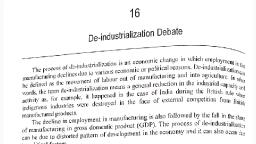
What is de-industrialization? Discuss its causes and effect of it., The reduction or destruction of a nation's or region's industrial capacity is known as Deindustrialization. In the opinion of Daniel Thorner, it is a decline in the proportion of the, working population engaged in secondary industry. De-industrialization is a process, of social and economic change caused by the removal or reduction of industrial capacity or, activity in a country or region, especially of heavy industry or manufacturing industry., Causes of De-Industrialization:, 1. Mughal disintegration: The main source of demand for the products of handicrafts was from the, royal courts of Mughals. With the abolition of the royal court, demand for the products of these, crafts decreased. Gradual extension of the British rule and the decline in royal power all over India, led to deindustrialization due to decreased demand., 2. British rule and policies: The establishment of the British rule affected the existence of the, handicrafts, both directly and indirectly., o, , The European officials favored imported manufactures. European introduced new forms and, pattern that impacted industry., , o, , Further, demand for cheaper goods without caring for quality consciousness by European led to, the extensive adulteration of the raw materials., , o, , The establishment of the British rule was also indirectly responsible for the loss of power of the, guilds and other bodies which regulated and supervised the trade., , o, , This led to the adulteration of materials resulting in a decline of the artistic and commercial value, of the products., , 3. Change in Habits: The consumption habits of the newly educated groups dealt a blow to these, industries. These newly created Indian ‘bourgeoisie’ not only disdained the products of the, indigenous industries but also tried to copy everything European which was considered to be the, hallmark., 4. Unequal Competition: The revolution in technology which gained momentum throughout the, 19th century in the wake of the industrial revolution increased the process of the decline of, traditional handicrafts. The invention of power-loom in Europe completed the decline of this, important industry. Though machine-made goods could not compete in quality with the local, products, lower price and change in taste led to de-industrialization.
Page 2 :
5. Tariffs: The oneway free trade policy which preached that what was good for England was, considered to be good for India led to decline of industry. England pursued the policy of protection, through the imposition of import duties and eased export duty for British goods., 6. Loss of powers: British rule establishment also resulted in the loss of powers of the craftsmen, organization and other bodies that used to supervise and regulate the trade, which results in the fall, down of raw materials as well as the skilled laborers which further results in the decline of market, value of the products., , Effects of De-industrialization:, 1. It led to destruction of India’s handicraft industry., 2. It led to ruralisation of India., 3. Artisans were displaced from traditional occupations. With no other alternative source of, livelihood, the artisans adopted agriculture., 4. Such overcrowding of agriculture badly affected its efficiency. Present problems of subdivision, and fragmentation of land holdings, over-cultivation or cultivation of inferior and unproductive, land, etc., are the direct effects of the British rule., 5. It led to disguised unemployment and underemployment. The rural unemployment and underemployment were rooted to the imbalance in the occupational structure due to such deindustrialization., 6. The trade to GDP ratio declined and international trade reshaped the domestic structure of the, economy. India became one of the major markets for the British made cotton yarns and cloths and, became one of the large suppliers of Grain., The large scale de-industrialization brought far reaching impacts on the economy with loss to, traditional economy, which was earlier considered as a blend of agriculture and handicrafts. The, de-industrialization of India played an important role in the underdevelopment and increasing, poverty of the country. Thus, the process of de-industrialization proved to be a disaster for the, several million persons.




 Learn better on this topic