Page 1 :
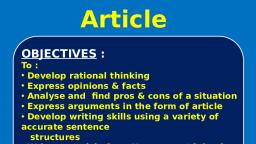
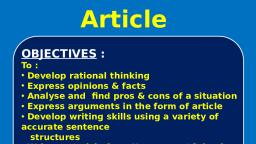
Article Writing, An Article is a piece of writing on a particular topic intended for publication in a, newspaper, magazine or journal. It describes an experience, event, person or, place; presents an opinion or balanced argument, compares and contrasts;, provides information, and offers suggestions or advice. It may include amusing, stories, reported speech and descriptions. It can be formal or informal, depending, on the target readers. It is written in a less formal style than a report., Since it is written for a wide readership, it has to be informative and thoughtprovoking to attract the attention of the readers., A good article should have the following elements:, 1. An eye-catching title to attract the readers' attention and suggest the theme of, the article., 2. An introduction which defines the topic to be covered and keeps the readers', interest intact., 3. The main body of two to five paragraphs in which the topic is further developed, in detail., 4. The conclusion, summarising the topic or giving a final opinion,, recommendation or comment., Model Article 1, Outline: India a single unit- extremes in every sphere physical features - climatic, conditions - the haves and have-nots., India is a Country of Extremes, India, though a well-marked distinct unit geographically, is defined as a country of, extremes or paradoxes. These extremes can be seen juxtaposed everywhere, be it, in physical features, climate, clothes, or ways of living. All these paradoxes have, made India a vibrant nation, full of diversities yet having a fundamental unity., India is a vast country with great diversity of physical features ranging from the, lofty Himalayas in the north, the Great Indian Desert in the west to sunny beaches
Page 2 :
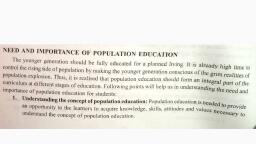
in the south. Due to these physical features, certain parts of India are very fertile,, while others are so unproductive and barren that hardly anything can be grown, there. The fertile plains of northern India belong to the first category, while, certain areas of Thar desert in Rajasthan fall under the latter category., Extreme contrasts in climatic conditions are seen in different regions of the, country. For example, Barmer in Rajasthan may record a temperature of 48^ C or, 50^ C ona June day, while it hardly reaches 22 °C at Pahalgam or Gulmarg in, Kashmir on the same day. However, in Dras near Kargil, the temperature may go, down to - 40 degrees * C during winter. Similarly, extremes are visible not only in, the types of precipitation but also in its amount and seasonal distribution. While, the places like Cherapunji and Mawsynram in Meghalaya get about 1100 cm rains, in the year, whereas Jaisalmer in Rajasthan hardly receives 9 cm of rainfall in a, year. Besides these, there are some other baffling extremes. India has some of, the richest people, who enjoy all the luxuries of life, while there are people, who, cannot make both ends meet. India has some of the brightest minds yet is not, able to provide basic education to a large section of poor children. Despite having, a huge illiterate population, India is the world's largest progressive democracy in, the world. It is one of the world's oldest civilisations, where modern and old ways, of living coexist. India is a mosaic of extremes, which exist side-by-side and makes, it a unique country., Model Article 2, Outline: The rising population in India to population growth remedies. causes of, population growth problems due, Population Explosion: A Grave Challenge, The population bomb in India is constantly ticking. The growing population is the, root cause of many socio-economic challenges faced by India. On the 24 per cent, area of the world our country is already supporting a large 16 per cent of the, world population. Having such a huge population is like a demographic crisis., Neither our geographical area nor our limited resources can be made to expand, by any means. Traditionally illiteracy and poverty had been the leading causes for, population growth in India. Lack of awareness amongst people about the, drawbacks of a huge family has led to a major increase in population. Cultural, factors like preference for a male child and considering family planning a taboo
Page 3 :
have added to the population growth. Improved healthcare facilities have, expanded lifespans and increased life expectancy, further adding to the problem., Population growth has neutralised our economic growth to a great extent. At, least one third of the growth in our GDP is rendered useless by rapid growth of, population. Resources can only increase arithmetically whereas population grows, geometrically. All our resources are under immense pressure due to this., Shortage of basic necessities like potable water indicate the strain on the carrying, capacity of the Earth's biosphere. The growth of population at a high rate is, leading to increased pollution, change in climate and reduction in the forest, cover. It is a source of various social evils like poverty, unemployment and, illiteracy. Development of infrastructure is unable to meet the pace of growth in, population. At present, the population of our country is more of a burden than an, asset. Family planning and planning for economic prosperity are the only, alternatives before us. Population is the primary cause of many other problems, and if the challenge of checking population growth is not met, all our plans for, development will go haywire.