Page 2 :
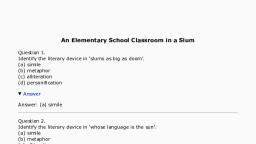
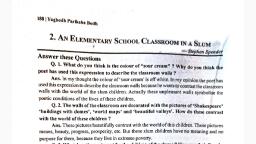
An Elementary School, Classroom in a Slum, By, Stephen, Spender, , "An Elementary School Classroom, in a Slum" was first published in 1964, in Stephen Spender's Selected Poems ., The poem has since appeared in, several collections, including Collected, Poems 1928-1985, published in 1985., "An Elementary School Classroom in a, Slum" is perhaps the best example of, Spender's political voice resonating, throughout the poem. In this poem,, Spender expresses his ideological, positions on government, economics,, and education . Spender's intent was to, shed light on social injustices, worldwide.
Page 3 :
Theme, In this poem Stephen Spender deals with, the theme of social injustice and class, inequalities. He presents the theme by talking of, two different and incompatible worlds. The world, of the rich and the 'civilized' has nothing to do, with the world of narrow lanes and cramped, holes. The gap between these two worlds, highlights, social, disparities, and, class, inequalities.
Page 5 :
Theme of the poem _ cont• Spender highlights the sorrowful state of children from, underprivileged sections in society, • Social injustice, oppression against the weak,, governments apathy , civil society’s evasion from its, responsibility are some of the issues discussed in this, poem, • The poet Exhorts the governments, Ngo s , and people, from privileged sections to extend a helping hand to, these deprived and dejected children to provide a new, hope and life
Page 6 :
Repetition, Alliteration, , Windy, / blowing in, ., sudden strong, rushes/fresh air, , Slum children, , Far far, far from gusty waves these children’s faces., Like rootless weeds, the hair torn around their pallor:, The tall girl with her weighed-down head., Simile, Uprooted, , pale faces, Useless
Page 7 :
Very thin, Metaphor, , Metaphor, , The paper seeming Boy, with rat’s eyes., Unfortunate successor, The stunted, unlucky heir, Of twisted bones, reciting a father’s gnarled disease,, His lesson, from his desk., coiled, , Pun, Explaining/speaking out, knotty
Page 8 :
dim/dull, , Has his fantasies, Class doesn’t appeal him, , At back of the dim class, One unnoted, sweet and young. His eyes live in a dream,, Of squirrel’s game, in tree room, other than this., A world of dream
Page 9 :
unpleasant, Pun, , Unhygienic, dull, wrecked state, Metaphor, , Help/aid, , On sour cream walls, donations. Shakespeare’s head,, Cloudless at dawn, civilized dome riding all cities., Belled, flowery, Tyrolese valley., Having bells, , Vast open sky
Page 10 :
Open-handed map, Awarding the world its world. And yet, for these, Children, these windows, not this map, their world,, Where all their future’s painted with a fog,, , Metaphor
Page 11 :
A narrow street sealed in with a lead sky, Far far from rivers, capes, and stars of words., Metaphor(world, of education), The grim reality is “far far” from the romantic image of the, river, the valley and scenes created by hollow words of poets.
Page 12 :
Surely, Shakespeare is wicked, the map a bad example,, With ships and sun and love tempting them to steal, For lives that slyly turn in their cramped holes, From fog to endless night?
Page 13 :
Their homes are, cramped holes, , Like very much, congested and, broken
Page 14 :
Look like, skeleton, , Pile of, bones/garbage/diseas, ed, , malnourished, bodies, Alliteration, , On their slag heap, these children, Wear skins peeped through by bones and spectacles of, steel, With mended glass, like bottle bits on stones., , repaired/poverty, , Alliteration, & Simile, , Scratches
Page 15 :
These children are compared to slag heap ( waste material )
Page 16 :
All of their time and space are foggy slum., , So blot their maps with slums as big as doom, , Disaster
Page 17 :
Map of Rich/the, world of, prosperity, , Initiate to bridge this gap against social, injustice and class inequality, Hope for slum children, , Unless, governor, inspector, visitor,, This map becomes their window and these windows, That shut upon their lives like catacombs,, , blocked, , Windows of, slum children, , simile, Tomb/, cemetery/grave
Page 18 :
Physical & mental barrier, ( shackles of deprivation), , Revolt, , Break O break open till they break the town, And show the children to green fields,, and make their world, , Run azure on gold sands, Deep, blue/sky, See/experience, themselves, , Sand on sea, shore, , Slum world, , Nature/let them, breathe, dream
Page 19 :
Green fields with bluish sky and gold sands- symbol of beauty and awareness of environment
Page 20 :
Anaphora, (Run azure… Run, naked, World of, knowledge, , and let their tongues, Run naked into books, Prosperity, the white and green leaves open, History theirs whose language is the sun., Peace/Blank, pages, , Metaphor, , They must break all the, shackles and quench their, thirst by taking energy and, life from this open world
Page 21 :
Books are symbol o education and green fields are symbol of prosperity. So one, can become prosperous if he is provided with quality education., Sun is used as symbol of knowledge, strength and freedom. If they are provided, opportunities, they achieve success to any extent.
Page 22 :
Recapitulation, • The poem is published during the American civil rights movement in, 1964, • This poem highlights the horrible condition of slum children who are, dejected, neglected and unheeded by all concerned agencies like, government, rich and privileged society ., • The poet uses powerful imageries and poetic devices to highlight the, theme of class inequalities and social injustice, • The theme has universal appeal beyond the limits of particular, country, race, location, colour or gender, • The poet points out the issues that plagued the slums like segregation, suffering, poverty, class inequalities , social injustice, and dearth of minimum basic facilities.
Page 23 :
Winding up note on the poem, The poem begins with despair and ends with a hope, (optimism) . The slum children’s life could be, improved if the powerful people take initiatives to, bring them out of the catacomb of poverty and, provide them proper education .He urges them to, review the system before it is too late.