Notes of Class 12th, English poem2.pdf - Study Material
Page 1 :
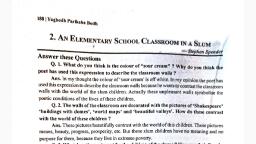
188 | Yugbodh Pariksha Bodh, , 2. ANE, LEMENTARY SCHOOL CLASSROOM IN 4 SLUM, es nn Stephien Spendet, Answer these Questions . j, , Q. 1. What do you think is the colour of “sour cream” ? Why do you think he, Poct has used this expression to describe the classroom walls 7, , Ans, In my thought the colour of ‘sour cream’ is off white. In my opinion the poet has, used this expression to describe the classroom walls because he wants to contrast the classroom, walls with the world of the slum children. Actually these unpleasant walls symbolise the, poetic conditions of the lives of these children., , Q. 2. The walls of the classroom are decorated with the pictures of ‘Shakespeare’, ‘buildings with domes’, ‘world maps’ and ‘beautiful valleys’. How do these contrast, with the world of these children ? ' :, , Ans. These pictures beautifully contrast with the world of this children. These pictures, means, beauty, progress, prosperity, etc. But these slum children have no meaning and no, purpose for them, because they live in extreme poverty., , Q. 3. What does the poet want for the children of the slums ? How can their lives be, made to change ?, , Ans. They can change their lives if they are shown green fields and their world is, made to run azure on gold sun. The dirty surroundings must be removed, then only they will, land in a world full of progress and prosperity. Then there will be no social injustice., , Q. 4. What is the message that Stephen Spender wants to give through the poem,, “An Elementary school classroom in a slum” ?, , Ans. Through this poem, the poet gives the message of social injustice and class, inequalities. These are two different worlds. The slum children have no interest in the world, of rich, i.e., art, culture and literature have no value for them. They live in dark, narrow,, cramped holes and lanes. The poet says, if gaps are not filled between two worlds, there can, not be any progress or developement anywhere in the world., , Q. 5. What does the poet say about the ‘open handed map’ ?, , Ans. The map has been called'‘open handed’ because it shows all the seas and lands, we have in the world. But the poet says that this world is not meant for the poor children., Their world is limited to what they see from the windows of their class room., , Q. 6. Why does the poet say : “Shakespeare is wicked” ?, , Ans. Actually, the poet does not really mean to say that Shakespeare is wicked. It, means that a picture of Shakespeare’s head is of no use in their class. For them Shakespeare, , hold no interest and serves no purpose to slum children., , Q. 7. What does the poet want the governor, the inspector and the visitor to do ?, , Ans. The poet wants these people to take steps by which the poor children can be, helped. He wants the children to be taken out of the slums in which they are living. He wants, that they should be taken to those places where they can play and run about among the trees., They should also enjoy the life out side the room., , Q. 8. How does the poet describe the classroom walls ?, , Ans. The poet says that the walls of the classroom emits bad smell. The walls bear the, , names of those who gave donations to build the classroom. The walls bear same pictures. A, big open map is also hanging on the wall.
Page 2 :
English (M.P.) : Class XII | 189, , , , stanzas for Comprehension aes, , Read the extracts given below and answer the questions that fo, 1. “Far far from gusty waves these children’s faces. ~, Like rootless weeds, the hair torn round their, pallor: The tall girl with her weighed-down head., | The paperseeming boy, with rat’s eyes., h The stunted, unlucky heir Of twisted bones,, reciting a father’s gnarled disease, His lesson,, i from his desk. At back of the dim class One unnoted,, - sweet and young. His eyes live in a dream, Of, squirrel’s game, in tree room, other than this.”, Q. 1. How are the children of this slum school look like 2 ), Ans. The children of this slum school look pale. Their uncombed hair looks like rootess, , wild herbs or plants., Q. 2. Explain “Weighed-down head.”, Ans. The burden of misfortunes has made them depress and bent down tl, Q. 3. Who is the unlucky heir and what is he reciting 2, Ans. The thin boy, having rats eye will inherit twisted bones of his parent:, reciting how his father developed that knotty disease., Q. 4. Find words from the Stanza which mean the following :, (i) blowing strongly, (ii) undeveloped, (iii) not clear/bright., Ans. (i) blowing strongly = gusty, (ii) undeveloped = stunted, (iii) not clear/bright = dim., Q. 5. What is the condition of the classroom wall ?, ‘Ans. The classroom wall is painted with cream colour but it emits foul smell., 2. “On sour cream walls, donations. Shakespeare’s, head, Cloudless at dawn, civilized dome riding, all cities. Belled, flowery, Tyrolese valley., Open-handed map Awarding the world its world., And yet, for these Children, these windows,, not this map, their world, Where all their future's, painted with a fog, A narrow street sealed in with, a lead sky Far far from rivers, capes, and stars of words.”, Q. 1. Where are donations and picture of Shake spear’s head placed ?, Ans. All donations and the picture of Shakespear's head are placed on the sour creamy, , heir heads., , s. He is, , walls., Q. 2. Explain the slum children's world and the world which is not their ?, , ‘Ans. The world of the rich, of civilized domes, bells and flowers are not the world of, these children. Narrow Janes with foggy skies form the world of these children., , Q. 3. Explain the future of these children., Ans. The future of these children is uncertain and is lost somewhere, in darkness., 2 or rivers and capes ?, . 4, What do they crave for : a narrow street, hn They crave for openness. They crave for rivers and capes and the starry sky:, , They didn’t want to live in narrow and crowded streets., , , , , , , ave aneiia
Page 3 :
190 | Yugbodh Pariksha Bodh, , y aoe from the stanza : ;, Aaa. th ues t, (ii) cloudy thick air, (iii) distant. rey, Pleasant = sour aan, (ii) cloudy thick air = fog, (iii) distant = far,, 3. “Surely, Shakespeare is wicked, the map a bad example,, With ships and sun and love tempting them to steal—, For lives that slyly turn in their cramped holes, From fog to endless night ? On their slag heap,, these children Wear skins peeped through by bones, and spectacles of steel With mended glass,, like bottle bits on stones. All of their time and, space are foggy slum. So blot their maps with, slums as big as doom”, Q. 1. Why is Shakespear described as wicked ?, Ans, Shakespear is described as wicked because he and his works are no use for slum, , children., , Q. 2. What tempt them and why ?, , Ans. The wonderful things of the world like the sun, love and all the beautiful things, tempt the slum children to steal them., , Q. 3. Explain, “From fog to endless night.”, Ans. ‘From fog to endless night’ means from ignorance to darkness like that of an |, , endless night. |, Q. 4. How do they live in their ‘holes’ ? |, Ans. They live like rats in their holes. Fog and darkness dominate their lives., , Q. 5. What blot their maps ?, Ans. Their maps are blotted by the civilized world. It is the world of the rich and great., , Q. 6. Who was Shakespear ?, , Ans. Shakespear was a great poet, dramatist, and novelist., , Q. 7. Find the word from the Stanza :, , (i) secretly, (ii) waste material, (iii) pieces., , Ans. (i) secretly - slyly, , (ii) waste material - slag, , (iii) pieces - bits., , 4. “Unless, governor, inspector, visitor, This map, becomes their window and these windows That, shut upon their lives like catacombs, Break O, break open till they break the town And show, the children to green fields, and make their world, Run are on gold sands, and let their tongues, Run naked into books the white and green leaves, open History theirs whose language is the sun.”
Page 4 :
English (M.P.) : Class XI | 191, , Q. 1. Who does the poet appeal to ?, , Q. 2. Who creates history ? z, Q. 3. This poem says about :, , (a) rich children (b) slum children (c) common man, Q. 4. Find the words from the passage : ‘, , (i) close (ii) underground graves ,, , Q. 5. Name the poem from which the extract is taken :, , Ans. 1. The poet appeals to the governor teacher, inspector and visitor., , 2. Those whose languages has the warmth and power of the sun can create history., 3. (b)., , 4. (i) close - shut, , (ii) underground graves - catacombs., , 5. ‘An Elementary school classroom in a slum.’, , 3. KEEPING QUIET, — Pablo Neruda, , Answer these Questions, , Q. 1. What will counting upto twelve and keeping still help us achieve ?, , Ans. Counting twelve and keeping still will help us to start our activities in a nice way., We can also feel the mutual understanding among us. ., , Q. 2. Do you think the poet advocates total inactivity and death ?, , Ans. No, the poet does not say this at all. Whatever he says is added with life and, activities that can be made better. He says only that we should stop our activities for a few, seconds and have quiet intros pection. It will help us to re-begin our activities in a better and, meaning manner., , Q. 3. What is the ‘sadness’ that the poet refers to in the poem ?, , Ans. The ‘sadness’ that poet refers in the poem is that those who remain all the time, busy in worldly activities can never understand themselves. We can understand ourselves, only if we stop all our activities for a few seconds and do some quiet introspection., , Q. 4. What symbol from nature does the poet invoke to say that there can be life, under apparent stillness ?, , Ans. The poet uses the symbol of the earth. He says that in winter, the earth seems to, be dead. But later in spring, it seems that it is alive. Thus, the poet proves that there is life in, stillness., , Q. 5. Why does the poet say to us to keep still ?, , Ans. The poet wants to say to stop our worldly activities for a few moment and do, some quiet introspection. It helps us to understand ourselves. It refreshes us to do our work, , in a better way., , Q. 6. What is an ‘exotic moment’ the poet Pablo Neruda wishes for ?, , Ans. According to the poet, it is, “The moment of quiet introspection”. He calls it, exotic because it gives us something strange feeling. We shall able to feel and understand, ourselves. In this situation we shall come out of all our greed, selfishness and cruelty.



 Learn better on this topic