Notes of Class 12th, English mcqs last lesson .pdf - Study Material
Page 1 :
MCQ Questions for Class 12 English, Flamingo Chapter 1, The Last Lesson with Answers, Question 1., Franz looked for opportunities to skip school to do what?, (a) work on mills, (b) go fishing, (c) water the plants, (d) collect birds eggs, Answer, Answer: (d) collect birds eggs, Question 2., What was Franz banking on to enter the class as he was late?, (a) M.Hamel’s teaching on the blackboard, (b) commotion in the class, (c) Hauser helping him sneak in, (d) to quietly walk in when everyone was preoccupied with participles, Answer, Answer: (b) commotion in the class, Question 3., M. Hamel is introduced as a ruler-wielding teacher. This demonstrates that:, (a) he is concerned., (b) he is adamant., (c) he is unfeeling., (d) he is a hard taskmaster., Answer, Answer: (d) he is a hard taskmaster., Question 4., Franz thinks- will they make them sing in German- even the pigeons? What could this, mean?, (a) German would use brutal force over everyone, (b) harsh orders will be passed, (c) when people are deprived of their essence even the surroundings are affected., (d) the Germans will rob France of its language., Answer, Answer: (c) when people are deprived of their essence even the surroundings are, affected., Question 5.
Page 2 :
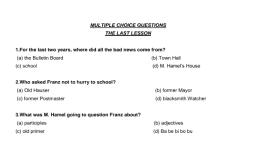
What does M. Hamel’s motionless posture reflect?, (a) the school is dismissed, (b) sense of finality, (c) changing order of life, (d) feeling of nostalgia, Answer, Answer: (b) sense of finality, Question 6., What is the moral that the Alphonse Daudet wants to bring out?, (a) not to put off things that one can do that day, (b) old order changed to new, (c) one should accept everything that happens, (d) teachers should be respected, Answer, Answer: (a) not to put off things that one can do that day, Question 7., Why did Hamel blame himself?, (a) not having taught them enough French, (b) not being strict, (c) giving students a holiday at times, (d) not being responsible, Answer, Answer: (c) giving students a holiday at times, Question 8., Who sat on the back bench on the last lesson?, (a) Franz, (b) Prussians, (c) the village people, (d) The new teacher, Answer, Answer: (c) the village people, Question 9., What was M. Hamel going to question Franz about?, (a) participles, (b) adjectives, (c) old primer, (d) Ba be bi bo bu, Answer, Answer: (a) participles, Question 10., For the last two years, where did all the bad news come from?
Page 3 :
(a) the Bulletin Board, (b) Town Hall, (c) school, (d) M. Hamel’s House, Answer, Answer: (a) the Bulletin Board, Question 11., Don’t go so fast, you will get to your school in plenty of time means ___, (a) getting late, (b) very early, (c) not early, (d) early enough, Answer, Answer: (d) early enough, Question 12., What did Mr. Hamel bring for his class on his last day in the school?, (a) new pens, (b) new notebooks, (c) sweets, (d) story books, Answer, Answer: (b) new notebooks, Question 13., What was Franz expected to be prepared for at school that day?, (a) song, (b) dance, (c) essay writing, (d) Participles, Answer, Answer: (d) Participles, Question 14., Why did the villagers come to meet M. Hamel in the school?, (a) to complain, (b) to say goodbye, (c) to gossip, (d) to show gratitude, Answer, Answer: (d) to show gratitude, Question 15., Why was Franz surprised?, (a) Because of village elders
Page 4 :
(b) Because of police patrolling, (c) because of students’ behavior, (d) because of M.Hamel’s kind and polite behaviour, Answer, Answer: (d) because of M.Hamel’s kind and polite behaviour, Question 16., What did Franz find on reaching the school?, (a) People were dancing, (b) school was closed, (c) Police patrolling, (d) strange quietness, Answer, Answer: (d) strange quietness, Question 17., The story ‘The Last Lesson’ highlights which human tendency?, (a) Male Chauvinism, (b) Procrastination, (c) Courage, (d) Cowardice, Answer, Answer: (b) Procrastination, Question 18., `Who is the author of The Last Lesson?, (a) Jane Austen, (b) Rabindra Nath Tagore, (c) None, (d) Alphonse Daudet, Answer, Answer: (d) Alphonse Daudet, , Some More, Question 1., ‘Viva la France’ became emotional evidence of M. Hamel’s?, (a) sadness and patriotism., (b) finality and depression., (c) nostalgia and emotional outburst., (d) love for the school and teaching as a profession., Answer, Answer: (a) sadness and patriotism., Question 2.
Page 5 :
Which district came under the Prussian rule?, (a) Alsace and Berlin, (b) Berlin and Lorraine, (c) Alsace and Lorraine, (d) the southern districts of France, Answer, Answer: (c) Alsace and Lorraine, Question 3., M. Hamel emerges as a when he teaches his last lesson., (a) meek person, (b) true patriot, (c) repentant man, (d) defeated the man, Answer, Answer: (b) true patriot, Question 4., Why does the author urge the reader to respect his language?, (a) It is what makes you respect your countrymen., (b) It is the key to freedom., (c) You can express yourself., (d) It is unique and reflects literature and art., Answer, Answer: (b) It is the key to freedom., Question 5., Why does Hamel blame the parents?, (a) they preferred children to work in farms, (b) they were not strict, (c) they did not come to M. Hamel’s class, (d) they did not love the French language, Answer, Answer: (a) they preferred children to work in farms, Question 6., What does the marching of soldiers under the windows represent?, (a) the departure of Hamel, (b) dawn of Prussia in France, (c) freedom for Franz, (d) sorrow of the villagers, Answer, Answer: (b) dawn of Prussia in France, Question 7., What does the last lesson taught by Hamel symbolize?
Page 6 :
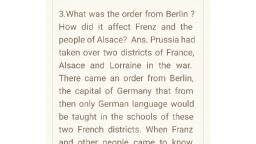
(a) no more teaching of French, (b) domination of Prussia, (c) learning of German, (d) loss of language and loss of freedom, Answer, Answer: (d) loss of language and loss of freedom, Question 8., What order had come from Berlin?, (a) to close the school, (b) teach German in schools of Alsace and Lorraine, (c) to open a new school in Alsace and Lorraine, (d) that Hamel would have to leave, Answer, Answer: (b) teach German in schools of Alsace and Lorraine, Question 9., What was unusual about M. Hamel’s dress?, (a) wore clean clothes, (b) wore a brand new outfit, (c) wore clothes he wore on prize days, (d) wore traditional French clothes, Answer, Answer: (c) wore clothes he wore on prize days, Question 10., Who asked Franz not to hurry to school?, (a) Old Hauser, (b) former Mayor, (c) former Postmaster, (d) blacksmith Watcher, Answer, Answer: (d) blacksmith Watcher, Question 11., “The Last Lesson” story was written in which year?, (a) 1869 – 1870, (b) 1870 – 1871, (c) 1872- 1873, (d) 1870 – 1872, Answer, Answer: (b) 1870 – 1871, Question 12., Why did Mr. M. Hamel call the French language the most beautiful?, (a) Because it was the clearest and logical
Page 7 :
(b) Because it was his native language, (c) Because people were from France, (d) None of these, Answer, Answer: (a) Because it was the clearest and logical, Question 13., Who occupied the back benches in the class?, (a) weak students, (b) teachers, (c) monitors of the class, (d) village elders, Answer, Answer: (d) village elders, Question 14., What were the things being taken for granted by the people of Alsace?, (a) Teachers of the school, (b) Time and school, (c) People around, (d) Money and power, Answer, Answer: (b) Time and school, Question 15., Alphonse Daudet was from which country?, (a) India, (b) France, (c) England, (d) New Zealand, Answer, Answer: (b) France, , Few More, Q1 - Who is the author of The Last Lesson?, A) Jane Austen, B) Rabindra Nath Tagore, C) None, D) Alphonse Daudet
Page 8 :
Q2- Alphonse Daudet was from which country?, A) India, B) France, C) England, D) New Zealand, , Q3- The story ‘The Last Lesson’ highlights which human tendency?, A) Male Chauvinism, B) Procrastination, C) Courage, D) Cowardice, , Q4 - What were the things being taken for granted by the people of Alsace?, A) Teachers of the school, B) Time and school, C) People around, D) Money and power, , Q5 - What does The Last Lesson symbolize?, A), Loss, B) Loss of freedom, C) Loss of language, D) Loss of language and freedom, , Q6 - What does The Last Lesson signify?, A) Change of power, B) change of Government, C) change in life, D) Change of teachers
Page 9 :
Q7- What do the marching soldiers under the windows represent?, A) The Dawn of Prussia in the defeat of French people, B) The defeat of Prussia, C) The victory of French, D) None of these, , Q 8-From where did the orders come to teach only German in the districts of, Alsace and Lorraine?, A) France, B) Lorraine, C)Berlin, D) Germany, , Q9- What does this story speak about?, A) Power, B) Money, C) Transition, D) people, , Q10- Why was Franz reluctant to go to school?, A) wanted to enjoy warm Sunlight, B) wanted to see soldiers drill, C) wanted to enjoy outdoor, D) lesson on participles was not prepared
Page 10 :
Q11- What did Franz find on reaching the school?, A) People were dancing, B) school was closed, C) Police patrolling, D) strange quietness, , Q12- Who occupied the back benches in the class?, A) weak students, B) teachers, C) monitors of the class, D) village elders, , Q13- Why was Franz surprised?, A) Because of village elders, B) Because of police patrolling, C) because of students' behavior, D) because of M.Hamel's kind and polite behaviour, , Q14- Why was Franz feeling regretful and sad?, A) for reaching late, B) for not learning participles, C) for change of the Government, D) for not learning his mother tongue
Page 11 :
Q15- Whom did M.Hamel blame for not sending students to school?, A) Parents, B) friends, C) teachers, D) watchman, , Q16- What did Hauser bring?, A) sweets, B) children, C) friends, D) old Primer, , Q17- What made Franz forget M.Hamel's ruler and crankiness?, A) Police Patrolling, B) Strange Quietness, C) Bustle on the streets, D) The idea of his going away, , Q18- For how many years did M. Hamel serve the school?, A) 20 years, B) 35 years, C) 30 years, D) 40 years
Page 12 :
Q19- Where did the parents send their children?, A) school, B) coaching, C) farms and mills, D) movies, , Q20- Why were the parents sending their children to the farms and mills?, A) to play, B) to meet friends, C) to meet relatives, D) to earn money, , Q21-Why did the villagers come to meet M. Hamel in the school?, A) to complain, B) to say goodbye, C) to gossip, D) to show gratitude
Page 13 :
Q22- Why did Mr. M. Hamel call the French language the most beautiful?, A) Because it was the clearest and logical, B) Because it was his native language, C) Because people were from France, D) None of these, , Q23- What was Franz expected to be prepared for at school that day?, A) song, B) dance, C) essay writing, D) Participles, , Q24- When people are enslaved, what key do they have to the prison,, according to M.Hamel?, A) their behaviour, B) power, C) aggressiveness, D) mother tongue
Page 14 :
Q25- What did Franz notice that was unusual that day?, A) strange quietness in the school, B) soldiers in the school, C) crowd in school, D) all of these, , Q26- What had been put up on the Bulletin Board that day?, A) Teach only French, B) Speak only English, C) Teach only German, D) Teach all these, , Q27- What changes did the order from Berlin cause in school that day?, A) hustle-bustle, B) people were happy, C) teachers were sad, D) strange quietness and sadness
Page 15 :
Q28- What changed Franz's feelings about M.Hamel and school?, A) Police Patrolling, B) Orders from Berlin, C) Strict words from M. Hamel, D) old Primer, , Q29- What made Franz and the people realize about the preciousness of their, mother tongue?, A) M. Hamel's words, B) School orders, C) Sudden orders from Berlin, D) School Principal, , Q30- Expression 'Thunder Clap" in the lesson means _______., A) loud but not clear, B) loud and clear, C) startling and unexpected, D) unpleasant
Page 16 :
Q31- What did Mr. Hamel bring for his class on his last day in the school?, A) new pens, B) new notebooks, C) sweets, D) story books, , Q32 "The Last Lesson" story was written in which year?, A) 1869 - 1870, B) 1870 - 1871, C) 1872- 1873, D) 1870 - 1872, , Q33- Don't go so fast, you will get to your school in plenty of time means ___, A) getting late, B) very early, C) not early, D) early enough
Page 17 :
Q34- What was there in front of the Bulletin Board?, A) children, B) police, C) hawkers, D) a crowd, , Q35- What bad news used to come from the Bulletin Board?, A) lost battles, B) the draft, C) orders of commanding officers, D) All of these, , Q36- Which language would the students study from the next day?, A) English, B) German, C) Dutch, D) Spanish
Page 18 :
Q37- What does the expression "in great dread of scolding" mean?, A) to be happy about it, B) very badly scared of scolding, C) To be indifferent, D) None of these, , Q38- Why was Franz shocked to see M. Hamel?, A) Because of his formal dress, B) because he gave sweets, C) because he had a flower in his hand, D) all of these, , Q 39- What attitude of M.Hamel surprised Franz?, A) soft and kind, B) rude, C) firm and strict, D) none of these, , Q40- Who was M.Hamel?, A) a spy, B) language teacher, C) soldier, D) School Principal
Page 19 :
ANSWER KEY, D, , 11, , D, , 21, , D, , 31, , B, , 2, , B, , 12, , D, , 22, , A, , 32, , B, , 3, , B, , 13, , D, , 23, , D, , 33, , D, , 4, , B, , 14, , D, , 24, , D, , 34, , D, , 5, , D, , 15, , A, , 25, , A, , 35, , D, , 6, , C, , 16, , D, , 26, , C, , 36, , B, , 7, , A, , 17, , D, , 27, , D, , 37, , B, , 8, , C, , 18, , D, , 28, , B, , 38, , A, , 9, , C, , 19, , C, , 29, , C, , 39, , A, , 10, , D, , 20, , D, , 30, , C, , 40, , B, , 1



 Learn better on this topic