Notes of Class12, English Indigo class 12th.docx - Study Material
Page 1 :
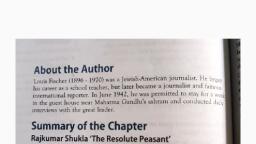
Summary of Indigo, About the author - Louis Fischer (1896-1970) was born in Philadelphia in 1896. He served as a volunteer in the British Army between 1918-1920. Fischer made a career as a journalist and wrote for The New York Times, The Saturday Review and for European and Asian publications. He was also a member of the faculty of Princeton University., Introduction - The story is based on the interview taken by Louis Fischer of Mahatma Gandhi. In order to write on him he had visited him in 1942 at his ashram- Sevagram where he was told about the Indigo Movement started by Gandhiji. The story revolves around the struggle of Gandhi and other prominent leaders in order to safeguard sharecroppers from the atrocities of landlords., Summary - Indigo summary is going to assist students in learning about the chapter in a summarized version. Indigo is about how Mahatma Gandhi struggled for the underprivileged peasants of Champaran. They were the sharecroppers with the British planters. The peasants use to live a wretched life and were under an agreement to grow Indigo. As Bihar has the landlord system back then, it worsened their condition. Thus, Gandhi decided to fight against injustice. He waged a war which lasted for a year to tackle the discrimination and got justice for the peasants. After that, it helped the peasants become courageous and aware of their fundamental rights. Moreover, Gandhiji did not just work to tackle political or economic issues, but he also took up social issues. He worked to provide them with education, health, hygiene and taught them self-confidence., This story is set in 1916 where Gandhi steps up to help a bunch of poor peasants from Champaran. It gives an account of how he struggled to bring them justice and equality. Thus, it begins with most of the arable land of Champaran that divides into a large estate. The owners of the estate are Englishmen and the workers are Indian tenants. We learn that the chief commercial crop on this land is Indigo. Moreover, we also see that the landlords compel all the tenants to plant 15% of their Indigo and submit the whole harvest in the form of rent. The tenants are under a long-term agreement to do so., However, Germany starts developing synthetic Indigo. Thus, the British do not require the Indigo crop any more. Thus, in order to release the poor peasant from their agreement of 15%, they start demanding compensation. While some of the uneducated peasants agreed on this, the other did not agree. Thus, we notice that one of the sharecroppers, Raj Kumar Shukla arranges for a meeting with Gandhi., He meets him for the same issues and insists Gandhi to visit the place to end the longstanding injustice. Gandhi agrees and boards a train to Patna in Bihar. After that, Raj Kumar Shukla helps Gandhi visit the house of Rajendra Prasad, a lawyer. As Gandhi dresses simply, the servants thought of him to be a poor peasant. Thus, Gandhi planned before trying to get the peasants any justice. It is because the British government are punishing anyone who is keeping national leaders or protestors., Thus, when Gandhi arrived in the place, the news of his arrival and mission spread across the town like wildfire. This resulted in a lot of lawyers and peasant groups pouring in large numbers in his support. Consequently, the lawyers did accept that the charges are quite high and too unreasonable for a poor peasant., However, Gandhi was criticizing them for collecting huge fees from the sharecroppers. He was emphasizing on counselling as this will provide the peasants with confidence to fight their fear. Thus, he manages to get justice after a yearlong fight for the peasants. He has also arranged for the education, health, and hygiene for the families of the poor peasants. Finally, he teaches them a lesson of self-sufficiency and self-confidence., Conclusion of Indigo, To sum up, Indigo summary, we learn how Gandhiji did not merely help in freeing India, but was always working for the betterment of his countrymen from the very start., Extracts with explanation and vocab words-, When I first visited Gandhi in 1942 at his ashram in Sevagram, in central India, he said, “I will tell you how it happened that I decided to urge the departure of the British. It was in 1917.”, The author explains about his first interaction (meeting) with Mahatma Gandhi. He says that he first met Gandhi in 1942 at his ashram which was in Sevagram. It was located in central India. Gandhi said that he would tell him about his struggle against the British which first took place in the year 1917., He had gone to the December 1916 annual convention of the Indian National Congress party in Lucknow. There were 2,301 delegates and many visitors. During the proceedings, Gandhi recounted, “a peasant came up to me looking like any other peasant in India, poor and emaciated, and said, ‘I am Rajkumar Shukla. I am from Champaran, and I want you to come to my district’!‘’ Gandhi had never heard of the place. It was in the foothills of the towering Himalayas, near the kingdom of Nepal., Convention: agreement, Delegates: Representatives, Peasant: small farmer, Emaciated: thin, Champaran: A place in Bihar, He says that in the month of December, in the year 1916, Mahatma Gandhi went to attend the annual meeting of the Indian National Congress at Lucknow. There were about 2,301 representatives and visitors. Gandhi recalled that a small farmer named Rajkumar Shukla came to him who was poor and thin. He requested Gandhi to visit Champaran, a place in the foothills of the Himalaya mountain range, near the Kingdom of Nepal., Under an ancient arrangement, the Champaran peasants were sharecroppers. Rajkumar Shukla was one of them. He was illiterate but resolute. He had come to the Congress session to complain about the injustice of the landlord system in Bihar, and somebody had probably said, “Speak to Gandhi.”, Sharecroppers: a tenant farmer who gives a part of each crop as rent., Resolute: determined, He told Gandhi that he was a sharecropper. A sharecropper is a farmer who gives a part of the crop as rent to the owner of that piece of land that he cultivates. He told him that because of an old agreement, many of the peasants in Champaran were sharecroppers. He had come to meet Gandhi on someone‘s suggestion as he was determined to find a solution for the sharecroppers who were facing hardships due to this agreement. He sought Gandhi ji’s help., Gandhi told Shukla he had an appointment in Cawnpore and was also committed to go to other parts of India. Shukla accompanied him everywhere. Then Gandhi returned to his ashram near Ahmedabad. Shukla followed him to the ashram. For weeks he never left Gandhi‘s side. “Fix a date,” he begged., Committed: dedicated, Accompanied: go somewhere with (someone) as a companion or escort, Cawnpore: British name for the city of Kanpur, After hearing his problem, Gandhiji told him that he had to visit Cawnpore and some other parts of India due to prior appointments. Shukla went with him everywhere. After this Gandhi returned to his ashram near Ahmedabad. Shukla was always there with him for several weeks, begging him to fix a date tio visit Champaran., Impressed by the sharecropper‘s tenacity and story Gandhi said, ‘‘I have to be in Calcutta on such-and-such a date. Come and meet me and take me from there.“, Months passed. Shukla was sitting on his haunches at the appointed spot in Calcutta when Gandhi arrived; he waited till Gandhi was free. Then the two of them boarded a train for the city of Patna in Bihar. There Shukla led him to the house of a lawyer named Rajendra Prasad who later became the President of the Congress party and of India. Rajendra Prasad was out of town, but the servants knew Shukla as a poor yeoman who pestered their master to help the indigo sharecroppers. So they let him stay on the ground with his companion, Gandhi, whom they took to be another peasant. But Gandhi was not permitted to draw water from the well lest some drops from his bucket pollute the entire source; how did they know that he was not an untouchable, Tenacity: determination, Haunches: thighs, Boarded: get on, enter, Yeoman: a man who cultivates a small piece of land, Pestered: bother, harass, Permitted: allowed, As Gandhi was impressed with the determination of the peasant, he said that he would be visiting Kolkata after a few months and that Shukla should meet him there. On the day that had been fixed, Shukla was eagerly waiting for Gandhiji. When Gandhi got free, they both took a train to Patna. Then they went to the house of a lawyer- Rajendra Prasad who later became the President of India. When they reached there, he was not at home. But the servants allowed both of them to stay at the grounds because they knew Shukla. They all knew him because Shukla used to assist their master in helping indigo sharecroppers. They didn‘t allow Gandhi to draw water from their well as they took him to be an untouchable and didn’t want to pollute the entire water source., Gandhi decided to go first to Muzaffarpur, which was en route to Champaran, to obtain a more complete information about conditions than Shukla was capable of imparting. He accordingly sent a telegram to Professor J.B. Kripalani, of the Arts College in Muzaffarpur, whom he had seen at Tagore‘s Shantiniketan School. The train arrived at midnight, 15 April 1917. Kripalani was waiting at the station with a large body of students. Gandhi stayed there for two days in the home of Professor Malkani, a teacher in a government school., En route: on the way, Imparting: pass on, giving, As Shukla was not able to provide Gandhi with adequate information, therefore, he decided to go to Muzaffarpur which was on the way to Champaran to obtain the complete information. He sent a telegram to Professor J.B Kriplani who was a teacher at Arts College in Muzaffarpur. Gandhi had seen him at Tagore‘s Shantiniketan School. Gandhi took a train to Muzaffarpur that arrived at midnight on 15th April 1917. Kriplani was already waiting there with his students. Gandhi stayed there for two days at Professor Malkani’s home who was a teacher in a government school., ‘‘It was an extraordinary thing ‘in those days,’‘ Gandhi commented, “for a government professor to harbour a man like me”. In smaller localities, the Indians were afraid to show sympathy for advocates of home-rule., The news of Gandhi‘s advent and of the nature of his mission spread quickly through Muzzafarpur and to Champaran. Sharecroppers from Champaran began arriving on foot and by conveyance to see their champion. Muzzafarpur lawyers called on Gandhi to brief him; they frequently represented peasant groups in court; they told him about their cases and reported the size of their fee, Extraordinary: exceptional, remarkable, Harbour: here, entertain, Sympathy: support, pity, Advocate: supporter, protector, Advent: arrival, Conveyance: transportation, According to Gandhi, it was a remarkable thing that a government professor was entertaining him because in those days people in small localities were afraid of supporting those who supported home rule. The news of Gandhi‘s arrival and the purpose of his mission spread through Muzaffarpur and Champaran, very fast. Sharecroppers started to visit him. Muzaffarpur lawyers informed Gandhi about the whole situation as they represented various peasants in the court. They explained to him about their cases and the fee that they charged them., Gandhi chided the lawyers for collecting big fee from the sharecroppers. He said, ‘‘I have come to the conclusion that we should stop going to the law courts. Taking such cases to the courts does litte good. Where the peasants are so crushed and fear-stricken, law courts are useless. The real relief for them is to be free from fear.’‘, Most of the arable land in the Champaran district was divided into large estates owned by Englishmen and worked by Indian tenants. The chief commercial crop was indigo. The landlords compelled all tenants to plant three twentieths or 15 percent of their holdings with indigo and surrender the entire indigo harvest as rent. This was done by long-term contract., Chided: criticize, scold, Conclusion: result, end of something, Fear stricken: afraid, Arable: land suitable for farming, Tenants: occupants paying rent in cash or kind, Estate: property, Compelled: forced, Surrendered: to give in, Contract: agreement, Indigo: plant that produces a blue color, Gandhi scolded the lawyers for charging such high fee from the poor sharecroppers. He decided that it was useless to go to the courts as the judiciary was not doing anything good for the peasants. He said that as long as the peasants were suppressed and full of fear, it was useless to visit the courts. He wanted to set them free from fear. Most of the cultivable land in the Champaran district was owned by Englishmen who had divided them into various estates (property). The peasants were the occupants of these lands. Englishmen forced the peasants to cultivate indigo on 15 percent of their land and to give the crop to them as rent. All this was done through a long term agreement., Presently, the landlords learned that Germany had developed synthetic indigo. They, thereupon, obtained agreements from the sharecroppers to pay them compensation for being released from the 15 percent arrangement., The sharecropping arrangement was irksome to the peasants, and many signed willingly. Those who resisted, engaged lawyers; the landlords hired thugs. Meanwhile, the information about synthetic indigo reached the illiterate peasants who had signed, and they wanted their money back., Learned: come to know, Synthetic: Chemical based, artificial, Compensation: payments, Arrangement: Process, Irksome: irritating, Resisted: opposed, to be against something, Thugs: cheats, Illiterate: uneducated, While all this was going on, the landlords came to know about the chemical indigo being prepared in Germany. It was a blue color dye made with chemicals. They started demanding money from the poor peasants in order to cancel their agreements as they no longer required the indigo plantations. The sharecropping system was very annoying, so many of the peasants paid for the cancellation of the agreements. But as the news about synthetic indigo spread and reached the uneducated peasants, they started demanding their money back., At this point Gandhi arrived in Champaran. He began by trying to get the facts. First he visited the secretary of the British landlord‘s association. The secretary told him that they could give no information to an outsider. Gandhi answered that he was no outsider., Next, Gandhi called on the British official commissioner of the Tirhut division in which the Champaran district lay. ‘‘The commissioner,’‘ Gandhi reports, ‘‘proceeded to bully me and advised me forthwith to leave Tirhut.’‘, Proceeded: begin a course of action, Bully: trying to harm others considering them to be weak, Forthwith: immediately, at once, When Gandhi arrived at Champaran, he decided to gather the facts. For this, he visited the secretary of the British landlord‘s association. The secretary didn’t answer him because he could not give any information to an outsider. After this, he went to the commissioner of the Tirhut division. Champaran district was under Tirhut division. The commissioner not only threatened Gandhi but also suggested him to leave Tirhut immediately., Gandhi did not leave. Instead he proceeded to Motihari, the capital of Champaran. Several lawyers accompanied him. At the railway station, a vast multitude greeted Gandhi. He went to a house and, using it as headquarters, continued his investigations. A report came in that a peasant had been maltreated in a nearby village. Gandhi decided to go and see; the next morning he started out on the back of an elephant. He had not proceeded far when the police superintendent‘s messenger overtook him and ordered him to return to town in his carriage. Gandhi complied. The messenger drove Gandhi home where he served him with an official notice to quit Champaran immediately. Gandhi signed a receipt for the notice and wrote on it that he would disobey the order., Accompanied: go along with someone, Multitude: a large number of people, Investigations: inquiries, Maltreated: ill treat, Superintendent: Manager, supervisor, Overtook: went ahead of him, Complied: followed or obeyed, Though Gandhi was threatened by the commissioner, he didn‘t leave the place. He then went to Motihari which was the capital of Champaran. He was joined by several lawyers. When they reached the station, they were welcomed by a large number of people. He then went to a house which was later converted into his headquarters. He started his inquiry into the matter. Gandhi decided to visit a nearby village when he came to know about an incident of ill treatment with a peasant. He was on his way, on an elephant, when the superintendent’s (Supervisor) messenger stop him and ordered him to return back to the town. Gandhi followed him and the messenger took him back to his home. He was then served a notice which ordered him to quit his movement and return back. Gandhi received the notice and signed a receipt on which he wrote that he would not obey the order., In consequence, Gandhi received the summons to appear in court the next day., All night Gandhi remained awake. He telegraphed Rajendra Prasad to come from Bihar with influential friends. He sent instructions to the ashram. He wired a full report to the Viceroy., Morning found the town of Motihari black with peasants. They did not know Gandhi‘s record in South Africa. They had merely heard that a Mahatma who wanted to help them was in trouble with the authorities. Their spontaneous demonstration, in thousands, around the courthouse was the beginning of their liberation from fear of the British., Consequence: result, Influential: powerful, Wired: Telegraphed, Merely: only, Authorities: officials, power, Spontaneous: voluntary, unforced, Demonstrations: protest, Courthouse: court building, Liberation: release, As a result, Gandhi got summons to appear in court next day.Gandhi wasn‘t able to sleep the whole night. He telegraphed Rajendra Prasad and asked him to come to Bihar and get some powerful people along. He sent some guidelines to the Ashram and also telegraphed the whole matter to the viceroy. Next morning, Motihari was full of peasants as they wanted to support Gandhi. None of them knew about his works in South Africa. They only knew that there was a Mahatma who wanted to help them and was in trouble due to the officials. They started gathering in front of the courthouse. This incident was their attempt of setting themselves free from the fear of the British., The officials felt powerless without Gandhi‘s cooperation. He helped them regulate the crowd. He was polite and friendly. He was giving them concrete proof that their might, hitherto dreaded and unquestioned, could be challenged by Indians., The government was baffled. The prosecutor requested the judge to postpone the trial. Apparently, the authorities wished to consult their superiors., Concrete: solid, Hitherto: Earlier, Previously, Dreaded: regarded with great fear or apprehension, Unquestioned: not examined or inquired into, Baffled: confused, Prosecutor: Lawyer or barrister, Postpone: delay, Apparently: seemingly, evidently, As the crowd had gathered in front of the court building, it became difficult for the officers to control the mob. They had to take Gandhi‘s help to regulate the crowd. Gandhi politely told the officials that if they would misuse their power, then there were chances that they would have to face a revolt from the Indians. As the situation was getting tougher, the lawyer requested the court to postpone the trial by some days. The authorities decided to first consult the higher authorities., Gandhi protested against the delay. He read a statement pleading guilty. He was involved, he told the court, in a “conflict of duties”— on the one hand, not to set a bad example as a lawbreaker; on the other hand, to render the “humanitarian and national service” for which he had come. He disregarded the order to leave, “not for want of respect for lawful authority, but in obedience to the higher law of our being, the voice of conscience”. He asked the penalty due., The magistrate announced that he would pronounce sentence after a two-hour recess and asked Gandhi to furnish bail for those 120 minutes. Gandhi refused. The judge released him without bail., Protested: objected, disapproved, Pleading: the action of making an emotional or earnest appeal to someone, Guilty: at fault, Conflict: to be against someone, Humanitarian: Concerned with human welfare, Conscience: sense of right and wrong, Magistrate: civil officer who administers law, Pronounce: declare or announce, Recess: break, Bail: an amount of money that a person who has been accused of a crime pays to a law court so that they can be released until their trial., Gandhiji objected against the delay in the proceedings of the case. He read a statement in front of the court in which he accepted his fault in a very humble manner. He said that he was not a lawbreaker and didn‘t want to go against the law but his duty towards humanity has a greater influence on him and it forced him to do so. He refused to leave the town because he wanted to help the sharecroppers as it was his moral duty. The magistrate asked him to arrange for bail because he was going to give his judgement after the 2 hour long break. Gandhiji refused to seek bail and later on, he was released without it., When the court reconvened, the judge said he would not deliver the judgment for several days. Meanwhile he allowed Gandhi to remain at liberty., Rajendra Prasad, Brij Kishor Babu, Maulana Mazharul Huq and several other prominent lawyers had arrived from Bihar. They conferred with Gandhi. What would they do if he was sentenced to prison, Gandhi asked. Why, the senior lawyer replied, they had come to advise and help him; if he went to jail there would be nobody to advise and they would go home., Reconvened: to start again after a small break, Liberty: free, Prominent: Important, well known, Conferred: granted, When the court proceedings restarted, the judge refused to deliver any judgement for many days to come. He allowed Gandhi to remain free. Some well known lawyers like Rajendra Prasad, Brij Kishor Babu and Maulana Mazharul Huq came from Bihar to help and advice Gandhi. Gandhi asked that if he was sentenced to jail, then what would be their course of action. One senior lawyer replied that they were there to help him out and if he was sentenced to jail, then they would return back., What about the injustice to the sharecroppers, Gandhi demanded. The lawyers withdrew to consult. Rajendra Prasad has recorded the upshot of their consultations — “They thought, amongst themselves, that Gandhi was totally a stranger, and yet he was prepared to go to prison for the sake of the peasants; if they, on the other hand, being not only residents of the adjoining districts but also those who claimed to have served these peasants, should go home, it would be shameful desertion”, They accordingly went back to Gandhi and told him they were ready to follow him into jail. ‘‘The battle of Champaran is won,’‘ he exclaimed. Then he took a piece of paper and divided the group into pairs and put down the order in which each pair was to court arrest., Injustice: unfairness, Withdrew: left, Upshot: result, conclusion, Consultations: discussion, Desertion: action of leaving a place, organization etc, When Gandhi came to know about their decision, he asked them to help the sharecroppers who were facing unfairness. Rajendra Prasad and other lawyers concluded that if Gandhi could go to jail for the people of their area, although he was a stranger, then they should also follow him as they had always claimed to serve the peasants and fought their legal battles too. They decided that if Gandhi went to jail, then they would follow too. On hearing this, Gandhi assured them that their struggle for Champaran‘s peasants had been won. He divided the group into pairs of two and made a sequence in which they had to voluntarily surrender in the court., Several days later, Gandhi received a written communication from the magistrate informing him that the Lieutenant-Governor of the province had ordered the case to be dropped., Civil disobedience had triumphed, the first time in modern India., Gandhi and the lawyers now proceeded to conduct a far-flung inquiry into the grievances of the farmers. Depositions by about ten thousand peasants were written down, and notes made on other evidence. Documents were collected. The whole area throbbed with the activity of the investigators and the vehement protests of the landlords., Lieutenant-Governor: deputy governor, Province: region, territory, Civil Disobedience: peaceful form of political protest, Triumphed: won, Grievances: complaints, Depositions: a formal written statement, Evidence: proof, Throbbed: produced a lot of vibrations due to a huge crowd, Investigators: the inspectors, Vehement: showing strong feeling; forceful, passionate, or intense., After some days, the Magistrate sent a letter to Gandhiji in which it was written that as per the orders of deputy governor, the case against him had been taken back. It was for the first time in modern India that a peaceful protest against the government had been won. Gandhi and other lawyers carried on with an in – depth investigation into the injustice with the farmers. Statements of about ten thousand peasants were recorded and various documentary proofs were collected. The whole area vibrated with activity- the investigators and the protesting landlords., In June, Gandhi was summoned to Sir Edward Gait, the Lieutenant-Governor. Before he went he met leading associates and again laid detailed plans for civil disobedience if he should not return., Gandhi had four protracted interviews with the Lieutenant- Governor who, as a result, appointed an official commission of inquiry into the indigo sharecroppers‘ situation. The commission consisted of landlords, government officials, and Gandhi as the sole representative of the peasants., Summoned: called, Leading: prominent, popular, Associates: supporters, Protracted: lasting for a long time or longer than expected or usual., Representative: spokesperson, agent, In June, Gandhi was called up to be present before deputy governor Sir Edward Gait. Before meeting him, he met his chief supporters and made plans for civil disobedience, in case he did not return. Gandhi had four long interviews with the deputy commissioner which led to the formation of a commission that inquired into the indigo sharecroppers‘ situation. The commission had landlords, government officials and Gandhi who was the only spokesperson for the peasants., Gandhi remained in Champaran for an initial uninterrupted period of seven months and then again for several shorter visits. The visit, undertaken casually on the entreaty of an unlettered peasant in the expectation that it would last a few days, occupied almost a year of Gandhi‘s life., The official inquiry assembled a crushing mountain of evidence against the big planters, and when they saw this they agreed, in principle, to make refunds to the peasants. “But how much must we pay?” they asked Gandhi., Initial: at the start, Uninterrupted: continuous, Entreaty: an earnest or humble request, Assembled: gathered, Gandhi remained in Champaran for seven months. He also made several short visits later. His visit on the request of a peasant was presumed to last a few days but it took a year. The official enquiry didn‘t favor the planters, hence, they agreed to pay back to the peasants. But they questioned Gandhi regarding the amount to be repaid., They thought he would demand repayment in full of the money which they had illegally and deceitfully extorted from the sharecroppers. He asked only 50 per cent. “There he seemed adamant,” writes Reverend J. Z. Hodge, a British missionary in Champaran who observed the entire episode at close range. “Thinking probably that he would not give way, the representative of the planters offered to refund to the extent of 25 per cent, and to his amazement Mr. Gandhi took him at his word, thus breaking the deadlock., “This settlement was adopted unanimously by the commission. Gandhi explained that the amount of the refund was less important than the fact that the landlords had been obliged to surrender part of the money and, with it, part of their prestige. Therefore, as far as the peasants were concerned, the planters had behaved as lords above the law. Now the peasant saw that he had rights and defenders. He learned courage., Deceitfully: dishonestly, Extorted: took forcibly, Adamant: firm, Amazement: surprise, Obliged: required, made legally bound to do something, Deadlock: a situation in which no progress can be made, Unanimously: without opposition, Prestige: honour, esteem, Defenders: protector, The moneylenders had thought that Gandhi would ask for the full payment of the money which they had taken from the peasants forcefully and fraudulently. But he asked for only fifty percent and his decision was firm. A missionary, Reverend J. Z. Hodge who had a close watch on the matter reported this. The planters offered to pay only 25 percent as they thought it would be rejected by Gandhi. He immediately accepted it. Gandhi said that the amount of money was not important but by giving money, the planters had bowed down to the peasants and had given away their honour too. The planters who earlier behaved as if they were above the law, now had to abide by it. This made the peasants realize their rights and give them courage to fight for them., Events justified Gandhi‘s position. Within a few years the British planters abandoned their estates, which reverted to the peasants. Indigo sharecropping disappeared., Gandhi never contented himself with large political or economic solutions. He saw the cultural and social backwardness in the Champaran villages and wanted to do something about it immediately. He appealed for teachers. Mahadev Desai and Narhari Parikh, two young men who had just joined Gandhi as disciples, and their wives, volunteered for the work. Several more came from Bombay, Poona and other distant parts of the land. Devadas, Gandhi‘s youngest son, arrived from the ashram and so did Mrs. Gandhi. Primary schools were opened in six villages. Kasturbai taught the ashram rules on personal cleanliness and community sanitation., Justified: marked by a good or legitimate reason, Abandoned: deserted, inhibited, Estates: property, Reverted: returned, Contented: willing to accept something, satisfied, Events had proven Gandhi‘s position. The British planters had to leave their property within the next few years. These properties were returned back to the peasants. Indigo sharecropping soon came to an end. Gandhi was not satisfied by achieving political or economic solutions – he sought to remove the cultural and social backwardness of Champaran. Gandhi wanted to do something to remove the backwardness in the villages of Champaran. He requested teachers such as Mahadev Desai and Narhai Parikh and their wives to teach the villagers. Both of them were followers of Gandhi. Many other volunteers came from Bombay and Poona to join them. Mrs. Gandhi and their youngest son Devdas arrived from the ashram for their help. Primary schools were opened in six villages where Kasturbai used to teach the ashram rules on cleanliness and community sanitation., Health conditions were miserable. Gandhi got a doctor to volunteer his services for six months. Three medicines were available — castor oil, quinine and sulphur ointment. Anybody who showed a coated tongue was given a dose of castor oil; anybody with malaria fever received quinine plus castor oil; anybody with skin eruptions received ointment plus castor oil., Gandhi noticed the filthy state of women‘s clothes. He asked Kasturbai to talk to them about it. One woman took Kasturbai into her hut and said, ‘‘look, there is no box or cupboard here for clothes. The sari I am wearing is the only one I have.“, Miserable: unhappy, sad, Volunteer: a person who offers his service free of cost, Eruptions: here, a spot, rash, or other mark appearing suddenly on the skin., The health conditions of the people of Champaran were very poor. So, Gandhi got a doctor who offered his services free of cost for six months. There were only three medicines- castor oil, quinine and sulphur ointment available. A patient with a coated tongue was given Castor oil, a malaria patient was served a dose of quinine and a patient with a skin disorder was given ointment and castor oil. The women of the area used to wear dirty clothes. When Gandhiji tried to know the reason through his wife, he was told that those were the only saris each of the women had., During his long stay in Champaran, Gandhi kept a long distance watch on the ashram. He sent regular instructions by mail and asked for financial accounts. Once he wrote to the residents that it was time to fill in the old latrine trenches and dig new ones otherwise the old ones would begin to smell bad., The Champaran episode was a turning-point in Gandhi‘s life. ‘‘What I did,“ he explained, “was a very ordinary thing. I declared that the British could not order me about in my own country.”, Instructions: orders, commands, Residents: locals, While Gandhiji was in Champaran, he kept a long distance vigil on the ashram. He used to send letters of orders regarding financial matters. Once, he wrote to the locals that it was time to dig new latrines as the old ones had started giving foul smell. The Champaran incident changed Gandhi‘s life. He said that he had done a regular thing- he had put his point across that the Britishers could not order him in his own country., But Champaran did not begin as an act of defiance. It grew out of an attempt to alleviate the distress of large numbers of poor peasants. This was the typical Gandhi pattern — his politics were intertwined with the practical, day-to-day problems of the millions. His was not a loyalty to abstractions; it was a loyalty to living, human beings., In everything Gandhi did, moreover, he tried to mould a new free Indian who could stand on his own feet and thus make India free., Defiance: opposition, Alleviate: uplift, Distress: torture, Intertwined: twisted, braided, knitted, Abstractions: something which exists only as an idea, The Champaran satyagraha was not an act of opposition. It was an attempt to help out the poor and tortured peasants. This was Gandhi‘s way to solve issues. His politics was knitted up with the everyday problems faced by the millions of people. He did not aim at the fulfilment of ideas, rather, he was concerned for the people. The basic idea was to serve humanity and make a free Indian who could stand for his rights., Early in the Champaran action, Charles Freer Andrews, the English pacifist who had become a devoted follower of the Mahatma, came to bid Gandhi farewell before going on a tour of duty to the Fiji Islands. Gandhi‘s lawyer friends thought it would be a good idea for Andrews to stay in Champaran and help them. Andrews was willing if Gandhi agreed. But Gandhi was vehemently opposed. He said, ‘‘you think that in this unequal fight it would be helpful if we have an Englishman on our side. This shows the weakness of your heart. The cause is just and you must rely upon yourselves to win the battle. You should not seek a prop in Mr. Andrews because he happens to be an Englishman’‘., ‘‘He had read our minds correctly,’‘ Rajendra Prasad comments, “and we had no reply… Gandhi in this way taught us a lesson in self-reliance’‘., Self-reliance, Indian independence and help to sharecroppers were all bound together., Pacifist: Peace maker, Vehemently: in an intense manner, Self Reliance: self sufficiency, self support, Prop: support, Charles Freer Andrews who was a peacemaker, visited Gandhi before going on a tour of duty to the Fiji islands. Gandhi‘s lawyer friends wanted Andrews to stay at the Ashram and help them but Gandhi refused. He said that they did not need the help of Britishers as it showed a lack of trust in their own abilities. He asked them not to seek any help from Mr. Andrews as he was an Englishman. Rajendra Prasad later on stated that Gandhi had read their thoughts and his reply served as a lesson of self sufficiency for them. Being self dependant, free and helping the peasants – all these acts of Gandhi were inter connected., Questions and Answers Extract Based, Read, the following paragraph and answer the questions that follow:, (Para-1), Under an ancient arrangement, the Champaran peas-ants were sharecroppers. Rajkumar Shukla was one of them. He was illiterate but resolute. He has come to the Congress session to complain about the injustice of the landlord system in Bihar, and somebody had probably said, “Speak to Gandhi.”, Questions :, (a) What was an ancient arrangement ?, (b) Who was Rajkumar Shukla ?, © Why Rajkumar Shukla had come to Congress session ?, (d) What, somebody had said to Rajkumar Shukla ?, Answers:, (a) An ancient arrangement was sharecropping. The Champaran peasants were share croppers., (b) Rajkumar Shukla was an illiterate but resolute peasant from Champaran, Bihar., © Rajkumar Shukla had come to Congress session to complain about the injustice of the landlord system in Bihar., (d) Somebody had said to Rajkumar Shukla, “Speak to Gandhi.”, (Para-2), The news of Gandhi‘s advent and of the nature of his mission spread quickly through Muzzafarpur and to Champaran. Sharecroppers from Champaran began arriv-ing on foot and by conveyance to see their Champion. Muzzafarpur lawyers called on Gandhi to brief him; they frequently represented peasant groups in court; they told him about their cases and reported the size of their fee., Questions :, (a) What was the news at Muzzafarpur ?, (b) How and why did the sharecroppers reach from Champaran ?, © What was the role of Muzzafarpur‘s lawyers ?, (d) Name the chapter and the writer., Answers:, (a) The news of Gandhi‘s advent and of the nature of his mission was the news at Muzzafarpur., (b) Sharecroppers from Champaran reached on foot and by Conveyance to see their Champion., © Muzzafarpur‘s lawyers were frequently representating peasant groups in court., (d) ‘Indigo’ is the chapter written by ‘Louis Fischer’., (Para-3), A report came in that a peasant had been maltreated in a nearby village. Gandhi decided to go and see; the next morning he started out on the back of an elephant. He had not proceeded far when the police supritendent‘s messanger overtook him and ordered him to return to town in his carriage. Gandhi complied. The messenger drove Gandhi home where he served him with an official notice to quit Champaran immediately. Gandhi signed a receipt for the notice and wrote on it that he would disobey the order., The consequence, Gandhi received a summons of appear in court the next day., Questions :, (a) What report came and what did Gandhi decide ?, (b) What happened when Gandhi was on the way to the nearby village ?, © What did the messenger do with Gandhi ?, (d) What was Gandhi‘s reaction to the notice and what consequence had he to face ?, Answers:, (a) A report came in that a peasant had been maltreated in a nearby village. Gandhi decided to go and see., (b) When Gandhi was on the way to the nearby village, the police supertendent‘s messenger overtook him and ordered him to return to town in his carriage., © The messenger served Gandhi with an official notice to quit Champaran immediately., (d) Gandhi signed a receipt for the notice and wrote on it that he would disobey the order. In consequence, Gandhi received a summons to appear in court the next day., (Para-4), What about the injustice to the sharecroppers, Gandhi demanded. The lawyers withdrew to consult. Rajendra Prasad has recorded the upshot of their consultations : “They thought, amongst themselves, that Gandhi was totally a stranger, and yet he was prepared to go to prision for the sake of the peasants : If they, on the other hand, being not only residents of the adjoining districts but also those who claimed to have served these peasants, should go home, it would be shameful desertion.”, Questions :, (a) What did Gandhi demand to the lawyers ?, (b) What was the reaction of the lawyers ?, © What was the conclusion of their consultations ?, (d) What would be- shameful desertion ?, Answers:, (a) Ghandi demanded the lawyers about the injustice to the sharecroppers., (b) The lawyers withdrew to consult., © According to their consultations : they, if would go home being local residents, would surely be shameful and a defeat to them in that war of injustice., (d) If they should go home, claiming to have served those peasants, it would be shameful desertion., (Para-5), They thought he would demand repayment in full of the money which they had illegally and deceitfully extorted from the sharecroppers. He asked only 50 per cent. “There he seemed adamant,” writes Reverend J.Z. Hodge, a British missionary in Champaran who observed the entire episode at close range. “Thinking probably that he would not give way, the representative of the planters offered to refund to the extent of 25 per cent, and to his amazement Mr. Gandhi took him at his word, thus breaking the deadlock.”, Questions :, (a) What landlords had done with the sharecroppers ?, (b) Who was Reverend J. Z. Hodge ?, © What did the representative of the planters offer to refund ?, (d) How did Mr. Gandhi break the deadlock ?, Answers:, (a) Landlords had illegally and deceitfully extorted money from the sharecroppers., (b) Reverend J. Z. Hodge was a British missionary in Champaran who observed the entire episode at close range., © Representative of the planters offered to refund to the extent of 25 per cent only., (d) Mr. Gandhi broke the deadlock by getting agree to the offer of 25 per cent refund by British planters., (Para-6), Gandhi never contented himself with large political or economic solutions. He saw the cultural and social backwardness in the Champaran villages and wanted to do something about it immediately. He appealed for teachers. Mahadev Desai and Narhari Parikh, two young men who had just joined Gandhi as disciples, and their wives, volunteered for the work. Several more came from Bombay, Poona and other distant parts of the land. Devdas, Gandhi‘s youngest son, arrived from the ashram and so did Mrs. Gandhi. Primary schools were opened in six villages. Kasturbai taught the ashram rules on personal cleanliness and community sanitation., Questions :, (a) What did Gandhi observe in the Champaran villages ?, (b) Whom did Gandhi appeal and why ?, © From Gandhi‘s family, who came to Champaran ?, (d) What did Kasturbai do to the people of Champaran ?, Answers:, (a) Gandhi, in Champaran villages observed the cultural and social backwardness and wanted to do something immediately, (b) Gandhi appealed Mahadev Desal and Narhari Parikh, two young teachers, to volunteer for the work., © Devdas, Gandhi‘s youngest son and Mrs. Gandhi Casturbai came to Champaran., (d) Kasturbal, Gandhi‘s wife taught the ashram rules on personal cleanliness and community sanitation to the people of Champaran., QUESTIONS FROM TEXTBOOK SOLVED, THINK AS YOU READ, Q1. Strike out what is not true in the following:, (a)Rajkumar Shukla was:, (i)a sharecropper (ii)a politician, (iii)delegate (iv)a landlord., (b) Rajkumar Shukla was:, (i) poor (ii)physically strong, (iii) illiterate., Ans: (a) (ii) a politician, (b) (ii) physically strong, Q2. Why is Rajkumar Shukla described as being ‘resolute’?, Ans: He had come all the way from Champaran district in the foothills of Himalayas to Lucknow to speak to Gandhi. Shukla accompanied Gandhi everywhere. Shukla followed him to the ashram near Ahmedabad. For weeks he never left Gandhi’s side till Gandhi asked him to meet at Calcutta., Q3. Why do you think the servants thought Gandhi to be another peasant?, Ans: Shukla led Gandhi to Rajendra Prasad’s house. The servants knew Shukla as a poor yeoman. Gandhi was also clad in a simple dhoti. He was the companion of a peasant. Hence, the servants thought Gandhi to be another peasant., THINK AS YOU READ, Q1. List the places that Gandhi visited between his first meeting with Shukla and his arrival at Champaran., Ans: Gandhi’s first meeting with Shukla was at Lucknow. Then he went to Cawnpore and other parts of India. He returned to his ashram near Ahmedabad. Later he went to Calcutta, Patna and Muzaffarpur before arriving at Champaran., Q2. What did the peasants pay the British landlords as rent? What did the British now want instead and why? What would be the impact of synthetic indigo on the prices of natural indigo?, Ans: The peasants paid the British landlords indigo as rent. Now Germany had developed synthetic indigo. So, the British landlords wanted money as compensation for being released from the 15 per cent arrangement. The prices of natural indigo would go down due to the synthetic Indigo., THINK AS YOU READ, Q1. The events in this part of the text illustrate Gandhi’s method of working. Can you identify some instances of this method and link them to his ideas of Satyagraha and non-violence?, Ans: Gandhi’s politics was intermingled with the day-to-day problems of the millions of Indians. He opposed unjust laws. He was ready to court arrest for breaking such laws and going to jail. The famous Dandi March to break the ‘salt law’ is another instance. The resistance and disobedience was peaceful and a fight for truth and justice…This was linked directly to his ideas of Satyagraha and non-violence., THINK AS YOU READ, Q1. Why did Gandhi agree to a settlement of 25 per cent refund to the farmers?, Ans: For Gandhi the amount of the refund was less important than the fact that the landlords had been forced to return part of the money, and with it, part of their prestige too. So, he agreed to settlement of 25 per cent refund to the farmers., Q2. How did the episode change the plight of the peasants?, Ans: The peasants were saved from spending time and money on court cases. After some years the British planters gave up control of their estates. These now reverted to the peasants. Indigo sharecropping disappeared., UNDERSTANDING THE TEXT, Q1.Why do you think Gaffdhi considered the Champaran episode to be a turning- point in his life?, Ans: The Champaran episode began as an attempt to ease the sufferings of large number of poor peasants. He got spontaneous support of thousands of people. Gandhi admits that what he had done was a very ordinary thing. He declared that the British could not order him about in his own country. Hence, he considered the Champaran episode as a turning- point in his life., Q2. How was Gandhi able to influence lawyers? Give instances., Ans: Gandhi asked the lawyers what they would do if he was sentenced to prison. They said that they had come to advise him. If he went to jail, they would go home. Then Gandhi asked them about the injustice to the sharecroppers. The lawyers held consultations. They came to the conclusion that it would be shameful desertion if they went home. So, they told Gandhi that they were ready to follow him into jail., Q3. “What was the attitude of the average Indian in smaller localities towards advocates of ‘home rule’?, Ans: The average Indians in smaller localities were afraid to show sympathy for the advocates of home-rule. Gandhi stayed at Muzaffarpur for two days at the home of Professor Malkani, a teacher in a government school. It was an extraordinary thing in those days for a government professor to give shelter to one who opposed the government., Q4. How do we know that ordinary people too contributed to the freedom movement?, Ans: Professor J.B. Kriplani received Gandhi at Muzaffarpur railway station at midnight. He had a large body of students with him. Sharecroppers from Champaran came on foot and by conveyance to see Gandhi. Muzaffarpur lawyers too called on him. A vast multitude greeted Gandhi when he reached Motihari railway station. Thousands of people demonstrated around the court room. This shows that ordinary people too contributed to the freedom movement in India., TALKING ABOUT THE TEXT, Discuss the following:, Q1. “Freedom from fear is more important than Legal justice for the poor.”, Do you think that the poor of India are free from fear after Independence?, Ans: For the poor of India means of survival are far more important than freedom or legal justice. I don‘t think the poor of India are free from fear after Independence.The foreign rulers have been replaced by corrupt politicians and self-serving bureaucracy. Power- brokers and moneylenders have a field day. The situation has improved in cities and towns for the poor but the poor in the remote villages still fear the big farmers and moneylenders. The police and revenue officials are still objects of terror for them.The poor, landless workers have to still work hard to make both ends meet. Peasants and tenant-farmers have to borrow money from rich moneylenders on exorbitant rates of interest, which usually they fail to repay due to failure of monsoon or bad crops. Cases of small farmers committing suicide are quite common. If this is not due to fear, what is the reason behind it?, Q2. The qualities of a good leader., Ans: A good leader has a mass appeal. He rises from the masses, thinks for them and works for them. He is sincere in his approach. He is a man of principles. Truth, honesty, patriotism, morality, spirit of service and sacrifice are the hallmarks of a good leader. He never mixes politics with religion or sect. He believes in working for the welfare of the nation and does not think in the narrow terms of class, caste or region. Corruption and nepotism are two evils that surround a leader in power. The life of a good leader is an open book. There is no difference between his words and actions. Such good leaders are very rare. What we find today are practical politicians, who think of achieving their end without bothering about . the purity of means. The law of expediency gets the better of morality., WORKING WITH WORDS, List the words used in the text that are related to legal procedures., For example: deposition, Ans: Notice, summons, prosecutor, trial, plead, guilty, order, penalty, sentence, bail, judgement, prison, case, inquiry, evidence, commission., •List other words that you know that fall into this category., Ans. Complaint, complainant, decree, defendant, witness, prosecution, defence, sessions, jury, verdict, decision., THINKING ABOUT LANGUAGE, Q1. Notice the sentences in the text which are in ‘direct speech’. Why does the author use quotations in his narration?, Ans: The following sentences in the text are in ‘direct speech’., (а)He said, “I will tell you how it happened that I decided to urge the departure of the British. It was in 1917.”, (b)Gandhi recounted. “A peasant came up to me looking like any other peasant in India, poor and emaciated, and said, ‘I am Rajkumar Shukla. I am from Champaran, and I want you to come to my district!”, ©Gandhi said, “I have to be in Calcutta on such-and-such a date. Come and meet me and take me from there”., (d)“It was an extraordinary thing ‘in those days,” Gandhi commented, Tor a government professor to harbour a man like me.’, €He said, “I have come to the conclusion that we should stop going to law courts. Taking such cases to the courts does little good. Where the peasants are so crushed and fear-stricken, law courts are useless. The real relief for them is to be free from fear.”, (f) “The commissioner,” Gandhi reports, “proceeded to bully me and advised me forthwith to leave Tirhut”., (g)‘But how much must we pay?’ they asked Gandhi., (h)One woman took Kasturbabai into her hut and said, “Look, there is no box or cupboard here for clothes. The sari I am wearing is the only one I have”., (i) “What I did”, he explained, “was a very ordinary thing. I declared that the British could not order me about in my own country”., (j) He said, “You think that in this unequal fight it would be helpful if we have an Englishman on our side. This shows the weakness of your heart. The cause is just and you must rely upon yourselves to win the battle. You should not seek a prop in Mr ‘ Andrews because he happens to be an Englishman”., (k) “He had read our minds correctly,” Rajendra Prasad comments, “and we had no reply … Gandhi in this way taught uS a lesson in self-reliance”., The choice of the direct form strengthens the effectiveness of narration. The author uses quotations to highlight certain points which may not appear so effective in reporting indirectly., Q2. Notice the use or non-use of the comma in the following sentences:, (a) When I first visited Gandhi in 1942 at his ashram in Sevagram, he told me what happened in Champaran., (b) He had not proceeded far when the police superintendent‘s messenger overtook him. (c) When the court reconvened, the judge said he would not deliver the judgement for several days., Ans: (i) When the subordinate clause comes before the main clause, a comma is used to separate it from the main clause., (ii) No comma is used when the main clause comes before the subordinate clause., THINGS TO DO, 1.Choose an issue that has provoked a controversy like the Bhopal Gas Tragedy or the Narmada Dam Project in which the lives of the poor have been affected., 2.Find out the facts of the case., 3.Present your arguments., 4.Suggest a possible settlement., Ans: Extension activity : To be attempted under the guidance of the teacher., SHORT ANSWER TYPE QUESTIONS, Q1.Who was Rajkumar Shukla? Why did he come to Lucknow?, Ans: Rajkumar Shukla was a poor peasant from Champaran district in Bihar. He had come to Lucknow, where a Congress session was being held, to complain about the injustice of the landlord system in Bihar., Q2- Why do you think Gandhi considered the Champaran episode to be a turning-point in his life?, AnsThe Champaran event had solved various problems faced by the poor peasants. They were relieved from the torture they had to face at the hands of the landlords. Thousands of people supported him. This was considered as a turning point in the life of Gandhi. He once said that what he did was an ordinary thing as he didn‘t want the Britishers to order him in his own country., Q3- How was Gandhi able to influence lawyers? Give instances., Ans Gandhi asked the lawyers about their course of action if he was sentenced to jail. They answered that they would return back. He then asked them about the plight of the peasants. This made them realize their duty towards the social issue and they decided to go to jail with Gandhi., Q4- What was the attitude of the average Indian in smaller localities towards advocates of ‘home rule’?, Ans The average Indians in smaller localities did not support the advocates of Home Rule as they feared to go against the British government. For Gandhi it was surprising that Professor Malkani allowed him to stay at his home even though he was a government teacher., Q5-How do we know that ordinary people too contributed to the freedom movement?, Ans Ordinary people too contributed to the freedom movement. This can be justified by the following events:, A large number of students accompanied Prof. J.B Kriplani to welcome Gandhi at Muzzafarpur railway station., Peasants also came to see him either on foot or by conveyance., A large number of people gathered to demonstrate around the courtroom., Q6. Where is Champaran district situated? What did the peasants grow there? How did they use their harvest?, Ans: Champaran district of Bihar is situated in the foothills of the Himalayas, near the kingdom of Nepal. Under an ancient arrangement, the Champaran peasants were sharecroppers. They had to grow indigo on 15 per cent of the land and give it to the English estate owners as rent., Q7.What made the lieutenant-governor drop the case against Gandhiji?, Ans:Thousands of peasants came in support of Gandhiji. The authorities felt that they could not control them and the condition of law and order could deteriorate. The pressure of the peasants was increasing. On the other hand, Gandhiji refuse to have any bail. Therefore the lieutenant-general dropped the case against Gandhiji., Q8. Why did Gandhiji tell the court that he was involved in a ‘conflict of duties’?, Ans: Gandhiji said in the court he was involved in ‘conflict of duties’. On the one hand, he didn‘t want to set a bad example as a lawbreaker; on the other hand, he wanted to render humanitarian and national service for which he had come to Champaran., Q9.How was civil disobedience won for the first time in India?, Ans:The judge said that he could not deliver his judgement for several days because of the overwhelming support to Gandhiji. However, he was allowed to remain at liberty. Several days later, Gandhiji received a written communication from the magistrate informing him that the Lieutenant-General had decided to drop the case against him. In this way the civil disobedience won for the first time in India., Q10.Why did Gandhiji agree for only 25 per cent refund?, Ans: Gandhiji knew that the planters wanted to prolong the dispute in some way or the other. But he proved too smart for them. He at once agreed to their offer of 25 per cent refund. In this way the planters had to part with some of their money and also their prestige., Q11. What social work did Gandhiji do in the villages of Champaran?, Ans :Gandhiji opened primary schools there. Many of his disciples came to volunteer their services. Health condition of the place was miserable. Gandhiji got a doctor to volunteer his services for six months., Q12. List the places that Gandhiji visited between his first meeting with Shukla and his arrival at Champaran., Ans :First of all Gandhiji went to Patna at Rajendra Prasad‘s house. From there he went to Muzzafarpur to obtain more information about the sharecropping system. There he stayed at Professor Malkani’s house and from there he went to Champaran., Q13. What did the peasants pay the British land¬lords as rent? What did the British now want instead and why? What would be the impact of synthetic indigo on the prices of natural indigo?, Ans:The peasants worked on large estates owned by the British planters. The landlords compelled all the peasants to crop three twentieths or 15 per cent of their holdings with indigo and surrender the entire indigo harvest as rent. The planters came to know that the Germany had developed synthetic indigo., Q14. What was the attitude of the average Indian 1 in smaller localities towards advocates of ‘home rule’?, Ans :In smaller localities the people were afraid to show sympathy for advocates of home rule. They were so crushed and frightened by the dreaded power of the British that it was impossible for them to support even the idea of home rule., Q15.How do we know that ordinary people too con-tributed to the freedom movement?, Ans:In the given text it was only due to the support of ordinary people that the sharecroppers of Champaran could get justice. When Gandhiji was arrested in Motihari, the ordinary people flocked on the roads in large numbers, as a result, the government had to drop the case against Gandhiji. This Champaran episode was just a glimpse of the freedom movement. Thus, from this episode, we can gauge the role of ordinary people in the freedom movement., Long Answer Questions, Q1.What information did Gandhiji get about the sharecropping system in Champaran?, Ans:The chief commercial crop of Champaran was indigo. The British landlords compelled all the ten-ants to plant 15% of their holdings with indigo and surrender the entire indigo harvest as rent. This was done by a long-term contract. Then the land-lords came to know that the Germany had developed synthetic indigo. Now producing natural indigo was not at all profitable. Very cunningly the British landlords obtained agreements from the sharecroppers to pay them compensation for being released, From the 15% agreement. Many sharecroppers signed it willingly while the others engaged lawyers. The landlords hired thugs. Meanwhile, the information about synthetic indigo reached the illiterate peasants. Who had paid the compensation wanted their money back., Q2.Describe Gandhiji‘s visit at Muzzafarpur., Ans:Gandhiji decided to go to Muzzafarpur, which was en route to Champaran. He wanted to obtain more information about the conditions there. He stayed for two days in the home of Professor Malkani who was a teacher in a government school. It was not an ordinary thing those days for a government professor to harbour a man like him. In smaller localities, the Indians were afraid to show sympathy for the advocates of home-rule. The news of the advent of Gandhiji spread quickly to Champaran and Muzzafarpur. Sharecroppers in large number came to see their champion., Gandhiji talked to the lawyers about the court cases of the sharecroppers. They brief him about the cases and also reported him about the size of their fees. Gandhiji chided the lawyers for collecting big fee from the sharecroppers. He said that it was useless to go to the courts when the peasants were so crushed and fear-stricken., Q3.Describe the incident related to Motihari. OR How can you say that the civil disobedience was succeeded first time in modern India?, Ans: Gandhiji visited British official commissioner of Trihut division. He tried to bully Gandhiji and ordered him to leave Trihut. Gandhiji proceeded to Motihari, the capital of Champaran. A large number of people greeted him at the railway station. A report came that a peasant had been maltreated in a nearby village. Gandhiji decided to go there. Gandhji was a given a notice to leave Champaran immediately. Gandhiji signed the receipt and wrote on it that he would disobey the order., As a result Gandhiji was ordered to present in the court the next day. The next morning a lot of peasants had gathered in the town of Motihari to support Gandhiji. The officials had to seek Gandhiji‘s help to control the crowd. However they got the clear message that the Indians couldn’t be ordered in their own country. The government was baffled. They wanted to postpone the trial., Gandhiji protested against it. He told the court that he was not a lawbreaker, but he had duties towards his countrymen. In the end the judge said he would not deliver any judgement for several days. Gandhiji was allowed to remain at liberty. After a few days the case against him was dropped. The civil disobedience was succeeded first time in modern India., Q4. The Champaran episode was a turning point in Gandhiji‘s life. Elucidate., Ans:Gandhiji considered the Champaran episode a turning point in his life. His revolutionary vision inspired many people. The episode was linked with day to day problems of the poor peasants of Champaran. They were compelled by the British landlords to crop Indigo in 15% of their total holdings and surrender the whole harvest as rent. When they discovered that synthetic Indigo had been developed by Germany, they no longer needed the harvest of the peasants. But they hid this fact from the peasants., Instead they demanded compensation from the poor peasants to release them from the 15% agreement. Some signed willingly, while others engaged lawyers. The landlords hired thugs. Gandhiji helped the poor peasants by protesting and civil disobedience. At last, he was successful in freeing the peasants from the exploitation. Many other movements took place after t that. It also meant the victory of civil disobedience for the first time in India., Q5.“Freedom from fear is more important than legal justice for the poor”. Do you think that the poor of India are free from fear after Independence?, Ans:The episode of Champaran represents the exploitation of the poor Indian peasants by the British planters. At that time India was under British rule. But even after seventy years of Independence there is Champaran everywhere in India. The poor are still exploited by the bureaucrats, moneylenders and politicians. The moneylenders charge unimaginably high rates of interest from the farmers., No wonder the incidents of suicides by the farmers are on the rise. Our constitution has given equal rights to all Indians. But in fact the poor can‘t enjoy any of the rights given to them by the constitution. They are remembered only at the time of elections. Though they had got political freedom yet this freedom is shameful.



 Learn better on this topic