Page 1 :
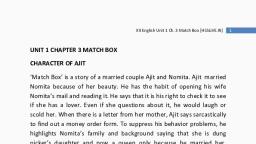
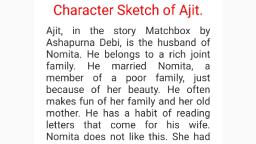
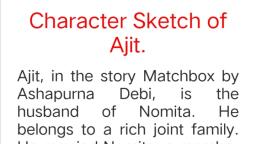
UNIT 1 CHAPTER 3 MATCH BOX, , CHARACTER OF AJIT, , ‘Match Box’ is a story of a married couple Ajit and Nomita. Ajit married, Nomita because of her beauty. He has the habit of opening his wife, Nomita’s mail and reading it. He says that it is his right to check it to see, if she has a lover. Even if she questions about it, he would laugh or, scold her: When there is a letter from her mother, Ajit says sarcastically, to find out a money order form. To suppress his behavior problems, he, highlights Nomita’s family and background saying that she is dung, picker’s daughter and now a queen only because he married her., Though he is from a rich family, his behavior towards Nomita seems not, up to his status. Towards the end of the story, Nomita burns the anchol, of her sari. He was frightened to see it and immediately he puts out the, fire. It s clear that Ajit is of dominating nature outwardly where as he, fears inwardly when Nomita asserts her rights and tries to break the, shackles of her domestic slavery. He is presented here as a man who, , always tries to keep his wife under his control)and thus becomes a, typical male- chauvinist.
Page 2 :
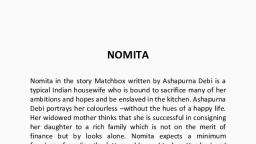
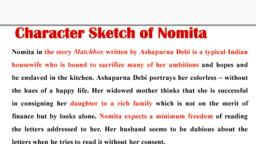
NOMITA, , Nomita in the story Matchbox written by Ashapurna Debi is a, typical Indian housewife who is bound to sacrifice many onthe?, ambitions and hopes and-be-enslaved in the kitchen. Ashapirna, Debi portrays her colourless —without the hues of a happy life., Her widowed mother thinks that she is successful in consigning, her daughter to a rich family which is not on the merit of, finance but by looks alone. Nomita expects a minimum, freedom of reading the letters addressed to her. Her husband, TYSPiCous : ;, seems to be dubious about the letters when he tries to read it, without her consent. It is true what Ashapurna Debi says, about Nomita and women in general that they are like, matchboxes settled at the corners of the house with their, hidden power to explode at any time. Nomita follows the, example of a matchbox and she burns with anger when she is, helpless. To break the shackles of marital slavery she is ready to, kill herself. Again she is depicted as a meek, innocent woman, who smiles infront of others when a volcanoe is burning inside, her. She can tear off the mask of her husband’s large, heastedness, but she doesn’t. Thus she proves to be a, * prototype-of-an Indian woman who is meek as a lamb.
Page 3 :
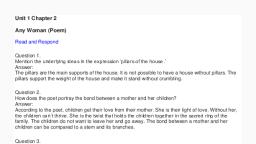
c., L,, , EXPLANATIONS A N vy Wo ™M A N, Take me away , and roof and wall, Would fall to ruin me utterly,’, The woman Proclair ; i, ms that she is the pillars and keystone of the house. If the pillars and, , coalaees tereuer ao family will ruin. The scattering of her family in ture will, . €s state that the identity of the woman and her family are, , complementary or mutually dependent., , 1am the twist that holds together, , The children in its sacred ring., , The twist connects the doors and windows to their frame. If the twist doesn’t function properly,, , it will be difficult to close and open the doors and windows. Just as the twist lets the doors and, , windows move around it smoothly, the woman’s love holds her children in the family sphere., , She knows that as long as her love and care are extended to her children, they will remain in the, , right track., , | spin the curtains, warp and woof, The woman lays the foundation of privacy by spinning curtains warp and woof, whenever and, , where ever necessary. This is an explicit example of allusion, where the woman’s role reminds, the reader of the procedures followed in spinning fabric., , And shake the down to be their bed., An image drawn from animal life states that just like the mother bird shakes its fine feathers to, , prepare bed for its off springs, the mother sacrifices her desires and pleasures for the family,, The self-effacing love of a mother is illustrated in this line., , | am their wall against all danger, , Their door against wind and snow., The terms ‘wall’, ‘door’, ‘wind and snow’ are symbols. The wall offers Protection from dangers., , Wind and snow represent adversities and unfavorable situations in life. Doors can be, conveniently opened or closed as the situation demands. By using these symbols the speaker, , metaphorically declares that she guards the family from probable disasters., , Thou whom a woman laid in a manger, , Take me not till the children grow. ;, Her prayer to Infant Jesus is that she may be granted life on earth.as long as her children need, , her support.The reference is an allusion to the birth of Infant Jesus in.a manger. His mother, Virgin Mary had to suffer lot of hardship to give birth to the redeemer of mankind. The speaker,, knowingly or unknowingly, glorifies motherhood by addressing Infant Jesus as ‘Thou whom a, , woman laid in a manger’., i ssive woman., The closing lines of the poem plot the speaker as a pious, submi
Page 4 :
he Lost, , c, 1., , 25, , EXPLANATIONS, , Take me away , and roof and wall, Would fall to ruin me utterly,’, , The woma, Nn proclaims that she is the pillars and keyst, Keystone arestaken Wa F the howe dh ce stone of the house. If the pillars and, hhaverstuntfiestige sco-whien th , the building will collapse. The pillars and key stone, soo hecores (eneeh En hey support the building erect. When the building collapses, these, tootthen Heke ebris. Similarly it is the woman who gives strength to the family to stay, . If she is taken away,the family will ruin. The scattering of her family in turn will, , anni i i, nnihilate her existence. The lines state that the identity of the woman and her family are, complementary or mutually dependent., , lam the twist that holds together, The children in its sacred ring., , (The twist connects the doors and windows to their rel Gs twist doesn’t function properly,, , O, , 3., , 4, , 5), , 2», , 6., , ut, , it will be difficult to close and open the doors and windows. ust as the twjst lets the doors and, , wl y, windows move around it smoothly, the woman’s love holds her children jin the family sphere:, She knows that as long as her love and care are extended to her children, they will remain in the, right track \, , 1 spin the curtains, warp and woof, ee ae, , tion of p eect by spinning curtains warp and woof, whenever and, , , , The woman lays the foul, , , , onpe i i, here ever necessary i isan explicit éxample of allusion, where the woman’s role reminds, whe : =, , the reader of the procedures followed in spinning fabric. ee, nd. ir bed., , ke the down to be their ao drawn from animal life states that just like the mother bird shakes its fine feathers to, An image d for its off springs, the mother sacrifices her desires and pleasures for the family., , be in this li, prepare love of a mother is illustrated in this line., , elf-effacing, , ata wall against all danger, ; against wind and snow._, Their doer oer door! ‘wind and snow’ are symbols. The wall offers protection from dangers., The terms wal ww represent adversities and unfavorable situations in life. Doors can be, wind and sno’ ened or closed as the situation demands. By using these symbols the speaker, congener OT eclarad that she guards the family from probable disasters.], metaphor woman laid in a manger, Thou es nottill the children grow., Take Dees to Infant Jesus is that she may be granted life on earth as long as her children need, fer aport. The reference is an allusion to the birth of Infant Jesus in a manger. His mother, Virgin Mary had to suffer lot of hardship to give birth to the redeemer of mankind. The speaker,, xnowinglY or unknowingly, glorifies motherhood by addressing Infant Jesus as ‘Thou whom a, woman laid in a manger ., The closing lines of the poem plot the speaker as a pious, submissive woman., , \