Page 1 :
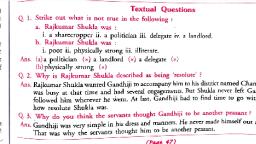
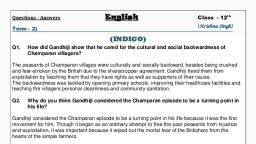
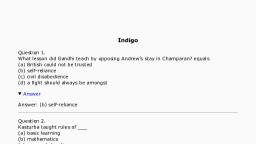
INDIGO, ( Practice questions based on the first part of chapter _ - Meeting between Shukla and Gandhiji, Short answer questions:, 1), 2), 3), 4), 5), 6), 7), 8), , What was the positive quality about Raj Kumar Shukla? How did he benefit from this quality?, How did R.K. Shukla establish that he was resolute?, What was the condition of the peasants before Gandhiji’s arrival in Champaran?, Why did Shukla come to the Congress meeting?, When and where did Gandhi decide ‘to urge the departure of the British’ and why?, How did Shukla succeed in persuading Gandhiji to visit Champaran?, Why did R.K. Shukla want to take Gandhiji to Champaran?, What was the long term contract or agreement that English landlords had made with the, sharecroppers of Champaran? How was it exploitative?, 9) Why did the Indigo planters obtain new agreements from the sharecroppers to pay them, compensation? Why did many sign willingly?, 10) How did even illiterate sharecroppers see through the trick and fraud of the English landlord? Why did, they want their money back?, 11) What did the peasants pay to the British landlords as rent?, 12) Why did the landlords compel the peasants to do as per the terms of a long-term contract?, 13) What did the British planters try to do when they came to know that synthetic Indigo has been, developed by Germany?, 14) Why did Gandhiji go to Lucknow in December 1916? Who met him there and why?, 15) What happened when the British planters ask the peasants for compensation for releasing them from, the 15% agreement?, 16) What did the peasants pay to the British landlord as rent?, 17) How did the invention of German synthetic Indigo affect the peasant-landlord relationship in, Champaran?, 18) Who was Rajkumar Shukla? Why and how did he persuade Gandhiji to come to Champaran?, 19) Why the arrangement between the landlords and sharecroppers was called ‘ancient’?, Very short answer questions:, 1), 2), 3), 4), 5), , “Indigo’ is an excerpt from which book?, When and where was the Annual Convention of Congress held that year?, Why did Gandhiji agree to come to Champaran?, Why was Gandhiji going to Cawnpore?, Where was Gandhiji’s ashram located?, , Objective questions:, 1) The chapter ‘Indigo’ is ____________ of Louis Fischer book., a) a preface, b) the blurb, c) an excerpt, d) the foreword, 2) What does Shukla’s following Gandhiji everywhere reflect about his nature?, a) His shamelessness, b) His Obstinate nature, c) Sheer determination, d) obsequiousness, 3) For how long did Shukla remain with Gandhiji?, a) For few months, b) For a year, c) For few days, d) For several weeks, 4) Why did Shukla come to Congress session?, a) To accompany Gandhiji to go to other parts of India., b) To hire him as a lawyer against the landlord system., c) To receive Gandhiji and take him to Champaran., d) To complain about the injustice faced by farmers.
Page 2 :
5) “Under the ancient arrangement the Champaran peasants were sharecroppers”. Here the purpose, of calling sharecropping an ancient arrangement is to imply that___________., a) Sharecropping does not suit the modern market., b) Sharecropping was adopted very early but now requires a change., c) Sharecropping was an exploitative arrangement., d) Sharecropping had not been beneficial for the peasants., 6) Gandhi told Shukla he had an appointment in Cawnpore and was also committed to go to other, parts of India. Shukla accompanied him everywhere., The given lines show that Shukla was ________________., i) Patient, ii) Irritating, iii) Dominating, iv) Resolute, v) Courageous, a) Only iv, b) i) and iv), c) ii) and iv), d) iv) and v), 7) Rajkumar Shukla’s efforts resulted in Gandhiji’s fight for the farmer’s cause. This showcases that, Shukla was ____________., a) Meticulous and kind, b) Sincere and curious, c) Enterprising and persistent, d) Respectful and congenial., 8) What was the problem from the synthetic Indigo from Germany?, a) It would grow everywhere so no one had to buy it., b) It would create more demand for Indigo from India., c) It would be an extremely expensive type of indigo., d) It would reduce the demand for farm-grown indigo., 9) What can be inferred from the fact that Gandhi had not heard of Champaran district in Bihar?, a) No one he knew lived in that part of the country., b) Champaran was deep in the interior of the country., c) Champaran was unreachable by transport., d) It was at the foothills of the Himalayas., 10) What does ‘a yeoman’ means?, a) a landowner, b) a pacifist, c) a farmer, d) a young man, 11) Which adjectives best suit Gandhiji?, i) impatient, ii) dedicated, iii) clumsy, d) inspirational, a) i) and ii), b) i) and iii), c) II and iv), d) III) and iv), 12)