Notes of Class 12, Education Education Syllabus .pdf - Study Material
Page 1 :
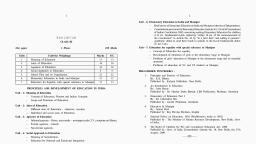
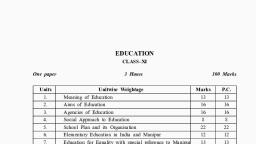
EDUCATION, CLASS–XI, One paper, Units, 1., 2., 3., 4., 5., 6., 7., , 3 Hours, Unitwise Weightage, Meaning of Education, Aims of Education, Agencies of Education, Social Approach to Education, School Plan and its Organisation, Elementary Education in India and Manipur, Education for Equality with special reference to Manipur, , 100 Marks, Marks, 13, 16, 16, 8, 22, 12, 13, , P.C., 13, 16, 16, 8, 22, 12, 13, , PRINCIPLES AND DEVELOPMENT OF EDUCATION IN INDIA, Unit – 1: Meaning of Education, – Concept of Education, Western and Indian Concepts., – Scope and Functions of Education., Unit – 2: Aims of Education, – Different aims of Education – character, vocation., – Individual and social aims of Education., Unit – 3: Agencies of Education, – Informal agencies – Home, mass media – newspaper, radio, T.V., computer and, library,, – Formal agencies – schools., – Non-formal agencies., Unit – 4: Social Approach to Education, – Meaning of Socialization., – Education for National and Emotional Integration., Unit – 5: School Plan and its Organisation, – Physical and human resources : School building and other equipments, teachers’, role in relation to school and society., – Curriculum – concepts, principles of Secondary school curriculum construction, – Co-curricular activities – meaning, objectives, activities and Organisations.
Page 2 :
Unit – 6: Elementary Education in India and Manipur, –, –, , Brief survey of elementary Education in India and Manipur at the time of Independence., Constitutional provisions for Elementary Education (Articles 45, 51A & 86th, Amendment of Indian Constitution 2002 concerning making Elementary Education, for children 6-14 yrs. fundamental rights, replacing “within 10 yrs. of the, commencement of the Constitution” in Article No. 45 by “to a later date” and, adding k) parents’/guardians’ duties to send their wards to schools in the list, of fundamental duties of Art 51A)., Unit – 7: Education for equality with special reference to Manipur, –, –, –, , Concept of Education for equality., Development of education of girls at the elementary stage in Manipur., Problems of girls’ education in Manipur at the elementary stage and its remedial, measures., – Problems of education of SC and ST students in Manipur., PRESCRIBED TEXTBOOKS :, 1., , Principles and Practice of Education, By : K.K. Bhatia, Published by : Kalyani Publishers, New Delhi., , 2., , An Introduction to Education, By : Jotin Borua, Published by : Sri Shaskar Dutta Baruah; LBS Publication, Panbazar, Guwahati., , 3., , Elementary of Education Part I, By : Dr. Lakshahira Das, Published by : Amrita Prakashan, Guwahati., , 4., , Education In Manipur, By : Jamini Devi, Published by : Raj Pravina Brothers, Imphal, , 5., , National Policy on Education, 1986 (Modification made in 1992), Published by : The Ministry of Human Resource Development, New Delhi, Govt., of India., , 6., , The Right of Children for Fee and Compulsory Education Act, 2009, Published by : Govt. of India, Extraordinary Gazette No. 39, New Delhi, the 27th, August, 2009., ——§§§——
Page 3 :
DESIGN OF, QUESTION PAPER, Subject, Class, Full Mark, Time, , I, , :, , EDUCATION, , :, :, :, , XI, 100, 3 Hours, , WEIGHTAGE TO OBJECTIVES, Objectives, Knowledge(K), Understanding (U), Application (A), Total :, , Marks, 20, 50, 30, 100, , Percentage, 20, 50, 30, 100, , WEIGHTAGE TO FORM OF QUESTIONS:, Form of Questions, No. of Question Time (in minute) Marks, Percentage, Essay/Long Answer (E/LA), 4, 91, 32, 32, Short Answer (SA-I), 8, 41, 32, 32, II Short Answer (SA-II), 12, 36, 24, 24, Very Short Answer (VSA), 8, 8, 8, 8, MCQ, 4, 4, 4, 4, Total:, 36, 180, 100, 100, WEIGHTAGE TO CONTENT:, UNIT /CONTENTS :, Marks, Percentage, I., Meaning of Education, 13, 13, II., Aims of Education, 16, 16, III. Agencies of Education, 16, 16, III IV. Social Approach to Education, 8, 8, V, School Plan and its Organization, 22, 22, VI. Elementary Education In India and Manipur, 12, 12, VII. Education for Equality with Special Reference to Manipur, 13, 13, Total:, 100, 100, Nil, IV SCHEME OF SECTIONS :, Internal option may be given in long answer., V SCHEME OF OPTIONS :, DIFFICULTY LEVEL :, Difficulty : 30% marks, VI, Average, : 50% marks, Easy, : 20% marks, Abbreviation :, , K(Knowledge), U(Understanding ), C(Comprehension), Exp.(Expression),, Skill(S), E(Essay Type), SA (Short Answer Type), VSA (Very Short Answer, Type), MCQ(Multiple Choice Question)
Page 4 :
EDUCATION, CLASS XII, One Paper, UNIT, 1., 2., 3., 4., 5., 6., 7., , 3 Hours, CONTENT, Psychology, Physical Basis of Mental Life, Human Growth and Development, Learning, Memory and Forgetting, Instinct and Emotion, Intelligence and Personality, Educational Statistics, , 100 Marks, MARKS, 13, 16, 16, 22, 8, 12, 13, , EDUCATIONAL PSYCHOLOGY AND STATISTICS, Unit 1: Psychology and its Educational Importance., - Meaning of psychology., - Meaning of Educational Psychology., - Application of knowledge of Psychology in Education., Unit 2:, , Physical Basis of Mental Life, - Human nervous system., - Sensation, Perception and formation of concept., , Unit 3: Human Growth and Development, - Infancy, Childhood and Adolescence ., - Need of Adolescent Education., - Heredity and environment and their educational importance., Unit 4:, , Learning, Memory and Forgetting, - Learning-meaning, Learning how to learn and Thorndike’s laws of learning., - Factors influencing learning and their importance, attention, interest., - Memory-meaning and types., - Forgetting, its causes and remedial measures., , Unit 5: Instinct and Emotion, - Meaning of instinct and emotion., - Me. Dougall’s classification of instinct and emotion., - Sublimation of instinct and emotion., Unit 6: Intelligence and Personality., - Meaning of intelligence and personality., - Assessment of intelligence and personality., , P.C., 13, 16, 16, 22, 8, 12, 13
Page 5 :
Unit 7: Educational Statistics., -, , Statistics-meaning and its uses in the field of education., Collection, tabulation and graphic representation of data (Polygon, and Histogram), Measures of Central Tendencies-meaning, calculation of mean,, median and mode and their uses in different situations., , PRESCRIBED TEXTBOOKS:, 1., , Elements of Educational Psychology, By: H.R. Bhatia, Published by: Orient Longman, Calcutta., , 2., , Educational Psychology, By: S.P. Chaube, Published by: Lakshmi Narain Agarwal, Agra.-3, , 3., , The Psychological Foundations of Education, By: Dandekar W.N., Published by: Macmillan India Limited, Madras., , 4., , Statistics in Psychology and Education, By: Henry E. Garrett., Published by: Vakils Feffer and Simons Ltd., Bombay., , 5., , Educational Psychology, By: Kundu C.L. and Tutoo D.N., Published by: Sterling Publishers Pvt. Ltd., New Delhi - 110016, , 6., , A Textbook of Higher Secondary Education for Class XII, By: Joseph Mathew, Published by: Zen Publications, New Delhi - 110049, , 7., , Elements of Education Part - II, By: Dr. Lakshahira Das, Published by: Amrita Prakashan, Guwahati, , 8., , An Introduction to Education, By: Jatin Barua, Published by: Shri Bhaskar Dutta Baruah, LBS Publication, Panbazar, Guwahati., ——§§§——
Page 6 :
DESIGN OF, QUESTION PAPER, Subject, Class, Full Mark, Time, , I, , : EDUCATION, : XII, : 100, : 3 Hours, , WEIGHTAGE TO OBJECTIVES, Objectives, Knowledge(K), Understanding (U), Application (A), Skill (S), Total :, , Marks, 20, 46, 30, 4, 100, , Percentage, 20, 46, 30, 4, 100, , WEIGHTAGE TO FORM OF QUESTIONS:, Form of Questions, No. of Question Time (in minute) Marks, Percentage, Essay/Long Answer (E/LA), 4, 91, 32, 32, Short Answer (SA-I), 8, 41, 32, 32, II Short Answer (SA-II), 12, 36, 24, 24, Very Short Answer (VSA), 8, 8, 8, 8, MCQ, 4, 4, 4, 4, Total:, 36, 180, 100, 100, WEIGHTAGE TO CONTENT:, UNIT /CONTENTS :, Marks, Percentage, I., Psychology, 13, 13, II., Physical Basis of Mental Life, 16, 16, III. Human Growth and Development, 16, 16, III IV. Learning Memory and Forgetting, 22, 22, V, Instinct and Emotion, 8, 8, Intelligence, and, Personality, VI., 12, 12, VII. Educational Statistics, 13, 13, Total:, 100, 100, Nil, IV SCHEME OF SECTIONS :, Internal option may be given in LA type Question only., V SCHEME OF OPTIONS :, DIFFICULTY LEVEL, :, Difficulty : 30% marks, VI, Average : 50% marks, Easy : 20% marks, Abbreviation :, , K(Knowledge), U(Understanding ), C(Comprehension), Exp.(Expression), Skill(S),, E(Essay Type), SA (Short Answer Type), VSA (Very Short Answer Type),, MCQ(Multiple Choice Question)



 Learn better on this topic