Page 2 :
A perfectly competitive market has the following, defining features:, 1. The market consists of a large number of buyers and sellers, 2. Each firm produces and sells a homogenous product. i.e., the, product of one firm cannot be differentiated from the product, of any other firm., 3. Entry into the market as well as exit from the market are free, for firms.
Page 6 :
4.2, • the money received by a firm selling its produced In, , the market, • Total revenue, • Average revenue, • Marginal revenue
Page 7 :
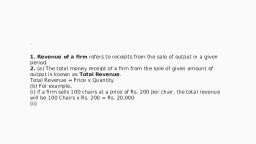
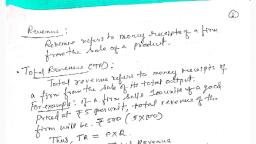
•It referes to total reciepits from the sale of given quantity of, commodity, • (TR) of the firm is defined as the market price of the good (p), multiplied by the firm’s, output (q). Hence,, TR = p × q
Page 8 :
Table 4.1: Total Revenue Curve, , Boxes sold, (Q), 0, 1, 2, 3, 4, 5, , price, (P), 10, 10, 10, 10, 10, 10, , TR, (PxQ), 0, 10, 20, 30, 40, 50, , Total revenue curve : it shows that how the total revenue curve changes as the, quantity sold changes.TR curve is an upward rising straight line its X axis shows the, number of units sold of a good and y axis shows the total revenue earned by the firm
Page 9 :
•The average revenue ( AR ) of a firm is defined as total revenue per unit of, output., • it is obtained by dividing total revenue by number of units sold, , AR=P, In other words, for a price-taking, firm, average revenue equals the, market price.
Page 10 :
• Average revenue Curve-, , **** AR=P, , It is a straight line parallel to x axis it is also, called the price line
Page 11 :
• The marginal revenue (MR) of a firm is defined as the increase in total, revenue for a unit increase in the firm’s output, MR = Δ TR/ΔQ
Page 12 :
UNIT, , PRICE, , TR, , MR, , AR, , 0, , 10, , 0, , -, , -, , 1, , 10, , 10, , 10, , 10, , 2, , 10, , 20, , 10, , 10, , 3, , 10, , 30, , 10, , 10, , 4, , 10, , 40, , 10, , 10, , 5, , 10, , 50, , 10, , 10, , =AR=MR, , ***Hence, AR=P=MR
Page 13 :
Relationship between revenue concept, , REVENUE CONCEPT, , When price remains constant, (under perfect competition), , When price falls with rise in, output, (under Imperfect competition)
Page 14 :
Relationship between AR and MR (when price remains constant), Unit, , Price, , TR, , AR, , MR, , 1, , 5, , 5, , 5, , 5, , 2, , 5, , 10, , 5, , 5, , 3, , 5, , 15, , 5, , 5, , 4, , 5, , 20, , 5, , 5, , 5, , 5, , 25, , 5, , 5
Page 15 :
Relationship between AR and MR (when price remains constant), , **AR=MR
Page 16 :
Relationship between TR and MR (when price remains constant), Unit, , Price, , TR, , AR, , MR, , 1, , 5, , 5, , 5, , 5, , 2, , 5, , 10, , 5, , 5, , 3, , 5, , 15, , 5, , 5, , 4, , 5, , 20, , 5, , 5, , 5, , 5, , 25, , 5, , 5
Page 17 :
Relationship between TR and MR (when price remains constant)
Page 18 :
Relationship between AR and MR (when price falls with rise in output constant), Units, , P, , TR, , AR, , MR, , Ratio of fall, AR:MR, , 1, , 5, , 5, , 5, , 5, , -, , 2, , 4, , 8, , 4, , 3, , 1:2, , 3, , 3, , 9, , 3, , 1, , 1:2, , 4, , 2, , 8, , 2, , -1, , 1:2, , 5, , 1, , 5, , 1, , -3, , 1:2
Page 19 :
Relationship between AR and MR (when price falls with rise in output constant)
Page 20 :
Relationship between TR and MR (when price falls with rise in output constant), , P/AR, , TR, , MR, , 1, , 5, , 5, , 5, , 2, , 4, , 8, , 3, , 3, , 3, , 9, , 1, , 4, , 2.25, , 9, , 0, , 5, , 1, , 5, , -4, , TR &MR, , Output, , 10, , 5, 0, 1, -5, , 2, , TR, , 3, , 4, , MR, , 5