Page 1 :
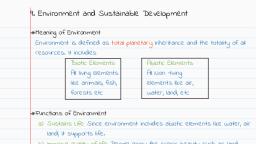
SUSTAINABLE DEVELOPMENT, , [29 January 2022 20:34, , Environment is defined as the total planetary inheritance, and the totality of all resources, , Biotic elements Abiotic elements, , Functions of the Environment, , It supplies resources, , , , Renewable resources are, , , , those which can be used No Le SUNS Se), me: Non-renewable resources are, resource beco: ed those which get exhausted, or exhausted. That is, a with extraction and use, for, continuous supply of the example, fossil fuel., , resource remains available., , Examples of renewable, , resources are the trees in the, forests and the fishes in the, ocean., , (ii) It assimilates waste., (iii) It sustains life by providing genetic and biodiversity., (iv) It also provides aesthetic services like scenery, , Reh nS ae, Absorptive capacity means the ability of the environment to absorb degradation.
Page 2 :
Cie issues such as omnia and ozone depletion also, contribute ed financial commitments for the government, , Eg, , UC, , , , But with population explosion and with the advent of industrial revolution, to meet the growing needs of the expanding population, things changed., , The result was that the demand for resources for both production and, consumption went beyond the rate of regeneration of the resources, , DamodarValley is one of India’s most industrialised, regions. Pollutants from the heavy industries along, the banks of the Damodar river are converting it into, an ecological disaster, , , , 9.2 State of India’s Environment, , 1. The black soil of the Deccan Plateau is particularly suitable, for cultivation of cotton, leading to concentration of textile, industries in this region, , , , 2. The Indo-Gangetic plains - spread from the Arabian Sea to
Page 3 :
the Bay of Bengal — are one of the most fertile, intensively, cultivated, , , , 3. India’s forests, though unevenly distributed, provide, , green cover for a majority of its population and natural cover for, its wildlife, , 4. Large deposits of iron-ore, coal and natural gas are found in the, country. India alone accounts for nearly 20 per cent of the world’s, total iron-ore reserves., , Major Coalfields, of India, www.pmfias.com
Page 4 :
[29 January 2022 22:59, , The most pressing environmental concerns of, India/Challenges to India’s environment, , The threat to India’s environment poses a dichotomy:, , (i) Threat of poverty-induced environmental degradation, , (ii) Threat of pollution from affluence and a rapidly growing, industrial sector, , , , Population Growth, , Wore Land Gaaenca == Technoogeal range, , , , The priority issues identified are:, , 1. Land degradation, , Some of the factors responsible for land degradation, are:, , Q Loss of vegetation occurring due to deforestation, Q Unsustainable fuel wood and fodder extraction, Q. Shifting cultivation
Page 5 :
Q Encroachment into forest lands, , Q Forest fires and over grazing, , Non-adoption of adequate soil conservation, , measures, , Q Improper crop rotation, , Q_ Indiscriminate use of agro-chemicals such as fertilisers and, pesticides, , Q Improper planning and management of irrigation systems, Q Extraction of ground water in excess of the recharge, capacity, , Q Open access resource, , Q Poverty of the agriculture-dependent people, , , , 2. Biodiversity loss, , India supports approximately 17 per cent of the world’s human, and 20 per cent of livestock population on a mere 2.5 per cent, of the world’s geographical area., , The per capita forest land in the country is only 0.08 hectare, against the requirement of 0.47 hectare to meet basic needs., , 3. Soil erosion