Page 2 :
Chapter 2 Sectoral Development, Social Infrastructure, Meaning –Basic activities and services which in addition to achieving, certain social objectives indirectly help different economic activities., Ex : Health ,Education, Housing –Social Overheads, 1. Education:, Human Capital Formation –Role of Education, Education- Acquisition of the art of utilizing knowledge for moral and, mental development.
Page 3 :
Importance of Education, • Modifies human behavior, • Education helps in creation of employment, • Education and GDP, • Quality of labour force –skilled and trained workers, • Promotes scientific outlook, technology and temper, • Good Standard of living, • Generates Sense of National Consciousness
Page 4 :
Development of Education in India, Directive principles of state policy-Free and compulsory education upto 14, years children by 1960, Concurrent list –state and centre responsibility, Ministry of Human Resource Development, 1. Expansion of General Education –, 2-Saakshar Bharat Adult Education- National Adult Education Programme, (NAEP)-1978, National Literacy Mission-1998 recast as Saakshar Bharat in, 2009- National Institute of Open Schooling (NIOS), 3. Vocationalisation of Secondary Education – National policy of Education, 1986 at +2 level, 4. Emphasis on Technical Education –by 11th plan 30 central universities, 8, new IIMS , 10 new NITS , 6 NEW IIMS, 20 NEW IIITS,3 NEW IISER
Page 6 :
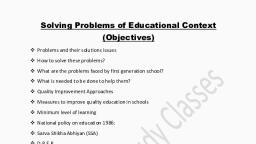
National Policies on Education, 1st National Policy on Education -1968 –, Kothari Commision recommendation -1964, • Free and compulsory education to all upto 14, • Three language formula, • Development of agricultural and Industrial education, • 6% of GDP should be spent on education, New National Policy on Education-1986, 10+2+3 formula, Universalization of primary education, vocationalisation of, secondary education, Specialisation of higher education, UGC was set up in 1956, NCERT AND SCERT
Page 7 :
National Education Policy 2020, • Universalisation of Education from pre school to secondary level, • Expansion of open schooling system, • 5+3+3+4 system instead of 10+2, • Vocational education from class 6
Page 8 :
Health, • Meaning –State of complete physical, mental ,social and spiritual well being, • Development of Health Care System in India, During 1941-51- Death rate-27.4 per 1000 population per annum , IMR-183 per, 1000 people per annum, Life Expectancy 32 years, National Health Programmes:, 1. Malaria – National Malaria Eradication Programmes-1958, 2. Filaria- National Filaria Control Programme- 1955, 3. Smallpox- By 1977 completely eradicated, 4. Tuberculosis (TB)- National TB Control Programme-1997 DOTS technique, 5. Leprosy- National Leprosy Eradication Programme-1983 MDT- Multi Drug, Therapy, 6. AIDS- National AIDS Control Programme (NACP) -1987
Page 10 :
Problems of Health Services in India, 1. Neglect of Rural Area2. Insufficient Outlay for Health-0.9% of GDP, 3.Shortage of Medical Personnel-1999-2000-5.5 DOCTORS PER 10000 population, 4. Social Inequality –, 5. Expensive Health Service6.Medical Research-