Page 1 :
New, syllabus, 2020-21, Chapter 5, , Recursion, , Computer Science, Class XII ( As per CBSE Board), Visit : python.mykvs.in for regular updates
Page 2 :
Recursion, It is a way of programming or coding technique, in which a, function calls itself for one or more times in its body. Usually, it is, returning the return value of this function call procedure. If a, function definition fulfils such conditions, we can call this, function a recursive function., , Visit : python.mykvs.in for regular updates
Page 3 :
Recursion, The Two Laws of Recursion, • Must have a base case - There must be at least one, base criteria/condition, when such condition is met, the function stops calling itself., • Must move toward the base case - The recursive, calls should moves in such a way that each time it, comes closer to the base criteria., , Visit : python.mykvs.in for regular updates
Page 4 :
Recursion, Simple algorithms with recursion, , ALGORITHM, 1.Test if n equal to base, case return 1., 2.If not, then call the, algorithm with n – 1(so, as to move towards base, case), Visit : python.mykvs.in for regular updates
Page 5 :
Recursion, Print a message forever, def hellomessage():, print("hello"), hellomessage(), hellomessage(), , Program explanation, Run this program.it will display ‘hello’, message forever ,because there is no, base case to exit., It call hellomessage() function &, Display ‘hello’, And again call hellomessage(), function., This will call hellomessage() function, forever and will display ‘hello’, continuously, To exit press ctrl+c, , Visit : python.mykvs.in for regular updates
Page 6 :
Recursion, Sum of Natural Numbers Program explanation, Using Recursive Function The input() function takes input from the, user and int() function converts its type to an, def sum(n):, integer as input() return string. Here we call, sum() function and pass the entered number, if n <= 1:, ,which is assigned to n. The base condition, return n, for recursion is defined and if the input, else:, number is less than or equals to 1, the, return n + sum(n-1) number is returned, else we return the same, , num = int(input("Enter a number: ")) function call with number decremented by 1., In this way, the recursive function works in, print("The sum is: ", sum(num)), Python that can calculate the sum of natural, numbers.It works like(suppose we pass 5 in, input, , 5+sum(4)+sum(3)+sum(3)+1, Visit : python.mykvs.in for regular updates
Page 7 :
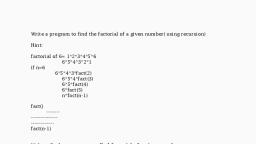
Recursion, Factorial of a Number Using Recursion, , ALGORITHM, 1.Test if n <= 0. If so,, return 1., 2.If not, then call the, factorial algorithm with n, – 1 and multiply the, result by n and return, that value., , (factorial 5), (* 5 (factorial 4)), (* 5 (* 4 (factorial 3))), (* 5 (* 4 (* 3 (factorial 2)))), (* 5 (* 4 (* 3 (* 2 (factorial 1))))), (* 5 (* 4 (* 3 (* 2 1)))), (* 5 (* 4 (* 3 2 ))), (* 5 (* 4 6 )), (* 5 24 )), 120, , Visit : python.mykvs.in for regular updates
Page 8 :
Recursion, Factorial of a Number Using Recursion, , PYTHON PROGRAM, def factorial(x):, if x==1:, return 1, else:, return x*factorial(x-1), f=factorial(5), print ("factorial of 5 is ",f), , (factorial 5), (* 5 (factorial 4)), (* 5 (* 4 (factorial 3))), (* 5 (* 4 (* 3 (factorial 2)))), (* 5 (* 4 (* 3 (* 2 (factorial 1))))), (* 5 (* 4 (* 3 (* 2 1)))), (* 5 (* 4 (* 3 2 ))), (* 5 (* 4 6 )), (* 5 24 )), 120, , Visit : python.mykvs.in for regular updates
Page 9 :
Recursion, Fibonacci numbers Using Recursion, 0, 1, 1, 2, 3, 5, 8, 13, 21, 34, 55, 89, 144, 233, …, , Algorithm, Fib(n), 1. If n =1 or n=2, then, 2. return 1, 3. Else, 4. a = Fib(n-1), 5. b = Fib(n-2), 6. return a+b, Visit : python.mykvs.in for regular updates
Page 10 :
Recursion, Fibonacci numbers Using Recursion, 0, 1, 1, 2, 3, 5, 8, 13, 21, 34, 55, 89, 144, 233, …, , Program, def fib(n):, if n <= 1:, return n, else:, return(fib(n-1) + fib(n-2)), nterms = int(input("enter a number")), if nterms <= 0:, print("Plese enter a positive integer"), else:, print("Fibonacci sequence:"), for i in range(nterms):, print(fib(i)), , Visit : python.mykvs.in for regular updates
Page 11 :
Recursion, Algorithm, , Binary Search Using Recursion, , 1. Find the midpoint of the array; this will be the element, at arr[size/2]. The midpoint divides the array into two, smaller arrays: lower half and upper half, 2. Compare key to arr[midpoint] by calling the user, function cmp_proc., 3. If the key is a match, return arr[midpoint]; otherwise, 4. If the array consists of only one element return NULL,, indicating that there is no match; otherwise, 5. If the key is less than the value extracted from, arr[midpoint] search the lower half of the array by, recursively calling search; otherwise, 6. Search the upper half of the array by recursively calling, search., NOTE:- For binary search all elements must be in order., Visit : python.mykvs.in for regular updates
Page 12 :
Recursion, Binary Search Using Recursion, def binarySearch (arr, first, last, x):, if last >= first:, mid =int( first + (last - first)/2), if arr[mid] == x:, return mid, elif arr[mid] > x:, return binarySearch(arr, first, mid-1, x), else:, return binarySearch(arr, mid+1, last, x), else:, return -1, arr = [ 1,3,5,6,7,8,10,13,14 ], x = 10, result = binarySearch(arr, 0, len(arr)-1, x), if result != -1:, print ("Element is present at index %d" % result), else:, print ("Element is not present in array"), , Visit : python.mykvs.in for regular updates