Page 1 :
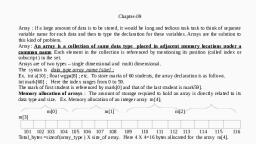
www.ncrtsolutions.in, UNIT-2 DATA STRUCTURES, In Computer Science, a data structure is a particular way of storing and organizing data in a computer so, that it can be used efficiently. Different kinds of data structures are suited to different kinds of, applications, and some are highly specialized to specific tasks. For example, Stacks are used in function, call during execution of a program, while B-trees are particularly well-suited for implementation of, databases. The data structure can be classified into following two types:, Simple Data Structure: These data structures are normally built from primitive data types like integers,, floats, characters. For example arrays and structure., Compound Data Structure: simple data structures can be combined in various ways to form more, complex structure called compound structures. Linked Lists, Stack, Queues and Trees are examples of, compound data structure., Data Structure Arrays, Data structure array is defined as linear sequence of finite number of objects of same type with following, set of operation:, Creating : defining an array of required size, Insertion: addition of a new data element in the in the array, Deletion: removal of a data element from the array, Searching: searching for the specified data from the array, Traversing: processing all the data elements of the array, Sorting : arranging data elements of the array in increasing or decreasing order, Merging : combining elements of two similar types of arrays to form a new array of same type, In C++ an array can be defined as, Datatype arrayname[size];, Where size defines the maximum number of elements can be hold in the array. For example, float b[10];//b is an array which can store maximum 10 float values, int c[5];, Array initialization, void main, {, int b[10]={3,5,7,8,9};//, cout<<b[4]<<endl;, cout<<b[5]<<endl;, }, Output is, 9, 0, In the above example the statement int b[10]={3,5,7,8,9} assigns first 5 elements with the given values, and the rest elements are initialized with 0. Since in C++ index of an array starts from 0 to size-1 so the, expression b[4] denotes the 5th element of the array which is 9 and b[5] denotes 6th element which is, initialized with 0., 3, 5, 7, 8, 9, 0, 0, 0, 0, 0, b[0] b[1] b[2] b[3] b[4] b[5] b[6] b[7] b[8] b[9], Searching, We can use two different search algorithms for searching a specific data from an array, Linear search algorithm, Binary search algorithm, 59, , Material Downloaded From http://www.ncrtsolutions.in
Page 2 :
www.ncrtsolutions.in, Linear search algorithm, In Linear search, each element of the array is compared with the given item to be searched for. This, method continues until the searched item is found or the last item is compared., #include<iostream.h>, int linear_search(int a[], int size, int item, {, int i=0;, whilei<size&& a[i]!=item, i++;, ifi<size, return i;//returns the index number of the item in the array, else, return -1;//given item is not present in the array so it returns -1 since -1 is not a legal index number, }, void main(, {, int b[8]={2,4,5,7,8,9,12,15},size=8;, int item;, cout<<”enter a number to be searched for”;, cin>>item;, int p=linear_search(b, size, item; //searc h item in the array b, ifp== -1), cout<<item<<” is not present in the array”<<endl;, else, cout<<item <<” is present in the array at index no “<<p;, }, In linear search algorithm, if the searched item is the first elements of the array then the loop terminates, after the first comparison best case, if the searched item is the last element of the array then the loop, terminates after size time comparison worst case and if the searched item is middle element of the array, then the loop terminates after size/2 time comparisons (average case. For large size array linear search not, an efficient algorithm but it can be used for unsorted array also., Binary search algorithm, Binary search algorithm is applicable for already sorted array only. In this algorithm, to search for the, given item from the sorted array in ascending order, the item is compared with the middle element of the, array. If the middle element is equal to the item then index of the middle element is returned, otherwise, if, item is less than the middle item then the item is present in first half segment of the array i.e. between 0, to middle-1), so the next iteration will continue for first half only, if the item is larger than the middle, element then the item is present in second half of the array i .e. between middle+1 to size-1), so the next, iteration will continue for second half segment of the array only. The same process continues until either, the item is found search successful or the segment is reduced to the single element and still the item is, not found (search unsuccessful., #include<iostream.h>, int binary_searchint a[ ], int size, int item, {, int first=0,last=size-1,middle;, whilefirst<=last, {, middle=first+last/2;, 60, , Material Downloaded From http://www.ncrtsolutions.in
Page 3 :
www.ncrtsolutions.in, ifitem==a[middle], return middle; // item is found, else ifitem< a[middle], last=middle-1; //item is present in left side of the middle element, else, first=middle+1; // item is present in right side of the middle element, }, return -1; //given item is not present in the array, here, -1 indicates unsuccessful search, }, void main(, {, int b[8]={2,4,5,7,8,9,12,15},size=8;, int item;, cout<<”enter a number to be searched for”;, cin>>item;, int p=binary_search(b, size, item; //search item in the array b, ifp== -1), cout<<item<<” is not present in the array”<<endl;, else, cout<<item <<” is present in the array at index no “<<p;, }, Let us see how this algorithm work for item=12, Initializing first =0 ; last=size-1; where size=8, Iteration 1, A[0] a[1] [2], a[3], a[4] a[5] a[6] a[7], 2, 4, 5, 7, 8, 9, 12, 15, first, , middle, , last, , First=0, last=7, middle=first+last/2=0+7)/2=3 // note integer division 3.5 becomes 3, value of a[middle] i.e. a[3] is 7, 7<12 then first= middle+1 i.e. 3 + 1 =4, iteration 2, A[4] a[5] a[6] a[7], 8, 9, 12, 15, first, , middle, , last, , first=4, last=7, middle=first+last/2=4+7)/2=5, value of a[middle] i.e. a[5] is 9, 9<12 then first=middle+1;5+1=6, iteration 3, a[6], 12, first middle, , a[7], 15, last, , first=6,last=7, , 61, , Material Downloaded From http://www.ncrtsolutions.in
Page 4 :
www.ncrtsolutions.in, middle=first+last/2 = 6+7)/2=6, value of a[middle] i.e. a[6] is 12 which is equal to the value of item being search i.e.12, As a successful search the function binary_search will return to the main function with value 6 as, index of 12 in the given array. In main function p hold the return index number., Note that each iteration of the algorithm divides the given array in to two equal segments and the only one, segment is compared for the search of the given item in the next iteration. For a given array of size N= 2 n, elements, maximum n number of iterations are required to make sure whether the given item is present in, the given array or not, where as the linear requires maximum 2n number of iteration. For example, the, number of iteration required to search an item in the given array of 1000 elements, binary search requires, maximum 10 (as 1000210 iterations where as linear search requires maximum 1000 iterations., Inserting a new element in an array, We can insert a new element in an array in two ways, If the array is unordered, the new element is inserted at the end of the array, If the array is sorted then the new element is added at appropriate position without altering the, order. To achieve this, all elements greater than the new element are shifted. For example, to add, 10 in the given array below:, a[0] a[1] [2] a[3] a[4] a[5] a[6] a[7] a[8], 2, , 4, , a[0] a[1], , 5, [2], , 7, 8, 11, 12, 15, Original array, a[3] a[4] a[5] a[6] a[7] a[8], , 2, 4, 5, 7, 8, 11, 12, 15, Elements greater than 10 shifted to create free place to insert 10, a[0] a[1] [2] a[3] a[4] a[5] a[6] a[7] a[8], 2, , 4, , 5, 7, 8, 10, 11, 12, 15, Array after insertion, Following program implement insertion operation for sorted array, #include<iostream.h>, void insertint a[ ], int &n, int item //n is the number of elements already present in the array, {, int i=n-1;, while (i>=0 && a[i]>item, {, a[i+1]=a[i]; // shift the ith element one position towards right, i--;, }, a[i+1]=item; //insertion of item at appropriate place, n++; //after insertion, number of elements present in the array is increased by 1, }, void main(, {int a[10]={2,4,5,7,8,11,12,15},n=8;, int i=0;, cout<<“Original array is: n”;, fori=0;i<n;i++, cout<<a[i]<<”, “;, inserta,n,10);, cout<<” nArray after inserting 10 is: n”;, 62, , Material Downloaded From http://www.ncrtsolutions.in
Page 5 :
www.ncrtsolutions.in, fori=0; i<n; i++, cout<<a[i]<<”, “;, }, Output is, Original array is:, 2, 4, 5, 7, 8, 11, 12, 15, Array after inserting 10 is:, 2, 4, 5, 7, 8, 10, 11, 12, 15, Deletion of an item from a sorted array, In this algorithm the item to be deleted from the sorted array is searched and if the item is found in the, array then the element is removed and the rest of the elements are shifted one position toward left in the, array to keep the ordered array undisturbed. Deletion operation reduces the number of elements present in, the array by1. For example, to remove 11 from the given array below:, a[0] a[1] [2] a[3] a[4] a[5] a[6] a[7], 2, , 4, , a[0] a[1], 2, , 4, , a[0] a[1], 2, , 5, [2], 5, [2], , 7, 8, 11, 12, 15, Original array, a[3] a[4] a[5] a[6] a[7], 7, 8, 12, 15, Element removed, a[3] a[4] a[5] a[6] a[7], , 4, , 5, 7, 8, 12, 15, Array after shifting the rest element, Following program implement deletion operation for sorted array, #include<iostream.h>, void delete_itemint a[ ], int &n, int item //n is the number of elements already present in the array, {int i=0;, whilei<n && a[i]<item, i++;, if (a[i]==item // given item is found, {while (i<n), {a[i]=a[i+1]; // shift the (i+1)th element one position towards left, i++;, }, cout<<” n Given item is successfully deleted”;, }, else, cout<<” n Given item is not found in the array”;, n--;, }, void main(, {int a[10]={2,4,5,7,8,11,12,15},n=8;, int i=0;, cout<<“Original array is : n”;, fori=0;i<n;i++, cout<<a[i]<<”, “;, delete_itema,n,11;, cout<<” nArray after deleting 11 is: n”;, 63, , Material Downloaded From http://www.ncrtsolutions.in
Page 6 :
www.ncrtsolutions.in, fori=0; i<n; i++, cout<<a[i]<<”, “;, }, Output is, Original array is:, 2, 4, 5, 7, 8, 11, 12, 15, Given item is successfully deleted, Array after deleting 11 is:, 2, 4, 5, 7, 8, 12, 15, Traversal, Processing of all elements i.e. from first element to the last element present in one -dimensional array is, called traversal. For example, printing all elements of an array, finding sum of all elements present in an, array., #include<iostream.h>, void print_arrayint a[ ], int n) //n is the number of elements present in the array, {int i;, cout<<” n Given array is : n”;, fori=0; i<n; i++, cout<<a[i]<<”, “;, }, int sumint a[ ], int n), {int i,s=0;, for i=0; i<n; i++, s=s+a[i];, return s;, }, void main(, {int b[10]={3,5,6,2,8,4,1,12,25,13},n=10;, int i, s;, print_arrayb,n);, s=sumb,n);, cout<<” n Sum of all elements of the given array is : ”<<s;, }, Output is, Given array is, 3, 5, 6, 2, 8, 4, 1, 12, 25, 13, Sum of all elements of the given array is : 79, , Sorting, The process of arranging the array elements in increasing ascending or decreasing descending order is, known as sorting. There are several sorting techniques are available e.g. selection sort, insertion sort,, bubble sort, quick sort, heap short etc. But in CBSE syllabus only selection sort, insertion sort, bubble sort, are specified., Selection Sort, The basic idea of a selection sort is to repeatedly select the smallest element in the remaining unsorted, array and exchange the selected smallest element with the first element of the unsorted array. For, example, consider the following unsorted array to be sorted using selection sort, , 64, , Material Downloaded From http://www.ncrtsolutions.in
Page 7 :
www.ncrtsolutions.in, Original array, 0, 8, iteration 1 :, , Iteration 2:, , 1, 5, , 2, 9, , 3, 3, , 4, 16, , 5, 4, , 6, 7, , Select the smallest element from unsorted array which is 3 and exchange 3 with the first, element of the unsorted array i.e. exchange 3 with 8. After iteration 1 the element 3 is at its, final position in the array., 0, 1, 2, 3, 4, 5, 6, 3, 5, 9, 8, 16, 4, 7, The second pass identify 4 as the smallest element and then exchange 4 with 5, , 0, 1, 2, 3, 4, 5, 6, 3, 4, 9, 8, 16, 5, 7, Iteration 3:, The third pass identify 5 as the smallest element and then exchange 5 with 9, 0, 1, 2, 3, 4, 5, 6, 3, 4, 5, 8, 16, 9, 7, Iteration 4:, The third pass identify 7 as the smallest element and then exchange 7 with 8, 0, 1, 2, 3, 4, 5, 6, 3, 4, 5, 7, 16, 9, 8, Iteration 5:, The third pass identify 8 as the smallest element and then exchange 8 with 16, 0, 1, 2, 3, 4, 5, 6, 3, 4, 5, 7, 8, 9, 16, Iteration 6:, The third pass identify 9 as the smallest element and then exchange 9 with 9 which makes, no effect., 0, 1, 2, 3, 4, 5, 6, 3, 4, 5, 7, 8, 9, 16, The unsorted array with only one element i.e. 16 is already at its appropriate position so no more iteration, is required. Hence to sort n numbers, the number of iterations required is n-1, where in each next iteration,, the number of comparison required to find the smallest element is decreases by 1 as in each pass one, element is selected from the unsorted part of the array and moved at the end of sorted part of the array ., For n=7 the total number of comparison required is calculated as, Pass1: 6 comparisons i.e. (n-1, Pass2: 5 comparisons i.e. (n-2, Pass3: 4 comparisons i.e. (n-3, Pass4: 3 comparisons i.e. (n-4, Pass5: 2 comparisons i.e. (n-5, Pass6: 1 comparison i.e. (n-6=n -n -1), Total comparison for n=n -1)+n -2)+n -3)+ ……….+n -n -1)= n(n -1/2, 7=6+5+4+3+2+1=7*6/2=21;, Note: For given array of n elements, selection sort always executes nn -1)/2 comparison statements, irrespective of whether the input array is already sorted(best case, partially sorted(average case or, totally unsorted(i.e. in reverse orderworst case., #include<iostream.h>, void select_sortint a[ ], int n) //n is the number of elements present in the array, {int i, j, p, small;, fori=0;i< n-1;i++, {small=a[i]; // initialize small with the first element of unsorted part of the array, p=i;, // keep index of the smallest number of unsorted part of the array in p, , 65, , Material Downloaded From http://www.ncrtsolutions.in
Page 8 :
www.ncrtsolutions.in, forj=i+1; j<n; j++ //loop for selecting the smallest element form unsorted array, {ifa[j]<small, {small=a[j];, p=j;, }, }// end of inner loop---------//----------exchange the smallest element with ith element------------a[p]=a[i];, a[i]=small;, //-----------end of exchange------------}, }//end of function, void main( ), {int a[7]={8,5,9,3,16,4,7},n=7,i;, cout<<” n Original array is : n”;, fori=0;i<n;i++, cout<<a[i]<<”, “;, select_sorta,n;, cout<<” nThe sorted array is: n”;, fori=0; i<n; i++, cout<<a[i]<<”, “;, }, Output is, Original array is, 8, 5, 9, 3, 16, 4, 7, The sorted array is, 3, 4, 5, 7, 8, 9, 16, Insertion Sort, Insertion sort algorithm divides the array of n elements in to two subparts, the first subpart contain a[0] to, a[k] elements in sorted order and the second subpart contain a[k+1] to a[n] which are to be sorted. The, algorithm starts with only first element in the sorted subpart because array of one element is itself in, sorted order. In each pass, the first element of the unsorted subpart is removed and is inserted at the, appropriate position in the sorted array so that the sorted array remain in sorted order and hence in each, pass the size of the sorted subpart is increased by 1 and size of unsorted subpart is decreased by 1. This, process continues until all n-1 elements of the unsorted arrays are inserted at their appropriate position in, the sorted array., For example, consider the following unsorted array to be sorted using selection sort, Original array, 0, 1, 2, 3, 4, 5, 6, 8, 5, 9, 3, 16, 4, 7, Sorted, , unsorted, , Initially the sorted subpart contains only one element i.e. 8 and the unsorted subpart contains n-1 elements, where n is the number of elements in the given array., Iteration1:, , To insert first element of the unsorted subpart i.e. 5 into the sorted subpart, 5 is compared, with all elements of the sorted subpart starting from rightmost element to the leftmost, element whose value is greater than 5, shift all elements of the sorted subpart whose value, is greater than 5 one position towards right to create an empty place at the appropriate, , 66, , Material Downloaded From http://www.ncrtsolutions.in
Page 9 :
www.ncrtsolutions.in, position in the sorted array, store 5 at the created empty place, here 8 will move from, position a[0] to a[1] and a[0] is filled by 5. After first pass the status of the array is:, 0, 1, 2, 3, 4, 5, 6, 5, 8, 9, 3, 16, 4, 7, Sorted, Iteration2:, , unsorted, , In second pass 9 is the first element of the unsorted subpart, 9 is compared with 8, since 8, is less than 9 so no shifting takes place and the comparing loop terminates. So the element, 9 is added at the rightmost end of the sorted subpart. After second pass the status of the, array is:, 0, 1, 2, 3, 4, 5, 6, 5, 8, 9, 3, 16, 4, 7, Sorted, , Iteration3:, , unsorted, , in third pass 3 is compared with 9, 8 and 5 and shift them one position towards right and, insert 3 at position a[0]. After third pass the status of the array is:, 0, 1, 2, 3, 4, 5, 6, 3, 5, 8, 9, 16, 4, 7, Sorted, , Iteration4:, , unsorted, , in forth pass 16 is greater than the largest number of the sorted subpart so it remains at the, same position in the array. After fourth pass the status of the array is:, 0, 1, 2, 3, 4, 5, 6, 3, 5, 8, 9, 16, 4, 7, Sorted, , Iteration5:, , unsorted, , in fifth pass 4 is inserted after 3. After third pass the status of the array is:, 0, 1, 2, 3, 4, 5, 6, 3, 4, 5, 8, 9, 16, 7, Sorted, , Iteration6:, , unsorted, , in sixth pass 7 is inserted after 5. After fifth pass the status of the array is:, 0, 1, 2, 3, 4, 5, 6, 3, 4, 5, 7, 8, 9, 16, Sorted, , Insertion sort take advantage of sorted(best case or partially sortedaverage case array because if all, elements are at their right place then in each pass only one comparison is required to make sure that the, element is at its right position. So for n=7 only 6 i.e. n -1) iterations are required and in each iteration only, one comparison is required i.e. total number of comparisons required= n -1)=6 which is better than the, selection sort for sort ed array selection sort required n(n-1)/2 comparisons. Therefore insertion sort is, best suited for sorted or partially sorted arrays., #include<iostream.h>, void insert_sortint a[ ],int n) //n is the no of elements present in the array, {int i, j,p;, for (i=1; i<n; i++, {p=a[i];, j=i-1;, //inner loop to shift all elements of sorted subpart one position towards right, 67, , Material Downloaded From http://www.ncrtsolutions.in
Page 10 :
www.ncrtsolutions.in, whilej>=0&&a[j]>p), {, a[j+1]=a[j];, j--;, }, //---------end of inner loop, a[j+1]=p;, //insert p in the sorted subpart, }, }, void main( ), {, int a[7]={8,5,9,3,16,4,7},n=7,i;, cout<<” n Original array is : n”;, fori=0;i<n;i++, cout<<a[i]<<”, “;, insert_sorta,n);, cout<<” nThe sorted array is: n”;, fori=0; i<n; i++, cout<<a[i]<<”, “;, }, Output is, Original array is, 8, 5, 9, 3, 16, 4, 7, The sorted array is, 3, 4, 5, 7, 8, 9, 16, Bubble Sort, Bubble sort compares a[i] with a[i+1] for all i=0..n-2, if a[i] and a[i+1] are not in ascending order then, exchange a[i] with a[i+1] immediately. After each iteration all elements which are not at their proper, position move at least one position towards their right place in the array. The process continues until all, elements get their proper place in the array i.e. algorithm terminates if no exchange occurs in the last, iteration), For example, consider the following unsorted array to be sorted using selection sort, Original array, 0, 1, 2, 3, 4, 5, 6, 8, 5, 9, 3, 16, 4, 7, Iteration1: The element a[0] i.e. 8 is compared with a[1] i.e. 5, since 8>5 therefore exchange 8 with 5., 0, 1, 2, 3, 4, 5, 6, 5, 8, 9, 3, 16, 4, 7, The element a[1] i.e. 8 and a[2] i.e. 9 are already in ascending order so no exchange required, 0, 1, 2, 3, 4, 5, 6, 5, 8, 9, 3, 16, 4, 7, The element a[2] i.e. 9 and a[3] i.e. 3 are not in ascending order so exchange a[2] with a[3], , 0, 1, 2, 3, 4, 5, 6, 5, 8, 3, 9, 16, 4, 7, The element a[3] i.e. 9 and a[4] i.e. 16 are in ascending order so no exchange required, 68, , Material Downloaded From http://www.ncrtsolutions.in
Page 11 :
www.ncrtsolutions.in, 0, 1, 2, 3, 4, 5, 6, 5, 8, 3, 9, 16, 4, 7, The element a[4] i.e. 16 and a[5] i.e. 4 are not in ascending order so exchange a[4] with a[5], 0, 1, 2, 3, 4, 5, 6, 5, 8, 9, 3, 4, 16, 7, The element a[5] i.e. 16 and a[6] i.e. 7 are not in ascending order so exchange a[5] with a[6], 0, 1, 2, 3, 4, 5, 6, 5, 8, 9, 3, 4, 7, 16, Since in iteration1 some elements were exchanged with each other which shows that array, was not sorted yet, next iteration continues. The algorithm will terminate only if the last, iteration do not process any exchange operation which assure that all elements of the array, are in proper order., Iteration2:, only exchange operations are shown in each pass, 0, 1, 2, 3, 4, 5, 6, 5, 8, 9, 3, 4, 7, 16, 0, 5, , 1, 8, , 2, 3, , 3, 9, , 4, 4, , 5, 7, , 6, 16, , 0, 5, , 1, 8, , 2, 3, , 3, 4, , 4, 9, , 5, 7, , 6, 16, , 0, 1, 2, 3, 4, 5, 6, 5, 8, 3, 4, 7, 9, 16, In iteration 2 some exchange operations were processed, so, at least one more iteration is, required to assure that array is in sorted order., Iteration3:, 0, 5, , 1, 8, , 2, 3, , 3, 4, , 4, 7, , 5, 9, , 6, 16, , 0, 5, , 1, 3, , 2, 8, , 3, 4, , 4, 7, , 5, 9, , 6, 16, , 0, 5, , 1, 3, , 2, 4, , 3, 8, , 4, 7, , 5, 9, , 6, 16, , 0, 5, , 1, 3, , 2, 4, , 3, 7, , 4, 8, , 5, 9, , 6, 16, , 0, 5, , 1, 3, , 2, 4, , 3, 7, , 4, 8, , 5, 9, , 6, 16, , 0, 3, , 1, 5, , 2, 4, , 3, 7, , 4, 8, , 5, 9, , 6, 16, , 0, 3, , 1, 4, , 2, 5, , 3, 7, , 4, 8, , 5, 9, , 6, 16, , Iteration4:, , 69, , Material Downloaded From http://www.ncrtsolutions.in
Page 12 :
www.ncrtsolutions.in, Iteration5:, 0, 1, 2, 3, 4, 5, 6, 3, 4, 5, 7, 8, 9, 16, In iteration 5 no exchange operation executed because all elements are already in proper, order therefore the algorithm will terminate after 5th iteration., Merging of two sorted arrays into third array in sorted order, Algorithm to merge arrays a[m]sorted in ascending order and b[n]sorted in descending order into third, array C[n+m] in ascending order., #include<iostream.h>, Mergeint a[ ], int m, int b[ n], int c[ ]// m is size of array a and n is the size of array b, {int i=0; // i points to the smallest element of the array a which is at index 0, int j=n-1;// j points to the smallest element of the array b which is at the index m-1 since b is, // sortet in descending order, int k=0; //k points to the first element of the array c, whilei<m&&j>=0), {ifa[i]<b[j], c[k++]=a[i++]; // copy from array a into array c and then increment i and k, else, c[k++]=b[j--]; // copy from array b into array c and then decrement j and increment k, }, whilei<m, //copy all remaining elements of array a, c[k++]=a[i++];, whilej>=0), //copy all remaining elements of array b, c[k++]=b[j--];, }, void main(, {int a[5]={2,4,5,6,7},m=5; //a is in ascending order, int b[6]={15,12,4,3,2,1},n=6; //b is in descending order, int c[11];, mergea, m, b, n, c;, cout<<”The merged array is : n”;, forint i=0; i<m+n; i++, cout<<c[i]<”, “;, }, Output is, The merged array is:, 1, 2, 2, 3, 4, 4, 5, 6, 7, 12, 15, Two dimensional arrays, In computing, row-major order and column-major order describe methods for storing multidimensional, arrays in linear memory. Following standard matrix notation, rows are identified by the first index of a, two-dimensional array and columns by the second index. Array layout is critical for correctly passing, arrays between programs written in different languages. Row-major order is used in C, C++; columnmajor order is used in Fortran and MATLAB., Row-major order, In row-major storage, a multidimensional array in linear memory is accessed such that rows are stored one, after the other. When using row-major order, the difference between addresses of array cells in increasing, rows is larger than addresses of cells in increasing columns. For example, consider this 2×3 array:, , 70, , Material Downloaded From http://www.ncrtsolutions.in
Page 13 :
www.ncrtsolutions.in, , An array declared in C as, int A[2][3] = { {1, 2, 3}, {4, 5, 6} };, would be laid out contiguously in linear memory as:, 1 2 3 4 5 6, To traverse this array in the order in which it is laid out in memory, one would use the following nested, loop:, for i = 0; i < 2; i++, for j = 0; j < 3; j++, cout<<A[i][j];, The difference in offset from one column to the next is 1*sizeoftype and from one row to the next is, 3*sizeoftype. The linear offset from the beginning of the array to any given element A[row][column], can then be computed as:, offset = row*NUMCOLS + column, Address of element A[row][column] can be computed as:, Address of A[row][column]=base address of A + (row*NUMCOLS + column* sizeof (type, Where NUMCOLS is the number of columns in the array., The above formula only works when using the C, C++ convention of labeling the first element 0. In other, words, row 1, column 2 in matrix A, would be represented as A[0][1], Note that this technique generalizes, so a 2×2×2 array looks like:, int A[2][2][2] = {{{1,2}, {3,4}}, {{5,6}, {7,8}}};, and the array would be laid out in linear memory as:, 1 2 3 4 5 6 7 8, Example 1., For a given array A[10][20] is stored in the memory along the row with each of its elements occupying 4, bytes. Calculate address of A[3][5] if the base address of array A is 5000., Solution:, For given array A[M][N] where M=Number of rows, N =Number of Columns present in the array, address of A[I][J]= base address+I * N + J*sizeoftype, here M=10, N=20, I=3, J=5, sizeoftype=4 bytes, address of A[3][5], , = 5000 + (3 * 20 + 5) * 4, = 5000 + 65*4=5000+260=5260, , 71, , Material Downloaded From http://www.ncrtsolutions.in
Page 14 :
www.ncrtsolutions.in, Example 2., An array A[50][20] is stored in the memory along the row with each of its elements occupying 8 bytes., Find out the location of A[5][10], if A[4][5] is stored at 4000., Solution:, Calculate base address of A i.e. address of A[0][0], For given array A[M][N] where M=Number of rows, N =Number of Columns present in the array, address of A[I][J]= base address+I * N + J*sizeoftype, here M=50, N=20, sizeoftype=8, I=4, J=5, address of A[4][5], = base address + 4*20 +5)*8, 4000 = base address + 85*8, Base address= 4000-85*8= 4000-680=3320, Now to find address of A[5][10], here M=50, N=20, sizeoftype=8, I=5, J=10, Address of A[5][10] = base address +5*20 + 10)*8, =3320 + 110*8 = 3320+880 = 4200, As C, C++ supports n dimensional arrays along the row, the address calculation formula can be, generalized for n dimensional array as:, For 3 dimentional array A[m][n][p], find address of a[i][j][k]:, Address of a[i][j][k] = base address + ( (I * n + j ) * p + k ) * sizeoftype, For 4 dimentional array A[m][n][p][q], find address of a[i][j][k][l]:, Address of a[i][j][k][l] = base address + ( (I * n + j ) * p + k ) * p + l ) * sizeoftype, Column-major order is a similar method of flattening arrays onto linear memory, but the columns are, listed in sequence. The programming languages Fortran, MATLAB, use column-major ordering. The, array, , if stored contiguously in linear memory with column-major order would look like the following:, 1 4 2 5 3 6, The memory offset could then be computed as:, offset = row + column*NUMROWS, Address of element A[row][column] can be computed as:, Address of A[row][column]=base address of A + (column*NUMROWS +rows* sizeof (type, Where NUMROWS represents the number of rows in the array in this case, 2., Treating a row-major array as a column-major array is the same as transposing it. Because performing a, transpose requires data movement, and is quite difficult to do in-place for non-square matrices, such, transpositions are rarely performed explicitly. For example, software libraries for linear algebra, such as, the BLAS, typically provide options to specify that certain matrices are to be interpreted in transposed, order to avoid the necessity of data movement, 72, , Material Downloaded From http://www.ncrtsolutions.in
Page 15 :
www.ncrtsolutions.in, Example1., For a given array A[10][20] is stored in the memory along the column with each of its elements occupying, 4 bytes. Calculate address of A[3][5] if the base address of array A is 5000., Solution:, For given array A[M][N] where M=Number of rows, N =Number of Columns present in the array, Address of A[I][J]= base address + J * M + I*sizeoftype, here M=10, N=20, I=3, J=5, sizeoftype=4 bytes, Address of A[3][5], , = 5000 + (5 * 10 + 3) * 4, = 5000 + 53*4 = 5000+215 =5215, , Example2., An array A[50][20] is stored in the memory along the column with each of its elements occupying 8 bytes., Find out the location of A[5][10], if A[4][5] is stored at 4000., Solution:, Calculate base address of A i.e. address of A[0][0], For given array A[M][N] where M=Number of rows, N =Number of Columns present in the array, address of A[I][J]= base address+J * M + I*sizeoftype, here M=50, N=20, sizeoftype=8, I=4, J=5, address of A[4][5], = base address + 5 * 50 +4)*8, 4000 = base address + 254*8, Base address= 4000-55*8= 4000-2032=1968, Now to find address of A[5][10], here M=50, N=20, sizeoftype=8, I =5, J=10, Address of A[5][10] = base address +10*50 + 10)*8, =1968 + 510*8 = 1968+4080 = 6048, 4 Marks Questions, 1. Write a function in C++ which accepts an integer array and its size as arguments and replaces elements, having even values with its half and elements having odd values with twice its value, 2. Write a function in C++ which accepts an integer array and its size as argument and exchanges the, value of first half side elements with the second half side elements of the array., Example: If an array of eight elements has initial content as 2,4,1,6,7,9,23,10. The function should, rearrange the array as 7,9,23,10,2,4,1,6., 3. Write a function in c++ to find and display the sum of each row and each column of 2 dimensional, array. Use the array and its size as parameters with int as the data type of the array., 4. Write a function in C++, which accepts an integer array and its size as parameters and rearrange the, array in reverse. Example if an array of five members initially contains the elements as 6,7,8,13,9,19, Then the function should rearrange the array as 19,9,13,8,7,6, 5. Write a function in C++, which accept an integer array and its size as arguments and swap the elements, of every even location with its following odd location. Example : if an array of nine elements initially, contains the elements as 2,4,1,6,5,7,9,23,10 Then the function should rearrange the array as, 4,2,6,1,7,5,23,9,10, 6. Write a function in C++ which accepts an integer array and its size as arguments and replaces elements, having odd values with thrice and elements having even values with twice its value. Example: If an array, of five elements initially contains the elements 3,4,5,16,9, Then the function should rearrange the content of the array as 9,8,15,32,27, , 73, , Material Downloaded From http://www.ncrtsolutions.in
Page 16 :
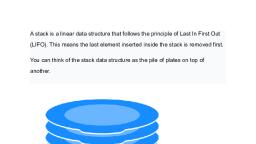
www.ncrtsolutions.in, STACKS, QUEUES AND LINKED LIST, Stack, In computer science, a stack is a last in, first out LIFO) data structure. A stack can is characterized by, only two fundamental operations: push and pop. The push operation adds an item to the top of the stack., The pop operation removes an item from the top of the stack, and returns this value to the caller., A stack is a restricted data structure, because only a small number of operations are performed on it. The, nature of the pop and push operations also mean that stack elements have a natural order. Elements are, removed from the stack in the reverse order to the order of their addition: therefore, the lower elements are, those that have been on the stack the longest. One of the common uses of stack is in function call., , Stack using array, #include<iostream.h>, const int size=5, class stack, {int a[size]; //array a can store maximum 5 item of type int of the stack, int top;, //top will point to the last item pushed onto the stack, public:, stack({top= -1;}, //constructor to create an empty stack, top=-1 indicate that no item is //present in the, array, void push(int item, {Iftop==size -1), cout<<”stack is full, given item cannot be added”;, else, a[++top]=item; //increment top by 1 then item at new position of the top in the array a, }, int pop(, {If (top==-1), {out<<”Stack is empty “;, return -1; //-1 indicates empty stack, }, else, return a[top--];//return the item present at the top of the stack then decrement top by 1, }, void main(, { stack s1;, s1.push(3);, s1.push(5);, cout<<s1.pop(<<endl;, cout<<s1.pop(<<endl;, cout<<s1.pop(;, }, , 74, , Material Downloaded From http://www.ncrtsolutions.in
Page 17 :
www.ncrtsolutions.in, Output is, 5, 3, Stack is empty -1, In the above program the statement stack s1 creates s1 as an empty stack and the constructor initialize top, by -1., Initially stack is empty, stack after s1.push(3), stack after s1.push(5), 4, 4, 4, 3, 3, 3, 2, 2, 2, 1, 1, top, 1, 5, 0, top, 0, 3, 0, 3, top, -1, After first s1.pop( statement, the item 5 is removed from the stack and top moves from 1 to 0, , top, , 4, 3, 2, 1, 0, , 3, , After second s1.pop( statement, the item 3 is removed from stack and top moves from 0 to -1 which, indicates that now stack is empty., 4, 3, 2, 1, 0, top, -1, After third s1.pop( statement the pop function display error message “stack is empty” and returns -1 to, indicating that stack is empty and do not change the position of top of the stack., Linked list, In Computer Science, a linked list or more clearly, "singly -linked list" is a data structure that consists of, a sequence of nodes each of which contains data and a pointer which points i.e., a link to the next node, in the sequence., , A linked list whose nodes contain two fields: an integer value and a link to the next node, The main benefit of a linked list over a conventional array is that the list elements can easily be added or, removed without reallocation or reorganization of the entire structure because the data items need not be, stored contiguously in memory or on disk .Stack using linked lists allow insertion and removal of nodes, only at the position where the pointer top is pointing to., Stack implementation using linked list, #include<iostream.h>, struct node, , 75, , Material Downloaded From http://www.ncrtsolutions.in
Page 18 :
www.ncrtsolutions.in, {, int item; //data that will be stored in each node, node * next; //pointer which contains address of another node, }; //node is a self referential structure which contains reference of another object type node, class stack, {node *top;, public:, stack( //constructor to create an empty stack by initializing top with NULL, { top=NULL; }, void push(int item;, int pop(;, ~stack(;, };, void stack::push(int item //to insert a new node at the top of the stack, {node *t=new node; //dynamic memory allocation for a new object of node type, ift==NULL, cout<<”Memory not available, stack is full”;, else, {t->item=item;, t->next=top; //newly created node will point to the last inserted node or NULL if, //stack is empty, top=t;, //top will point to the newly created node, }, }, int stack::pop(//to delete the last inserted nodewhich is currently pointed by the top), {iftop==NULL, {cout<<”Stack is empty n”;, return 0; // 0 indicating that stack is empty, }, else, {node *t=top; //save the address of top in t, int r=top->item; //store item of the node currently pointed by top, top=top->next; // move top from last node to the second last node, delete t; //remove last node of the stack from memory, return r;, }, }, stack::~stack( //de-allocated all undeleted nodes of the stack when stack goes out of scope, {node *t;, whiletop!=NULL, {t=top;, top=top->next;, delete t;, }, };, void main(, {, 76, , Material Downloaded From http://www.ncrtsolutions.in
Page 19 :
www.ncrtsolutions.in, stack s1;, s1.push(3);, s1.push(5);, s1.push(7);, cout<<s1.pop(<<endl;, cout<<s1.pop(<<endl;, cout<<s1.pop(<<endl;, cout<<s1.pop(<<endl;, }, Output is, 7, 5, 3, Stack is empty 0, In the above program the statement stack s1; invokes the constructor stack( which create an empty stack, object s1 and initialize top with NULL., top, NULL, After statement s1.push(3) the stack become, top, , 3, , NULL, , 3, , NULL, , After statement s1.push(5) the stack become, top, , 5, , After statement s1.push(7) the stack become, top, , 7, , 5, , 3, , NULL, , After the first s1.pop( statement the node currently pointed by top i.e. node containing 7 is deleted from, the stack, after deletion the status of stack is, , top, , 5, , 3, , NULL, , After the second s1.pop( statement the node currently pointe d by top i.e. node containing 5) is deleted, from the stack, after deletion the status of stack is, , top, , 3, , NULL, , After the third s1.pop( statement the node currently pointed by top (i.e. node containing 3) is deleted from, the stack, after deletion the stack become empty i.e., Top, NULL, After the fourth s1.pop( statement, the error message “stack is empty“ displayed and the pop( function, return 0 to indicate that stack is empty., , 77, , Material Downloaded From http://www.ncrtsolutions.in
Page 20 :
www.ncrtsolutions.in, Application of stacks in infix expression to postfix expression conversion, Infix expression, operand1 operator operand2 for example a+b, Postfix expression, operand1 operand2 operator for example ab+, Prefix expression, operator operand1 operand2 for example +ab, Some example of infix expression and their corresponding postfix expression, Infix expression, postfix expression, a*(b-c/e, abc-*e/, a+b)*c -d/e, ab+cd-*e/, a+b*c/d -e+f, abc*+de-/f+, Algorithm to convert infix expression to postfix expression using stack, Let the infix expression INEXP is to be converted in to equivalent postfix expression POSTEXP. The, postfix expression POSTEXP will be constructed from left to right using the operands and operators, except ““, and “” from INEXP. The algorithm begins by pushing a left parenthesis onto the empt y, stack, adding a right parenthesis at the end of INEXP, and initializing POSTEXP with null. The algorithm, terminates when stack become empty., The algorithm contains following steps, 1., 2., 3., 4., 5., 6., , Initialize POSTEXP with null, Add ‘’ at the end of INEXP, Create an empty stack and push ‘‘ on to the stack, Initialize i=0,j=0, Do while stack is not empty, If INEXP[i] is an operand then, POSTEXP[j]=INEXP[i], I=i+1, j=j+1, Goto step 5, 7. If INEXP[i] is ‘‘ then, push (INEXP[i], i=i+1, Goto step 5, 8. If INEXP[i] is an operator then, While precedence of the operator at the top of the stack > precedence of operator, POSTEXP[j]=pop(, J=j+1, End of while, Push (INEXP[i], I=i+1, Goto step 5, 9. If INEXP[i] is ‘’ then, While the operator at the top of the stack is not ‘‘, POSTEXP[j]=pop(, J=j+1, End while, Pop(, 10. End of step 5, 11. End algorithm, For example convert the infix expression A+B*(C -D)/E into postfix expression showing stack status, after every step., 78, , Material Downloaded From http://www.ncrtsolutions.in
Page 21 :
www.ncrtsolutions.in, Symbol scanned from infix, , A, +, B, *, C, D, /, E, , Stack status, bold letter, shows the top of the stack), , +, +, *, *, *, *( *( *, /, /, , Postfix expression, , A, A, AB, AB+, AB+, AB+, AB+C, AB+C, AB+CD, AB+CDAB+CD-*, AB+CD-*E, AB+CD-*E/, , Answer: Postfix expression of A+B*(C -D)/E is AB+CD-*E/, Evaluation of Postfix expression using Stack, Algorithm to evaluate a postfix expression P., 1. Create an empty stack, 2. i=0, 3. while P[i] != NULL, if P[i] is operand then, Push(P[i], I=i+1, Else if P[i] is a operator then, Operand2=pop(, Operand1=pop(, Push (Operand1 operator Operator2, End if, 4. End of while, 5. return pop( // return the calculated value which available in the stack., End of algorithm, Example: Evaluate the following postfix expression showing stack status after every step, 8, 2, +, 5, 3, -, *, 4 /, , 79, , Material Downloaded From http://www.ncrtsolutions.in
Page 22 :
www.ncrtsolutions.in, token scanned from Stack status bold letter shows the top of the, postfix expression, stack) after processing the scanned token, 8, 8, 2, 8, 2, +, 10, , 5, 3, -, , 10, 5, 10, 5, 3, 10, 2, , *, , 20, , 4, /, , 20, 4, 5, , NULL, , Final result 5, , Operation performed, Push 8, Push 2, Op2=pop( i.e 2, Op1=pop( i.e 8, Push(op1+op2) i.e. 8+2, Push(5), Push(3), Op2=pop( i.e. 3, Op1=pop( i.e. 5, Push(op1-op2) i.e. 5-3, Op2=pop( i.e. 2, Op1=pop( i.e. 10, Push(op1-op2) i.e. 10*2, Push 4, Op2=pop( i.e. 4, Op1=pop( i.e. 20, Push(op1/op2) i.e. 20/4, Pop 5 and return 5, , Evaluate the following Boolean postfix expression showing stack status after every step, True, False, True, AND, OR, False, NOT, AND, token scanned Stack status bold letter, from, postfix shows the top of the, expression, stack) after processing, the scanned token, True, True, False, True, False, True, True, False, True, AND, True, False, , OR, , True, , False, NOT, , True, False, True, True, , AND, , True, , NULL, , Final result True, , Operation performed, , Push True, Push False, Push True, Op2=pop( i.e. True, Op1=pop( i.e. False, Push(Op2 AND Op1) i.e. False AND, True=False, Op2=pop( i.e. False, Op1=pop( i.e. True, Push(Op2 OR Op1) i.e. True OR False=True, Push False, Op1=pop( i.e. False, Push(NOT False i.e. NOT False=True, Op2=pop( i.e. True, Op1=pop( i.e. True, Push(Op2 AND Op1 i.e. True AND, True=True, Pop True and Return True, , 80, , Material Downloaded From http://www.ncrtsolutions.in
Page 24 :
www.ncrtsolutions.in, After execution of the statement q1.addQ3), status of queue is, Front, a[0] a[1] a[2] a[3] a[4], 3, Rear, After execution of the statement q1.addQ5), status of queue is, Front, a[0] a[1] a[2] a[3] a[4], 3, 5, Rear, After execution of the statement q1.addQ7), status of queue is, Front, a[0] a[1] a[2] a[3] a[4], 3, 5, 7, Rear, After execution of the first cout<<q1.delQ statement, 3 is deleted from queue status of queue is, Front, a[0] a[1] a[2] a[3] a[4], 3, 5, 7, Rear, After execution of the second cout<<q1.delQ statement, 5 is deleted from the queue status of queue is, Front, a[0] a[1] a[2] a[3] a[4], 3, 5, 7, Rear, After execution of the third cout<<q1.delQ statement, 7 is deleted from the queue. The status of queue is, empty, Front, a[0] a[1] a[2] a[3] A[4], 3, 5, 7, , After execution of the fourth cout<<q1.delQ, status of queue is, , Rear, statement, the message “queue is empty“ displayed and, Front, , a[0] a[1] a[2] a[3] a[4], 3, 5, 7, Rear, Note that since rear and front moves only in one direction therefore once the rear cross the last element of, the arrayi.e. rear==size then even after deleting some element of queue the free spaces available in queue, cannot be allocated again and the function delQ display error message “queue is full”., 82, , Material Downloaded From http://www.ncrtsolutions.in
Page 26 :
www.ncrtsolutions.in, Output is, 3, 5, 7, Queue is empty 0, In the above program the statement queue q1; invokes the constructor queue which create an empty, queue object q1 and initialize front and rear with NULL., front, NULL, rear, After statement q1.addQ3) the stack become, front, NULL, , 3, rear, After statement q1.addQ(5) the stack become, front, 5, , 3, , NULL, , rear, After statement q1.addQ(7) the stack become, front, 3, , NULL, , 7, , 5, , rear, After the first q1.delQ( statemen t the node currently pointed by front i.e. node containing 3) is deleted, from the queue, after deletion the status of queue is, front, 5, , 7, , NULL, , rear, After the second q1.delQ statement the node currently poi nted by front i.e. node containing 5) is deleted, from the queue, after deletion the status of queue is, front, NULL, 7, rear, After the third q1.delQ statement the node currently pointed by front i.e. node containing 7) is deleted, from the queue, after deletion the queue become empty therefore NULL is a assigned to both rear and, front, Front=rear= NULL ;, After the fourth q1.delQ( statement, the error message “queue is empty“ displayed and the pop( function, return 0 to indicate that queue is empty., , 84, , Material Downloaded From http://www.ncrtsolutions.in
Page 28 :
www.ncrtsolutions.in, 2,3 & 4 Marks Practice Questions, 1., , Convert the following infix expressions to postfix expressions using stack, 1. A + (B * C ^ D – E / F – G), 2. A * B / C * D ^ E * G / H, 3. A*B -C_D)*E/F*G, , 2, , 2. Evaluate the following postfix expression E given below; show the contents of the stack during the, evaluation, 1. E= 5,9,+2,/,4,1,1,3,_,*,+, 2, 2. E= 80,35,20,-,25,5,+,-,*, 3. E= 30,5,2,^,12,6,/,+,4. E=15, 3, 2, +, /, 7, + 2, *, 3. An array A[40][10] is stored in the memory along the column with each element occupying 4 bytes., Find out the address of the location A[3][6] if the location A[30][10] is stored at the address 9000. 3, 4 Define functions in C++ to perform a PUSH and POP operation in a dynamically allocated stack, considering the following :, 4, struct Node, { int X,Y;, Node *Link; };, class STACK, { Node * Top;, public:, STACK( ) { TOP=NULL;}, void PUSH( );, void POP );, ~STACK( );, };, 5. Write a function in C++ to perform a Add and Delete operation in a dynamically allocated Queue, considering the following:, 4, struct node, { int empno ;char name[20] ;float sal ;, Node *Link;, };, , 86, , Material Downloaded From http://www.ncrtsolutions.in