Notes of Class XII (2021-22), Commercial Art Rajasthani school of Art - Study Material
Page 1 :
, , Unit-1
Page 2 :
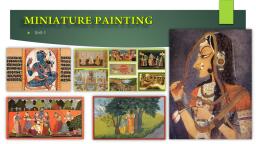
, , , , India has been very well known for several of its traditions, artistic and cultural, heritage. The Jain and Buddhist traditions of painting are the roots from which, many branches of Indian art have developed. Indian miniatures from ages have, also been a source of joy millions of people all over the world., Any painting done in small size, in any medium and on any surface is called a, miniature painting. Earlier these painting were made on palm leaf (Tad patra, /bhoj patra) a piece of cloth, a piece of leather or ivory and later on hand made, paper. The miniature painting is mostly presented with minor details. It may be a, portrait an illustration of a story or a scene from daily life. From medieval period, onward, we find a strong tradition of miniature painting in different schools of, painting.
Page 3 :
PALA SCHOOL/EASTERN SCHOOL OF BENGAL, BIHAR AND ORISSA, (750 A.D. to the middle of the 12th century):, , The Pala painting got its name after the kings Dharam Pal and Dev Pal while their chief artists, were Dhiman and his son Vittapal. It resembles the ideal forms of contemporary bronze and, stone sculptures of Pala and Sena, and reflects some feelings of the classical art of Ajanta., Paintings are characterised by mostly sava-chasma' faces, curvy black outlines, bright colours,, simple compositions and graceful figures., Ellora and Ajanta, the great centres of Buddhist learning and art saw the greatest masterpieces of art, like murals and frescoes. After this, the Buddhist monasteries (maha viharas) of Nalanda, Vikramsila, and Somarupa witnessed a great phase of Buddhism and Buddhist art in India. A large number of, manuscripts on palm leaves relating to Buddhist themes were written and illustrated with images of, Buddhist deities under the patronage of the ruling Pala kings these centres., A fine example of a typical Buddhist palm-leaf manuscript illustrated in Pala style is Astasahasrika, Prajnaparamita, a manuscript of Mahayana Buddhism written in eight thousand lines. The manuscript, has illustrations on six folios (of size 22 12 x 2 12 each) and also on the inside and outside of two, wooden covers. The writing was done after leaving space in the middle for painting. thereafter it was, sent to painters for illustrations.
Page 4 :
(Later half of the 10 century to the 16 century):, , The motivating force for the artistic activity in Western, India was Jainism that was patronised by the Kings of, Chalukya Dynasty who ruled Gujarat, parts of Rajasthan, and Malwa. The oldest paintings of this school are of Tirthankaras – Parsvanath, Neminath and, Rishabhnath. Twenty Tirthankaras were painted in these manuscripts which are available in the Jain, libraries found at many places in Western India., The illustrations on these manuscripts are in a unique style of strong distortion. One finds in this style an, exaggeration of certain physical traits for instance - eyes, breasts and hips are enlarged. Figures are flat, with the angularity of features and the further eye protruding into space. This is an art of primitive vitality,, vigorous line and forceful colours., From about 1100 to 1400 A.D. palm leaf was used for the manuscripts and later on paper was introduced for the, purpose. Two very popular, influential and moralizing Jain texts that were repeatedly written and illustrated with, paintings are :, 1. The Kalpasutra (The Book of Ritual), , 2. The Kalakacharya-Katha, Story of the Teacher Kalaka.
Page 5 :
The Kalpa-Sutra illustrations of Mandu (in the Malwa region of Madhya, Pradesh) mark the initial phase of the miniature/manuscript art in central, India as early as the 11th-12th century., Being in central India, Mandu was influenced by art from all directions - Jain, manuscripts of Gujarat, Muslim elements of Jaunpur and Awadh from the east,, Rajput art of the North and Deccan style from the south. In the 15 century,, Mandu was ruled by the Khalji dynasty under which we see the Persian, influence in Nimat-Nama . Later when it was ruled by Sultan Baz bahadur,, Ragmala series, Laur Chanda and Chaurpanchshikha series became, subjects due to the rulers' inclination for secular and romantic themes., , , , , Large protruding eyes, angular faces, men and women of moderate, height, plenty of motifs and a large amount of gold characterise these, Kalpa-Sutra paintings., , , , In Malwa (M.P) in Central India, the art of miniature painting was pioneered, at Dhar, Ujjain, Narsinghpur and Narsinghgarh in the 16th century., , , , The subjects were Ragamala, Ramayana, Bhagavata-Purana, etc. The, main feature is their frequent narrative depiction of themes in small, compartments on a small area. Bright basic colours, a blend of folk elements, and highly charged faces are the other features of Malwa miniatures., , Jain monk preaching to a king, Jain style, circa 1500-25 A.D.,, National Museum, New Delhi, , Rama & golden deer Maricha, Malwa, circa 1634-40 A.D., , Krishna stealing butter and other Krishnalila scenes,, Malwa, circa 1680 A.D.
Page 8 :
, , 1. Diverse Sub-matter: The themes of the paintings were primarily, the following three:, (i) Religious paintings: Ramayana, Mahabharata, Radha-Krishn,, Bhagwat Puran, Durga etc., , (ii) Literary Paintings: Other than the above subjects inspired from, Indian epics, devotional poetry, romantic poetry and Indian, music were also their themes, Bhakti Sagar, Riti Kavya, Geet, Govind, Sursagar, Ragmala, Rasik- Priya, Ramchandrika,, Nayak-Nayika Bheda, Barahmasa, Panchtantra are the, examples of the illustrated literary themes., (iii) General : Court scenes, Battle scenes, portraits, night scenes,, general life have been beautifully painted in Rajasthan schools., , , 2. Linear Beauty: Since this art developed from western and, Central Indian schools, bold lines are apparent in the initial, phases. Later line became thin, rhythmic, soft and graceful in all, sub-schools of Rajasthan.
Page 9 :
, , 3. Colour Scheme : The main colours used are the primary colours, (red, yellow & blue), green, brown and white. Other colours in use, are golden and silver., , , , 4. Costumes : Females are wearing Lehanga and Choli with, Transparent Dupatta. Males are wearing turbans and Jhoba (a, group of threads), pyjama and Patka., , , , 5. Facial features : Faces are full of emotions and feelings according, to the mood. The faces are in profile, elongated and oval. Face and, neck are long with high sloping forehead. long and pointed nose,, swelling out lips and pointed chin., , , , 6. Depiction of women : The women of Rajasthani School are very, impressive. Women bodies are slim, flexible and tall like creepers., Eyes are like lotus and eyebrows are the shape of a bow., , , , 7. Depiction of Nature: Nature has also been depicted very, beautifully. Different types of trees, floral trees, mountains, water, springs and lakes have been depicted in a very attractive manner.
Page 10 :
, , , 1. Diversity in themes e.g., scenes of any activity related to Religion. Social, Court, hunting, Nayak and Nayaka Bheda, Season (Barahamasa),Rag Ragni etc., 2. The powerful and rhythmic lines of this school are from old traditional Indian Art., , , , 3. Glowing colours in deep harmonious contrast., , , , 4. Variety of costumes of male and female of Rajasthan region., , , , 5. Inspired from Indian epics, devotional poetry (Bhakti Sagar), Romantic poetry, (Riti Kavya) and Indian music., , , , 6. Human faces are shown from different angles., , , , 7. Female figures are frequently painted., , , , 8. Mostly faces are profile (side pose)., , , , 9. Classification of feminine charm in different modes and moods. 10. Some large, paintings and wall paintings are only at Kishangarh, Kota,Bundi and Bikaner.
Page 12 :
, , Mewar school flourished under the patronage of Rajput kings in a completely, indigenous folk style. This School attained its height during the reign of, Maharaja Jagat Singh (1628-1652). Sahibdin, a court painter of Mewar and, Manohar, an artist from Mandu were noted painters of this school. Sahibdin, Painted “Nayak-Nayika Bheda”, Bhagwat purana and series of “Ragmala”, paintings. he also painted the themes from social and cultural life and, transform paintings from Mewar paintings from primitive folk style into, sophisticated style., , , , FEATURES OF MEWAR SCHOOL :, 1. The larger number of painting in this style is cantered around Krishna Bhakti, cult. The costumes prevailing at the period, village life, senses from Rajput court,, marriage processions songs and dances, inner life of the places but battle, scenes have also been painted., 2. Bright and brilliant colours have been profusely used., 3. Male and female figure have long nose, oval shaped faces, elongated fish, like eyes. the males use loose fitting garments. embroidered Pataka and, turbans and females use loose long skirts. choli and transparent odhani, (veils) The female figure have been drawn relatively smaller than the male.
Page 13 :
❑, , Bundi school developed in Kota, Bundi and Jhalmar in the, beginning of 17th century A.D. under the reign of raja ram, Singh and Raja Arjun Singh. This school reached its climax in the middle, of 18th century A.D. in the beginning this school had the effect of, Mughal and Mewar school. Later on, it came as an independent school., , ❑ In this school the nature has been depicted in real form. Red brown complexion, is its special quality of Bundi school. They had round faces, long chin and eyes, like lotus petals. The female faces are shown soft and smiling. Light and shade, shown near the eyes, shows depth. The male figures are shown healthy, strong, courageous. The ladies are painted in lehenga, choli and Ghaghara., ❑ The favourite themes of this school are Ragmala, Barahmasa and Rasikpriya. Lord, Krishna is painted in blue colour. Later on, the complexion of human face is, replaced by flesh pink orange colour. Bright colours like orange and green are, almost only used in proper proportion. Gold and silver colours have also been, used. Red color sky and lotus pond with bird are the special style of Bundi school., The main painters are Dondia, Surjanmal, Ahmed Ali, Ramlal and Utkalram.
Page 14 :
❑, , Rathore clan of Rajput of central India, Rao Jodha founded jodhpur in, 1459. Initially jodhpur painter paint in Jain style. Jodhpur style developed, during (1760-1780) A.D. in the reign of Vijay Singh., , ❑ The soft and rhythmic lines and jewel like color composition excelled this style as, a separate sub school of Rajasthani miniature. The relative size of jodhpur, miniature art is bigger than that of others. This school reached its climax during, the reign of man Singh (1803-1843) A.D. a series of 121 paintings painted in, 1802 A.D. based on “Dhola and Marwani” ballad are assets of this school., , ❑ FEATURES OF JODHPUR SCHOOL :, 1. Female figures are tall, trees tied up high in a knot and have high forehead. The heads are smaller, compression in to the body, Eyes are starched to the ear in the shape of wagtail. Nose are sharp like, the beak of parrot, waists are slim, Breast and buttocks are heavy and legs are long. The mustache and, side burns of the male are spectacular., 2. Jodhpur painting are somewhat larger than other miniatures., 3. Female figures are somewhat shorter than compression to males., 4. The pavilions are white and large. There are massed twisted clouds in the sky and a dense grove of, trees in the back ground.
Page 15 :
❑, , Bikaner school developed under the patronage of Rathore clan of Rajput, kings, like Raja Rai Singh, Raja Karan Singh and Raja Anup Singh after 17th, century A.D. with a high Mughal character. In 1750A.D. Bikaner accepted, Mughal sovereignty and a large number of artists from Aurangzeb’s court, migrated to Bikaner. Ustad Hamid Ruknuddin, a famous painter was one of, them. He illustrated themes of Rasikpriya and Bhagwat purana in this style., He was also expert in painting female figure and portraiture. Other famous, artists were Hasan Raza, Nooruddin etc. Bikaner school reached its climax, during the reign of raja Anup Singh. The best form of these miniature can be, seen in the illustrations of Barahmasa and Ragmala., , ❑ FEATURES OF BIKANER SCHOOL :, 1. Main theme of Bikaner paintings is based on Ramayana, Mahabharat,, Lord Krishna, Ragmala and other love scenes of Radha and Krishna ., 2. In human figures, a little tight lip is painted, eyes are half open chin, small wrist are very thin. Mustaches of men, a little downward bent., Ghaghra of the women are decorated with diagonal strips., 3. Clouds are painted in special circular style., 4. Hunting scenes have also been beautifully depicted.
Page 16 :
❑, , A very small estate Kishangarh is surrounded by Jodhpur, Shahpur, and Ajmer. This estate was inherited by raja Kishan Singh in 1609, A.D., the eighth son of Raja Udai Singh of jodhpur. The credit of, flourishing this school goes to its scholar raja Sawant Singh, (1748-1757). He himself was a great poet, critic, artist and, musician. He wrote 76 books under his pen name Nagari Das., Being the follower of Vallabh sect he was devotee of lord Krishna., He fell in love with an extraordinarily beautiful maid servant, named Bani Thani. In his poems, he described Bani Thani as, Radha.it was the heavenly beauty of Bani Thani which inspired, the painters of kishangarh to paint Radha most beautifully. The, most famous artist of this school is Nihalchand whose painting, Bani-thani is supposed to represent kishangarh school. He was a, court painter of Raja Sawant Singh. Some artist of kishsngarh, school are Amirchnd, Surdhwaj, Bhawani das etc.
Page 17 :
❑ FEATURES OF KISHANGARH SCHOOL :, 1. Subject matter in kishangarh Schools widely varied. Hunting, scenes, court scenes, portraits of kings, Nawabs, emperors, and, saints have been beautifully painted., 2. The picture are romantic life of Radha and Krishna described in GeetGovind, stories from Bhagwat purana, scenes from Bihari Chandrika, and Nayak nayika Bheda are main subjects of Kishangarh paintings., 3. Female figures are made Slim, flexible and tall like creepers. Face, are long with high and sloping foreheads. Pointed long nose bulging, out well-cut-lips. long chins the long-drawn eyes curved upward in, the shape “KHANJAN PKSHI” and bow like eyebrows have been, beautifully painted. Long neck, long fingers, a lock of hanging near, the ear enhance their aesthetic beauty., 4. Mostly primary colours have been applied., 5. Horizon and Sky are replaced by creepers and foliages.
Page 18 :
❑, , Raja Sawai Jai Singh (1693-1793) A.D. established Jaipur kingdom in a, properly planned manner. The rulers of Jaipur were great lover of art and, patronized paintings. Jaipur was he first Rajasthani kingdom which, allowed Mughals in Rajasthan that caused Mughals influence on, Rajasthani art and architecture by strong mutual and cultural exchange., Initially, Mughal impact dominated this indigenous art style. But later on,, in late 18th century A.D., the Rajasthani style dominated the Mughal style, under the personal inspiration of Jaipur kings so the birth of Jaipur school., Jaipur school has the special place in the history due to its originality., Jaipur school reached its climax during the reign of raja Pratap Singh, (1779-1803) A.D. He was a great lover of art and a devotee of Krishna., , ❑ FEATURES OF JAIPUR SCHOOL :, 1. In the painting of Jaipur, there is a grace in the use of colours and lines., There is the expression of different postures., 2. The face of women is round. figure is in medium size; eyes are large and elongated with an upward curve., 3. The male figures have a robust body, round nose, and hair reaching up to the ear. The men wear loose, Payzamas and turban studded with diamonds. Ghaghara od women are painted with dark colours., 4. Jaipur paintings have ornamented borders., 5. Light and shades has been used properly.
Page 22 :
, , , , , , This is a horizontal painting in which, two princesses are playing polo whit their four maids., , DESCRIPTION :
Page 23 :
, , , , , , , DESCRIPTION : This painting is divided in two parts. the artists seem to have, slightly change the episode. The upper parts of the painting relate to the first part, of the episode, though with some change. Krishna is alone on the swing. he has his eyes fixed on Radha who is sitting, on the porch, or on terrace. Radha too is looking at Krishna. thus, ego of both ends obstructs union and offends both., in the, lower part Krishna is seen sitting inside one bower and Radha inside the other. the eyes and faces of both, betray grief and pain. From the action of Gopi’s hands, she appears to assert that being male and the mightier he is, expected to have a broader, wider and more liberal mind and a greater responsibility towards Radha., This painting reflects the folk art elements whereas in its fine draughtsmanship technical execution and use of softer, tones of colours, lines are thin and sharp. Krishna is wearing a crown and ornaments. At the back of Krishna and, Radha there is a round pillow. White colour is used for ornaments.
Page 25 :
This painting is based on the court dancer of king Sawant Singh of kishangarh named, Bani Thani. the king was great devotee of Radha and Krishna, he gave the name to this court dancer., , DESCRIPTION : This is one of the most well-known paintings of Rajasthani art of Kishangarh., Nihal Chand’s painting Radha of kishangarh or Bani Thani which means well turned out. Her, face is elongated with high sloping forehead, pointed and long nose and bulging out well cut, lips and pointed chin her long black tresses are flowing down from her shoulders to her waist., Long tapering fingers of her right hand are delicately holding the edge of the transparent, odhahni. in her left hand there are two lotus buds of pink and white colour which she is, holding with her delicate fingers. Odhani is decorated with golden motifs. her dress and, jewellery reflect the taste and the costumes of the contemporary Rajput royalty. she is wearing, a white pearl necklace around her neck., The background is painted in deep blue colour. lines are very sharp and thin . It is believed, that Nihal Chand used Bani Thani the court dancer as his model for Radha. her body I, painted in peach colour. This painting has beautiful colour scheme. on the whole the, painting is very beautiful.
Page 26 :
, , , , , , , DESCRIPTION : The theme of this painting has been taken from Ramayana, here Ram’s brother Bharat has come to, meet Rama along with his three mother and guru Vashishth . Green colour has been used in different shades. The, use of green colours is the highlight of the painting. Green banana trees have been shown behind the huts., Rama has been shown in different postures like bowing downwards for touching the feet of guru, folding his hand in, front of guru Vashishath etc. There are total 49 figures in this painting. Rama, Laxman their mother’s guru Vashishtha, have been shown many times. Some ladies have also been shown sitting in profile pose in the foreground. Almost 9, scenes are painted in a one painting . Stream, red and white lotus flower has been shown. By observing the painting, one feels that the painter in successful in depicting the subject matter every character in the painting seems to be, familiar to the observes so the subject matter is justified .In this painting 49 human figure have been wonderfully, depicted in nine different groups.



 Learn better on this topic