Page 1 :
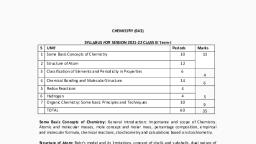
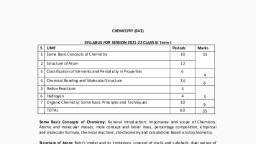
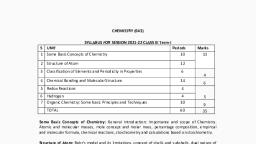
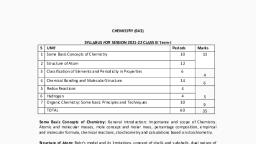
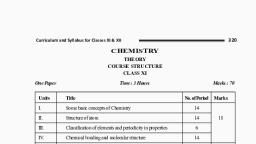
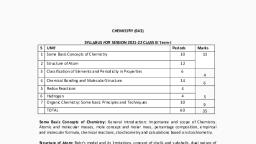
Curriculum and Syllabus for Classes XI, CHEMISTRY, THEORY, COURSE STRUCTURE, CLASS XI, One Paper, Units, I, II, III, IV, V, VI, VII, VIII, IX, X, XI, XII, XIII, XIV, , Title, Some basic concepts of Chemistry, Structure of atom, Classification of elements and periodicity in properties, Chemical bonding and molecular structure, States of matter : Gases and liquids, Thermodynamics, Equilibrium, Redox reactions, Hydrogen, S-block elements, Some p-block elements, Organic Chemistry: Some basic principles and techniques, Hydrocarbons, Environmental chemistry, Total, , Marks:70, Marks, 18, , 16, , 18, , 18, 70
Page 2 :
Unit I : Some basic Concepts Of Chemistry., Importance of Chemistry, properties of matter and their measurement, uncertainty, in measurement, Atomic and Molecular masses, Mole concept and Molar masses,, Percentage composition, Stoichiometry and Stoichiometric calculations., Unit II : Structure of Atom., B, concept of shells an sub shells, dual nature of, matter an, B, H, orbitals, quantum numbers, shapes of s, p and d orbitals, rules for filling electrons in, orbitals-A, P, H, configuration of atoms stability of half- filled and completely filled orbitals., Unit III : Classification of Elements and Periodicity in properties., Modern Periodic Law and the present form of the Periodic Table, nomenclature of, elements with Atomic number >100, Electronic configurations of elements and the periodic, table, Electronic configurations and types of elements, periodic trends in properties of, elements-, s, p, d and f-blocks, periodic trends in properties of elements- atomic radii, ionic, radii, electronic gain enthalpy, electronegativity, ionization enthalpy, periodic trends in, chemical properties., Unit IV : Chemical Bonding and Molecular Structure., Kossal-Lewis approach to chemical bonding, Ionic or Electrovalent bond, Bond, parameters, The Valence Shell Electron Pair Repulsion (VSEPR) Theory, Valence Bond theory,, Hybridization, Molecular Orbital theory, bonding in some Homonuclear diatomic molecules,, Hydrogen bonding., Unit IV : States of Matter., Intermolecular forces, thermal energy, Intermolecular forces vs thermal interaction,, The Gaseous state, Gas laws, Ideal gas equation Kinetic Molecular Theory of Gas, Behaviuor, of Real Gases : Deviation from Ideal Gas behaviour., Unit V : Thermodynamics, Thermodynamic terms, Applications, Measurement of U and H: Calorimetry,, Enthalpy change Hr of a reaction, Enthalpies for different types of reactions, Spontaneity,, G, Unit VI: Equilibrium., Equilibrium in physical processes, Equilibrium in chemical processes-Dyanamic, Equilibrium, Laws of chemical equilibrium and equilibrium constant, Homogeneous, equilibria Heterogeneous equilibria, Application of equilibrium constant, Relationship
Page 3 :
between equilibrium constant K, reaction quotient Q an G, G F, equilibria, Ionic equilibrium in solution, Acids, Bases and Salts, Ionization of acids and, bases,Buffer solutions, Solubility equilibria of sparingly soluble salts., Unit VIII : Redox Reactions., Classical idea of Redox reaction Oxidation and Reuction Reations, Redox reactions, in terms of Electron transfer reactions, Oxidation number, Redox reactions and Electrode, processes., Unit IX : Hydrogen., Position of Hydrogen in the Periodic Table, Hydrides, Water, Heavy water,, Dihydrogen as fuel., Unit X: The s Block Elements., Group I elements : Alkali Metals, General Characteristics of the compounds of Alkali, Metals, Anomalous properties of Lithium, Group 2 elements : Alkaline Earth Metals,, General Characteristics of the compounds of Alkaline Earth Metals, Anomalous properties of, Berylium., Unit XI : The p Block Elements., Group I3 elements : The Boron family, Important trends and , Anomalous properties, of Boron, Uses of Boron and Aluminium and their compounds, Group I4 elements : The, Carbon family, Important trends and , Anomalous properties of Carbon, Allotropes of, Carbon., Unit XII : Organic Chemistry Some Basic principles and Techniques., General Introduction, Tetra valence of carbon : shapes of organic compounds,, structural representations of organic compounds, classification of organic compounds, ,Nomenclature of organic compounds, Isomerism of, Fundamental concepts in organic, reaction mechanism., Unit XIII : Hydrocarbons., Classification, Alkanes Nomenclature, isomerism, conformations (ethane only),, Preparations, Physical properties, Chemical properties including free radical mechanism of, halogenations, combustion and pyrolysis., Alkenes Nomenclature, Structure of double bond (ethene) geometrical isomerism,, Physical properties, methods of preparations, chemical reactions : addition of hydrogen,, halogen, water, hydrogen halides (Markovni, oxidation, mechanism of electrophilic addition.
Page 5 :
CHEMISTRY, PRACTICALS, CLASS- XI, Evaluation scheme, for Examination, A, B, C, D, , Marks, Volumetric analyss, Salt analysis, Content based Experiment, Class Record and Viva, Total, , 10, 8, 6, 6, 30, , A . Quantitative estimation, Using a chemical balance, Preparation of Standard solution of oxalic acid., Determination of strength of a given solution of sodium hydroxide by titrating it, against standard solution of oxalic acid., Preparation of Standard solution of sodium carbonate., Determination of strength of a given solution of hydrochloric acid by titrating it, against standard solution of sodium carbonate., , B., , Quantitative analysis., Determination of on cation and one anion in a given salt, Cations : Pb+2, Cu+2, As3+, Fe3+, Mn2+, Ni2+, Zn2+, Co2+, Ca2+, Sr2+, Ba2+, Mg2+, NH4+, Anion : CO32-, S2-, SO32- , SO42-, NO2- , NO3-, Cl-, Br-, I-, PO43-, C2O42-, CH3COO(Note : Insoluble salts Excluded), , C., , Content based experiment, (i), , Basic Laboratory Technique :, (a) Cutting glass tube and glass rod, (b) Bending a glass tube
Page 6 :
(c) Drawing out a glass jet, (d) Boring a cork, (iI), , Characterization and Purification of Chemical Substances :, (ii) Determination of melting point of an organic compound., (ii) Determination of melting point of an organic compound., (iii) Crystallization Involving impure sample of any one of the following:, Alum, Copper sulphate, Benzoic acid, (iv) Detection of nitrogen, sulphur, chlorine, , D., , Class record and Viva voce.
Page 8 :
(ii), , Test for Functional Groups in Organic Compounds., Unsaturation, alcoholic, phenolic, aldehydic, ketonic, carboxylic amino, (primary) groups., , (iii), , D., , Characteristic tests of carbohydrates, fats and proteins I pure samples and, their detection in the given food stuffs., , Class record and Viva voce.
Page 9 :
CHEMISTRY, CLASS XI, SL., No., 1, , 2, , 3, , 4, , 5, 6, 7, 8, 9, 10, , 11, 12, , 13, 14, , Unit, , Portion to be Reduced, , Some Basic, Concepts of, Chemistry., Structure of, Atom., , Nature of Matter, Laws of Chemical combination, Daltons Atomic, theory, , Classification of, Elements and, Periodicity in, properties., Chemical, Bonding and, Molecular, Structure., States of Matter., , Discovery of electron, proton and neutron, atomic number,, isotopes and isobars, T, R, Why do we need to classify elements? Genesis of periodic, classification., , Kinetic energy and Molecular speeds, Liquefaction of Gases,, Liquid State, Thermodynamics Heat capacity , Relationship between Cp and CV, Equilibrium, Hydrolysis of salts and the pH of their solutions, Redox Reactions, Hydrogen, Di hydrogen preparation and properties, types of hydride,, hydrogen peroxide, The s-Block, Some important compounds of sodium, Biological importance of, Elements, sodium and potassium, some important compounds of calcium,, Biological importance of calcium and magnesium., The p-Block, Some important compounds of boron, some important, Elements, compounds of carbon and silicon., Organic, Methods of purification of organic compounds, Qualitative, chemistry some analysis of organic compounds, Quantitative analysis., basic principles, and techniques, Hydrocarbons, Free radical mechanism of halogenation, combustion and, pyrolysis, Environmental, Soil pollution, chemical reaction in atmosphere, smog, acid rain, Chemistry, ozone and its reaction, effect of depletion of ozone layer, green, house effect, pollution due to industrial wastes ,green chemistry, as an alternative tool for reducing pollution.
Page 10 :
Curriculum and Syllabus for class XII, CHEMISTRY, Theory, Time: 3 Hours, , Units, i, ii, iii, iv, v, vi, vii, viii, ix, x, xi, xii, xiii, xiv, xv, xvi, , Titles, Solid state, Solutions, Electrochemistry, Chemical Kinetics, Surface Chemistry, General Principles and processes of isolation of Elements, p-Block elements, d- and f- Block Elements, Co-ordination compounds, Haloalkanes and Haloarenes, Alcohols, Phenols and Ethers, Aldehydes, Ketones and Carboxylic acids, Amines, Biomolecules, Polymers, Chemistry in everyday life, , Marks : 70, , Marks, , 23, , 19, , 18, , 10, 70, , Total:
Page 11 :
Unit I: Solid State, General characteristics of solid state, Amorphous and Crystalline solids, Classification of, crystalline solids, crystal lattice, and unit cell, Number of atoms in a unit cell, Closed packed, structures, Packing efficiency, Calculations involving unit cell dimensions., Unit II: Solutions, Types of solutions, Expression of concentration of solutions of solids in liquids, Solubility, of gases in liquids, solid solutions, Colligative properties- lowering of vapour pressure, Raoult’s, law, elevation of boiling point, depression of freezing point, osmotic pressure, determination of, molecular masses using colligative properties., Unit III: Electrochemistry, Electrochemical cells, Galvanic cells, Nernst equation, Conductance of electrolytic solutions., Unit IV: Chemical Kinetics, Rate of a reaction (average and instantaneous), factors affecting rates of reaction:, concentration, temperature, catalyst, Order and Molecularity of reactions, rate law and, specific rate constant, integrated rate equations and half-life (only for zero and first order, reactions)., Unit V: Surface Chemistry, Adsorption- Physisorption and Chemisorption, factors affecting adsorption of gases, on solids, Colloidal solutions and suspensions; lyophilic, lyophobic, multimolecular and, macromolecular colloids, properties of colloids-Tyndall effect, Brownian movement,, Electrophoresis, Coagulation., Unit VI: General Principles and Processes of isolation of elements, Principles and methods of extraction- concentration, oxidation, reduction,, Electrochemical principles of metallurgy and refining., Unit VII: The p-Block elements, Group 15 elements: Dinitrogen, Ammonia, Nitric acid, Phosphorus, phosphorus, halides, Oxoacids of phosphorus., Group 16 elements: Dioxygen, Simple oxides- ozone, Sulphur- sulphur dioxide,, oxoacids of sulphur, Sulphuric acid., Group 17 elements: Chlorine, Hydrogen chloride, Interhalogen compounds., Group 18 elements: General introduction, electronic configuration, occurrence,, trends in physical and chemical properties.
Page 12 :
Unit VIII: The d- and f-Block elements:, General introduction, electronic configuration, occurance and characteristics of, transition metals, general trends in properties of the first row transition metals- metallic, character, ionization enthalpy, oxidation states, ionic radii, colour, catalytic property,, magnetic properties., Lanthanoids- electronic configuration and oxidation states., Actinoids- electronic configuration and oxidation states., Unit IX: Coordination compounds, Werner’s theory of co-ordination compounds, Definition of some important terms, pertaining to co-ordination compounds, Nomenclature of co-ordination compounds, Bonding, in coordination compounds, Bonding in metal carbonyls., Unit X: Haloalkanes and Haloarenes, Haloalkanes: Classification, Nomenclature, nature of C-X bond, methods of, preparation of haloalkanes, physical and chemical properties, mechanism of substitution, reactions., Haloarenes: Nature of C-X bond, methods of preparation of haloarenes, substitution, reactions (directive influence of halogen for mono substituted compounds only)., Unit XI: Alcohols, Phenols and Ethers, Classification, Nomenclature and structure of the functional groups, Praparation,, physical properties and reactions of alcohols and phenols. Preparation, physical properties, and chemical reactions of ethers., Unit XII: Aldehydes, Ketones and Carboxylic acids, Nomenclature and structure of carbonyl group, preparation of aldehyhydes and, ketones, physical properties and chemical reactions., Nomenclature and structure of carboxyl group, methods of preparation of carboxylic, acids, physical properties and chemical reactions., Unit XIII: Amines, Structure of amines, classification and nomenclature of amines,, preparation, methods, physical properties and chemical reactions., Unit XIV: Biomolecules, Carbohydrates: Structure of glucose and fructose., Proteins: Amino acids- classification, structure of proteins, denaturation of proteins., Nucleic acids: Chemical compositions, functions of nucleic acids.
Page 13 :
Unit XV: Polymers, Classification of polymers, types of polymerization reactions, biodegradable polymers, of commercial importance., Unit XVI: Chemistry in Everyday life, Drugs and their classification, Drug-target interaction.
Page 14 :
Class XII, Theory, Sl.No., , Unit, , Portion to be removed, , I, , Solid state, , Imperfection in solids, Electrical and Magnetic properties., , II, , Solutions, , Abnormal molecular mass, van’t Hoff factor and calculations, involving it., , III, , Electrochemistry, , Electrolytic cells and Electrolytes, Batteries, Fuel cells and, corosion., , IV, , Chemical Kinetics, , Concept of collision theory, Activation energy, Arrhenius, equation., , V, , Surface Chemistry, , Catalysis-Homogenous and Heterogenous, activity and, selectivity, enzyme catalysis, emulsion-elementary idea of, nanomaterials., , VI, , General Principles and, processes of isolation, of Elements, , Thermodynamic principles of metallurgy, Uses of, aluminium, copper, zinc and iron., , VII, , p-Block elements, , Group 15 elements: Oxides of nitrogen, allotropic forms of, phosphorus, phosphine, PCl5, Hypophosphorus acid,, Cyclotrimetaphosphoric acid, Polymetaphosphoric acid, Group 17 elements: Oxoacids of halogens., Group 18 elements: Xenon oxygen compounds, uses of, noble gases., , VIII, , d- and f- Block, Elements, , Some important compounds of transition elements., Chemical reactivity and lanthanoid contraction and its, consequences. General characteristics and comparison of, actinoides with lanthanoids., , IX, , Coordination, compounds, , Isomerism in coordination compounds, stability of, coordination compounds. Importance and applications of, coordination compounds., , X, , Haloalkanes and, Haloarenes, , Stability of carbocations, R,S- and D,L-configurations, uses, and environmental effects of dichloromethane,, trichloromethane, tetrachloromethane, iodoform, freons,, DDT
Page 15 :
XI, , Alcohols, Phenols and, Ethers, , Some commercially important alcohols-methanol and, ethanol,, , XII, , Aldehydes, Ketones, and Carboxylic acids, , Uses of aldehydes, ketones and carboxylic acids., , XIII, , Amines, , Diazonium salts, preparations, properties and its, importance in synthesis of aromatic compounds., , XIV, , Biomolecules, , Disaccharides, polysaccharides, cellulose and importance of, carbohydrates., Enzymes, Vitamin and Hormones, , XV, , Polymers, , Molecular mass of polymers,, , XVI, , Chemistry in everyday, life, , Therapeutic action of different classes of drugs, chemicals in, foods, cleansing agents
Page 16 :
DESIGN OF QUESTION PAPER, Subject, Paper, Class, Full Mark, Time, , I, , :, , CHEMISTRY, , :, :, :, :, , Theory, XI, 70, 3 Hours, , WEIGHTAGE TO OBJECTIVES:, Objectives, Knowledge (K), Understanding (U), Application (A), Including Analysis, Synthesis and Evaluation, Total :, , II, , III, , IV, V, VI, , WEIGHTAGE TO FORM OF QUESTIONS:, Form of Questions, No. of Question Time (in minute), Essay/Long Answer(E/LA), 3, 60, Short Answer(SA-I), 7, 42, Short Answer(SA-II), 10, 40, Very Short Answer(VSA), 10, 30, MCQ, 4, 8, Total:, 34, 180, WEIGHTAGE TO CONTENT:, UNIT/CONTENTS:, Some basic concepts of Chemistry, 1, Structure of Atom, 2, Classification of Elements and Periodicity in Properties, 3., Chemical Bonding and Molecular Structure, 4, 5, , States of Matter : Gases and Liquids, , 6, , Thermodynamics, , 7, , Equilibrium, , 8, , Redox reactions, , 9, , Hydrogen, , 10, , s - Block elements, , 11, , Some p-block elements, , 12, , Organic Chemistry :Some basic Principles and Techniques, , 13, , Hydrocarbons, , 14, , Environmental chemistry, , Marks, 21, 35, 14, , Percentage, 30, 50, 20, , 70, , 100, , Marks, 15, 21, 20, 10, 4, 70, , Percentage, 21, 30, 29, 14, 6, 100, Marks, 18, , 16, , 18, , 18, , Total :, 70, Note: A minimum of 3 marks must be allotted to each unit., SCHEME OF SECTIONS :, Nil, SCHEME OF OPTIONS :, Internal option may be given in Essay Type Questions and SA I, (4 question ) only., DIFFICULTY LEVEL, :, Difficult, :, 20%, Average, :, 50%, Easy, :, 30%, , Abbreviation :, , K(Knowledge), U(Understanding ), C(Comprehension), Exp.(Expression), (S)Skill, ,, E(Essay Type), SA (Short Answer Type), VSA (Very Short Answer Type),, MCQ(Multiple Choice Question)
Page 17 :
DESIGN OF QUESTION PAPER, Subject, Paper, Class, Full Mark, Time, , :, :, :, :, :, , CHEMISTRY, Theory, XII, 70, 3 Hours, WEIGHTAGE TO OBJECTIVES :, , Objectives, Knowledge (K), Understanding (U), Application (A), Including Analysis, Synthesis and Evaluation, , I, , Form of Questions, Essay/Long Answer(E/LA), Short Answer(SA-I), Short Answer(SA-II), Very Short Answer(VSA), MCQ, Total:, , Marks, , Percentage, , 21, 35, 14, , 30, 50, 20, , No. of Question, , Total :, Time (in minute), , 70, Marks, , 100, Percentage, , 3, 7, 10, 10, 4, , 60, 42, 40, 30, 8, , 15, 21, 20, 10, 4, , 21, 30, 29, 14, 6, , 34, , 180, , 70, , 100, , WEIGHTAGE TO CONTENT:, , Marks, UNIT/CONTENTS:, Solid State, Solutions, Electrochemistry, Chemical Kinetics, Surface chemistry, General Principles and Process of Isolation of Elements, p- Block elements, III, d- and f- Block elements, Co- ordination compounds, Haloalkanes and Haloarenes, Alcohols, Phenols and Ethers, Aldehydes, Ketones and Carboxylic acids, Amines, Bio molecules, Polymers, Chemistry in everyday life, Total :, Note: A minimum of 3 marks must be allotted to each unit., 1, 2, 3., 4, 5, 6, 7, 8, 9, 10, 11, 12, 13, 14, 15, 16, , IV, V, , SCHEME OF SECTIONS : NIL, SCHEME OF OPTIONS : Internal option may be given in Essay Type Questions and, SA I (4 question ) only., , VI, , DIFFICULTY LEVEL :, Difficult:, 20%, Average :, 50%, Easy :, 30%, , Abbreviation :, , K(Knowledge), U(Understanding ), C(Comprehension), Exp.(Expression), (S)Skill, ,, E(Essay Type), SA (Short Answer Type), VSA (Very Short Answer Type),, MCQ(Multiple Choice Question), , 23, , 19, , 18, , 10, 70