Page 1 :
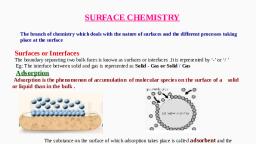
SURFACE CHEMISTRY, The branch of chemistry which deals with the nature of surfaces and the different processes taking, place at the surface, , Surfaces or Interfaces, The boundary separating two bulk faces is known as surfaces or interfaces .It is represented by ‘-’ or ‘/ ’, Eg: The interface between solid and gas is represented as Solid - Gas or Solid / Gas, , Adsorption, Adsorption is the phenomenon of accumulation of molecular species on the surface of a solid, or liquid than in the bulk ., , The substance on the surface of which adsorption takes place is called adsorbent and the, substance adsorbed is known as adsorbate., , Eg.(i) Gases like O2,H2 ,NH3 ,SO2 etc are get adsorbed on the surface of charcoal, (ii)Aqueous solution of raw sugar can be de colourised by adsorbing the colouring substances by, charcoal, (iii) Air becomes dry in the presence of silica gel because water gets adsorbed by silica gel., Desorption :- The process of removing adsorbate from the surface of adsorbent is called desorption., , Sorption: A process involving simultaneous adsorption and absorption is called sorption, Eg: Dyes gets adsorbed as well as absorbed in cotton fibres., , sorption
Page 2 :
Distinction between adsorption and absorption, Adsorption differ from absorption. In adsorption the substance is concentrated only at the surface and, does not penetrate into the bulk of the adsorbent. But in absorption the molecule of the substance are, uniformly distributed through out the bulk of the solid, Eg: Water vapour are adsorbed by silica gel, but are absorbed by anhydrous calcium chloride., , Adsorption, , Absorption, , (i) It is a surface phenomenon, , (i) It is a bulk phenomenon, , (ii) In adsorption the substance is, concentrated only at the surface and, does not penetrate into the bulk of the, absorbent, , (ii) In absorption the molecule of the, substance are uniformly distributed through, out the bulk of the solid, , Mechanism of Adsorption, Adsorption arises due to the presence of some unbalanced or residual attractive forces on the, molecules present on the surface of adsorbent. The forces acting on the molecule inside the bulk are acting, on the molecule inside the bulk are mutually balanced. But the surface particles are not surrounded by atoms, or molecules in all directions. Hence they posses some unbalanced or residual attractive forces. These forces, are responsible for attracting and retaining the adsorbate particles on the surface., Residual attractive forces, , Enthalpy or Heat of adsorption, Adsorption generally occurs with release in energy ie,it is exothermic in nature.The enthalpy change for the, adsorption for one mole of an adsorbate on the adsorbent surface is called enthalpy or heat of adsorption. During, adsorption there is generally a decrease in entropy. This is because the translational freedom of the adsorbate is, reduced when it is absorbed., Thus for the process of adsorption ΔH =’-’ve ΔS = ‘-’ve, According to Gibb’s Helmholtz equation ΔG = ΔH- T ΔS, Thus ΔG can be ‘-’ve if ΔH >T ΔS . As adsorption proceeds , ΔH becomes less and finally ΔH becomes, equal to T ΔS .Thus ΔG becomes zero and equilibrium is attained, , Types of Adsorption, Depending upon the nature of forces existing between adsorbate and adsorbent ,the adsorption can be classified, into two types, (i) Physical adsorption (Physisorption), (ii) Chemical adsorption (Chemisorption)
Page 3 :
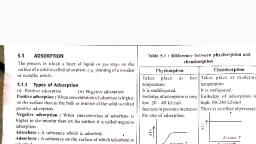
Physical Adsorption, , Chemical Adsorption, , 1.The force of attraction between adsorbate, molecules and adsorbent are weak vander waals, forces, , 1.The force of attraction between adsorbate, molecules and adsorbent are strong chemical, bond, , 2.Enthalpy of adsorption is of the order of 20-40, KJ/mol, , 2.Enthalpy of adsorption is of the order of 80-240, KJ/mol, , 3.Low temperature is favourable for, adsorption.It decreases with increase in, temperature, , 3. High temperature is favourable for, adsorption.It increases with the increase of, temperature, , 4.No surface compounds are formed, , 4.Surface compounds are formed, , 5.It depends on nature of the gas .More easily, liquefiable gases are adsorbed readily, , 5.It also depends on the nature of the gas. Gases, which react with the adsorbent show, chemisorption, , 6.It is reversible, , 6.It is irreversible, , 7.It does not require activation energy, , 7. It require activation energy.High activation, energy is sometimes needed, , 8.It depends on the surface area. It increases with 8.It depends on the surface area. It too, increase of surface area, increases with increase of surface area, 9.It form multi-molecular layer, , 9.It form mono-molecular layer, , 10.It is not specific in nature, , 10.It is highly specific in nature, , Physical Adsorption, , Chemical Adsorption, , Example for Physical and Chemical Adsorption, (i) At low temperature dihydrogen is adsorbed on the surface of nickel as hydrogen molecule by vander, waals forces (physical adsorption), (ii) But at high temperature molecules of hydrogen dissociate into hydrogen atom and chemisorbed on the, nickel surface(Chemical adsorption), , Adsorption of Gases on Solids, Generally gases are adsorbed by solids .The extent of adsorption of gas on a solid is effected by following, factors., (i) Nature of the adsorbate :- Easily liquifiable gases like NH3,HCl ,CO2 etc are adsorbed to a greater, extent than the permanent gases such as H2,O2,N2 etc .This is because vander waals forces are more, predominant in easily liquifiable gases., , Ease of adsorption – SO2 > NH3 > HCl > CO2 > CH4 > CO > N2 > H2
Page 4 :
(ii)The effect of temperature(Adsorption isobar), The effect of temperature on the rate of adsorption at a given pressure can be expressed by a, graph with rate of adsorption (x/m) [ where ‘x’ is the mass of the gas adsorbed and’m’ mass of the, adsorbent] against temperature .The curve is called is called adsorption isobar., , T, In the case of physical adsorption x/m decreases with increase in temperature ie, on increasing the, temperature desorption takes place., , (iii) Effect of pressure(Adsorption isotherm), Adsorption is a reversible process. At a given temperature the amount of gas adsorbed on the, surface of a solid increases with increase of pressure. As the pressure increases the amount of gas adsorbed, also increases and reaches a maximum and after that there is no increases in adsorption with increase in, pressure. The rate of adsorption depends on the mass of the gas adsorbed (x) and mass of the adsorbent., If x/m is plotted against the pressure at constant temperature ,the curve, obtained is known as adsorption isotherm, , x/m, Saturation pressure or, Equilibrium pressure, , From the graph it is clear that x/m increases with increase in pressure and reaches a maximum value and, remain constant. This pressure is called saturation pressure or equilibrium pressure (Ps) .Above this pressure, pressure has no effect ie,x/m is a constant., , Freundlich Adsorption Isotherm, Freundlich gave the relation between the quantity of gas adsorbed by unit mass of a adsorbent and, pressure at particular temperature. The relation is,, , x/m =KP1/n, Where ‘x’ is the mass of the gas adsorbed on mass’m’ of the adsorbent at a pressure’P’.’K’ and ‘n’ are, constant., Taking logarithm on both sides,, log(x/m) = logK +1/n log P, A graph is plotted with log(x/m) against log P will get a straight line .The slope is ‘1/n’ and intercept of, straight line ‘logK’
Page 5 :
The factor ‘1/n’ can have values, between 0 and 1(probably 0.1 to, 0.5) .Thus this equation hold good only over a limited range of pressure., When 1/n = 0 ,, x/m = constant ie, adsorption is independent of pressure, When 1/n = 1 ,, x/m =KP ie, x/m α P, ie, The adsorption varies directly with pressure., , Adsorption from solutions, Solid surfaces can also adsorb certain solute from solutions .Freundlich adsorption isotherm is applicable, to adsorption of solutes from solutions also .The relation between x/m and the concentration of the solute ‘C’, is given by, , x/m =KC1/n, where ‘C’ is the equilibrium concentration., Taking logarithm, , log(x/m) = logK +1/n log C, A graph between log(x/m) and logC is a straight line with slope 1/n and intercept logK over a small range of, concentration., Eg: Adsorption of ammonia from NH4OH solution and acetic acid from its solution in water by, activated charcoal, , Applications of adsorption, 1.Gas masks : Activated charcoal is used in gas masks is usually used for breathing in coal mines to, adsorb poisonous gases such as CH4 ,CO etc, 2.For removing colouring matters from solutions :Animal charcoal remove colours of solutions, by adsorbing coloured impurities, 3.Control of humidity:Silica and aluminium gel are used as adsorbents for removing moisture, and control humidity., 4.In heterogeneous catalysis: Adsorption of reactants on the solid surface of catalyst increase the, rate of reaction., For example in the manufacture of ammonia by Haber process,iron is used as catalyst increase the, rate of reaction., 5.In chromatography: Chromatography is based on the principle of adsorption, 6.Production of high vacuum : The traces of air can be removed by using charcoal from a vessel, after evacuating with a vacuum pump., 7.Adsorption indicators: Surfaces of certain precipitates such as silver halide have the property of, adsorbing some dyes like eosin,fluorescein etc, and thereby producing characteristic colour at the end, point.Therefore these dyes are used as adsorption indicators., 8.In curing diseases: A number of drugs kill germs by getting adsorbed on them, 9.Froth floatation process: Sulphide ore is purified by adsorbing in froth formed by pine oil and, frothing agent.
Page 6 :
10)Separation of inert gases: Due to the difference in degrees of adsaorption of gases by charcoal,a, mixture of noble gases can be separated on coconut charcoal at different temperature.A mixture of, noble gases can be separated on coconut charcoal based on their difference in adsorption, , CATALYSIS, A catalyst is a substance which alter the rate of chemical reaction without itself, undergoing any permanent chemical change is called catalyst and the phenomenon is, called catalysis., Eg:- The decomposition of KClO3 takes place at a faster rate at low temperature in, presence of MnO2, The important point in catalysis is, (i)A catalyst speed up the reaction by providing an alternate path of lower activation, energy .The catalyst lowers the activation energy by interacting with the reactant, leading to the formation of some intermediate. Finally the intermediate compound is, decomposed and the catalyst is regenerated, (ii) A catalyst speed up the forward and reverse reaction to the same extent.Therefore it, does not affect the equilibrium constant, , Catalytic promoters and poisons, Certain external substances which enhance the activity of a catalyst are called catalytic, promoters., Eg:Mo is used as a promoter along with Fe catalyst in Haber process, Fe(s), N2+ 3H2, NH3(g), Certain external substances which decrease the activity of a catalyst are called catalytic, poisons, Eg:In the manufacture of H2SO4 by contact process, presence of a very minute quantity of, arsenic is almost completely destroying the activity of platinum catalyst.
Page 7 :
Types of Catalysis, (i) Homogenous catalysis, A catalytic process in which the reactant and catalyst are in the same phase is known as, homogenous catalysis, Eg 1.In the Lead-chamber process SO2 is oxidise to SO3 in the presence of NO, 2SO2(g) + O2(g) NO(g), , 2SO3(g), , 2.Hydrolysis of sugar is catalysed by H+ ions furnished by H2SO4, C12H22O11(l) +H2O(l), , H2SO4(l), , C6H12O6 + C6H12O6, 3.Hydrolysis of ester is catalysed by H+ ions furnished by HCl, CH3COOC2H5(l) +H2O(l) HCl(l), , CH3COOH(l) + C2H5OH(l), , (ii) Heterogenous catalysis, , A catalytic process in which the reactant and catalyst are in different phases is known as, heterogenous catalysis, Eg (1) Manufacture of NH3 from N2& H2 using Fe as catalyst, N2(g)+ 3H2(g) Fe(s), , 2NH3(g), , (2)In the manufacture of H2SO4 by contact process , SO2 can be oxidise to SO3 using Pt as, catalyst, 2SO2(g) + O2(g) Pt(s) 2SO3(g), (3) Oxidation of NH3 to NO in the presence of Pt gauze in Ostwald’s process, 4NH3 (g) + 5O2 (g) Pt(s) 4NO(g)+ 6H2O(g), , Nature of solid Catalyst, The two important aspects of the solid catalyst are activity and, selectivity, , (i)Activity:The ability of a catalyst to increase the rate of reaction is called activity., Eg A mixture of H2 & O2 react in presence of Pt catalyst to form water violent, explosion, (ii) Selectivity, The ability of a catalyst to direct a particular reaction to give a particular product is, called selectivity., Eg Starting with H2,CO and using different catalyst,we get different products
Page 8 :
ENZYMES, , Enzymes are biological catalyst produced by living cells which, catalyse biochemical reaction in living organism, Characteristics of Enzymes, (i)Enzyme catalyst increases the speed of reaction by many times as compared to the, uncatalysed reaction, (ii) A small quantity of enzyme catalyst can increase the rate of reaction by a factor of, 103 to 10 6, (iii)The enzyme catalyst are highly specific in nature ie,each enzyme catalyses only one, type of chemical reaction, (iv)They are active at moderate temperature called optimum temperature (370C) and, PH around 7(5-7), (v) The activity of enzyme is controlled by various mechanism and are inhibited by, various organic and inorganic molecules, , (iv) The activity of enzyme is increased in the presence of certain substances ,known as, co-enzyme(no-protein -vitamin), Activators are usually metal ions such as Na+ ,Mn2+ ,Co2+,Cu2+etc.These metal, ions ,when weakly bonded to enzyme molecule increase their catalytic activity., Amylose in presence of sodium chloride ie Na+ ions are catalytically active., , Shape selective catalysis by zeolite, Zeolites are alumino silicates of metals.These are porous and have cavities of, different sizes.The catalytic behaviour of zeolite catalyst depends on the size of the, cavities in them.The size usually varies form 260pm-740pm.Only the reactant molecules, o particular size and shape eneter these cavities and get adorbed.Thus zeloites are shape, selective catalyst. These are used in petrochemical industries for cracking of, hydrocarbons. A synthetic zeolite catalyst know as ZSM-5 (Zeolite sieve of molecular, porosity ) is used for the conversion of alcohol to gasoline (petrol)
Page 9 :
COLLOIDS, Colloidal solutions are intermediate between true solutions and suspension. The, diameter of colloidal particles is between 1nm and 1000nm(10-9m to 10-6m)., A colloidal solution is heterogeneous in nature, A colloidal solution is made up of two phase -dispersed phase and dispersion medium, Dispersed phase:- It is the component present in small proportion and consists of, particles of colloidal dimensions (1-1000nm), Dispersion medium:- It is the medium in which colloidal particles are dispersed., Example : - In a colloidal solution of gold in water gold constitute dispersed phase and, water constitute dispersion medium., , Classification of colloids, (i)Classification based on physical state of dispersed phase and dispersion medium, Gas in gas is not a colloid because gases mixed together to form a homogenous mixture., , Sl.No Dispersed, phase, , Dispersion, medium, , Colloidal name, , Examples, , Foam, , Soap lather,Froth, , 1, , Gas, , Liquid, , 2, , Gas, , Solid, , Solid sol, , Foam rubber,pumice stone, , 3, , Liquid, , Gas, , Aerosol, , Fog,mist, cloud, , 4, , Liquid, , Liquid, , Emulsion, , Milk,medicine, , 5, , Liquid, , Solid, , Gel, , Cheese,butter,jellies, , 6, , Solid, , Gas, , Aerosol, , Smoke ,Dust, , 7, , Solid, , Liquid, , Sol, , Gold sol,sulphur sol,paints, , 8, , Solid, , Solid, , Solid sol, , Gemstone,some coloured, glass, , (ii) Classification based on nature of interaction between dispersed phase and, dispersion medium, 1.Lyophilic sols (Lyophilic colloids), The colloidal solution in which dispersed phase has greater affinity for the dispersion, medium are called lyophilic sols.In such colloids ,the dispersed phase does not get easily, precipitated and the sols are quite stable.If the dispersion medium is separated from the, dispersed phase , the sol can be reconstituted by simple remixing.Therefore they are, also called reversible sols.
Page 10 :
Eg : Sols of gum ,gelatine, starch ,rubber etc., 2.Lyophobic sols (Lyophobic colloids), Substances like metal,their sulphides etc when simply mixed with the dispersion, medium do not form the colloidal sol.Their colloidal sols can be prepared only by, special methods.Such sols are called lyophobic sol.These are easily precipitated by the, addition of small amount of electrolyte or by shaking and hence,are not stable .Once, precipitated they do not give back the colloidal sol by simple addition of dispersion, medium Hence these are also called irreversible sols.Lyophobic sols need stabilising, agent for their preservation., Lyophilic colloids, 1.These are reversible in nature, , (Lyophobic colloids), 1.These are irreversible in nature, , 2.They are quite stable and not easily, 2.They are less stable and readily, precipitated by the addition of electrolyte precipitated on the addition of small, amount of electrolytes,by heating or by, shaking., 3.These are obtained by direct mixing, , 3.These sol can be prepared only by, special methods, , 4.They are self stabilised, , 4.They need stabilising agents for their, preservation, , Depending upon the nature of dispersed phase particles ,the colloidal solutions are, classified as, 1.Multimolecular colloids :- When a large number atoms or small molecules of a, substance having size less than 1nm aggregate together in dispersion medium to form, species having size in the colloidal range, Eg :(i) Gold sol consists of particles of several gold atoms, (ii) A sol of sulphur consists of colloidal particle which are aggregate of 1000 or so of S8, molecule, 2.Macromolecular colloids, When certain substances having big size molecules (macromolecules) are dispersed in a, suitable solvent form a solution in which the size of the dispersed particles are in the, colloidal range.Such colloids thus formed are called macromolecular colloids, Eg Starch ,cellulose,proteins ,plastics etc, 3.Associated colloids, The substances which behaves as a normal electrolyte at lower concentration but, exhibit colloidal properties at higher concentration due to the formation of aggregated, particle called associated colloids The aggregated particle thus formed are called, micelles ., The formation of micelles takes place only above a particular temperature called kraft, temperature (Tk) and above particular concentration called critical micelle, concentration(CMC)
Page 11 :
Soaps and detergents are examples od associated colloids. Micelle may contain 1000, molecule or more, For soaps the CMC is 10-4 to 10-3 mol/L, , Preparation of colloids, Lyophilic sols are quite stable and can easily prepared by shaking or warming the, material to be dispersed with dispersion medium, Eg Colloidal solution of glatin,gum,starch etc can be prepared by this method, , Preparation of Lyophobic colloids, Lyophobic colloids can be prepared by two types, (i) Dispersion method, (ii) Condensation method, , Electrical dispersion (Bredig’s arc method), Colloidal solution of metals such as gold,silver ,Pt etc can be prepared by this method, The metal whose sol is to be prepared is made as two electrodes immersed in dispersion, medium such as water. The dispersion medium is cooled by surrounding it with a freezing, mixture. An electric arc is struck between the two electrodes .The heat generated by the, arc vaporise the metal which are condensed immediately to give colloidal solution, , Dispersion medium, , Ice bath
Page 12 :
Peptization, The process of converting a freshly prepared precipitate into colloidal form by the, addition of suitable electrolyte is called peptization, During peptization the precipitate adsorb one of the ions of the electrolyte on its, surface.This causes the development of positive or negative charge on precipitate which, ultimately breaks up into small particles of colloidal size, Eg Fe(OH)3 is obtained when FeCl3 solution is added to Fe(OH)3 precipitate, , 2.Condensation method, (i) Chemical method, (ii) Physical method, (1) Chemical method, (i) Oxidation, (ii) Reduction, (iii) Hydrolysis, (iv) Double decomposition, 1.Oxidation:- A colloidal solution of sulphur can be obtained by passing H2S into, solutions if SO2 in H2O, 2.Reduction :- A colloidal solutions of a metal like silver,gold and Pt can be prepared by, reducing its salt solution with a suitable reducing agents such as stannous chloride, (SnCl4), 2AuCl3 + 3SnCl2, , 2Au + 3SnCl4, , ., , 3 Hydrolysis:- A red sol of Fe(OH)3 is obtained by the hydrolysis of FeCl3 with boiling, water, FeCl3 + 3H2O, Fe(OH)3 + 3HCl, , 4.Double Decomposition, A colloidal sol of Arsenic sulphide is obtained by passing H2S into a solution of Arsenic, oxide, As2O3 + 3H2S, , As2S3 + 3H2O, , Purification of colloids, 1.Dialysis, The process of removing dissolved substance (impurity)[crystalloid] from a colloid by, means of diffusion through a suitable membrane is called dialysis.The colloidal solution, is taken in bag made up of parchment paper ,animal bladder or cellophane membrane., The bag is suspended in freshwater,the impurities slowly diffused out of the bag leaving, behind pure colloidal solution .
Page 13 :
2.Electro Dialysis, The ordinary process of dialysis is slow.To increase the process of purification the, dialysis is carried out by applying electric field. This process is called electro dialysis, , 3.Ultra filtration, It is the process of removing the impurities from the colloidal solution by passing it, through a special type of filter paper called ultrafilter.This filter paper allow the ions, and molecule of the impurities to pass but retain colloidal particle.This filter papers are, made from ordinary filter paper by impregnating with collodion solution ., The usual collodion is a 4% solution of nitrocellulose in a mixture alcohol and ether, , Cleansing action of soaps, Soap is sodium or potassium salts of a higher fatty acids represented as RCOO-Na+, Eg Sodium stearate(major component of many bar soap) is composed of long, hydrocarbon chain (also called non polar tail)which is hydrophobic(water repelling), and a polar group coo- ions(also called polar ionic ‘head’)which is hydrophilic (water, loving ), C17H35COO-Na+, tail, head, , Dirt sticks to an oily or greasy layer on the fabric.When the cloth is dipped, in aqueous soap solution,the soap and dirt come in contact with each, other.The non polar end(tail) dissolves in the grease or oil while the polar, end COO- is directed towards water.
Page 14 :
In this manner each oil drop is surrounded by large number of negatively charged, carboxylate ions.Since similar charges repel each other. The oil droplets breaks up and, form small droplets.These small droplets get dispersed in water forming emulsion. Thus, the cloth gets cleaned, The cleansing action of soap is due to its tendency to form micelles., , Properties of colloids, 1.Charge on Colloidal particle, Colloidal particle always carry an electrical charge.The nature of the charge is same in, all particles in a colloidal solution.The charge is either positive or negative., Preferential adsorption of ions is the most accepted reason.The sol particles acquire, positive or negative by preferential adsorption of + ve or -ve ions., Preferential adsorption of ions common to the colloidal particle usually takes place., Example, When silver nitrate solution is added to potassium iodide solution,the precipitated, silver iodide adsorbs iodide ions from the dispersion medium and negatively charged, colloidal solution results., However when KI solution is added to AgNO3 solution ,positively charged sol results, due to adsorption of Ag+ ions from the dispersion medium, AgI/ INegatively charged, , AgI/Ag+, Positively charged, , This layer attracts counter ions from the medium forming a second layer, , AgI/ I- K +, , AgI/Ag +I-, , The combination of the two layers of opposite charges around the colloidal particle is, called Helmholtz electrical double layer, The first layer of ions is firmly held and is called fixed layer.The second layer is mobile, and is called diffused layer. Then there develops a potential difference between the fixed, layer and diffused layer., The potential difference between the fixed layer and the diffused layer of opposite, charge is called zeta potential or Electrokinetic potential, , 2.Brownian movement, The continuous rapid zig zag movement of colloidal particles in the dispersion medium, is called Brownian movement, This phenomenon was discovered by Robert Brown
Page 15 :
3.Tyndall Effect, The phenomenon of scattering of light by colloidal particles is, known as Tyndall effect., The bright cone of the light is called Tyndall cone, This effect was first observed by Faraday and later studied in detail by Tyndall, , Condition for Tyndall Effect, 1.Diameter of the dispersed particles should not be much smaller than the wavelength, of light used, 2.The refractive indices of the dispersed phase and dispersion medium should differ, greatly in magnitude, , Coagulation or precipitation of colloids, The stability of the lyophobic sols is due to the presence of charge on colloidal particles., If the charge is removed,the colloidal particles will come nearer to each other to form, aggregates and settle down under the force of gravity., The process of setting of colloidal particles is called coagulation or precipitation of the, sol, , Hardy Shulz Rule, Different electrolytes have different coagulation value.The coagulation power of various, electrolyte was studied by Hardy and Shulz.According to this rule, (i) The ions carrying the charge opposite to that of sol particles are effective in causing, the coagulation of the sol, (ii)Greater the valence of the flocculating ion added,the greater is its coagulating power., For Example
Page 16 :
In the coagulation of a negative sol,the flocculating power is in the order, Al3+ > Ba2+ > Na+, In the coagulation of a positive sol,the flocculating power is in the order, [Fe(CN)4]4- >PO43- >SO42- >Cl-, , Protection of colloids, Lyophilic sols are more stable than lyophobic sols.The process of protecting lyophobic, colloidal solution from precipitation by electrolyte due to the previous addition of some, lyophilic colloids is called protection, Lyophilic colloids used for this purpose are called protective colloids, , Emulsions, Emulsions are colloidal solutions in which the dispersed phase as well as dispersion, medium are liquids, There are two types of emulsions, (i) Oil in water type (O/W), In this type oil is the dispersed phase and water is the dispersion medium, Eg :- Milk,Vanishing cream, (ii)Water in oil type (W/O), In this type water is the dispersed phase and oil is the dispersion medium ., Eg:- Butter,Cream, Emulsions may be obtained by shaking both the liquids., Emulsions of oil in water are unstable and sometimes they separate into two layers on, standing.For stabilisation of an emulsion ,a third component called emulsifying agent is, usually added.The emulsifying agent forms an interfacial film between suspended, particles and the medium., The emuslifying agents for O/W emulsions are proteins,gums ,natural and synthetic, soaps etc and for W/O heavy metal salts of fatty acids ,lamp black, long chain alcohols, etc., , Colloids Arround us, (i)Blue colour of sky is due to scattering of light by the colloidal dust particles and, water suspended in air., (ii) Food articles :- Milk,Butter ,halwa ,ice creams ,fruit juices etc are colloids, (iii) Artificial Rain, Clouds are aerosol having small droplets of water in air. Artificial rain is caused by, spraying oppositely charged colloidal sand particles over the clouds by aeroplane.The, colloidal water particles present in the cloud will get neutralised and coagulate to form, bigger water drops causing artificial rain.
Page 17 :
(iv)Blood is a colloidal solution of albuminoid substance.The styptic action of alum and, ferric chloride solution is due to coagulation of blood forming clot which stops further, bleeding, (v) Formation of Delta, River water contains charged colloidal particles of clay in water.When the river water, come in contact with sea water , the clay particles get coagulated by the ions present in, the sea water.Thus there is the formation of delta at the point where the river enters the, sea., , Application of colloids, (i) Electrical precipitation of smoke, (ii)Purification of drinking water, (iii) Medicines, (iv) Tanning, (v) Cleansing action of soaps and detergents, (vi) Photographic plates and films, (vii) Rubber Industry, (viii) Industrial products