Page 2 :
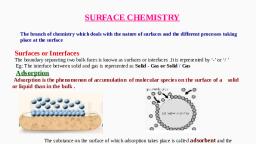
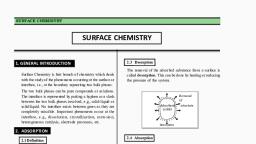
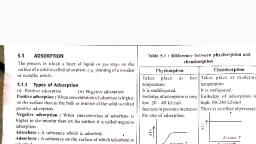
CHAPTER 04, , Surface Chemistry, [TOPIC 1] Adsorption, The phenomenon of accumulation of higher concentration of any molecular species at the surface, than in the bulk of a solid (or liquid) is called adsorption. It deals with the chemistry at the, boundary which separates two bulk phases. This boundary is also known as surface or interface., AH (change in enthalpy) and As (change in entropy) of adsorption are negative. Mostly, , adsorption processes are exothermic, therefore, adsorption decreases with increasing, temperature., () Adsorbent is a substance on the surface of which adsorption takes place., , (i) Adsorbate is the species which concentrates or accumulates at the surface., (ii) In adsorption, the concentration of the adsorbate increases only at the surface of the, , adsorbent, while in absorption, the concentration is uniform throughout the bulk of the, solid. Adsorption is a surface phenomenon while, absorption is a bulk phenomenon,, e.g. water vapours are absorbed by anhydrous CaCl2 but adsorbed by silica gel., (iv) The term sorption is used when both the processes of adsorption and absorption takes place, , simultaneously., (v) Desorption is the process of removing an adsorbed substance from the surface on which, it is adsorbed., , 1.1 Types of Adsorption, Depending on forces which hold the adsorbate on the surface of adsorbent there are mainly two, types of adsorption of gases on solid., , (i) In physical adsorption, forces of attraction between adsorbent and adsorbate is weak, van der Waals' type with low heat of adsorption. Characteristics of physisorption are:, (a) It lacks specificity., (b) The amount of gas adsorbed by solid depends on the nature of gas. Easily liquefiable, gases with high critical temperature are readily adsorbed., (c) At a given temperature and pressure with the increase in the surface area of the, adsorbent, the extent of adsorption increases too., , (d) It is an exothermic process and has low enthalpy of adsorption (20 -40 kJ mol)., (e) It decrease with increase in temperature.
Page 3 :
92, , Chapterwise CBSE Solved, , Papers, , CHEMISTRY, , :, , (f) No appreciable activation energy is, , required., (g) It results in formation of, , 1.2 Factors Affecting, Adsorption of Gases, , multimolecular layers on adsorbent, surface under high pressure., (ii) In chemical adsorption, adsorbate is, held to adsorbent by strong chemical, bond. Enthalpy of adsorption is high., , Characteristics of chemisorption are:, , (a) It is highly specific in nature and, , forms unimolecular layer., (b) With the increase of surface area, rate, of chemisorption increases., (c) It has high heat of adsorption, , (80-240 kJ mol)., (d) It first increases and then decreases, with increase of temperature., , (e) Sometimes, high activation energy is, required., , NOTE, , Both types of adsorption increases with, , on Solids, (i) Nature of adsorbent Greater are the, strained forces on the surface, more is the ease, with which adsorption takes place on the, surface. The activated adsorbents have high, , adsorbing power., (ii) Surface area of adsorbent Greater the, surface area, more is the adsorption., (ii) Nature of gas being adsorbed Easily, liquefiable gases like NH,, HCl, Cl2, SO2, CO2, etc. (whose critical temperature is high) are, , adsorbed to greater extent., (iv) Pressure Adsorption increases with increase, in pressure. The effect of pressure is large at, low temperature., , increase in surface area of the adsorbent., , Comparison of Physisorptlon and Chemisorption, , Physisorption, Waals' forces., , Chemisorption, is, caused by chemical, bond formation., , It arises due to van der, lt is non-specific in, , It is highly specific in, , nature., , nature., , It is reversible in nature., , It is irreversible., , Itdepends on the nature, , of gas. More casily, , It also depends on the, nature of gas. Gases, which can react with the, , adsorbed readily., , adsorbent, show, , liquefiable gases are, , (v) Temperature Since, adsorption is an, exothermic procesS so according to, , Le-Chatelier's principle adsorption decreaces, with increase in temperalure., , 1.3 Adsorption Isotherm, When the extent of adsorption, , (;where, x is the amount of adsorbate and m is, m, , chemisorption., , the, , constant, , low(20-40kJ mol)., , Enthalpy of adsorption is, high (80-240 kJ mol)., , It decreases with, increase of temperature., Low temperature is, favourable for, , It increases with the, increase of temperature., High temperature is, favourable for, , physisorption., , chemisorption., , No appreciable activation, , High activation energy is, sometimes needed., , Enthalpy of adsorption is, , energy is needed., , It depends on the surface, area. It increases with an, increase of surface area., , It also depends on the, surface area. It too, increases with an, increase of surface area., , Jt results into, multimolecular layers on, adsorbent surlace under, , It results in formation of, unimolecular layer., , mass, , of, , adsorbent), , temperature,, adsorption isotherm., , is, , plotted against, , curve, , obtained is, , pressure at, , known as, , 195, 244K, , 273 K, P, Adsorption Isotherm, , Freundlich's Adsorption Isotherm, In order to show a relation between the extent of, , high pressure., , adsorption, , temperature,, , and pressure at a particular
Page 4 :
93, , CHAPTER 4: Surface Chemistry, , Freundlich proposed the following relation:, , PREVIOUS YEARS, EXAMINATION QUESTIONS, , loglog k+log, , TOPIC 1, , m, , A plot of logversus log p gives a straight line, with slope =, , and intercept = logk as shown, , 1, , Mark Questions, , 1. Why is adsorption always exothermic?, , 2018 C, Dellhi 2014,AllIndia2010, , below:, , 2. Write one similarity between, physisorption and chemisorption. Delhi2017, , to0 m, , Slope-1, n, , 3. Physisorption is reversible while, chemisorption is irreversible. Why?, , Forelgn 2015, , log k = intercept, , logp, , X, , 4. Define the following term by giving an, , example: Adsorption., , Freundlich Isotherm, In case of solution, the isotherm takes the form,, , Delhi 2015C, 2014C;AllIndla 2013, 5. What is the effect of temperature on, , chemisorption? Delhi 2014, 6. What type of forces are responsible for the, , loglogk+logc, , occurrence, , 7. Out of, , (i), (ii), (ii), (iv), , Production of high vacuum, Gas masks, Control of humidity, Removal of colouring matter from solutions, , (v) Heterogeneous catalysis, (vi) Separation of inert gases, (vii') Froth floatation process, , (vii) Adsorption indicators, (ix) Chromatographic analysis, (x) In curing diseases, , or, , chemisorption,, , adsorption?All India 2013, 8. Out ofNH, and COg, which gas will be, , adsorbed more readily on the surface of, , constants, n> l., , Applications of Adsorption, , physisorption, , which has a higher enthalpy of, , where, x is the amount of adsorbate adsorbed on, m gram of adsorbent at pressure p or, concentration C of the adsorbate, k and n are, , of physisorption? Forelgn 2014, , activated charcoal, 9., , Adsorption, , of, , a, , and, , gas, , on, , why? Delhi 2012C, surface of solid is, , generally accompanied by a decrease in, entropy, still it is a spontaneous process., , Explain. Delhi 2012C, 10. Write the two, , applications of adsorption., AllIndla 2012c, 11. Physisorption is multilayered, while, chemisorption is monolayered. Dalhi 2012, 12. What is meant by chemisorption?', Delhi 2011c, , 13., , Why is a finely divided substance, offective as an adsorbent?, , AllIndla 2011C; Delhl 2010C, , more
Page 6 :
CHAPTER, 8., , 4:, , Surface, , 95, , Chemistry, , Easily liquefiable, , while in absorption, the substance is uniformly, distributed throughout the bulk of the solid,, , gases, i.e. with higher critical, temperatures are readily adsorbed as van der, , Waals' forces are stronger.near the critical, , e.g. water vapours are adsorbed by silica gel but, , temperature. Therefore, out of NH, and CO, gas,, , absorbed by anhydrous calcium chloride., , NH, gas will be adsorbed more readily on the, surface due to its high critical temperature than, , CO2 gas., 9., , Adsorption, , (1), , an exothermic, process, i.e. energY, factor control the process. For, AG = AH -TAS, in, , is, , 18. Physisorption When the gas molecules or atoms, on the surface of a solid are held to the surface by, weak van der Waals" forces of attraction, the, adsorption is called physisorption., (1/2), , adsorption, though AS is negative but AH is also, , Chemisorption Refer to solution 12., , negative and AH> TAS in magnitude so that dG is, negative. Hence, the process is spontaneous., (1), , (i) Chromatographic analysis based on the, phenomenon of adsorption finds a numberof, applications in analytical and industrial fields., (1/2), (i) Separation of inert gases due to the, difference in degree of adsorption of gases by, , chemisorption are:, Physisorption, , Chemisorption, , It arises because of, van der Waals' forces., , It is caused by chemical, bond formation., , It is reversible in, , It is irreversible., , nature., , (1), 20. (i) Production of high vacuum The traces of air, can be adsorbed by charcoal from a vessel, , evacuated by a vacuum pump to give a very, high vacuum., (0), (ii) Heterogeneous catalysis Adsorption of, , 11. Physical adsorption occurs due to intermolecular, attractive forces between the adsorbate and, adsorbent. If the size of the adsorbent pores is, close to the size of adsorbate molecules,, , reactants on the solid surface of the catalyst, , multilayer adsorption takes place such that all the, pores are filled with adsorbate molecules., Whereas in chemisorption, chemical bonds are, , Use of finely divided nickel in the, , formed between adsorbate and adsorbent, molecules. Therefore, it is monolayered., , of heterogeneous catalysis., , (, , increases the rate of reaction., hydrogenation of oils is an excellent example, , solid surface by chemical bonds, the adsorption is, (1), , 13. A finely divided substance is more effective as an, adsorbent because, (i) it has more surface area so, more adsorption, , Criterla, , Physisorption, , Chemisorption, , Specificity, , It is not specific, in nature., , It is highly, specific in, nature., , Temperature, dependence, , occurs., , (i) the number of active sites (active centres), , become more and the extent of adsorption, increases., , (1), , 14. Desorption is the process of removing an, , 15. Physisorption and chemisorption., , It decreases, with increase in, , It occurs at, moderate, , temperature., , temperature. It, , Thus, low, temperature is, favourable for, , first increases, and then, decreases with, increase in, , physisorption., , adsorbed substance from a surface on which itis, adsorbed., , (1, , 21., , 12. When the gas molecules or atoms are held to the, known as chemisorption., , (1/2), , 19. Differences between physisorption and, , 10. The two main applications of adsorption are:, , charcoal, a mixture of noble gases can be, separated by adsorption on coconut charcoal, at different temperatures., (1/2), , (), , temperature., , (), (1/2+1/2=1), , 16. Adsorption is an exothermic process, so AH is, always negative and AS is also negative because, after adsorption of gas, entropy decreases., (1), 17. In adsorption, the substance is concentrated, only at the surface and does not penetrate, through the surface to the bulk of the adsorbent, , Reversibility, Bnthalpy, change, , Reversible in, nature., , Irreversible in, nature., , Low enthalpy of, , High enthalpy, , adsorption., , of adsorption., , (20-40 kJmol), , (80-240, kJmol, , (2)
Page 7 :
96, 22., , Chapterwlse CBSE Solved Papers: CHEMISTRY, Distinguishing features between, and chenmisorption, , physisorptlon, , of the adsorbent is plotted against pressIC,, , These curves indicate that at a lixcd prcssure,, , Refer to Solution 21., , (4x1/2 2), , 23. Refer to Solution 21., , (3), , there is a decrease in physical adsorption with, increase in temperature., , Taking log of eq. (1), we get, , 24. Effect of temperature Physisorption decreases with, increase of temperature and chemisorption first, , loglogk +, , increases then decreases with increase of, temperature., (1), Effect of surface area Greater the surface area of, , validity of Freundlich isotherm can be, verified by plotting logon Y-axis and los p, , on X-axis., , (1), , Effect of activation energy ln physisorption, no, , if it comcs to be a straight line, the, , appreciable activation energy is necded. In, chemisorption, sonetimes high activation energy is, , Freundlich isotherm is valid., , needed., 25. (i) Refer, , (1), , Solution 20 (i)., (ii) Refer to Solution 20 i)., to, , (1), (1), , (ii) Froth floatation process, , A low, , logm, , grade sulphide, , orc is concentrated by separating it from silica and, , and frothing agent., , logp, , (1), , Adsorption isotherm The variation in the amount, of gas adsorbed by the adsorbent with pressure at, constant temperature can be expresscd by means of a, , curve called adsorption isotherm., , Slopo, , log k (lIntercopt), , other carthy matter by this method using pine oil, 26., , log/P, , The, , adsorbent, greater is the physisorption and, , chemisorption., , (1), , Freundllch Isotherm, 27., , (1), , Effect of pressure on adsorption of gases, on solids At constant temperature, the, adsorptlon of gases increases with increase of, pressure. This is further explained by, , 195 K, , Freundlich's adsorption isotherm. Refer to, solution 26., Effect of temperature, , 244 K, , (1), , Adsorption is an, , exothermic process. Therefore, in accordance, with Le-Chatelier's principle, the magnitude, of adsorption increases with decrease in, , 273 K, , temperature. Actually, physisorption, increases with decrease in temperature but, , Adsorption isotherm, , (1), , Freundlich's adsorption Isotherm, , It is an, , chemisorption first increases and then, decreases with increase in temperature., , empirical relationship between the quantity of gas, adsorbed by unit mass of solid adsorbent and, , p-constant, , pressure at a particular temperature., , = kp(n>1), when,, , n=1,, , =kp, , or, , P-Constant, , .(1), , «p, , where, x is the mass of gas adsorbed on mass n of the, , adsorbent at pressure p, k and n are constants which, depcnds on the nature of the adsorbent and the gas, dl, , a, , particular temperature., , Physlsorption, , Appllcatlon, humidity, , of, , Chemisorption 1, adsorptlon ln controlling, , Slica and alunminium, gels are used, for removing moisture, and, , adsorbents, , The relationship is generally represented in the fornm, , as, , of, , controlling humidity., , a, , curve, , where mass of the gas adsorbed per gram, , (1)
Page 8 :
(TOPIC 2] Catalyst, Substances which alter the rate of a chemical, reaction while remaining themselves remain, chemically and quantitatively unchanged, are, known as catalysts and the phenomenon is, known as catalysis., Promoters are the substances which increase, , the activity of a catalyst while poisons are the, substances which decrease the activity of a, , catalyst., , 2.1 Catalytic Activity, Catalysis on the basis of phases, is of two types, i.e. homogeneous catalysis and heterogeneous, catalysis. Types and mechanism of catalysis are, discussed further., , Homogeneous and, , Heterogeneous Catalysis, In homogeneous catalysis, the reactants and, , the catalysts are in the same phase (i.e. liquid, or gas) while in heterogeneous catalysis,, the reactants and the catalysts are in different, , phases, e.g., 3, , 0,0) (Homogeneous catalysis), , Features of Solid Catalysts, (i) Activity The activity of a catalyst depends, , on, , the strength of chemisorption to a large extent., , It is the ability of a catalyst to accelerate, chemical reaction. e.g. H, and O2, in presence, , of platinum react to form water explosively., , 2H,9)+0,0), , 2H,0 0, , (il) Selectivity For a particular reaction, the, selectivity of a catalyst is its ability to direct, reaction to yield a particular product. e.g., , CO (g)+H2g), , Cog)+3H,g), , a, , HCHO(), , CH,9)+H,0g), , Shape Selective Catalysis, The catalytic reaction that depends upon the pore, structure of the catalyst and the size of the reactant, and product molecules is called shape-selective, catalysis. Zeolites are microporous aluminosilicates, with three dimensional network of silicates in which, some silicon atoms are replaced by aluminium atoms, , giving Al-0-Si framework. They are good, shape-selective catalysts because of their honeycomb, like structures. An important zeolite catalyst used in, the petroleum industry is ZSM-5 which converts, , alcohols directly into gasoline (petrol) by dehydrating, them to give a mixture of hydrocarbons., , Pt(s), , 4NH,g)+50,(9)-, , 4NO ()+6H,0 (9), , (Heterogeneous catalysis), , Adsorption Theory of, , Heterogeneous Catalysis, According to adsorption theory of, heterogeneous catalysis, the reactants in, gaseous state or in solutions are, adsorbed on, , the surface of the solid catalyst by, physisorption or chemisorption. The increase, in concentration of the reactants on the surface, increases the rate of reaction. As adsorption is, an exothermic process, the heat of adsorption, is utilised in enhancing the rale of the reaction., , 2.2 Enzymes, Enzymes are complex nitrogeneous organic, , compounds. They are usually protein molecules of, high molecular mass. These are biochemical catalysts, as numerous reactions that occur in the bodies of, animals and plants to maintain the life process are, , catalysed by enzymes. They are highly efficient,, highly specific in nature and highly active under, optimum temperature and optimum pH., , .The enzymatic activity is increased in the presence, of certain substances, known, , as, , co-enzymes., Certain substances known as inhibitors or poisons, reduce or completely destroy the catalytic activity, of the enzymes.
Page 9 :
98, , Chapterwlse CBSE, , The enzyme catalyscd reactions may be, , considered to proceed in two steps:, Step I Binding of enzyme to substrate to, form an activated complex., , E+S, , ES, , (fasl and reversible), , Step 11 Decomposition of the activated, complex to form product., , ES, , E+P (slow and rate determining), , where, E is enzyme, S is substrate and P is, product., , Some industrial catalytic processes are as follows:, Process, , Catalyst, , Haber's process for the, manufacture of ammonia., , Fincly divided iron,, , N2 (9)+ 3H,(9), , molybdenum as promoter., 2NH ,(g) Now-a-days, a mixture of, iron oxidc, potasslum, oxide and alumina is, used., , Ostwald's process for the, manufacture of nitric acid., , 2, , Solved Papers:, , CHEMISTRY, , Marks Questions, 6. Name the two groups into which, , phenomenon of catalysis can be divided, Give an example of each group with th, , chemical equation involved. Delhi 2012, , Explanations, 1. COlg) and H2(9 reacts to give different products in, the presence of different catalyst., , CO(g)+H,(9), , C.8., , HCHO(, , colg+ 3H,l CH,(g)+ HO1g), selectivity of catalyst action is shown by, , (1), these, , reactions., 2. Enzymes which help in catalysis of biochemical, reactions that maintains the life process are called, biocatalysts. e.g. Inversion of cane sugar with the, help of enzyme 'invertase'. It converts cane sugar, , into glucose and fructose., , Platinised asbestos., , CiH201(ag) +H O(), , CH0,(ag)+ CgHO(aq), Glucose, , Cane sugar, , Fructose, , (1), , 3. Bnzymes are complex nitrogeneous organic, compounds which are produced by living plants, , PREVIOUS YEARS, , and animals. They are actually protein molecules, of high molecular mass. These are biochemical, catalysts, highly efficient, highly specific in, , EXAMINATION QUESTIONSS, , temperature and optimum pH., , TOPIC 2, , 1, , Mark Questions, , 1. CO(g) and H,(g) react to give different, , products in the presence of different, catalysts. Which ability of the catalyst is, shown by these reactions? cBSE 2018, 2. What are biocatalysts? Give an example., , Forelgn 2014, 3. What are enzymes? All Indio 2014C, 4. What is meant by shape-selective, , nature and highly active under optimum, , 4. The catalytic reaction that depends upon the pore, structure of the catalyst and the size of the, reactant and product molecules is called, , shape-selective catalysis. Zeolites are good, , shape-selective catalysts., 5. ZSM-5, a zeolite, shows shape-selective catalysis, when it converts alcohol directly into gasoline, (petrol) by dehydrating them to give a mixture of, , 201;Delhl 2011, 5. Give an example of shape-selective, , catalysis. Delhi 2010, Forelgn 2010, , (1), , hydrocarbons., , 6. Catalysis can be broadly divided into two groups:, Homogeneous catalysls When the reactants, and the catalysts are in the same phase (i.e. liquid, or gas), the catalysis is known as homogeneous, (1/2), catalysis., , catalysis?, , Delhi 2014C; Forelgn 2012; All Indio 2012, , (1), , c.g., or, , 2H0aq), , 2o,, , 2HO)+0,l9, , 0,19, , (1/2)
Page 10 :
99, , CHAPTER 4: Surface Chemistry, , Heterogeneous catalysis When reactants and, the catalysts are in different phases, the catalysis, is known as heterogeneous catalysis. In most of, , these cases, the catalyst is solid, while reactants, are either liquids or gases. Here, the catalyst is, , usually, , a, , metal, , or an, , form. e.g., , oxide in, , finely, , divided, , (1/2), , Ni(s, , ghee (), Vegetable oils ()+ H, Vegetable, A, 4NH,9)+ 50,(), , 4NO() + 6HO(9, , (1/2), , TOPIC 3] Colloids, Finely divided particles of any substance with, diameter lying within 1 to 1000 nm range, dispersed in any medium constitute colloidal, system. They are intermediate between true, solutions and suspensions., On the basis of the size of the dispersed phase,, , solutions are divided into following three classes., , True Solution, It has dispersed particles with size less than 1 nm, , (i.e. <10m)., Here, the dispersed particle constitute single, molecules or ions. e.g. sugar in water or salt in water., , Colloidal Solution, Here, the size of dispersed particles range between, Inm and 1000 nm (i.e. 10m-10m). e.g. Protein, globules in blood plasma, fat droplets in milk., , Suspension, , These are directly formed by mixing the substance, with dispersion medium. These are reversible and, more stable., , Lyophobic Colloids, Lyophobic colloids have very less int raction, , between dispersed phase and dispersion medium., These cannot be prepared by direct mixing. These, , are ireversible and less stable. They need, stabilising agents for their preservation., , Classification based on Physical, State of Dispersed Phase and, Dispersion Medium., Types of colloidal systems, , Dispersed, Dispersion, Type, of, mediun, colloid, phase, Solid, , Solid, , Solid sol, , Solid, , Liquid, , Sol, , It has size of dispersed particles greater than 1000, , nm (i.e.> 10m) which are aggregates of, millions of molecules., , 3.1 Types of Colloidal, , Solutions, Classification Based on Nature of, Interaction between Dispersed, Phase and Dispersion Medium, , dispersed phase and dispersion medium., , Paints, cell, , fluids, Solid, , Gas, , Aerosol, , Liquid, , Solid, , Gel, , Smoke, dust, , Cheese, butter,, , jellies, Liquid, , Liquid, , Emulsion, , Milk, hair, cream, , Liquid, , Gas, , Aerosol, , Fog, mist,, cloud,, insecticide, sprays, , Gas, , Solid, , Solid sol, , Gas, , Liquid, , Foam, , Lyophilic Colloids, , Lyophilic colloids have strong interaction between, , Some coloured, glasses and, , gemstones, , e.g. soil particles in water or soot particles in, , smoke., , Examples, , Pumice stor, foam rubber, , Froth, whipped, cream
Page 11 :
100, , Chapterwise CBSE Solved Papers: CHEMISTRY, , Classification based on Type of, Particles of the Dispersed Phase, Multimolecular Colloids, It consist of aggregates of atoms or small molecules, with diameter of less than I nm, e.g. gold sol and, , sulphur sol., , Macromolecular Colloids, The, , dispersed particles, , are, , themselves, , large, , molecules of colloidal dimensions, c.g. cellulose,, starch, proteins, synthetic polymers, etc., , Associated colloids (Micelles), Surface active agents like soaps and synthetic, detergents belong to this class. CMC (Critical Micelle, Concentration) is the lowest concentration at which, micelle formation appears. Micelles from the ionic, , 3.3 Purification of, , Colloidal Solution, Colloidal sols are purified by following methods., (i) Dialysis is a process of removing a, dissolved substance from a colloidal, solution by means of diffusion through a, suitable membrane. In the presence of, electric field, it is called electrodialysis., , (ii) Ultrafiltration is the process of, separating the colloidal particles from the, , solvent and soluble solutes present in the, colloidal solution., , 3.4 Properties of, , Colloidal Solutionss, , surfactant can be formed only above a certain, , Colloids are heterogeneous in nature, have, , temperature, called the Kraft temperature., , colligative properties, undergo Brownian, , NOTE, , Function of surface active agents (soaps, detergents), is to convert oily and greasy dirt to micelles., , Preparation of Colloids, (i) Chemlcal methods Colloidal solutions can be, prepared by chemical reactions leading to the, formation of molecules by double, , decomposition, oxidation, reduction or, hydrolysis. These molecules then aggregate, leading to formation of sols., , motion, electro-osmosis and electrophoresis,, exhibit Tyndall effect (scattering of light)., , Brownian movement, The continuous rapid zig-zag motion of the, , colloidal particles in the dispersion medium is, called Brownian movement. It is due to the, unbalanced bombardment of the particles by, the molecules of dispersion medium. This, stabilises the sol., , decomposition, e.g. As,0, +3H,SDouble, , AsS,, (sol)+3H,0o, (ii) Electrical disintegration (Bredig's Arc, method) This process involves dispersion as, well as condensation. Colloidal sols of metals, such as gold, silver, platinum, etc., can be, prepared by this method., (ii) Peptisation The process of conversion of fresh, precipitate into colloidal sol by shaking it with, , dispersion medium in the presence of a smal, , amount of electrolyte (peptising agent)is, known as peptisation., , Brownlan movement, , Tyndall Effect, When a beam of light is passed through a, colloidal solution and viewed perpendicular to, the path of incident light, the path of beam is, illuminated by a bluish light. This phenomenon, is known as Tyndall effect and the bright cone, of the light is called Tyndall cone.
Page 12 :
101, , CHAPTER4: Surface Chemistry, , (AEye, , Coagulation, Change of state from colloidal to suspended, called coagulation or flocculation., , -Microscope, Tyndall cone, , Scattered ight, , Light, SOurce, , Greater the valency of the coagulating ion, the, greater will be the coagulating power (Hardy Schulze, , rule). Coagulating power of anions, positively charged, , Colloidal solution, , to, , coagulate, , a, , colloidal sol is, , T< SO, , Tyndall effect, , is, , <, , PO;, , Coagulating power of cations to coagulate, negatively charged colloidal sol is, Ag< Pb< Fe"< Si**, , a, , Flocculation Value, , Electrophoresis, , Minimum concentration of an electrolyte required, , The movement of colloidal particles towards, positive or negative electrode in an electric field, is called electrophoresis. It is prevented by some, suitable means, it is observed that the dispersion, , flocculation value (mmol L-")., , to cause coagulation or flocculation of a sol is its, , medium begins to move in an electric field. This, , phenomenon is known as electro-osmosis., , Protective Colloids, , Coagulation can, , be, , prevented by, , the addition of, , suitable lyophilic colloidal sols. Such sols are called, protective colloids., , Charge on the Colloidal Sol, , Gold Number, , Charge on the colloidal sol is due to the, , The minimum number of milligrams of a lyophilic, sol needed to protect 10 mL of gold sol by the, addition of I mL of 10% NaCl is called gold number., , preferential adsorption of either positive ion or, negative ion which is common and present in, excess., , Protective power is the reciprocal of gold number., , (i) Agl will adsorb I of KI ( I being common), to make negatively charged sol [AgI] I., , (i) Agl wil adsorb Ag* of AgNO,, , (Ag being, , common), , to, , form, , positively, , charged sol [AgI]Ag"., , 3.5 Emulsion, Emulsion is dispersion of one liquid into another, liquid which is immiscible., Types of emulsions, (i) Oil dispersed in water (O/W), , Zeta Potential, There is formation of an electrical double, layer of opposite charges on the surface of, , colloidal particles., The potential difference between these two, layers of opposite charges is called the zeta, , potential or electrokinetic potential., , (i") Water dispersed in oil (W/0), To obtain stable emulsion, emulsifier is added., Proteins, gums, natural and synthetic soaps are, emulsifiers for oil in water type emulsions. While,, , heavy metal salts of fatty acids,, long chain alcohols and lamp black, etc. are, , emulsifiers for water in oil type emulsions.
Page 13 :
102, , Chapterwise CBSE Solved Papers : CHEMISTRY, , Emulsions, , can be broken into constituent, liquids, by heating. freczing., centrifuging, etc. The process, of making emulsion is called emulsification., To stabilise an emulsion, an, emulsifying agent or, , emulsifier is added. Soaps and detergents are, most frequently used as emulsifiers., , 3.6 Applications of, , Colloids, (i)Electrical precipitation of smoke, , (i), (ii), (iv), (v), (vi), , Purification of drinking water, Medicines, Tanning, Cleansing action of soaps and detergents, Rubber industry, etc, , negatively charged colloidal sol? Give, reason. Delhl 2015, , 8. What are emulsions? Give an example., , All India 2015C, Or Define emulsion., , Delhi2010, All India 2014C, 9. In reference to surface chemistry, define, , dialysis. Delhi 2015C, 10. A delta is formed at the meeting point of, sea water and river water. Why?, , All Indla 2015, 11. Write the dispersed phase and dispersion, medium of butter. All Indla 2015; Foreign 2014, 12. What are the dispersed phase and, , dispersion medium in milk? pelhi2014, 13. Give one example each of 'oil in water, and 'water in oil' emulsion. All Indla, 2014, 14. Give, , PREVIOUS YEARS, , EXAMINATION QUESTIONS, TOPIC 3, , one, , example of sol and gel., , All India 2014, 15. Give one example each of lyophobic sol, and lyophilic sol. AllIndla 2014, 16. What are emulsions? Name an emulsion, in which water is a dispersed phase., , All Indla 2014C, , 1, , Mark Questions, , 1. Define associated colloid with an example., , Allindio2019, 2. Why are medicines more effective in, colloidal state? pelhi2019, 3. What is difference between an emulsion, and, , a, , gel? Delhi 2019, , 4. What type of colloid is formed when a, liquid is dispersed in a solid? Give an, , example.AllIndla 2017, 5. What type of colloid is formed when a gas, is dispersed in a liquid? Give an example., , All indio 2017, 6. What is the reason for stability of colloidal, Bols? Delhi 2016, 7. Out of BaCl, and KCI, which one is more, effective in causing coagulation of a, , 17. Name the temperature about which the, formation of micelles take place. Fareign 2014, 18. Based on the type of dispersed phase,, what type of colloid is micelles? Forelgn2014, 19. What is the difference between lyophobic, sol and lyophilic sol? Delhl 2014C, 20. Which aerosol depletes ozone layer?, , AllIndia2013, 21. What is especially obaerved when a beam, of light is passed through a colloidal, , solution? AIlLndia 2019, 22. To which colloidal ayatem does milk, , belong? Al Indla 20130, 23. Define peptisation. All indla 2012, 24. How can a colloidal solution and true, Bolution of the same colour be, , distinguished from each other' Delihi 20120c
Page 14 :
103, , CHAPTER 4: Surface Chemistry, , 36. Describe a conspicuous change observed, when, ) a solution of NaCl is added to a sol of, hydrated ferric oxide., , 25. How is a sol different from an, , emulsion? AllIndia 2012, 26. Define electrophoresis.Delhl 2011, 27. What are lyophobic colloids? Give one, example for them. All India201, , 2, , (i), , sol. Delhi 2012, , Marks Questions, , 28. Explain the following:, 4) Same substance can act both as, , 37. What is meant by coagulation of a colloidal, solution? Describe briefly any three methods, , by which coagulation of lyophobic sols, , i) Artificial rain is caused by, spraying salt over clouds. Delhi2013C, , 38. Explain the following terms by giving one, example for each., ), , 29. How are the following colloidal, solutions prepared?, i) Sulphur in water, , soaps not work in hard water? AllIndio 2012, 40., , (i) Same substances can act both as, , colloids and crystalloids. Explain., , 30. What is the difference between oil in, , water (O/W) type and water in oil (W/O), type emulsions? Give an example of, each type. Delhi 2013, 31. Write the dispersed phase and, , dispersion medium of the following, colloidal systems:, , (i) What will be the charge on AgI colloidal, particles when it is prepared by adding, small amount of AgNOg solution to KI, solution in water? What is responsible, for the development of this charge?, , Delhl 2012C, 41. Define the following terms by giving an, , ) Smoke, (ii) Milk All India 2013, , example of each., ) Emulsion, (1i) Hydrosol, , 32. What are lyophilic and lyophobic, , colloids? Which of these sols can be, easily coagulated on the addition of, small amount of electrolytes and why?, , Delhi 2013, , multimolecular and macromolecular, colloids? Give one example of each., , Delhi 2013, 34. What are the characteristics of the, , following colloids? Give one example of, each., , (i) Multimolecular colloids, (i), , an, , Foreign 2011, , 42. Define the following terms:, , i) Aerosol, , (ii), , Coagulation of colloids Foreign 2011, , 43. Define each of the, , (i) Micelles, , 33. What is the difference between, , ) Associated colloids, (1i) Lyophilic sol all India 2013, , (ii) Aerosol Delhi2012, , Micelles, , 39. Explain the cleansing action of soap. Why do, , (i) Gold in water Delhi 2013c, , example of each., , can, , be carried out. Delhi 2012;AllIindia 2010, , colloids and crystalloids., , Lyophobic sols All India 2013, 35. Define the following terms giving, , a beam of light is passed through a, solution of NaCl and then through a, , following, , terms., , (i) Peptisation Delhi 2011, , 44. Define the following terms., , G) Peptisation, (ii) Reversible sols, 45. How, , All India 2010, , are associated colloids different from, macromolecular colloids? Give one example of, each type. Delhi, 2010, 46. What are emulsions? State one, application, of emulsification., Delhi 2010, 47. What is the difference between a, colloidal1, solution and emulsion? What is the, role of, emulsifier in forming emulsion?, Delhl 2010,
Page 15 :
104, , 3, , Chapterwise CBSE Solved Papers, , Marks Questions, , 48. ive, , (i) Multimolecular colloid and, associated colloid., , for the following : All India, 2019, (a) Leather gets hardened after tanning., (b) FeCly is preferred over KCI in case of, reasons, , a, , cut, , leading, , to, , bleeding., , (c) Freundlich isotherm becomes, independent of pressure at high, pressure for a gas absorbed on a, solid., , 49., , CHEMISTRY, , (i) Coagulation and peptisation., , (ii) Homogeneous catalysis and, heterogeneous catalysis. All India 2017, 54. (i) Differentiate between adsorption and, , absorption., , (ii) Out of MgCl, and AlClh, which is, more effective in causing, coagulation, of negatively charged solution and, , why?, , (i) What is the role of activated charcoal, in gas mask?, i) A colloidal sol is, , prepared by the given, method in figure., , FeCla, , Solution, , 55. Define the following terms, ) lyophilic colloid, , What is the charge on, , hydrated ferric oxide, colloidal particles, , NaOH, Solution, , formed in the test, tube? How is the sol represented?, (iii) How does chemisorption vary with, , temperature? Dehi 2019, 50. What happens when, (a) a freshly prepared precipitate of, Fe(OH) is shaken with a small, amount of FeCly solution?, (b) persistent dialysis of a colloidal, solution is carried out?, , (c) an emulsion is centrifuged? CBSE 2018, , 51. Give reason for the following observations:, G) When silver nitràte solution is added, to potassium iodide solution, a, negatively charged colloidal solution, is formed., (ii) Finely divided substance is more, effective as an adsorbent., , ii) Lyophilic colloids are also called, reversible sols. 2018c, , 52. Write one difference in each of the, , following, , ) Lyophobic sol and lyophilic sol., ii) Solution and colloid., (iii) Homogeneous catalyaÍs and, , heterogeneous catalysis. Delhi2017, , 53. Write, , one, , following, , difference in each of the, , (iii) Out of sulphur sol and proteins,, which one forms multimolecular, colloids? Delhi2016, , (i) zeta potential, , (ii) associated colloid All India 2015C, 56. Describe the following processes:, , () Dialysis, , (ii) Electrophoresis, , (iii) Tyndall effect All India 2015C, 57. Give, , reasons, , for the, , observations:, , following, , i) A delta is formed at the meeting, point of sea water and river water., , (ii) NH3 gas gets adsorbed more readily, than N2 8as on the surface of charcoal., (iii) Powdered substances are more, effective adsorbents. Foreign2015, 58. Define the following terms:, , ) Electrophoresis, i) Adsorption, (iii) Shape selective catalysis Delhi 2015C, 59. Give reasons for the following observations:, ) Leather gets hardened after tanning., , i) Lyophilic sol is more stable than, , lyophobic sol., (ii) It is necessary to remove CO when, ammonia is prepared by Haber's, process. Delhi2015, 60. (i) In reference to Freundlich's, adsorption isotherm, write the, expression for adsorption of gases on, solids in the form of an equation.
Page 16 :
105, , CHAPTER 4: Surface Chemistry, , (i) Write an important characteristic of, lyophilic sols., (ii) Based on the type of particles of, , (i) an electric current is passed through, a sol?, , dispersed phase, give one example, , (ii), , each of associated colloid and, multimolecular colloid. All India 2014, , (iii), , All India2011; Foreign2010, , ) adsorption, (i) peptisation, , 70. Explain the following terms:, , ) Electrophoresis i) Dialysis, (ii) Tyndall effect Al India2011, , ii) sol Delhi 2014c, 62. Define the following terms:, , 71. Distinguish between multimolecular,, , ) Sorption, , macromolecular and associated colloids., Give one example of each. Delhi 2011C, , (i) Tyndall effect, , ii) Electrophoresis, , Delhi 2014C, , 63. What are emulsions? What are their, different types? Give one example of each, , type. Delhi 2014, 64. i) Write the expression for the, Freundlich's adsorption isotherm for, , the, adsorption of gases, the form of an equation., , on, , solids,, , in, , (i) What are the dispersed phase and, dispersion medium of butter?, (ii) A delta is formed at the meeting, place of sea and river water. Why?, , Or What is the difference between, multimolecular and macromolecular, colloids? Give one example of each type., How are associated colloids different from, these two types of colloids?, , Delhi 2010; Foreign 2010, 72. How are the following colloids different, from each other in respect of their, , dispersion medium and dispersed phase?, Give one example of each., G) Aerosol, (ii) Emulsion, , i) Hydrosol Delhi 2010, , Forelgn2014, 65. Define the following terms with an, example in each case., , () Macromolecular sol, , (i) Peptisation, (ii) Emulsion All India 2013, 66. Differentiate among a homogeneous, solution, a suspension and a colloidal, , solution, give a suitable example of each., , Foreign 2012, 67. Explain the following terms giving a, suitable example for each., , () Aerosol, (i) Emulsion, ii) Micelle All India 2012, , Classify colloids, , where the dispersion, medium is water. State their, , characteristics and write an.example of, each of these classes., , beam of light is passed through a sol?, a n electrolyte (say NaCl or KCI) is, added to ferric hydroxide sol, a, , (or hydrated ferric oxide sol)?, , 61. Define the following termns:, , 68., , 69. Explain what is observed when, , All India 2011, , 73. Explain the following terms:, , (i) Electrophoresis, i) Coagulation, (ii) Tyndall effect All India 2010o, , Explanations, 1. Associated Colloid The colloids,, produced by, the aggregates of large number of ions because of, attraction towards oppositely charged ions in a, , solution are called associated colloids or micelles., c.g. soap-solution., (, 2. Medicines are more effective in the, colloidal form, because they have large surlace area per unit, mass so they are, easily assimilated in the body., 3. An 'emulsion' is a colloidal, dispersion in which, both the dispersed phase and the, dispersion, medium are liquids (eg. milk)., ()
Page 17 :
Chapterwise CBSE Solved Papers: CHEMISTRY, , 106, , 15. Lyophobic sol Gold sol, Lyophilic sol Starch sol, , colloidal dispersion in which, liquid (dispersed phase) is dispersed in solid, (dispersion medium) e.g. butter., ), , Whereas, 'gel', , is, , a, , 4. The colloid which is formed when a liquid is, dispersed in a solid is gel, e.g. butter., , (1), , 5. Foam is obtained when gas is dispersed in liquid., C.g. whipped cream., , 17. Micelles can be formed only above a certain, temperature, called the Kraft temperature (T,l, , (1), , 18. Associated colloids form micelles There are, some substances which at low concentration, behave as normal strong electrolyte, but at higher, concentration exhibit colloidal behaviour due to, the formation of aggregates. The aggregated, particles thus, formed are called micelles., , coalescing or aggregating or coagulating when, they come closer to one another., (1), , 19. Lyophilic sol The colloidal sols directly formed, by mixing substances like gum, gelatin, starch, with a suitable liquid (the dispersion medium), are called lyophilic sols. If the dispersion medium, is separated from dispersed phase, the sol can be, reconstituted by simply mixing with the, , 6. The presence of equal and similar charges on, colloidal particles is largely responsible in, , providing stability to the colloidal solution. It is, because the repulsive forces between charged, , particles having same charge prevent them from, , 7. According to Hardy-Schulze rule, the greater the, , valency of the flocculating ion added to the, , colloid, greater is its power to cause coagulation., Hence, BaCl, (i.e. being divalent Ba" ion) is more, effective in causing coagulation of negatively, charged colloidal sol than monovalent K* ion, (i.e. KCl)., (1), 8. Emulsions are, , liquid-liquid colloidal systems, i.e., the dispersion of finely divided droplets in, another liquid. In other words, we can say if a, mixture of two immiscible or partially miscible, , liquid is shaken, a coarse dispersion of one liquid, in the other is obtained which is called emulsion., c.g. oil in water and water in oil., , 9., , Dialysis, , (1), , is the process of, , removing a dissolved, substance from a colloidal solution by means of, diffusion through a suitable membrane. A bag of, suitable membrane containing the colloidal, solution is suspended in a vessel through which, fresh water flows continuously. The molecules or, , ions diffuse through membrane into the water, and pure colloidal solution is left behind., (1), 10. River water is a colloidal solution of, Sea, , clay., , water contains a number of electrolytes. When, river water meets the sea water, the, electrolytes, present in sea water coagulate the colloidal, , dispersion medium. That is why these sols are, also called reversible sols. These sols are, stable and cannot be easily coagulated., , (1/2), , formed, , directly by mixing with dispersion, can be, prepared only by special, methods. These are called lyophobic sols. These, sols are readily, coagulated on the addition of, small amounts of electrolytes, or, by heating or, not, , medium and, , shaking and hence are not stable. Once, coagulated, they do not give back the colloidal sol, by simple addition of the dispersion medium., Hence, these sols are called irreversible, sols.(1/2), , 20. Chlorofluorocarbons., (1, 21. When a beam of, light is passed through a, colloidal solution and viewed, to the, path of incident light, the pathperpendicular, of beam is, illuminated by a bluish light. This, phenomenon is, called Tyndall effect. This is due to, the fact that, , colloidal particles scattered light, directions in space., , in all the, (1/2), , Eye, Tyndall cone, , Dispersed phase Liquid (water), Dispersion medium Solid (fat), , quite, , Lyophobic sols The colloidal sols like gold do, , solution of clay resulting in deposition with the, formation of delta., (1, 11., , (2x, , 16. For emulsions: Refer to solution 8., e.g. butter and cream., , (2x 1/2), , Microscope, Scattered, light, , 12. Dispersed phase Liquid (fat), , Dispersion medium Liquid (water), 13. Oil in water Milk, Water in oil Butter, 14. Sol Paints, cell luids (anyone), Gel Jellies, butter (anyone), , Light, , (2x 1/2), , SOurce, , Colloidal, solution, (1/2), , (2 x 1/2), , 22. Emulsion., , (1)
Page 18 :
CHAPTER 4: Surface Chemistry, , 23. The process of, ofa fresh precipitatc, into colloidal sol by shaking it with, dispersion, medium in the presence of electrolyte is called, peptisation., , 107, , conversion, , (), , 24. When a beam of light is passed through true and, , 29. (i) Sulphur sol is prepared by the oxidation of, , colloidal solutions each kept in a glass vessel,, colloidal solution exhibits Tyndall effect whercas,, true solution does not., , an aeroplane, the colloidal water particles of, the clouds gct neutralised and coagulate to, form bigger water drops which causes, artificial rain., (1, , HSwith SO., , (1), , 25. Sol is a type of colloid in which the dispersed, phase is solid and the dispersion medium is a, liquid. e.g. mud, milk of magnesia., (1/2), Emulslon is a type of colloid in which the, dispersed phase is liquid and the dispersion, medium is a liquid too, e.g. milk, hair cream., (1/2), , so,+ 2Hs_xdaion 3S+ 2H0, (Sol), , (1), , (il) Gold sol is prepared by Bredig's arc process or, by the reduction of AuCl, with HCHO., , 2AuCl+, , 3HCHO+, , Reduction, , 3H0, , 2Au+3HCOOH+ 6HCI, (Sol), , negatively charged particles move towards the, , (1), 30. Oil in water (OW) type emulsion It has oil as, dispersed phase and water as dispersion, medium, e.g. milk, vanishing cream., (1), Water in oil (W/O) type emulsion It has, water as dispersed phase and oil as dispersion, medium, e.g. cod liver oil., (1), , anode., , 31. (i) Dispersed phase of smoke = Solid, , 26. The movement of colloidal particles under an, applied electric potential is called, , electrophoresis. Positively charged colloidal, particles move towards the cathode, while, , Dispersion medium of smoke = Gas, (ü) Dispersed phase of milk = Liquid fat, , Anode, , Cathode, , Dispersion medium of milk = Water (liquid), , (1/2), , Electrode, , 32. Refer to solution 19., , Coagulatedsol particles, , -Wate-, , (negatively, , charged), , Multimolecular, , 0-Stopcock, (1), , (1), , 28. (i) The same substance can act as both colloid and, crystalloid. It depends on the size of the, particles. When the size of the particles lies, between 1 to 1000 nm it behaves as a colloid. If, , Macromolecular, , colloids, , colloids, , When a large number of, small molecules or atoms, (diameter< I nm) of a, substance combine, together in a dispersion, , size in the colloidal1, , When substances which, possess very high, molecular masses are, dispersed in suitable, dispersion medium, the, colloidal solutions, thus, formed, are called, macromolecular, , range, the colloidal, , colloids., , medium to form, , 27. Refer to solution 19., e.g. starch sol., , (2), , 33. Differences between multimolecular and, macromolecular colloids, , AszSg sol, , Electrophoresis, , (1/2), (/2), (1/2), , aggregates, which have, solutions, thus formed,, are known as, multimolecular colloids., , particle size is less than I nm, it exists as a true, , These colloids are not, , These colloids are quite, , solution and behaves like a crystalloid. e.g., NaCl in water behaves as a crystalloid while in, (1), benzene behaves as a colloid., , very much stable., , stable., , e.g.gold sol,, sulphur sol, etc., , e.g. cellulose,, , (i)| Clouds are aerosols in which small droplets of, water are suspended., When electrified sand or a sol carrying charge, opposite to the one on clouds is spraycd from, , starci, etc., (2), , 34. (i) Multimolecular colloids Refer to, solution 33., (ii) Lyophobic sols Refer to solution 19., , (1), (1)
Page 19 :
108, , Chapterwise CBSE, , 35. (i) Associated colloids Refer to solution 1., , synthetic detergents., (ii) Lyophilic sol Refer to solution 19., , (1), (), , Solved Papers: CHEMISTRY, , and hydrophilic part interact with water, the oil, droplet surrounded by stearate ions is now pulled, in water and removed from the dirty surface., Thus, soap helps in emulsification and washing, , 36. (i) Particles of hydrated ferric oxide sol are, , away of oils and fats. The negatively charged, , positively charged and contains Fe ions on, its surface. When NaCl is added to ferric oxide, , sol, it dissociates to give Na' and C ions., Thus, these Fe" get coagulated in the presence, , sheath around the globules prevents them from, coming together and forming ag8gregates., , of negatively charged CF ions., (ii) When a beam of light is passed througha, solution of NaCl no scattering of light, i.e., , Tyndall effect is observed as NaCl solution is a, true solution. But when light is passed, , through a sol, scattering of light is observed., This is known as the Tyndall effect. This, , (b), , (a), Grease on cloth, , Stearate ions arranging, around the grease droplets, , (1, , 37. The process of aggregating together the colloidal, particles or settling of colloidal particles is called, , coagulation of the sol. It is also known as, precipitation. Following are the three methods by, which coagulation of lyophobic sols can be carried, out:, , (1), , (i) Electrophoresis In this process, the colloidal, , particles move towards oppositely charged, clectrodes and get discharged resulting in, , Hard water contains calcium and magnesium, , ions. These ions form insoluble calcium and, magnesium salt when sodium or potassium soaps, are dissolved in hard water. These insoluble salts, separate as scum in water, and are useless as, (1), cleansing agent., 40. (i) Refer to solution 28 (i), , (1), (ii) When AgNO, solution is added to aqueous KI, solution, a negatively charged sol of Agl is, formed. This is due to selective adsorption of, , I ions from the dispersion medium., , coagulation., , (ii) Mixing of two oppositely charged sols, When equal proportions of oppositely charged, sols are mixed, they neutralise each other, resulting in coagulation., , [AgI, , Agl+I., Dispersion, medium, , Negative sol, , (1), , 41. (i) Refer to solution 8., , (1), , (i) Hydrosol When solid is dispersed in water, it, , (ii) Prolonged dialysis By this method,, electrolytes present in sol are removed, completely and colloid becomes unstable, , resulting in coagulation., 38. (i) Micelles Son.e substances, , Surrounded by, stearate ions, , (micelle formed) (1), , scattering of light illuminates the path of the, , beam in the colloidal solution., , (c), Grease droplet, , (1), at, , higher, , concentrations show colloidal 'behaviour due, to the formation of aggregates. These, aggrega ed particles are alled micelles or, associated colloids, e.g. soap at concentration, 10 to10 mol/L behaves as micelles., (1), (ii) Aerosol It is a type of colloidal system in, which dispersion medium is gas and dispersed, phase is either solid or liquid, e.g. fog, smoke,, mist, etc. Colloidal suspensions in the air are, also called acrosols., (1), 39. The cleansing action of soap is due to the fact that, soap molecules form micelle around the oil, droplet in such a way that hydrophobic part of, the stearatle ions C,H,,CO0|is in the oil droplet, , is called hydrosol, e.g. starch sol., , (1, , 42. (i) Aerosol Refer to solution 38 (ii)., , (1), , (ii) Coagulation of colloids Refer to solution 37., (1, , 43. (i) Micelles Refer to solution 38 (i)., (ii) Peptisation Refer to solution 23., , (1, , 44. (i) Refer to solution 23., , (1), , (1, , (ii) Reversible sols Lyophilic colloids are also, known as reversible sols. These sols are, , directly formed by mixing substances like, , gum, gelatine, starch, etc., with a suitable, liquid. These sols are stable and cannot be, , easily coagulated., 45. Associated colloids, , (, , Refer to solution, , Macromolecular colloids Refer, 46. Emulsion Refer, , to, , solution, , 8., , to, , 1., , solution 33. (0, , (1
Page 20 :
CHAPTER 4: Surface Chemistry, , 109, , Application of emulsification Cleansing action, of soaps is due to the emulsification of oils and, , fats. Actually, soaps help in emulsification of oils, and fats., , (), , 49. (i) Activated charcoal adsorbs various poisonous, gases on its surface present in coal mines., (1), (l) When ferric chloride solution is added to, NaOH solution; a negatively charged sol is, , 47. Colloidal solution These are the solutions in, which the diameter of dispersed phase particles, , obtained due to adsorption of OH ions., , FeCl+NaOH, , may range from 1 to 1000 nm. These are, , Fe0, xHO:OH, , (1), (1), , Negatively charged sol, , intermediate of true solutions, , and suspensions., The colloidal particles do not settle down under, the force of gravity even on long standing. A, colloid is a heterogeneous system, e.g. gold sol,, , (i) Refer to sol 5 of topic 1., , 50. (a) When a freshly prepared precipitate of, Fe(OH), is shaken with a small amount of, solution, sol formation takes place. It is, , sulphur sol, soap, etc., , FeCl, , due to the preferential adsorption of Fe" of, , Emulsions are one of the many types of colloidal, system, in which both the dispersed phase and, dispersion medium are liquids, e.g. milk., (1), , FeCl, over Fe(OH)3., The resultant particles formed after adsorption, , Role of emulsifier Emulsifying agents are added, to emulsions to stabilise them. The emulsifying, agent forms an interfacial film between, , remaining dispersion medium. The complete, , are of colloidal size. Thus, forming sol with, reaction can be seen as, Fe (OH), + xFe* ., Fe(OH), xFe3*, , suspended particles and the medium. For oil in, water type emulsions, the principal, emulsifying, soaps., , (), , Colloidal sol, , agents are gums, proteins, natural and synthetic, , (b) Persistent and prolonged dialysis of colloidal, sol remove even traces of electrolytes, completely and colloids become unstable and, , (), , 48. (a) Leather gets hardened after tanning because of, colloidal nature of animal-skin having positively, , ultimately coagulate., , charged-particles, whereas tannin consists of, negatively charged colloidal particles, which, when combine, leather gets hardened., (0), (b) FeCl, is preferred over KCl in case of cut, leading to bleeding because FeCl, has better, coagulating efficiency than that of KCl due to, more positive charge on Fe (i.e. +3) than on K, (i.e., +1) in accordance with Hardy-Schulze, rules., , (), , (c) When emulsion is centrifuged, demulsification, occurs. Demulsification is defined as breaking, of emulsion into its constituents., (1), 51. (i) Refer to sol. 40 (ii)., (i) Refer to sol. 13. of topic 1., (ii) Refer to sol. 19, 52. (i) Refer to sol. 19., , (1, (1), , (1), , (, , (ii) Solution It contains small solute particles, , dispersed throughout the solvent. The particle, , (c) Freundlich isotherm can be expressed as, , size is less than 1 nm., Colloid It contains particles of intermediate, size. It is a heterogeneous solution. The, particles of colloid have diameters between, , m, , where,= amount ofthe gas adsorbed per, m, , 1 to 1000 nm., , unit mass of the adsorbent., , (1), , (ii) Homogeneous catalysis It is the, phenomenon in which reactants and catalyst, , i.e. =k, At high pressure:p°, m, m, , are present in the sanme phase., , 2S09+0,(9), , 2s0,), , Heterogeneous catalysis It is the, phenomenon in which reactants and catalyst, are present in the different, phase., , 2S0,19+0,9) Oxidation, 2s0,(9, 53., , Pressure (p), Freundlich adsorption Isotherm, , (i) Multimolecular, , colloid These are aggregates, of atoms or molecules with diameter less than, I nn., , (1), , (1)
Page 21 :
110, , Chapterwlse CBSE, Associated colloid These colloids are, produced by the aggregates of a large number, of ions because of the attraction towards, , oppositely charged ions in concentrated, solution., (ii), , Coagulation, , It is, , (1), , process of aggregating, together the colloidal particles so as to change, a, , them into large sized particles which, , ultimately settle as a precipitate., Peptisation It is the process of converting, freshly prepared precipitate into colloidal sol, by shaking it with the dispersion medium in, the presence of electrolyte., (1), (ii) Homogeneous catalysis and Heterogeneous, catalysis Refer to solution 52(il)., (1), , : CHEMISTRY, , (1), 56. (i) Dlalysis Refer to solution 9., 26., to, solution, Refer, (1), (ii) Electrophoresis, (ii) Tyndall effect When a beam of light is, passed through a colloidal solution and viewed, perpendicular to the path of incident light, the, path of bcam appears illuminated by a bluish, light. This phenomenon is known as Tyndall, effect and the bright cone of the light is called, (1), , Tyndall cone, 57. (i) Refer to solution 10., , (1), , (ii) NH, has higher critical temperature than N,,, , i.e. NH, is more easily liquefiable than N,2., Hence, NH, has greater intermolecular forces, of attraction and thus will be adsorbed more, , readily on, , the surface of charcoal., , (1, , (iil) Powdered substances have more surface area, , 54. (i), , Absorption, , and the adsorption increases with increase in, surface area of the adsorbent and hence,, powdered substances are more effective, adsorbents., (1), , Adsorption, , It is a bulk phenomenon,, , It is a surface, , e.g. water vapours are, , phenomenon. e.g. water, , absorbed by anhydrous, calcium chloride., , vapours are adsorbed by, silica gel on its surface., , The concentration of, solute is uniform, throughout the bulk of, , The concentration of, substance (adsorbate) is, more on the surface and, less in the bulk. The, concentration increases, only at the surface of, adsorbent. e.g. when a, chalk stick is dipped in, ink, it is blue on the, surface and white in, , the solid, e.g. when, cotton is dipped in blue, ink, it gets blue, , throughout., , (1), bulk., (ii) According to Hardy-Schulze rule, "greater the, valency of the flocculating ion added, the, greater is its power to cause precipitation.", , AICl, is more effective than MgCl, in causing, , (1), coagulation of negatively charged sol., multimolecular colloids. It, forms, sol, (ii) Sulphur, consists of particles containing a thousand or, more S, , to, , form, , a multimolecular colloid., , (1), , (1), 55. (i) Lyophilic colloid Refer to sol. 19., (ii) Zeta potential The type of potential, difference produced between the fixed charge, diffused layer having opposite, is called, charges around the colloidal particles, (1), eta potentíal., , layer and, , 1., Associated collolds Refer to solution, , (1), , (ii) Adsorption Refer to solution 4 of Topic 1., (ii) Shape selective catalysis, , (), , Refer to solution 4 of Topic 2., , (1, , 59. (i) Refer to sol 48 (i)., , (ii) Lyophilic sols are more stable than Iyophobic, sols. This is due to the fact that lyophilic, colloids are extensively solvated, i.e. colloidal, particles are covered by a sheath of the liquid, (1), , in which they are dispersed., , (ii) It is important to remove CO when ammonia, is prepared by Haber's process because CO acts, as a poison for the catalyst by lowering their, , (1), , activity., , adsorption of gases in the form of an equation, , is=kp, m, , where, m = mass of adsorbent, x = mass of the, , gas adsorbed on mass m,, p, , pressure and k,n = constants, , (, , (ii) Lyophilic sols are reversible sols. These are, , sulphur molecules which associate, , together, , 58. (i) Electrophoresis Refer to solution 26., , 60. (i) Freundlich's adsorption isotherm for, , As A1 ion due to greater valency has more, flocculating power than Mg* ion. Therefore,, , (iii), , Solved Papers, , (1), , quite stable and cannot be coagulated., , (ii) Associated collold Soap solution, detergent., (/2), , Multimolecular collold Sulphur sol, gold, sol., , (v2), , 61. (i) Adsorptlon Refer to solution 4 of Topic 1., , (, , (il) Peptisation Refer to solution 23., (il) Sol is solid dispersed in liquid, e.g. paints, cell, , fluids etc., , (
Page 22 :
111, , CHAPTER 4: Surface Chemistry, , 62. (i) Sorption It is the process in which adsorbate, dissolves into adsorbent. Thus, adsorption, , 69. (i) Colloidal particles move towards oppositely, charged electrodes and get discharged and, (1), precipitated, i.e. coagulation takes place., , changes into absorption. Moreover, both, adsorption and absorption can take place, , simultaneously also., (i) Tyndall effect Refer to solution 56 (ii)., (ii) Electrophoresis Refer to solution 26., , (), (1), , (iil) The ferric hydroxide sol gets precipitated, because positively charged ferric hydroxide sol is, , 63. Liquid-liquid colloidal system in which finely, divided droplets of a liquid are dispersed into, other liquid are called emulsion., , preaipitated by the negatively charged Cl, (1), (, (), , 64. (i) Refer to solution 60 (i)., (1, (i) In butter, dispersed phase-liquid; dispersion, , 71. Multimolecular colloids, , size < I nm., , between, , Associated colloids, , Constituent, , particles are, ions or small, molecules., , particles aare, , single, , (1), , Refer to solution 1., 72, , TYpe of, colloids, , Dispersed medium, Dispersion Examples, , Aerosol, , Solid or, , Suspenslon, , phase, , Gas, , Smoke,, dust, fog, , liquid, , Particle size, > 1000 nm., , and mist, , 1 to 1000 nm., , Constituent, , (, , Refer to solution 33., , 66., , Particle size, , (, , Refer to solution 33., , (), , 65. (i) Macromolecular sol Refer to solution 33. (), (i) Peptisation Refer to solution 23., (ii) Emulslon Refer to solution 8., (1), , Particle, , (1), , Refer to solution 9., , Macromolecular colloids, , (ii) Refer to solution 10., , solution, , Emulsion Liquid, Constituent, particles are, molecules., , Liquid, , Milk, hair, cream, , Hydrosol, , Solid, , water, , macromolecule or, , Gold sol,, starch sol, , aggregates of, , (3x1 3 ), , many atoms, ions, , 73. (i) Electrophoresis Refer to solution 26., , or molecules., , e.g. sugar, solution, , e.g. paints, , (1), , (ii) Tyndall effect Refer to solution 56 (ii). (, , medium- solid., , solution, , (1), , 70. (i) Electrophoresis Refer to solution 26., (i) Dialysis, , (i) Oil in water, e.g. milk., (il) Water in oil, e.g. butter., , Colloidal, , ions, , provided by NaCl or KCa, , Types of emulsions:, , Homogeneous, , path of light becomes clearly visible due to, scattering of light by colloidal particles., (, , The, , (i) Coagulation Refer to text on page 102., , e-g. sand, , (1), (), , (ii) Tyndall effect Refer to solution 56 (i)., , in water, (3*1 3 ), , 67. (i) Aerosols Refer to solution 38 (ii)., , (1), , (ii) Emulsion Refer to solution 8., , (1), , (ii) Micelle, , (1, , Refer to solution 38 (i)., , Objective Questions, , 68. Following three colloids have water (liquid) as a, dispersion mediumn., , For Complete Chapter), , (i) Sol When solid is dispersed in liquid, it is, , called sol, e.g. gold sol, starch sol., , (, , (i) Emulsion When liquid is dispersed in another, liquid, it is called emulsion, e.g. milk., (1), , (ii) Foam When gas is dispersed in water, it is, called foam or froth, c.g. soap lather, whipped, cream., , (1), , 1, , Mark Questions, , 1. In adsorption of oxalic acid on activated, characoal, the activated charcoal is called, (a) adsorber, (c) adsorbent, , (b) adsorbate, (d) occlusion
Page 23 :
112, , Chapterwise CBSE Solved Papers : CHEMISTRY, , 2. Which of the following statement is, incorrect for physical adsorption?, (a) t is instantaneous, , (b) Monomolecular layer forms on the adsorbent, c) Less activation energy is required for it, , (d) Generally it results at low temperature and, , adsorption decreases with Increase in, teniperature, 3. The gas that is adsorbed to a larger extent, on charcoal is, (a) H, , (c)Co, , (b) cO, (d) NH, , =kpin, , (c)=kp", , (b) x = mkpn, , (d) All of these, , 5. The best condition for heterogeneous, catalysis is, (a) adsorption, (b) absorption, (c) diffusion, , (d) occlusion, , 6. The catalyst used in the manufacture of, , HSO, by contact process is, (a) V,O, , (b) V,O,, , (c) FeO, , (d) Cu, , 7. The conversion of maltose to glucose is, , possible by the enzyme, (a) zymase, (c) mallase, , (c)coagulatlon, , (d) Tyndall effect, , 12. Milk is a kind of, (a) sol, (c) emulsion, , (b) gel, (d) mixture, , Explanations, 1. (c), , 4. Freundlich adsorption isotherm is, , (a), , 11. The phenomenon observed when a beam, of light is passed through a colloidnl, 8olution, is, (a) cataphoresls, (b) declecirophoresis, , (b) lactase, (d) diastase, , 8. Shape-selective catalysis is a reaction, , catalysed by, (a) zeolites, , (b) enzymes, () platinum, (d) Zeigler-Natta catalyst, Which substance is not used for preparing, lyophilic sols?, (a) Starch, , (b) Gum, , (c) Gelatin, , (d) Metal sulphide, , 10. Which property of colloids is not, dependent on the charge of colloidal, , Adsorption is the phenomenon of attracting, and retaining the nmolecules of a substance on the, surface of solid or liquid resulting into higher, concentration of molecules on the surface. The, substance thus adsorbed on the surface is called, absorbate and the substance on which it is, adsorbed is called adsorbent., , So, activated charcoal is adsorbent here because, oxalic acid is adsorbed on its surface., 2. (b) Physical adsorption is an instantaneous, process in which van der Waals' forces exist, between the adsorbate and adsorbent. Thus,, , activation energy of such adsorption is low and it, results in the formation of multimolecular layer., Physisorption occurs at low temperature and, decreases with rise in temperature., , 3. (d) It is seen that, higher the critical temperature, of the gas, more casily it can be liquified, i.c., greater arce the intermolecular forces of attraction, of gaseous molecules on the surface of adsorbent., Hence, greater will be the adsorption., Gas, , Critical temperature, , H2, , 4.7, , CO, , 4.8, , CO, , 9.3, , NH, , 181, , Hence, NH, is adsorbed to a larger extent on, , charcoal., 4. (a) Freundlich adsorption isotherm is represented by, , particles?, , (a) Coagulation, , (b) Electrophoresis, , (c) Elcctroosimosis, , (d) Tyndal effect, , Here, k and n are constant and p is pressure.
Page 24 : 113, , CHAPTER 4: Surfoce Chemistry, , 5. (a) In heterogeneous catalysis, the reactant, , molecules are adsorbed on the surface of the, catalyst and the reaction takes place on that, surface. The adsorbed molecules are held to the, surface of the catalyst by bonds similar in, strength to those in chemical compounds. Now, some bonds of adsorbed molecule may be, , stretched, weakened and ultimately cleaved to, from products., , 6. (b) VO, (vandium pentoxide) is used as a catalyst, in the manufacture of H,SO, by contact process,, since it is not easily poisoned., 7. (c) Maltose also known as malt sugar is a, reducing sugar and gives two molccules of, o-D-glucose upon hydrolysis. In it two glucose, molecules are joined by a-glycosidic linkage, between C of the first unit and C of the second, unit., , Maltose, , Mallasea-D-glucose +a-D-glucose, , 8. (a) Zeolites are shape selective catalyst. Their, general formula is, , MgnCAIO,), (Sio),}-mHO, where, M =Na*,K* or Ca2*, n= charge on cation, , m =number of molecules of water of, , The reaction selectivity of zeolites depends upon, the size of cavities and pores in the structure., 9. (d) Metal sulphides are not used to prepare, , lyophilic sols as lyophilic sols are prepared by just, dissolving substance into water, c.g. Sols of, starch, gum and gelatin are prepared byY, , dissolving them in water. Thus, they are lyophilic., , 10. (d) Tyndall effect is an optical phenomenon, which occurs due to scattering of light by the, colloidal particles hence, it is independent of, , charge., 11. (d) On passing a beam of light through a colloidal, solution, the colloidal particles absorb light, energy and then emit it in all the possible, directions. This phenomenon is called scattering, of light or Tyndall effect., Note Tyndall effect is not observed in true, , solutions., 12. (c) An emulsion is a liquid-liquid colloidal, system. If a mixture of two immiscible or partially, miscible liquid is shaken, a coarse dispersion of, one liquid in the other is obtained which is, , termed as emulsion e.g. milk, vanishing cream,, butter cream etc., , Milk is an emlusion of liquid dispersed in watcr, , (liquid)., , crystallisation, , Download Free Chapter Test, Visit: http://tinyurl.com/y2zj7999 OR Scan the Code, Note, , Name, School Name, City, Test,
[email protected], , For solution to this test mail your;, , Name, , D, , (chapter) at