Page 1 :
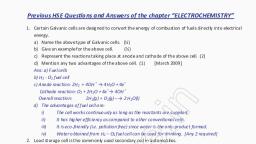
Questions and Answers (HGE Board Exam), , ("SE MARCH 2010), 1. From = mical series, Cu can, displa seal ativer nitrate solution, , (a), , wo, , Represent the cell constructed with, silver and copper electrodes, , Write down the reaction taking place, at the anode, , (c})_ Write down the reaction taking place, , @, , Ans: (a), (b), , at the cathode, , Write Nernst equation for the above, cell reaction, , Cu(s)/ Cu (aq)//Ag*(aq)/ Ag, Cu{s) + Cu?*(aq) + 2e, , , (c), (d), , Agtiaq) + e-> Ants), , Cell reaction is, Cu(s) + 2Ag*(aq) -» Cu**(aq) + 2Ag(s), , Nernst equation can be written as, , | 2.303 RT, [Cu, Boag = Bag — FOE tog OF or, , ‘Cu?*, , 0.059, 8 iag'f at 298 K, , —_—_, , Eee = Econ ~ 2, , (HSE MARCH 2011), , 2., , The limiting molar conductivity of an, , . electrolyte is obtained by adding the, limiting molar conductivities of cation and, anion of the electrolyte., , , , a
Page 2 :
26, , (a) Name the above law, , (b) What is meant by Mi, conductivity?, , (c) Explain how conductivi, ments help to determine, tion constant of weak ele, acetic acid., , (4) Explain the change of:, molar conductivity of, dilution., Kohlrausch’s law a1 ', , imiti jue Oo!, maximum or limiting V!, ° wale conductivity of an electrolyte, , when its concentration approaches, zero is called the limiting molar, , conductivity (4%) of the electrolyte., , (c) Degree of dissociation (a) of the weak, electrolyte such as acetic acid at any, concentration can be determined by, experimentally determining its molar, , miting molar, , ty measurethe ionisactrolyte like, , conductivity and, a solution with, , Ans: (a), , afin, conductivity (A,,). % 7°, ‘m, where »Qis the limiting molar, conductivity., , Ionisation constant K, of a weak, electrolyte can be calculated using the, , 2, , Ca, relation, K, Fen’ where C is the, , concentration. .,, , (@) The conductivity (K) of an electrolytic, solution decreases with decrease in, concentration (or increase in dilution), This is due to the decrease in, the number of ions per unit volume., But the molar conductivity of any, electrolytic solution increases with, dilution. For a strong electrolyte, it is, due to decrease in the interionic, attractive forces. For weak electrolytes it is due to increase in the degree, of dissociation,, , 'HSE SAY 2011), , 3. The standard electrode potentials of some, electrodes are given below:, , , , (@) Find the value of K, (equilibrium constant) in the Daniell cell at 298 K., Ans:(a) Yes, , (HSE MARCH 2012), 4., , E, =-0.76V, Bian oy = +0-34V,, EL. =+0.80V, Evy y,) =, , (a), , (b) Zinc or copper which can displace, , (c) What is the reaction taking place at, , Focus Area Topics 2022 ~ Chemistry ~ Ii, , (Zn?* Zn}, , ‘Ag’ Ag, Can CuSO, solution be kept in silver, vessel?, , hydrogen from dil. H,SO,?, , SHE when it is connected to Ag/Ag+, electrode to form a galvanic cell?, , , , , , , Since the standard reduction potential of silver is more than that of copper, it is less reactive than copper and, hence cannot react with CuSO,., , (b) Zinc with negative standard electrode, potential can displace H, from dil., H,SO,. But copper with a positive, , “ standard electrode potential cannot, displace hydrogen from dil. H,SO,., , (c) The electrode potential of Ag is higher, than that of hydrogen. So when silver, electrode is connected with S.H.E.,, silver will act as cathode and S.H.E. will, act as anode. Hence, the reaction, taking place at S.H.E. is, , 1 ——, gaa > Ag + €, , (d) At 298 K, for Daniell cell,, , 0.059, , Ean = —p— log K,, 2 Bk., , (cell) =, 2% ey 2x11, , 0.059 0.059, “. K, = antilog (37.29) = 1.95 x 10°”, , , , , , log K, = 37.29, , Daniell cell is a galvanic cell made of zinc, and copper electrodes., , (i) Write anode and cathode reactions in, Daniell cell, , (ii) Nernst equation for the electrode reaction M™* +ne > M is, , , , Qt. ee
Page 3 :
Bay ® Be,, , al, Derive Nernst equation for Daniell Cell,, OR, , Leclanche cell, lead storage cell and, , fuel cell are galvanic cells having, different uses,, , Among these, Leclanche cell is a, Primary cell and lead storage cell is a, secondary cell., , Write any two differences between, Primary cells and secondary cells., , What is a fuel cell?, , Write the overall cell reaction in, H, - O, fuel cell., , Daniell cell can be represented as, Zn | Zn || Cu* | Cu, Anode reaction:, , (i), , Gi), , (iii, , Zn (s) > Zr?*(aq) + 2eCathode reaction: 1, Cu*(ag) + 2e- Cu(s), , (ii) The electrode reaction in Daniell cell, “is Zn (s) + Cu2* (aq) > Zn®* (aq) + Cu (s), Ey Exsttode ~ Panede., 2.303 RT 1, Brats = Baya, = Pam op PRG, 2.303RT, 1, Ease = Ena 2B aim OF [Zn], 2.303 RT 1, os Bagg “(Bom ~ 2808 Fg |, 2.303RT 1, (2m 2F ea), , 2.303 RT, , Ea =(Ex-e 7 em) ~ OF, , , , OR, , Primary cell: The electrode reactions are, not reversible, These are not recharge-able., e.g., Dry cell, Mercury cell, , Secondary cell: The electrode reactions are, reversible. These are rechargeable., , , , Blectrochemistry, , e.g., Lead storage cell., converts, ii) A fuel cell is a device that, " the energy produced by the combus-tion of fuel into electrical energy. The, fuels used are H,, CH,, CO, etc. The, ’ common fuel cell is H,- O, fuel cell., (iil) The overall cell reaction in H,-O, fuel, cell is 2H, + O,—+ 2H,O, , (HSE SAY 2012 and HSE SAY 2013), , 5. Innumerable number of galvanic cells can, be constructed on the pattern of Daniell cell, , by taking combination of different half cells., , (i) What is galvanic cell?, , (ii) Name the anode and cathode of the, Daniell cell., , (iii) Write the name of the half cell, represented by Pt (s)/H,(g)/H+(aq)., , (iv) What is the potential of the above half, , Pa “cell at all temperatures?, (vy) Write the use of above cell., , Ans: (i) The device used for converting chemical energy into electrical energy is, known as an electrochemical cell or, galvanic cell., , (ii) In Daniell cell, zinc electrode is anode, and copper electrode is cathode., , (iii) Standard hydrogen electrode (SHE), , (iv) The potential 6f SHE is zero., , (v) SHE is used as the reference electrode, to determine the electrode potentials, of other electrodes., , (HSE MARCH 2013), , 6. With decrease in concentration of an, , electrolytic solution, conductivity (K), decreases and molar conductivity (a), increases., , (i) Write the equation showing the, relationship between conductivity and, molar conductivity, , How will you account for the increase, in molar conductivity with decrease in, concentration?, , (ti), , , , i,
Page 4 :
(iii) Limiting molar conductivity (*,) of a, strong electrolyte can be deter-mined, by graphical extrapolation method., Suggest a method for the determination of limiting molar conductivity of a, weak electrolyte, taking acetic acid, (CH,COOH) as example., , K x 1000, Molar conductivity (Am ) * —1, , M + Molarity K - Conductivity, , (ii), Molar conductivity increases with, decrease in concentration. This is, because of the decrease in interionic, attraction for strong electrolytes. For, weak electrolytes, it is due to the, increase in the number of ions due to, greater dissociation., , /° of acetic acid can be calculated from, the values of the molar con-ductivity, at infinite dilution of three strong, electrolytes CH,COONa, HCI and NaCl, as shown below:, , Ans: (i), , (iii), , , , , , , Weak electrolyte, , Strong electrolyte, , vc, An (CH,COONa) = 2° (CH,COO) +.°Na* — (1), , A° (HCI) = 0°(H*) +2°(CI-), , A°(NaCl) = 1°(Na*) +2°(CI-), , (1)+(2) - (3) >, , 1° (CH,COOH) = 0°(CH,COONa) +, °(HC1)- 0°(NaCt), , — (2), “= (3), , (HSE MARCH 2014), , 7. (a) The cell reaction in Daniell Cell is, Zn(s) + Cu?*(aq) + Zn?*(aq) + Cus) and, Nernst equation for single electrode, potential for general electrode, reaction, , M"* (aq) + ne> ——> M(s) is, , , , Focus Area Topics 2022 ~ Chemistry _, , 2.303RT ,,,_[M), = Eheim ae 8 iM], ation for Danie, , wen, Derive Nernet equ!, Cell ;, imary cell whi, (b) Daniell Cell is 4 pri le, lead storage cell is 4 secondary cel, Write any one difference betwee,, primary celle and secondary cells,, Refer to the Answer of HSE MARcy, 2012, , (HSE SAY 2014), 8. Fuel cells are special type of galvanic cells,, (a) (i) What are galvanic cells?, (ii) Write any two advantages of fue|, cells, , Ans: (a), , (}) Write the electrode reactions ig, H, - O, fuel cell :, , Ans: (a) (i) A galvanic cell is a device which, can convert chemical energy into, electrical energy., , e.g., Daniell cell., , (ii) 1. More efficiency, 2. Does not cause pollution, (b) - anode, 2H,(g)+ 40H (aq) ——> 4H,O(1) + 4@, cathode, 0,(g)+ 2H,O(l)) + 4€—+ 40H (aq), , cell reaction, , 2H,(9) + 0,(g) + 2H,0(!), (HSE MARCH 2015), 9. You are supplied with the following substances:, , Copper rod, Zinc rod, Salt bridge, , "1 5 , two glass, beakers; a piece of wire, 1:M CuSO solution,, 1 MZnSO, solution. ‘i, , (a) Represent the cell made using the, above materials, , () (i) Write the Nernst i, soma cai equation for the, , (ii) Calculate the Standard fina of the, cell if E° (Zn) Zn) = 0.76V,, (AP/Cuy=+034y, , , , , , itt
Page 5 :
a=, , o), , , , , 10. (a), , ; 11a), , (c), , Ans: (a), _ 0, (c), , gas: (a) Zn |Znso, CuSO, jo,, , S iM im 5, , (i) Refer to answer of Hse MARCH 2012, , (ii) ES, = Ro Ry,, = 0.34 ~.0,76 « lav, , SE BAY 2015), , Conductance (G), conduc:, , \ tivity (K) and, molar conductivity (A,,) are terms used, in electrolytic conduction,, , (i) Write any two factors on which, conductivity depends on., , How do conductivity and molar, , conductivity vary with concentration of electrolytic solution?, , Write any one difference between, Primary cell and secondary cell., , i) Temperature, concentration of, electrolyte, , Conductivity (K) of an electrolyte, decreases with decrease in concentration of electrolytic solution., , Molar conductivity (a) of an electrolyte increases with decrease in, concentration of electrolytic solution., , Primary cells cannot be recharged, while secondary cells can be recharged., Primary cells are short lived while, secondary cells have long life., , (ii), , (ii), , : {HSE MARCH 2016), , Which of the following is a secondary, cell?, , (a) Dry cell (b) Leclanche cell, (ce) Mercury cell (d) None of these, , What is the relationship between, resistance and conductance?, , One of the fuel cells uses the reaction, of hydrogen and oxygen to form water., Write down the cell reaction taking, place in the anode and cathode of that, fuel cell. :, , None of these, Inversely proportional. G= 1/R, Refer to answer of HSE SAY 2014 (b), , , , (| eimai, , (HSE BAY 2016), , 12. Galvanic celle are classified into primary, and secondary cells, , (a), , (b), , Ans: (a), , (b), , Write any two differences between, primary cell and secondary cell., (i) What is a fuel cell?, , (li) Write the overall cell reaction in, H, - O, fuel cell., , Refer to the Answer of HSE 2015 SAY (b), , Refer to the Answer of HSE MARCH, 2012 (ti, ili), , (HSE MARCH 2017), , 13. (a), , 0), , ), , Ans: (a), (), , (c), , (HSE SAY 2017), , 14. (a), , (b), , Represent the galvanic cell based on, the cell reaction given below:, , Cu +2Ag* —>Cu™ +2Ag, Write the half cell reactions of the, above cell., , a’, for NaCl, HCland NaAc are 126.4,, 425.9 and 91.0 S cm? mol" respectively., , Calculate »?, for HAc., , Cu| Cu” || Ag* | Ag, , Atanode : Cu——>Cu’? + 2e", , At cathode : 2Ag* + 2e° —>2Ag, , an (HAC), , ~ ALWaAc) +22 (HCY ~ A2NaCI, , = 91+ 425.9- 126.4, = 390.5 Scm? mol, , Identify the weak electrolyte from the, following:, , (i) KA (ii) Nac, (iii) KBr (iv) CH,COOH, , Kghirausch’s law helps to determine, the degree of dissociation of a weak, electrolyte ata given concentration., , (i) State Kohlrausch's law., , , , 7 No