Page 1 :
CHEMICAL, HEMICAL KINETICS- Previous HSE Questions, 1. Differentiate molecularity and order of a reaction., (2), 2. Write the Arrhenius equation and identify the terms in it., (2), [SAY 2019], 3. For the reaction, 2NO(g) + O2(g), 2NO2(g), the rate law is given as, Rate : k[NO]2 [O2]. The order of the, reaction with respect to O2 is …………. (1), 4. Examine the graph given below. Identify the integrated rate equation and the order of the reaction, corresponding to it., , 5., 6., 7., 8., , (2), tion at 293, 293K is 1.7 x 10 s . When the temperature is increased by 20 K, the rate, The rate constant of a reaction, 6 -1, constant is increased to 2.57 x 10 s . Calculate Ea and A of the reaction., (3), [March 2019], The rate of a reaction quadruples when the tem, temperature changes from 293 K to 313 K. Calculate the energy of, activation, ctivation of the reaction assum, assuming that it does not change with temperature., (3), What is the order of a reaction, if its half life is ind, independent, endent of initial concentration?, concentration, (1), [June 2018], For hydrolysis of methyl acetate in aqueous solution, the following results were observed., observ, 5, , -1, , t/s, 0, 30, 60, CH3COOH, 0.60, 0.30, 0.15, C/mol L-1, Show that it follows pseudo first order reaction as the concentration of water remains constant. (3), 9. Identify the order, er of reaction if the unit of rate constant is mol L-l s-l., (1), [March 2018], 10. The effect of temperature on rate of reaction is given by Arrhenius equation., i), Write Arrhenius equation., (1), ii) Define activation energy (Ea) (1), iii) Rate constant k2 of a reaction at 310K is two times of its rate constant k1 at 300 K. Calculate activation, energy of the reaction. (log 2 = 0.3010 and log 1 = 0) [SAY 2017], 11. a) Plot a graph showing variation in the concentration of reactants against time for a zero order reaction. (1), b) What do you mean by zero order reaction? (1), c) The initial concentration of the first order reaction, N2O5(g), 2 NO2(g) + ½ O2(g), was 1.24 x 10⁻² mol L-1, at 300 K. The concentration of N2O5 after 1 hour was 0.20 x 10⁻² mol L-1. Calculate the rate constant of the, reaction at 300 K., (2), [March 2017], 12. Rate of a reaction is the change in concentration of any one of the reactants or products in unit time., a) Express the rate of the following reaction in terms of reactants and products, 2NO(g) + O2(g) → 2NO2(g), (1), b) (i) N2O5(g) → 2NO2(g) + ½ O2(g) is a first order reaction. Find the unit of k. (1), (ii) Calculate the time required for the completion of 90% of a first order reaction. (k = 0.2303 s-1), (2), [SAY 2016], 13. (i) The molecularity of the reaction 2NO + O2 → 2NO, is:, a) 5, b) 2, c) 3, d) 0, (1), Chemical Kinetics, , Page 1
Page 2 :
(ii) What do you mean by rate of a reaction ? (1), (iii) What will be the effect of temperature on rate of a reaction ?, (1), -14 -1, (iv) A first order reaction is found to have a rate constant, k = 5.5 x 10 s . Find out the half-life of the, reaction., (1), [March 2016], 14. Integrated rate expression for rate constant of a first order reaction R → P is given by k = 2.303 log[R]0 ., t, [R], i) Derive an expression for half life period of first order reaction. (2), ii) A first order reaction has a rate constant 1.15 x 10⁻³ s-1. How long will 5 g of the reactant take to reduce 3g?, [SAY 2015], 15. The terms order and molecularity are common in chemical kinetics., a) What do you mean by order and molecularity?, (2), b) i) Write two factors influencing rate of a reaction. (1), ii) Write Arrhenius equation., (1), [March 2015], 16. a) Consider a general reaction aA + bB → cC + dD. The rate expression for the reaction is r = k[A]x[b]y, i), Establish the significance of (a+b) and (x+y) in terms of order and molecularity. (1), ii), Write any two differences between order and molecularity., (2), b) “Reactions with zero order are possible, but zero molecularity is not”. Justify the statement. (1) [March `14], 17. a) Unit of rate constant (k) of a reaction depends on the order of the reactions. Values of ‘k’ of two reactions, are given below. Find the order of each reaction., i), k = 3 x 10⁻² mol L-1 S-1, ii), k = 5 x 10⁻³ mol-1 L S-1 (1), b) i) Write integrated rate equation for a first order reaction. (1), ii) Write the relation between half life (t½) and rate constant (k) of a first order reaction., (1), -2 -1, iii) Rate constant of a reaction is 5 x 10 S . Find the half life (t½) of the reaction., (1), [SAY 2014], 18. The conversion of a molecule A to B follows second order kinetics., a) Write the rate equation for the second order reaction. (1), b) If the concentration of A is increased to four times, how will it affect the formation of B., (2), c) Indicate the order and Molecularity of the reaction given below:, +, C12H22O11, H, C6H12O6 + C6H12O6, (1), (SAY 2013), 19. a) Zero order reaction means that the rate of a reaction is independent of the concentration of the reactants., i), Write an example for a zero order reaction., (1), ii), Write the integral rate expression for the zero order reaction, R, P. (1), b) The temperature dependence of rate of a chemical reaction can be accurately explained by Arrhenius, equation. With the help of Arrhenius equation, calculate the rate constant for the first order reaction, C2H4 + HI at 700K. Energy of activation (Ea) for the reaction is 209 kJ/mol and rate constant at, C2H5I, 600 K is 1.6x10⁻⁵ s-1 (R = 8.314 J/K/mol). (2), (March 2013), 20. Rate of a reaction is the change in concentration of any one of the reactants or any one of the products in unit, time., i), Express the rate of the following reaction in terms of reactants and products: 2HI, H2 + I2 (1½), 2, ii), If the rate expression for the above reaction is rate = k[HI] , what is the order of the reaction ? (½ ), iii), Define order of a reaction., (1), iv), Whether the Molecularity and order of the above reaction are the same? Give reason (1) [March 2012], 21. For a first order reaction half life period is independent of initial concentration of its reacting species., i), What is mean by half life period of a reaction? (1), Chemical Kinetics, , Page 2
Page 3 :
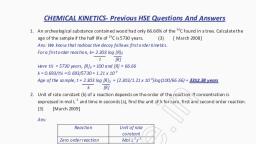
By deriving the equation for t½ of first order reaction, prove that t½ is independent initial concentration, of reacting species., (3), [SAY 2012], 22. The hydrolysis of an ester in acidic medium is a first order reaction., a) What do you mean by a first order reaction?, (½ ), b) What is the relation between Rate constant and Half life period of a first order reaction? (½ ), c) Half life period of a first order reaction is 20 seconds. How much time will it take to complete 90% of the, reaction? (3), [March 2011], 23. The value of rate constant k of a reaction depends on temperature. From the values of k at two different, temperatures, the Arrhenius parameters Ea and A can be calculated., ii), , a) The rate constants of a reaction at 600K and 900K are 0.02s-1 and 0.06s-1 respectively. Find the values of Ea, and A., (3), b) Write the unit of rate constant of a 2nd order reaction if concentration is in mol L-1 and time in S.(1) [SAY 11], 24. The order of a reaction can be zero and even a fraction but Molecularity cannot be zero or a non-integer., i), What do you mean by the order of a reaction? (1), ii), What is Molecularity of a reaction?, (1), iii), The conversion of molecules A to B follows second order kinetics. If concentration of A is increased to, three times, how will it affect the rate of formation of B?, (2), [March 2010], 25. The value of rate constant k of a reaction depends on temperature. From the values of k at two different, temperatures, the Arrhenius parameters Ea and A can be calculated., The rate constants of a reaction at 1000K and 1060K are 0.01M-1S-1 and 0.10M-1S-1 respectively. Find the values, of Ea and A., (3), [March 2010], 26. Unit of rate constant (k) of a reaction depends on the order of the reaction. If concentration is expressed in mol, L-1 and time in seconds (s), find the unit of k for zero, first and second order reaction. (3) [March 2009], 27. An archeological substance contained wood had only 66.66% of the 14C found in a tree. Calculate the age of the, sample if the half life of 14C is 5730 years., (3), [ March 2008], ------------------------------------------------------------------------------------------------------------------------, , Chemical Kinetics, , Page 3