Page 1 :
Chapter, , 16, , The p-Block Elements, Solutions, SECTION - A, Objective Types Questions, 1., , On moving down the group 13 density, (1) Increases, , (2), , Decreases, , (3) First decreases then increases, , (4), , Remains same, , Sol. Answer (1), Density =, , Mass, Volume, , On moving down the group atomic mass increases as well as due to addition of shells, there is an increase, in volume. But mass increases at a rate faster than volume., 2., , High melting point of boron is due to its existance as, (1) Small covalent molecule, , (2), , Giant covalent molecule, , (3) Giant covalent solid, , (4), , Giant ionic molecule, , Sol. Answer (3), Boron exists as a giant covalent solid due to which its melting point is high., 3., , Elements of group 13 mainly form covalent compounds because, (1) Size of ions is small, , (2), , Sum of three ionization energies is very high, , (3) Electronegativity values are high, , (4), , All of these, , Sol. Answer (4), Due to small size of ions, high electronegative values and high sum of the three ionization energies, the, elements of group 13 form covalent compounds., 4., , Oxidation state shown by group 13 elements is, (1) +1 and +3, , (2), , +1, +2 and +3, , (3), , +2, +3 and +4, , (4), , +1 and +4, , Sol. Answer (1), Boron shows +1 and +3 oxidation states., Aakash Educational Services Pvt. Ltd. - Regd. Office : Aakash Tower, Plot No.-4, Sector-11, Dwarka, New Delhi-75 Ph.011-47623456
Page 2 :
40, 5., , The p-Block Elements, , Solution of Assignment, , Which one of the following elements of group 13 can react with alkali solutions to give H2 gas?, (1) Boron, , (2), , Aluminium, , (3), , Gallium, , (4), , All of these, , Sol. Answer (4), Boron, aluminium and gallium are all elements of group 13., 6., , Lewis acid character of boron trihalides is as follows, (1) BI3 > BBr3 > BCl3 > BF3, , (2), , BF3 > BCl3 > BBr3 > BI3, , (3) BCl3 > BF3 > BBr3 > BI3, , (4), , BI3 > BBr3 < BF3 < BCl3, , Sol. Answer (1), Acidic strength is inversely proportional to back-bonding as back-bonding decreases from BF3 to BI3, hence, the Lewis acidic strength will be, BF3 < BCl3 < BBr3 < BI3., 7., , Dimer Al2Cl6 is formed because, (1) Al is electron rich, (2) Aluminium is having lone pair of electron, (3) Aluminium forms coordinate bonds with chlorine to complete its octet, (4) Aluminium donates lone pair to form bridge, , Sol. Answer (3), , Cl, , Cl, , Cl, , Al, , Al, , Cl, Cl, Cl, Aluminium forms coordinate bonds with chlorine to complete its octet., 8., , When we heat borax strongly then it will yield the following compound, (1) NaBO2, , (2), , B2O3, , (3), , Na2B4O7, , (4), , Both (1) & (2), , (3), , 3, , (4), , 4, , Sol. Answer (4), , Pt, Loop, , Na2B4O7.10H2O, , Na2B4O7 + 10H2O, Anhyd Borax, , , NaBO2 + B2O3, Glassy bead, , 9., , –, , B(OH)3 accept how many OH ions?, (1) 1, , (2), , 2, , Sol. Answer (1), , H, , O, , B, , O, O, , H, H, , + H2O, , H+[B(OH)4]–, , It does not lose 3H+ but accepts one lone pair from H2O., Aakash Educational Services Pvt. Ltd. - Regd. Office : Aakash Tower, Plot No.-4, Sector-11, Dwarka, New Delhi-75 Ph.011-47623456
Page 3 :
Solution of Assignment, , The p-Block Elements, , 41, , 10. Boric acid is having a polymeric type structure because of its, (1) Basic nature, , (2), , Acidic nature, , (3), , Hydrogen bonds, , (4), , Co-ordinate bonds, , Sol. Answer (3), Boric acid is layered structure. B(OH)3 units are joined by hydrogen bonds and form two dimensional sheet., 11. Select the incorrect statement for B2H6, 3, , (1) It contains B—B ionic bond, , (2), , Each boron is sp hybridised, , (3) It has two types of hydrogen bonds, , (4), , All of these, , (3), , Four bonds, , Sol. Answer (1), , H, , H, , H, B, , B, H, , H, , H, , It does not contain B–B bonds., 12. In diborane each boron forms, (1) Two bonds, , (2), , Three bonds, , (4), , Five bonds, , (4), , Aluminium carbide, , Sol. Answer (3), In diborane each boron forms four bonds., 13. Which one of the following compounds has similar structure to that of graphite?, (1) Boron nitride, , (2), , Boron carbide, , (3), , Aluminium oxide, , Sol. Answer (1), Boron nitride has graphite-like structure., 14. The number of sigma and pi bonds present in inorganic benzene are respectively, (1) 3, 12, , (2), , 12, 3, , (3), , 3, 3, , (1) Resistance to corrosion, , (2), , Poor conductivity, , (3) Heaviness, , (4), , All of these, , (4), , 12, 12, , Sol. Answer (2), Borazine B3N3H6 is called inorganic benzene., , H, H, , H, , N, , B, , B, , H, , N, B, , N, , H, , H, , H, , H, , H, Borazine, , +, N, , –, B, , N+, –, B, , –B, N+, , H, , H, , H, , 15. Aluminium is used for making alloys because of its, , Sol. Answer (1), Due to the lightness and resistance to corrosion aluminium is used for making alloys., Aakash Educational Services Pvt. Ltd. - Regd. Office : Aakash Tower, Plot No.-4, Sector-11, Dwarka, New Delhi-75 Ph.011-47623456
Page 4 :
42, , The p-Block Elements, , Solution of Assignment, , 16. Group 14 elements have general electronic configuration, 2, , (1) ns, , (2), , 2, , 4, , ns np, , (3), , 2, , 6, , ns np, , (4), , 2, , 2, , ns np, , Sol. Answer (4), General electronic configuration of group 14 elements is ns2np2., 17. Tendency of carbon for catenation is because carbon–carbon atom bond energy is, (1) Low, , (2), , High, , (3), , Zero, , (4), , Negative, , Sol. Answer (2), Due to high carbon-carbon atom bond energy, the tendency of carbon for catenation is generally high., 18. All elements except carbon have tendency to show maximum covalency of six, (1) Due to absence of vacant d-orbitals, , (2), , Due to presence of vacant d-orbitals, , (3) Due to presence of partially filled d-orbitals, , (4), , Due to presence of completely filled d-orbitals, , Sol. Answer (2), All elements except carbon have tendency to show maximum covalency of six due to the presence of vacant, d-orbitals., 19. Most abundant metal by mass in earth crust is, (1) Silicon, , (2), , Germanium, , (3), , Aluminium, , (4), , Arsenic, , Sol. Answer (3), Next to silica and oxygen, aluminium is the most widely distributed element. It is present to the extent of, 7.3 percent in the earth's crust., 20. Which one of the following elements is a metalloid?, (1) Carbon, , (2), , Germanium, , (3), , Lead, , (4), , All of these, , Sol. Answer (2), Carbon – Non-metal, , (On moving down the group the metallic character increases), , Germanium – Metalloid, Lead – Metal, 21. On moving down the group, acidic nature of oxides of group 14, (1) Decreases, , (2), , Increases, , (3) Remains same, , (4), , Increases then decreases, , Sol. Answer (1), The acidic nature decreases with increase of atomic number of the oxides. CO2 and SiO2 are acidic and GeO2,, SnO2 & PbO2 are amphoteric. Basic character of both mono and dioxide increases down the group., 22. Which one of the following elements forms double or triple bond involving p-p bonding?, (1) Carbon, , (2), , Silicon, , (3), , Germanium, , (4), , Tin, , Sol. Answer (1), Carbon atoms form double or triple bonds involving p-p bonding. Carbon shows anomalous behaviour due, to its smaller size, higher electronegativity, higher ionization enthalpy and unavailability of d-orbitals., Aakash Educational Services Pvt. Ltd. - Regd. Office : Aakash Tower, Plot No.-4, Sector-11, Dwarka, New Delhi-75 Ph.011-47623456
Page 5 :
Solution of Assignment, , The p-Block Elements, , 43, , 23. Allotropy is due to, (1) Difference in the number of atoms in the molecules, (2) Difference in the arrangement of atoms in the molecules in the crystal, (3) Difference in chemical properties, (4) All of these, Sol. Answer (2), Allotropy : The existence of a chemical element in two or more forms, which may differ in the arrangements, of atoms in crystalline solids., 24. In diamond, carbon have, 3, , (1) sp hybridisation, , (2), , sp hybridisation, , (3), , 2, , sp hybridisation, , (4), , 3 2, , sp d hybridisation, , Sol. Answer (1), In diamond each carbon is joined to other four carbon tetrahedrally and carbon-carbon bond length is 1.54Å, and the bond angle is 109°28' having sp3 hybridisation on each carbon., 25. Graphite has, (1) 2-D sheet structure, (2) Van der Waals forces between different layers, 2, , (3) sp hybridised carbon linked with other three carbon atoms in hexagonal planar structure, (4) All of these, Sol. Answer (4), In graphite each carbon is ‘sp2’ hybridised. It has a layered structure. These layers are attracted by van der, Walls forces., 26. In graphite, the bond is, (1) Ionic, , (2), , Covalent, , (3), , Co-ordinate, , (4), , Metallic, , Sol. Answer (2), In graphite a carbon atom is attached to another carbon atom i.e. the two atoms bonded together are of equal, electronegativity. Thus, a covalent bond is formed., 27. Which one of the following is properties of CO gas?, (1) It is a colourless gas, , (2), , It is an odourless gas, , (3) It is a neutral oxide, , (4), , All of these, , Sol. Answer (4), Carbon monoxide is a colourless, odourless gas. It is also a neutral oxide as it does not form salts when, reacted with acids or bases., 28. Carbonic acid is a, (1) Weak tribasic acid, , (2), , Weak dibasic acid, , (3) Strong tribasic acid, , (4), , Strong dibasic acid, , Aakash Educational Services Pvt. Ltd. - Regd. Office : Aakash Tower, Plot No.-4, Sector-11, Dwarka, New Delhi-75 Ph.011-47623456
Page 7 :
Solution of Assignment, , The p-Block Elements, , 45, , 34. In which of the following reactions, products given are not correct?, , (1) (NH4 )2 Cr2O7 , N2 4H2O Cr2O3, , (2), , Ba(N3 )2 Ba 3N2, , , , , (3) 3Mg N2 , Mg3N2, , (4), , NH4 Cl NaNO2 NaCl NH3 NO2, , Sol. Answer (4), The correct reaction is, , NH 4Cl + NaNO 2 , N 2 + 2H 2O + NaCl, 35. Oxide of nitrogen which is acidic in nature and blue coloured liquid at –30°C, (1) N2O, , (2), , NO, , (3), , N2O3, , (4), , NO2, , Sol. Answer (3), N2O3 is an acidic oxide and present as a blue coloured liquid at –30°C. N2O and NO are neutral whereas, NO2 is brown coloured., 36. Covalency and oxidation numbers of nitrogen in N2O5 is respectively, (1) 5, +5, , (2), , 4, +5, , (3), , 3, +3, , (4), , 3, +5, , Sol. Answer (2), Covalency of N is 4 in N2O5 and its oxidation state is +5., , O, O, , N, , O, N, , O, O, , As clear from the structure of N2O5, covalency of nitrogen is 4 but the oxidation state is +5., , x– 2, N 2 O 5 is a neutral compound. Let the oxidation state of N2O5 be x., (2 × x) + (–2 × 5) = 0, 2x – 10 = 10, x=5, 37. Which has maximum melting point?, (1) NH3, , (2), , PH3, , (3), , AsH3, , (4), , SbH3, , Sol. Answer (1), NH3 has maximum melting point among the hydrides of group 15 because NH3 molecules are associated, through H-bonding. Thus H-bonding is absent in other hydrides of group 15, as a result their melting point, is lower than that of NH3., 38. In which of the following N–N bond is not present?, (1) N2O5, , (2), , N2O, , (3), , N2O4, , (4), , N2O3, , Sol. Answer (1), Structure of N2O5 shows the absence of N–N bond, , O, O, , N, , O, N, , O, O, , Aakash Educational Services Pvt. Ltd. - Regd. Office : Aakash Tower, Plot No.-4, Sector-11, Dwarka, New Delhi-75 Ph.011-47623456
Page 8 :
46, , The p-Block Elements, , Solution of Assignment, , 39. Which set of oxide of nitrogen is paramagnetic in monomeric state?, (1) NO, N2O, , (2), , NO2, N2O, , (3), , NO, NO2, , (4), , N2O, NO, NO2, , Sol. Answer (3), NO and NO2 are both odd electron species. Due to the presence of odd electron, they are paramagnetic in, monomeric state., 40. The incorrect statement among the following is, (1) Reducing character of hydrides of group 15 increases down the group, (2) Basicity of hydrides of group 15 increases down the group, (3) Phosphorus and arsenic can form p–d bond but not nitrogen, (4) NCl5 does not exist, Sol. Answer (2), Hydrides of group 15 are basic due to their ability to donate lone pair of electrons. On moving down the group,, the size of atom increases and consequently charge density decreases. Therefore the lone pair is less available, for donation. Hence basicity decreases down the group., 41. Metal which become passive with conc. HNO3, (1) Cr, , (2), , Zn, , (3), , Al, , (4), , Both (1) & (3), , Sol. Answer (4), Both chromium and aluminium become passive on reaction with conc. HCl because of the formation of oxide, on the surface of the metal., 42. In brown ring test for nitrate ions, brown ring is formed having composition, (1) [Fe(H2O)6]2+, , (2), , [Fe(H2O)5NO]2+, , (3), , [Fe(H2O)5NO]3+, , (4), , [Fe(H2O)5NO2]2+, , Sol. Answer (2), In the brown ring test, the reaction takes place as, ⎡⎣Fe H 2O 6 ⎤⎦, , 2, , + NO , ⎡⎣Fe H 2O 5 NO ⎤⎦, , 2, , + H 2O, , Brown, , NO is formed as a result of oxidation of Fe2+ to Fe3+, , NO 3 – + 3Fe 2+ + 4H + , NO + 3Fe 3+ + 2H 2O ., 43. Allotrope of phosphorus which is polymeric consisting of chains of P4 tetrahedral linked together is, (1) White phosphorus, , (2), , Red phosphorus, , (3) Yellow phosphorus, , (4), , Both (1) & (2), , Sol. Answer (2), Red phosphorus is polymeric in nature consisting of chain of P4 tetrahedra linked together, , P, P, , P, P, , P, , P, , P, P, , P, , P, , P, P, , Aakash Educational Services Pvt. Ltd. - Regd. Office : Aakash Tower, Plot No.-4, Sector-11, Dwarka, New Delhi-75 Ph.011-47623456
Page 9 :
Solution of Assignment, , The p-Block Elements, , 47, , 44. Which is dibasic?, (1) Orthophosphoric acid, , (2), , Pyrophosphoric acid, , (3) Orthophosphorus acid, , (4), , Hypophosphorus acid, , Sol. Answer (3), Orthophosphorus acid to H3PO3 which is a dibasic acid, , O, P, H, , OH, , OH, , Orthophosphorus acid contains two ionizable hydrogen and behaves as dibasic acid., 45. Cyclotrimeta phosphoric acid has total number of P=O & P–O bonds respectively, (1) 5, 3, , (2), , 3, 9, , (3), , 3, 6, , (4), , 5, 6, , Sol. Answer (2), The structure of cyclotrimetaphosphoric acid is, , O, HO, , O, P, , P, , O, , P, O, , O, OH, , O, OH, , As shown in the figure, cyclotrimetaphosphoric acid contain 3 P=O bond and 9 P–O single bond., 46. The one with lowest negative electron affinity in group 16 is, (1) Oxygen, , (2), , Sulphur, , (3), , Selenium, , (4), , Tellurium, , Sol. Answer (1), Because of small size of oxygen atom, addition of additional electron is not much favourable. On moving down, the group size of p-orbitals increases and it can easily accommodate the additional electron. Therefore among, group 16 elements, O has lowest electron affinity. Higher the stability of anion formed, higher is the negative, value of electron affinity., 47. The hybridisation and shape of SF4 is respectively, (1) sp3d2, square planar, , (2), , sp3d2, octahedral, , (3) sp3d, see-saw, , (4), , sp3d, trigonal bipyramidal, , Sol. Answer (3), In SF4, there are four bond pairs and one lone pair of electron. This result in sp3d hybridization of s and the, shape becomes see-saw, , F, F, , S, , F, F, , Aakash Educational Services Pvt. Ltd. - Regd. Office : Aakash Tower, Plot No.-4, Sector-11, Dwarka, New Delhi-75 Ph.011-47623456
Page 13 :
Solution of Assignment, , The p-Block Elements, , 51, , 65. Structure of XeO2F2 is correctly represented by, (1), , O, , F, , F, , (2), , Xe, , Xe, , O, , F, , F, , (3), , O, , O, , (4), , F, , O, , Both (2) & (3), , Xe, , O, , F, , Sol. Answer (2), The hybridization in XeO2F2 is sp3d but due to the presence of one lone pair of electron, its shape is distorted, trigonal bipyramidal., , SECTION - B, Objective Type Questions, 1., , Boron compounds behave as lewis acids because of their, (1) Acidic nature, , (2), , Covalent nature, , (3) Ionisation energy, , (4), , Electron deficient nature, , Sol. Answer (4), Boron compounds, especially the hydrides are electron deficient compounds which can accept a lone pair, of electrons hence behave as Lewis acids., 2., , The compound that is not a lewis acid is, (1) BF3, , (2), , AlCl3, , (3), , PCl3, , (4), , SnCl4, , Sol. Answer (3), In PCl3 molecule, P-atom has a ‘lone-pair’ of electrons. This lone pair of electrons can be donated to electron, deficient species (Lewis acid). PCl3 can act as a Lewis base., 3., , Borax is, (1) Na2[B4O5(OH)4].8H2O, , (2), , Na2[B4O5(OH)6].7H2O, , (3) Na2[B4O3(OH)8].6H2O, , (4), , Na2[B4O2(OH)10].5H2O, , Sol. Answer (1), Na2B4O710H2O / Na2[B4O5(OH)4]8H2O., Aakash Educational Services Pvt. Ltd. - Regd. Office : Aakash Tower, Plot No.-4, Sector-11, Dwarka, New Delhi-75 Ph.011-47623456
Page 14 :
52, 4., , The p-Block Elements, , Solution of Assignment, , In Diborane, the incorrect statement is, (1) All 6 B–H bond are on same plane, (2) 4 B–H bonds are on the plane and two B–H bonds above and below the plane, (3) It is the 12 e– species, (4) Two BH3 are attached with three centre electron pair bond, , Sol. Answer (1), Diborane (B2H6), , H, H, , H, 120° B 97°, , B, H, , H, H, , Number of atoms present in same plane = 6., 5., , On strong heating, boric acid yields, (1) B, , (2), , B2H6, , (3), , B2O3, , (4), , BO2, , (4), , B + HNO3 , , Sol. Answer (3), 100 C, H 3BO 3 , HBO 2 + H 2O, , 160 C, 4HBO 3 , H 2B 4O 7 + H 2O, , Red hot, H 2B 4O 7 , 2B 2O 3 + H 2O, , 6., , In which of the following reaction boron does not act as reducing agent?, (1) B + CO2 , , (2), , B + Mg , , (3), , B + SiO2 , , Sol. Answer (2), B + Mg , In the above reaction boron oxidises Mg to Mg2+, hence it acts as an oxidising agent., 7., , Which of the following statement is correct?, (1) Boron and aluminium halides behave as Lewis acids, (2) Al forms [AlF6]3– ion but B does not form [BF6]3– ion, (3) The p – p back bonding occurs in the halides of boron and not in those of aluminium, (4) All of these, , Sol. Answer (4), Boron and aluminium halides behave as Lewis acid. Al forms [AlF6]3– ion but B does not form [BF6]3– ion., The p-p back bonding occurs in the halides of boron and not in those of aluminium., Aakash Educational Services Pvt. Ltd. - Regd. Office : Aakash Tower, Plot No.-4, Sector-11, Dwarka, New Delhi-75 Ph.011-47623456
Page 17 :
Solution of Assignment, , The p-Block Elements, , 55, , 17. Dry ice is composed of, (1) Solid He, , (2), , Solid CO2, , (3), , Solid SO2, , (4), , Solid C6H6, , (1) Decreases from top to bottom, , (2), , Increases from top to bottom, , (3) Does not change gradually, , (4), , Metallic character is not seen, , Sol. Answer (2), Dry ice composed of solid CO2., 18. The metallic character of group 14, , Sol. Answer (2), The atomic radii increases down the group and ionization energies decreases. According to periodic trends, the metallic character of group 14 increases down the group., 19. In carbon family the tendency to show +2 oxidation state increases in order of, (1) Ge < Sn < Pb, , (2), , Pb < Sn < Ge, , (3), , Sn < Ge < Pb, , (4), , Sn < Pb < Ge, , Sol. Answer (1), Due to inert pair effect, the stability of +4 oxidation state decreases down the group while the stability of +2, oxidation state increases., 20. Which one of the following is correct statement of fullerenes –C60?, (1) Fullerenes are made by heating of graphite in an electric arc in the presence of Hydrogen, (2) Fullerenes are the only impure form of carbon due to presence of dangling bonds, (3) Both (1) & (2), (4) It contains twenty six-membered rings and twelve five membered rings, Sol. Answer (4), According to the structure of fullerene which has a football-like structure. It contains 20 hexagonal sixmembered ring and 12 pentagonal five-membered ring., 21. The mixture of CO & H2 is known as, (1) Water gas or producer gas, , (2), , Water gas or synthesis gas, , (3) Synthesis gas or producer gas, , (4), , Producer gas, , Sol. Answer (2), , H2O + C, , H2 + CO, , ( H = +131 kJ/mol), , (steam) (Red hot fuel), Water gas or, synthesis gas, , 22. When SiCl4 is allowed to undergo hydrolysis it gives, (1) SiO2 – Silicic acid, , (2), , Si(OH)4 – Silicic acid, , (3) Si(OH)Cl3 – Silicic acid, , (4), , SiCl4 do not undergo hydrolysis, , Sol. Answer (2), SiCl4 + H2O, , Si(OH) 4 + 4HCl, (Silicic acid), , Aakash Educational Services Pvt. Ltd. - Regd. Office : Aakash Tower, Plot No.-4, Sector-11, Dwarka, New Delhi-75 Ph.011-47623456
Page 18 :
56, , The p-Block Elements, , Solution of Assignment, , 23. Which statement is correct for carbon family?, (1) Tin mainly occurs as Cassiterite, SnO2, (2) Silicon is the third most abundant element on earth's crust, (3) Only two isotopes of carbon are present C12 and C13, (4) Germanium is most abundant than other members of carbon family, Sol. Answer (1), Tin mainly occurs as cassiterite (SnO2)., 24. p–p multiple bond is seen in, (1) Mostly carbon, , (2), , All carbon family member, , (3) Sn but not in carbon, , (4), , Boron family and not in carbon family, , Sol. Answer (1), Carbon has smaller size, high electronegativity; higher ionization enthalpy and unavailability of d-orbitals due, to which it can form only p–p bond., 25. A + CO CO2, B + CO CO2, X + O2 CO2, A, B & X respectively are, (1) CH4, Carbon, Fe2O3, , (2), , Fe2O3, ZnO, CH4, , (3) Fe2O3, CH4, ZnO, , (4), , HCOOH, Carbon, CH4, , (3), , Octahedral, , Sol. Answer (2), Fe2O3 + 3CO 2Fe + 3CO2, ZnO + CO CO2 + Zn, CH4 + 2O2 CO2 + 2H2O, 26. The geometry of SiCl4 is, (1) Tetrahedral, , (2), , Square planar, , (4), , Planar triangular, , Sol. Answer (1), , Cl, Si, Cl, , Cl (Tetrahedral geometry), , Cl, , 27. The silicates which contain discrete tetrahedral units are, (1) Sheet silicates, , (2), , Ortho silicates, , (3) Three dimensional silicates, , (4), , Pyrosilicate, , Sol. Answer (2), –, , O, , Si, –, , O, , (Tetrahedral geometry), –, , O, , –, , O, , The orthosilicates contain discrete tetrahedral units., Aakash Educational Services Pvt. Ltd. - Regd. Office : Aakash Tower, Plot No.-4, Sector-11, Dwarka, New Delhi-75 Ph.011-47623456
Page 19 :
Solution of Assignment, , 28., , The p-Block Elements, , Cu Powder, CH3Cl Si , , , x, , 57, , 2H2O, y, , , 570 K, , y & x respectively are, (1) (CH3)2SiCl2, (CH3)2Si(OH)2, , (2), , (CH3)2Si(OH)2, (CH3)2SiCl2, , (3) SiCl4, Si(OH)4, , (4), , Si(OH)4, SiCl4, , Sol. Answer (2), Silicone polymers, Si + 2CH3Cl (CH3)2SiCl2, (CH3)2SiCl2 + 2H2O (CH3)2Si(OH)2 + 2HCl, 29. Hydrolysis of dimethyldichloro silane; (CH3)2SiCl2 followed by condensation polymerisation yields straight chain, polymer of, , (1), , O, , O, , O, , Si, , Si, , O, , O, , CH3, (3), , O, , Sol. Answer (3), , Si, CH3, , O, , (2), , Si O, , Si, , Si, , CH3 CH3, , CH3, O, , O, , O, , (4), , O, , Si, , Si, , O, , CH3 CH3, , CH3, , Polymerisation of silicones, , R, HO, , Si, , R, OH + HO, , R, , Si, , R, OH + HO, , R, , Si, , R, OH, , Polymerisation, –H2O, , R, , Si, R, , R, O, , Si, R, , R, O, , Si, , O, , R, , Silicon, , 30. Silicons are, (1) Water repelling in nature, , (2), , With high thermal stability, , (3) With high dielectric strength, , (4), , All of these, , Sol. Answer (4), Silicons are water repellants, good electrical insulators, stable towards heat, non-toxic resistant to chemicals., 31. Which one is correct statement for zeolite?, (1) They are alumino silicates, (2) Hydrated zeolites are used as ion exchangers in hardening of soft water, (3) ZSM-5 is used to convert gasoline to alcohol, (4) All of these, Sol. Answer (1), If Al atoms replace few silicon atoms in 3D-network of SiO2, overall structure is known as aluminosilicates, acquires a negative charge., Aakash Educational Services Pvt. Ltd. - Regd. Office : Aakash Tower, Plot No.-4, Sector-11, Dwarka, New Delhi-75 Ph.011-47623456
Page 23 :
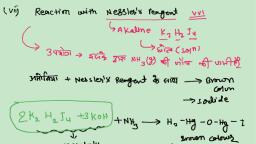
Solution of Assignment, , The p-Block Elements, , 61, , 49. Hybridisation of central ‘N’-atom in N2O is, (1) sp, , (2), , sp2, , (3), , sp3, , (4), , sp & sp2, , Sol. Answer (1), , , –, , –, , , , N N – O N=N=O, In N2O, the hybridization of central N atom is sp, since it contains one bond and 3 bonds and no lone, pair of electrons., 50. The most acidic oxide among the following is, (1) SO3, , (2), , P2O5, , (3), , Cl2O7, , (4), , SiO2, , Sol. Answer (3), Cl2O7 is more acidic than SO2, P2O5 and SiO2 because Cl is present in a very high oxidation state of +7., Higher the oxidation state of central atom in an oxide, highers the acidity., 51. In solid state PBr5 exist as, (1) [PBr4]+ [PBr6]–, , (2), , [PBr5]+ [PBr5]–, , (3), , [PBr4]+ [Br–], , (4), , PBr5, , Sol. Answer (3), In solid state PBr5 exist as [PBr4]+ [Br–], in which [PBr4]+ has tetrahedral shape., 52. Which of the following metal gives NH4NO3 with very dilute HNO3?, (1) Fe, , (2), , Ti, , (3), , Cu, , (4), , Hg, , Sol. Answer (1), With very dilute HNO3, Fe gives NH4NO3, , 4Fe + 10HNO 3 , 4Fe(NO 3 ) 2 + NH 4NO 3 + 3H 2O, 43. In iodide of Millon’s base formed by the reaction of Nessler’s reagent with NH3, the coordination number of Hg will, be, (1) 2, , (2), , 3, , (3), , 4, , (4), , 6, , (4), , HgCl2, , Sol. Answer (1), , K 2HgI 4, , + NH 3 + 3KOH NH 2 – Hg – O – Hg – I + 7KI + 2H 2O, , Nessler's Reagent, , Hg, O, Hg, , Iodide of millon's base, , +, N, , H, , I–, , H, , Iodide of millon's base, In iodide of millon's base, the coordination number of Hg is 2., 54. The compound insoluble in aqueous NH3 is, (1) AgI, , (2), , AgCl, , (3), , ZnSO4, , Sol. Answer (1), Silver Iodide (AgI) is insoluble in aqueous solution of ammonia., Aakash Educational Services Pvt. Ltd. - Regd. Office : Aakash Tower, Plot No.-4, Sector-11, Dwarka, New Delhi-75 Ph.011-47623456
Page 25 :
Solution of Assignment, , The p-Block Elements, , 63, , 61. Which of the following do not exist?, (1) NCl5, , (2), , PH5, , (3), , [BCl6]3–, , (4), , All of these, , Sol. Answer (4), NCl5 does not exist neither do [BCl6]3– because of the non availability d orbital in N and B. PH5 does not, exist because H is more electropositive than P and it cannot bring +5 oxidation state of phosphorus. Since, Cl is more electronegative than P, PCl5 exist., 62. PCl3 + H2O A + B. What are A and B, (1) H3PO2 + HCl, , (2), , H3PO4 + HCl, , (3), , H3PO3 + HCl, , (4), , HPO3 + HClO3, , Sol. Answer (3), PCl3 + 3H2O H3PO3 + 3HCl, PCl3 on complete hydrolysis gives H3PO3 and HCl., 63. Which of the following is correct?, (1) In PF5, axial and equatorial bonds are interchanged, known as pseudoreaction, (2) In solid state PF5 remains covalent, (3) PH5 cannot be obtained, because H is not sufficiently electronegative to make the d-orbitals contact, sufficiently, (4) All of these, Sol. Answer (4), When axial and equatorial bonds are interchanged in a trigonal bipyramidal compound, this is known as pseudo, reaction or pseudo rotation. In solid state PF5 exists as covalent compound unlike PCl5 which exists as, [PCl5+][PCl6]–. PH5 does not exist because H is not much electronegative to make the d orbital contact which, is required for the formation of PH5., 64. Thermodynamically most stable allotrope of carbon is, (1) Fullerene, , (2), , Diamond, , (3), , Graphite, , (4), , All are equally stable, , Sol. Answer (3), Graphite is the thermodynamically most stable form of carbon and it is considered as the reference state of, carbon., , SECTION - C, Previous Years Questions, 1., , The variation of the boiling points of the hydrogen halides is in the order HF > HI > HBr > HCl., What explains the higher boiling point of hydrogen fluoride?, , [Re-AIPMT-2015], , (1) The bond energy of HF molecules is greater than in other hydrogen halides, (2) The effect of nuclear shielding is much reduced in fluorine which polarises the HF molecule, (3) The electronegativity of fluorine is much higher than for other elements in the group, (4) There is strong hydrogen bonding between HF molecules, Sol. Answer (4), Fact., Aakash Educational Services Pvt. Ltd. - Regd. Office : Aakash Tower, Plot No.-4, Sector-11, Dwarka, New Delhi-75 Ph.011-47623456
Page 26 :
64, 2., , The p-Block Elements, , Solution of Assignment, , The stability of +1 oxidation state among Al, Ga, In and Tl increases in the sequence, (1) TI < In < Ga < Al, , (2), , In < Tl < Ga < Al, , (3), , Ga < In < Al < Tl, , (4), , [Re-AIPMT-2015], Al < Ga < In < Tl, , Sol. Answer (4), Due to INERT PAIR EFFECT group oxidation state less by 2 becomes more stable going down the group., Group oxidation state of group 13 is +3., Stability of +1 oxidation state would be, Al < Ga < In < Tl, 3., , Which of the statements given below is incorrect?, , [Re-AIPMT-2015], , (1) ONF is isoelectronic with O2N–, , (2), , OF2 is an oxide of fluorine, , (3) Cl2O7 is an anhydride of perchloric acid, , (4), , O3 molecule is bent, , Sol. Answer (2), In oxides, oxidation state of oxygen is –2, but in OF2, oxidation state of oxygen is +2 because F is more, electronegative than oxygen., 4., , Strong reducing behaviour of H3PO2 is due to, , [Re-AIPMT-2015], , (1) High oxidation state of phosphorus, (2) Presence of two –OH groups and one P – H bond, (3) Presence of one –OH group and two P – H bonds, (4) High electron gain enthalpy of phosphorus, Sol. Answer (3), , O, H, , P, , OH, H, [H3PO2], , Strong reducing behaviour of H3PO2 is due to presence of one –OH group and two P – H bonds., 5., , Acidity of diprotic acids in aqueous solutions increases in the order, (1) H2S < H2Se < H2Te, , (2), , H2Se < H2S < H2Te, , (3), , [AIPMT-2014], , H2Te < H2S < H2Se (4), , H2Se < H2Te < H2S, , Sol. Answer (1), In aqueous solution, acidity of p-block element increases down the group., due to maximum molecular weight., Or, The dissociation energy decreases as the bond length M – H increases from O to Te, this facilitates the release, of proton., 6., , Which of the following structure is similar to graphite?, (1) B, , (2), , B4C, , [NEET-2013], (3), , B2H6, , (4), , BN, , Sol. Answer (4), One B atom and one N atom together have the same number of valency electron as two carbon atom. Thus,, BN has almost the same structure as graphite, with sheets made up of hexagonal rings of alternate B and, N atoms joined together., Aakash Educational Services Pvt. Ltd. - Regd. Office : Aakash Tower, Plot No.-4, Sector-11, Dwarka, New Delhi-75 Ph.011-47623456
Page 27 :
Solution of Assignment, , 7., , The p-Block Elements, , Which of these is not a monomer for a high molecular mass silicone polymer?, (1) Me2SiCl2, , (2), , Me3SiCl, , (3), , PhSiCl3, , 65, , [NEET-2013], (4), , MeSiCl3, , Sol. Answer (2), Linear chain silicone formed by hydrolysis of Me2SiCl2 followed by condensation. Cross link silicone form by, hydrolysis of Me3SiCl3. (MeSiCl is used to stop chain length), HOH, Me 3SiCl , Me 3SiOH, , Me 3SiOH + HOSiMe 3 , Me 3Si – O – OSiMe 3, 8., , Which of these is least likely to act as a Lewis base ?, (1) F–, , (2), , BF3, , [NEET-2013], (3), , PF3, , (4), , CO, , Sol. Answer (2), 9., , The basic structural unit of silicates is, (1) SiO44 , , (2), , SiO32 , , [NEET-2013], (3), , SiO24, , (4), , SiO–, , Sol. Answer (1), –, , O, , Si, –, , O, , [SiO4]4–, –, , O, , O–, , 10. Which is the strongest acid in the following?, (1) HClO3, , (2), , HClO4, , [NEET-2013], (3), , H2SO3, , (4), , H2SO4, , Sol. Answer (2), In HClO4, the oxidation state of chlorine is +7 and the conjugate base of HClO4 is stabilized by four oxygen, atom which are involved in resonance. HClO4 is even more acidic than H2SO4 since Cl is more electronegative, than S which makes the release of H+ easier., 11. Which of the following is electron-deficient?, (1) (SiH3)2, , (2), , (BH3)2, , [NEET-2013], (3), , PH3, , (4), , (CH3)2, , Sol. Answer (2), 12. Roasting of sulphides give the gas X as by product. This is a colourless gas with choking smell of burnt sulphur, and causes great damage to respiratory organs as a result of acid rain. Its aqueous solution is acidic, acts as a, reducing agent and its acid has never been isolated. The gas X is, [NEET-2013], (1) SO2, , (2), , CO2, , (3), , SO3, , (4), , H2S, , Sol. Answer (1), 13. XeF2 is isostructural with, (1) ICI2–, , [NEET-2013], (2), , SbCl3, , (3), , BaCl2, , (4), , TeF2, , Sol. Answer (1), Both XeF2 and ICl2 are linear in shape., Aakash Educational Services Pvt. Ltd. - Regd. Office : Aakash Tower, Plot No.-4, Sector-11, Dwarka, New Delhi-75 Ph.011-47623456
Page 28 :
66, , The p-Block Elements, , Solution of Assignment, , 14. Which of the following does not give oxygen on heating?, (1) Zn(ClO3)2, , (2), , K2Cr2O7, , [NEET-2013], (3), , (NH4)2Cr2O7, , (4), , KClO3, , Sol. Answer (3), Ammonium dichromate gives the following products upon heating, , NH 4 2 Cr2O 7 (s), , , Cr2O 3 (s) + N 2 (g) + H 2O(g), , 15. Which of the following species contains three bond pairs and one lone pair around the central atom ?, [AIPMT (Prelims)-2012], –, 2, , (2), , (1) NH, , PCl3, , (3), , H2O, , (4), , BF3, , Sol. Answer (2), 16. When Cl2 gas reacts with hot and concentrated sodium hydroxide solution, the oxidation number of chlorine, changes from, [AIPMT (Prelims)-2012], (1) Zero to –1 and zero to +3, , (2), , Zero to +1 and zero to –3, , (3) Zero to +1 and zero to –5, , (4), , Zero to –1 and zero to +5, , Sol. Answer (4), This reaction is, 0, , 5, , –1, , 6NaOH + 3Cl 2 , NaCl + NaClO 3 + 3H 2O, , hot & conc., , In Cl2, the oxidation number of Cl is O but in NaClO3 the oxidation number of Cl is +5 and – 1 in NaCl., 17. A mixture of potassium chlorate, oxalic acid and sulphuric acid is heated. During the reaction which element, undergoes maximum change in the oxidation number?, [AIPMT (Prelims)-2012], (1) Cl, , (2), , C, , (3), , S, , (4), , H, , Sol. Answer (1), 18. Sulphur trioxide can be obtained by which of the following reaction, , , (1) S + H2SO4 , , , (3) CaSO4 + C , , [AIPMT (Prelims)-2012], , , (2), , H2SO4 + PCl5 , , (4), , , Fe2(SO4)3 , , Sol. Answer (4), , Fe 2 SO 4 3 , Fe 2O 3 + 3SO 3, , 19. Which of the following statements is not valid for oxoacids of phosphorus?, , [AIPMT (Prelims)-2012], , (1) All oxoacids contain tetrahedral four coordinated phosphorus, (2) All oxoacids contain atleast one P = O unit and one P–OH group, (3) Orthophosphoric acid is used in the manufacture of triple superphosphate, (4) Hypophosphorous acid is a diprotic acid, Sol. Answer (4), Hypophosphorous acid is H3PO2 which contains only one ionizable –OH group. It is a monoprotic (monobasic), acid., O, , P, H, , H, , OH, , Aakash Educational Services Pvt. Ltd. - Regd. Office : Aakash Tower, Plot No.-4, Sector-11, Dwarka, New Delhi-75 Ph.011-47623456
Page 32 :
70, , The p-Block Elements, , Solution of Assignment, , 40. Carbon and silicon belong to (IV) group. The maximum coordination number of carbon in commonly occurring, compounds is 4, whereas that of silicon is 6. This is due to, (1) Availability of low lying d-orbitals in silicon, , (2), , Large size of silicon, , (3) More electropositive nature of silicon, , (4), , Both (2) & (3), , Sol. Answer (1), Due to non-availability of d-orbitals in carbon and availability of low lying d-orbitals in silicon, the difference, in coordination number is observed., 41. Which of the following statements about H3BO3 is not correct?, (1) It has a layer structure in which planar BO3 units are joined by hydrogen bonds, (2) It does not act as proton donor but acts as a Lewis acid by accepting hydroxyl ion, (3) It is a strong tribasic acid, (4) It is prepared by acidifying an aqueous solution of borax, Sol. Answer (3), , O, , H, , O, , B, , O, , H, , + H2O, , H+[B(OH)4]–, , H, , It is a weak monobasic Lewis acid., 42. Aluminium (III) chloride forms a dimer because aluminium, (1) Belongs to 3rd group, , (2), , Can have higher coordination number, , (3) Cannot form a trimer, , (4), , Has high ionization energy, , Sol. Answer (2), AlCl3 achieves stability by forming a dimer, , Cl, , Cl, Al, , Cl, , Cl, Al, , Cl, , Cl, , 43. Boron compounds behave as Lewis acids, because of their, (1) Ionisation property, , (2), , Electron deficient nature, , (3) Acidic nature, , (4), , Covalent nature, , Sol. Answer (2), Boron compounds, especially the hydrides are electron deficient compounds which can accept a lone pair, of electrons hence behave as Lewis acids., 44. In graphite, electrons are, (1) Localised on each C-atom, , (2), , Localised on every third C-atom, , (3) Delocalised within the layer, , (4), , Present in anti-bonding orbital, , Sol. Answer (3), In graphite all electrons get delocalised in one layer and form -bond., Aakash Educational Services Pvt. Ltd. - Regd. Office : Aakash Tower, Plot No.-4, Sector-11, Dwarka, New Delhi-75 Ph.011-47623456
Page 33 :
Solution of Assignment, , The p-Block Elements, , 71, , 45. In borax bead test which compound is formed?, (1) Orthoborate, , (2), , Metaborate, , (3), , Double oxide, , (4), , Tetraborate, , Sol. Answer (2), In borax bead test metal metaborates are formed, , Na 2B 4O 7 , 2NaBO 2 + B 2O 3, , , , Sodium, metaborate, , , , CuO + B 2O 3 , Cu(BO 2 ) 2, , , , Cupric, metaborate, , , , 46. Which one of the following statements about the zeolite is false?, (1) They are used as cation exchangers, (2) They have open structure which enables them to take up small molecules, (3) Zeolites are aluminosilicates having three dimensional network, (4) Some of the SiO44– units are replaced by AlO45– and AlO69– ions in zeolites, Sol. Answer (4), Fact, 47. The straight chain polymer is formed by, (1) Hydrolysis of (CH3)2 SiCl2 followed by condensation polymerisation, (2) Hydrolysis of (CH3)3 SiCl followed by condensation polymerisation, (3) Hydrolysis of CH3 SiCl3 followed by condensation polymerisation, (4) Hydrolysis of (CH3)4 Si by addition polymerisation, Sol. Answer (1), Hydrolysis of (CH3)2 SiCl2 followed by condensation polymerisation forms a straight chain polymer., Reactions(CH3)2SiCl2 + 2H2O (CH3)2Si(OH)2 + 2HCl, n(CH3)2Si(OH)2 [–(CH3)2SiO–]n + nH2O, 48. The metal oxide which cannot be reduced to metal by carbon is, (1) Fe2O3, , (2), , Al2O3, , (3), , PbO, , (4), , ZnO, , Sol. Answer (2), Carbon + Metal oxide Metal + Carbon dioxide, According to the reactivity series, carbon cannot reduce the oxides of reactive metals such as potassium,, sodium, calcium, magnesium and aluminium., 49. In which of the following compounds, nitrogen exhibits highest oxidation state?, (1) N3H, , (2), , NH2OH, , (3), , N2H4, , (4), , NH3, , Sol. Answer (1), (1) N3H 3x + 1 = 0, , x=–, , 1, 3, , Aakash Educational Services Pvt. Ltd. - Regd. Office : Aakash Tower, Plot No.-4, Sector-11, Dwarka, New Delhi-75 Ph.011-47623456
Page 34 :
72, , The p-Block Elements, , Solution of Assignment, , (2) NH2OH Þ x + 2 – 2 + 1 = 0, x = –1, (3) N2H4 2x + 1 4 = 0, 2x + 4 = 0, x = –2, (4) NH3 x + 3 = 0, x = –3, 50. Which of the following displaces Br2 from an aqueous solution containing bromide ions?, (2), , (1) I2, , I3–, , (3), , Cl2, , (4), , Cl–, , Sol. Answer (3), Chlorine is stronger oxidizing agent as compared to Br2. It oxidizes Br– ions present in solution,, , Cl 2 + 2Br – , 2Cl – + Br2, 51. Repeated use of which one of the following fertilizers would increase the acidity of the soil?, (1) Ammonium sulphate, , (2), , Superphosphate of lime, , (3) Urea, , (4), , Potassium nitrate, , Sol. Answer (1), Ammonium sulphate on hydrolysis gives sulphuric acid which can increase the acidity of soil if it is used, regularly, , NH , , SO, , 4 2, 4, Ammonium sulphate, , + 2H 2O 2NH 4OH + H 2SO 4, , 52. Which of the following oxides is most acidic?, (1) As2O5, , (2), , P2O5, , (3), , N2O5, , (4), , Sb2O5, , Sol. Answer (3), In the given options, all group 15 elements are present in +5 oxidation state. But since nitrogen is most, electronegative and has maximum non-metallic character, its oxide, N2O5 is most acidic., 53. Which of the following phosphorus is the most reactive?, (1) Scarlet phosphorus, , (2), , White phosphorus, , (3), , Red phosphorus, , (4), , Violet phosphorus, , Sol. Answer (2), White phosphorus is most reactive form of phosphorus because it is less stable due to angular strain present, in its molecule. Thus angular strain makes white phosphorus unstable and reactive., 54. The decomposition of organic compounds, in the presence of oxygen and without the development of odoriferous, substances, is called, (1) Nitrification, , (2), , N2-fixation, , (3), , Decay, , (4), , Denitrification, , Sol. Answer (3), The decomposition of organic compounds, in presence of oxygen and without the formation of odoriferous, substances is called decay., Aakash Educational Services Pvt. Ltd. - Regd. Office : Aakash Tower, Plot No.-4, Sector-11, Dwarka, New Delhi-75 Ph.011-47623456
Page 35 :
Solution of Assignment, , The p-Block Elements, , 73, , 55. Nitrogen forms N2, but phosphorus does not form P2, however, it forms P4, reason is, (1) Triple bond present between phosphorus atom, , (2), , p – p bonding is weak, , (3) p – p bonding is strong, , (4), , Multiple bonds form easily, , Sol. Answer (2), Nitrogen forms N2 because small size of nitrogen atom allows it to from strong p – p bond but in phosphorus,, p – p bonding is weak due to the large size of phosphorus atom. Therefore phosphorus forms sigma bonds, and exist as P4 which is tetrahedral in shape., 56. Which reaction is not feasible?, (1) 2KI + Br2 2KBr + I2, , (2), , 2KBr + I2 2KI + Br2, , (3) 2KBr + Cl2 2KCl + Br2, , (4), , 2H2O + 2F2 4HF + O2, , Sol. Answer (2), The oxidation of Br by I2 is not possible because Br is stronger oxidizing agent than iodine. Hence the above, reaction is not feasible., 57. Which one of the following statements is not true?, (1) Among halide ions, iodide is the most powerful reducing agent, (2) Fluorine is the only halogen that does not show a variable oxidation state, (3) HOCl is a stronger acid than HOBr, (4) HF is a stronger acid than HCl, Sol. Answer (4), HCl is a stronger acid than HF. H–Cl bond is weaker than H–F bond because of bigger size of chlorine atom, which allows easier release of H+ ion., 58. Oxidation states of P in H4P2O5, H4P2O6, H4P2O7, are respectively, (1) + 3, + 4, + 5, , (2), , + 3, + 5, + 4, , (3), , + 5, + 3, + 4, , (4), , + 5, + 4, + 3, , Sol. Answer (1), H4P2O5, (4 1) + (2 P) + 5 (–2) = 0, , Oxidation no. of H = +1, , 4 + 2P – 10 = 0, , Oxidation no. of O = –2, , 2P = +6, P = +3, H4P2O6, (4 1) + 2 P + 6 (–2) = 0, 2P = 8, P = +4, H4P2O7, 4 (+1) + 2 P + 7 (–2) = 0, , Oxidation no. of H = +1, , 2P = +10, P = +5, Hence oxidation state of P in H4P2O5, H4P2O6 and H4P2O7 are +3, +4 and +5 respectively., Aakash Educational Services Pvt. Ltd. - Regd. Office : Aakash Tower, Plot No.-4, Sector-11, Dwarka, New Delhi-75 Ph.011-47623456
Page 38 :
76, , The p-Block Elements, , Solution of Assignment, , SECTION - D, Assertion-Reason Type Questions, 1., , A : Borazine is more reactive than benzene., R : Borazine is isostructural with benzene., , Sol. Answer (2), Borazine is considerably more reactive than benzene, B3N3H6 + 3HCl B3N3H9Cl3, Addition reactions occur readily, Structure of borazine is iso-structural with benzene, , H, H, , H, , N, , H, , B, , N, , B, , B, N, , H, , H, , H, , H, , H, , H, H, Benzene, , H, Borazine, 2., , A : In Diborane containing eight –B–H bonds only four B–H bonds are on the plane., R : Boron in B2H6 is sp2 hybridised., , Sol. Answer (3), , H, , H, B, , H, B, , H, H, Total B–H bonds = 8, , H, , The bridge bonded hydrogens are out of the plane. Hybridization of boron is sp3., 3., , A : All the oxides of boron family with the general formula M2O3 are basic., R : From B2O3 to Tl2O3 basic character decreases., , Sol. Answer (4), Boron compounds are acidic in nature. Basic character increases with atomic number of central atom., 4., , A : When borax is strongly heated it forms transparent glassy bead., R : Borax is the other name for sodium tetraborate decahydrate., , Sol. Answer (2), , Na2B4O7.10H2O, , Pt, Loop, , Na2B4O7 + 10H2O, , NaBO2 + B2O3, Glassy bead, , Borax is also called sodium tetraborate decahydrate., Aakash Educational Services Pvt. Ltd. - Regd. Office : Aakash Tower, Plot No.-4, Sector-11, Dwarka, New Delhi-75 Ph.011-47623456
Page 39 :
Solution of Assignment, , 5., , The p-Block Elements, , 77, , A : CBr4 is thermally more stable than CI4., R : C–Br bond energy is more than C–I., , Sol. Answer (1), Smaller size of carbon makes it difficult to accommodate large anions. Due to this bond energy increases, for small anions., 6., , A : Boric acid is weak monobasic acid., R : Boric acid give one H+ ion., , Sol. Answer (3), H3BO3 is a weak monobasic acid. It reacts with water molecule and releases H+ ion. Three of its OH– groups, are not ionisable., 7., , A : Al forms [AlF6]3–., R : It is octahedral complex., , Sol. Answer (2), Al has vacant d-orbitals and can expand its octet in [AlF6]3–., , F, F, , F, 3–, , Al, F, , F, , Octahedral, geometry, , F, 8., , A : Anhydride of carbonic acid is CO2., R : Carbonic acid is dibasic., , Sol. Answer (2), Anhydride of carbonic acid is CO2 and carbonic is dibasic as it gives 2H+ on ionization., 9., , A : CaC2 is interstitial carbide., R : Calcium ions are present in the Interstices., , Sol. Answer (4), Interstitial carbides are formed by transition metals of the periodic group IV B, V B and VI B., 10. A : Fullerene is the purest allotrope of carbon., R : They have smooth structure without dangling bonds., Sol. Answer (1), Fullerene is the purest allotrope of carbon. They have smooth structure without dangling bonds., 11. A : GeCl4 is easily hydrolysed by water., R : Central atom can accommodate lone pair of e – from oxygen atom of water molecules in, GeCl4., Sol. Answer (1), GeCl4 is easily hydrolysed by water because the central atom can accommodate lone pair of oxygen atom, of water molecule of GeCl4., Aakash Educational Services Pvt. Ltd. - Regd. Office : Aakash Tower, Plot No.-4, Sector-11, Dwarka, New Delhi-75 Ph.011-47623456
Page 40 :
78, , The p-Block Elements, , Solution of Assignment, , 12. A : Carbon has maximum tendency of catenation among group 14., R : C – C bond strength is very strong., Sol. Answer (1), Catenation in carbon is due to its small size and high electronegativity. Catenation is mostly seen in carbon, is because of the high bond strength., 13. A : Oxides of carbon in higher oxidation state is more acidic than in lower oxidation state., R : Both CO2 and CO can exist., Sol. Answer (2), Oxides of carbon in higher oxidation state is more acidic than in lower oxidation state. Both CO2 and CO, can exist., 14. A : Heavier elements of 14th group do not form p – p bonds., R : Atomic orbital of heavier elements are too large and do not have effective overlapping., Sol. Answer (1), Heavier elements of 14th group do not form p – p bonds because the atomic orbital of heavier elements, are too large and do not have effective overlapping., 15. A : Carbon shows anomalous behaviour in group Gp-14., R : Carbon has maximum covalency of 4., Sol. Answer (2), Carbon shows anomalous behaviour because of small size, high electronegativity, high ionization enthalpy., Carbon has the maximum covalency of 4., 16. A : H2O is the only hydride of chalcogen family which is liquid., R : Acidic nature of hydrides of chalcogen family increases down the group., Sol. Answer (2), H2O is the only hydride of chalcogen family (group 16) which is liquid while rest of the hydrides are gases, because H2O is associated through hydrogen bonding. Also in chalcogen family, the acidity of hydrides, increases down the group but this is not the explanation of Assertion., 17. A : PF5 and IF5 have similar shapes., R : All the bond lengths are equal in PF5., Sol. Answer (4), PF5 is sp3d hybridized because it contains five bond pairs while IF5 is sp3d2 hybridized because it five bond, pair and one lone pair, therefore they have different shapes. PF5 has trigonal bipyramidal shape in which three, P–F bonds are equatorial and 2 P–F bonds are axial and axial bonds are longer than equatorial bonds. Hence, both Assertion and Reason are false., 18. A : Atomic size of F is smaller than that of Cl., R : F-F bond is stronger than Cl-Cl bond., Sol. Answer (3), Atomic size of F is smaller than Cl because Cl contains extra shell. F–F bond is weaker than Cl–Cl bond, because there is repulsion between lone pairs of electrons in the smaller sized F2 molecules. Hence Assertion, is true and Reason is false., Aakash Educational Services Pvt. Ltd. - Regd. Office : Aakash Tower, Plot No.-4, Sector-11, Dwarka, New Delhi-75 Ph.011-47623456
Page 41 :
Solution of Assignment, , The p-Block Elements, , 79, , 19. A : P4 is more reactive than N2., R : P-P bonds are relatively weaker than N N bond., Sol. Answer (1), P4 is more reactive than N2 because N2 contains a triple bond which requires a high amount of energy to, break, whereas in P4 single bonds are present which can be easily broken. Hence P4 is more reactive., 20. A : Noble gases have highest ionization energies in their respective periods., R : The outermost sub-shell of noble gases in which electron enters is completely filled., Sol. Answer (1), Higher the stability of an element, higher is its ionization enthalpy. Noble gases are very stable due to, completely filled sub-shells hence exhibit highest ionization enthalpy among their respective period., 21. A : The bond angle of NH3 is greater than BiH3., R : 'Bi' is metal while 'N' is non-metal., Sol. Answer (2), Bond angle depends on the electronegativity of control atom. N is more electronegative than B and pulls the, electrons of N–H towards itself, which makes the bond angle greater in NH3 than in BH3., 22. A : 'XeF6' on the reaction with 'RbF' gives Rb[XeF7]., R : XeF6 is non-reactive., Sol. Answer (3), XeF6 + RbF , Rb XeF7 , , This shows that XeF6 is reactive. Hence Reason is false., 23. A : Tailing of Hg caused by ozone is due to formation of HgO., R : In the presence of O3, Hg does not loses its meniscus., Sol. Answer (4), Tailing of Hg caused by ozone is due to the formation of Hg2O, , O 3 + 2Hg , Hg 2O + O 2, This results in the change in the meniscus of liquid mercury. Hence both Assertion and Reason are false., 24. A : The valency and oxidation number of sulphur in S8 respectively are 2 and 0., R : S8 Rhombic is the most stable allotropic form of sulphur., Sol. Answer (2), Valency of S in S8 is two since each S is linked with other two S atoms and in elemental state oxidation, state of every element is O. Rhombic sulphur is the most stable allotropic form of sulphur but this reason, does not explains the Assertion., 25. A : Dissolution of concentrated H2SO4 in water is highly exothermic process., R : Sulphuric acid is always diluted by adding acid to water slowly., Sol. Answer (2), Dissolution of H2SO4 in water is highly exothermic process., Aakash Educational Services Pvt. Ltd. - Regd. Office : Aakash Tower, Plot No.-4, Sector-11, Dwarka, New Delhi-75 Ph.011-47623456
Page 42 :
80, , The p-Block Elements, , Solution of Assignment, , 26. A : N2 is more stable than O2., R : Bond order of N2 is 3., Sol. Answer (1), N2 contains a triple bond whereas O2 contains a double bond. Since a triple bond is more stable than a double, bond N2 is more stable than O2. Bond order of three indicates triple bond. Higher the bond order, higher is, the stability., 27. A : PH5 is not possible., R : –5 oxidation state of phosphorus is not possible., Sol. Answer (1), PH5 does not exist because five oxidation state of phosphorus is not possible. Hence Assertion is true and, Reason is the correct Explanation., 28. A : NH3 is more polar than NF3., R : NF3 cannot be hydrolysed., Sol. Answer (2), NH3 is more polar than NF3 because in NF3 magnetic moment due to lone pair and N–F bond are aligned, in opposite direction. NF3 does not undergoes hydrolysis., 29. A : O3 is better oxidizing agent than H2O2., R : O3 converts Ag to Ag2O., Sol. Answer (2), O3 is a better oxidizing agent than H2O2 because O2 is unstable and easily provides oxygen required for, oxidation O3 oxidizes Ag to Ag2O. This Reason is not the correct explanation of Assertion., 30. A : Na2S2O3 on reaction with I2 gives Na2S4O6., R : This reaction involves colour and electronic change both., Sol. Answer (2), , 2Na 2S 2O 3 + I 2 , Na 2S 4O 6 + 2NaI, This reaction envolve charge in oxidation state which changes the colour of compound as well as electronic, configuration of S. But Reason does not explain the Assertion., 31. A : Cl2 on reaction with NaOH (cold and dilute) gives NaClO3., R : Cl2 get oxidized only in this reaction., Sol. Answer (4), Cl2 on reaction with cold and dilute NaOH gives NaOCl, , Cl 2 + 2NaOH , NaCl + NaOCl + H 2O, This is a disproportionation reaction in which Cl goes both oxidation as well as reduction. Hence both, Assertion and Reason are false., Aakash Educational Services Pvt. Ltd. - Regd. Office : Aakash Tower, Plot No.-4, Sector-11, Dwarka, New Delhi-75 Ph.011-47623456
Page 43 :
Solution of Assignment, , The p-Block Elements, , 81, , 32. A : 2F– + Cl2 2Cl– + F2, is a reaction having G = –ve., R : Cl2 is better oxidizing agent than F2., Sol. Answer (4), , 2F – + Cl 2 , 2Cl – + F2, This reaction is not feasible because flourine is the strongest oxidizing agent. G for this reaction is positive, Both Assertion and Reason are false., 33. A : H3PO4 is less acidic than H3PO3., R : Oxidation state of phosphorus in H3PO4 < H3PO3., Sol. Answer (3), H3PO4 is less acidic then H3PO3 because H3PO3 contains only two O–OH group which can be easily ionized, as compared H3PO4 which contains 3–OH group. Oxidation state of P in H3PO4 is +5 whereas in H3PO4 it, is +3., 34. A : CN– is pseudohalide., R : (CN)2 is pseudohalogen., Sol. Answer (2), CN– is cyanide ion and it is a pseudohalide because at resembles halide ions. It gives corresponding molecule, (CN)2 which is known cyanogen which resembles Halogen. Both Assertion and Reason are correct but Reason, is not the correct explanation of Assertion., 35. A : Xe is the only element of group 18 which from compounds., R : Xe does not form clatherates., Sol. Answer (4), In group 18, Kr can also form compound. Xe forms clatherates with phenol derivatives. Hence both Assertion, and Reason are false., , � � �, , Aakash Educational Services Pvt. Ltd. - Regd. Office : Aakash Tower, Plot No.-4, Sector-11, Dwarka, New Delhi-75 Ph.011-47623456