Notes of 12 B, Chemistry Chemistry Reduced Syllabus - Study Material
Page 1 :
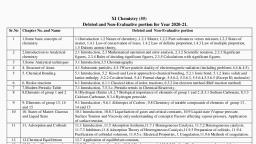
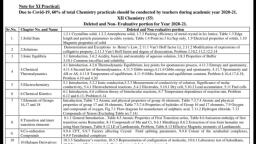
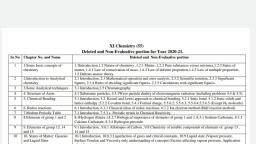
XI Chemistry (55), Deleted and Non-Evaluative portion for Year 2020-21., Deleted and Non-Evaluative portion, Sr.No Chapter No. and Name, LSome basic concepts of, chemistry, LiIntroduction L2 Nature of chemistry 1.2.1 Matter, 1.22 Pure substances verses mixtures, 1.2.3 States of, matter, 1.4.1 Law of conservation of mass, 1.4.2 Law of definite proportion,1.43 Law of multiple proportion,, 1.5 Daltons atomic theory., 2.1 Introduction, 23 Mathematical operation and error analysis, 2.3.2 Scientific notation, 23.3 Significant, figures, 2.3.4 Rules of deciding significant figures, 2.3.5 Calculations with significant figures., 3.1 Introduction,3,5 Chromatography, 4.1 Subatomic particles, 4.5.1Wave particle duality of electromagnetic radiation (including problems 4.4 & 4.5)., 5.1 Introduction, 5.2 Kossel and Lewis approach to chemical bonding, 5.2.1 lonic bond, 5.1.2 lonic solids and, lattice enthalpy 5.2.2 Covalent bond, 5.4,1 Formal charge, 5.5.6.2, 5.5.6.3, 5.5.6.4,5.5.6.5 (Except H, molecule), 6.1 Introduction, 6.1.I Classical ideas of redox reactions, 6.3.2 kon electron method (Half reaction method), 7.1 Introduction, 7.5.3.c. Periodic trends in Chemical Reactivity., 8.1Hydrogen (Entire ),8.2.7 Biological importance of elements of group 1 and 2,83.1 Sodium Carbonate, 8.3,3, Calcium Carbonate, 8.3.4 Hydrogen peroxide., 9.1 Introduction, 9.6.1 Allotropes of Carbon, 9.8 Chemistry of notable compounds of elements of group 13., 14 and 15, 10.1 Introduction, 10.8.3 Liquefaction of gases and critical constants, 10.9 Liquid state (Vapour pressure,, Surface Tension and Viscosity only understanding of concepts) Factors affecting vapour pressure, Application, of surface tension, 11.1 Introduction ,11.5 Adsorption Isotherm, 11.7.1 Homogeneous Catalysis, 1 1.7.2 Heterogeneous catalysis,, 11.7.3 Inhibitors, 118 Adsorption Theory of Heterogeneous Catalysis, 11.9.3 Preparation of colloids, 11.9.4, Purification of colloidal solutions, 11.9.5 e. Electrical Properties, f. Coagulatiom, I1.9.6 Methods of coagulation., 12.7 Application of equilibrium constant,, 13.2 Classification of nuclides, 13,3,4 Nuclear potential, 13.3.5 Nuclear Binding energy and mass defect, 2.Introduction to Analytical, chemistry, 3 Some Analytical techniques, 3, 4, 4. Structure of Atom, in, 5. Chemical Bonding, 6. Redox reactions, 6., 7.Moderm Periodic Table, 8.Elements of group I and 2, 8, 9. Elements of group 13, 14, and 15, 10. States of Matter: Gaseous, 9, 10, and Liquid State, 11. Adsorption and Colloids, 12.Chemical Equilibrium, 13. Nuclear Chemistry and, Radioactivity, 14. Basic principle of atganie, chemistry, 15.Hydrocarbon, 12, 13, 14, 14.1 Introduction ,14.6 Theoretical basis of organic reactions,, 15.1.3 Industrial preparation of alkanes, Free radical mechanism of halogenation of alkanes, 2. Combustion 3, Pyrolysis, 4 Reforming a) Industrial source of alkenes, 15.4.2 Structure of Benzene,, Introduction, Traditional knowledge in medicine, Toble 16.2 Active ingredients of some medicinal plants, 15, 16, 16.Chemistry in everyday life, Note for XI Practical:, Due to Covid-19, 60% of total Chemistry practicals should be conducted by teachers during academic year 2020-21., XII Chemistry (55), Deleted and Non- Evaluative portion for Year 2020-21., Sr.Na. Chapter Na, and Name, Deleted and Non evaluative portion, 1.2.1 Crystalline solid, 1.22Amorphorus solid, 1.7.3 Packing efficiency of metal crystal in fece lattice, Table 13 Edge, length and particle parameters in cubic system, Table 1.4 Point no.3 fec/hep only, 1.9 Electrical properties of solids, L.10, Magnetic properties of solid, Demonstration and Exceptions to Henry's Law, 2.11.1 Van't Hoff factor (i), 2.11.2 Modification of expressions of, colligative property, 2113 Van't Hoff factor and degree of dissociation, Problem 2.10,2 112.12,2 14, 3.1 Introduction, 3.6.2 Acidity, basicity and neutrality of aqueous solution, 3.8.3 Properties of Buffer, 3.10.1 Common ion effect and solubility, 4.1 Introduction, 4.26 Thermodynamic Equilibrium, key points for spontaneous process, 4.11.3 Entropy and spontaneity,, 4.11.4 Second law of thermodynamics, 4.11.5 Gibbs energy,4.11.6 Gibbs energy and spontaneity, 4.11.7 Spontaneity and, AH or AS, 4.11.8 Temperature of equilibrium, 4.11.9 Gibbs function and equilibrium constant, Problem 4.16,4.17,4.18., Problem 4.19 and 4.20, 5.1 Introduction, 5,22 lonic conduction,5.23 Measurement of conductivity of solution, Significunce of molur, Conductivity, 5.4 1 Electrochemical reactions 542 Electrodes, 5. 10.1 Dry cell, 5.10.2 Lead accumulator, 5.11 Fuel cells, 6.1 Introduction, 6,6 collision theory of bimolecular reactions, 6.7 Temperature dependence of reaction rate, Problem, 6.12 and 6.13, Problem 6.14, Introduction, Table 7.2 Atomic and physical properties of group 16 elements, Table 7.3,7.4 Atomic and physical, properties of group 17 and 18 elements, Table 7.5,7.6 Properties of hydrides of Group 16 and 17 elements, 7.9 Oxygen, and compounds of axygen, Fig.7.1 Flow diagram for manufacture of sulphuric acid, 7.11.2 Hydrogen chloride, 7.13, Compounds of Xenon (Excluding Table no.7.14), 81.I General Introduction. Table 8.5 Atomic Properties of First Transition series, Table 8.6 lonisation enthalpy of first, transition series Remember, 8.3 Compounds of Mn and Cr, 8,6.1 Metallurgy 8.6.2 Extraction of iron farm hematite ore, using blast furnace, Table 8.12 LE of Lanthanoids, Problem, Table 8.13 Effective Magnetic moments of Lanthanoids, 9.9.6 CFT, 9,9.7 Factors affecting Crystal Ficld splitting parameters, 9.9.8 Colour of the octahedral complexes,, 9.9.9 Tetrahedral complexes, 10.35 Sandmeyer's reaction, 10.5.5 Representation of configuration of molecule, 10.6.1 Laboratory test of haloalkane,, 107 Uses and Environmental effect of some polyhalogen compound, Preparation of alcohols a) From alkyl halide b) By acid catalyzed hydration of alkenes, a)laboratory test of alcohols and, phenol i) Litmus test, ) Reaction with base, 1., 1.Solid State, 2., 2.Solutions, 3., 3.Jonic Equlibria, 4.Chemical, Thermodynamics, 5. Electrochemistry, 6.Chemical Kinetics, 7.Elements of Groups, 16,17 and 18, 8.Transition and inner, transition elements, 9.Co-ordination, 9., Compounds, 10, 10. Halogen Derivatives, 11.Alcohols, Phenols, and Ethers, Reaction with Phosphorus Halide, ii) Dehydration of alcohols to alkenes, a)lahoratory test of ether, 12.Aldehydes, Ketones, 121 Introduction, a)By axidation of alcohol b) from bydrocarbons, i) Preparation of aromatic ketones from acyl, chloride, b) Laboratory test for ketonie group. 12.9.2 Laboratory tests for carboxyl group., 13.6.1 Laboratory test for amines, Reaction with fluroboric acid b) Reactions involving retention of diazonium group., 14.1 Introduction, 14.2.10 Polysaccharides(Statch.cellulose and glycogen ), b) Secondary structure of protein, c) Tertiary, structure of protein, d) Quaternary structure of protein, Fig.14.26 Formation of nucleoside, Fig.14.27 Structure of, nucleotide, Fig. 14.28 Formation of dinucleotide. 14.43 DNA double helix, Fig. 15.2 Classification of polymers, 15.3.6 Phenol-formaldehyde and related polymers, Fig. 15.3 Preparation of Bakelite., Fig. 15.4 Formation of crosslinked malemine formaldehyde resin, 15.3.9 Viscose rayon, Fig 15.7 Formation of viscose, rayon, 15.4 Molecular mass and degree of polymerization of polymers, 12, and carboxylic acids, 13 Amines, 13, 14, 14. Biomolecules, 15. Introduction to, 15, Polymer chemistry, 16. Green Chemistry and Fig. 16.1 Macro-materials to atoms, Fig. 16.2 Scale of Nanomaterials, I6.6.4 Thermal properties, 16.6.5 Mechanical, 16, Nanochemistry, |Property, 16.6.6 Electrical conductivity,16.7 Synthesis of Nanomaterial, 16.7.4 Photographs of Instruments, Note for XII Practical:, Due to Covid-19, 60% of total Chemistry practicals should be conducted by teachers during academic year 2020-21.



 Learn better on this topic