Page 1 :
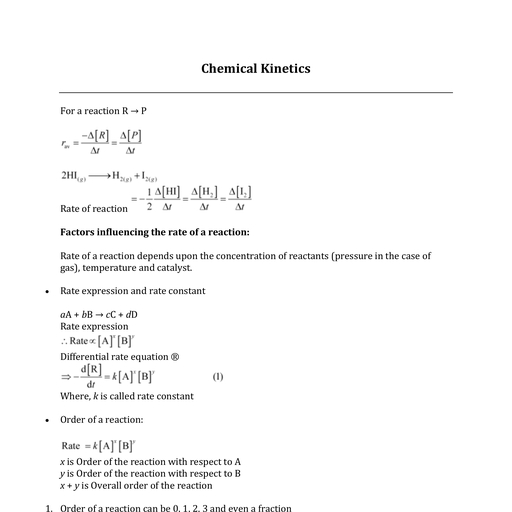
CHEMICAL KINETICS, , CHEMICAL KINETICS, , INTRODUCTION, Chemical Kinetics, (Kinesis : Movement), The branch of chemistry which deals with the study of the, rates of chemical reactions, the factors affecting the rates, of the reactions and the mechanism by which the reactions, proceed is called Chemical Kinetics., Classification of reactions, , 1.2 Instantaneous rate, Rate of change of concentration of any one of the reactants, or products at that particular instant of time is called, instantaneous rate., As 't o 0 or rinst, , �d [R], dt, , d [P], dt, , IMPORTANT :, , On the basis of rates :, , Rate of a reaction is always positive., , x, , Since, ' [R] is a negative quantity (as concentration of, reactants is decreasing), it is multiplied with –1 to make, the rate of the reaction a positive quantity., , Very fast reactions, e.g. precipitation of AgCl, , x, , Very slow reactions, e.g. rusting of iron, , x, , 1.3 Units of rate of a reaction, , Reactions taking place at moderate speeds, , Units of rate are concentration time–1, , e.g. hydrolysis of starch, , e.g. mol L–1s–1; atm s–1 (for gaseous reactions), 1.4 Overall rate of a reaction, , 1. RATE OF A CHEMICAL REACTION, The rate of a reaction can be defined as the change in, concentration of a reactant or a product in unit time., 1.1 Average rate, , When there are several reactants and products the, individual rates of the various components may differ as, they would depend on the stoichiometric coefficients., For a reaction,, A + 2B, , 3C + 4D, , The rate of reaction measured over a definite time interval, is called average rate of a reaction., , Rate of disappearance of B = 2 × Rate of disappearance of, , Consider a hypothetical reaction,, , Rate of formation of C = 3 × Rate of disappearance of A, , R, , P, , A (2:1), , (3:1), , Average rate of reaction = (Decrease in concentration of R), , Rate of formation of D = 4 × Rate of disappearance of A, , / (Time taken), , (4:1), , = �['R] / 't, , To define a unique value for the overall rate of the reaction, we divide the individual rates by the respective coefficients, , Or = (Increase in concentration of P) / (Time taken), [ 'P] / 't, , and equate their signs., Overall Rate = – 'A / 't = (–1/2) 'B / 't = (+1/3) 'C / 't, , = (+1/4) 'D / 't
Page 2 :
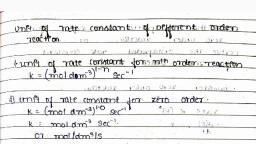
CHEMICAL KINETICS, , Remember!!!, , 2.2 Order of a Reaction, , aA + bB, , cC + dD, aA + bB, , Overall Rate = (–1/a) 'A / 't = (–1/b) 'B / 't, = (+1/c) 'C / 't = (+1/d) 'D / 't, Instantaneous Rate = (–1/a)dA/dt = (–1/b) dB/dt, = (+1/c) dC/dt = (+1/d) dD/dt, , 2. DEPENDENCE OF RATE ON CONCENTRATION, Factors Influencing Rate of a Reaction, , x, , concentration of reactants (pressure in case of gases),, , x, , temperature and, , x, , catalyst., , Rate = k [A]x [B]y, Sum of these exponents, i.e., x + y gives the overall order of, a reaction where x and y represent the order with respect to, the reactants A and B respectively., Hence, the sum of powers of the concentration of the, reactants in the rate law expression is called the order of, that chemical reaction., Order of a reaction can be 0, 1, 2, 3 and even a fraction., 2.3 Units of rate constant, , Rate = k [A]x [B]y, , Dependence on Concentration :, k, , 2.1 Rate law, Consider a general reaction, aA + bB, , cC + dD, , Rate, [A]x [B]y, , concentration, 1, u, time, (concentration)n, , Reaction, , Order, , Units of rate constant, , cC + dD, , The rate expression for this reaction is, , Zero order reaction, , Rate D [A]x [B]y, , 0, , where exponents x and y may or may not be equal to the, stoichiometric coefficients (a and b) of the reactants., , = mol L–1 s–1, , First order reaction, , 1, , mol L�1, 1, u, s, (mol L�1 )1, , Second order reaction, , 2, , mol L�1, 1, u, s, (mol L�1 )2, , Rate = k [A]x [B]y, – d>R@���dt = k >$@x >%@y, Above equation is known as differential rate equation,, , k is a proportionality constant called rate constant., Rate law is the expression in which reaction rate is given, in terms of molar concentration of reactants with each, term raised to some power, which may or may not be same, as the stoichiometric coefficient of the reacting species in, a balanced chemical equation., , mol L�1, 1, u, s, (mol L�1 )0, , s �1, , = mol–1 L s–1, , 3. INTEGRATED RATE EQUATIONS, , IMPORTANT, , 3.1 Zero order reaction, , Rate law for any reaction cannot be predicted by merely, looking at the balanced chemical equation, i.e.,, theoretically but must be determined experimentally., , The rate of the reaction is proportional to zero power of the, concentration of reactants., , e.g 2NO(g) + O2(g) o 2NO2 (g) Rate = k [NO]2[O2], , CHCl3 + Cl2 o CCl4 + HCl, , Rate = k [CHCl3] [Cl2]1/2, , Ro P, Rate = –>dR@���dt = kR0
Page 3 :
CHEMICAL KINETICS, k = ([R]0 � [R])/t, , e.g., , x, , The decomposition of gaseous ammonia on a hot platinum, surface at high pressure., 1130K, 2NH3 (g) , o N2 (g) � 3H 2 (g), Pt catalyst, , Rate = k [NH3]0 = k, , x, , Thermal decomposition of HI on gold surface, 3.2 First order, , Consider the reaction,, , The rate of the reaction is proportional to the first power of, the concentration of the reactant R., , RoP, Rate = �, , d [R], dt, , k [R]0, , Rate = �, , d [R], dt, , k u1, , Rate = – d>R@���dt� �k>R@, , d [R] = – k dt, Integrating both sides, [R] = – k t + I, where, I is the constant of integration., At t = 0, the concentration of the reactant R = [R]0, where, [R]0 is initial concentration of the reactant., Substituting in equation, [R]0 = – k × 0 + I, [R]0 = I, Substituting the value of I in the equation, [R] = –kt + [R]0, Ro P, , Rate �, , or, , d [R], [R], , d [R], dt, , k [R], , � kdt, , Integrating this equation, we get, In [R] = –kt + I, , ........ (1), , Again, I is the constant of integration and its value can be, determined easily.
Page 4 :
CHEMICAL KINETICS, , When t = 0, R = [R]0, where [R]0 is the initial concentration, of the reactant., , The first order rate equation (3) can also be written in the, form, , Therefore, equation can be written as, In [R]0 = – k × 0 + I, , k, , [R]0, 2.303, log, t, [R], , log, , [R]0, [R], , In [R]0 = I, Substituting the value of I in equation, In [R] = –kt + ln [R]0, , kt, 2.303, , ......... (2), , Rearranging this equation, , ln, , [R], [R]0, , � kt, [R]0, 1, ln, t, [R], , or k, , ......... (3), , At time t1 from equation (2), In [R]1 = – kt1 + ln [R]0, e.g., , At time t2, ln [R]2 = – kt2 + ln [R]0, , x, , C 2 H 4 (g) � H 2 (g) o C 2 H 6 (g), , where, [R]1 and [R]2 are the concentrations of the reactants, at time t1 and t2 respectively., Subtracting, , Rate = k [C2H4], , x, , ln [R]1 – ln [R]2 = – kt1 – (–kt2), , [R]1, ln [R], 2, k=, , The half-life of a reaction is the time in which the, concentration of a reactant is reduced to one half of its, initial concentration., , [R]1, 1, ln, (t 2 - t1 ) [R]2, , equal to ln [R]0, , Decomposition of N2O5 and N2O, 3.3 Half-Life of a Reaction, , k (t 2 � t1 ), , Comparing equation (2) with y = mx + c, if we plot In [R], against t, we get a straight line with slope = –k and intercept, , Hydrogenation of ethane,, , Represented as : t1/2., , x, , For a zero order reaction, rate constant is given by equation., k, , [R]0 � [R], t, , At t = t1/2, [R] =, , 1, [R]0, 2, , The rate constant at t1/2 becomes, k, , [R]0 � 1/ 2 [R]0, t1/ 2, , t1/ 2, , [R]0, 2k
Page 5 :
CHEMICAL KINETICS, , x, , For the first order reaction,, , 3.5 Practical Analysis of First Order Reactions, , [R]0, 2.303, log, t, [R], , k, , Case - 1 : In gaseous phase reactions we prefer to measure, the pressure of the gases or volume. For example the, following reactions :, , at t1/2, [R], , x, , [R]0, 2, , t1/ 2, , t1/ 2, , Let pi be the initial pressure of A and pt the total pressure at, time ‘t’., , [R]0, 2.303, log, t1/ 2, [R]/ 2, , Integrated rate equation for such a reaction can be derived, as :, , 2.303, log 2, k, , or t1/ 2, , B(g) + C(g), , A(g), , So, the above equation becomes, k, , For a first order gas phase reaction of the type :, , Total pressure pt = pA + pB + pC (pressure units) pA, pB and, pC are the partial pressures of A, B and C, respectively., , 2.303, u 0.301, k, , If x atm be the decrease in pressure of A at time t and one, mole each of B and C is being formed, the increase in, pressure of B and C will also be x atm each., , 0.693, k, A(g), , At t, , 3.4 Pseudo First Order Reactions, , 0, , o, , pi atm, , B(g) � C(g), , 0 atm, , 0 atm, , At time t (pi � x) atm x atm, , x atm, , Reactions which are not truly of the first order but under, where, pi is the initial pressure at time t = 0., , certain conditions become reactions of the first order., , pt = (pi – x) + x + x = pi + x, , e.g., , x = (pt – pi), , H�, , CH 3COOC2 H 5 � H 2O o CH 3COOH � C2 H 5OH, , pA = pi – x = pi – (pt – pi), , Rate = k [CH3COOC2H5] [H2O], , = 2pi – pt, , The concentration of water does not get altered much during, the course of the reaction. So, in the rate equation the term, [H2O] can be taken as constant., , k, , pi ·, § 2.303 · §, ¸, ¨, ¸ ¨ log, pA ¹, © t ¹ ©, , Rate = k c [CH3COOC2H5], where k c = k [H2O], , 2.303, pi, log, t, (2pi � p t ), �, , H, , o C6 H12 O6 � C6 H12O6, C12 H 22O11 � H 2O , Cane Sugar, , Rate = k [C12H22O11], , Glu cose, , Fructose, , x, , For a first order gas phase reaction of the type :, , A(s) o B(s) � C(g)
Page 6 :
CHEMICAL KINETICS, , The data given to us is:, Time, , Pressure of gas C/Total Pressure, , 0, , 0, , t, , Pt, , f, , Pf, , If we have to find the expression for k or verify that its a, first order reaction then we will use the expression for k:, , ln, , a, a�x, , analysis the expression would have been same for the, following reactions as well as the constants will cancel out., A(s) o B(s) + 2C(g), A(s) o 2B(g) + C(g) (if total pressure is given), And the results will be same if the similar data is given in, terms of volume., Case 2 : If one of reactants is titrated with a red/ox reagent:, Suppose we have a reaction of the type:, , kt, , AoB+C, But we don’t know the values for a or a – x but we can find, the above ratio by relating the given data with concentration, values., For gases, P v number of moles, A(s) o B(s) + C(g), t=0, , a, , 0, , 0, , t=t, , a–x, , x, , x, , 0, , a, , a, , t= f, , Now we can write:, , And suppose we detect the amount of A left by titrating it, with some reagent and volume of that reagent reacting with, the left over A is given at different time intervals:, Time, , Volume of the reagent, , 0, , V0, , t, , Vt, , Now the volume of the reagent will be proportional to the, moles of A present. Therefore:, V0 v a, , Pt v x, , Vt v a – x, , Pf v a, , We can evaluate k:, , Pf – Pt v a – x, , a/(a –x) = Pf /( Pf – Pt), Now we can substitute this into the expression for k., , kt = ln (V0/Vt), If the same reagent reacts with all the reactants and, products:, V0 v a, Vt v a + x, , k = (1/t) ln [ Pf /( Pf – Pt)], 2V0 – Vt v a – x, The above expression can be used to evaluate the value of, k from the pressure data and also verify that the reaction is, of first order by checking 2-3 data points. In the above, , kt = ln (V0/2V0 – Vt)
Page 7 :
CHEMICAL KINETICS, , Reaction, , Expression for rate constant, , 2.303, Vf, log, t, Vf � Vt, Here V t = volume of O 2 after time t and V f, volume of O2 after infinite time., Same as above, here Vt and Vf are volumes, of N2 at time t and at infinite time respectively., , 1, N 2O5 o 2NO2 � O2a, 2, , k, , NH4 NO2 (aq) o 2H2O + N2, , V, �.303, log 0, t, Vt, Here V o and V t are the volumes of KMnO 4, solution used for titration of same volume, of reaction mixture at zero time (initially), and after time t., , 1, H 2O 2 o H 2 O � O 2, 2, , k, , �, , H, , o CH 3COOH, CH 3 COOC 2 H 5 � H 2 O , , �C2H5 OH, , k, , V � V0, 2.303, log f, t, Vf � Vt, , Here V 0 ,V t and V f are the volumes of NaOH, solution used for titration of same volume, of reaction mixture after time, 0, t and, infinite time respectively., �, , H, , o C6 H12 O 6 � C6 H12 O 6, C12 H 22 O11 � H 2 O , d �sucrose, , d �Glucose, , A � Fructose, , (After the reaction is complete the, equimolar mixture of glucose and fructose, obtained is laevorotatory), , r �r, 2.303, log 0 f, t, rt � rf, Here, r 0,r t and r f are the polarimetric, 0, t, readings after time, and infinity, respectively., k, , 3.6 Practical Methods of determining order of a reaction, i., , Initial Rate Data Method:, We take different set of initial concentration and measure, the initial rate. Then by keeping the concentration of one, of the reactants constant and varying the other one we can, study the effect on the rate and hence find out the order., , ii., , Logarithmic data method:, For any order, be it fractional or integral, if we plot log (rate), vs log (concentration) graph it will always be a straight line, for the reactions of the type:, A o products, , Rate, r = k[A]n, log r = log k + n log [A], We can take various data points and convert them to log, values and plot them. We will obtain a straight line after, curve-fitting with slope n and intercept log k. And hence, we can find out the order and rate constant from the graph., , iii., , Half Life Method:, If we take various concentrations of reactant and measure, half life for all of them then we can find out the order of the, reaction by mere observation or with the help of some, calculations., t1/2 v [A]01-n
Page 8 :
CHEMICAL KINETICS, , If simple observation is not possible then we can calculate, the order of the reaction by taking two data points and, using log for calculating n., iv., , Bimolecular reactions : involve simultaneous collision, between two species, for example, dissociation of hydrogen, iodide., , By integrated rate Equations:, If we have simple data of concentration and time we can, use the integrated rate equations to find out the order. For, this we will have to try and fit the data into the equation at, various intervals and calculate the value of rate constants., If the values come out to be the same in all intervals then, the data fits into the equation taken and we will know the, order. For example, we have the following data:, , 2HI o H2 + I2, , x, , Trimolecular or termolecular reactions : involve, simultaneous collision between three reacting species, for, example,, 2NO + O2 o 2NO2, Reactions with molecularity greater than three are very, rare., , Time:, , 0, , t1, , t2, , t3 ....... t, , 4.2 Mechanism, , Conc:, , A0, , A1, , A2, , A3.......At, , The reactions taking place in one step are called elementary, reactions., , And if we assume that it can be of first order then we will, calculate the values of k at minimum three data points by, using the equation for first order:, (1/t) ln (A0/At) = k, Let these values be k1, k2 and k3. If k1 = k2 =k3 then it means, that this data fits into the above equation hence the order, is 1. If it doesn’t we will have to try other equations as well., v., , x, , When a sequence of elementary reactions (called, mechanism) gives us the products, the reactions are called, complex reactions., The different steps in which the complex reaction takes, place is called the mechanism of the reaction., Rate determining step :, , Isolation method:, In this method we try and eliminate one of the two reactants, from the rate equation by taking it in excess. What happens, is when the amount of a reactant is in excess its effect on, the rate becomes marginal or negligible and then we can, vary the concentration of the other reactant and observe, its effect on rate and find out the order., , 4. MOLECULARITY AND MECHANISM, , The overall rate of the reaction is controlled by the slowest, step in a reaction called the rate determining step., A complex reaction can be represented as a series of, elementary steps., For example, 2NO2(g) + F2(g) o 2NO2F(g), Experimentally, Rate of reaction = k[NO2][F2], , 4.1 Molecularity, , Probable mechanism :, , The number of reacting species (atoms, ions or molecules), taking part in an elementary reaction, which must collide, simultaneously in order to bring about a chemical reaction, is called molecularity of a reaction., , Step-1:, , Classification of reactions on the basis of Molecularity :, , x, , Unimolecular reactions : when one reacting species is, involved,, for example, decomposition of ammonium nitrite., NH4NO2 o N2 + 2H2O, , NO2 + NO2 o NO + NO3, , (slow), , Step-2 :, NO3 + CO o NO2 + CO2, , (fast), , Slow step : bimolecular, Hence, a bimolecular reaction.
Page 9 :
CHEMICAL KINETICS, Threshold energy = Activation energy + Energy possessed, , Reaction intermediates :, , by the reactants, , There are some species which are formed during the course, of the reaction but do not appear in the overall reaction., They are called reaction intermediates., , Less is the activation energy, faster is the reaction., In order that the reactants may change into products, they, , e.g. NO3 in the above example., , have to cross an energy barrier (corresponding to threshold, , Distintion between Order and Molecularity of a reaction, , energy). Reactant molecules absorb energy and form an, , Order, 1., , intermediate called activated complex which immediately, , Order is the sum of the powers of the concentration of the, reactants in the rate law expression., , 2., , It can be zero and even a fraction., , 3., , It is applicable to elementary as well as complex reactions., , 4., , It can be determined experimentally only and cannot be, calculated., , 5., , For complex reaction, order is given by the slowest step., , dissociates to form the products., e.g., , Reaction profile of an exothermic reaction, , Molecularity, 1., , Molecularity is the number of reacting species taking part, in an elementary reaction, which must collide, simultaneously in order to bring about a chemical reaction., , 2., , It cannot be zero or a non integer., , 3., , It is applicable only for elementary reactions. For complex, reaction molecularity has no meaning., , 4., , It can be calculated by simply adding the molecules of the, slowest step., , 5., , Generally, molecularity of the slowest step is same as the, order of the overall reaction., , 5. TEMPERATURE DEPENDENCE, 5.1 Activation Energy, According to collision theory, a reaction takes place, because the reactant molecules collide with each other., The minimum energy which the colliding molecules must, have in order that the collision between them may be, effective is called threshold energy., The minimum extra amount of energy absorbed by the, reactant molecules so that their energy becomes equal to, threshold value is called activation energy., , Reaction profile of an endothermic reaction
Page 10 :
CHEMICAL KINETICS, , 5.2 Temperature Dependence of the Rate of a Reaction, For a chemical reaction with rise in temperature by 10°,, the rate constant is nearly doubled., Temperature coefficient = (Rate constant at T + 100) / (Rate, constant at T0), , The area under the curve remains constant since total, probability must be one at all times. At (t + 10), the area, showing the fraction of molecules having energy equal to, or greater than activation energy gets doubled leading to, doubling the rate of a reaction., Arrhenius equation, Quantatively, the temperature dependence of the rate of a, chemical reaction can be explained by Arrhenius equation, , Explanation :, At a particular temperature, if fractions of molecules are, plotted versus corresponding kinetic energies, a graph of, the type shown is obtained. The peak of the curve, represents the kinetic energy possessed by the maximum, fraction of molecules and is called most probable kinetic, energy., , Ae� Ea / RT, , k, , where A is the Arrhenius factor or the frequency factor or, pre-exponential factor. R is gas constant and Ea is activation, energy measured in joules/mole., The factor e� Ea / RT corresponds to the fraction of molecules, that have kinetic energy greater than Ea., Thus, it has been found from Arrhenius equation that, increasing the temperature or decreasing the activation, energy will result in an increase in the rate of the reaction, and an exponential increase in the rate constant., Taking natural logarithm of both sides of equation, �, , ln k, Distribution curve showing energies among gaseous, molecules, , Ea, � ln A, RT, , The plot of ln k vs 1/T gives a straight line with slope, �, , Ea, and intercept = ln A., R, , At temperature T1, equation, ln k1, , Ea, � ln A, RT1, , At temperature T2, equation is, Distribution curve showing temperature dependence of rate of, a reaction, With increase in temperature :, (i), , maximum of the curve moves to the higher energy value, i.e., most probable kinetic energy increases, , (ii), , the curve spreads to the right i.e., there is a greater, proportion of molecules with much higher energies., , ln k 2, , Ea, � ln A, RT2, , (since A is constant for a given reaction), k1 and k2 are the values of rate constants at temperatures T1, and T2 respectively., Substracting equation form, we obtain, ln k 2 � ln k1, , Ea, E, � a, RT1 RT2
Page 11 :
CHEMICAL KINETICS, , k2, ln k, 1, , log, , k2, k1, , k, log 2, k1, , Ea ª 1 1 º, « � », R ¬ T1 T2 ¼, , Ea, 2.303R, , ª1 1º, « � », ¬ T1 T2 ¼, , E a ª T2 � T1 º, «, », 2.303R ¬ T1T2 ¼, , Important characteristics of catalyst :, , , A small amount of the catalyst can catalyse a large amount, of reactants., , , , A catalyst does not alter Gibbs energy, 'G of a reaction., , , , It catalyses the spontaneous reactions but does not, catalyse non-spontaneous reactions., , , , A catalyst does not change the equilibrium constant of a, reaction rather, it helps in attaining the equilibrium faster., , 7. COLLISION THEORY OF CHEMICAL REACTIONS, 6. EFFECT OF CATALYST, According to this theory, the reactant molecules are, assumed to be hard spheres and reaction is postulated to, occur when molecules collide with each other., , A catalyst is a substance which alters the rate of a reaction, without itself undergoing any permanent chemical change., , Rate of reaction depends on the number of effective, collisions which in turn depends on :, , e.g., MnO2, 2KClO3 o, 2 KCl � 3O 2, , (i), , Energy factor : colliding molecules must have energy more, than threshold energy., , (ii), , Steric or probability factor (P) : colliding molecules must, have proper orientations at the time of collision., , Action of the catalyst, According to intermediate complex theory, reactants first, combine with catalyst to form intermediate complex which, then decomposes to form the products and regenerating, the catalyst., , Thus, the Arrhenius equation is modified to, k = PZ AB e � Ea /RT, , 8. IMPORTANT FORMULAE, , 8.1 Rate of Reactions, Effect of catalyst on activation energy, , (aA + bB o cC + dD), Instantaneous Rate = –, , 1 dA, 1 dB 1 dc 1 dD, =–, =, =, a dt, b dt c dt d dt, , Average Overall Rate = �, , 8.2 Arrhenius Equation, , k, , Catalyst provides an alternate pathway by reducing the, activation energy between reactants and products and, hence lowering the potential energy barrier., , Ae, , �, , Ea, RT, , ., , 1 'A, a 't, , �, , 1 'B, b 't, , 1 'C, c 't, , 1 'D, d 't
Page 12 :
CHEMICAL KINETICS, , Zero-Order, d[A], dt, , Rate Law, , �, , Integrated, , [A] = [A]0 – kt, , k, , First Order, , �, , d[A ], dt, , k[A ], , [A] = [A]0e–kt, , Second Order, , �, , d[ A], dt, , 1, [A ], , k[ A]2, , 1, � kt, [ A]0, , �, , d[A ], dt, , k[A ]n, , 1, , 1, , [A ]n �1, , [A]0n �1, , � (n � 1)kt, , (Except first Order), , Rate Law, , Units of Rate, , nth-Order, , 1, , M, s, , 1, s, , 1, M.s, , [A] vs. t, , ln([A]) vs. t, , 1, vs. t, [A ], , M, , n �1, , .s, , Constant (k), , Linear Plot to, , [A ]n �1, , vs. t, , (Except first Order), , determine k, , Half-life, , 1, , t 1/ 2, , [ A ]0, 2k, , t1 / 2, , ln(2), k, , t 1/ 2, , 1, [ A ]0 k, , t1 / 2, , 2 n �1 � 1, (n � 1)k [A ]0n �1, , (Except first Order)