Page 1 :
BIOMOLECULES, , , , , , , , , , 1. INTRODUCTION, , Complex organic compounds which govern the common, activities of the living organisms are called biomolecules., Living systems are made up of various complex biomolecules, like carbohydrates, proteins, nucleic acids, lipids, etc. In, addition, some simple molecules like vitamins and mineral, salts also play an important role in the functions of organisms., , 2. CARBOHYDRATES, , Carbohydrates are primarily produced by plants and form a, very large group of naturally occurring organic compounds., Some common examples are cane sugar, glucose, starch etc., Most of them have a general formula, CHO, and were, considered as hydrates of carbon from where the name, carbohydrate was derived. For example, the molecular formula, of glucose (C,H,,0,) fits into this general formula, C,(H,O),,, But all the compounds which fit into this formula may not be, classified as carbohydrates. Rhamnose, C,H,,O, is a, carbohydrate but does not fit in this definition. Chemically,, the carbohydrates may be defined as optically active, polyhydroxy aldehydes or ketones or the compounds which, produce such units on hydrolysis. Some of the carbohydrates,, which are sweet in taste, are also called sugars. The most, common sugar, used in our homes is named as sucrose, whereas the sugar present in milk is known as lactose., , | 2.1 Classification of Carbohydrates >, , Carbohydrates are classified on the basis of their behaviour, on hydrolysis. They have been broadly divided into, following three groups, , 2.1.1 Monosaccharides, , A carbohydrate that cannot be hydrolysed further to give, simpler units of polyhydroxy aldehyde or ketone is called a, monosaccharide. Some common examples are glucose,, , , , , , , , , , Monosaccharides are further classified on the basis of, number of carbon atoms and the functional group present, in them. Ifa monosaccharide contains an aldehyde group, it, is known as an aldose and if it contains a keto group, it is, known as a ketose. Number of carbon atoms constituting, the monosaccharide is also introduced in the name as is, evident from the examples given, , , , , , , , Different types of Monosaccharides, , Carbon | General Aldehyde, ud orn), , Triose Aldotriose Ketotriose, , Tetrose Aldotetrose | Ketotetrose, Pentose | Aldopentose | Ketopentose, Hexose | Aldohexose | Ketohexose, , Heptose | Aldoheptose | Ketoheptose, , , , Olig, , , , Carbohydrates that yield two to ten monosaccharide units,, on hydrolysis, are called oligosaccharides. They are further, classified as disaccharides, trisaccharides, tetrasaccharides,, etc., depending upon the number of monosaccharides, they, provide on hydrolysis. Amongst these the most common are, disaccharides. The two monosaccharide units obtained on, hydrolysis of a disaccharide may be same or different. For, example, sucrose on hydrolysis gives one molecule each of, glucose and fructose whereas maltose gives two molecules, of glucose only., , , , Carbohydrates which yield a large number of monosaccharide, units on hydrolysis are called polysaccharides. Some common, examples are starch, cellulose, glycogen, gums, etc, Polysaccharides are not sweet in taste, hence they are also, called non-sugars., , [aaa Reducing and Non-Reducing Sugars >, , The carbohydrates may also be classified as either reducing, or non-reducing sugars. All those carbohydrates which, reduce Fehling’s solution and Tollens’ reagent are referred, to as reducing sugars. All monosaccharides whether aldose, or ketose are reducing sugars., , In disaccharides, if the reducing groups of monosaccharides, ie., aldehydic or ketonic groups are bonded, these are nonreducing sugars e.g. sucrose, On the other hand, sugars in, which these functional groups are free, are called reducing, sugars, for example, maltose and lactose
Page 3 :
(F)__ Reaction with phenylhydrazine (formation of osazone), , CHO CH=N—NH—Ph, CH—OH — 3p,—Nn—Nn, C=N—NH—Ph, (CH—OH), t-te, _ —, , Glucosazone, , to form osazone. 2 moles give hydrazone group, , - One mole consumes three moles of PhNHNH,, . and one is used to oxidise CHOH group to, \, , c=0., , , , Glucose is correctly named as D(+)-glucose. “D” before the, name of glucose represents the configuration whereas ‘(+)’, represents dextrorotatory nature of the molecule. It may be, remembered that ‘D’ and *L’ have no relation with the optical, activity of the compound. The meaning of D- and, L— notations is given as follows. The letters “D’ or *L’ before, the name of any compound indicate the relative configuration, ofa particular stereoisomer. This refers to their relation with, a particular isomer of glyceraldehyde. Glyceraldehyde, contains one asymmetric carbon atom and exists in two, enantiomeric forms as illustrated., , CHO CHO, OH oO H, CH,OH CH,OH, , (+}Giyceraldehyde, , All those compounds which can be chemically correlated to, (+) isomer of glyceraldehyde are said to have D-configuration, whereas those which can be correlated to (—) isomer of, glyceraldehyde are said to have L-configuration. For, assigning the configuration of monosaccharides, it is the, lowest asymmetric carbon atom (as shown below) which is, compared. As in(+) glucose, —OH on the lowest asymmetric, carbon is on the right side which is comparable to (+), glyceraldehyde, so it is assigned D-configuration. For this, comparison, the structure is written in a way that most, oxidised carbon is at the top., , (Gilyceraldehyde, , , , , , , , , , CHO, H—}—0u, , CHO HO—}—H, H OH H—}—0ou, CH,OH H—— OH, D-+}Gilyceraldehyde CH,OH, D-(+)-Glucose, , lic Structure of Glucose, , Glucose is found to exist in two different crystalline forms which, are named as a and f. The a-form of glucose (m.p. 419 K) is, obtained by crystallisation from concentrated solution of glucose, at 303 K while the B-form(m p. 423 K) is obtained by crystallisation, from hot and saturated aqueous solution at 371 K., , Both a-D-glucose and B-D-glucose undergo mutarotation, in aqueous solution. Although the crystalline forms of aand B-D (+)-glucose are quite stable in aqueous solution, but each form slowly changes into an equilibrium mixture of, both. This is evident from the fact that the specific rotation, of a freshly prepared aqueous solution of a-D(+)-glucose, falls gradually from +111° to +52.5° with time and that of, B-D(+)-glucose increases from +19.2° to 52.5°. Thus,, , a-D(+)-Glucose =—* Equilibrium mixture, , [ay = + 52.5°, , p, B-D(+)-Glucose, , [al* = + 19.2°, , [alg =+ 111°, , This spontaneous change in specific rotation of an optically, active compound with time, to an equilibrium value, is called, mutarotation., , It was found that glucose forms a six-membered ring in which, —OH at C-5 is involved in ring formation. This explains the, absence of -CHO group and also existence of glucose in, two forms as shown below. These two cyclic forms exist in, equilibrium with open chain structure, , , , , , , , , , , , , , , , , , , , , , , , , , H—t+_on NAR Ho—1—H, Hon Hon! Hon, HOS-H 9 —sHO. 2 )—sHo4}+H °, Hon H—or H—}-on, , H-5 H— on HS, °CH,OH °CH,OH °CH,OH
Page 4 :
The two cyclic hemiacetal forms of glucose differ only in, the configuration of the hydroxyl group at C, , called anomeric, carbon (the aldehyde carbon before cyclisation). Such, isomers, i.¢., a-form and f-form, are called anomers. The six, membered cyclic structure of glucose is called pyranose, structure (aor B—), in analogy with pyran, Pyran is acyclic, organic compound with one oxygen atom and five carbon, atoms in the ring, The cyclic structure of glucose is more, correctly represented by Haworth structure., , O., , Pyran, , 6 6, CH,OH CH,OH, , , , , , , , H OH H OH, a-D-(+)-Glucopyranose, 1 How to draw orth Projection, , Aring of 6 atoms (5 °C’ and 1 ‘O’) is drawn in which *O’ atom, is placed at right hand top corner as shown below, , B-D-(+)-Glucopyranose, , , , , , 5—o, 4 |, 3 2, Carbon atom at the right hand side of oxygen is given number, 1. Then other carbon atoms are given numbers 2, 3 in, , a clockwise fashion, Groups attached to a carbon in Fischer, projection lying on the right hand side of that carbon are, placed below the ring and on the left hand side are placed, above the ring, But CH,OH group of carbon 5 is placed, above the plane of ring by convention, , 6, H—C-oH CH,OH, -—0O, H, = I, 4, OH, OH, , , , , , , , , , , , , , H OH, , 6,, oH,08 Haworth Projection, , a-D-Glucose of a-D-Glucose, , , , pin gS 0) 0) 28h) 9], , Fructose also has the molecular formula C,H,,O, and on, the basis of its reactions it was found to contain a ketonic, functional group at carbon number 2 and six carbons in, straight chain as in the case of glucose. It belongs to, D-series and is a laevorotatory compound, It is appropriately, , written as D-(—)-fructose. Its open chain structure is as shown, , 'CH,OH, ‘, ‘c=0, al, HO—C—H, H—c—ou, H—c—ou, “CH,OH, Fructose, , It also exists in two cyclic forms which are obtained by the, ~, addition of -OH at C5 to the Pe group. The ring,, , thus formed is a five membered ring and is named as furanose, with analogy to the compound furan. Furan is a five membered, cyclic compound with one oxygen and four carbon atoms., , O,, , , , , , , , , , , , , , , , Furan, CH,OH, HoH 0 Ho+-H oO, Hon Hon, 4 =, 6 6, CH,OH CH,OH, , a-D-(-)-Fructofuranose B-D-(~)-Fructofuranose, The cyclic structures of two anomers of fructose are, represented by Haworth structures as given, , 6 1 6, HOH,C CH,OH HOH,C, , , , , H\y HO/OH H\y ou/CH,OH, J, , OH OH H, , a-D-{-)-Fructofuranose P-D-(--Fructofuranose
Page 5 :
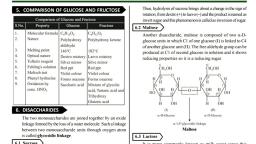
ree Nh) OF GLUCOSE AND FRUCTOSE, , , , , , 1 Molecular formula} C,H,,0, CH 205, , 2 Nature Polyhydroxy | Polyhydroxy ketone, aldehyde, , 3. | Melting point 146°C 102°C, , 4 Optical nature Dextro rotatory |Laevo rotatory, , 5. Tollen's reagent | Silver mirror _ | Silve mirror, , 6. Fehling’s solution | Red ppt Red ppt, , Molisch test, Phenyl hydrazine, Oxidation by, , Violet colour | Violet colour, , Forms osazone | Forms osazone, , 2», , Saccharic acid |Mixture of glycolic, , , , cone. HNO, acid, Tartaric acid and|, Trihydroxy, , Gluteric acid, , , , ay Neate) 3, , The two monosaccharides are joined together by an oxide, linkage formed by the loss ofa water molecule. Sucha linkage, between two monosaccharide units through oxygen atom, is called glycosidic linkage, , , , rose, , , , One of the common disaccharides is sucrose which on, hydrolysis gives equimolar mixture of D-(+)}-glucose and, D-(—)-fructose, , , , , , C)H,,0,, + HO —* G,H),0, + CyH),0,, Sucrose D4(+)}-Ghucose D-(-)-Fructose, [aly = + 66. [a}p=+525° [a}y=-924', , These two monosaccharides are held together by a, glycosidic linkage between C1 of a-glucose and C2 of, B-fructose. Since the reducing groups of glucose and, fructose are involved in glycosidic bond formation, sucrose, is a non reducing sugar., , 6, CH,OH, , , , , , linkage, , H OH, , OH H, a-D-Glucose, B-D-Fructose, a-linkage —_B-linkage, , Sucrose is a dextrorotaty compound and its hydrolysis, produces an equimolar solution of glucose and fructose, This solution is laevorotaty because laevo rotation of, fructose is greater than dextro rotation of glucose, , , , Thus, hydrolysis of sucrose brings about a change in the sign of, rotation, from dextro (+) to laevo (—-) and the product is named as, invert sugar and this phenomenon is called as inversion of sugar., , Itose, , , , 2, , , , Another disaccharide, maltose is composed of two a-Dglucose units in which C1 of one glucose (I) is linked to C4, ofanother glucose unit (II). The free aldehyde group can be, produced at C1 of second glucose in solution and it shows, reducing properties so it is a reducing sugar., , 6 6, CH,OH CH,OH, , HO, , , , , , , , H OH, @, , , , , , a-D-Glucose, , a-1.4'-glycosidic linkage, , Maltose, , | Lactose », , It is more commonly known as milk sugar since this, disaccharide is found in milk. It is composed of B-D-galactose, and B-D-glucose. Fischer projections of B-D-Glucose and, {-D-Galactose are drawn below, , , , , , , , °CH,OH, , D-Glucose, , ow, , , , , , , , , , , , , , , , , , H Ho—+H, H H—-oH, He + HO: H, H H+ on, H Xo, °CH,OH °CH,OH, a-D-Glucose B-D-Glucose