Page 1 :
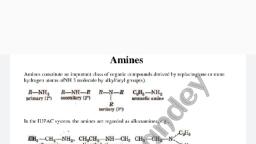
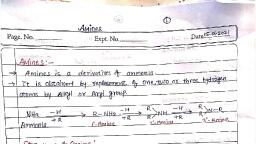
AMINES, AMINES, 1. INTRODUCTION, 3. STRUCTURE OF AMINES, Ammonia has a slightly distorted tetrahedral shape. A lone pair of, nonbonding electrons occupies one of the tetrahedral positions., Amines are organic derivatives of ammonia with one or more alkyl or, aryl groups bonded to the nitrogen atom. Amines serve many functions, in living organisms, such as bioregulation, neurotransmission, and, defense against predators. Because of their high degree of, biological activity, many amines are used as drugs and medicines., This geometry is represented by sp hybridization of nitrogen,, with the bulky lone pair compressing the H-N-H bond angles, to 107° from the "ideal" sp' bond angle of 109.5°. Trimethylamine, The alkaloids are an important group of biologically active amines,, mostly synthesized by plants to protect them from being eaten by, insects and other animals. Although some alkaloids are used, shows less angle compression because the bulky methyl groups, open the angle slightly., medicinally (chiefly as painkillers), all alkaloids are toxic and cause, death if taken in large quantities., N, CH3, H,C, CH3, 2. CLASSIFICATION, 107°, 108°, H, Amines are classified as primary (1°), secondary (2°), or tertiary, (3°), corresponding to one, two or three alkyl or aryl groups, bonded to nitrogen., Ammonia, Trimethylamine, A tetrahedral amine with three different substituents (and a lone, pair) is non-superimposable on its mirror image. In most cases, we, Туре, Examples, cannot resolve such an amine into two enantiomers, however,, because the enantiomers interconvert rapidly. This interconversion, takes place by nitrogen inversion, in which the lone pair moves, CH,, -ўн, , н,с—с—NH,, Primary (1°), R-NH,, from one face of the molecule to the other., CH3, Tert-Butylamine (1°), sp orbital, p orbital, Cyclohexylamine (1°), CH3, C,H3, H., CH,CH,, CH, CH3, 3, Secondary (2°), C,H5, sp orbital, N:, H, R,NH, C,H5, (R)-ethylmethylamine, [Transition State], (S)-ethylmethylamine, H, N-Ethylaniline (2°), Piperidine (2°), In case of quaternary ammonium salts with asymmetic nitrogen, atoms, inversion of configuration is not possible because there is, no lone pair to undergo nitrogen inversion., CH,CH3, Tertiary (3°), R,N, -N:, N:, CH,CH3, N, N-Diethylaniline (3°), Quinuclidine (3°), Quaternary ammonium salts have four alkyl or aryl bonds to a, nitrogen atom. The nitrogen atom bears a positive charge, just as, it does in simple ammonium salts such as ammonium chloride., The following are examples of quaternary (4°) ammonium salts., (CH;),CH N, H,C, CH(CH3)2, CH,CH, H,CH,C, CH,, (R), (S), CH;CH, 1°, Amines that cannot attain the sp²-hybrid transition state for, H;CH,C-N-CH,CH,, nitrogen inversion also show chirality. If the nitrogen atom is, contained in a small ring, for example, it is prevented from attaining, CH,CH3, the 120° bond angles that facilitate inversion, Tetraethylammonium Iodide
Page 2 :
AMINES, Therefore, lower aliphatic amines are soluble in water because, they can form hydrogen bonds with water. However, solubility, H,C., CH3, decreases with increase in molar mass of amines due to increase, in size of the hydrophobic alkyl part. Higher amines are essentially, H,C, CH3, insoluble in water., CH3, H;C, 4.4 Boiling Point, (R)-1,2,2-Trimethylaziridine, (S)-1,2,2-Trimethylaziridine, Because nitrogen is less electronegative than oxygen, the N-H, bond is less polar than O-H bond. Therefore, amines form weaker, 4. PHYSICAL PROPERTIES, hydrogen bonds than do alcohols of similar molecular weights., Primary and secondary amines have boiling points that are lower, than those of alcohols, yet higher than those of ethers of similar, molecular weights. With no hydrogen bonding, tertiary amines, have lower boiling points than primary and secondary amines of, similar molecular weights., 4.1 State, The lower aliphatic amines are gases with fishy odour. Primary, amines with three or more carbon atoms are liquid and higher, ones are solid., Aniline and other aryl amines are usually colourless but gets, coloured on storage due to atmospheric oxidation., Molecular, 4.2 Dipole Moment, Compound, BP(°C), Туре, Weight, Amines are strongly polar because the large dipole moment of the, lone pair of electrons adds to the dipole moments of the C+H, Tertiary, Amine, (CH3),N:, 59, and H+N bonds., CH;-0-CH,CH3, 8, Ether, 60, CH; NH-CH, CH;, Secondary, Amine, 37, 59, overall, dipole, CH,CH3, Primary, Amine, CH;CH,CH,-NH,, 48, 59, llt., moment, H, CH3, CH,CH,CH, —Он, 97, Alcohol, 60, 4.3 Solubility, Primary and secondary amines have N-H bonds, allowing them to, form hydrogen bonds. Having no N-H bonds, pure tertiary amines, cannot engage in hydrogen bonding. They can, however, accept, hydrogen bonds from molecules having O H or N-H bonds., 5. PREPARATION OF AMINES, Carbonyl Compounds, Reductive Amination, H, -----H, Alkyl Halides, 1. Hofmann's, Ammonolysis, 2. Gabriel's, R-, R, Alcohols, R-NH,, Sabatier's Reaction, Phthalimide, 1° or 2° Amine:, Hydrogen Bond Donor and Acceptor, Synthesis, Carboxylic Acids, and Derivatives, Nitrogen, Compounds, Reduction of, R, -----H, 1. Schmidt Reaction, 2. Curtius Reaction, 3. Hofmann's Degradation, 4. Hydrolysis of Amides, 5. Decarboxylation of Amino Acids, Azides, Cyanides,, Isocyanides and, Nitro Compounds, R, H, 3° Amine:, Hydrogen Bond Acceptor only
Page 5 :
AMINES, 5.4.3 Hofmann's Degradation of Amides, NH,, Amide is warmed with bromine and concentrated aqueous KOH, or NaOH solution., R-CH, + Ba(ОН),, RCH,NH, + BaCO,t + H,O, СООН, (a), Product is 1° amine having one carbon less than amide., (b), Alkyl isocyanate is the intermediate and rearrangement is, 5.5 Nitrogen Compounds, intramolecular., 5.5.1 Reduction of Cyanides, Isocyanides, Oximes, Imines, Example - 11, Nitrile (-CN), oxime ENOH), imine ENH), enamine etc. on, .CONH2, CON"H,, catalytic reduction with H, Ni give the corresponding amine., 1. The reduction of nitrile by Na/C,H OH is, Noto., known as Mendius reaction., 2. In most of the cases LIAIH, is also effective for reduction., OBS, 3. Reduction of alkyl isocyanides with Na/C,H,OH or H,/Pt, gives 2° amine., NH2, Example - 14, D', H,, Ni, A, CH,CH,C=N, CH,CH,CH,NH,, OR, 5.4.4 Hydrolysis of Amides & Isocyanides, Na, C,H,OH, N-substituted amide and isocyanide on hydrolysis give 1° amine., Example - 15, Example - 12, Н, Ni, or Na, C,H,OH, CH,-C=NOH, CH,-CH-NH,, CH3, CH3, (1) ÕH, CH,CH,CNH, (1I) R–I, + CH,CH,CNHR, Acetonoxime, ÕH, Example - 16, Н, Ni, Ph-CH=NH, PHCH,-NH,, A, CH,CH,CO + RNH,, Imine, Example - 17, Example - 13, КОН, Н,О, 4[H], CH,CH,-N=Č, CH,CH,NHCH,, 2° Amine, R-NC, → R-NH, + HCOOK, A, Hydrolysis of Isocyanates also yields amines., Example - 18, R-N=C=0, → R-NH,, A, H,, Pt, Alkyl Isocyanate, CH;-CH,-N, → CH,CH,-NH–CH3, 5.4.5 Decarboxylation of Amino Acids, 5.5.2 Reduction of Nitro Compounds, Amino acids on heating with barium hydroxide gives 1° amine., Nitroalkanes are usually reduced by tin and hydrochloric acid or, Quaternary ammonium hydroxide on heating gets decomposed, into alcohol if B-hydrogen is not present in the alkyl group but if, there is B-hydrogen, Hofmann elimination proceeds., lithium aluminium hydride into corresponding amine. H, and, catalyst is also used for such a reduction.