Notes of 12,11,9, Chemistry & Organic Chemistry & Inorganic Chemistry & Physical Chemistry & Science aldehyde.pdf - Study Material
Page 1 :
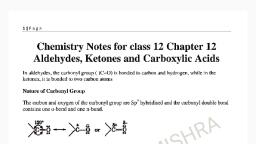
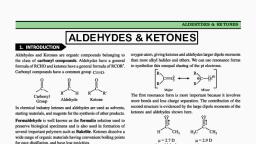
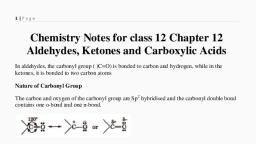
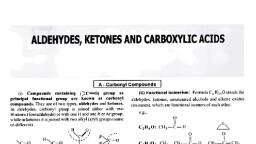
CARBONYL COMPOUNDSAldehydes, ketones and carboxylic acids are the, compounds containing carbon-oxygen double, bond (>C=O) called carbonyl group. The carbon, and oxygen of the carbonyl group are, sp2 hybridised ., Due to high electronegativity of oxygen compared, to carbon, the carbonyl group is polar and the, dipole is formed.
Page 7 :
ANSWERS
Page 9 :
(ii) By dehydrogenation of alcohols:, Removal of hydrogen ,which take place in the, presence of oxidizing catalyst Cu.
Page 10 :
(b) BY OZONOLYSIS OF ALKENES:, Ozonolysis of alkenes followed by reaction with zinc, dust and water gives aldehydes, ketones or a mixture, of both depending on the substitution pattern of the, alkene.
Page 14 :
( c) FROM AROMATIC HYDROCARBONS-, , (i) By oxidation of methylbenzene, (a)Use of chromyl chloride: Reaction of, methyl benzene with chromyl chlorides in CS2, followed by hydrolysis leads formation of, benzaldehyds, , This reaction is called Etard reaction.
Page 16 :
(ii) By side chain chlorination of, methybenzene followed by hydrolysis:, , This is a commercial method of manufacture of, benzaldehyds.
Page 17 :
(iii) By Gatterman – Koch reaction –, , When benzene or its derivative is treated, with CO and HCl under anhydrous, condition, it gives Benzaldehyde.
Page 20 :
3. FROM BENZENE OR SUBSTITUTED, BENZENE-, , The reaction is called FRIDEL CRAFT, ACYLATION reaction.
Page 22 :
PHYSICAL PROPERTIES OF ALDEHYDES, AND KETONES, • The intermolecular forces of attraction in, aldehydes and ketones are dipole-dipole, interactions. These are stronger than, vander Waals forces in alkanes but weaker, than H- bonding in alcohols. Therefore, the, boiling point order is:, , Alkanes < Aldehyde / Ketones < Alcohols
Page 23 :
• Due to the polarity of the carhonyl group, lower, aldehydes and ketones are capable of forming, hydrogen bond with water and are soluble while, solubility decreases down the homologous series, as size of R group increases., , • All aldehydes and ketones are fairly soluble in, organic solvents like benzene, ether, methanol,, chloroform, etc.
Page 25 :
*Aldehydes are generally more reactive than, ketones in nucleophilic addition reactions due to, steric and electronic reasons (or inductive effect)., , (i)Electronic Effect:, +I Effect α 1/reactivity, Electron releasing power of two alkyl groups in, ketones is more than one in aldehyde. Therefore, positive charge is reduced in ketones as compared to, aldehydes. Thus ketones are less reactive than, aldehydes.
Page 26 :
2.STEARIC EFFECT: As the number and size, of alkyl group increase, the hindrance to the, attack of nucleophile also increases and, reactivity decreases. In aldehydes there is one, alkyl group and one hydrogen atom, whereas, in ketones there are two alkyl groups (same or, different)., Nu-
Page 29 :
(c) ADDITION OF ALCOHOL, Reactions of aldehydes with alcohols produce, either hemiacetals (a functional group consisting, of one —OH group and one —OR group bonded, to the same carbon) or acetals (a functional group, consisting of two —OR groups bonded to the same, carbon), depending upon conditions.
Page 31 :
(D) ADDITION OF AMMONIA, DERIVATIVES, Aldehydes and ketones react with primary, amines to form a class of compounds called, imines.
Page 36 :
(ii) REDUCTION TO HYDROCARBONS-
Page 38 :
(ii) TOLLEN’S TEST- When an aldehyde is, introduced to the Tollens reagent, two things, occur:, The aldehyde is oxidized by the Tollens, reagent and forms a carboxylic acid. This, reaction can be written as follows:
Page 39 :
(iii) FEHLING TEST-Fehling's solution can be, used to distinguish aldehyde vs ketone functional, groups. The compound to be tested is added to, the Fehling's solution and the mixture is, heated. Aldehydes are oxidized, giving a positive, result, but ketones do not react, unless they are αhydroxy ketones.
Page 41 :
IODOFORM REACTIONA chemical reaction in which a, methyl ketone is oxidized to a, carboxylate by reaction with aqueous, HO and I2. The reaction also, produces iodoform (CHI3), a yellow, solid which may precipitate from, the reaction mixture.
Page 44 :
(b) CROSS ALDOL CONDENSATION, REACTIONWhen aldol condensation is carried out between, two different aldehydes, or two different ketones, or, an aldehyde and a ketone, then the reaction is, called a cross-aldol condensation. If both the, reactants contain α-hydrogens, four compounds are, obtained as products.
Page 47 :
( c) CANNIZZARO REACTIONreaction under the action of a strong base., Examples of aldehydes without active, hydrogen include , benzaldehyde and, formaldehyde. They undergo oxidationreduction reactions under the action of a, strong base (NaOH) to form a molecule of, carboxylic acid and a molecule of alcohol .
Page 51 :
CLASSIFICATION, Depending upon the number of -COOH, groups, they are classified as, , (I) MONOCARBOXYLIC ACIDS- containing, one -COOH group
Page 55 :
METHODS OF PREPARATION, (i) From primary alcohols and aldehydes-
Page 57 :
III-PREPARATION OF CARBOXYLIC, ACIDS FROM NITRILES AND, AMIDES:, Nitriles are hydrolysed to amides and, then to acids in the presence of H+ or OH–, as catalyst. Mild reaction conditions are, used to stop the reaction at the amide, stage.
Page 59 :
IV-PREPARATION OF CARBOXYLIC ACIDS, FROM GRIGNARD REAGENTS:, Grignard reagents react with carbon dioxide, (dry ice) to form salts of carboxylic acids, which in turn give corresponding carboxylic, acids after acidification with mineral acid.
Page 64 :
PHYSICAL PROPERTIES, STATE- The smaller members of the, aliphatic carboxylic acid series are colorless,, volatile, liquids, with, strong, odors., Ethanoic acid is commonly known as, acetic acid and common household vinegar, is a 5% solution of acetic acid., Larger carboxylic acids are solids with low, melting points.
Page 66 :
SOLUBILITY Carboxylic acids are soluble in water. Carboxylic, acids do not dimerise in water, but forms hydrogen, bonds with water. Carboxylic acids are polar and due, to, the, presence, of, the, hydroxyl, in, the carboxyl group, they are able to form hydrogen, bonds with water molecules.
Page 67 :
CHEMICAL PROPERTIES OF CARBOXYLIC, ACIDS, , (a) Reactions Involving Cleavage of O–H Bond, • ACIDITY: Carboxylic acids dissociate in, water to give resonance stabilised carboxylate, anions and hydronium ion.
Page 68 :
• REACTIONS WITH METALS AND ALKALIES:
Page 69 :
ACIDITY OF ALCOHOL AND CARBOXYLIC, ACIDWhen a carboxylic acid donates its proton, it, becomes a negatively charged ion, RCOO−, called, a carboxylate ion. A carboxylate ion is much, more, stable, than, the, corresponding, alkoxide ion because of the existence of resonance, structures for the carboxylate ion which disperse its, negative charge.
Page 71 :
RELATIVE ACIDITY OF PHENOL AND CARBOXYLIC, ACID- CARBOXYLIC ACID > PHENOL, , The carboxylate ion is more stable than, the phenoxide ion. This is because in, the phenoxide ion, the negative charge resides on, one electronegative oxygen atom and the lesser, electronegative carbon atoms. Consequently their, contribution towards resonance stabilization of, the phenoxide ion is less.
Page 72 :
The presence of electron withdrawing, group (EWG) increases the acidic, strength and presence of electron, denoting group (EDG) decreases the, acidic strength.
Page 75 :
FORMATION OF ACID CHLORIDES:
Page 78 :
FORMATION OF AMIDES:, , FORMATION OF ANHYDRIDES:
Page 79 :
V) BY KOLBE’S ELECTROLYSIS-, , Only alkanes with even number of carbon, atoms can be formed., Alkane and CO2 are liberated at anode while, H2 is liberated at cathode.
Page 80 :
(C) REACTIONS INVOLVING –COOH GROUP, AS A WHOLE, •, , REDUCTION-
Page 82 :
RING SUBSTITUTION–COOH group of aromatic carboxylic acids, is a meta–directing group and is the, deactivating group.



 Learn better on this topic