Page 2 :
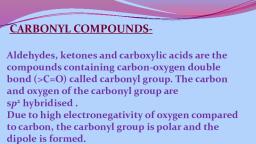
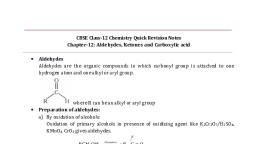
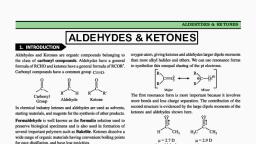
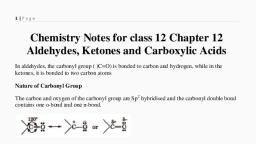
These are compounds containing carbon-oxygen double bond (>C=O) called carbonyl group. , In aldehydes, the functional group is –CHO; in ketones, the functional group is > C =O and , In carboxylic acid, the functional group is –COOH
Page 3 :
Preparation of Aldehydes and Ketones, By oxidation of alcohols: Primary alcohols on oxidation with mild oxidising agents like CrO3 to give aldehydes while secondary alcohols give ketones., By dehydrogenation of alcohols: , Alcohols when heated with Cu or Silver catalyst at 573K, we get carbonyl compounds. Primary alcohols give aldehydes, while secondary alcohols give ketones.
Page 4 :
From acyl chloride (Acid chloride) [Rosenmund’s Reduction]:, Acid chlorides react with hydrogen in presence of Pd supported on BaSO4, we get aldehydes. This reaction is called Rosenmund’s reduction .
Page 6 :
Preparation of Ketones, From benzene or substituted benzenes [Friedel – Crafts acylation reaction], When benzene or substituted benzene is treated with acid chloride (R-COCl) in the presence of anhydrous aluminium chloride, we get a ketone. This reaction is known as Friedel-Crafts acylation reaction
Page 7 :
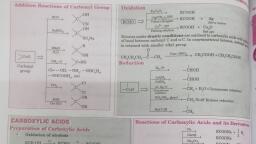
Chemical Reactions of Aldehydes and Ketones, Reduction:, Reduction to alcohols: When reduced using sodium borohydride (NaBH4) or lithium aluminium hydride (LiAlH4) or H2 in presence of Ni, Pd or Pt catalyst (Catalytic hydrogenation), aldehydes give primary alcohols, while ketones give secondary alcohols.
Page 9 :
Wolff-Kishner reduction: , Carbonyl group can also be reduced to methylene group, by treating with hydrazine followed by heating with sodium or potassium hydroxide in high boiling solvent such as ethylene glycol.
Page 11 :
Tests to distinguish Aldehydes and Ketones, i) Tollens’ test: , Tollen’s reagent is freshly prepared ammoniacal Silver nitrate. Aldehydes on warming with Tollens’ reagent, we get a bright silver mirror. During this reaction, the aldehyde is oxidised to corresponding carboxylate ion and silver nitrate is reduced to silver metal.
Page 18 :
2. From alkylbenzenes: , Aromatic carboxylic acids can be prepared by vigorous oxidation of alkyl benzenes with chromic acid or acidic or alkaline potassium permanganate. The entire side chain is oxidised to the carboxyl group irrespective of length of the side chain. Primary and secondary alkyl groups are oxidised in this manner while tertiary group is not affected
Page 19 :
Chemical Reactions , Acidity: , Reactions with metals and alkalies: , Like alcohols and phenols, carboxylic acids react with electropositive metals and liberate hydrogen gas., Unlike alcohols and phenols, carboxylic acids react with sodium carbonates and bicarbonates and give brisk effervescence of carbon dioxide.
Page 20 :
Due to the formation of hydronium ion in water, carboxylic acids are acidic in nature. The acidity of a substance is expressed in terms of pKa value, which is the negative logarithm of Ka
Page 21 :
Comparison of acidic character , Carboxylic acids are weaker than mineral acids, but they are stronger acids than other organic compounds like alcohols and simple phenols. , The higher acidity of carboxylic acids as compared to phenols is due to the higher stability of the carboxylate ion formed from the ionization of carboxylic acid. , The carboxylate ion is more stable than the phenoxide ion due to the following two equivalent resonance structures:
Page 22 :
Effect of substituents on the acidity of carboxylic acids: , Presence of electron withdrawing groups increase the acidity of carboxylic acids by stabilising the carboxylate ion through delocalisation of the negative charge by inductive and resonance effects. , But electron donating groups decrease the acidity by destabilising the carboxylate ion. Direct attachment of groups such as phenyl or vinyl to the carboxylic acid, increases the acidity of corresponding carboxylic acid.
Page 23 :
This is because of the greater electronegativity of sp2 hybridised carbon to which carboxyl carbon is attached. The presence of electron withdrawing group on the phenyl of aromatic carboxylic acid increases their acidity while electron donating groups decrease their acidity. , Thus the acidic character of formic acid, acetic acid and benzoic acid decreases in the order.
Page 24 :
2. Reaction with ammonia: , Carboxylic acids react with ammonia to give ammonium salts which on further heating at high temperature to give amides
Page 26 :
3. Kolbe’s electrolysis: , When an aqueous solution of sodium or potassium salt of carboxylic acid is electrolysed, we get alkanes having twice the number of carbon atoms that present in the alkyl group of the acid. This reaction is known as Kolbe electrolysis.
Page 28 :
5. Electrophilic substitution reactions: , The –COOH group is a deactivating group and meta-directing. So on electrophilic substitution reactions, we get meta derivatives.
Page 29 :
But carboxylic acids do not undergo Friedel-Crafts reactions because the carboxyl group is deactivating and the catalyst aluminium chloride (Lewis acid) gets bonded to the carboxyl group to form salts.