Page 1 :
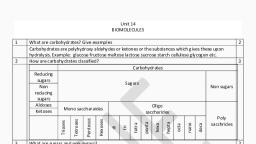
Unit 14, BIOMOLECULES, , 3, , 4, , 5, , 6, , 7, , 8, , 9, , 10, , 2, , 3, , deca, , nano, , octa, , hepta, , hexa, , penta, , tetra, , tri, , di, , Hexoses, , Pentoses, , Trioses, , 2, , What are carbohydrates? Give examples, Carbohydrates are polyhydroxy aldehydes or ketones or the substances which gives these upon, hydrolysis. Example: glucose fructose maltose lactose sucrose starch cellulose glycogen etc., How are carbohydrates classified?, Carbohydrates, Reducing, sugars, Sugars, Non sugars, Non, reducing, sugars, Aldoses, Oligo, Mono saccharaides, Ketoses, saccharides, Poly, sacchrides, Tetroses, , 1, , What are sugars and non-sugars?, 2, Sugars are the carbohydrates; soluble in water crystalline in nature and sweet in taste Example, glucose fructose maltose lactose etc. non-sugars are carbohydrates; insoluble in water, amorphous, in nature and tasteless. Example :starch cellulose glycogen etc., What are reducing sugars? Give example, 2, The sugars which can reduce Tollen’s reagent, Benedict’s reagent and Fehling’s reagent are reducing, sugars. These contain a free hydroxyl group on anomeric carbon., Example glucose fructose maltose lactose, 2, What are non-reducing sugars? Give example (Is sucrose a reducing sugar or not? Give reason.), The sugars which cannot reduce Tollen’s reagent, Benedict’s reagent and Fehling’s reagent are nonreducing sugars. These do not contain a free aldehydic group(aldehydic groups are bonded)., Example : sucrose, What are monosaccharaides? Give examples, Monosaccharaides are the simple sugars which do not undergo hydrolysis. Example : glucose, fructose, Galactose, What are oligosaccharides? Give examples, Oligosaccharides are the sugars which undergo hydrolysis to give 2 to 10 monosaccharaide units., Example: maltose lactose sucrose etc., What are disaccharides? Give examples, Disaccharides are the sugars which undergo hydrolysis to give 2 monosaccharaide units., Example: maltose lactose sucrose etc., What are polysaccharides? Give examples, Polysaccharides are the carbohydrates which undergo hydrolysis to give more than 10 (many), monosaccharaide units. Example: starch, cellulose, glycogen etc., Give an example of aldohexose, Glucose or Galactose, , 2, , 2, , 2, , 1
Page 2 :
11, 12, , 13, , Give example of ketohexose, Fructose, How is glucose prepared?, , 1, , Elucidate the structure of glucose, (i) Molecular formula, , 5, , 2, , − C6H12O6, , (ii) Suggestion of straight chain, , (iii) Confirmation of carbonyl (> C = O) group, , (iv) Confirmation of the presence of carbonyl, group as aldehydic group, , (v) Confirmation of the presence of five −OH, groups, , (vi) Indication of the presence of a primary alcohol, , The correct configuration of glucose is given by, Kiliyanissyntesis, , 14, , Gluconic acid on oxidation with HNO3 gives saccharic acid. What does it indicate about the structure, , 1
Page 3 :
of glucose?, 15, 16, 17, , Confirmation of the presence of primary alcoholic group, Mention the structural features of open chain structure of glucose, It has 1 aldehyde group, 1 primary alcohol group and 4 secondary alcoholic groups, Mention the structural features of open chain structure of fructose, It has 1 ketone group, 2 primary alcohol group and 3 secondary alcoholic groups, Mention demerits of open chain structure of glucose, The following reactions of glucose cannot be explained by its open-chain structure., , 2, 2, 3, , 1. Aldehydes give 2, 4-DNP test, Schiff’s test, and react with NaHSO4 to form the hydrogen, sulphite addition product. However, glucose does not undergo these reactions., 2. The penta-acetate of glucose does not react with hydroxylamine. This indicates that a free, −CHO group is absent from glucose., 3. Glucose exists in two crystalline forms, α and β., 18, , How do you explain the absence of aldehyde group of the pentaacetate of D – glucose?, The aldehyde group is involved in formation of cyclic hemiacetal with secondary alcoholic group of, 5th carbon. In pentaacetate of D – glucose, all 5 -OH groups are acetylated, therefore, it does not, form an open chain structure, and does not react with NH2OH. This fact indicates absence of, aldehyde group in glucose., But, D-glucose reacts with hydroxylamine (NH2OH) to form an oxime because of the presence of, aldehydic (−CHO) group or carbonyl carbon. This happens as the cyclic structure of glucose forms an, open chain structure in an aqueous medium, which then reacts with NH 2OH to give an oxime., , 2, , 19, , What is glycosidic bond / linkage?, Glycosidic linkage − Linkage between two monosaccharide units through oxygen atom, Name the sugar present in cane sugar, Sucrose, What are the expected products of hydrolysis of sucrose, α –glucose and β - fructose, What are the expected products of hydrolysis of lactose, Β – Galactose and β- glucose, Name the sugar present in milk sugar, Lactose, Name the components of starch, Amylose and amylopectin, Name water soluble component of starch, Amylose, Name water insoluble component of starch, Amylopectin, Name the storage polysaccharide in plants, , 1, , 20, 21, 22, 23, 24, 25, 26, 27, , 1, 1, 1, 1, 1, 1, 1, 1
Page 4 :
28, 29, 30, , 31, , Starch, Name the storage polysaccharide in animals, Glycogen( animal starch), Name the structural polysaccharide in plants, cellulose, Write Haworth structure for α glucose / monomer in cellulose. (β glucose) / α fructose /β fructose, , 1, 1, 2, , 2, , Write Haworth structure of sucrose/ maltose / lactose, Structure of sucrose:, Structure of Maltose:, , Structure of Lactose, , 32, 33, , Why cellulose cannot be used as food by human beings?, Human saliva do not contain the enzyme that can hydrolyses β 1-4 linkages present in cellulose, What is glycogen? How does it differ from starch, Glycogen is a polymer of α – glucose linked by α 1-4 glycosidic bond and α 1-6 glycosidic bond at, the point of branching, starch, , glycogen, , Storage polysaccharide in plants, , Storage polysaccharides in animals, , Made of two compenents 1) amylose 2), , Made of one component, , 1, 3
Page 5 :
amylopectin, , 34, , Amylopectin has branched structure. The, Glycogen has branched structure. The, frequency of branching is at every 30 glucose, frequency of branching is at every 10 glucose, units, units, Mention two differences between starch and cellulose, starch, cellulose, Storage polysaccharide in plants, , Structural polysaccharides in plants, , Made of two compenents 1) amylose, 2) amylopectin, Amylose is linear chain of α – glucose linked by, α 1-4 glycosidic bond, , Made of one component, , 2, , cellulose is linear chain of β – glucose linked by, β 1-4 glycosidic bond, , 37, , Amylopectin has branched structure. The, frequency of branching is at every 30 glucose, units, Name the products obtained when proteins are hydrolysed? What do you understand by this, reaction?, Proteins upon hydrolysis form amino acids. This indicates that proteins are made of amino acids, What are amino acids? How many naturally occurring amino acids are present in proteins, These are the organic compounds containing both amino and carboxyl group on α carbon atom., These are the building blocks(monomers) of proteins. There are 20 naturally occurring amino, acids, Write the general structure of amino acids, , 38, , Write the structure of an optically inactive aminoacid, , 1, , 39, , Name an amino acid containing sulphur, Cysteine ,methionine, Name an amino acid which is acidic, Aspateric acid, Glutamic acid, Name an amino acid which is basic, Glutamine,Lysine, Name an amino acid which contains heterocyclic nucleus, Proline,histidine, How amino acids are classified based on dietary requirement?, Based of dietary requirement they are classified into essential and Non-essential amino acids:, , 1, , 35, , 36, , 40, 41, 42, 43, , 2, , 2, , 1, , 1, 1, 1, 2
Page 6 :
Essential amino acids: Amino acids that cannot be synthesised in the body, and must be obtained, through diet Example − Valine, leucine, isoleucine, , 44, , 45, 46, , 47, , 48, 49, , 50, , 51, , Non-essential amino acids: Amino acids that can be synthesised in the body, Example − Glycine, alanine, glutamic acid Non-essential amino acids:, What is zwitter ion? Write its general structure, These are the amino acid dipolar ions, carrying both positive and negative charges. These moves, neither towards cathode nor towards anode in electric field, , 2, , What is isoelectric point, The pH at which amino acids acts as zwitter ions in aqueous solution is called isoelectric pH / point, What is peptide bond? How is it formed?, It is the amide bond present between two amino acids units in peptides and protein. It is formedby, eliminating on molecule of water from α−COOH group and α −NH2 group of two amino acid, , 1, , What is poly peptide?, Poly peptides are the polymers of (n)amino acids containing 10 to 50 amino acids in chain linked by, (n-1) peptide bonds, How many peptide bonds are present in a pentapeptide?, 4, What are proteins?, proteins’ are the polymers of (n)amino acids containing more than 50 amino acids in chain linked by, (n-1) peptide bonds, , 1, , Name a hormone which controls the carbohydrate metabolism., , 1, , insulin, How are proteins classified based on their molecular shape and solubility?, Based on the molecular shape, proteins are classified into two types, Fibrous proteins, polypeptide chains run parallel and are held together by hydrogen and disulphide, bonds. These are insoluble in water. These are also called structural proteins, Example: keratin (hair and nail), actin and myosin ( muscles) and collagen( cartilage), Globular proteins In Polypeptide chains coil around, giving a spherical shape. These are soluble in, , 2, , 1, , 3
Page 7 :
52, , 53, , 54, , 55, , 56, , 57, , water. These are also called functional proteins. Example: albumin, globulin etc, Write a note on structure of proteins, Structures and shapes of proteins are studied at four different levels: primary, secondary, tertiary, and quaternary., Primary structure of proteins: Contains one or more polypeptide chains, and each chain has amino, acids linked with each other in a specific sequence. This sequence of amino acids represents the, primary structure of proteins., Secondary structure of proteins: Shape in which a long polypeptide chain can exist; two types of, secondary structures: α-helix, β-pleated sheet, stabilised by hydrogen bonds, α- Tertiary structure of proteins: Overall folding of the polypeptide chains; results in fibrous and, globular proteins; secondary and tertiary structures of proteins are stabilised by hydrogen bonds,, disulphide linkages, van der Waals forces and electrostatic forces., Quaternary structure of proteins: Spatial arrangement of subunits, each containing two or more, polypeptide chains, What is denaturation of proteins?, Denaturation means loss of biological activity of proteins due to the unfolding of globules and, uncoiling of helix. Denaturation takes place due to action of heat, addition of electrolytes etc, Example − Coagulation of egg white on boiling, curdling of milk, What are enzymes? Give example, Enzymes are biocatalysts. Specific for a particular reaction and for a particular substrate, , For example, maltase catalyses hydrolysis of maltose, What are vitamins? How are these classified?, Vitamins are micronutrients that take part in metabolic process, to produce energy and growth., These are classified as water soluble vitamins (vitamin B complex and vitamin C). fat soluble, vitamins ( vitamin A,D,K,E,), Mention the source and deficiency syndrome of vitaminA, Sources, Deficiency diseases, Xerophthalmia, night blindness, Fish liver oil, carrots, butter and milk, Mention the source and deficiency syndrome of Vitamin B12, Sources, Meat, fish, egg and curd, , 58, , 59, , Mention the source and deficiency syndrome of Vitamin D, Sources, , 2, , 2, , 3, , 1, , 1, Deficiency diseases, Pernicious anaemia, 1, , Mention the source and deficiency syndrome of Vitamin C, Sources, Citrus fruits, amla and green leafy vegetables, , 4, , Deficiency diseases, Scurvy, 1, Deficiency diseases
Page 8 :
Exposure to sunlight, fish and egg yolk, , Rickets and osteomalacia, , 60, , Name the products when nucleic acids are hydrolysed step wise, Nucleic acids → nucleotides, Nucleotides → nucleosides + phosphoric acid, Nucleosides → pentose sugar + heterocyclic bases (purine and pyrimidine), , 2, , 61, , How nucleoside and nucleotide are formed?, , 2, , 1) Nucleoside is formed when N-base gets attached to 1 position of pentose sugar., N-base + Pentose sugar , nucleoside, 2) Nucleotide is formed when nucleoside is linked to phosphoric acid at 5th position of, pentose sugar., Nucleoside + H3PO4 , nucleotide, 62, , 1, , 65, , What are nucleic acids?, Nucleic acids are the polymers of nucleotides linked by 3-5 phosphodiester bond, What are the differences between DNA and RNA, DNA, RNA, Contains de- oxy ribose sugar, Contains ribose sugar, Bases are A,G,C,T, Bases are A.G.C.U, Has double helical structure, Has single stranded structure, Present in nucleus of the cell, Present in cytoplasm, Hereditary material, Involved in protein synthesis, Messenger RNA (m-RNA), Ribosomal RNA (r-RNA), Transfer RNA (t-RNA), Name, a. The sugar moiety present in DNA, b. Nitrogenous base present only in DNA, but not in RNA., a) de- oxy ribose sugar, b)Thymine, Write the structure of ribose sugar / deoxy-ribose sugar, , 66, , Name any 3 Biological functions of nucleic acids, , 3, , 67, , 1. DNA is chief chemical as reserve genetic information., 2. DNA is chiely responsible for identity of a species., 3. DNA is capable of self replication during cell division., 4. Important function of RNA is in protein synthesis in the cells. Message for the protein, synthesis is in DNA but various RNAs take part in protein synthesis., What are hormones? Give an example for each type of hormone, , 63, , 64, , 3, , 2
Page 9 :
a) Polypeptide hormones, b) Amino acid derivatives, c) Steroid hormones, Hormones are biochemical messengers produced by endocrine glands., a) Polypeptide hormones ----- insulin/ glucagons, b) Amino acid derivatives----- Thyroxine/Epinephrine, c) Steroid hormones--- Testosterone/Estradiol/progesterone, 68, , Write the function of the following hormones :, a) Insulin, b) Thyroxine, c) Estrogen and androgen, a) Insulin: Maintains blood sugar level, b) Thyroxine: Growth and development, c) Estrogen and androgen: Development of secondary sex characters