Page 2 :
The molecules present in living, system like carbohydrates, proteins,, nucleic acids, lipids, vitamins etc., which are essential for the growth, and maintenance of our body are, called Biomolecules.
Page 3 :
Carbohydrates, •These are the hydrates of carbon and most of them have a, general formula Cx(H2O)y., •They can be defined as polyhydroxy aldehydes or ketones or, the compounds which produce such units on hydrolysis., , •Some of the carbohydrates are crystalline, water soluble and, sweet in taste. They are called sugars., •Carbohydrates which are not crystalline, water insoluble and, have no sweet taste are called non-sugars. Carbohydrates are, also called ‘Saccharides .
Page 4 :
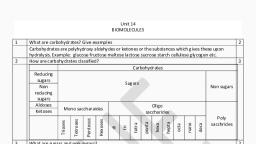
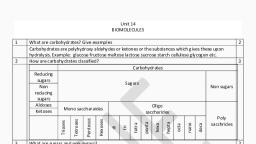
Classification of carbohydrates, I) Based on their behaviour on hydrolysis:, Based on this, carbohydrates are classified into three, types:, 1) Monosaccharides: These are carbohydrates which cannot be, hydrolysed into simpler units of polyhydroxyaldehydes or, ketones. E.g. glucose, fructose, ribose, galactose etc., 2) Oligosaccharides: These are carbohydrates which give two to, ten monosaccharide units on hydrolysis. They are further, , classified as disaccharides, trisaccharides, tetrasaccharides etc., E.g. Sucrose, maltose, lactose.
Page 5 :
Sucrose on hydrolysis gives one molecule each of, glucose and fructose,, maltose gives two molecules of glucose while lactose, , gives one molecule each of glucose and galactose., , 3) Polysaccharides: These are carbohydrates which give, a large number of monosaccharide units on hydrolysis., , E.g. starch, cellulose, glycogen etc
Page 6 :
II) Based on their reducing character:, Based on this, carbohydrates are of two types –, •reducing sugar and, •non-reducing sugar., ➢Carbohydrates which contain free aldehydic or, ketonic groups are called reducing sugars,, while those which do not contain free, aldehydic or ketonic group are called non-reducing, sugars., ➢All monosaccharides are reducing sugars., ➢Disaccharides like maltose and lactose are reducing, while sucrose is non-reducing.
Page 7 :
Methods used for the preparation of glucose, , 1. From sucrose (Cane sugar):, If sucrose is boiled with dilute HCl or H2SO4 in, alcoholic solution, glucose and fructose are obtained, in equal amounts., C12H22O11 + H2O ⎯⎯⎯→ C6H12O6 + C6H12O6, 2. From starch:, Commercially glucose is obtained by hydrolysis of, starch by boiling it with dilute H2SO4 at 393 K, under pressure., , (C6H10O5)n + nH2O ⎯⎯⎯⎯⎯⎯⎯→ nC6H12O6
Page 8 :
Structure of glucose:, •Glucose is an aldohexose and is also known as dextrose., •Its molecular formula is C6H12O6., >>Experiments suggest that, , i) all the six carbon atoms are linked in a straight chain, ii) there is a free aldehydic group and 5 hydroxyl groups, , and, iii) iii) one of the alcoholic group is primary., Based on the above informations, Fischer proposed an, open chain structure for glucose ;
Page 9 :
D- Glucose (Open chain structure), , But this open chain structure cannot explain the following, , observations:, 1. Glucose does not react with 2,4-Dinitrophenyl hydrazine,, Schiff’s reagent and with NaHSO3., 2. The existence of two different crystalline forms of glucose, (α and β form).
Page 10 :
In order to explain the above, it was proposed that one of the –OH, groups may add to the –CHO group and form a cyclic hemi-acetal, , structure., The –OH at C5 is involved in ring formation. (1,5 – oxide ring).
Page 11 :
•Thus the two cyclic forms exist in equilibrium with the, open chain structure., •The two cyclic hemi-acetal forms of glucose differ only, in the configuration at first carbon (anomeric carbon). So, , they are called anomers., •They are stereo isomers which differ only in the, configuration at the first carbon.
Page 12 :
The Pyranose structure of Glucose, The six membered cyclic structure of glucose is called Pyranose, structure., The anomeric forms of glucose can be represented as follows:
Page 13 :
Hydrolysis of cane sugar, Cane sugar is sucrose, which on hydrolysis gives an equimolar, mixture of D(+)glucose and D(-)fructose., , C12H22O11 + H2O → C6H12O6 + C6H12O6, Sucrose, , D(+)Glucose (+52.50 ) D(-)Fructose (-92.40 ), , Sucrose is dextro rotatory but after hydrolysis gives dextro, rotatory glucose and laevo rotatory fructose., Since the laevo rotation of fructose ((-92.40 ) is more than dextro, , rotation of glucose (+52.50 ), the mixture is laevo rotatory., So the process is called inversion of cane sugar and the product, , formed is called invert sugar.
Page 14 :
Glycosidic linkage, •During the formation of a disaccharide or polysaccharide,, the monosaccharides are joined together through oxide, , linkage by losing water molecules., •Such a linkage (C-O-C) between monosaccharide units, through oxygen atom is called glycosidic linkage.
Page 16 :
Uses of carbohydrates, ❑Carbohydrates are used as storage molecules as starch in, plants and glycogen in animals., ❑Cell wall of bacteria and plants is made up of cellulose., Carbohydrates are used as raw materials for many important, , industries like textiles, paper, lacquers and breweries., ❑Carbohydrate in the form of wood is used for making, furniture etc.
Page 18 :
•Amino acids are generally represented by a three letter symbol., , (e.g. ‘Gly’ for glycine, ‘Ala’ for alanine etc)., •Amino acids are classified as acidic, basic or neutral depending, upon the relative number of amino and carboxyl groups in their, molecule., •Amino acids having equal number of amino and carboxyl groups is, , neutral; those containing more number of amino groups are basic, and those containing more number of carboxyl groups are acidic., •For e.g. glycine, alanine, valine etc. are neutral, arginine, lysine etc., are basic and glutamic acid, aspartic acid etc. are acidic.
Page 19 :
•The amino acids which can be synthesised in the body are known, as non-essential amino acids., •While which cannot be synthesised in the body and must be, obtained through diet, are known as essential amino acids. In, aqueous solution, the carboxyl group can lose a proton and amino, , group can accept a proton, giving rise to a dipolar ion known as, zwitter ion., •This is neutral but contains both positive and negative charges. In, , zwitter ionic form, amino acids show amphoteric behaviour as, they react both with acids and bases.
Page 21 :
Peptides and polypeptides, •A peptide is formed by the combination of α-amino acid, molecules. Chemically peptide linkage is an amide formed between, , –COOH group and -NH2 group., •When two molecules of amino acids combine, the amino group of, one molecule reacts with –COOH group of another molecule by, , losing one water molecule to form a CO-NH linkage, commonly, called peptide linkage., , •The peptide formed between two amino acid molecules is called a, dipeptide.
Page 23 :
Different types of proteins:, Based on the shape of molecules, proteins are classified into 2 types:, a) Fibrous proteins:, , •They have fibre like structure. Here the linear polypeptide chains, are held together by H-bond and disulphide bond., •They are generally insoluble in water. E.g. Keratin (present in hair,, wool, silk etc.) and myosin (present in muscles)., b) Globular proteins:, , •Here the chains of polypeptides coil around to give a spherical, shape., •These are usually soluble in water. Insulin and albumins are the, , common examples of globular proteins.
Page 24 :
Structure of proteins:, There are four types of structure for a protein. They are primary,, secondary, tertiary and quaternary structure., 1. Primary structure: It gives the sequence of amino acid, , molecules in a polypeptide chain of protein. Any change in the, primary structure creates a different protein., 2. Secondary structure: The secondary structure of protein refers to, , the shape in which a long polypeptide chain can exist. There are, two different types of secondary structures - α-helix and β-, , pleated sheet structure.
Page 25 :
These structures arise due to the regular folding of the backbone of, the polypeptide chain due to hydrogen bonding between >CO and, , –NH– groups of the peptide bond., 3. Tertiary structure:, , •The tertiary structure represents overall folding of the polypeptide, chains. i.e., further folding of the secondary structure. It gives rise, to two major molecular shapes - fibrous and globular., , 4. Quaternary structure:, •Some of the proteins contain two or more polypeptide chains, called sub-units. The spatial arrangement of these sub-units is, known as quaternary structure.
Page 27 :
Denaturation of protein:, •When a protein is subjected to physical change (like change in, temperature) or chemical change (like change in pH), it loses the, , biological activities. This process is called denaturation of protein., •During denaturation, secondary and tertiary structures are, destroyed, while primary structure remains unaffected., , •e.g. coagulation egg white on boiling, curding of milk etc.
Page 28 :
Starch:, •Starch is the main storage polysaccharide of plants., •It is a polymer of α-D-glucose and consists of two components—, , Amylose and Amylopectin., •Amylose is water soluble component which constitutes about 1520% of starch. It is a linear polymer of α-D-(+)-glucose units., , •Amylopectin is insoluble in water and constitutes about 80- 85%, of starch. It is a branched chain polymer of α-D-glucose units.
Page 29 :
Vitamins, It has been observed that certain organic compounds are, required in small amounts in our diet but their deficiency causes, specific diseases. These compounds are called vitamins., Depending on the solubility, vitamins are of two types:, , a) Fat soluble vitamins: e.g. Vitamins A, D, E, & K, b) Water soluble vitamins: e.g. Vitamins B & C, Vitamin B cannot be stored in our body. Because Vitamin B, , is water soluble and so it is excreted through urine.
Page 31 :
Nucleic acids:, •They are long chain polymers of nucleotides and are responsible, , for transmission of heredity. These are of two types –, deoxyribonucleic acid (DNA) and ribonucleic acid (RNA)., , •Nucleic acid contains a pentose sugar, phosphoric acid unit and, a nitrogen base. In DNA, the pentose sugar is β–D-2-deoxy, ribose, while in RNA, it is β–D-ribose.
Page 32 :
•DNA contains 4 bases – Adenine (A), Guanine (G), Cytosine (C), , and Thymine (T). [A, G, C &T],, •while RNA contains the bases Adenine (A), Guanine (G),, Cytosine (C) and Uracil (U). [A, G, C & U]., •The pentose sugar combines with the base to form nucleoside,, which combines with the phosphoric acid group to form, nucleotide., •The nucleotide units combine to form nucleic acid.
Page 33 :
Biological functions of nucleic acids:, , 1. DNA is responsible for the transmission of hereditary characters, from one generation to other., 2. Another important function of nucleic acids is protein synthesis.